
Section 5 3 092407 Problem Solving and Unit
Section 5. 3 09/24/07 Problem Solving and Unit Conversions DIMENSIONAL ANALYSIS
Section 5. 3 Problem Solving and Unit Conversions Objectives 1. To learn how dimensional analysis can be used to solve problems 2. To learn to convert from one metric unit to another 3. To learn to convert between SI units and standard US units 4. To practice using problem solving techniques
Section 5. 3 Problem Solving and Unit Conversions A. Tools for Problem Solving • Be systematic • Ask yourself these questions – Where do we want to go? – What do we know? – How do we get there? – Does it make sense?
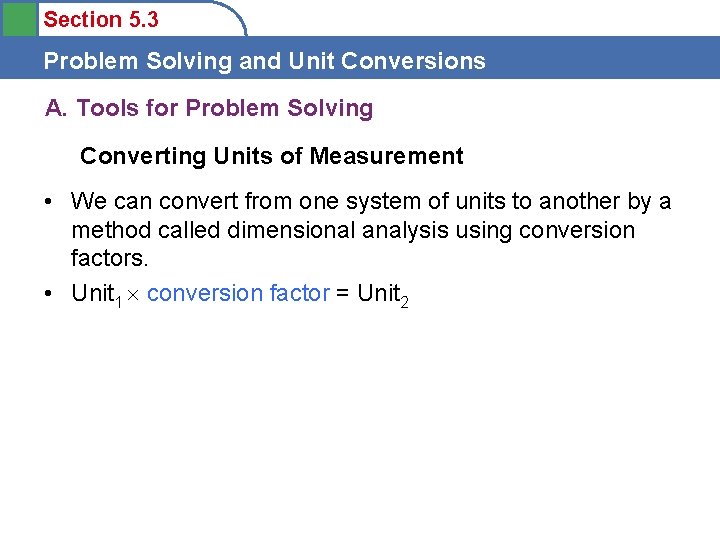
Section 5. 3 Problem Solving and Unit Conversions A. Tools for Problem Solving Converting Units of Measurement • We can convert from one system of units to another by a method called dimensional analysis using conversion factors. • Unit 1 conversion factor = Unit 2
Section 5. 3 Problem Solving and Unit Conversions A. Tools for Problem Solving Converting Units of Measurement • Conversion factors are built from an equivalence statement which shows the relationship between the units in different systems. • Conversion factors are ratios of the two parts of the equivalence statement that relate the two units.
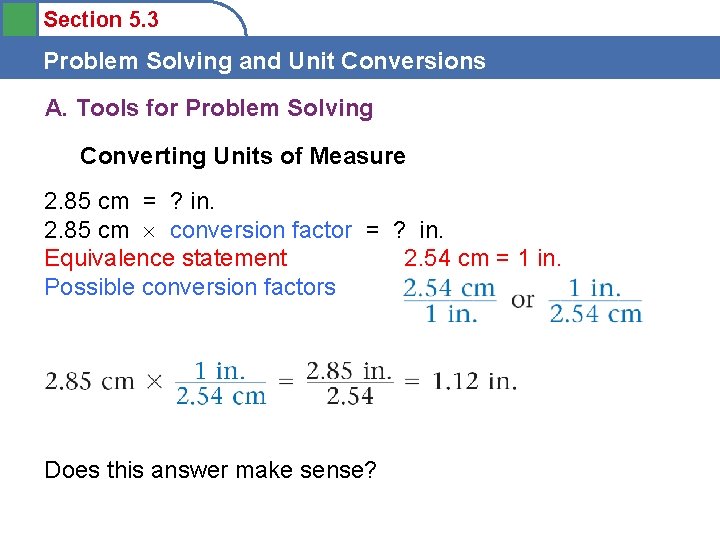
Section 5. 3 Problem Solving and Unit Conversions A. Tools for Problem Solving Converting Units of Measure 2. 85 cm = ? in. 2. 85 cm conversion factor = ? in. Equivalence statement 2. 54 cm = 1 in. Possible conversion factors Does this answer make sense?

Section 5. 3 Problem Solving and Unit Conversions ***THINGS TO REMEMBER when doing Conversions 1. Take what you are given -i. e. What is/are my starting unit(s)? 2. Determine what units want to convert to -i. e. What is/are the unit(s) I want in my final answer (what are the ending unit(s))? 3. Find the Equivalence Statement. -To convert between any units you must have a conversion factor 4. What is/are the possible conversion factors?

Section 5. 3 Problem Solving and Unit Conversions ***THINGS TO REMEMBER when doing Conversions cont… 5. Choose the conversion factor that fits your problem. 6. Conversion factor should be a ratio. 7. The unit you want to get rid of should be on the bottom (i. e. in the denominator) to cancel out (or on the top depending on your conversion) 8. The ending unit should be on the top (i. e. in the numerator) -The answer should make sense if you got to the right unit(s) 9. Check you Sig. Figs. -Remember the EXACT NUMBERS Sig. Figs. Rule? ? ?
Section 5. 3 Problem Solving and Unit Conversions A. Tools for Problem Solving Tools for Converting from One Unit to Another Step 1 Find an equivalence statement that relates the 2 units. Step 2 Choose the conversion factor by looking at the direction of the required change (cancel the unwanted units). Step 3 Multiply the original quantity by the conversion factor. Step 4 Make sure you have the correct number of significant figures.
- Slides: 9