
Section 5 2Drawing Molecules Drawing Molecules on Paper

- Slides: 35
Section 5. 2—Drawing Molecules
Drawing Molecules on Paper l Lewis Structures (or Dot Structures) are one way we draw molecules on paper l A flaw of the Lewis method is that it is 2 -D and molecules are 3 D. However, Lewis Dots are essential to finding out the correct 3 -D shape!
Drawing Ionic Compounds
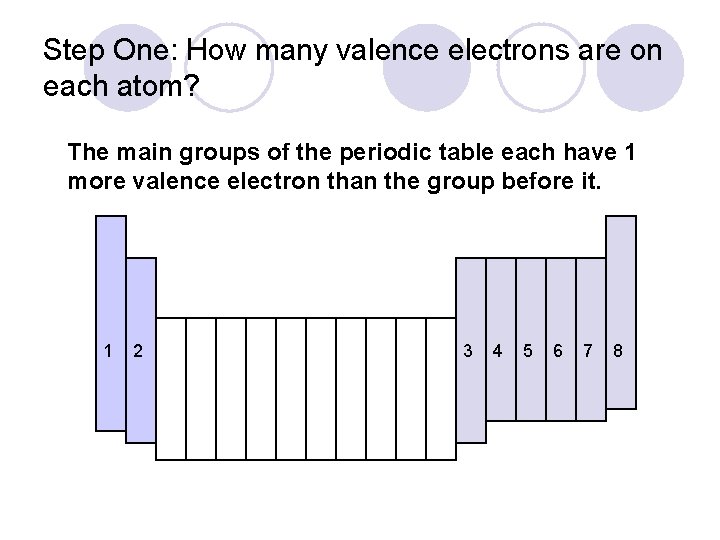
Step One: How many valence electrons are on each atom? The main groups of the periodic table each have 1 more valence electron than the group before it. 1 2 3 4 5 6 7 8
Step 2: Place the valence electrons around an atom l When atoms bond, they bond with their valence orbitals. Those are the outmost s or s and p. So, they have 4 orbitals available (1 “s” and 3 “p”s). There are 4 places to put electrons. Imagine the element symbol has a box around it. Each side of the box, represents an orbital. l Put one on each side before doubling up! Example: Draw the Lewis Structure for a sulfur atom
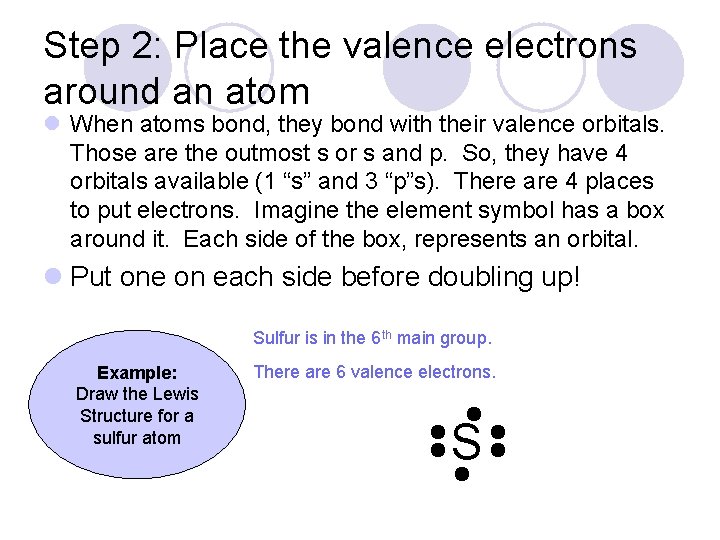
Step 2: Place the valence electrons around an atom l When atoms bond, they bond with their valence orbitals. Those are the outmost s or s and p. So, they have 4 orbitals available (1 “s” and 3 “p”s). There are 4 places to put electrons. Imagine the element symbol has a box around it. Each side of the box, represents an orbital. l Put one on each side before doubling up! Sulfur is in the 6 th main group. Example: Draw the Lewis Structure for a sulfur atom There are 6 valence electrons. S
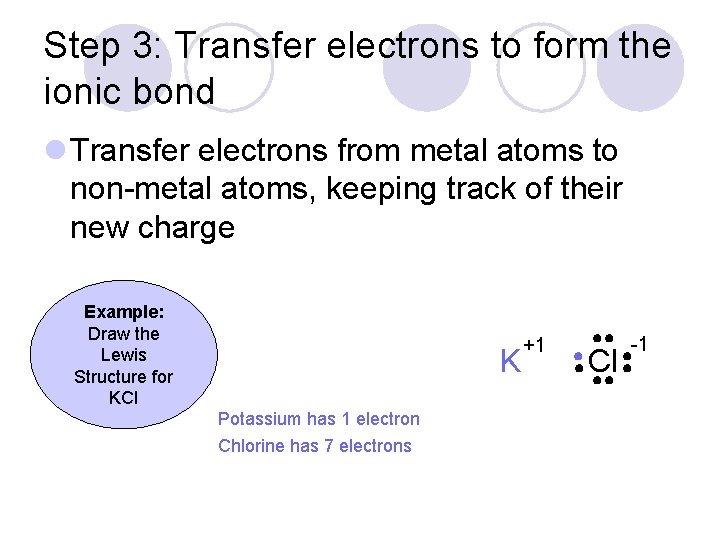
Step 3: Transfer electrons to form the ionic bond l Transfer electrons from metal atoms to non-metal atoms, keeping track of their new charge Example: Draw the Lewis Structure for KCl
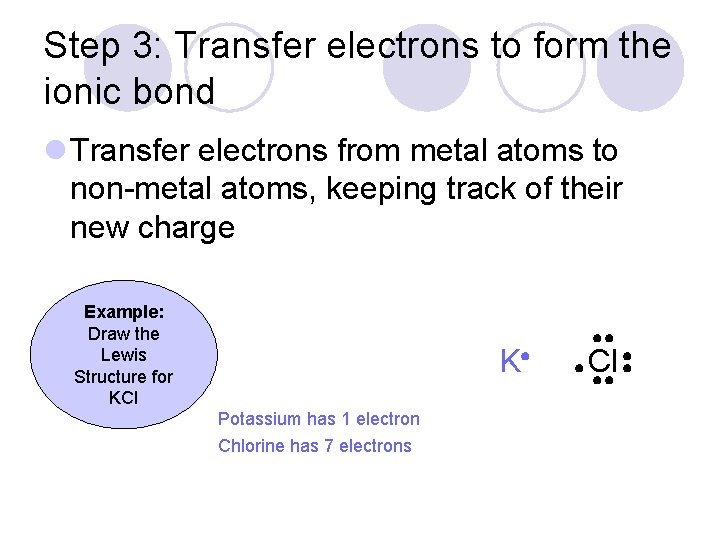
Step 3: Transfer electrons to form the ionic bond l Transfer electrons from metal atoms to non-metal atoms, keeping track of their new charge Example: Draw the Lewis Structure for KCl K Potassium has 1 electron Chlorine has 7 electrons Cl
Step 3: Transfer electrons to form the ionic bond l Transfer electrons from metal atoms to non-metal atoms, keeping track of their new charge Example: Draw the Lewis Structure for KCl K Potassium has 1 electron Chlorine has 7 electrons +1 Cl -1
Step 4: Add more atoms if needed l If the transfer from one atom to another doesn’t result in full outer shells, add more atoms Example: Draw the Lewis Structure for the ionic compound of Calcium Chloride
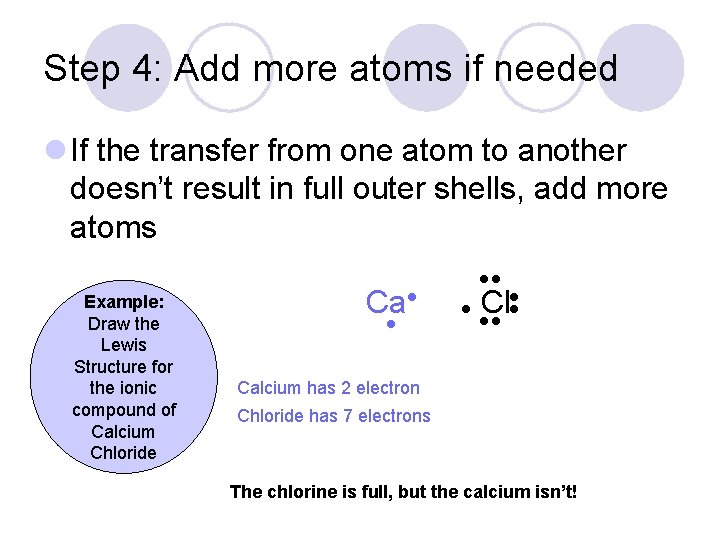
Step 4: Add more atoms if needed l If the transfer from one atom to another doesn’t result in full outer shells, add more atoms Example: Draw the Lewis Structure for the ionic compound of Calcium Chloride Ca Cl Calcium has 2 electron Chloride has 7 electrons The chlorine is full, but the calcium isn’t!
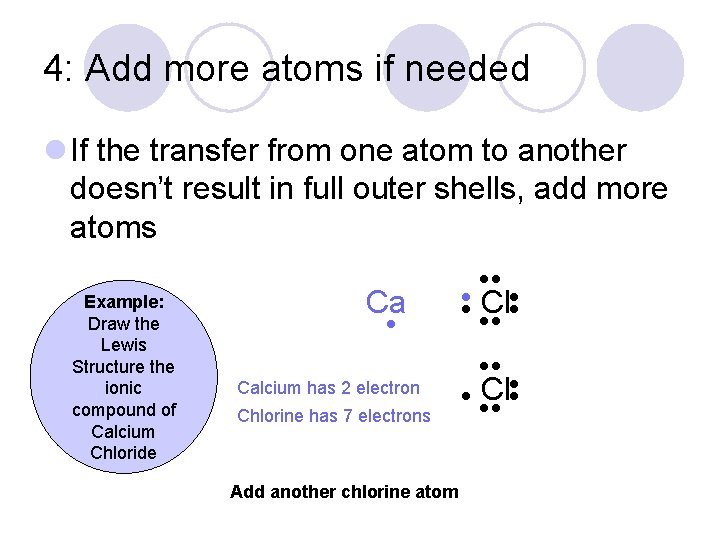
4: Add more atoms if needed l If the transfer from one atom to another doesn’t result in full outer shells, add more atoms Example: Draw the Lewis Structure the ionic compound of Calcium Chloride Ca Calcium has 2 electron Chlorine has 7 electrons Add another chlorine atom Cl Cl
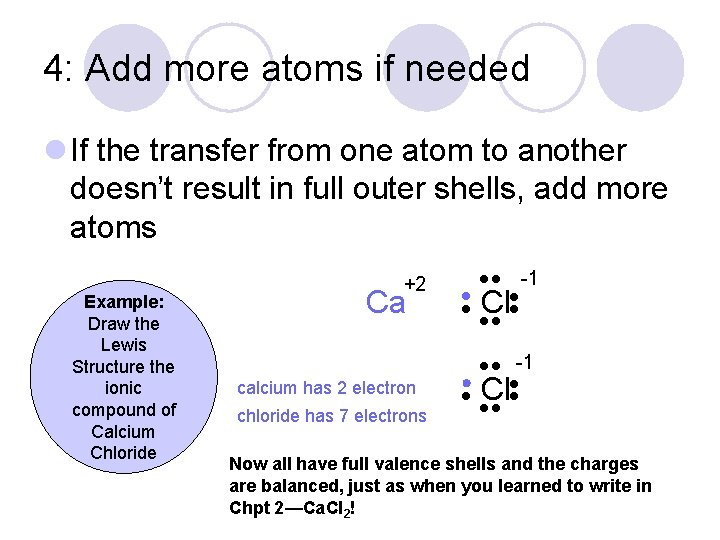
4: Add more atoms if needed l If the transfer from one atom to another doesn’t result in full outer shells, add more atoms Example: Draw the Lewis Structure the ionic compound of Calcium Chloride +2 Ca calcium has 2 electron chloride has 7 electrons Cl Cl -1 -1 Now all have full valence shells and the charges are balanced, just as when you learned to write in Chpt 2—Ca. Cl 2!
A note about Ionic Dot Structures l The atoms are not sharing the electrons— make sure you clearly draw the atoms separate! To complete the Ionic Dot Structure, we place brackets around each ion with a charge. And we organize the ions so the similar charges are not near each other!
Drawing Covalent Compounds
Tips for arranging atoms l Hydrogen & Halogens (F, Cl, Br, I) can only bond with one other atom—they can’t go in the middle of a molecule ¡ Always put them around the outside l In general, write out the atoms in the same order as they appear in the chemical formula
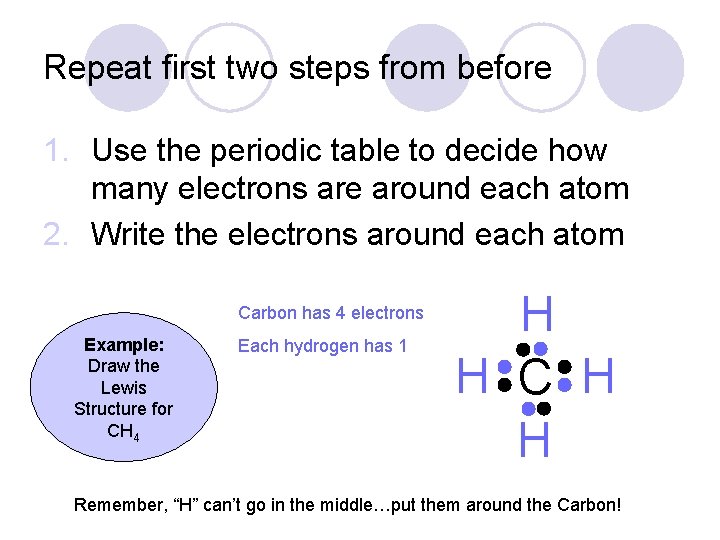
Steps for the Covalent Lewis Dot 1. Use the periodic table to decide how many electrons are around each atom 2. Write the electrons around each atom Example: Draw the Lewis Structure for CH 4
Repeat first two steps from before 1. Use the periodic table to decide how many electrons are around each atom 2. Write the electrons around each atom Carbon has 4 electrons Example: Draw the Lewis Structure for CH 4 Each hydrogen has 1 H H C H H Remember, “H” can’t go in the middle…put them around the Carbon!
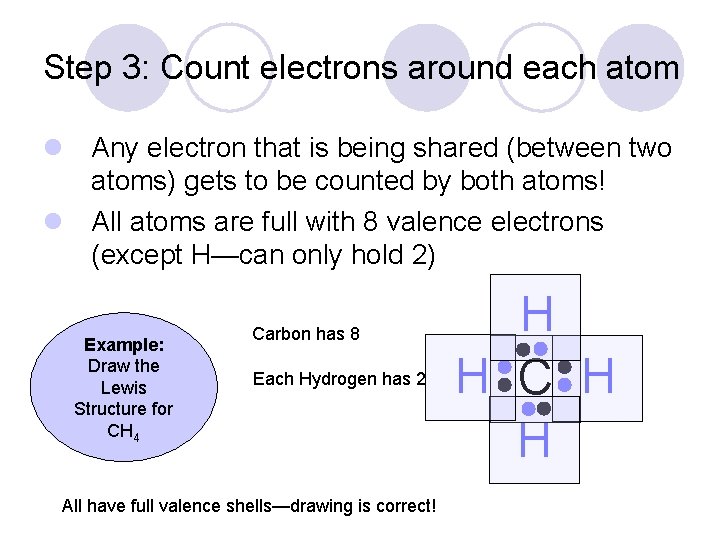
Step 3: Count electrons around each atom l Any electron that is being shared (between two atoms) gets to be counted by both atoms! l All atoms are full with 8 valence electrons (except H—can only hold 2) Example: Draw the Lewis Structure for CH 4 Carbon has 8 Each Hydrogen has 2 All have full valence shells—drawing is correct! H H C H H
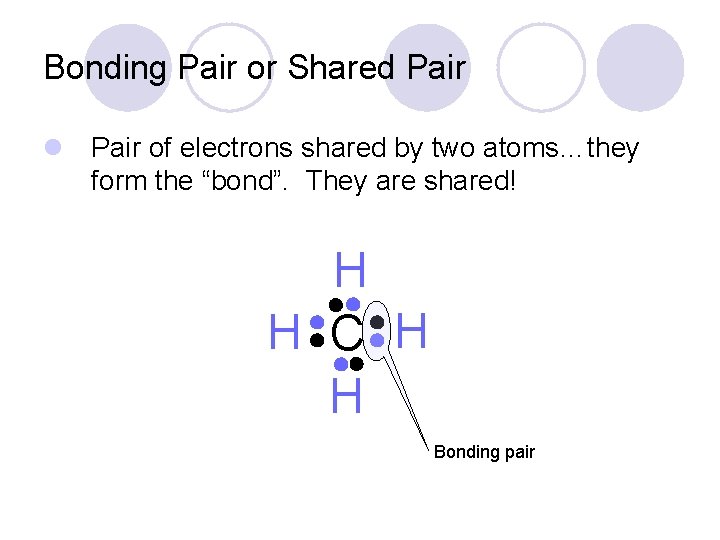
Bonding Pair or Shared Pair l Pair of electrons shared by two atoms…they form the “bond”. They are shared! H H C H H Bonding pair
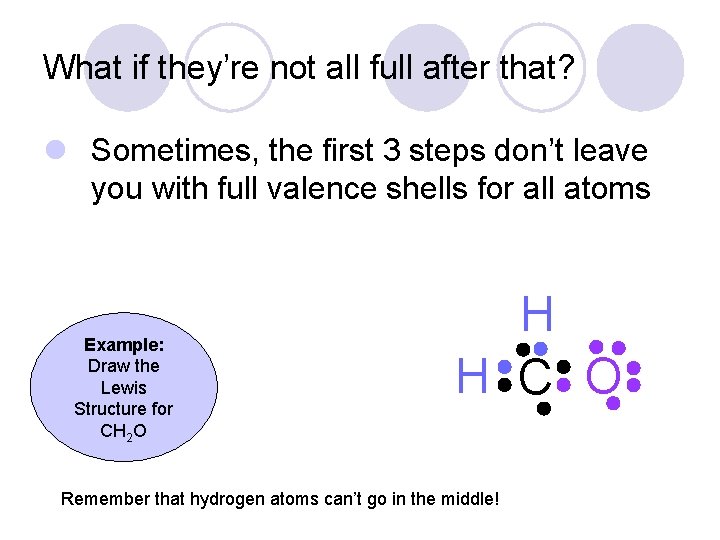
What if they’re not all full after that? l Sometimes, the first 3 steps don’t leave you with full valence shells for all atoms Example: Draw the Lewis Structure for CH 2 O
What if they’re not all full after that? l Sometimes, the first 3 steps don’t leave you with full valence shells for all atoms Example: Draw the Lewis Structure for CH 2 O H H C O Remember that hydrogen atoms can’t go in the middle!
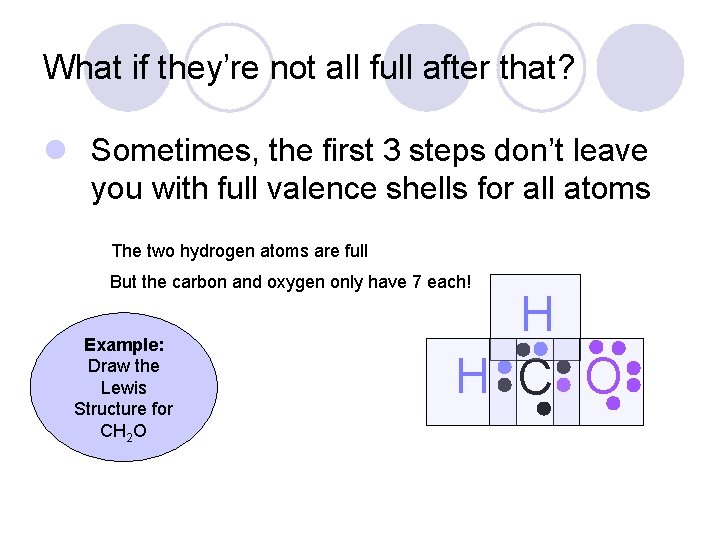
What if they’re not all full after that? l Sometimes, the first 3 steps don’t leave you with full valence shells for all atoms The two hydrogen atoms are full But the carbon and oxygen only have 7 each! Example: Draw the Lewis Structure for CH 2 O H H C O
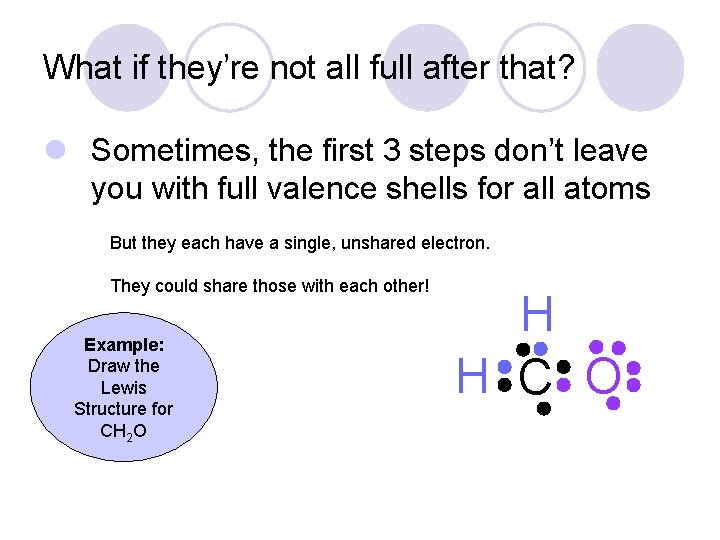
What if they’re not all full after that? l Sometimes, the first 3 steps don’t leave you with full valence shells for all atoms But they each have a single, unshared electron. They could share those with each other! Example: Draw the Lewis Structure for CH 2 O H H C O
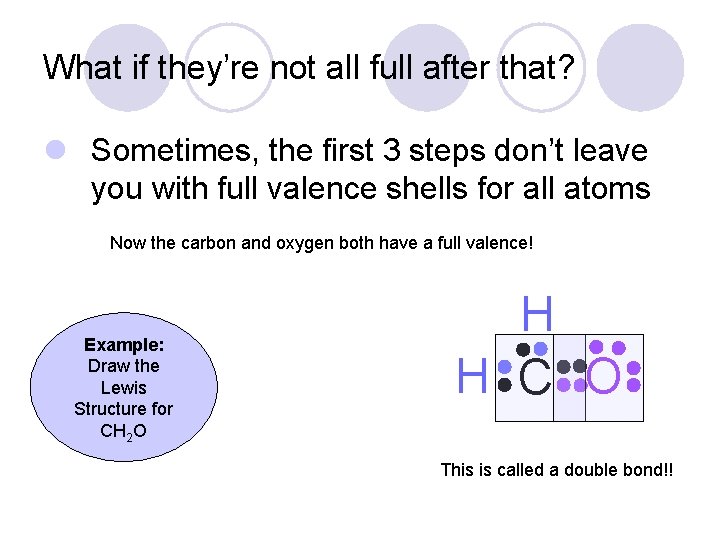
What if they’re not all full after that? l Sometimes, the first 3 steps don’t leave you with full valence shells for all atoms Now the carbon and oxygen both have a full valence! Example: Draw the Lewis Structure for CH 2 O H H C O This is called a double bond!!
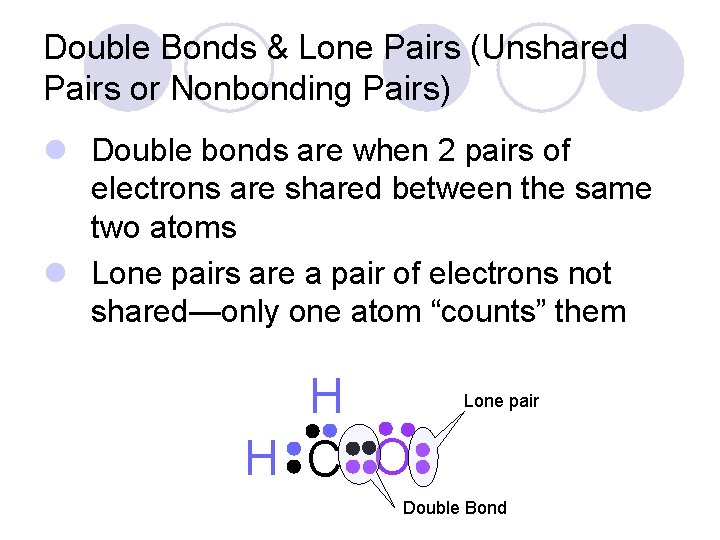
Double Bonds & Lone Pairs (Unshared Pairs or Nonbonding Pairs) l Double bonds are when 2 pairs of electrons are shared between the same two atoms l Lone pairs are a pair of electrons not shared—only one atom “counts” them H H C O Lone pair Double Bond
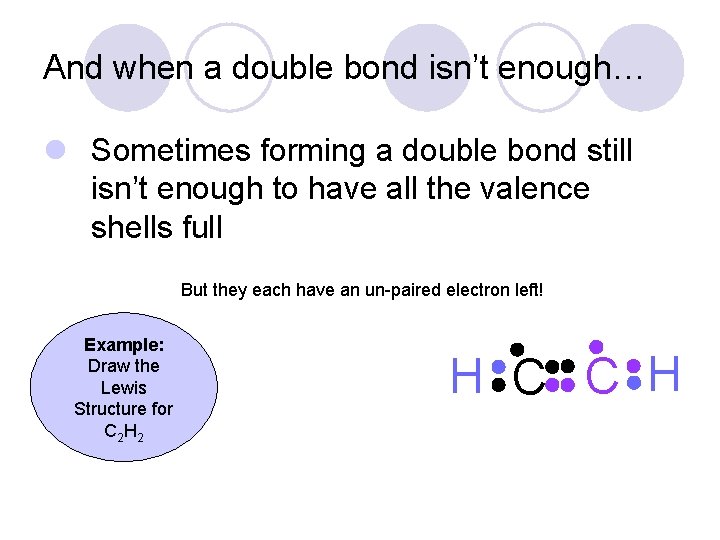
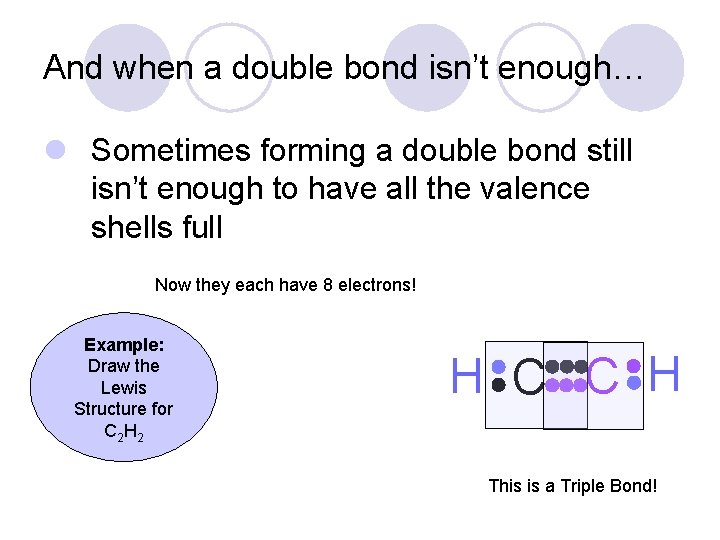
And when a double bond isn’t enough… l Sometimes forming a double bond still isn’t enough to have all the valence shells full Example: Draw the Lewis Structure for C 2 H 2
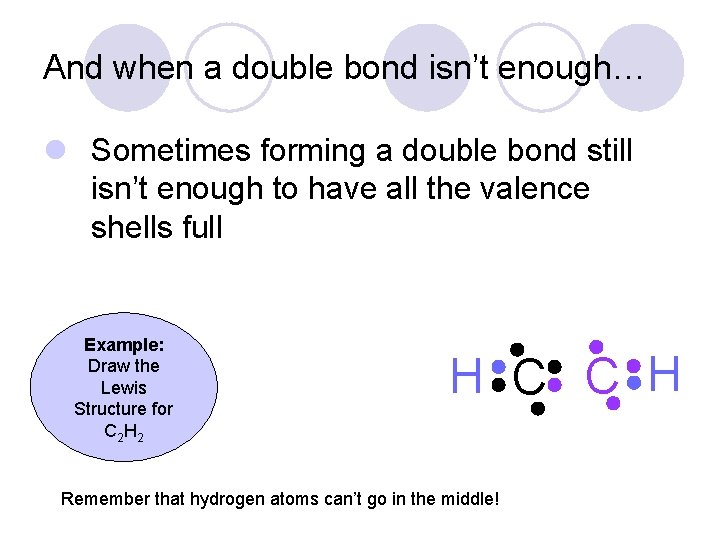
And when a double bond isn’t enough… l Sometimes forming a double bond still isn’t enough to have all the valence shells full Example: Draw the Lewis Structure for C 2 H C C H Remember that hydrogen atoms can’t go in the middle!
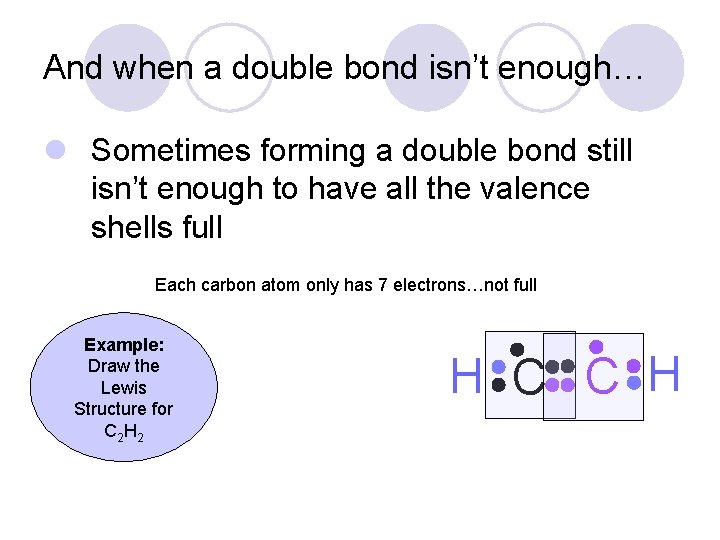
And when a double bond isn’t enough… l Sometimes forming a double bond still isn’t enough to have all the valence shells full Each carbon atom only has 7 electrons…not full Example: Draw the Lewis Structure for C 2 H C C H
And when a double bond isn’t enough… l Sometimes forming a double bond still isn’t enough to have all the valence shells full But they each have an un-paired electron left! Example: Draw the Lewis Structure for C 2 H C C H
And when a double bond isn’t enough… l Sometimes forming a double bond still isn’t enough to have all the valence shells full Now they each have 8 electrons! Example: Draw the Lewis Structure for C 2 H C C H This is a Triple Bond!
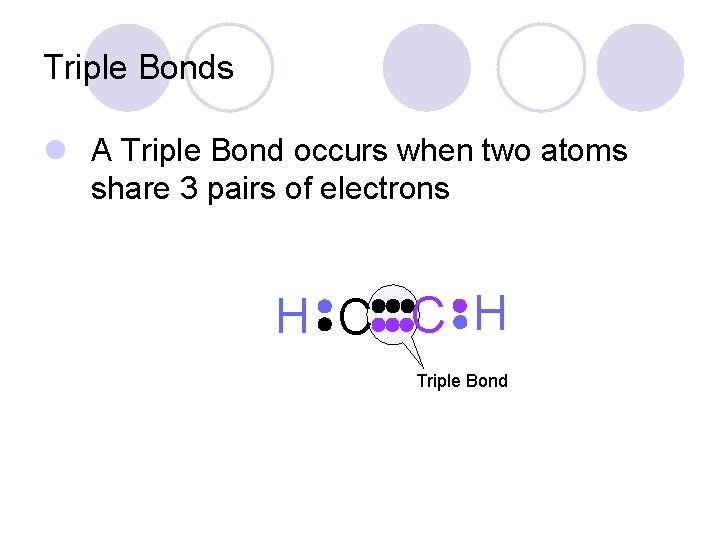
Triple Bonds l A Triple Bond occurs when two atoms share 3 pairs of electrons H C C H Triple Bond
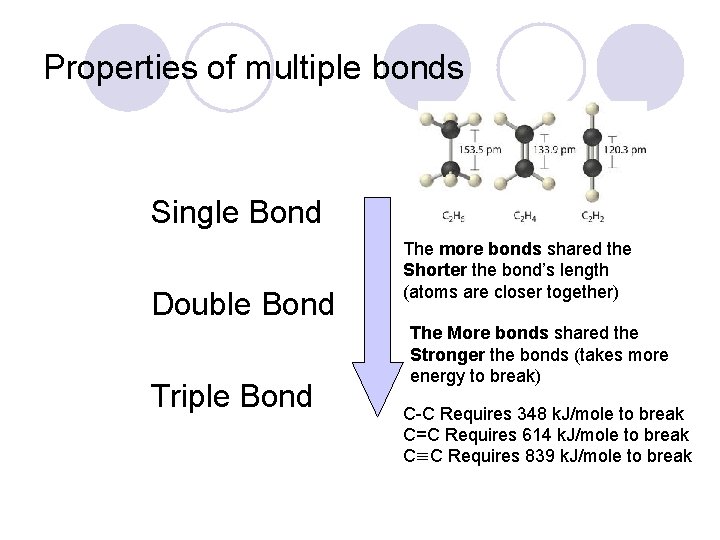
Properties of multiple bonds Single Bond Double Bond Triple Bond The more bonds shared the Shorter the bond’s length (atoms are closer together) The More bonds shared the Stronger the bonds (takes more energy to break) C-C Requires 348 k. J/mole to break C=C Requires 614 k. J/mole to break C≡C Requires 839 k. J/mole to break
Polyatomic Ions
Polyatomic Ions l They are a group of atoms bonded together that have an overall charge Example: INSTRUCTOR – Please present the polyatomic ion for NH 4+1