
Section 5 2 The Standard Normal Distribution The
Section 5. 2 The Standard Normal Distribution
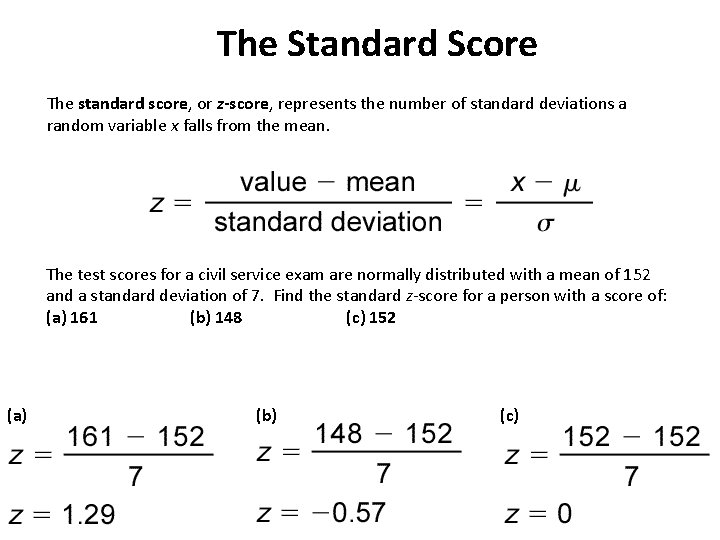
The Standard Score The standard score, or z-score, represents the number of standard deviations a random variable x falls from the mean. The test scores for a civil service exam are normally distributed with a mean of 152 and a standard deviation of 7. Find the standard z-score for a person with a score of: (a) 161 (b) 148 (c) 152 (a) (b) (c)
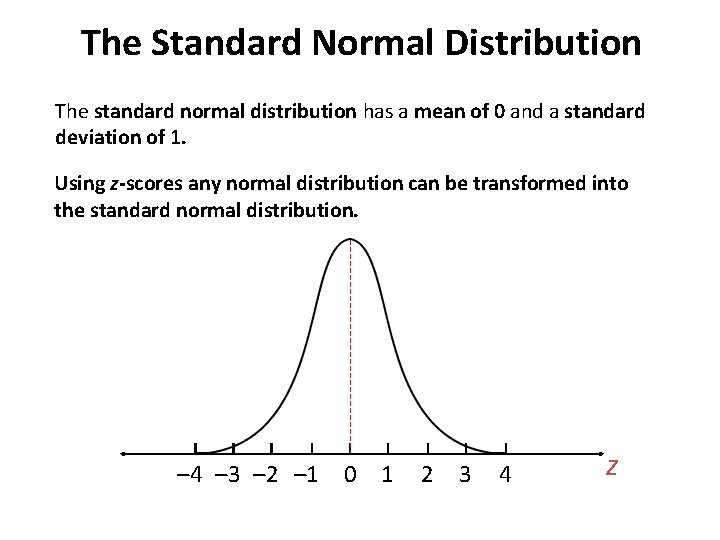
The Standard Normal Distribution The standard normal distribution has a mean of 0 and a standard deviation of 1. Using z-scores any normal distribution can be transformed into the standard normal distribution. – 4 – 3 – 2 – 1 0 1 2 3 4 z
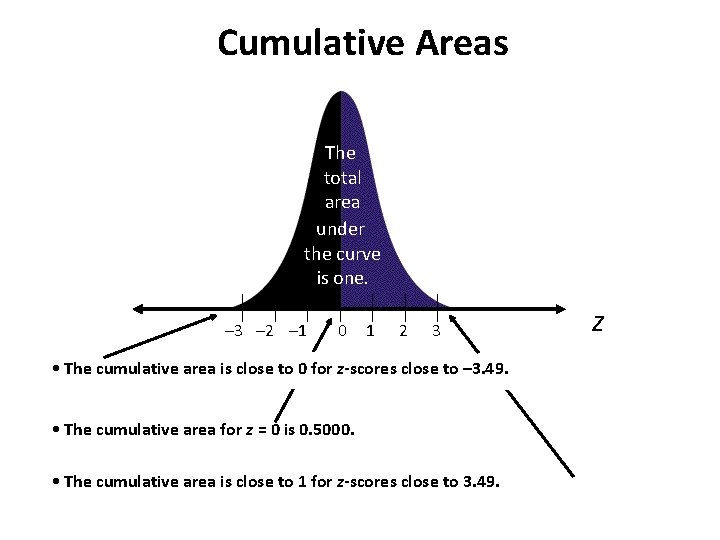
Cumulative Areas The total area under the curve is one. – 3 – 2 – 1 0 1 2 3 • The cumulative area is close to 0 for z-scores close to – 3. 49. • The cumulative area for z = 0 is 0. 5000. • The cumulative area is close to 1 for z-scores close to 3. 49. z

Cumulative Areas Find the cumulative area for a z-score of – 1. 25. 0. 1056 – 3 – 2 – 1 0 1 2 3 z Read down the z column on the left to z = – 1. 25 and across to the column under. 05. The value in the cell is 0. 1056, the cumulative area. The probability that z is at most – 1. 25 is 0. 1056.

Finding Probabilities To find the probability that z is less than a given value, read the cumulative area in the table corresponding to that z-score. Find P(z < – 1. 45). P (z < – 1. 45) = 0. 0735 – 3 – 2 – 1 0 1 2 3 z Read down the z-column to – 1. 4 and across to. 05. The cumulative area is 0. 0735.
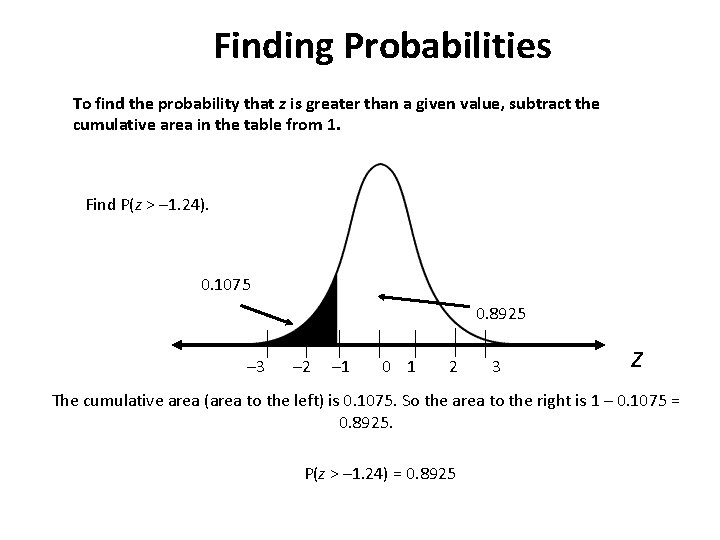
Finding Probabilities To find the probability that z is greater than a given value, subtract the cumulative area in the table from 1. Find P(z > – 1. 24). 0. 1075 0. 8925 – 3 – 2 – 1 0 1 2 3 z The cumulative area (area to the left) is 0. 1075. So the area to the right is 1 – 0. 1075 = 0. 8925. P(z > – 1. 24) = 0. 8925
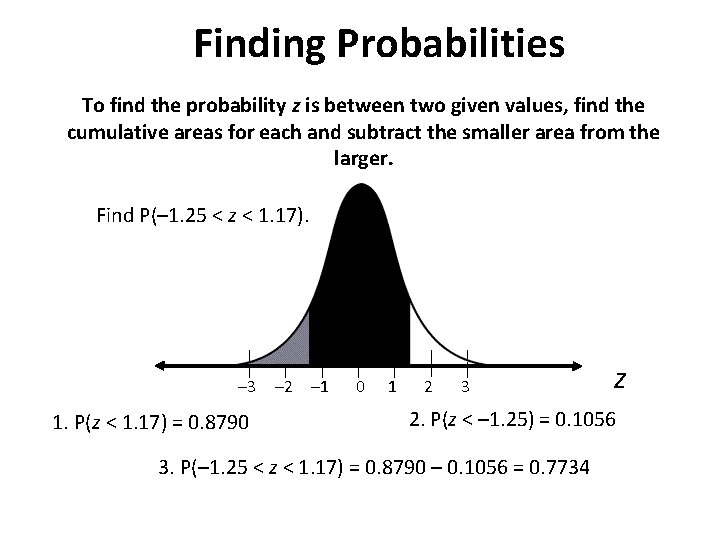
Finding Probabilities To find the probability z is between two given values, find the cumulative areas for each and subtract the smaller area from the larger. Find P(– 1. 25 < z < 1. 17). – 3 1. P(z < 1. 17) = 0. 8790 – 2 – 1 0 1 2 3 z 2. P(z < – 1. 25) = 0. 1056 3. P(– 1. 25 < z < 1. 17) = 0. 8790 – 0. 1056 = 0. 7734
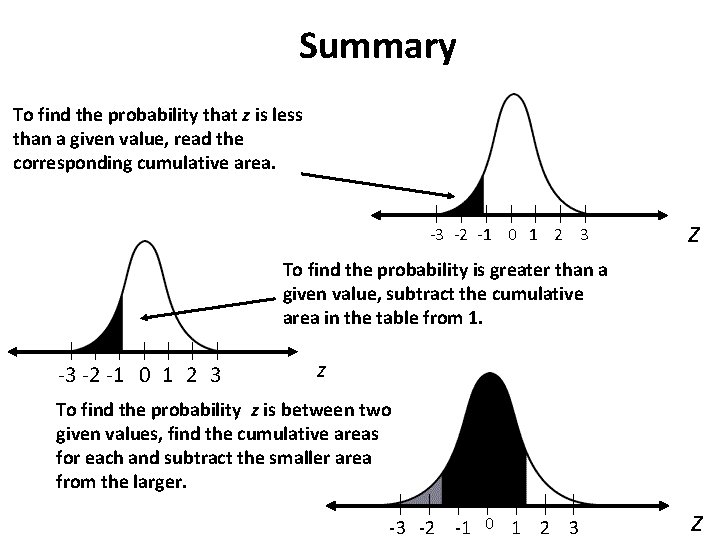
Summary To find the probability that z is less than a given value, read the corresponding cumulative area. -3 -2 -1 0 1 2 3 z To find the probability is greater than a given value, subtract the cumulative area in the table from 1. -3 -2 -1 0 1 2 3 z To find the probability z is between two given values, find the cumulative areas for each and subtract the smaller area from the larger. -3 -2 -1 0 1 2 3 z
Homework : 1 -15 all pgs. 232 -233 Day 2: 16 -30 all pgs. 233 -235
- Slides: 10