
Section 5 2 The Integers Order of Operations
- Slides: 23
Section 5. 2 The Integers; Order of Operations Objectives 1. 2. 3. 4. 5. 6. Define the integers. Graph integers on a number line. Use symbols < and >. Find the absolute value of an integer. Perform operations with integers. Use the order of operations agreement. 12/15/2021 Section 5. 2 1
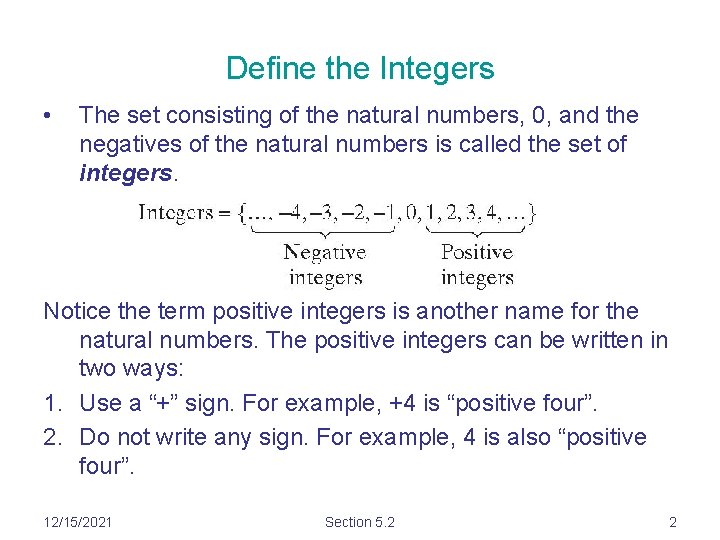
Define the Integers • The set consisting of the natural numbers, 0, and the negatives of the natural numbers is called the set of integers. Notice the term positive integers is another name for the natural numbers. The positive integers can be written in two ways: 1. Use a “+” sign. For example, +4 is “positive four”. 2. Do not write any sign. For example, 4 is also “positive four”. 12/15/2021 Section 5. 2 2
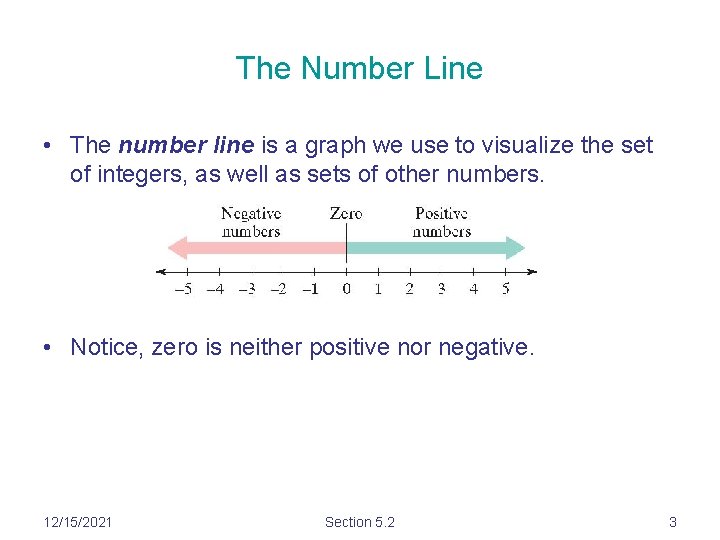
The Number Line • The number line is a graph we use to visualize the set of integers, as well as sets of other numbers. • Notice, zero is neither positive nor negative. 12/15/2021 Section 5. 2 3
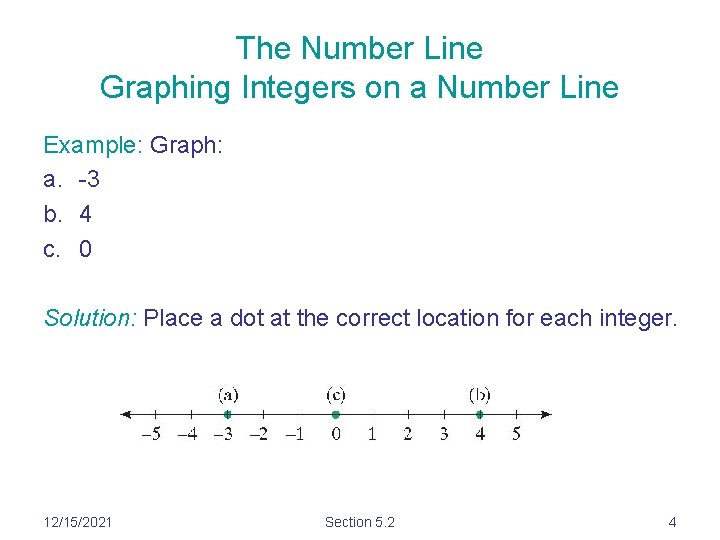
The Number Line Graphing Integers on a Number Line Example: Graph: a. -3 b. 4 c. 0 Solution: Place a dot at the correct location for each integer. 12/15/2021 Section 5. 2 4
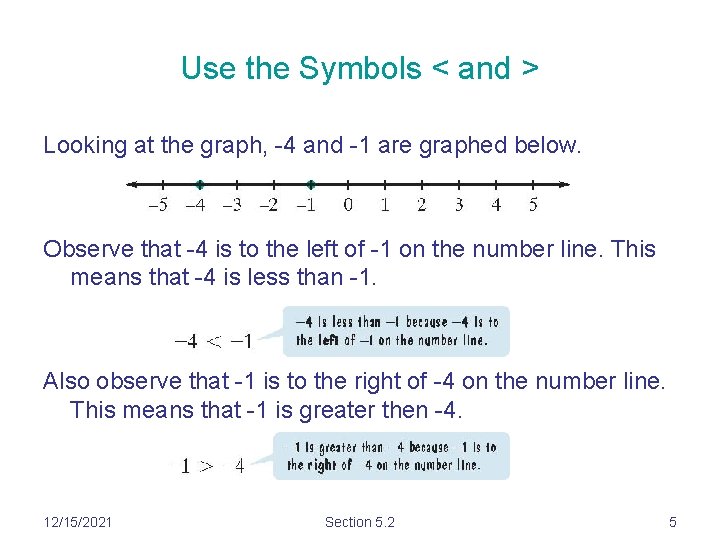
Use the Symbols < and > Looking at the graph, -4 and -1 are graphed below. Observe that -4 is to the left of -1 on the number line. This means that -4 is less than -1. Also observe that -1 is to the right of -4 on the number line. This means that -1 is greater then -4. 12/15/2021 Section 5. 2 5
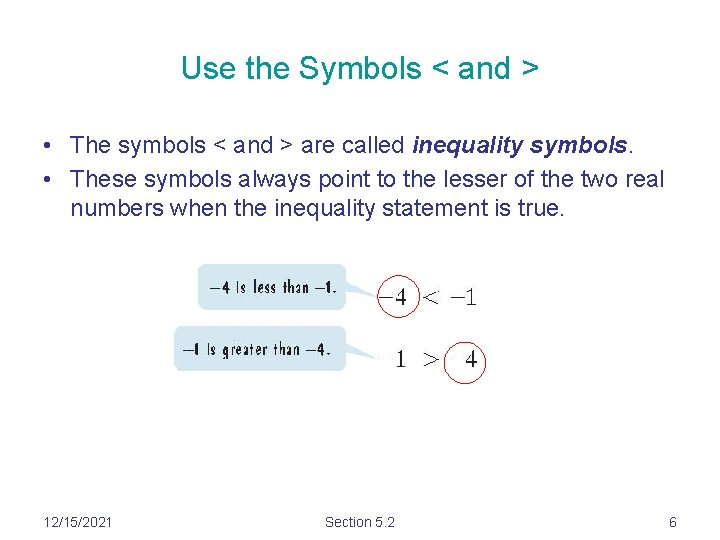
Use the Symbols < and > • The symbols < and > are called inequality symbols. • These symbols always point to the lesser of the two real numbers when the inequality statement is true. 12/15/2021 Section 5. 2 6
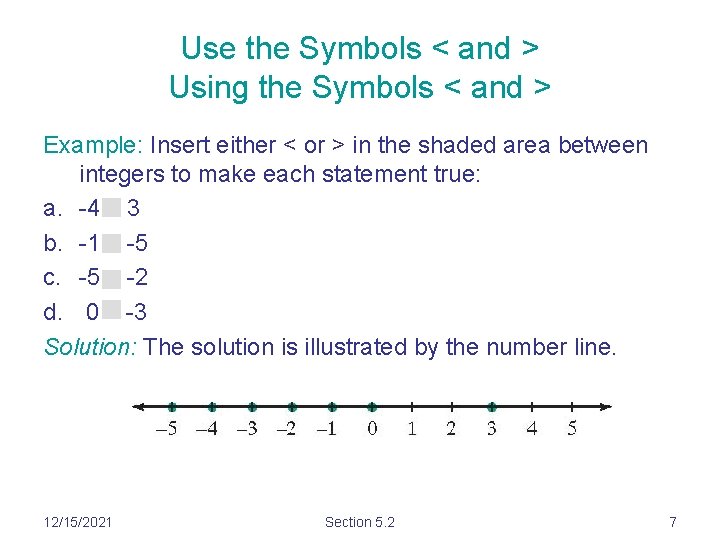
Use the Symbols < and > Using the Symbols < and > Example: Insert either < or > in the shaded area between integers to make each statement true: a. -4 3 b. -1 -5 c. -5 -2 d. 0 -3 Solution: The solution is illustrated by the number line. 12/15/2021 Section 5. 2 7
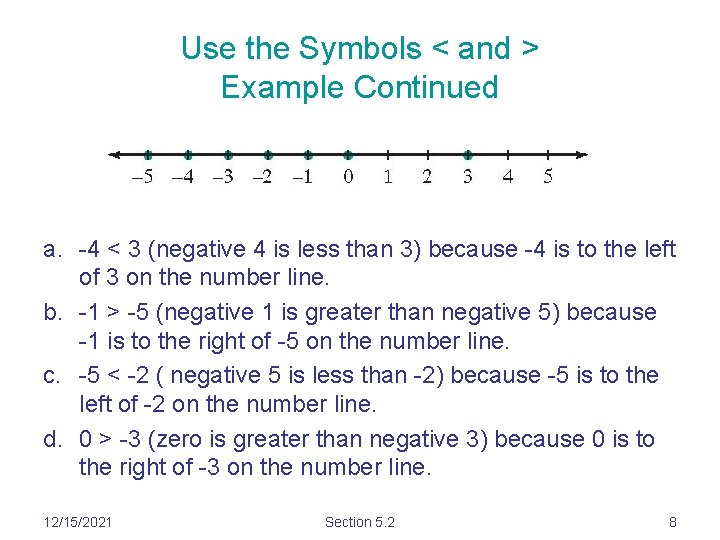
Use the Symbols < and > Example Continued a. -4 < 3 (negative 4 is less than 3) because -4 is to the left of 3 on the number line. b. -1 > -5 (negative 1 is greater than negative 5) because -1 is to the right of -5 on the number line. c. -5 < -2 ( negative 5 is less than -2) because -5 is to the left of -2 on the number line. d. 0 > -3 (zero is greater than negative 3) because 0 is to the right of -3 on the number line. 12/15/2021 Section 5. 2 8
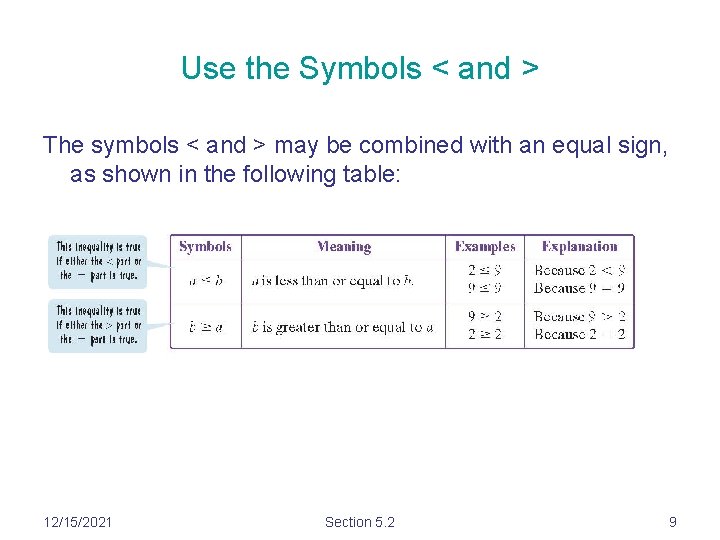
Use the Symbols < and > The symbols < and > may be combined with an equal sign, as shown in the following table: 12/15/2021 Section 5. 2 9
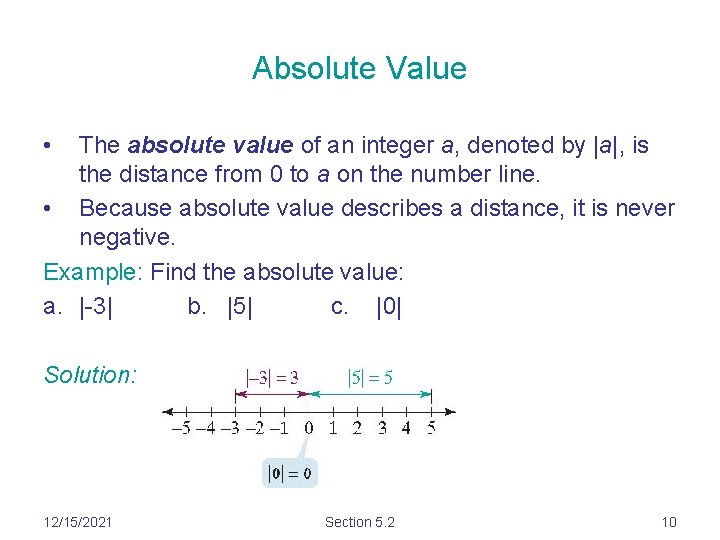
Absolute Value • The absolute value of an integer a, denoted by |a|, is the distance from 0 to a on the number line. • Because absolute value describes a distance, it is never negative. Example: Find the absolute value: a. |-3| b. |5| c. |0| Solution: 12/15/2021 Section 5. 2 10
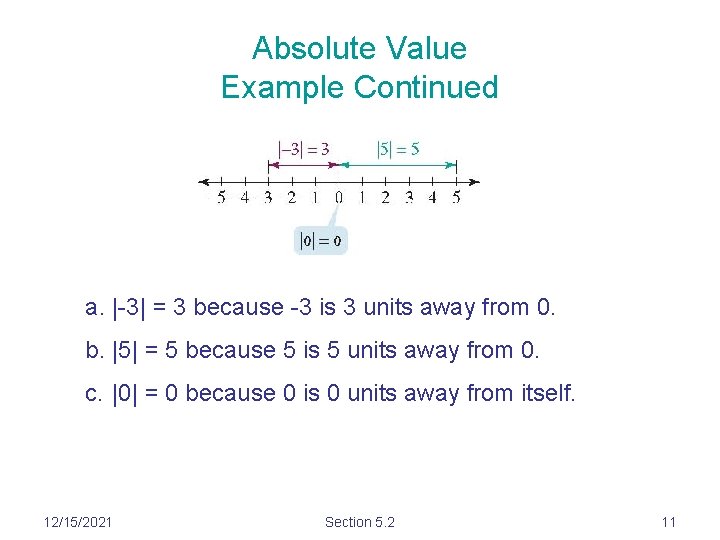
Absolute Value Example Continued a. |-3| = 3 because -3 is 3 units away from 0. b. |5| = 5 because 5 is 5 units away from 0. c. |0| = 0 because 0 is 0 units away from itself. 12/15/2021 Section 5. 2 11
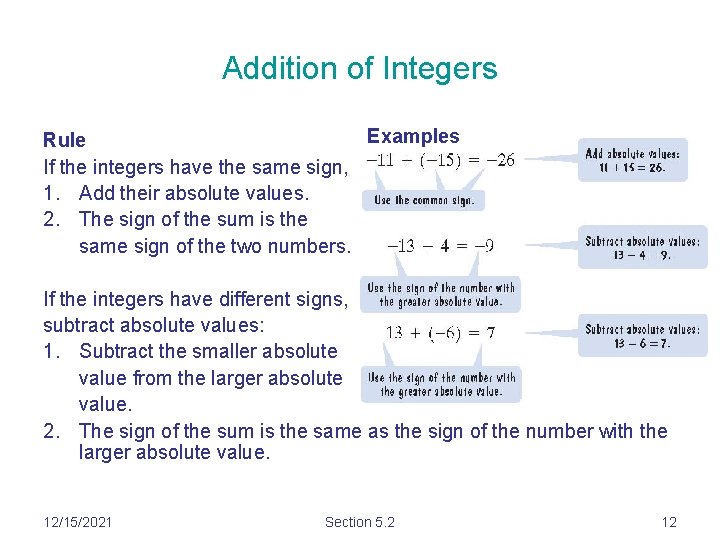
Addition of Integers Examples Rule If the integers have the same sign, 1. Add their absolute values. 2. The sign of the sum is the same sign of the two numbers. If the integers have different signs, subtract absolute values: 1. Subtract the smaller absolute value from the larger absolute value. 2. The sign of the sum is the same as the sign of the number with the larger absolute value. 12/15/2021 Section 5. 2 12
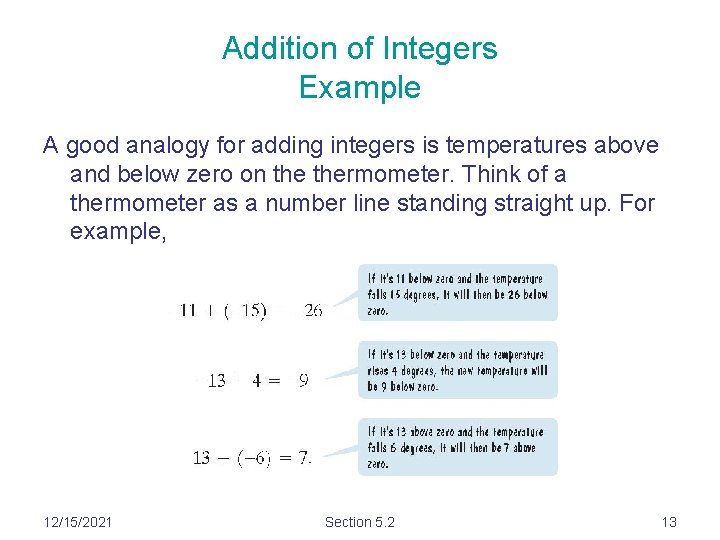
Addition of Integers Example A good analogy for adding integers is temperatures above and below zero on thermometer. Think of a thermometer as a number line standing straight up. For example, 12/15/2021 Section 5. 2 13
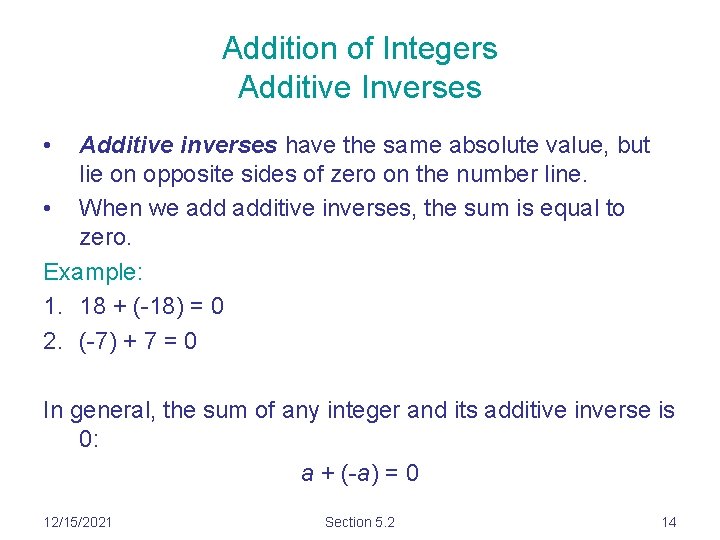
Addition of Integers Additive Inverses • Additive inverses have the same absolute value, but lie on opposite sides of zero on the number line. • When we additive inverses, the sum is equal to zero. Example: 1. 18 + (-18) = 0 2. (-7) + 7 = 0 In general, the sum of any integer and its additive inverse is 0: a + (-a) = 0 12/15/2021 Section 5. 2 14
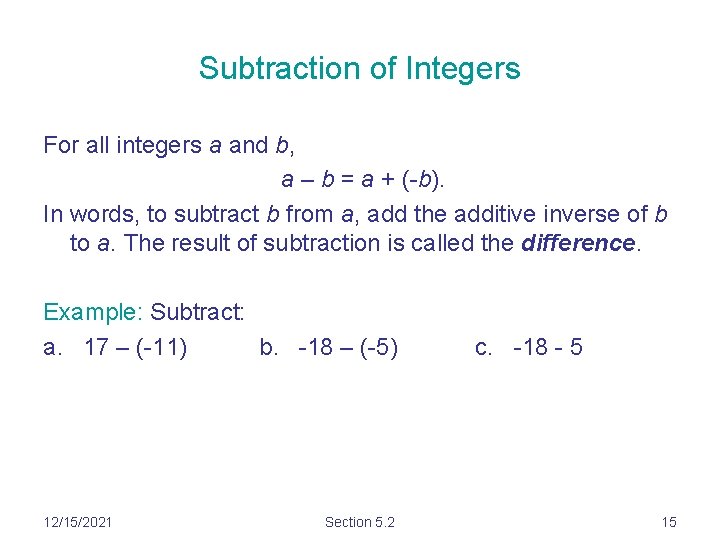
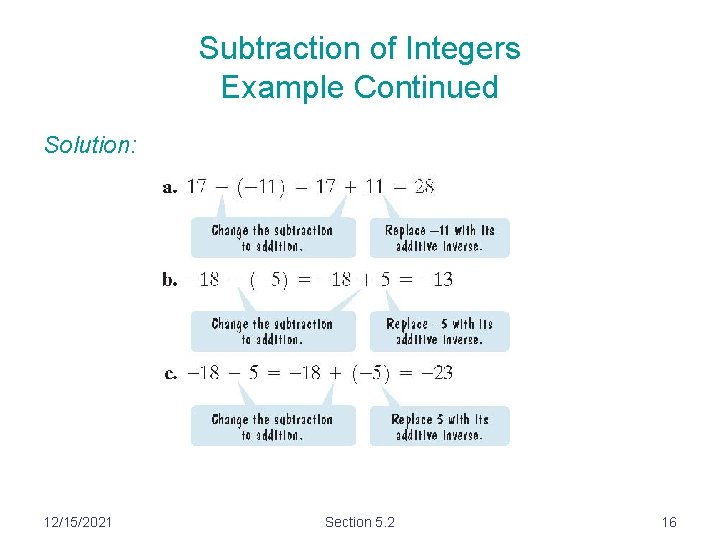
Subtraction of Integers For all integers a and b, a – b = a + (-b). In words, to subtract b from a, add the additive inverse of b to a. The result of subtraction is called the difference. Example: Subtract: a. 17 – (-11) b. -18 – (-5) 12/15/2021 Section 5. 2 c. -18 - 5 15
Subtraction of Integers Example Continued Solution: 12/15/2021 Section 5. 2 16
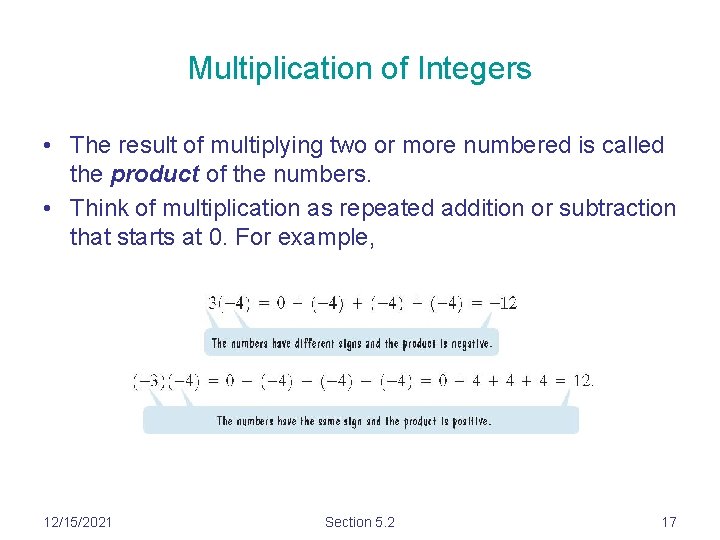
Multiplication of Integers • The result of multiplying two or more numbered is called the product of the numbers. • Think of multiplication as repeated addition or subtraction that starts at 0. For example, 12/15/2021 Section 5. 2 17
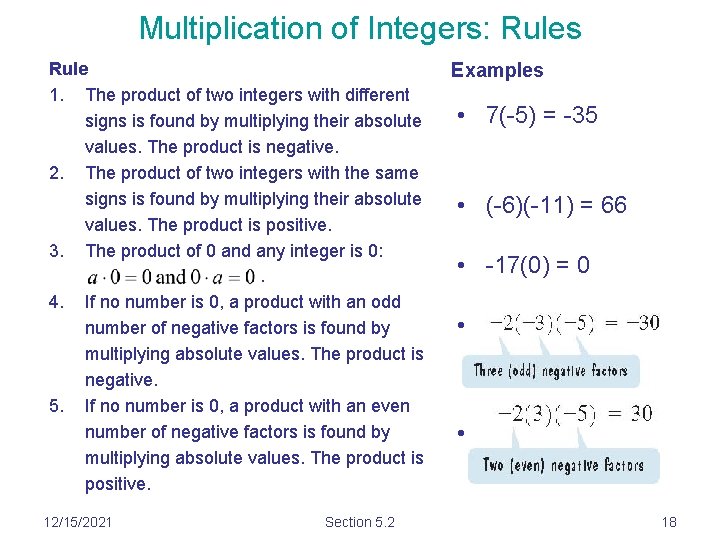
Multiplication of Integers: Rules Rule 1. The product of two integers with different signs is found by multiplying their absolute values. The product is negative. 2. The product of two integers with the same signs is found by multiplying their absolute values. The product is positive. 3. The product of 0 and any integer is 0: . 4. If no number is 0, a product with an odd number of negative factors is found by multiplying absolute values. The product is negative. 5. If no number is 0, a product with an even number of negative factors is found by multiplying absolute values. The product is positive. 12/15/2021 Section 5. 2 Examples • 7(-5) = -35 • (-6)(-11) = 66 • -17(0) = 0 • • 18
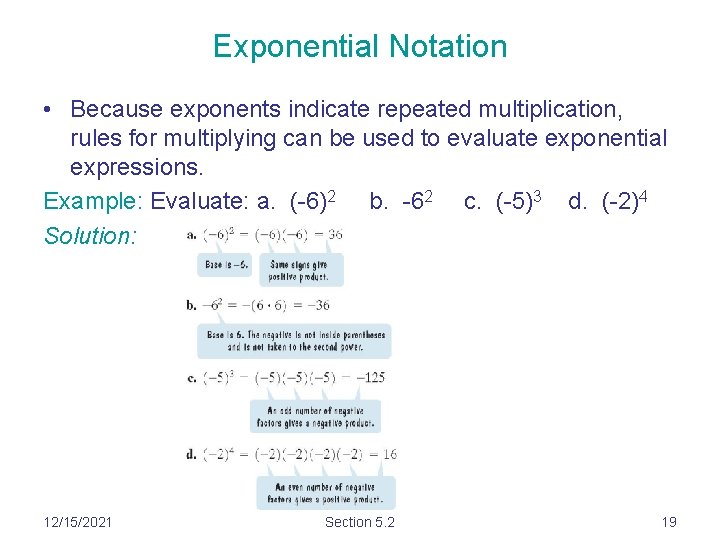
Exponential Notation • Because exponents indicate repeated multiplication, rules for multiplying can be used to evaluate exponential expressions. Example: Evaluate: a. (-6)2 b. -62 c. (-5)3 d. (-2)4 Solution: 12/15/2021 Section 5. 2 19
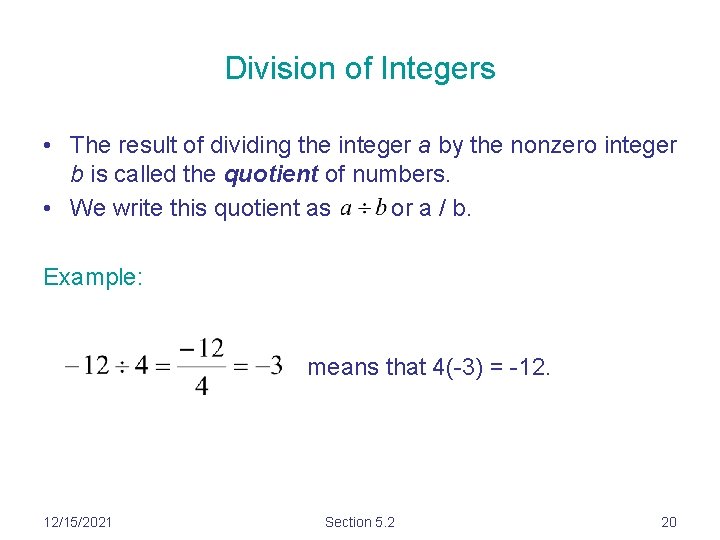
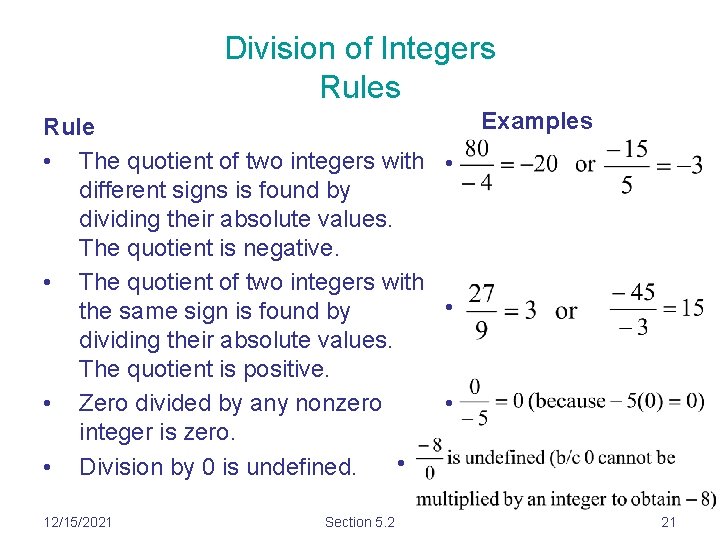
Division of Integers • The result of dividing the integer a by the nonzero integer b is called the quotient of numbers. • We write this quotient as or a / b. Example: means that 4(-3) = -12. 12/15/2021 Section 5. 2 20
Division of Integers Rule • The quotient of two integers with • different signs is found by dividing their absolute values. The quotient is negative. • The quotient of two integers with • the same sign is found by dividing their absolute values. The quotient is positive. • • Zero divided by any nonzero integer is zero. • • Division by 0 is undefined. 12/15/2021 Section 5. 2 Examples 21
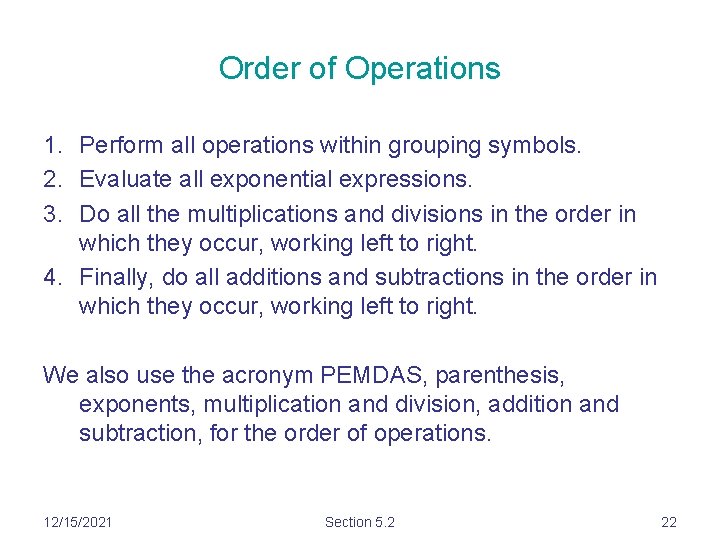
Order of Operations 1. Perform all operations within grouping symbols. 2. Evaluate all exponential expressions. 3. Do all the multiplications and divisions in the order in which they occur, working left to right. 4. Finally, do all additions and subtractions in the order in which they occur, working left to right. We also use the acronym PEMDAS, parenthesis, exponents, multiplication and division, addition and subtraction, for the order of operations. 12/15/2021 Section 5. 2 22
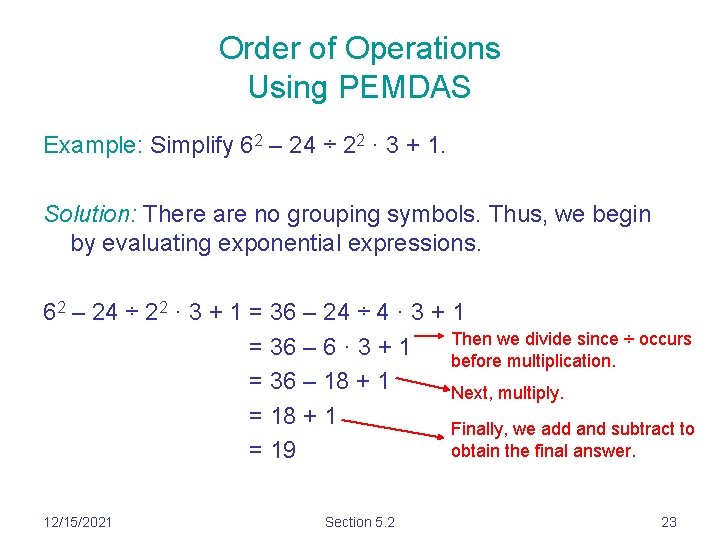
Order of Operations Using PEMDAS Example: Simplify 62 – 24 ÷ 22 · 3 + 1. Solution: There are no grouping symbols. Thus, we begin by evaluating exponential expressions. 62 – 24 ÷ 22 · 3 + 1 = 36 – 24 ÷ 4 · 3 + 1 Then we divide since ÷ occurs = 36 – 6 · 3 + 1 before multiplication. = 36 – 18 + 1 Next, multiply. = 18 + 1 Finally, we add and subtract to obtain the final answer. = 19 12/15/2021 Section 5. 2 23