
Section 5 1 Parallelograms 1115 Remember a quadrilateral
Section 5. 1 - Parallelograms 11/15 • Remember: a quadrilateral is any 4 -sided polygon. • Parallelograms are a type of quadrilateral with both pairs of opposite sides parallel. • Recall: The sum of the interior angles of a parallelogram (and quadrilateral) is 36. • If you know a shape is a parallelogram, then it has 4 big properties (theorems).
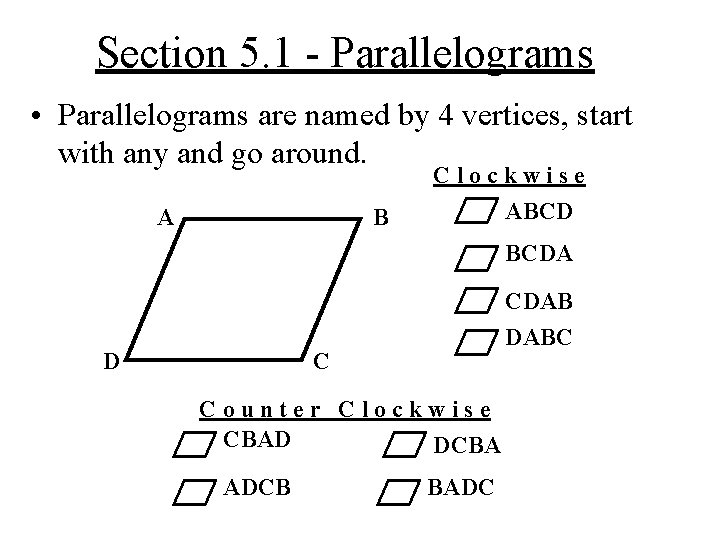
Section 5. 1 - Parallelograms • Parallelograms are named by 4 vertices, start with any and go around. A B Clockwise ABCD BCDA D CDAB DABC C Counter Clockwise CBAD DCBA ADCB BADC

Section 5. 1 - Parallelograms Theorem #1: The opposite sides of a parallelogram are congruent.
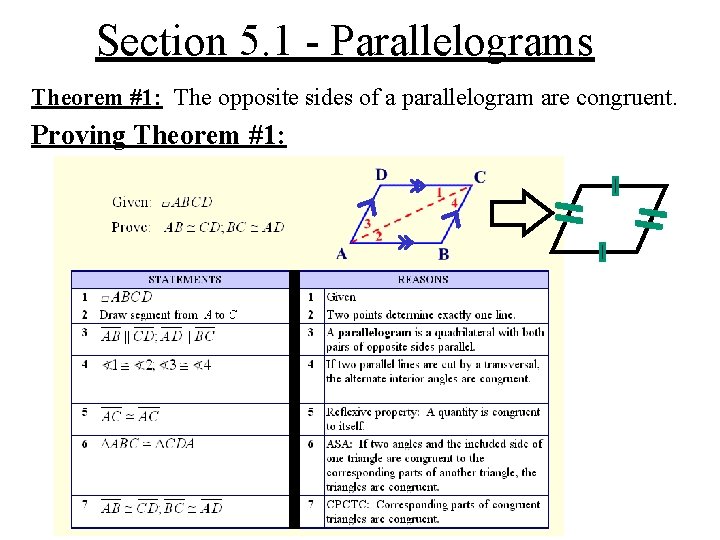
Section 5. 1 - Parallelograms Theorem #1: The opposite sides of a parallelogram are congruent. Proving Theorem #1:
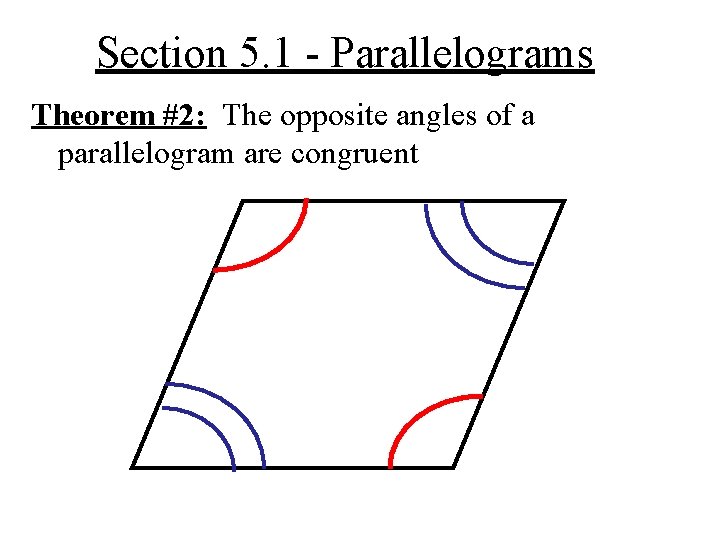
Section 5. 1 - Parallelograms Theorem #2: The opposite angles of a parallelogram are congruent
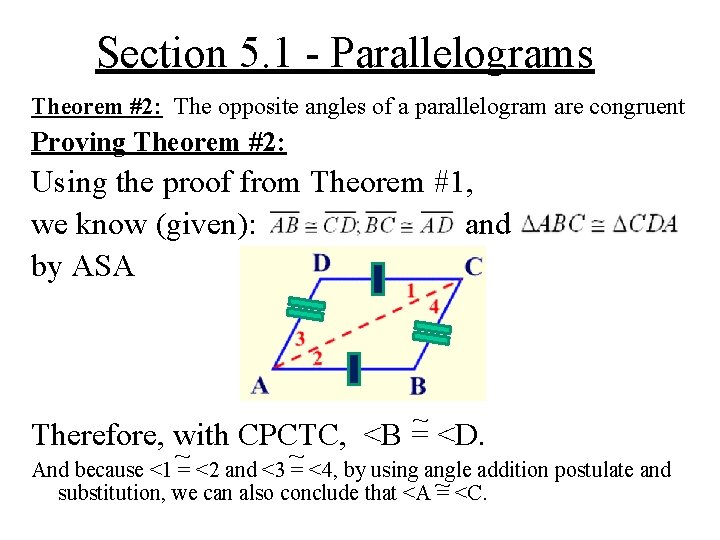
Section 5. 1 - Parallelograms Theorem #2: The opposite angles of a parallelogram are congruent Proving Theorem #2: Using the proof from Theorem #1, we know (given): and by ASA ~ Therefore, with CPCTC, <B = <D. ~ ~ And because <1 = <2 and <3 = <4, by using angle addition postulate and substitution, we can also conclude that <A ~ = <C.
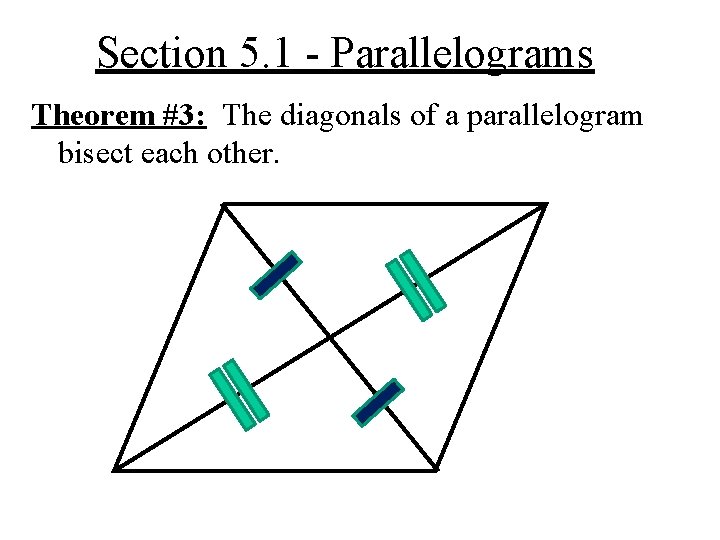
Section 5. 1 - Parallelograms Theorem #3: The diagonals of a parallelogram bisect each other.
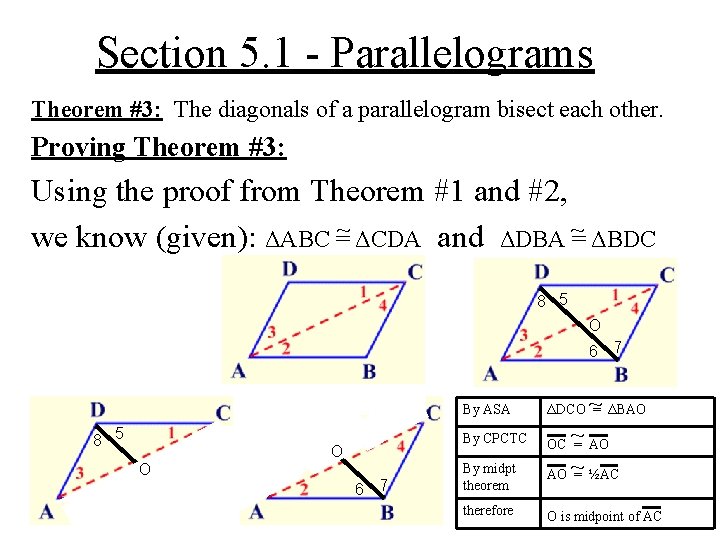
Section 5. 1 - Parallelograms Theorem #3: The diagonals of a parallelogram bisect each other. Proving Theorem #3: Using the proof from Theorem #1 and #2, we know (given): ΔABC =~ ΔCDA and ΔDBA ~= ΔBDC 8 5 O 6 7 8 5 O O 6 7 ~ By ASA ΔDCO = ΔBAO By CPCTC OC = AO By midpt theorem therefore ~ AO ~ = ½AC O is midpoint of AC
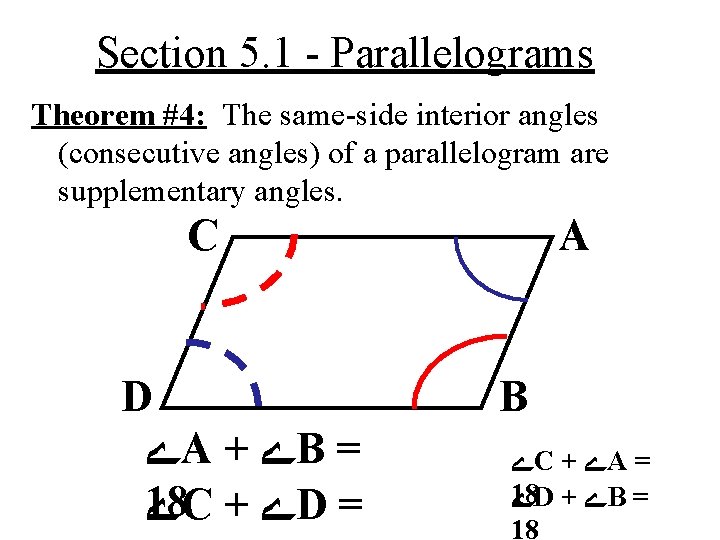
Section 5. 1 - Parallelograms Theorem #4: The same-side interior angles (consecutive angles) of a parallelogram are supplementary angles. C D ﮮ A + ﮮ B = 18 ﮮ C + ﮮ D = A B ﮮ C + ﮮ A = 18 ﮮ D + ﮮ B = 18
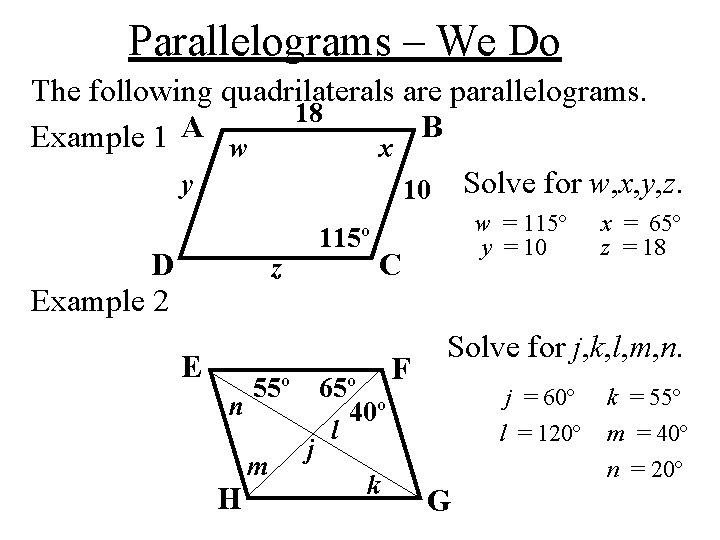
Parallelograms – We Do The following quadrilaterals are parallelograms. 18 B Example 1 A w x y 10 Solve for w, x, y, z. D Example 2 115º z E n H 55º m j w = 115º y = 10 C 65º 40º l k F x = 65º z = 18 Solve for j, k, l, m, n. j = 60º l = 120º G k = 55º m = 40º n = 20º
Parallelograms – You Do • Textbook practice: Pg 168 #2 -8
- Slides: 11