
SECTION 5 1 MAXIMUM MATERIAL REQUIREMENT Definition1 Maximum
- Slides: 10
SECTION 5. 1 MAXIMUM MATERIAL REQUIREMENT
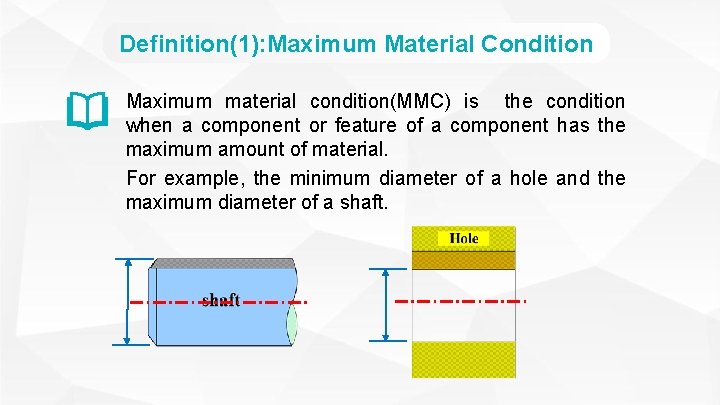
Definition(1): Maximum Material Condition Maximum material condition(MMC) is the condition when a component or feature of a component has the maximum amount of material. For example, the minimum diameter of a hole and the maximum diameter of a shaft.
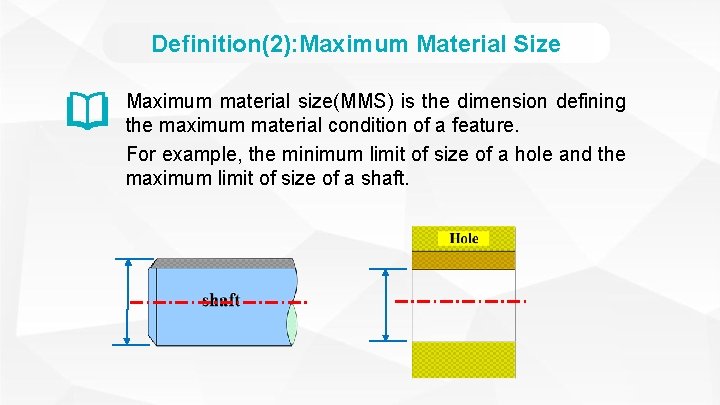
Definition(2): Maximum Material Size Maximum material size(MMS) is the dimension defining the maximum material condition of a feature. For example, the minimum limit of size of a hole and the maximum limit of size of a shaft.
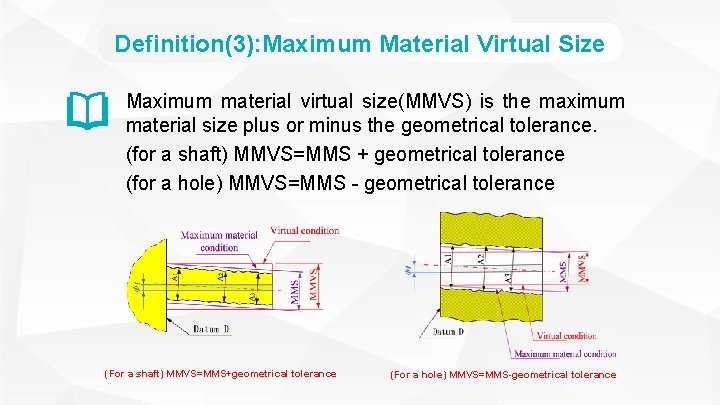
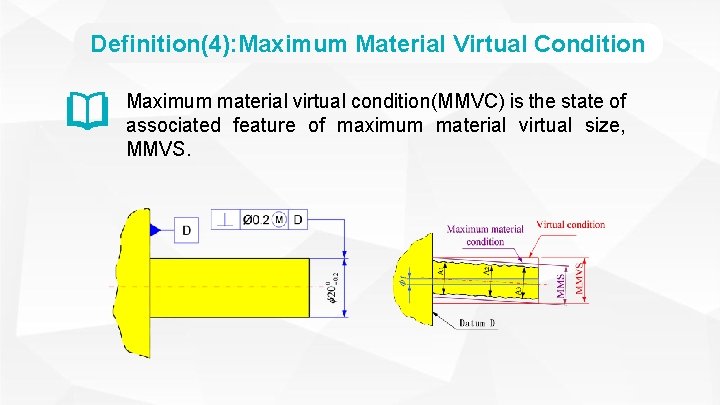
Definition(3): Maximum Material Virtual Size Maximum material virtual size(MMVS) is the maximum material size plus or minus the geometrical tolerance. (for a shaft) MMVS=MMS + geometrical tolerance (for a hole) MMVS=MMS - geometrical tolerance (For a shaft) MMVS=MMS+geometrical tolerance (For a hole) MMVS=MMS-geometrical tolerance
Definition(4): Maximum Material Virtual Condition Maximum material virtual condition(MMVC) is the state of associated feature of maximum material virtual size, MMVS.
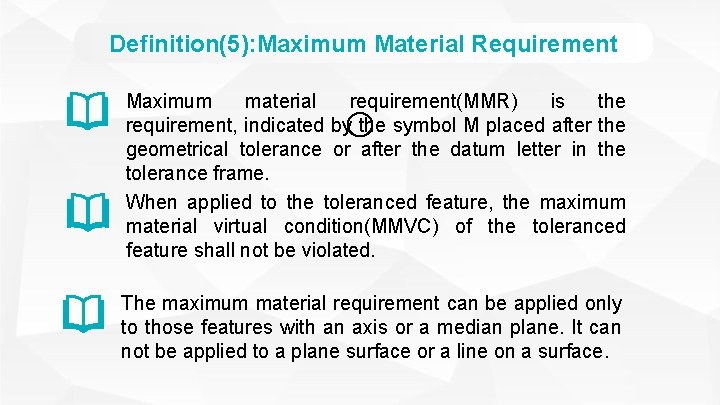
Definition(5): Maximum Material Requirement Maximum material requirement(MMR) is the requirement, indicated by the symbol M placed after the geometrical tolerance or after the datum letter in the tolerance frame. When applied to the toleranced feature, the maximum material virtual condition(MMVC) of the toleranced feature shall not be violated. The maximum material requirement can be applied only to those features with an axis or a median plane. It can not be applied to a plane surface or a line on a surface.
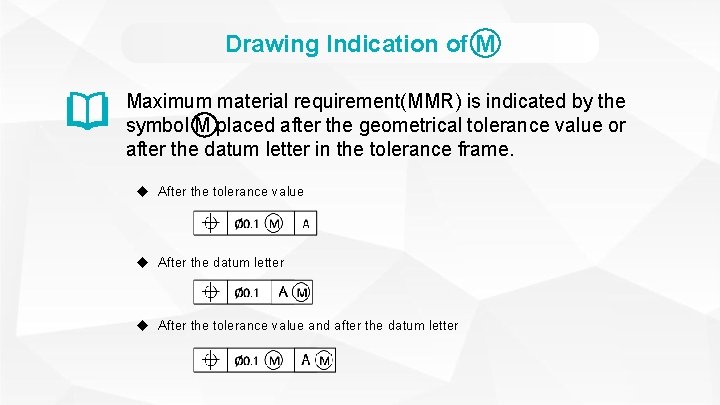
Drawing Indication of M Maximum material requirement(MMR) is indicated by the symbol M placed after the geometrical tolerance value or after the datum letter in the tolerance frame. u After the tolerance value u After the datum letter u After the tolerance value and after the datum letter
Using Maximum Material Requirement The only geometrical tolerances where maximum material condition can be applied are: (1)Straightness (axis); (2)Parallelism; (3)Perpendicularity; (4)Angularity; (5)Position. The true benefit of using the maximum material condition is the ability to call out geometrical tolerances with dimensional tolerances and be able to gauge for them at the same time. So, the maximum material requirement can be explained as functional gauging requirement.
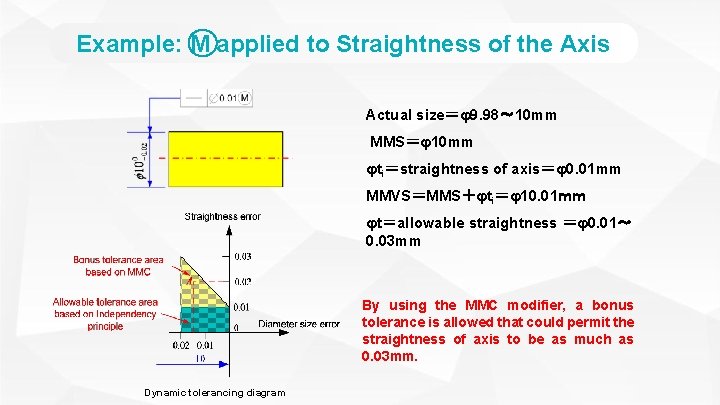
Example: M applied to Straightness of the Axis Actual size=φ9. 98~ 10 mm MMS=φ10 mm φti=straightness of axis=φ0. 01 mm MMVS=MMS+φti=φ10. 01mm φt=allowable straightness =φ0. 01~ 0. 03 mm By using the MMC modifier, a bonus tolerance is allowed that could permit the straightness of axis to be as much as 0. 03 mm. Dynamic tolerancing diagram
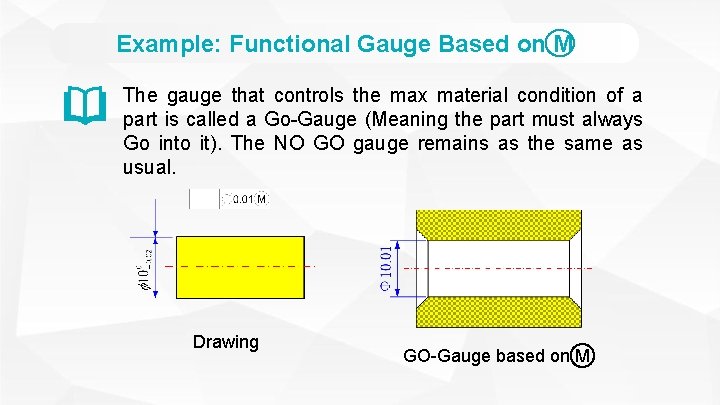
Example: Functional Gauge Based on M The gauge that controls the max material condition of a part is called a Go-Gauge (Meaning the part must always Go into it). The NO GO gauge remains as the same as usual. Drawing GO-Gauge based on M