
Section 5 1 Growth and Decay Integral Exponents
- Slides: 11
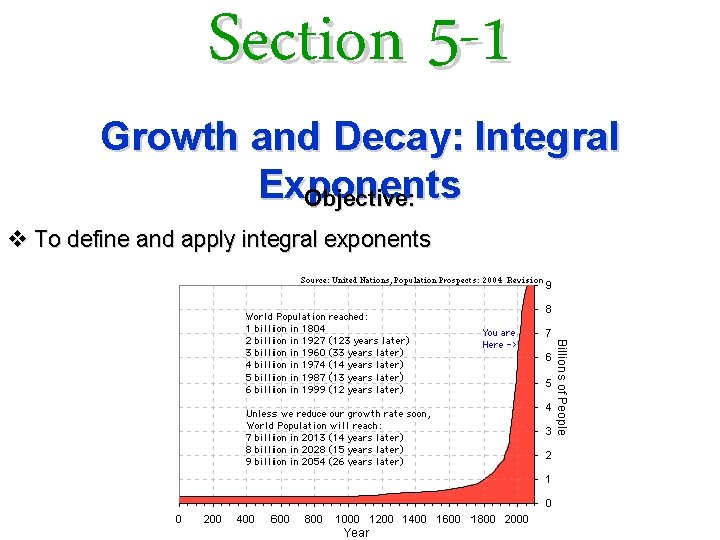
Section 5 -1 Growth and Decay: Integral Exponents Objective: v To define and apply integral exponents
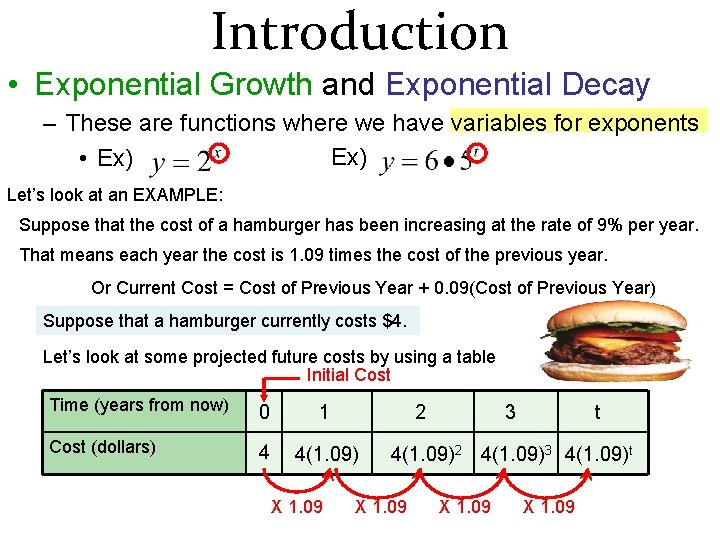
Introduction • Exponential Growth and Exponential Decay – These are functions where we have variables for exponents Ex) • Ex) Let’s look at an EXAMPLE: Suppose that the cost of a hamburger has been increasing at the rate of 9% per year. That means each year the cost is 1. 09 times the cost of the previous year. Or Current Cost = Cost of Previous Year + 0. 09(Cost of Previous Year) Suppose that a hamburger currently costs $4. Let’s look at some projected future costs by using a table Initial Cost Time (years from now) 0 1 Cost (dollars) 4 4(1. 09) X 1. 09 2 3 t 4(1. 09)2 4(1. 09)3 4(1. 09)t X 1. 09
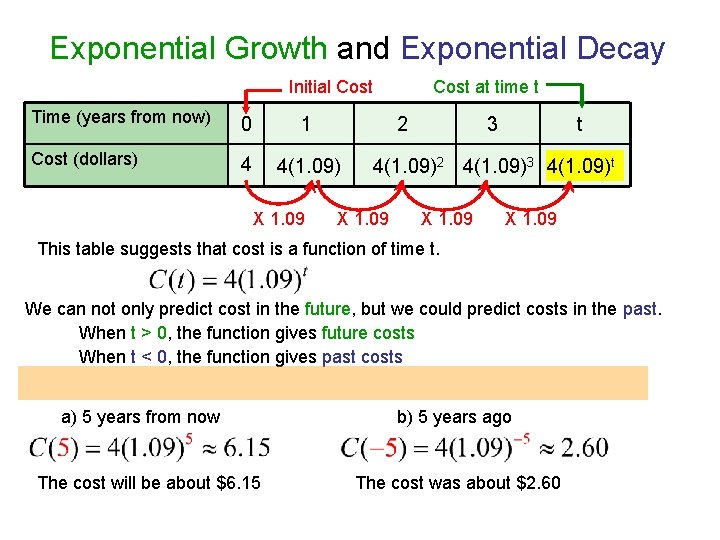
Exponential Growth and Exponential Decay Initial Cost Time (years from now) 0 1 Cost (dollars) 4 4(1. 09) X 1. 09 Cost at time t 2 3 t 4(1. 09)2 4(1. 09)3 4(1. 09)t X 1. 09 This table suggests that cost is a function of time t. We can not only predict cost in the future, but we could predict costs in the past. When t > 0, the function gives future costs When t < 0, the function gives past costs a) 5 years from now The cost will be about $6. 15 b) 5 years ago The cost was about $2. 60
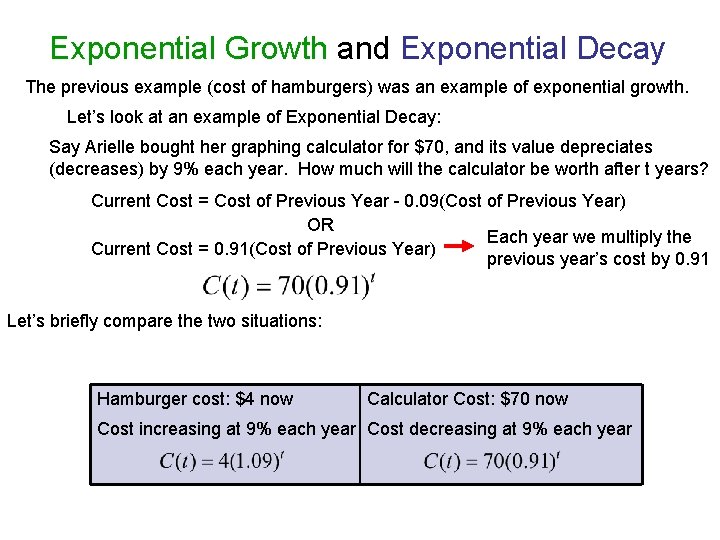
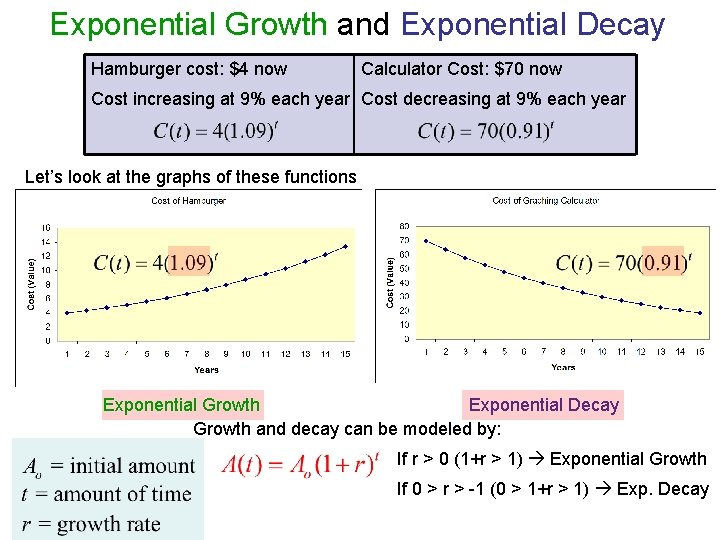
Exponential Growth and Exponential Decay The previous example (cost of hamburgers) was an example of exponential growth. Let’s look at an example of Exponential Decay: Say Arielle bought her graphing calculator for $70, and its value depreciates (decreases) by 9% each year. How much will the calculator be worth after t years? Current Cost = Cost of Previous Year - 0. 09(Cost of Previous Year) OR Each year we multiply the Current Cost = 0. 91(Cost of Previous Year) previous year’s cost by 0. 91 Let’s briefly compare the two situations: Hamburger cost: $4 now Calculator Cost: $70 now Cost increasing at 9% each year Cost decreasing at 9% each year
Exponential Growth and Exponential Decay Hamburger cost: $4 now Calculator Cost: $70 now Cost increasing at 9% each year Cost decreasing at 9% each year Let’s look at the graphs of these functions Exponential Growth Exponential Decay Growth and decay can be modeled by: If r > 0 (1+r > 1) Exponential Growth If 0 > r > -1 (0 > 1+r > 1) Exp. Decay
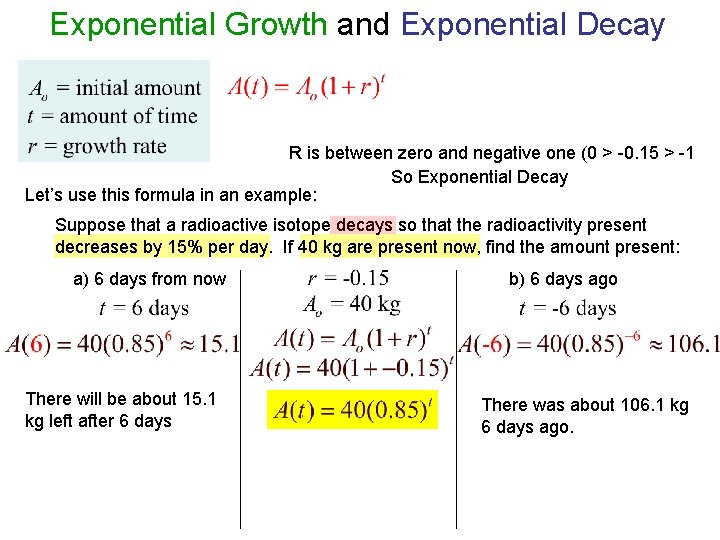
Exponential Growth and Exponential Decay R is between zero and negative one (0 > -0. 15 > -1 So Exponential Decay Let’s use this formula in an example: Suppose that a radioactive isotope decays so that the radioactivity present decreases by 15% per day. If 40 kg are present now, find the amount present: a) 6 days from now There will be about 15. 1 kg left after 6 days b) 6 days ago There was about 106. 1 kg 6 days ago.
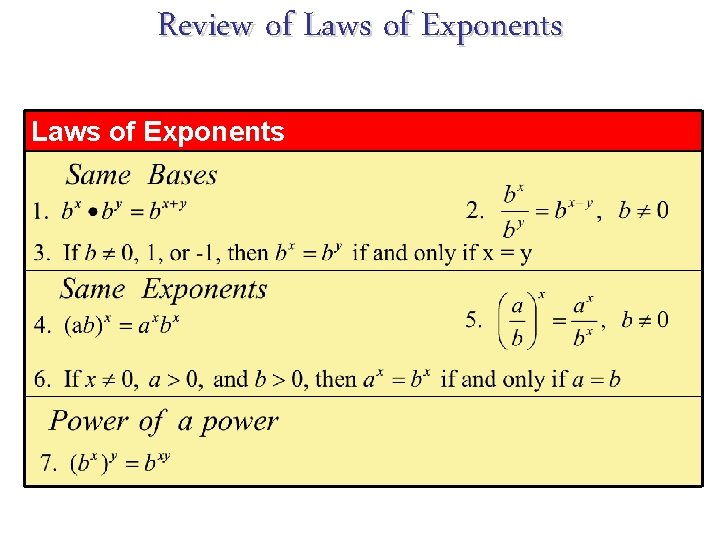
Review of Laws of Exponents
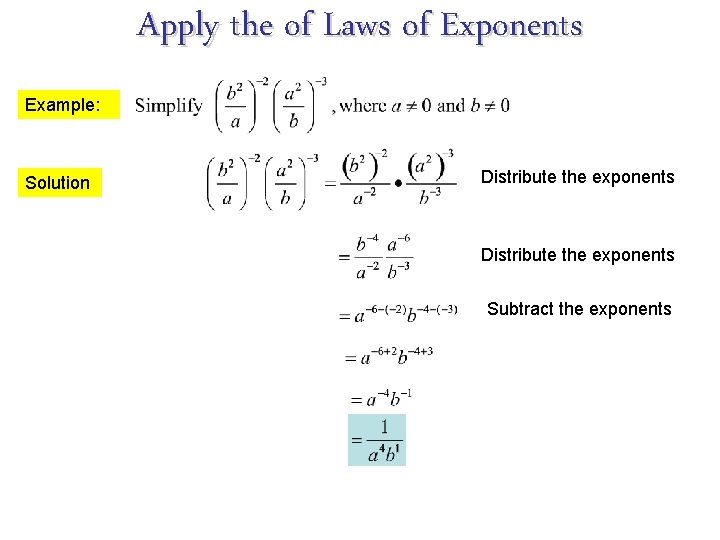
Apply the of Laws of Exponents Example: Solution Distribute the exponents Subtract the exponents
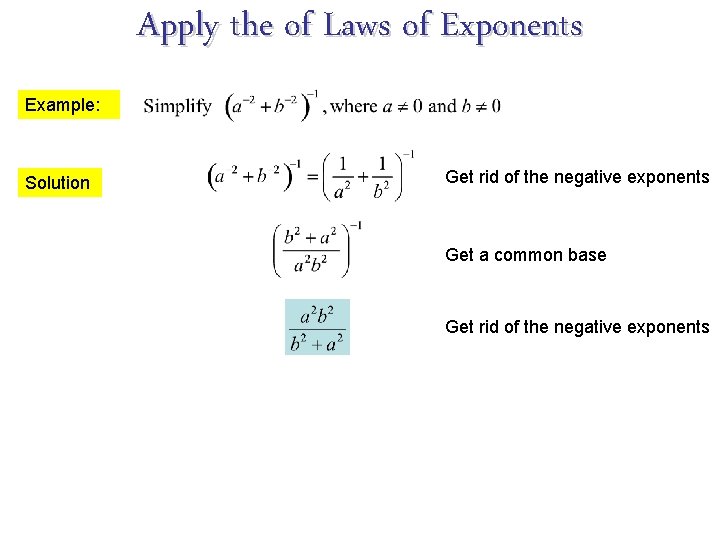
Apply the of Laws of Exponents Example: Solution Get rid of the negative exponents Get a common base Get rid of the negative exponents
Where do we see Exponential Growth? • Wikipedia
Homework • P 173 -174: 1 -21(odd) Day 2: 23 -45 (odd)