
Section 4 Simple Machines Key Concepts What are

- Slides: 27
Section 4 Simple Machines
Key Concepts • What are the six types of simple machines? • What determines the mechanical advantage of the six types of simple machines?
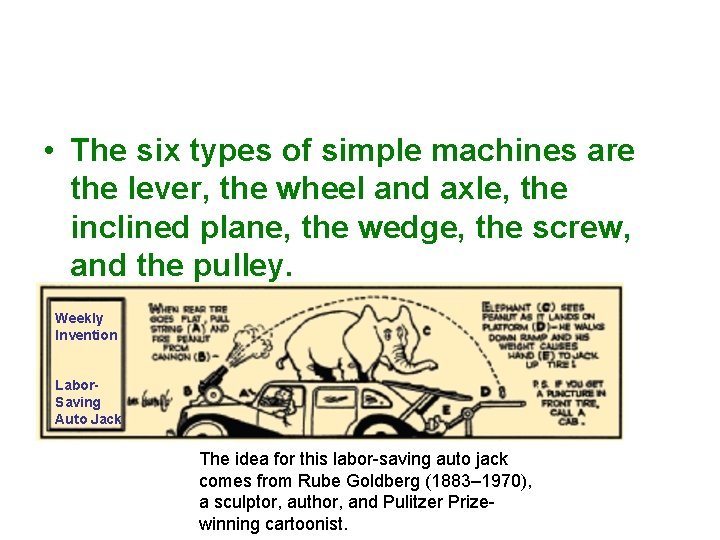
• The six types of simple machines are the lever, the wheel and axle, the inclined plane, the wedge, the screw, and the pulley. Weekly Invention Labor. Saving Auto Jack The idea for this labor-saving auto jack comes from Rube Goldberg (1883– 1970), a sculptor, author, and Pulitzer Prizewinning cartoonist.
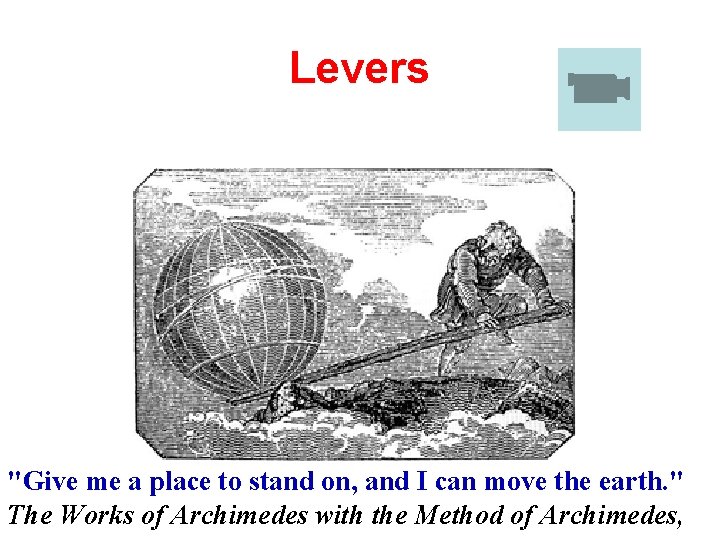
Levers "Give me a place to stand on, and I can move the earth. " The Works of Archimedes with the Method of Archimedes,
Levers • a lever, a rigid bar that is free to move around a fixed point. • The fixed point the bar rotates around is the fulcrum. • Levers are classified into three categories based on the locations of the input force, the output force, and the fulcrum.
Levers • The input arm of a lever is the distance between the input force and the fulcrum. • The output arm is the distance between the output force and the fulcrum. • There are three classes of Levers: 1 st class, 2 nd class, and 3 rd class
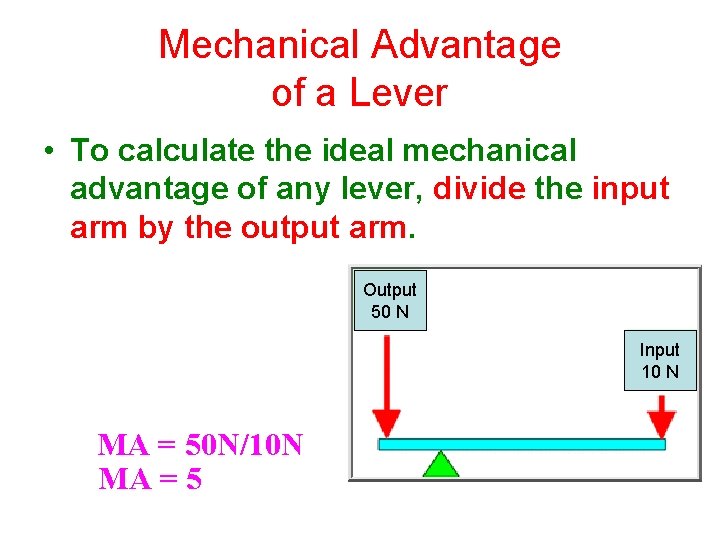
Mechanical Advantage of a Lever • To calculate the ideal mechanical advantage of any lever, divide the input arm by the output arm. Output 50 N Input 10 N MA = 50 N/10 N MA = 5
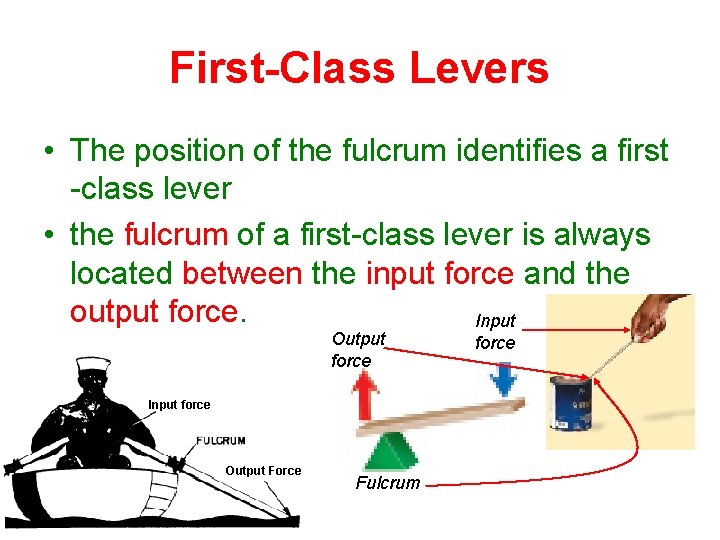
First-Class Levers • The position of the fulcrum identifies a first -class lever • the fulcrum of a first-class lever is always located between the input force and the output force. Input Output force Input force Output Force Fulcrum force
First-Class Levers • Depending on the location of the fulcrum, the mechanical advantage of a first-class lever can be greater than 1, equal to 1, or less than 1. • Examples of first-class levers include a seesaw, scissors, and tongs. Fear of Physics
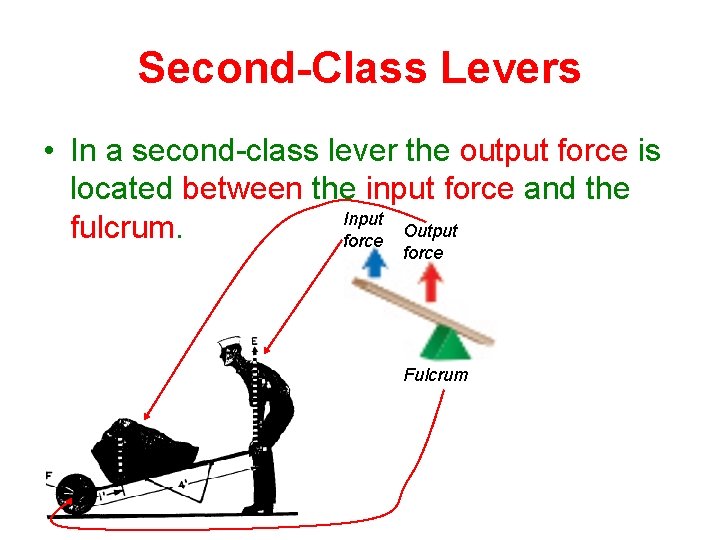
Second-Class Levers • In a second-class lever the output force is located between the input force and the Input Output fulcrum. force Fulcrum
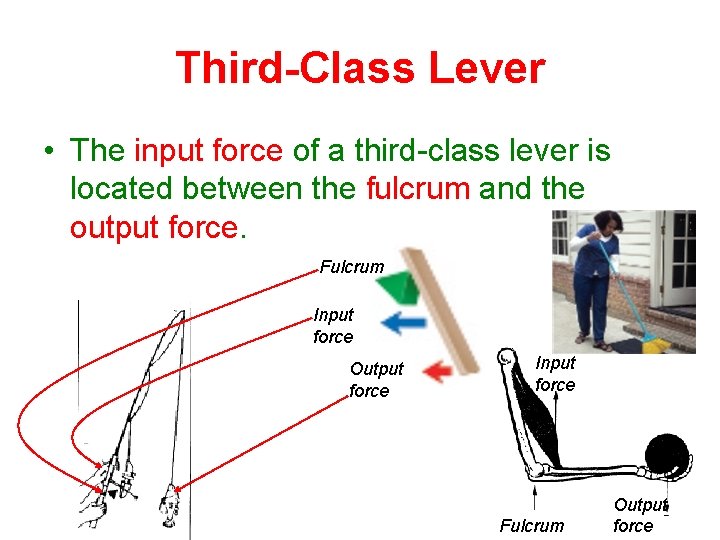
Third-Class Lever • The input force of a third-class lever is located between the fulcrum and the output force. Fulcrum Input force Output force Input force Fulcrum Output force
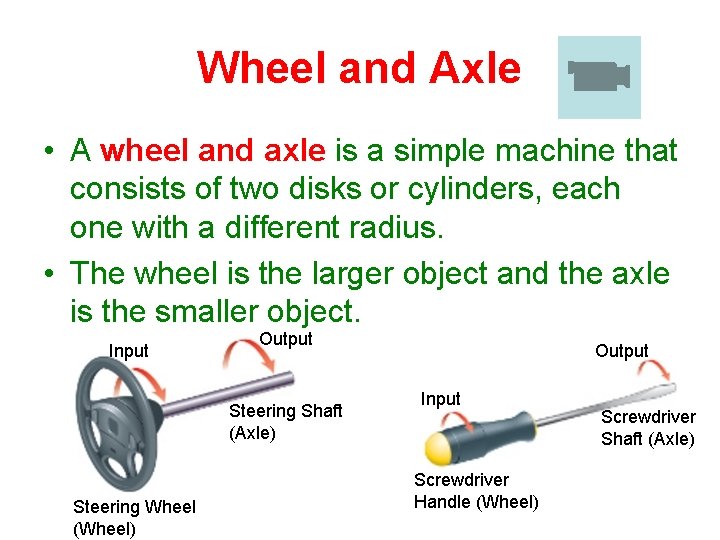
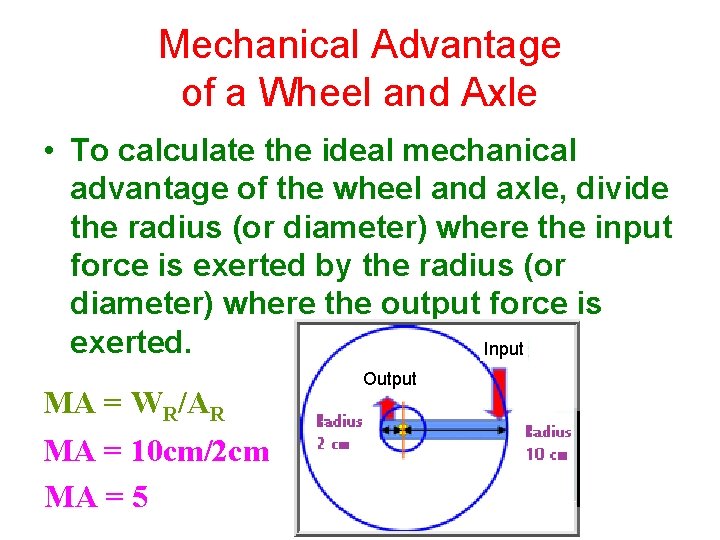
Wheel and Axle • A wheel and axle is a simple machine that consists of two disks or cylinders, each one with a different radius. • The wheel is the larger object and the axle is the smaller object. Input Output Steering Shaft (Axle) Steering Wheel (Wheel) Output Input Screwdriver Handle (Wheel) Screwdriver Shaft (Axle)
Mechanical Advantage of a Wheel and Axle • To calculate the ideal mechanical advantage of the wheel and axle, divide the radius (or diameter) where the input force is exerted by the radius (or diameter) where the output force is exerted. Input MA = WR/AR MA = 10 cm/2 cm MA = 5 Output
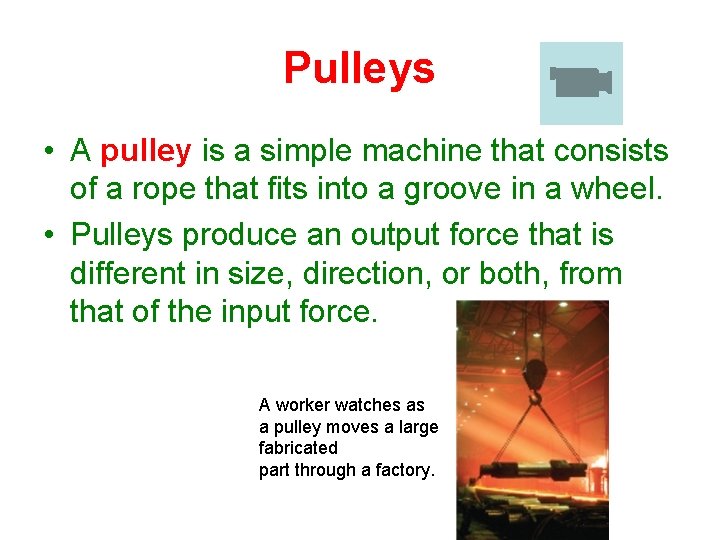
Pulleys • A pulley is a simple machine that consists of a rope that fits into a groove in a wheel. • Pulleys produce an output force that is different in size, direction, or both, from that of the input force. A worker watches as a pulley moves a large fabricated part through a factory.
Three Types of Pulleys • There are 3 types of pulleys: Fixed Pulley, Moveable Pulley, and Block and Tackle
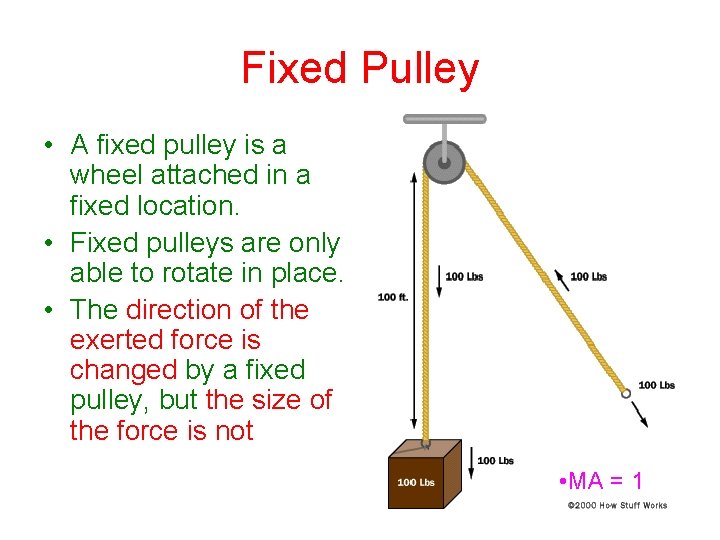
Fixed Pulley • A fixed pulley is a wheel attached in a fixed location. • Fixed pulleys are only able to rotate in place. • The direction of the exerted force is changed by a fixed pulley, but the size of the force is not • MA = 1
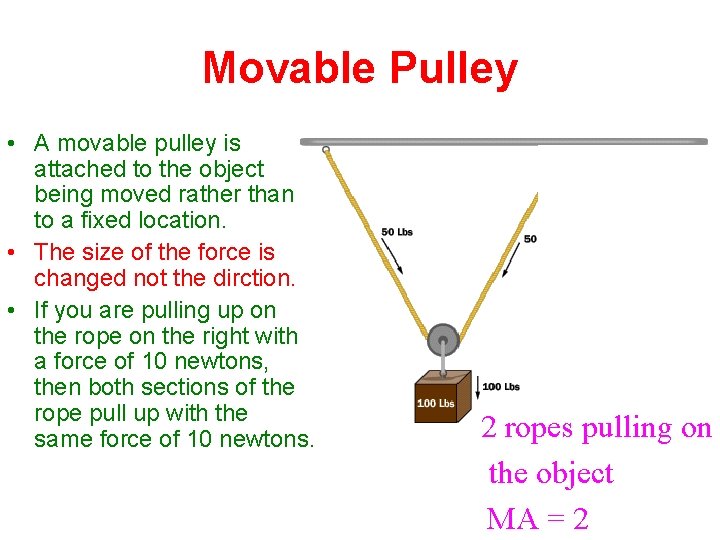
Movable Pulley • A movable pulley is attached to the object being moved rather than to a fixed location. • The size of the force is changed not the dirction. • If you are pulling up on the rope on the right with a force of 10 newtons, then both sections of the rope pull up with the same force of 10 newtons. 2 ropes pulling on the object MA = 2
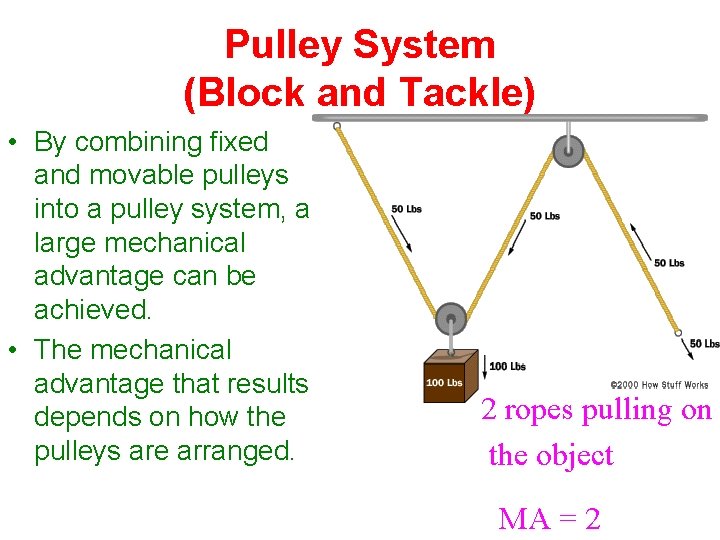
Pulley System (Block and Tackle) • By combining fixed and movable pulleys into a pulley system, a large mechanical advantage can be achieved. • The mechanical advantage that results depends on how the pulleys are arranged. 2 ropes pulling on the object MA = 2
Mechanical Advantage of a Pulley • The ideal mechanical advantage of a pulley or pulley system is equal to the number of rope sections supporting the load being lifted. MA = 2 MA = 5
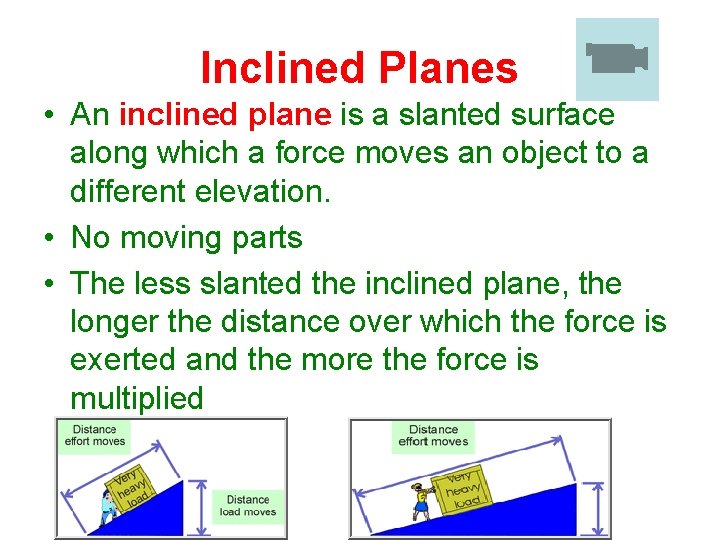
Inclined Planes • An inclined plane is a slanted surface along which a force moves an object to a different elevation. • No moving parts • The less slanted the inclined plane, the longer the distance over which the force is exerted and the more the force is multiplied
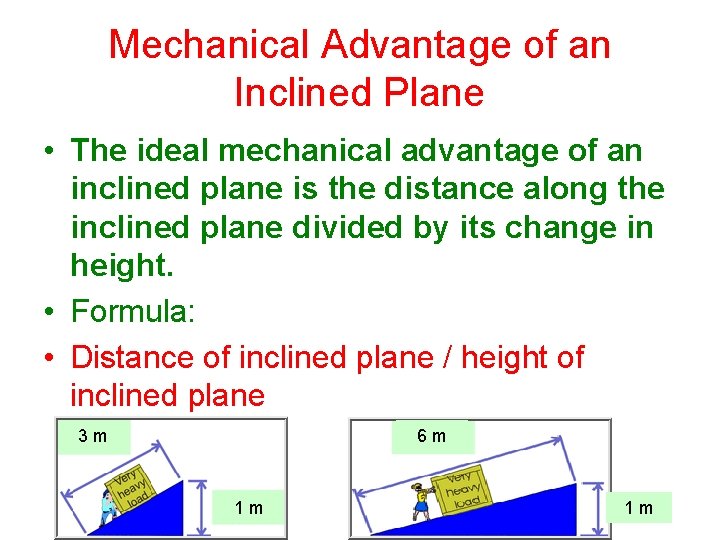
Mechanical Advantage of an Inclined Plane • The ideal mechanical advantage of an inclined plane is the distance along the inclined plane divided by its change in height. • Formula: • Distance of inclined plane / height of inclined plane 3 m 6 m 1 m 1 m
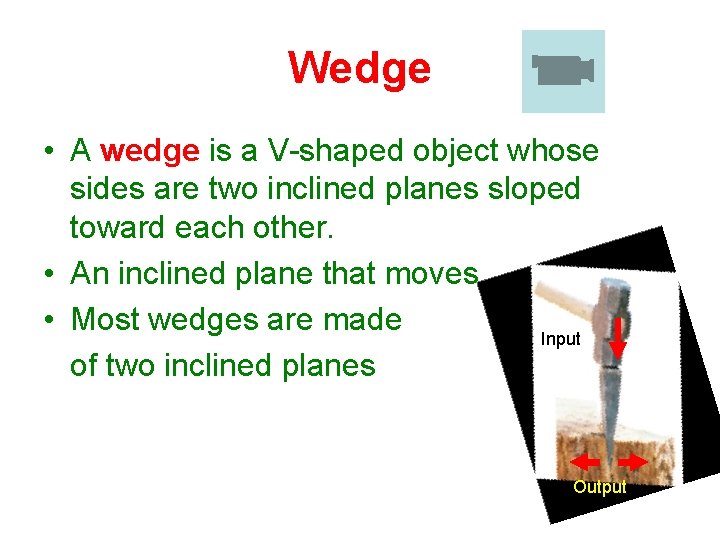
Wedge • A wedge is a V-shaped object whose sides are two inclined planes sloped toward each other. • An inclined plane that moves • Most wedges are made Input of two inclined planes Output
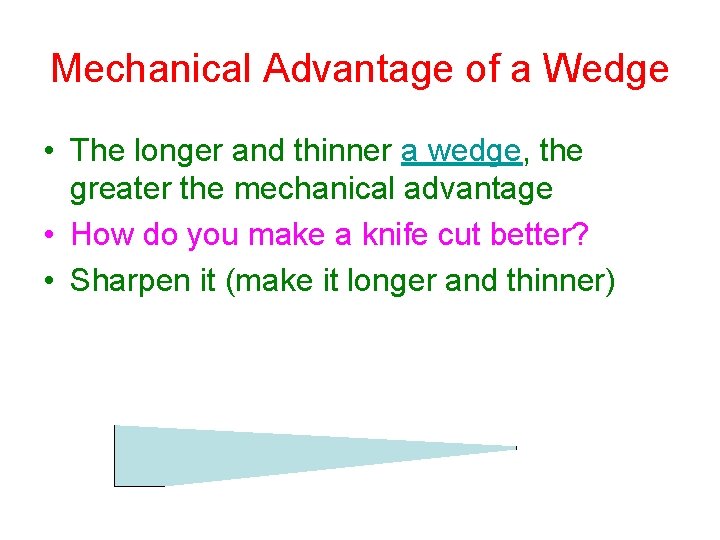
Mechanical Advantage of a Wedge • The longer and thinner a wedge, the greater the mechanical advantage • How do you make a knife cut better? • Sharpen it (make it longer and thinner)
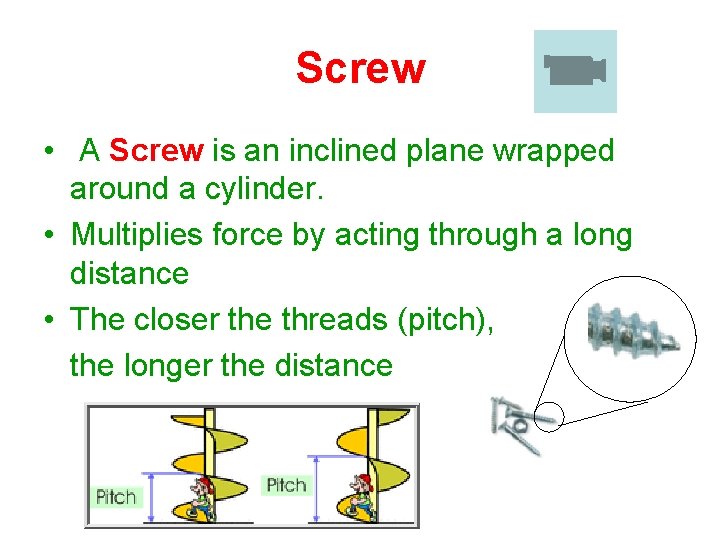
Screw • A Screw is an inclined plane wrapped around a cylinder. • Multiplies force by acting through a long distance • The closer the threads (pitch), the longer the distance
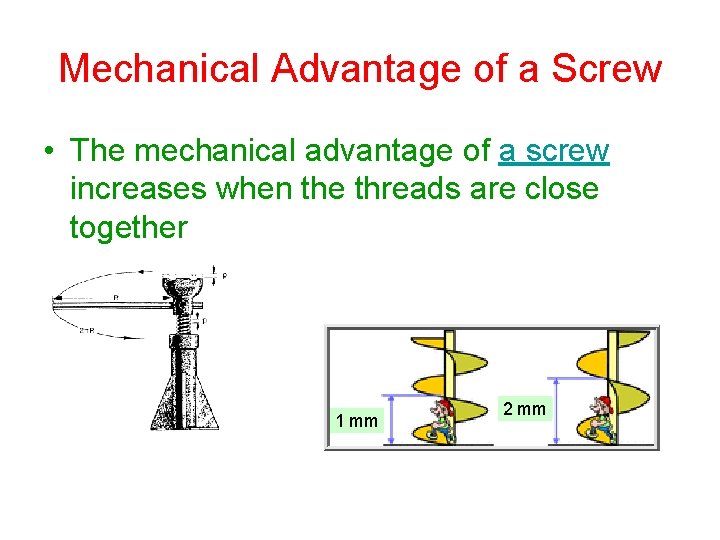
Mechanical Advantage of a Screw • The mechanical advantage of a screw increases when the threads are close together 1 mm 2 mm
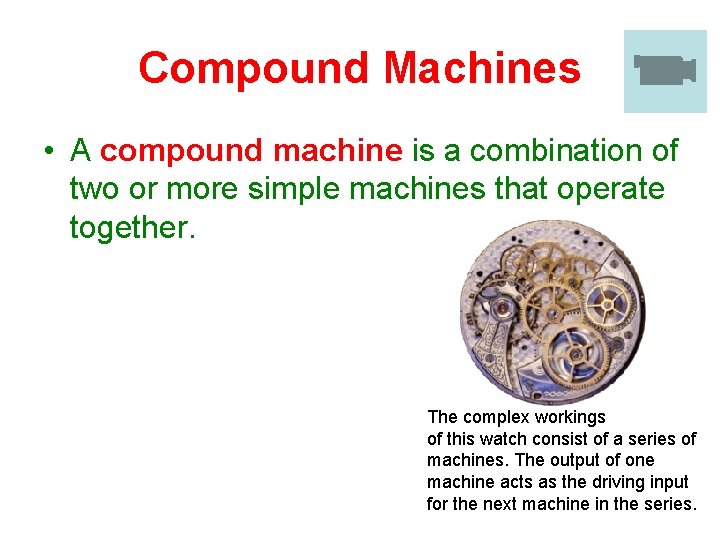
Compound Machines • A compound machine is a combination of two or more simple machines that operate together. The complex workings of this watch consist of a series of machines. The output of one machine acts as the driving input for the next machine in the series.
Reviewing Concepts • 1. Name six kinds of simple machines. Give an example of each. • 2. Describe how to determine the ideal mechanical advantage of each type of simple machine. • 3. How are the lever and the wheel and axle related to each other? • 4. What is the ideal mechanical advantage of a ramp if its length is 4. 0 m and its higher end is 0. 5 m above its lower end? • 5. Tightening a screw with a larger spacing between its threads requires fewer turns of a screwdriver than tightening a screw with smaller thread spacing. What is a disadvantage of the screw with larger thread spacing? • 6. What class or classes of lever always have a mechanical advantage greater than 1?