
Section 4 Planetary Motion Objectives Explain the difference
Section 4 Planetary Motion Objectives • Explain the difference between rotation and revolution. • Describe three laws of planetary motion. • Describe how distance and mass affect gravitational attraction. End of Slide Copyright © by Holt, Rinehart and Winston. All rights reserved.
Section 4 Planetary Motion A Revolution in Astronomy • Kepler’s First Law of Motion The planets move around the sun in an ellipse. • Kepler’s Second Law of Motion the planets seemed to move faster when they are close to the sun and slower when they are farther away. • Kepler’s Third Law of Motion Planets further from the sun, such as Saturn, take longer to orbit the sun. End of Slide Copyright © by Holt, Rinehart and Winston. All rights reserved.
Section 4 Planetary Motion Astronomical Day, Month, Year • A day is the amount of time it takes for a planet to rotate once on its axis • A month is the amount of time it takes for our moon to go around the earth one time • A year is the amount of time it takes for a planet to revolve around its host star one time. • We use earth time to describe a day or year on other planets End of Slide Copyright © by Holt, Rinehart and Winston. All rights reserved.
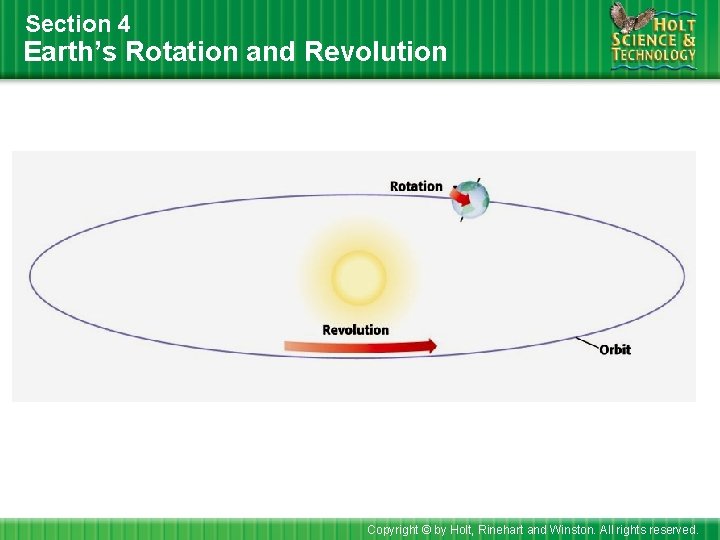
Section 4 Earth’s Rotation and Revolution Copyright © by Holt, Rinehart and Winston. All rights reserved.
Section 4 Moons Luna: The Moon of the Earth continued • Eclipses When the shadow of one celestial body falls on another, an eclipse occurs. • Solar Eclipses During a total solar eclipse, the disk of the moon completely covers the disk of the sun. The Sun is covered • Lunar Eclipse During a lunar eclipse, the disk of the Earth covers the disk of the moon. The moon is covered. • The Tilted Orbit of the Moon The moon’s orbit around Earth is tilted—by about 5°—relative to the orbit of Earth End of Slide around the sun. Copyright © by Holt, Rinehart and Winston. All rights reserved.
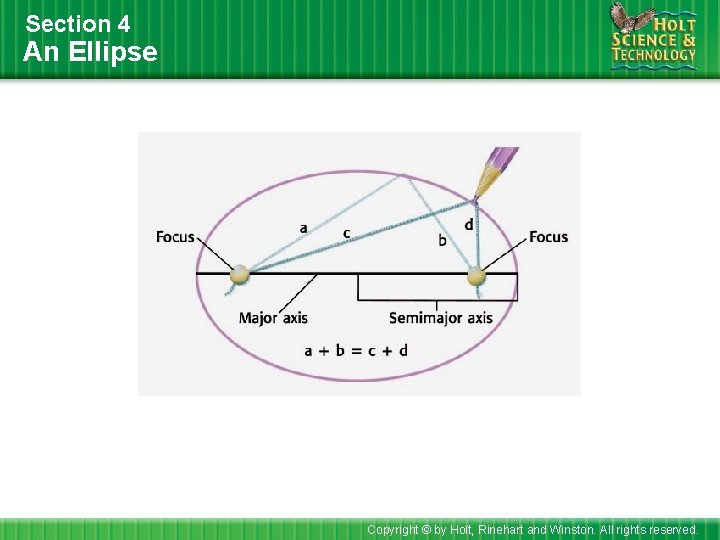
Section 4 An Ellipse Copyright © by Holt, Rinehart and Winston. All rights reserved.
Section 4 Planetary Motion Newton to the Rescue! • The Law of Universal Gravitation Newton’s law of universal gravitation states that the force of gravity depends on the product of the masses of the objects divided by the square of the distance between the objects. • Orbits Falling Down and Around Gravity keeps the moon from flying off in a straight path. The next slide shows gravity’s effect on the motion of the moon. End of Slide Copyright © by Holt, Rinehart and Winston. All rights reserved.
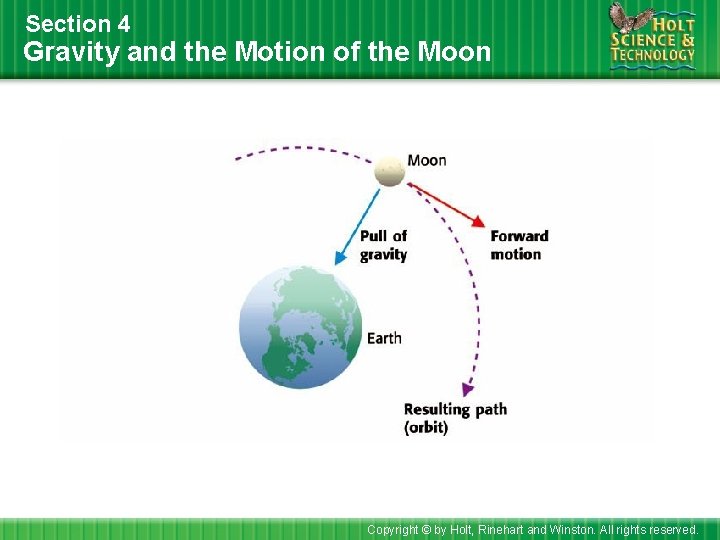
Section 4 Gravity and the Motion of the Moon Copyright © by Holt, Rinehart and Winston. All rights reserved.
- Slides: 8