
Section 4 Geologic Time Relative dating and absolute
Section 4: Geologic Time Relative dating and absolute dating are used to infer Earth’s geologic past. K What I Know W What I Want to Find Out L What I Learned
Essential Questions • • What are geologic epochs, periods, and eras? What are the characteristics of the main geologic eras? Which geologic laws are used to determine relative age? What methods are used to determine absolute age? Copyright © Mc. Graw-Hill Education Geologic Time
Vocabulary Review New • radioactivity • • • Copyright © Mc. Graw-Hill Education absolute dating relative dating uniformitarianism principle of superposition unconformity fossil Geologic Time
Measuring Time Absolute and relative dating • Absolute dating is the process of assigning a precise numerical age to an organism, object, or event. • Relative dating is the process of placing objects or events in their proper sequence in time. Copyright © Mc. Graw-Hill Education Geologic Time
Measuring Time Uniformitarianism • Uniformitarianism states that the laws of nature operate today as they have in the past. • Studying geologic processes that take place today, help scientists infer how such processes took place in the past. Copyright © Mc. Graw-Hill Education Geologic Time
Principles of Relative Age Dating Principle of superposition • Principle of superposition states in an undisturbed sequence of sedimentary rock layers the youngest rocks will be at the top and the oldest will be at the bottom of the sequence. Original Horizontality • Sedimentary layers always start off as horizontal layers. Copyright © Mc. Graw-Hill Education Geologic Time
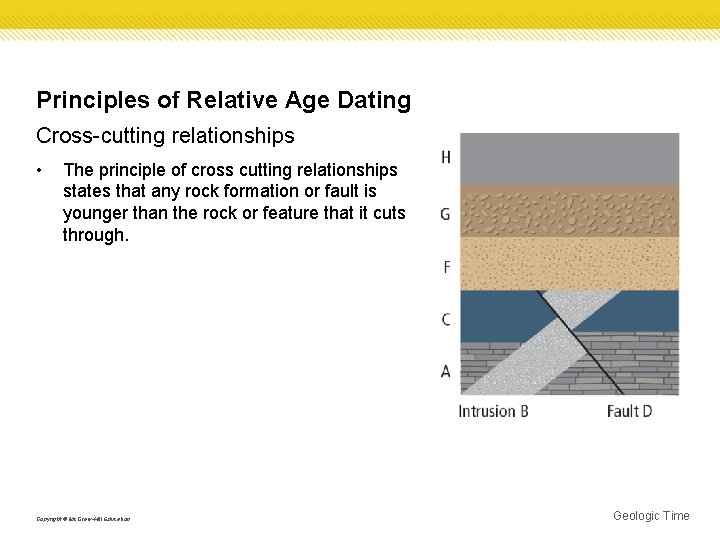
Principles of Relative Age Dating Cross-cutting relationships • The principle of cross cutting relationships states that any rock formation or fault is younger than the rock or feature that it cuts through. Copyright © Mc. Graw-Hill Education Geologic Time

Principles of Relative Age Dating Unconformities • Unconformities represent gaps in the rock record during which erosion occurred or deposition was absent. • A disconformity is an erosional surface between two horizontal rock layers. Copyright © Mc. Graw-Hill Education Geologic Time

Principles of Relative Age Dating Unconformities • An angular unconformity is an erosional surface between rock layer segments that intercept at an angle. • A nonconformity is an erosional surface between sedimentary rock and igneous or metamorphic rock. Copyright © Mc. Graw-Hill Education Geologic Time

Angular Unconformity Animation FPO Add link to animation from page 871 here. Copyright © Mc. Graw-Hill Education Geologic Time
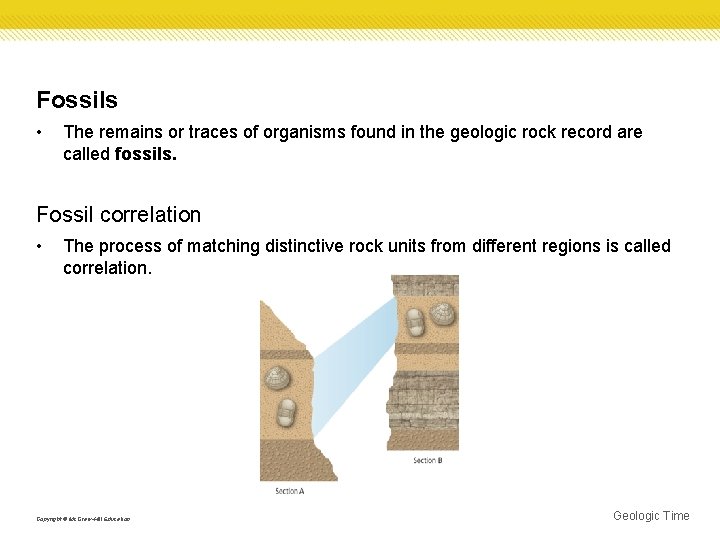
Fossils • The remains or traces of organisms found in the geologic rock record are called fossils. Fossil correlation • The process of matching distinctive rock units from different regions is called correlation. Copyright © Mc. Graw-Hill Education Geologic Time

Fossils Brain. POP FPO Add link to animation from page 871 here. Copyright © Mc. Graw-Hill Education Geologic Time
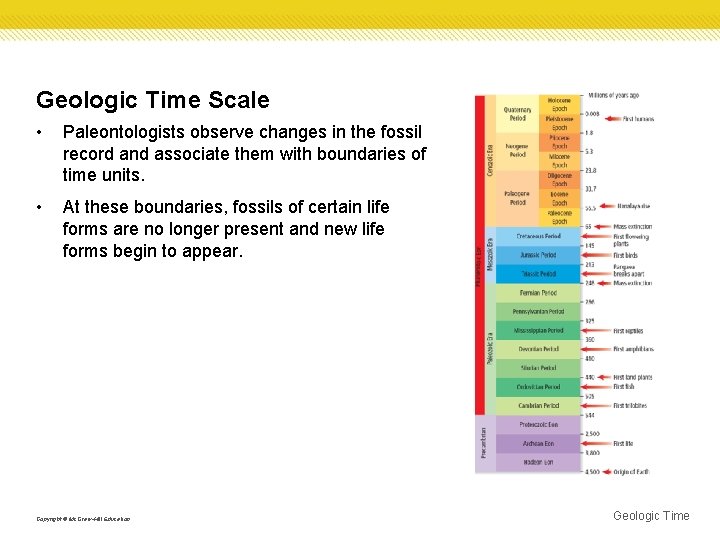
Geologic Time Scale • Paleontologists observe changes in the fossil record and associate them with boundaries of time units. • At these boundaries, fossils of certain life forms are no longer present and new life forms begin to appear. Copyright © Mc. Graw-Hill Education Geologic Time
Geologic Time Scale Animation FPO Add link to animation from page 872 here. Copyright © Mc. Graw-Hill Education Geologic Time
Absolute Age Dating • Some types of atoms are unstable and decay by casting off, or emitting, parts of their nuclei. • The half-life is the time it takes for one-half of a radioactive parent isotope to decay to a stable daughter isotope. Copyright © Mc. Graw-Hill Education Geologic Time
Review Essential Questions • • What are geologic epochs, periods, and eras? What are the characteristics of the main geologic eras? Which geologic laws are used to determine relative age? What methods are used to determine absolute age? Vocabulary • absolute dating • relative dating • uniformitarianism Copyright © Mc. Graw-Hill Education • principle of superposition • unconformity • fossil Geologic Time
- Slides: 16