
Section 4 Effectively Using NASA Configuration Management Policy
- Slides: 21
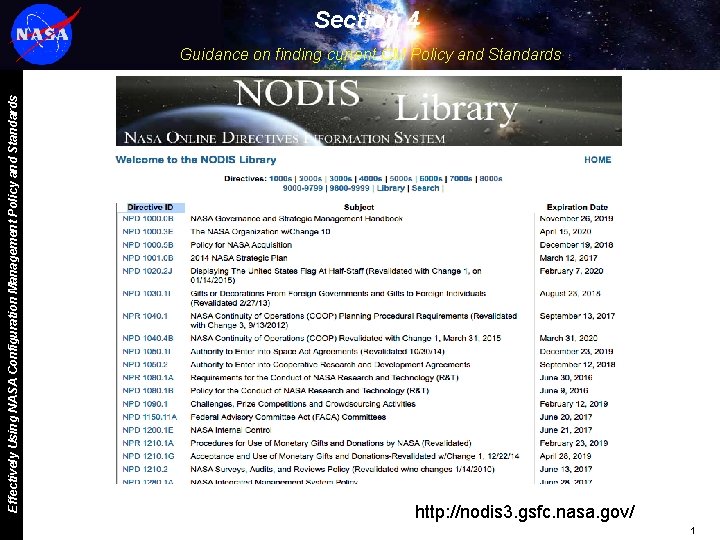
Section 4 Effectively Using NASA Configuration Management Policy and Standards Guidance on finding current CM Policy and Standards http: //nodis 3. gsfc. nasa. gov/ 1
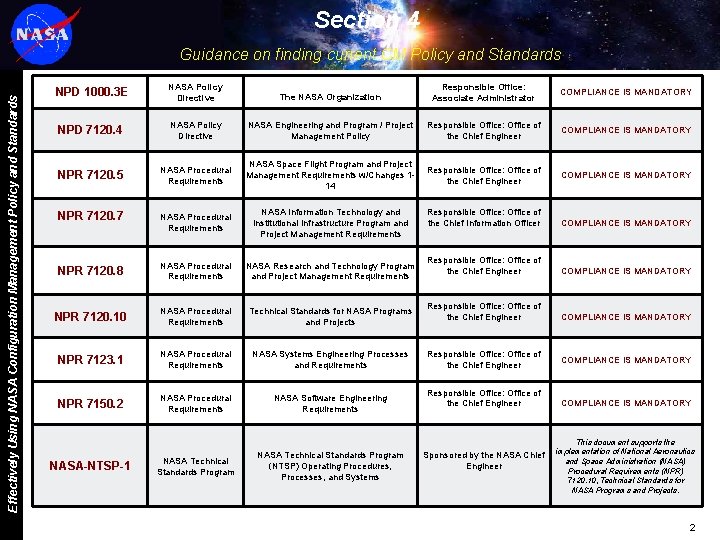
Section 4 Effectively Using NASA Configuration Management Policy and Standards Guidance on finding current CM Policy and Standards NPD 1000. 3 E NASA Policy Directive The NASA Organization Responsible Office: Associate Administrator COMPLIANCE IS MANDATORY NPD 7120. 4 NASA Policy Directive NASA Engineering and Program / Project Management Policy Responsible Office: Office of the Chief Engineer COMPLIANCE IS MANDATORY NPR 7120. 5 NASA Procedural Requirements NASA Space Flight Program and Project Management Requirements w/Changes 114 Responsible Office: Office of the Chief Engineer COMPLIANCE IS MANDATORY NPR 7120. 7 NASA Procedural Requirements NASA Information Technology and Institutional Infrastructure Program and Project Management Requirements NPR 7120. 8 NASA Procedural Requirements NASA Research and Technology Program and Project Management Requirements NPR 7120. 10 NASA Procedural Requirements Technical Standards for NASA Programs and Projects NPR 7123. 1 NASA Procedural Requirements NASA Systems Engineering Processes and Requirements NPR 7150. 2 NASA Procedural Requirements NASA Software Engineering Requirements NASA Technical Standards Program (NTSP) Operating Procedures, Processes, and Systems NASA-NTSP-1 Responsible Office: Office of the Chief Information Officer COMPLIANCE IS MANDATORY Responsible Office: Office of the Chief Engineer Sponsored by the NASA Chief Engineer COMPLIANCE IS MANDATORY This document supports the implementation of National Aeronautics and Space Administration (NASA) Procedural Requirements (NPR) 7120. 10, Technical Standards for NASA Programs and Projects. 2
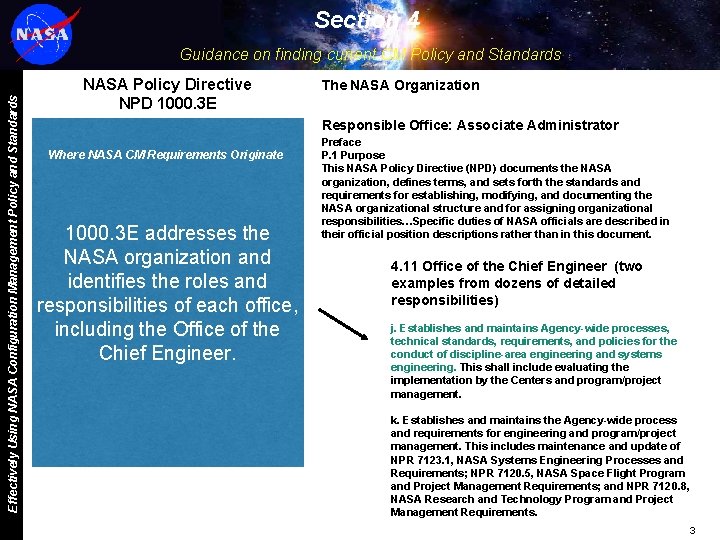
Section 4 Effectively Using NASA Configuration Management Policy and Standards Guidance on finding current CM Policy and Standards NASA Policy Directive NPD 1000. 3 E The NASA Organization Responsible Office: Associate Administrator Where NASA CM Requirements Originate 1000. 3 E addresses the NASA organization and identifies the roles and responsibilities of each office, including the Office of the Chief Engineer. Preface P. 1 Purpose This NASA Policy Directive (NPD) documents the NASA organization, defines terms, and sets forth the standards and requirements for establishing, modifying, and documenting the NASA organizational structure and for assigning organizational responsibilities…Specific duties of NASA officials are described in their official position descriptions rather than in this document. 4. 11 Office of the Chief Engineer (two examples from dozens of detailed responsibilities) j. Establishes and maintains Agency-wide processes, technical standards, requirements, and policies for the conduct of discipline-area engineering and systems engineering. This shall include evaluating the implementation by the Centers and program/project management. k. Establishes and maintains the Agency-wide process and requirements for engineering and program/project management. This includes maintenance and update of NPR 7123. 1, NASA Systems Engineering Processes and Requirements; NPR 7120. 5, NASA Space Flight Program and Project Management Requirements; and NPR 7120. 8, NASA Research and Technology Program and Project Management Requirements. 3
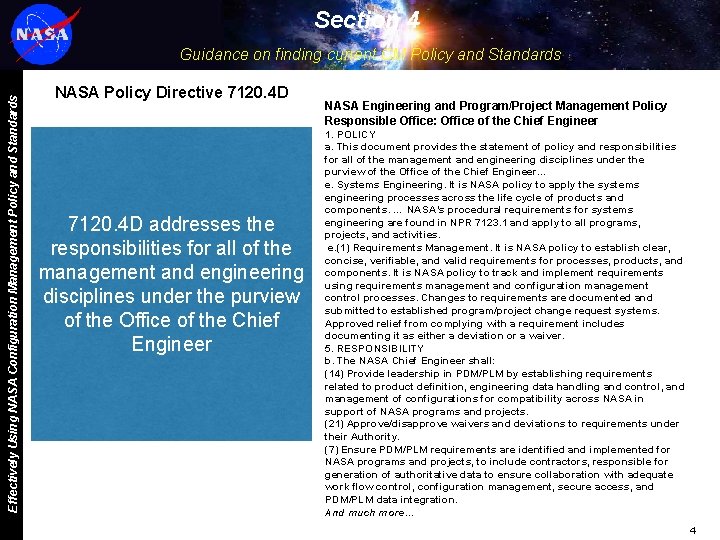
Section 4 Effectively Using NASA Configuration Management Policy and Standards Guidance on finding current CM Policy and Standards NASA Policy Directive 7120. 4 D addresses the responsibilities for all of the management and engineering disciplines under the purview of the Office of the Chief Engineer NASA Engineering and Program/Project Management Policy Responsible Office: Office of the Chief Engineer 1. POLICY a. This document provides the statement of policy and responsibilities for all of the management and engineering disciplines under the purview of the Office of the Chief Engineer… e. Systems Engineering. It is NASA policy to apply the systems engineering processes across the life cycle of products and components. … NASA’s procedural requirements for systems engineering are found in NPR 7123. 1 and apply to all programs, projects, and activities. e. (1) Requirements Management. It is NASA policy to establish clear, concise, verifiable, and valid requirements for processes, products, and components. It is NASA policy to track and implement requirements using requirements management and configuration management control processes. Changes to requirements are documented and submitted to established program/project change request systems. Approved relief from complying with a requirement includes documenting it as either a deviation or a waiver. 5. RESPONSIBILITY b. The NASA Chief Engineer shall: (14) Provide leadership in PDM/PLM by establishing requirements related to product definition, engineering data handling and control, and management of configurations for compatibility across NASA in support of NASA programs and projects. (21) Approve/disapprove waivers and deviations to requirements under their Authority. (7) Ensure PDM/PLM requirements are identified and implemented for NASA programs and projects, to include contractors, responsible for generation of authoritative data to ensure collaboration with adequate work flow control, configuration management, secure access, and PDM/PLM data integration. And much more… 4
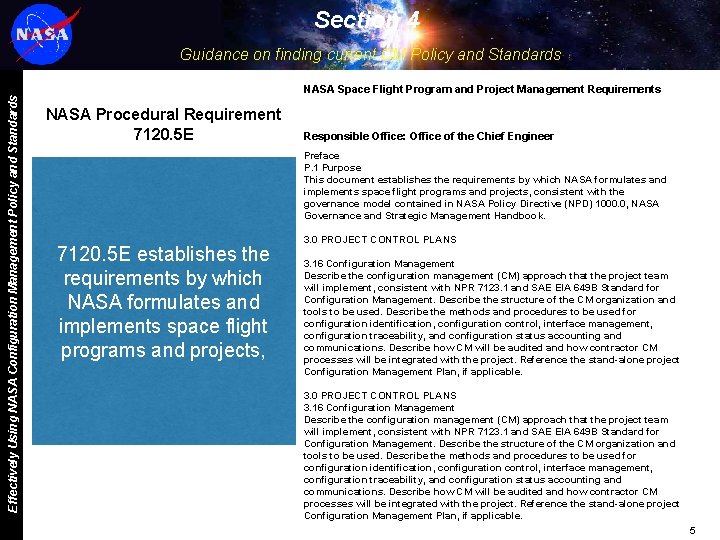
Section 4 Effectively Using NASA Configuration Management Policy and Standards Guidance on finding current CM Policy and Standards NASA Space Flight Program and Project Management Requirements NASA Procedural Requirement 7120. 5 E Responsible Office: Office of the Chief Engineer Preface P. 1 Purpose This document establishes the requirements by which NASA formulates and implements space flight programs and projects, consistent with the governance model contained in NASA Policy Directive (NPD) 1000. 0, NASA Governance and Strategic Management Handbook. 7120. 5 E establishes the requirements by which NASA formulates and implements space flight programs and projects, 3. 0 PROJECT CONTROL PLANS 3. 16 Configuration Management Describe the configuration management (CM) approach that the project team will implement, consistent with NPR 7123. 1 and SAE EIA 649 B Standard for Configuration Management. Describe the structure of the CM organization and tools to be used. Describe the methods and procedures to be used for configuration identification, configuration control, interface management, configuration traceability, and configuration status accounting and communications. Describe how CM will be audited and how contractor CM processes will be integrated with the project. Reference the stand-alone project Configuration Management Plan, if applicable. 5
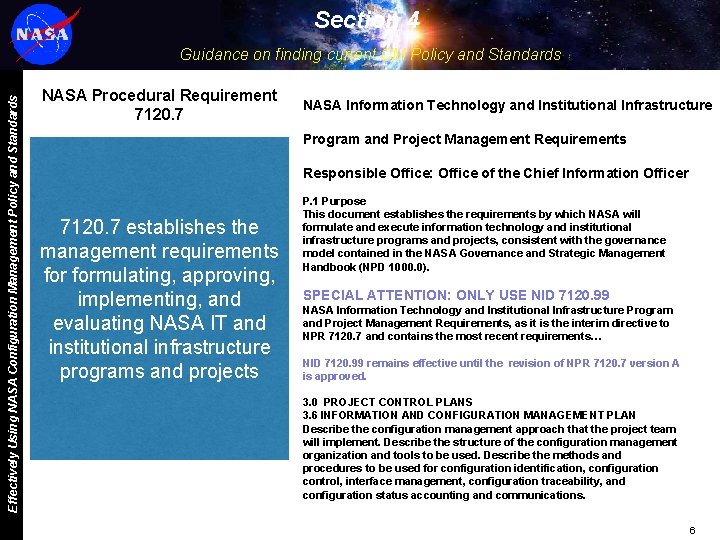
Section 4 Effectively Using NASA Configuration Management Policy and Standards Guidance on finding current CM Policy and Standards NASA Procedural Requirement 7120. 7 NASA Information Technology and Institutional Infrastructure Program and Project Management Requirements Responsible Office: Office of the Chief Information Officer 7120. 7 establishes the management requirements formulating, approving, implementing, and evaluating NASA IT and institutional infrastructure programs and projects P. 1 Purpose This document establishes the requirements by which NASA will formulate and execute information technology and institutional infrastructure programs and projects, consistent with the governance model contained in the NASA Governance and Strategic Management Handbook (NPD 1000. 0). SPECIAL ATTENTION: ONLY USE NID 7120. 99 NASA Information Technology and Institutional Infrastructure Program and Project Management Requirements, as it is the interim directive to NPR 7120. 7 and contains the most recent requirements… NID 7120. 99 remains effective until the revision of NPR 7120. 7 version A is approved. 3. 0 PROJECT CONTROL PLANS 3. 6 INFORMATION AND CONFIGURATION MANAGEMENT PLAN Describe the configuration management approach that the project team will implement. Describe the structure of the configuration management organization and tools to be used. Describe the methods and procedures to be used for configuration identification, configuration control, interface management, configuration traceability, and configuration status accounting and communications. 6
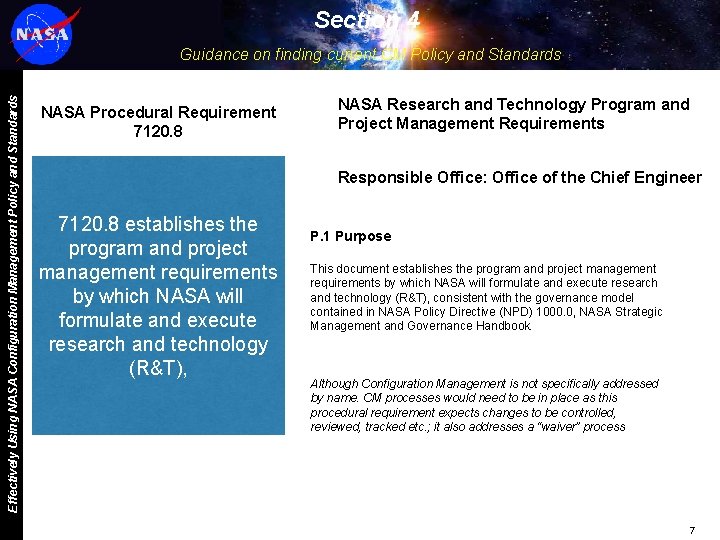
Section 4 Effectively Using NASA Configuration Management Policy and Standards Guidance on finding current CM Policy and Standards NASA Procedural Requirement 7120. 8 NASA Research and Technology Program and Project Management Requirements Responsible Office: Office of the Chief Engineer 7120. 8 establishes the program and project management requirements by which NASA will formulate and execute research and technology (R&T), P. 1 Purpose This document establishes the program and project management requirements by which NASA will formulate and execute research and technology (R&T), consistent with the governance model contained in NASA Policy Directive (NPD) 1000. 0, NASA Strategic Management and Governance Handbook. Although Configuration Management is not specifically addressed by name. CM processes would need to be in place as this procedural requirement expects changes to be controlled, reviewed, tracked etc. ; it also addresses a “waiver” process 7
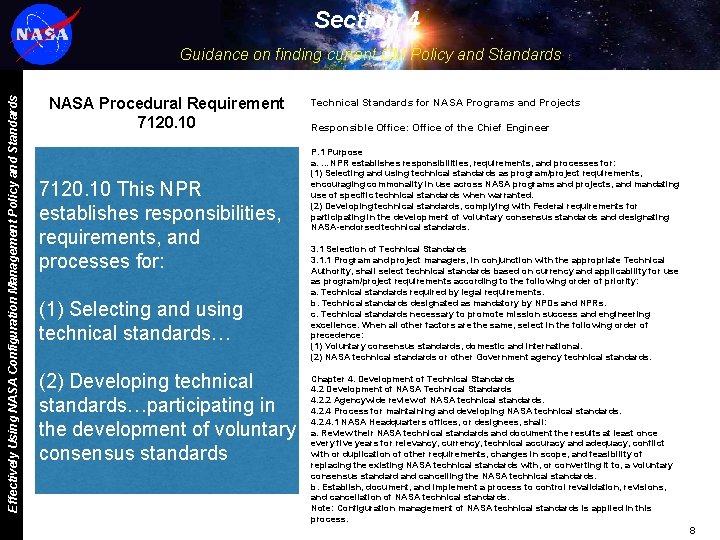
Section 4 Effectively Using NASA Configuration Management Policy and Standards Guidance on finding current CM Policy and Standards NASA Procedural Requirement 7120. 10 This NPR establishes responsibilities, requirements, and processes for: (1) Selecting and using technical standards… (2) Developing technical standards…participating in the development of voluntary consensus standards Technical Standards for NASA Programs and Projects Responsible Office: Office of the Chief Engineer P. 1 Purpose a. …NPR establishes responsibilities, requirements, and processes for: (1) Selecting and using technical standards as program/project requirements, encouraging commonality in use across NASA programs and projects, and mandating use of specific technical standards when warranted. (2) Developing technical standards, complying with Federal requirements for participating in the development of voluntary consensus standards and designating NASA-endorsed technical standards. 3. 1 Selection of Technical Standards 3. 1. 1 Program and project managers, in conjunction with the appropriate Technical Authority, shall select technical standards based on currency and applicability for use as program/project requirements according to the following order of priority: a. Technical standards required by legal requirements. b. Technical standards designated as mandatory by NPDs and NPRs. c. Technical standards necessary to promote mission success and engineering excellence. When all other factors are the same, select in the following order of precedence: (1) Voluntary consensus standards, domestic and international. (2) NASA technical standards or other Government agency technical standards. Chapter 4. Development of Technical Standards 4. 2 Development of NASA Technical Standards 4. 2. 2 Agencywide review of NASA technical standards. 4. 2. 4 Process for maintaining and developing NASA technical standards. 4. 2. 4. 1 NASA Headquarters offices, or designees, shall: a. Review their NASA technical standards and document the results at least once every five years for relevancy, currency, technical accuracy and adequacy, conflict with or duplication of other requirements, changes in scope, and feasibility of replacing the existing NASA technical standards with, or converting it to, a voluntary consensus standard and cancelling the NASA technical standards. b. Establish, document, and implement a process to control revalidation, revisions, and cancellation of NASA technical standards. Note: Configuration management of NASA technical standards is applied in this process. 8
Section 4 Effectively Using NASA Configuration Management Policy and Standards Guidance on finding current CM Policy and Standards NASA Procedural Requirement 7150. 2 B , Establishes the engineering requirements for software acquisition, development, maintenance, retirement, operations, and management consistent with the governance model contained in NASA Policy Directive (NPD) 1000. 0, NASA Governance and Strategic Management Handbook. P. 1 Purpose Software engineering is a core capability and a key enabling technology for NASA's missions and supporting infrastructure. This directive establishes the engineering requirements for software acquisition, development, maintenance, retirement, operations, and management consistent with the governance model contained in NASA Policy Directive (NPD) 1000. 0, NASA Governance and Strategic Management Handbook. This NASA Procedural Requirements (NPR) supports the implementation of the NASA Policy Directive (NPD) 7120. 4. Chapter 3: Software Management Requirements 3. 8 Automatic Generation of Software Source Code b. Configuration management of the auto-generation tools and associated data. g. Configuration management of the input to the auto-generation tool, the output of the auto-generation tool, and modifications made to the output of the autogeneration tools. 3. 11 Software Development Processes 3. 11. 3 The project manager shall acquire, develop, and maintain software from an organization with a non-expired CMMI-DEV rating as measured by a CMMI Institute authorized or certified lead appraiser as follows: [SWE-032] b. For Class B software (except Class B software on NASA Class D payloads, as defined in NPR 8705. 4): CMMI-DEV Maturity Level 2 Rating or higher for software, or CMMI-DEV Capability Level 2 Rating or higher for software in the following process areas: (1) (2) (3) (4) (5) (6) (7) Requirements Management. Configuration Management. Process and Product Quality Assurance Measurement and Analysis. Project Planning. Project Monitoring and Control. Supplier Agreement Management (if applicable). 3. 13 Software Monitoring 3. 13. 2 The project manager shall participate in any joint NASA/supplier audits of the software development process and software configuration management process. [SWE-045] Chapter 6: Recommended Software Records Content 6. 1 d. Software Configuration Management Plan. (More on next page) 9
Section 4 Effectively Using NASA Configuration Management Policy and Standards Guidance on finding current CM Policy and Standards NASA Procedural Requirement 7150. 2 B Chapter 5: Supporting Software Life-Cycle Requirements Unlike development processes, support processes are not targeted primarily at a specific phase of the project life cycle, but typically occur with similar intensity throughout the complete project or product life cycle. For example, typical configuration management baselines (e. g. , requirements, code, and products) happen across the life cycle. Support processes are software management and engineering processes that typically support the entire software life cycle (e. g. , configuration management). 5. 1 Software Configuration Management (SCM) 7150. 2 B , Addresses software engineering requirements and addresses configuration management as a process area. 5. 1. 1 SCM is the process of applying configuration management throughout the software life cycle to ensure the completeness and correctness of software configuration items. SCM applies technical and administrative direction and surveillance to: identify and record the functional and physical characteristics of software configuration items, control changes to those characteristics, record and report change processing and implementation status, and verify compliance with specified requirements. SCM establishes and maintains the integrity of the products of a software project throughout the software life cycle. Use of standard Center or organizational SCM processes and procedures is encouraged where applicable. 5. 1. 2 The project manager shall develop a software configuration management plan that describes the functions, responsibilities, and authority for the implementation of software configuration management for the project. [SWE-079] 5. 1. 3 The project manager shall track and evaluate changes to software products. [SWE-080] 5. 1. 4 The project manager shall identify the software configuration items (e. g. , software records, code, data, tools, models, scripts) and their versions to be controlled for the project. [SWE-081] 5. 1. 5 The project manager shall establish and implement procedures to: [SWE-082] a. Designate the levels of control through which each identified software configuration item is required to pass. b. Identify the persons or groups with authority to authorize changes. c. Identify the persons or groups to make changes at each level. Note: IEEE Standard for Configuration Management in Systems and Software Engineering, IEEE 828 -2012, describes configuration management processes to be established, how they are to be accomplished, who is responsible for doing specific activities, when they are to happen, and what specific resources are required. It addresses configuration management activities over a product's life cycle. Configuration management in systems and software Engineering is a specialty discipline within the larger discipline of configuration management. Configuration management is essential to systems engineering and to software engineering. 5. 1. 6 The project manager shall prepare and maintain records of the configuration status of software configuration items. [SWE-083] 5. 1. 7 The project manager shall perform software configuration audits to determine the correct version of the software configuration items and verify that they conform to the records that define them. [SWE-084] 5. 1. 8 The project manager shall establish and implement procedures for the storage, handling, delivery, release, and maintenance of deliverable software products. [SWE-085] 10
Section 4 Guidance on finding current CM Policy and Standards Effectively Using NASA Configuration Management Policy and Standards NASA Systems Engineering Processes and Requirements NASA Procedural Requirement 7123. 1 B, Clearly articulates and establishes the requirements on the implementing organization for performing systems engineering. Systems Engineering (SE) is a logical systems approach performed by multidisciplinary teams to engineer and integrate NASA's systems to ensure NASA products meet customers' needs. Responsible Office: Office of the Chief Engineer Preface P. 1 Purpose The purpose of this document is to clearly articulate and establish the requirements on the implementing organization for performing systems engineering. Systems Engineering (SE) is a logical systems approach performed by multidisciplinary teams to engineer and integrate NASA's systems to ensure NASA products meet customers' needs. Implementation of this systems approach will enhance NASA's core engineering capabilities while improving safety, mission success, and affordability. This systems approach is applied to all elements of a system (i. e. , hardware, software, human system integration) and all hierarchical levels of a system over the complete project life cycle. P. 2 Applicability a. This NASA Procedural Requirement (NPR) applies to NASA Headquarters and NASA Centers, including component facilities and technical and service support centers. This NPR applies to NASA employees and NASA support contractors that use NASA processes to augment and support NASA technical work. This NPR applies to Jet Propulsion Laboratory, a Federally Funded Research and Development Center, other contractors, grant recipients, or parties to agreements only to the extent specified or referenced in the appropriate contracts, grants, or agreements. (See Chapter 4. ) b. This NPR applies to space flight, research and technology, and institutional programs and projects (including Information Technology (IT)), as appropriately tailored and customized for size and complexity. See Paragraph 2. 2 for tailoring and customization descriptions. c. In this document, a project is a specific investment having defined goals, objectives, requirements, life-cycle cost, a beginning, and an end. A project yields new or revised products or services that directly address NASA's strategic needs. Projects may be performed wholly in-house; by Government, industry, or academia partnerships; or through contracts with private industry. d. The requirements enumerated in this document are applicable to all new programs and projects, as well as to all programs and projects currently in Formulation Phase as of the effective date of this document. (See NPR 7120. 5, NPR 7120. 7, and NPR 7120. 8, as appropriate, for definitions of program phases. ) This NPR also applies to programs and projects in their Implementation Phase as of the effective date of this document. For existing programs/projects regardless of their current phase, the Designated Governing Authority (DGA) may grant waivers/deviations allowing continuation of current practices that do not comply with all or sections of this NPR. e. Many other discipline areas such as health and safety, medical, reliability, maintainability, quality assurance, IT, security, logistics, and environmental perform functions during project life-cycle phases that influence or are influenced by the engineering functions performed and need to be fully integrated with the engineering functions. The description of these disciplines and their relationship to the overall management life cycle are defined in other NASA directives; for example, the safety, reliability, maintainability, and quality assurance requirements are defined in the 8700 series of directives, and health and medical requirements are defined in the 8900 series. To that end, this document contains human systems integration language and requirements. (See NASA Standard 3001, NASA Space Flight Human System Standard, and NPR 8705. 2, Human-Rating Requirements for Space Systems. ) f. In this NPR, all mandatory actions (i. e. , requirements) are denoted by statements containing the term "shall. " The requirements are explicitly shown as [SE-XX] for clarity and tracking purposes. The terms "may" or "can" denote discretionary privilege or permission, "should" denotes a good practice and is recommended but not required, "will" denotes expected outcome, and "are/is“ denotes descriptive material. g. In this NPR, all document citations are assumed to be the latest version, unless otherwise noted. 11
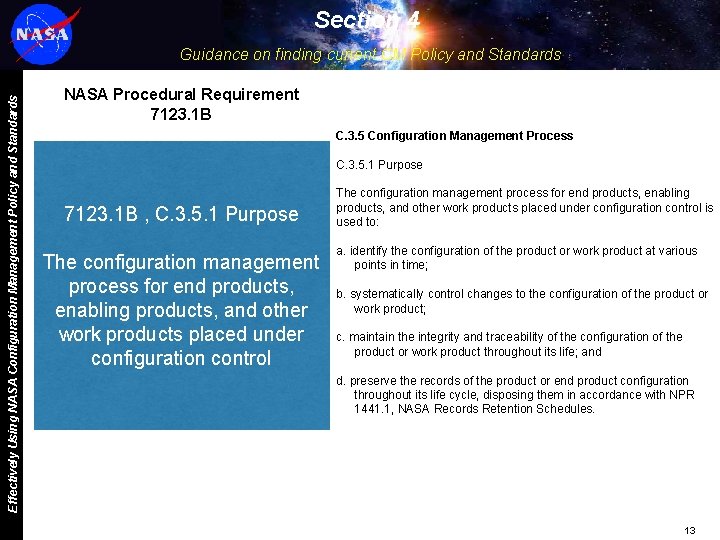
Section 4 Effectively Using NASA Configuration Management Policy and Standards Guidance on finding current CM Policy and Standards NASA Procedural Requirement 7123. 1 B, 3. 2. 15. 1 Center Directors or designees shall establish and maintain a Configuration Management process to include activities, requirements, guidelines, and documentation for configuration management [SE-20]. 3. 2. 15 Configuration Management Process 3. 2. 15. 1 Center Directors or designees shall establish and maintain a Configuration Management process to include activities, requirements, guidelines, and documentation for configuration management [SE-20]. 3. 2. 15. 2 The configuration management process for end products, enabling products, and other work products placed under configuration control is used to: (a) identify the configuration of the product or work product at various points in time; (b) systematically control changes to the configuration of the product or work product; (c) maintain the integrity and traceability of the configuration of the product or work product throughout its life; and (d) preserve the records of the product or end product configuration throughout its life cycle, dispositioning them in accordance with NPR 1441. 1, NASA Records Retention Schedules. 3. 2. 15. 3 Typical practices of this process are defined in Appendix C. 3. 5. 12
Section 4 Effectively Using NASA Configuration Management Policy and Standards Guidance on finding current CM Policy and Standards NASA Procedural Requirement 7123. 1 B C. 3. 5 Configuration Management Process C. 3. 5. 1 Purpose 7123. 1 B , C. 3. 5. 1 Purpose The configuration management process for end products, enabling products, and other work products placed under configuration control is used to: a. identify the configuration of the product or work product at various points in time; b. systematically control changes to the configuration of the product or work product; c. maintain the integrity and traceability of the configuration of the product or work product throughout its life; and d. preserve the records of the product or end product configuration throughout its life cycle, disposing them in accordance with NPR 1441. 1, NASA Records Retention Schedules. 13
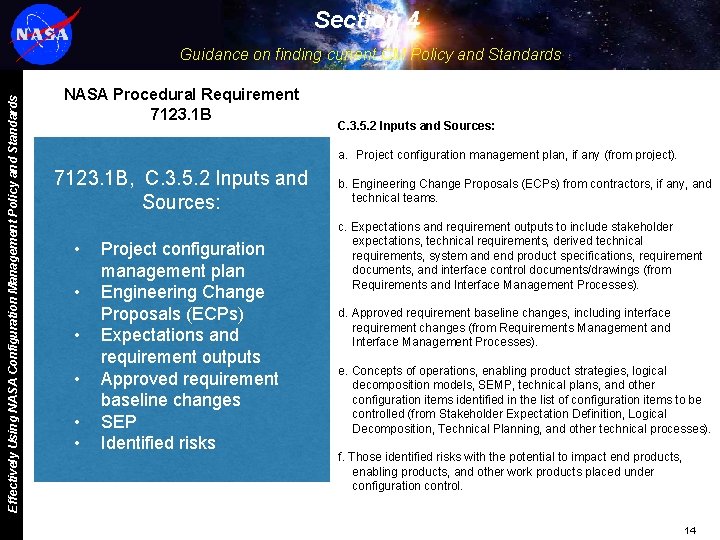
Section 4 Effectively Using NASA Configuration Management Policy and Standards Guidance on finding current CM Policy and Standards NASA Procedural Requirement 7123. 1 B C. 3. 5. 2 Inputs and Sources: a. Project configuration management plan, if any (from project). 7123. 1 B, C. 3. 5. 2 Inputs and Sources: • • • Project configuration management plan Engineering Change Proposals (ECPs) Expectations and requirement outputs Approved requirement baseline changes SEP Identified risks b. Engineering Change Proposals (ECPs) from contractors, if any, and technical teams. c. Expectations and requirement outputs to include stakeholder expectations, technical requirements, derived technical requirements, system and end product specifications, requirement documents, and interface control documents/drawings (from Requirements and Interface Management Processes). d. Approved requirement baseline changes, including interface requirement changes (from Requirements Management and Interface Management Processes). e. Concepts of operations, enabling product strategies, logical decomposition models, SEMP, technical plans, and other configuration items identified in the list of configuration items to be controlled (from Stakeholder Expectation Definition, Logical Decomposition, Technical Planning, and other technical processes). f. Those identified risks with the potential to impact end products, enabling products, and other work products placed under configuration control. 14
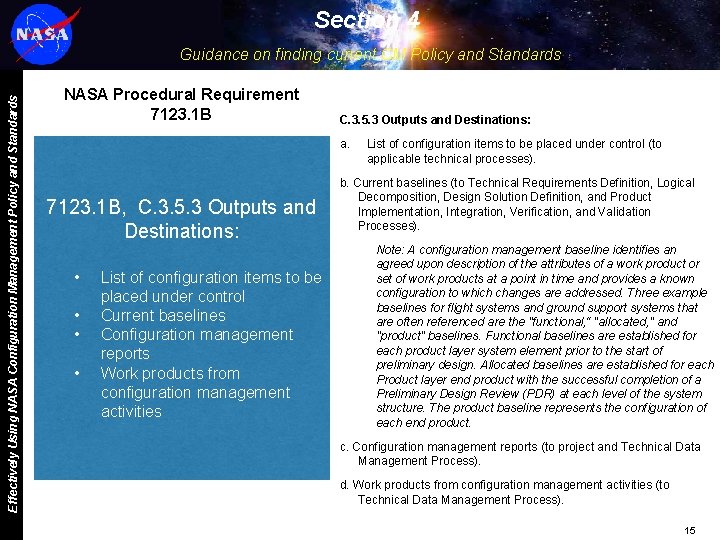
Section 4 Effectively Using NASA Configuration Management Policy and Standards Guidance on finding current CM Policy and Standards NASA Procedural Requirement 7123. 1 B C. 3. 5. 3 Outputs and Destinations: a. 7123. 1 B, C. 3. 5. 3 Outputs and Destinations: • • List of configuration items to be placed under control Current baselines Configuration management reports Work products from configuration management activities List of configuration items to be placed under control (to applicable technical processes). b. Current baselines (to Technical Requirements Definition, Logical Decomposition, Design Solution Definition, and Product Implementation, Integration, Verification, and Validation Processes). Note: A configuration management baseline identifies an agreed upon description of the attributes of a work product or set of work products at a point in time and provides a known configuration to which changes are addressed. Three example baselines for flight systems and ground support systems that are often referenced are the "functional, “ "allocated, " and "product" baselines. Functional baselines are established for each product layer system element prior to the start of preliminary design. Allocated baselines are established for each Product layer end product with the successful completion of a Preliminary Design Review (PDR) at each level of the system structure. The product baseline represents the configuration of each end product. c. Configuration management reports (to project and Technical Data Management Process). d. Work products from configuration management activities (to Technical Data Management Process). 15
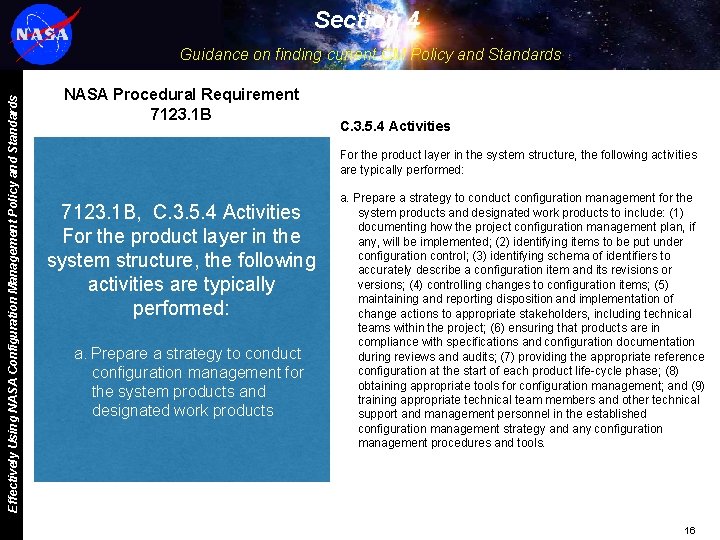
Section 4 Effectively Using NASA Configuration Management Policy and Standards Guidance on finding current CM Policy and Standards NASA Procedural Requirement 7123. 1 B C. 3. 5. 4 Activities For the product layer in the system structure, the following activities are typically performed: 7123. 1 B, C. 3. 5. 4 Activities For the product layer in the system structure, the following activities are typically performed: a. Prepare a strategy to conduct configuration management for the system products and designated work products to include: (1) documenting how the project configuration management plan, if any, will be implemented; (2) identifying items to be put under configuration control; (3) identifying schema of identifiers to accurately describe a configuration item and its revisions or versions; (4) controlling changes to configuration items; (5) maintaining and reporting disposition and implementation of change actions to appropriate stakeholders, including technical teams within the project; (6) ensuring that products are in compliance with specifications and configuration documentation during reviews and audits; (7) providing the appropriate reference configuration at the start of each product life-cycle phase; (8) obtaining appropriate tools for configuration management; and (9) training appropriate technical team members and other technical support and management personnel in the established configuration management strategy and any configuration management procedures and tools. 16
Section 4 Effectively Using NASA Configuration Management Policy and Standards Guidance on finding current CM Policy and Standards NASA Procedural Requirement 7123. 1 B Continued 7123. 1 B, C. 3. 5. 4 Activities For the product layer in the system structure, the following activities are typically performed: b. Identify baselines to be under configuration control c. Manage configuration change control C. 3. 5. 4 Activities b. Identify baselines to be under configuration control to include: (1) listing the configuration items to control; (2) providing each configuration item with a unique identifier; (3) identifying acceptance requirements for each baseline identified for control; (4) identifying the owner of each configuration item; and (5) establishing a baseline configuration for each configuration item. Note: Typical acceptance requirements for a baseline include: product life-cycle management phase and entry or exit criteria to be satisfied; when the baseline will be approved; when work products will be ready for evaluation; degree of control desired; cost and schedule limitations; and customer requirements. c. Manage configuration change control to include: (1) establishing change criteria, procedures, and responsibilities; (2) receive, record, and evaluate change requests; (3) tracking change requests to closure; (4) obtaining appropriate approvals before implementing a change; (5) incorporating approved changes in appropriate configuration items; (6) releasing changed configuration items for use; and (7) monitoring implementation to determine whether changes resulted in unintended effects (e. g. , have compromised safety or security of baseline product). Note: A configuration management change board is typically established to receive, review, and approve change requests such as an engineering change proposal submitted by a contractor. 17
Section 4 Effectively Using NASA Configuration Management Policy and Standards Guidance on finding current CM Policy and Standards NASA Procedural Requirement 7123. 1 B, C. 3. 5. 4 Activities For the product layer in the system structure, the following activities are typically performed: d. Maintain the status of configuration documentation e. Conduct configuration audits Capture work products from configuration management activities C. 3. 5. 4 Activities d. Maintain the status of configuration documentation to include: (1) maintaining configuration item description records and records that verify readiness of configuration items for testing, delivery, or other related technical efforts; (2) maintaining change requests, disposition action taken, and history of change status; (3) maintaining differences between successive baselines; and (4) controlling access to and release of configuration baselines. e. Conduct configuration audits to include: (1) auditing baselines under control to confirm that the actual work product configuration matches the documented configuration, the configuration is in conformance with product requirements, and records of all change actions are complete and up to date; (2) identifying risks to the technical effort based on incorrect documentation, implementation, or tracking of changes; (3) assessing the integrity of the baselines; (4) confirming the completeness and correctness of the content of configuration items with applicable requirements; (5) confirming compliance of configuration items with applicable configuration management standards and procedures; and (6) tracking action items to correct anomalies from audit to closure. f. Capture work products from configuration management activities to include a list of identified configuration items; description of configuration items placed under control; change requests, disposition of the requests, and rationale for the dispositions; documented changes with reason for changes and change actions; archive of old baselines; and required reports on configuration management outcomes. 18
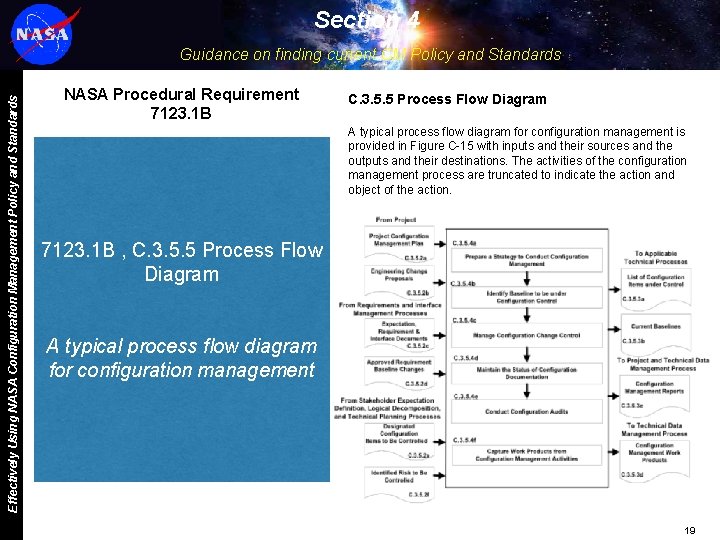
Section 4 Effectively Using NASA Configuration Management Policy and Standards Guidance on finding current CM Policy and Standards NASA Procedural Requirement 7123. 1 B C. 3. 5. 5 Process Flow Diagram A typical process flow diagram for configuration management is provided in Figure C-15 with inputs and their sources and the outputs and their destinations. The activities of the configuration management process are truncated to indicate the action and object of the action. 7123. 1 B , C. 3. 5. 5 Process Flow Diagram A typical process flow diagram for configuration management 19
Section 4 Guidance on finding current CM Policy and Standards Effectively Using NASA Configuration Management Policy and Standards Chapter 2. Institutional and Programmatic Requirements NASA Procedural Requirement 7120. 5 E, Technical Authority 7120. 5 E , 2. 1. 1. 2 The roles and responsibilities associated with program and project management and Technical Authority (TA) are defined 2. 1 Roles and Responsibilities 2. 1. 1 General The roles and responsibilities of senior management are defined in part in NPD 1000. 0, NASA Governance and Strategic Management Handbook, and NPD 7120. 4, NASA Engineering and Program/Project Management Policy. NPR 7120. 5, NASA Space Flight Program and Project Management Requirements; NPR 7120. 7, NASA Information Technology and Institutional Infrastructure Program and Project Management Requirements; NPR 7120. 8, NASA Research and Technology Program and Project Management Requirements; and other NASA directives define the responsibilities of program and project managers. This NPR establishes systems engineering processes and responsibilities. 2. 1. 1. 1 For programs and projects involving more than one Center, the lead organization will develop documentation for DGA approval to describe the hierarchy and reconciliation of Center plans implementing this NPR. The governing Mission Directorate or mission support office determines whether a Center executes a project in a lead role or in a supporting role. For Centers in supporting roles, compliance should be jointly negotiated and documented in the lead Center's project SEMP. 2. 1. 1. 2 The roles and responsibilities associated with program and project management and Technical Authority (TA) are defined in the Program and Project Management NPRs (for example, NPR 7120. 5 for space flight projects). Specific roles and responsibilities of the program/project manager and the engineering technical authority related to the SEMP are defined in Paragraphs 2. 1. 6 and 6. 2. 20
Section 4 Effectively Using NASA Configuration Management Policy and Standards Guidance on finding current CM Policy and Standards Key Points • NASA has a hierarchy of Directives and procedural requirements outlining various authorities and requirements. • The Office of the Chief Engineer… Establishes and maintains Agency-wide processes, technical standards, requirements, and policies for the conduct of discipline-area engineering and systems engineering. • This includes evaluating the implementation by the Centers and program/project management… and, establishing and maintaining the Agency-wide process and requirements for engineering and program/project management including configuration management processes. • The Chief Information Officer also has configuration management responsibilities. • Configuration Management is clearly spelled out in many of these documents and can be inferred in others. • Questions? 21