
SECTION 4 8 Triangles and Coordinate Proof Coordinate


- Slides: 13
SECTION 4. 8 Triangles and Coordinate Proof
Coordinate proofs use figures in the coordinate plane and algebra to prove geometric concepts. The first step in a coordinate proof is placing the figure on the coordinate plane.
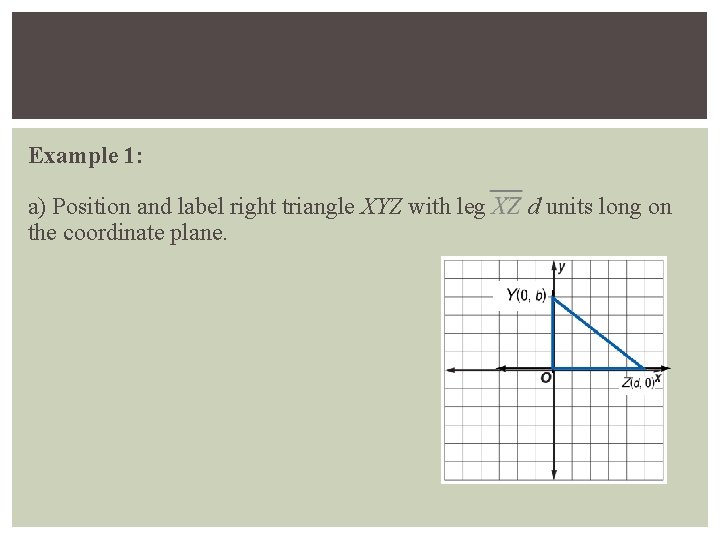
Example 1: a) Position and label right triangle XYZ with leg the coordinate plane. d units long on
b) Which would be the best way to position and label equilateral triangle ABC with side w units long on the coordinate plane? a) b) c) d)
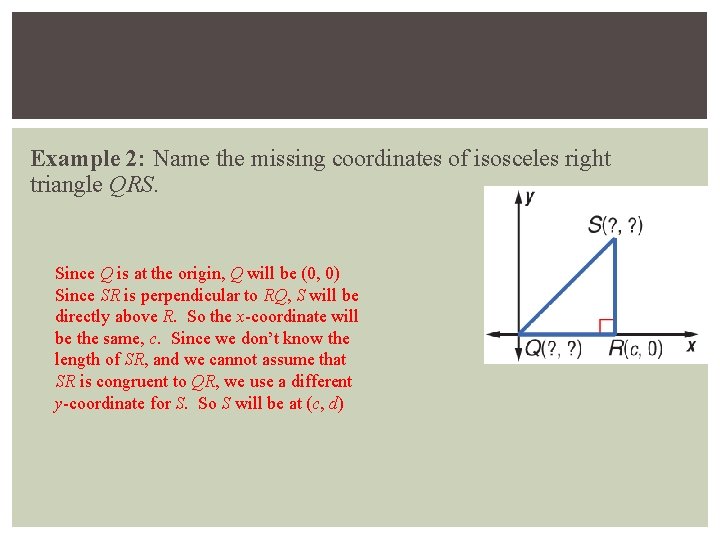
Example 2: Name the missing coordinates of isosceles right triangle QRS. Since Q is at the origin, Q will be (0, 0) Since SR is perpendicular to RQ, S will be directly above R. So the x-coordinate will be the same, c. Since we don’t know the length of SR, and we cannot assume that SR is congruent to QR, we use a different y-coordinate for S. So S will be at (c, d)
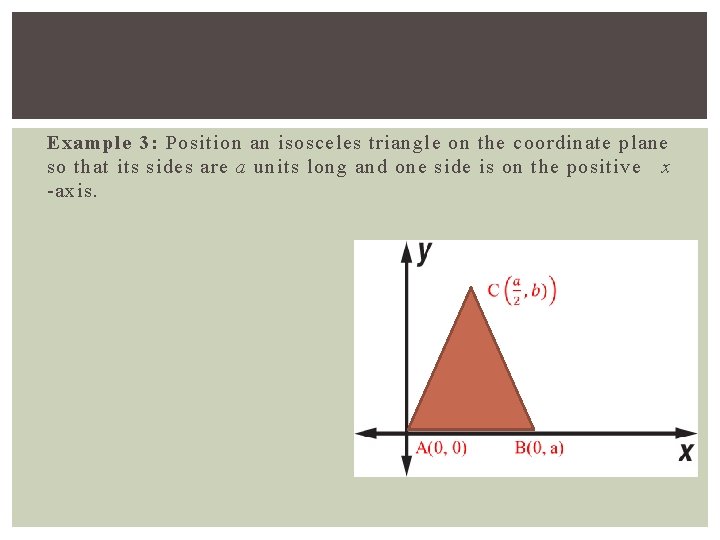
Example 3: Position an isosceles triangle on the coordinate plane so that its sides are a units long and one side is on the positive x -axis.
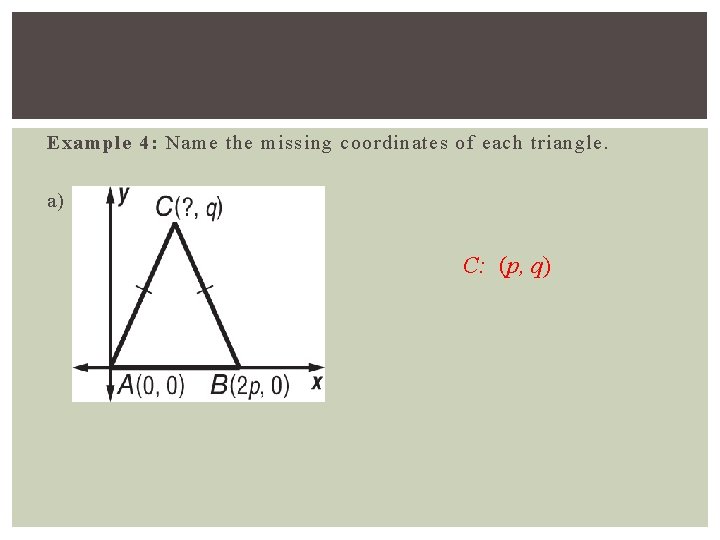
Example 4: Name the missing coordinates of each triangle. a) C: (p, q)
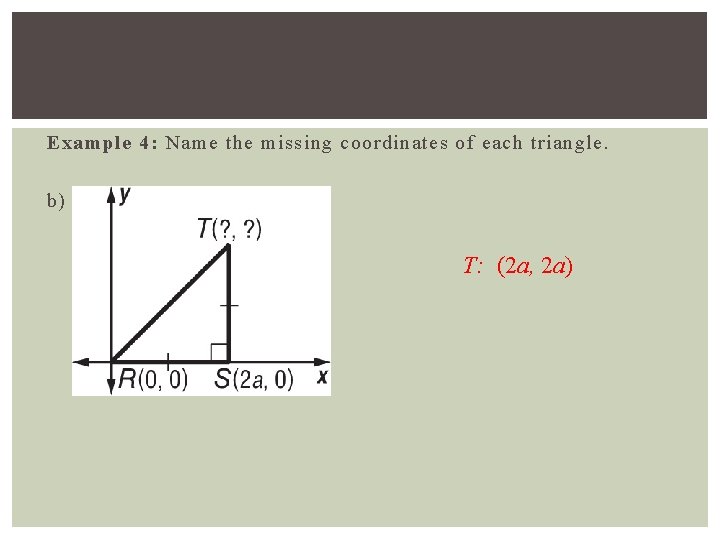
Example 4: Name the missing coordinates of each triangle. b) T: (2 a, 2 a)
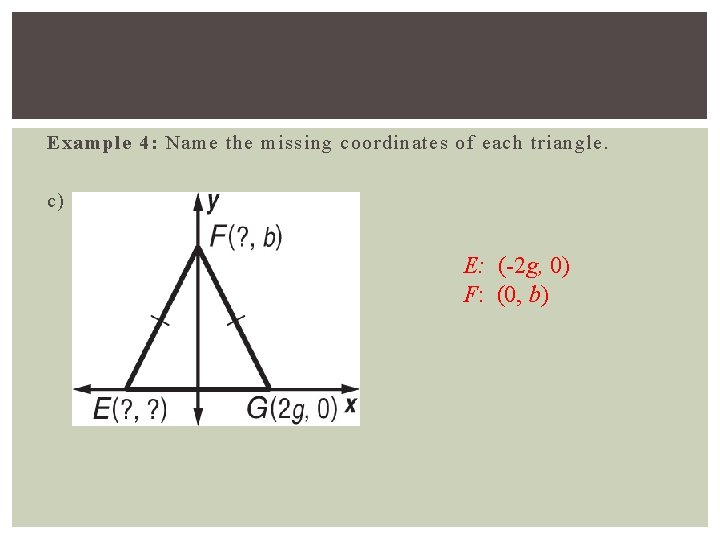
Example 4: Name the missing coordinates of each triangle. c) E: (-2 g, 0) F: (0, b)
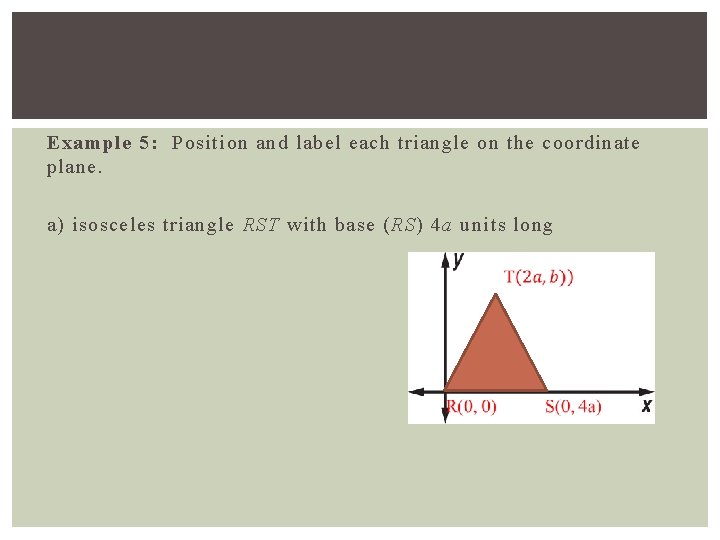
Example 5: Position and label each triangle on the coordinate plane. a) isosceles triangle RST with base (RS) 4 a units long
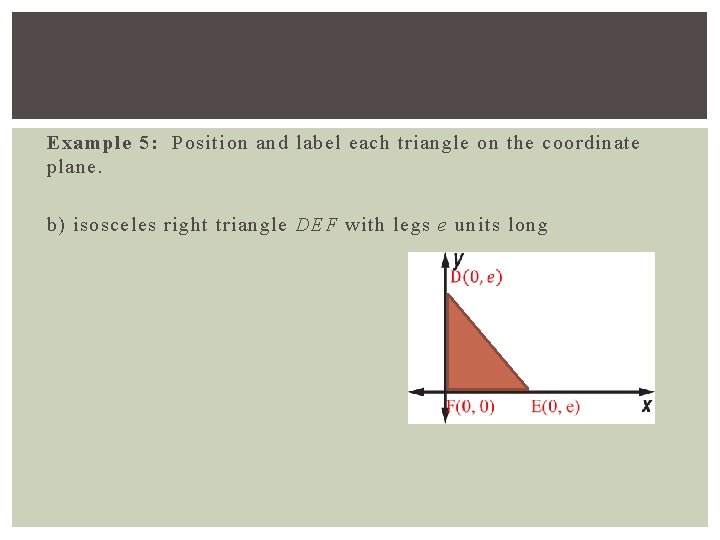
Example 5: Position and label each triangle on the coordinate plane. b) isosceles right triangle DEF with legs e units long
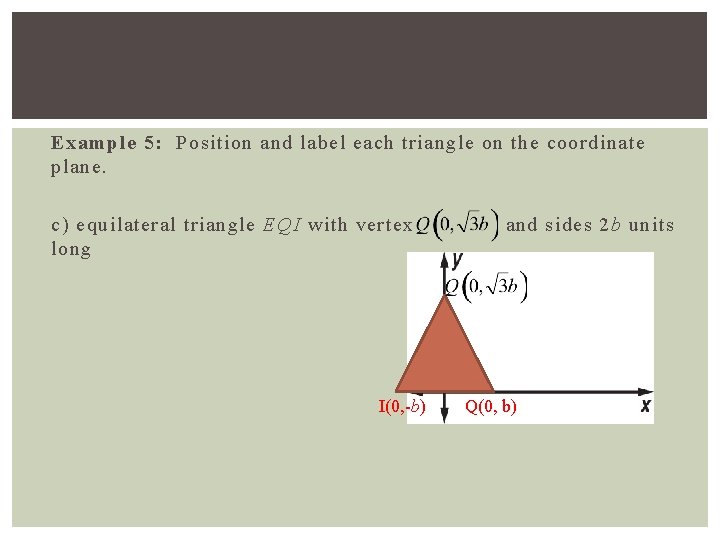
Example 5: Position and label each triangle on the coordinate plane. c) equilateral triangle EQI with vertex long I(0, -b) and sides 2 b units Q(0, b)