
Section 4 6 Periodic Trends of the Elements







- Slides: 32
Section 4. 6 Periodic Trends of the Elements
Section 4. 6 Periodic Trends of the Elements Supplemental packet page 58
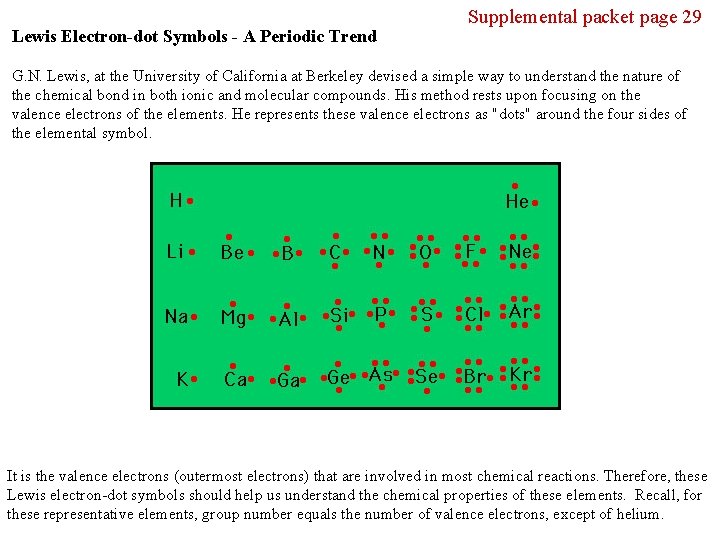
Lewis Electron-dot Symbols - A Periodic Trend Supplemental packet page 29 G. N. Lewis, at the University of California at Berkeley devised a simple way to understand the nature of the chemical bond in both ionic and molecular compounds. His method rests upon focusing on the valence electrons of the elements. He represents these valence electrons as "dots" around the four sides of the elemental symbol. It is the valence electrons (outermost electrons) that are involved in most chemical reactions. Therefore, these Lewis electron-dot symbols should help us understand the chemical properties of these elements. Recall, for these representative elements, group number equals the number of valence electrons, except of helium.
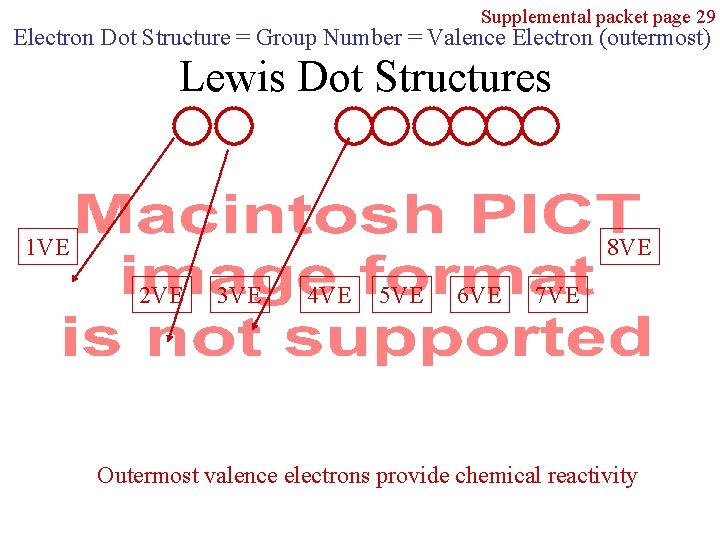
Supplemental packet page 29 Electron Dot Structure = Group Number = Valence Electron (outermost) Lewis Dot Structures 1 VE 8 VE 2 VE 3 VE 4 VE 5 VE 6 VE 7 VE Outermost valence electrons provide chemical reactivity
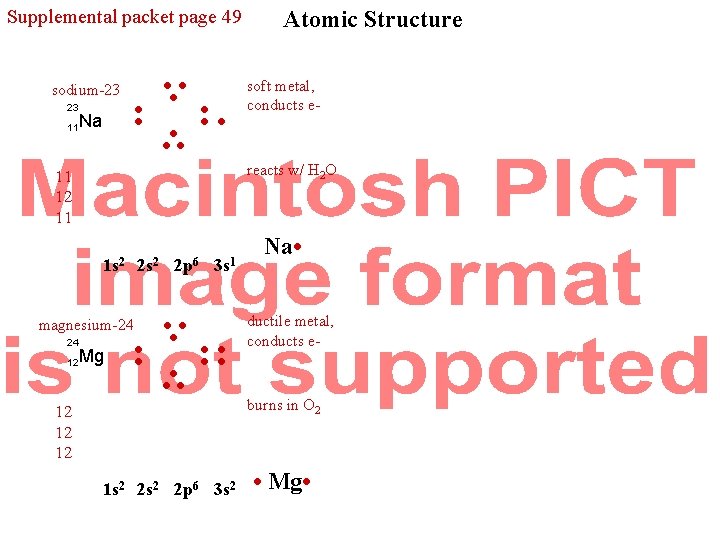
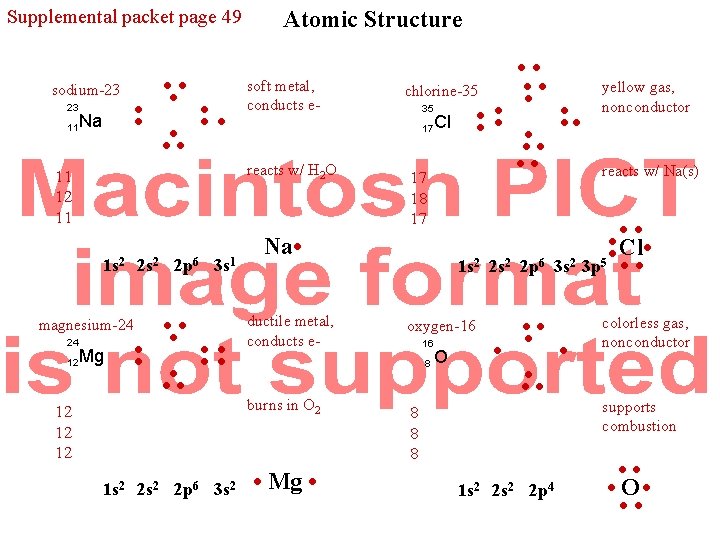
Supplemental packet page 49 sodium-23 23 11 Na • • • • 1 s 2 magnesium-24 12 soft metal, conducts e- reacts w/ H 2 O 11 12 11 24 Atomic Structure Mg 2 s 2 2 p 6 3 s 1 • • • • • • 12 12 12 1 s 2 2 p 6 3 s 2 Na • ductile metal, conducts e- burns in O 2 • Mg •
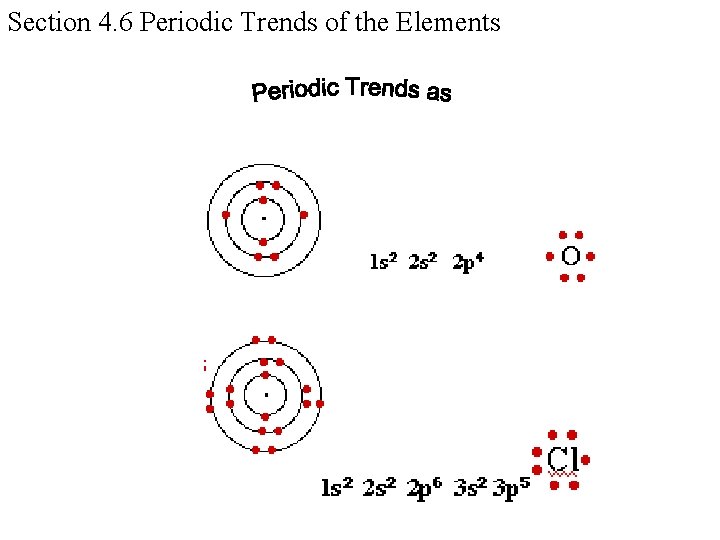
Supplemental packet page 49 sodium-23 23 11 Na • • • • 1 s 2 magnesium-24 12 soft metal, conducts e- reacts w/ H 2 O 11 12 11 24 Atomic Structure Mg 2 s 2 2 p 6 3 s 1 • • • • • • 12 12 12 1 s 2 2 p 6 3 s 2 • • chlorine-35 • • • 17 Cl • • • • 17 18 17 Na • ductile metal, conducts e- 1 s 2 2 p 6 oxygen-16 16 8 burns in O 2 • Mg • O 1 s 2 2 p 4 reacts w/ Na(s) • • Cl • 3 s 2 3 p 5 • • • 8 8 8 yellow gas, nonconductor colorless gas, nonconductor supports combustion • • • O • • •
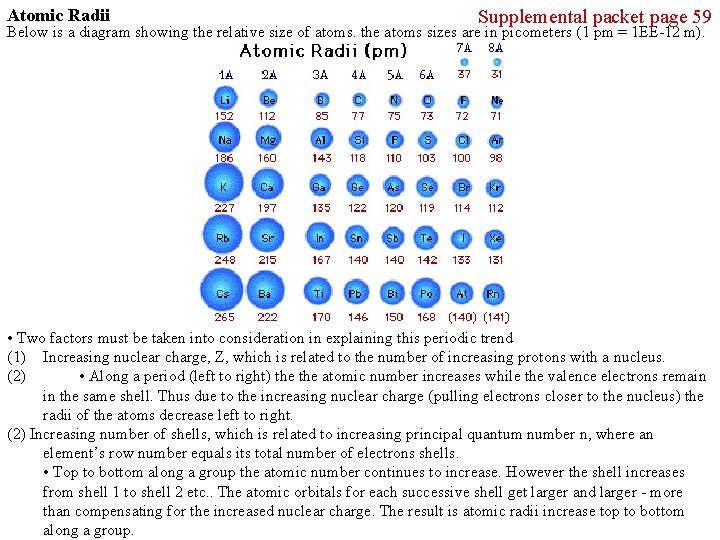
Atomic Radii Supplemental packet page 59 Below is a diagram showing the relative size of atoms. the atoms sizes are in picometers (1 pm = 1 EE-12 m). • Two factors must be taken into consideration in explaining this periodic trend (1) Increasing nuclear charge, Z, which is related to the number of increasing protons with a nucleus. (2) • Along a period (left to right) the atomic number increases while the valence electrons remain in the same shell. Thus due to the increasing nuclear charge (pulling electrons closer to the nucleus) the radii of the atoms decrease left to right. (2) Increasing number of shells, which is related to increasing principal quantum number n, where an element’s row number equals its total number of electrons shells. • Top to bottom along a group the atomic number continues to increase. However the shell increases from shell 1 to shell 2 etc. . The atomic orbitals for each successive shell get larger and larger - more than compensating for the increased nuclear charge. The result is atomic radii increase top to bottom along a group.
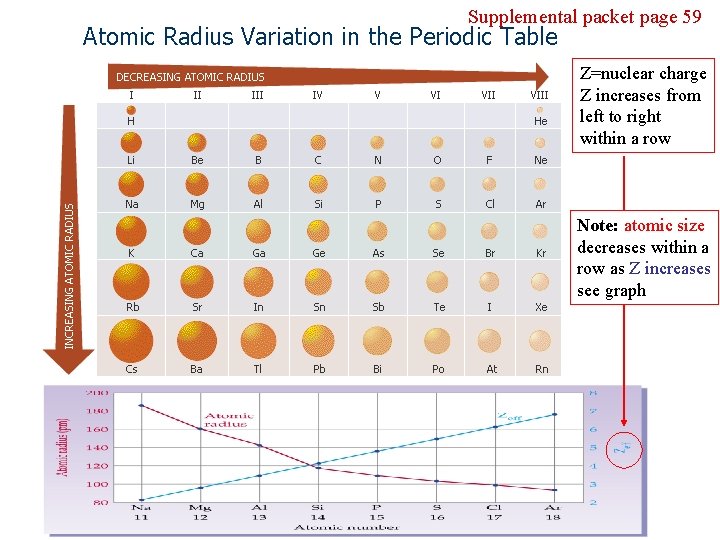
Supplemental packet page 59 Atomic Radius Variation in the Periodic Table Z=nuclear charge Z increases from left to right within a row Note: atomic size decreases within a row as Z increases see graph
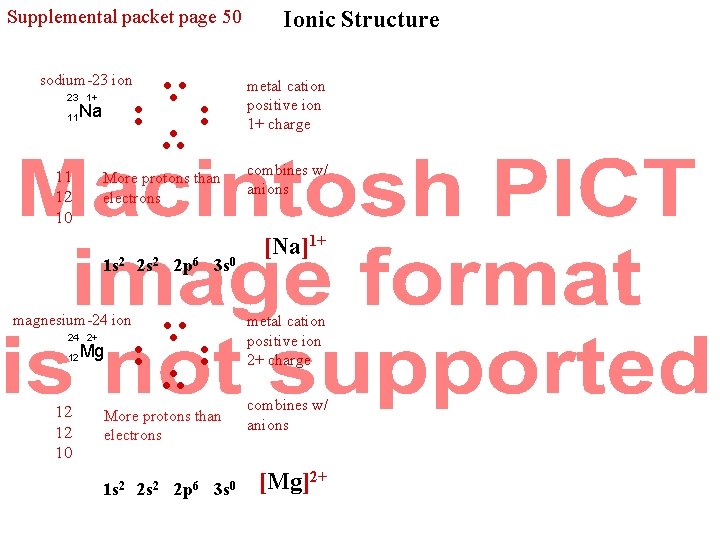
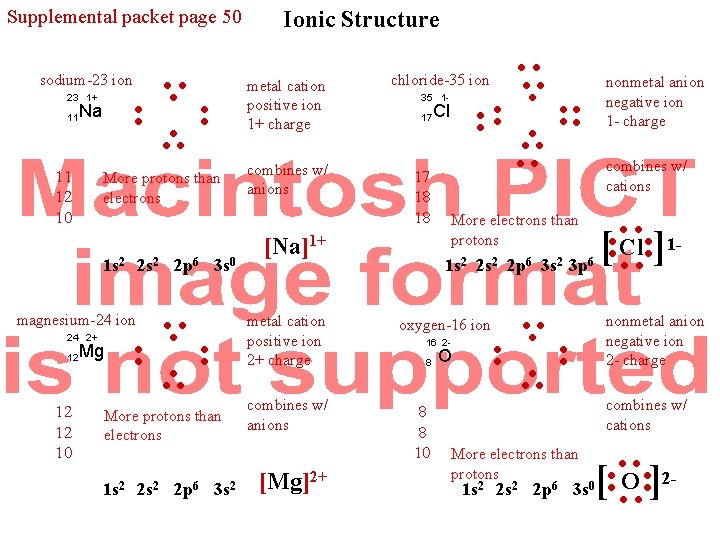
Supplemental packet page 50 sodium-23 ion 23 1+ 11 Na 11 12 10 • • • • More protons than electrons 1 s 2 2 p 6 3 s 0 magnesium-24 ion • 24 2+ 12 12 12 10 Mg • • • More protons than electrons 1 s 2 2 p 6 3 s 0 Ionic Structure metal cation positive ion 1+ charge combines w/ anions [Na]1+ metal cation positive ion 2+ charge combines w/ anions [Mg]2+
Supplemental packet page 50 sodium-23 ion 23 1+ 11 Na 11 12 10 • • • • More protons than electrons 1 s 2 2 p 6 3 s 0 magnesium-24 ion 24 2+ 12 Mg 12 12 10 • • • More protons than electrons 1 s 2 2 p 6 3 s 2 Ionic Structure metal cation positive ion 1+ charge combines w/ anions 35 117 combines w/ anions [Mg]2+ Cl 17 18 18 [Na]1+ metal cation positive ion 2+ charge • • • • • • chloride-35 ion oxygen-16 ion 16 2 - 8 8 10 combines w/ cations More electrons than protons 1 s 2 2 p 6 3 s 2 8 nonmetal anion negative ion 1 - charge O • • Cl • • [ 3 p 6 • • • More electrons than protons 1 s 2 2 p 6 3 s 0 ]1 - nonmetal anion negative ion 2 - charge combines w/ cations • • • O • • • [ ]2 -
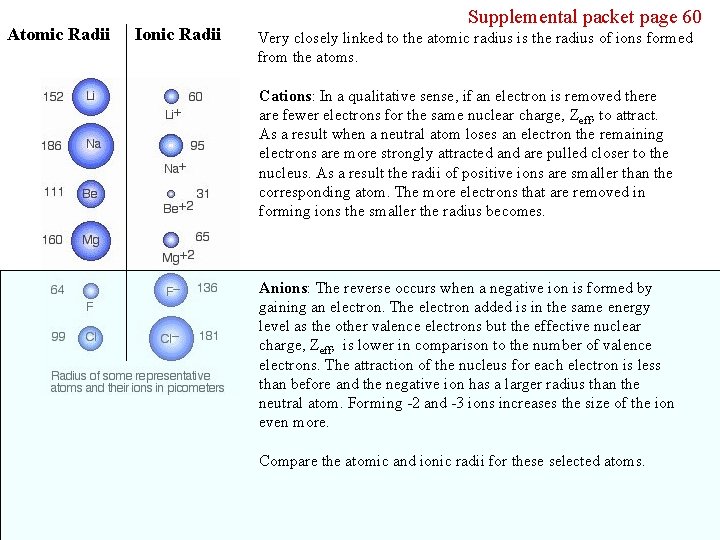
Atomic Radii Ionic Radii Supplemental packet page 60 Very closely linked to the atomic radius is the radius of ions formed from the atoms. Cations: In a qualitative sense, if an electron is removed there are fewer electrons for the same nuclear charge, Zeff, to attract. As a result when a neutral atom loses an electron the remaining electrons are more strongly attracted and are pulled closer to the nucleus. As a result the radii of positive ions are smaller than the corresponding atom. The more electrons that are removed in forming ions the smaller the radius becomes. Anions: The reverse occurs when a negative ion is formed by gaining an electron. The electron added is in the same energy level as the other valence electrons but the effective nuclear charge, Zeff, is lower in comparison to the number of valence electrons. The attraction of the nucleus for each electron is less than before and the negative ion has a larger radius than the neutral atom. Forming -2 and -3 ions increases the size of the ion even more. Compare the atomic and ionic radii for these selected atoms.
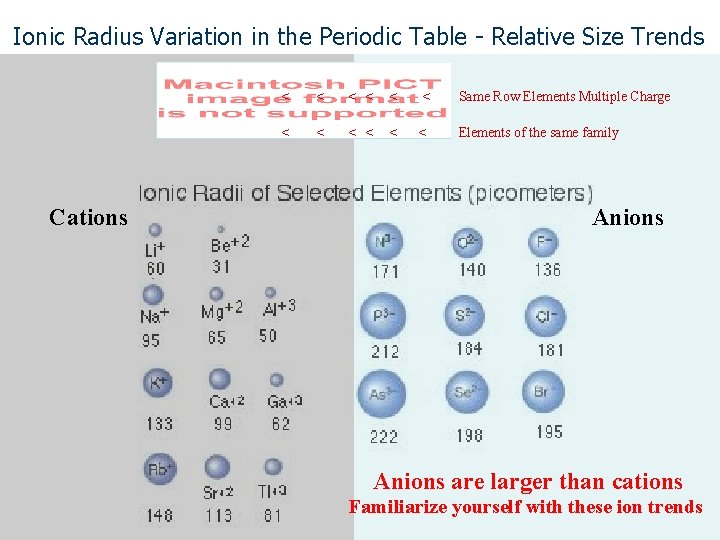
Ionic Radius Variation in the Periodic Table - Relative Size Trends Cations < < < < Same Row Elements Multiple Charge < < < Elements of the same family Anions are larger than cations Familiarize yourself with these ion trends
Plasmas (hot gaseous ions) - The Fourth State of Matter
Ionization Energy
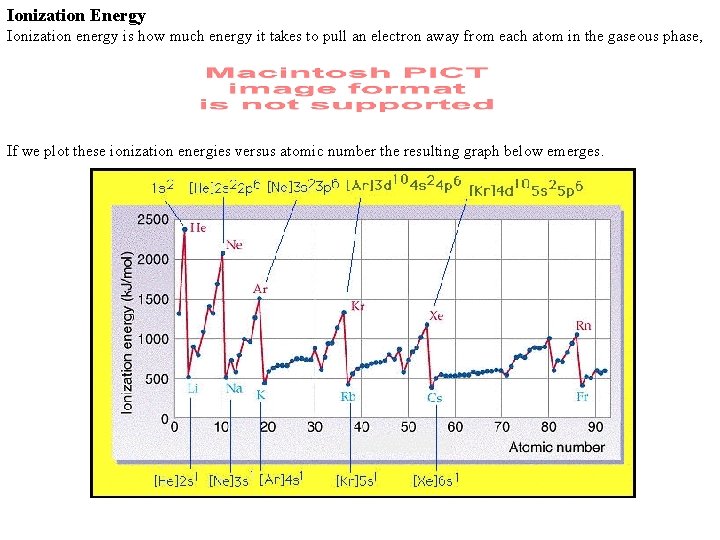
Ionization Energy Ionization energy is how much energy it takes to pull an electron away from each atom in the gaseous phase, If we plot these ionization energies versus atomic number the resulting graph below emerges.
Electron Affinity
Electron Affinity Electron affinity is, essentially the opposite of the ionization energy: Instead of removing an electron from the element we add an electron to the element to create an anion. Generally, the energy that results from this process (the electron affinity) is negative or close to zero. The more negative this energy the more this process is favored. In the figure below we see the trends in the electron affinity for many of the elements. Note that the noble gases, alkali metals and alkali earth metals have E. A. close to zero - indicating that these groups of elements do not particularly like to become anions. However, the nonmetals and especially the halogens are highly negative and thus readily become anions. A periodic trend is evident, as was the case for the ionization energy. This periodic trend can be understood as a reflection of the underlying periodicity in the electronic configuration of the elements
Reduction is the gain of electrons Oxidation is the loss of electrons
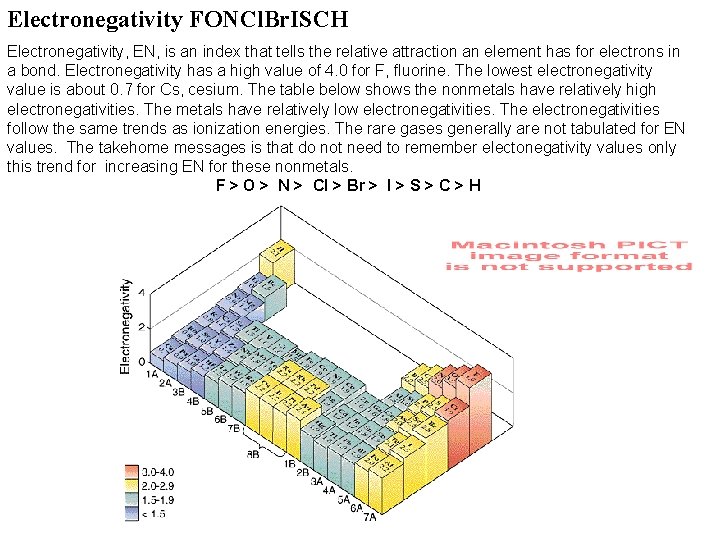
Electronegativity FONCl. Br. ISCH Electronegativity, EN, is an index that tells the relative attraction an element has for electrons in a bond. Electronegativity has a high value of 4. 0 for F, fluorine. The lowest electronegativity value is about 0. 7 for Cs, cesium. The table below shows the nonmetals have relatively high electronegativities. The metals have relatively low electronegativities. The electronegativities follow the same trends as ionization energies. The rare gases generally are not tabulated for EN values. The takehome messages is that do not need to remember electonegativity values only this trend for increasing EN for these nonmetals. F > O > N > Cl > Br > I > S > C > H
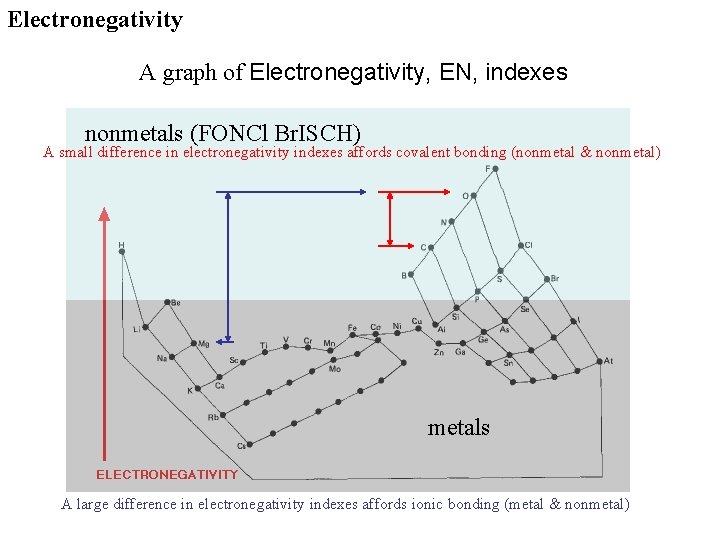
Electronegativity A graph of Electronegativity, EN, indexes nonmetals (FONCl Br. ISCH) A small difference in electronegativity indexes affords covalent bonding (nonmetal & nonmetal) metals A large difference in electronegativity indexes affords ionic bonding (metal & nonmetal)
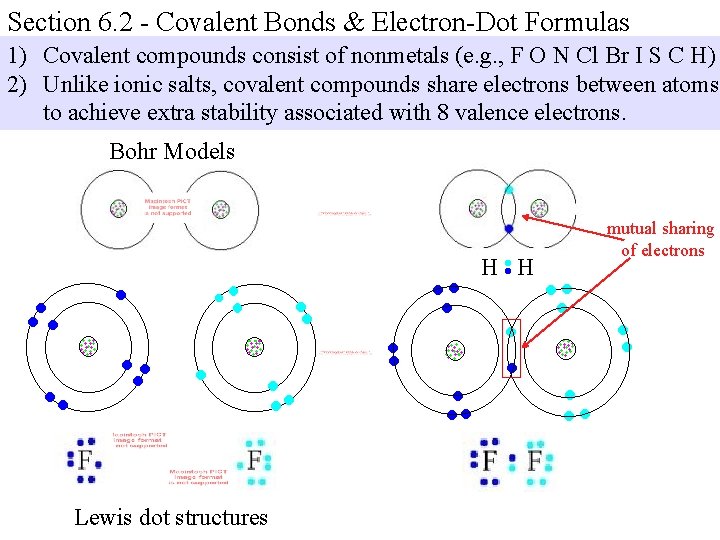
Section 6. 2 - Covalent Bonds & Electron-Dot Formulas 1) Covalent compounds consist of nonmetals (e. g. , F O N Cl Br I S C H) 2) Unlike ionic salts, covalent compounds share electrons between atoms to achieve extra stability associated with 8 valence electrons. Bohr Models mutual sharing of electrons Lewis dot structures
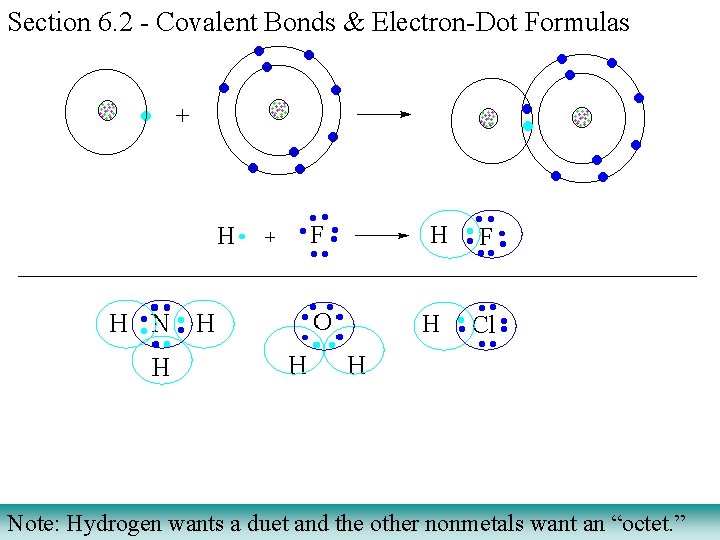
Section 6. 2 - Covalent Bonds & Electron-Dot Formulas Note: Hydrogen wants a duet and the other nonmetals want an “octet. ”
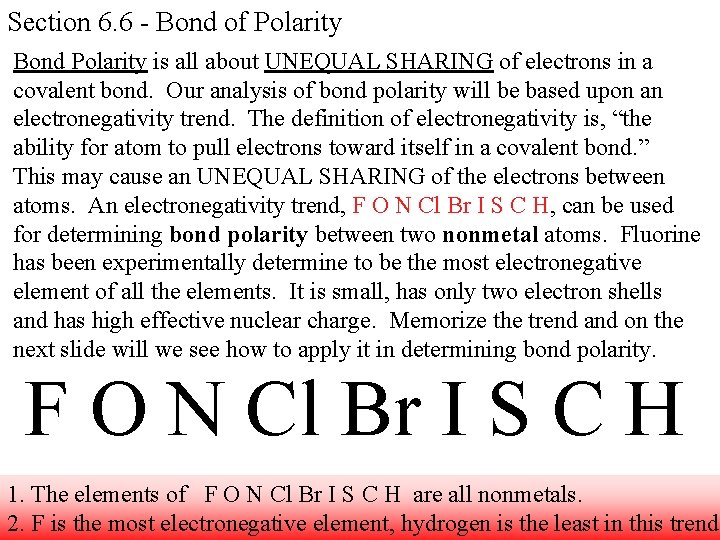
Section 6. 6 - Bond of Polarity Bond Polarity is all about UNEQUAL SHARING of electrons in a covalent bond. Our analysis of bond polarity will be based upon an electronegativity trend. The definition of electronegativity is, “the ability for atom to pull electrons toward itself in a covalent bond. ” This may cause an UNEQUAL SHARING of the electrons between atoms. An electronegativity trend, F O N Cl Br I S C H, can be used for determining bond polarity between two nonmetal atoms. Fluorine has been experimentally determine to be the most electronegative element of all the elements. It is small, has only two electron shells and has high effective nuclear charge. Memorize the trend and on the next slide will we see how to apply it in determining bond polarity. F O N Cl Br I S C H 1. The elements of F O N Cl Br I S C H are all nonmetals. 2. F is the most electronegative element, hydrogen is the least in this trend
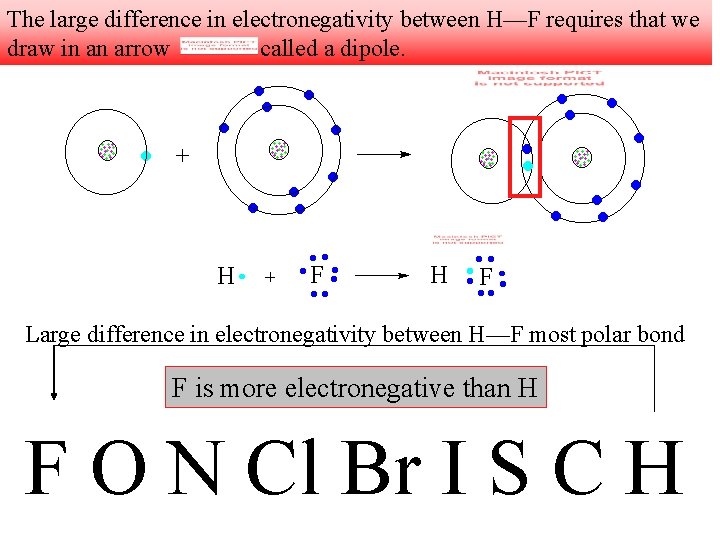
The large difference in electronegativity between H—F requires that we draw in an arrow called a dipole. Large difference in electronegativity between H—F most polar bond F is more electronegative than H F O N Cl Br I S C H
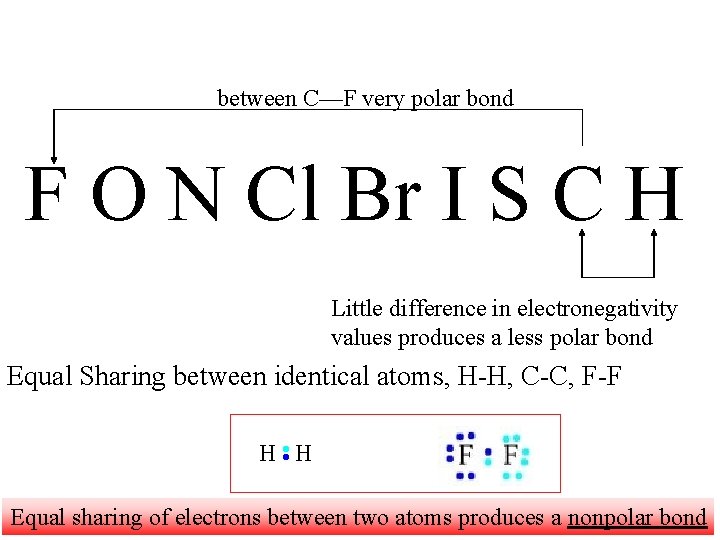
between C—F very polar bond F O N Cl Br I S C H Little difference in electronegativity values produces a less polar bond Equal Sharing between identical atoms, H-H, C-C, F-F Equal sharing of electrons between two atoms produces a nonpolar bond
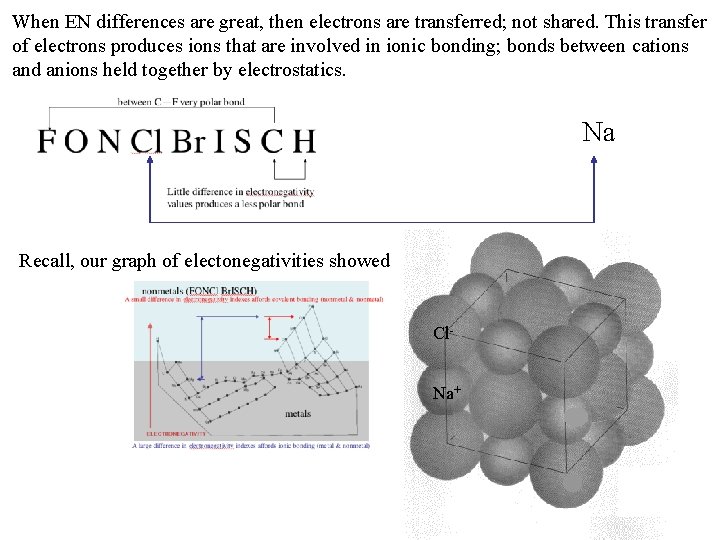
When EN differences are great, then electrons are transferred; not shared. This transfer of electrons produces ions that are involved in ionic bonding; bonds between cations and anions held together by electrostatics. Na Recall, our graph of electonegativities showed Cl. Na+
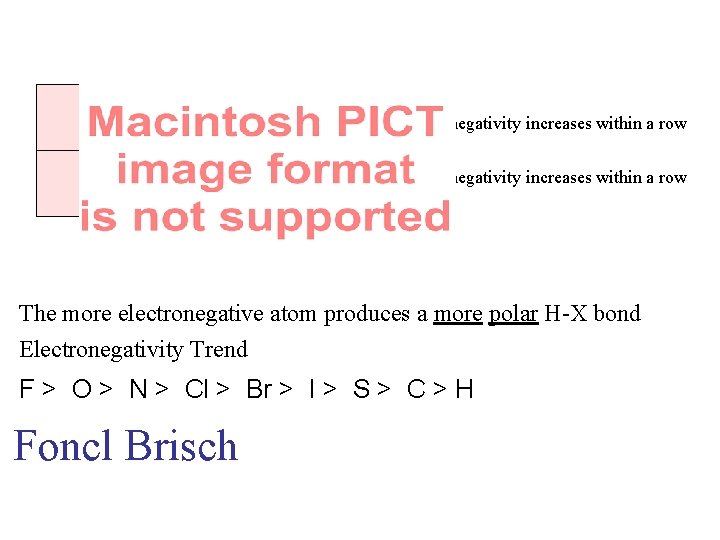
Electronegativity increases within a row The more electronegative atom produces a more polar H-X bond Electronegativity Trend F > O > N > Cl > Br > I > S > C > H Foncl Brisch
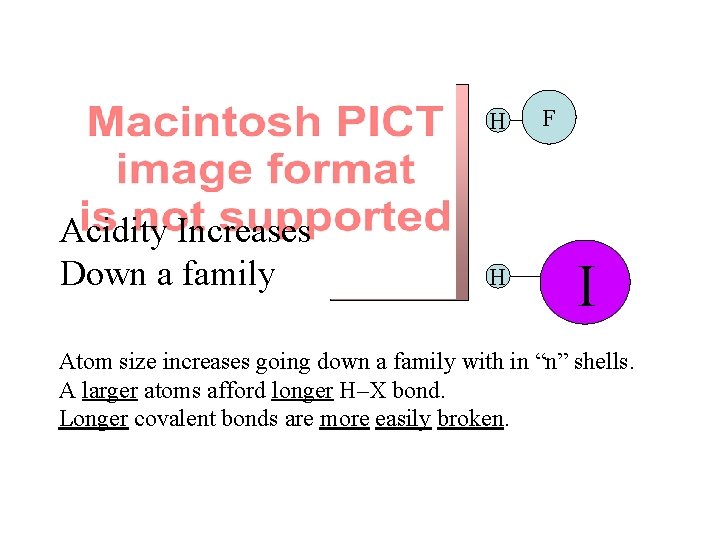
H Acidity Increases Down a family H F I Atom size increases going down a family with in “n” shells. A larger atoms afford longer H–X bond. Longer covalent bonds are more easily broken.
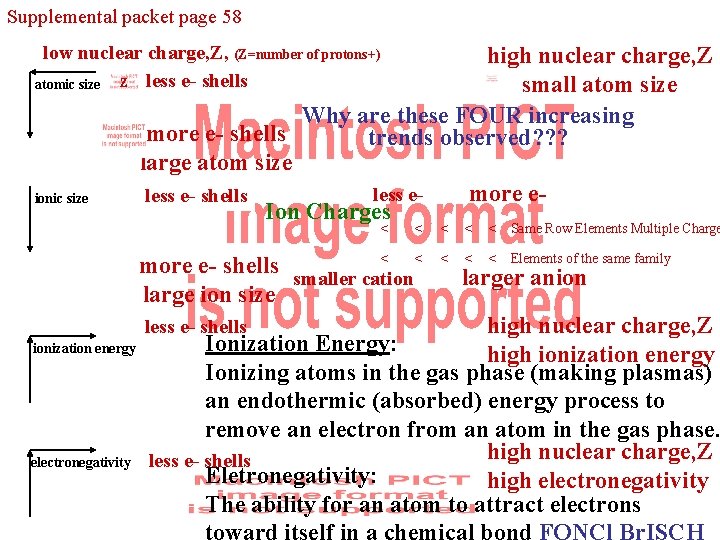
Supplemental packet page 58 low nuclear charge, Z, (Z=number of protons+) atomic size Z less e- shells ionic size high nuclear charge, Z small atom size Why are these FOUR increasing more e- shells trends observed? ? ? large atom size less emore eless e- shells Ion Charges < < < Same Row Elements Multiple Charge < < more e- shells smaller cation large ion size < < < electronegativity larger anion high nuclear charge, Z Ionization Energy: high ionization energy Ionizing atoms in the gas phase (making plasmas) an endothermic (absorbed) energy process to remove an electron from an atom in the gas phase. high nuclear charge, Z less e- shells Eletronegativity: high electronegativity The ability for an atom to attract electrons less e- shells ionization energy Elements of the same family
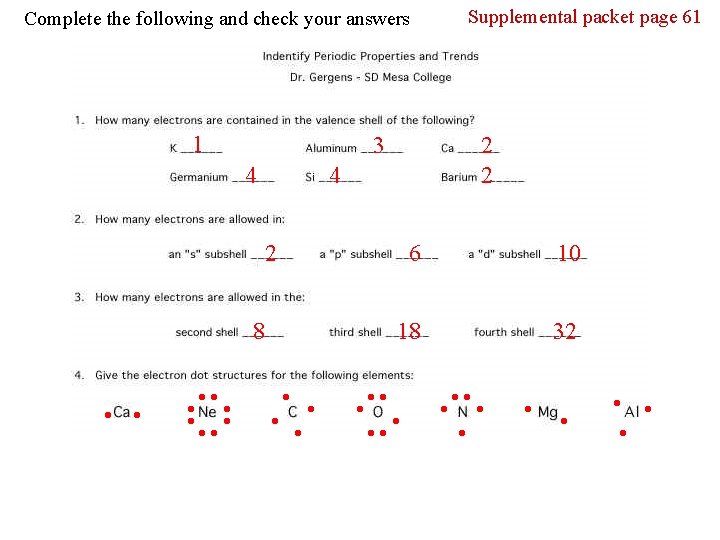
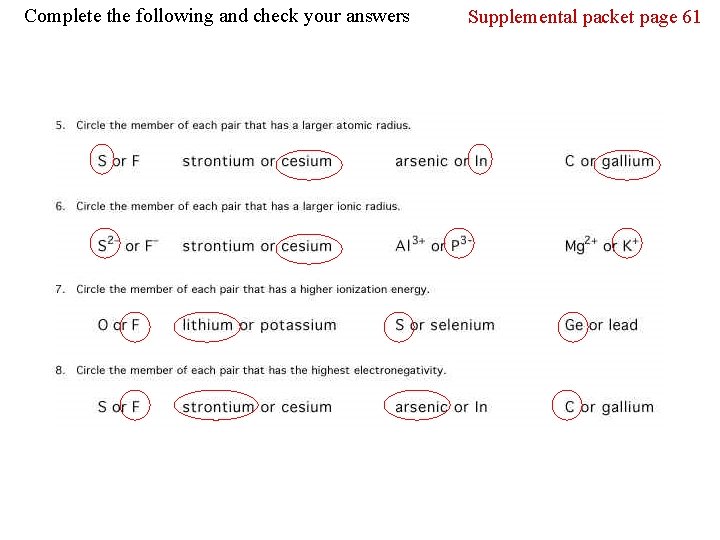
Supplemental packet page 61 Complete the following and check your answers 1 3 4 2 2 4 2 8 • • • • • • 6 10 18 32 • • • •
Complete the following and check your answers Supplemental packet page 61