
Section 4 4 Undetermined Coefficients Superposition Approach SOLUTION
- Slides: 9
Section 4. 4 Undetermined Coefficients— Superposition Approach
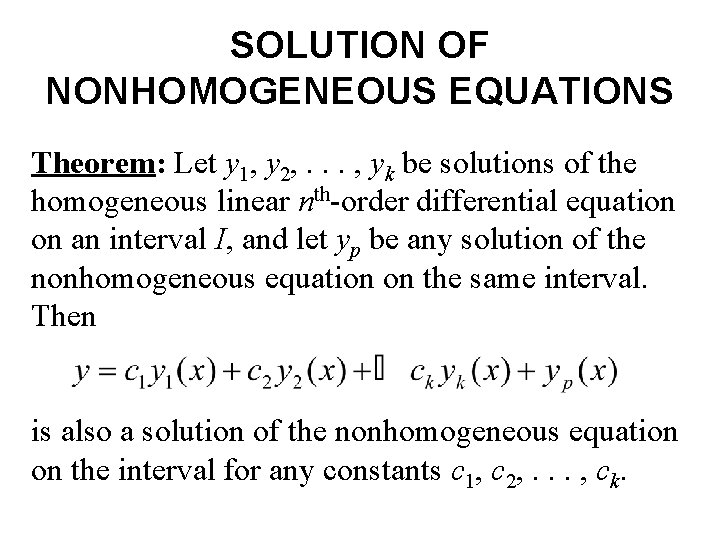
SOLUTION OF NONHOMOGENEOUS EQUATIONS Theorem: Let y 1, y 2, . . . , yk be solutions of the homogeneous linear nth-order differential equation on an interval I, and let yp be any solution of the nonhomogeneous equation on the same interval. Then is also a solution of the nonhomogeneous equation on the interval for any constants c 1, c 2, . . . , ck.
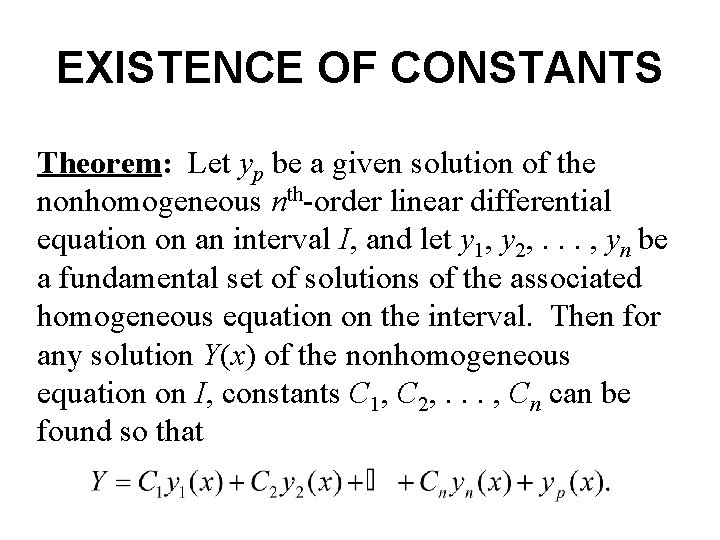
EXISTENCE OF CONSTANTS Theorem: Let yp be a given solution of the nonhomogeneous nth-order linear differential equation on an interval I, and let y 1, y 2, . . . , yn be a fundamental set of solutions of the associated homogeneous equation on the interval. Then for any solution Y(x) of the nonhomogeneous equation on I, constants C 1, C 2, . . . , Cn can be found so that
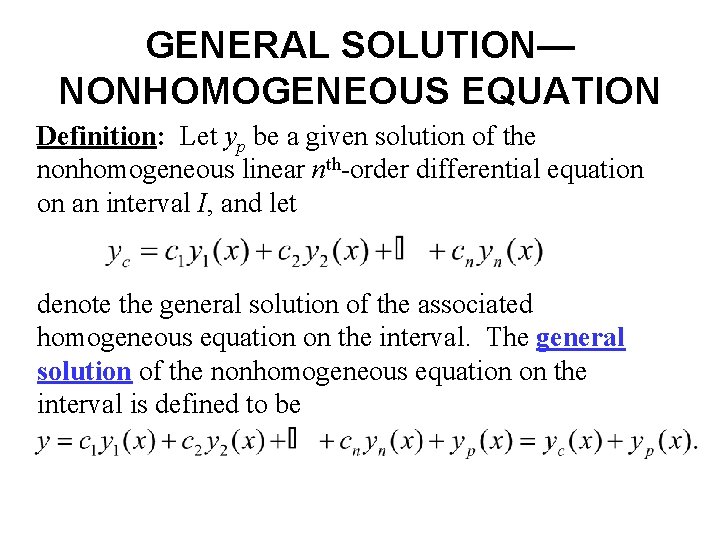
GENERAL SOLUTION— NONHOMOGENEOUS EQUATION Definition: Let yp be a given solution of the nonhomogeneous linear nth-order differential equation on an interval I, and let denote the general solution of the associated homogeneous equation on the interval. The general solution of the nonhomogeneous equation on the interval is defined to be
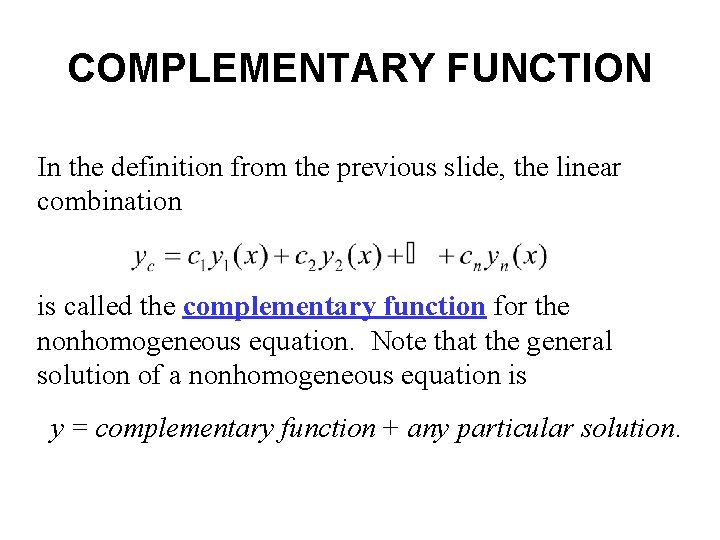
COMPLEMENTARY FUNCTION In the definition from the previous slide, the linear combination is called the complementary function for the nonhomogeneous equation. Note that the general solution of a nonhomogeneous equation is y = complementary function + any particular solution.
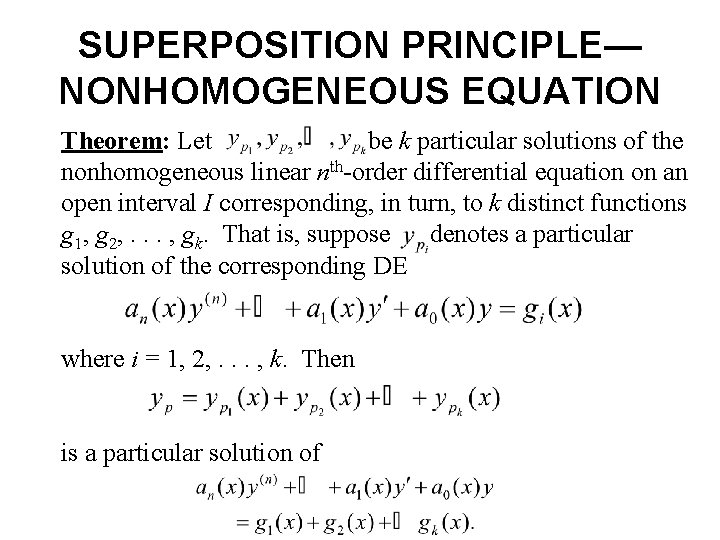
SUPERPOSITION PRINCIPLE— NONHOMOGENEOUS EQUATION Theorem: Let be k particular solutions of the nonhomogeneous linear nth-order differential equation on an open interval I corresponding, in turn, to k distinct functions g 1, g 2, . . . , gk. That is, suppose denotes a particular solution of the corresponding DE where i = 1, 2, . . . , k. Then is a particular solution of
FINDING A SOLUTION TO A NONHOMOGENEOUS LINEAR DE To find the solution to a nonhomogeneous linear differential equation with constant coefficients requires two things: (i) Find the complementary function yc. (ii) Find any particular solution yp of the nonhomoegeneous equation.
LIMITATIONS OF THE METHOD OF UNDETERMINED COEFFICIENTS The method of undetermined coefficients is limited to nonhomogeneous equations which • coefficients are constant and • g(x) is a constant k, a polynomial function, an exponential function eαx, sin βx, cos βx, or finite sums and products of these functions.
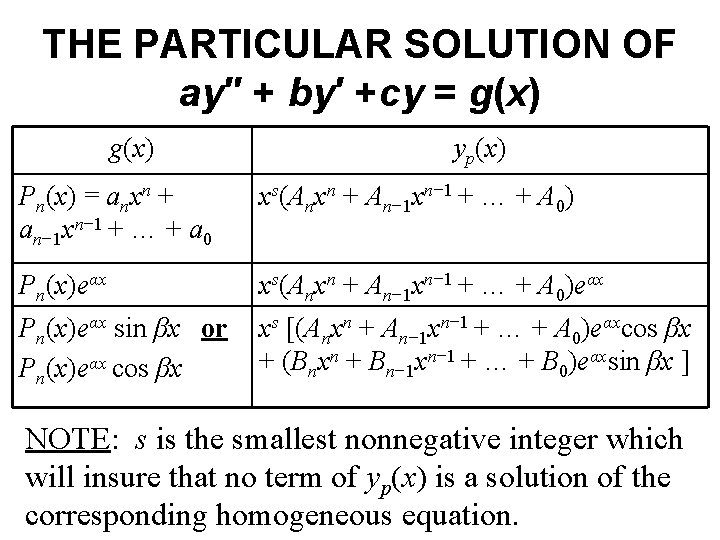
THE PARTICULAR SOLUTION OF ay″ + by′ +cy = g(x) yp(x) Pn(x) = anxn + an− 1 xn− 1 + … + a 0 xs(Anxn + An− 1 xn− 1 + … + A 0) Pn(x)eαx xs(Anxn + An− 1 xn− 1 + … + A 0)eαx Pn(x)eαx sin βx or Pn(x)eαx cos βx xs [(Anxn + An− 1 xn− 1 + … + A 0)eαxcos βx + (Bnxn + Bn− 1 xn− 1 + … + B 0)eαxsin βx ] NOTE: s is the smallest nonnegative integer which will insure that no term of yp(x) is a solution of the corresponding homogeneous equation.