
Section 4 4 Chemical Reactions Quiz 1 Types
- Slides: 8
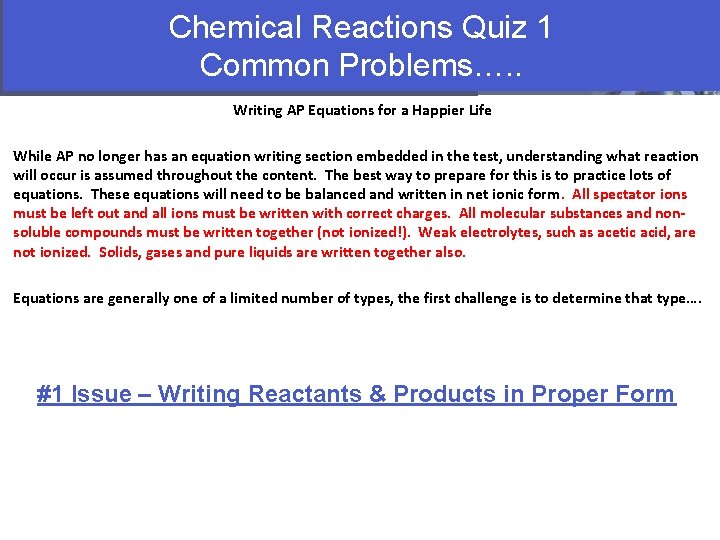
Section 4. 4 Chemical Reactions Quiz 1 Types of Chemical Reactions. Problems…. . Common Writing AP Equations for a Happier Life While AP no longer has an equation writing section embedded in the test, understanding what reaction will occur is assumed throughout the content. The best way to prepare for this is to practice lots of equations. These equations will need to be balanced and written in net ionic form. All spectator ions must be left out and all ions must be written with correct charges. All molecular substances and nonsoluble compounds must be written together (not ionized!). Weak electrolytes, such as acetic acid, are not ionized. Solids, gases and pure liquids are written together also. Equations are generally one of a limited number of types, the first challenge is to determine that type…. #1 Issue – Writing Reactants & Products in Proper Form
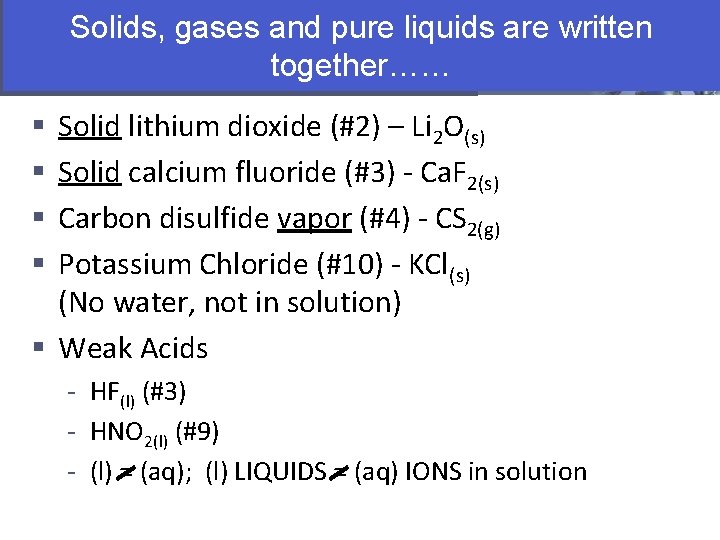
Solids, Section 4. 4 gases and pure liquids are written Types of Chemical Reactions together…… Solid lithium dioxide (#2) – Li 2 O(s) Solid calcium fluoride (#3) - Ca. F 2(s) Carbon disulfide vapor (#4) - CS 2(g) Potassium Chloride (#10) - KCl(s) (No water, not in solution) § Weak Acids § § - HF(l) (#3) - HNO 2(l) (#9) - (l) = (aq); (l) LIQUIDS = (aq) IONS in solution
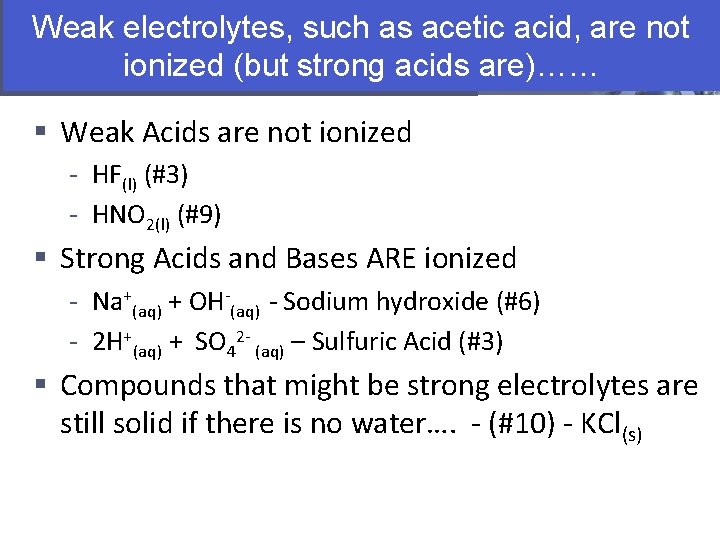
Weak 4. 4 electrolytes, such as acetic acid, are not Section Types of Chemical ionized Reactions (but strong acids are)…… § Weak Acids are not ionized - HF(l) (#3) - HNO 2(l) (#9) § Strong Acids and Bases ARE ionized - Na+(aq) + OH-(aq) - Sodium hydroxide (#6) - 2 H+(aq) + SO 42 - (aq) – Sulfuric Acid (#3) § Compounds that might be strong electrolytes are still solid if there is no water…. - (#10) - KCl(s)
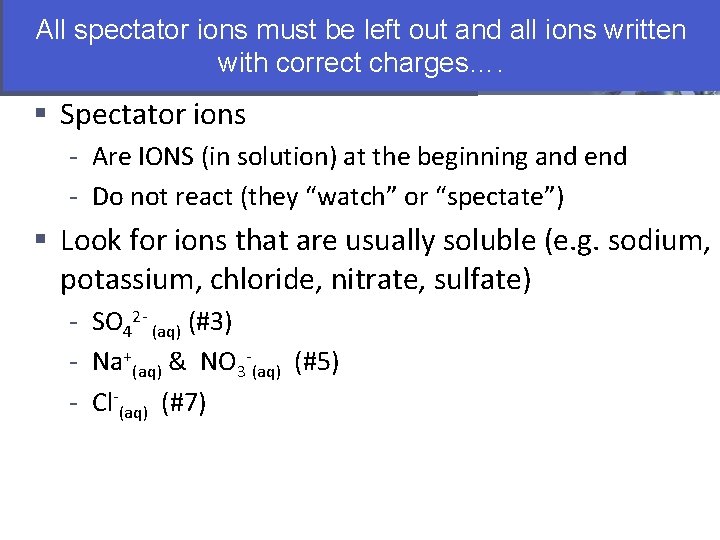
Section 4. 4 All spectator ions must be left out and all ions written correct charges…. Types of Chemicalwith Reactions § Spectator ions - Are IONS (in solution) at the beginning and end - Do not react (they “watch” or “spectate”) § Look for ions that are usually soluble (e. g. sodium, potassium, chloride, nitrate, sulfate) - SO 42 - (aq) (#3) - Na+(aq) & NO 3 -(aq) (#5) - Cl-(aq) (#7)
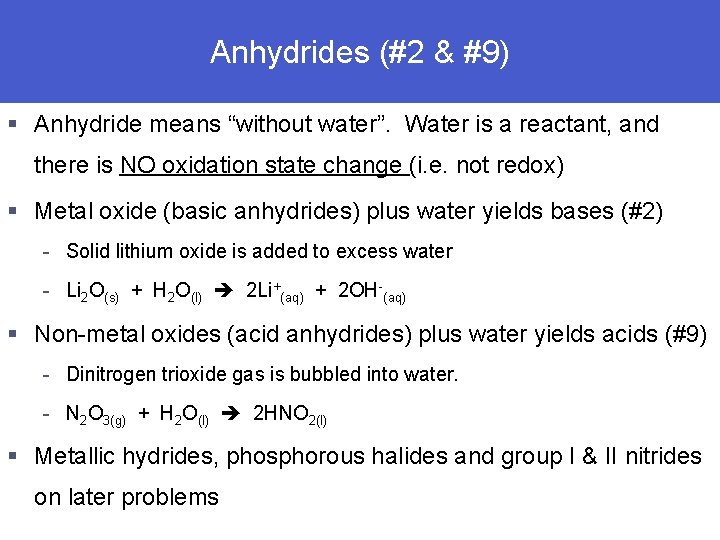
Section 4. 4 Anhydrides Types of Chemical Reactions (#2 & #9) § Anhydride means “without water”. Water is a reactant, and there is NO oxidation state change (i. e. not redox) § Metal oxide (basic anhydrides) plus water yields bases (#2) - Solid lithium oxide is added to excess water - Li 2 O(s) + H 2 O(l) 2 Li+(aq) + 2 OH-(aq) § Non-metal oxides (acid anhydrides) plus water yields acids (#9) - Dinitrogen trioxide gas is bubbled into water. - N 2 O 3(g) + H 2 O(l) 2 HNO 2(l) § Metallic hydrides, phosphorous halides and group I & II nitrides on later problems
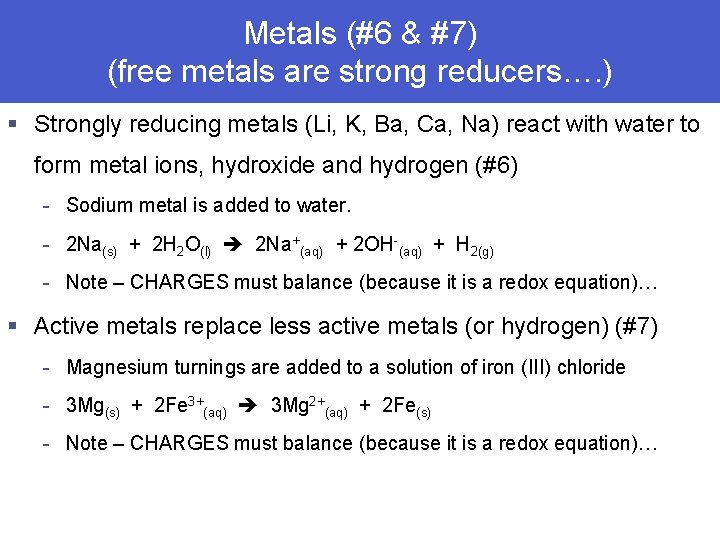
Section 4. 4 Metals (#6 & #7) Types of(free Chemical Reactions metals are strong reducers…. ) § Strongly reducing metals (Li, K, Ba, Ca, Na) react with water to form metal ions, hydroxide and hydrogen (#6) - Sodium metal is added to water. - 2 Na(s) + 2 H 2 O(l) 2 Na+(aq) + 2 OH-(aq) + H 2(g) - Note – CHARGES must balance (because it is a redox equation)… § Active metals replace less active metals (or hydrogen) (#7) - Magnesium turnings are added to a solution of iron (III) chloride - 3 Mg(s) + 2 Fe 3+(aq) 3 Mg 2+(aq) + 2 Fe(s) - Note – CHARGES must balance (because it is a redox equation)…
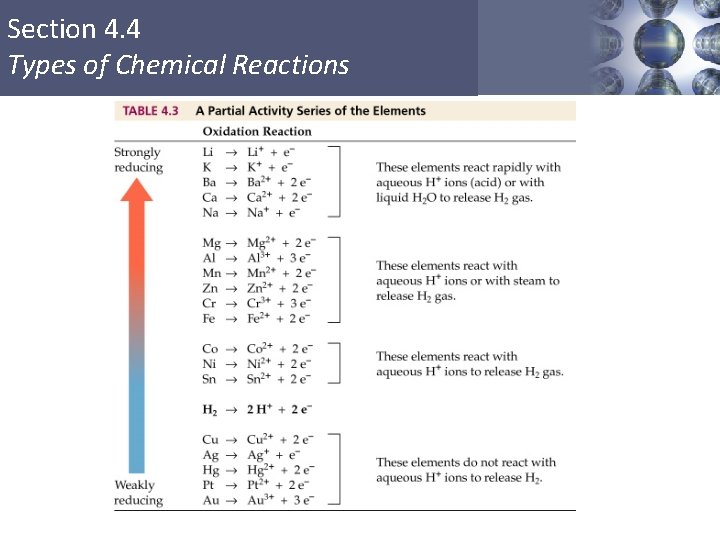
Section 4. 4 Types of Chemical Reactions
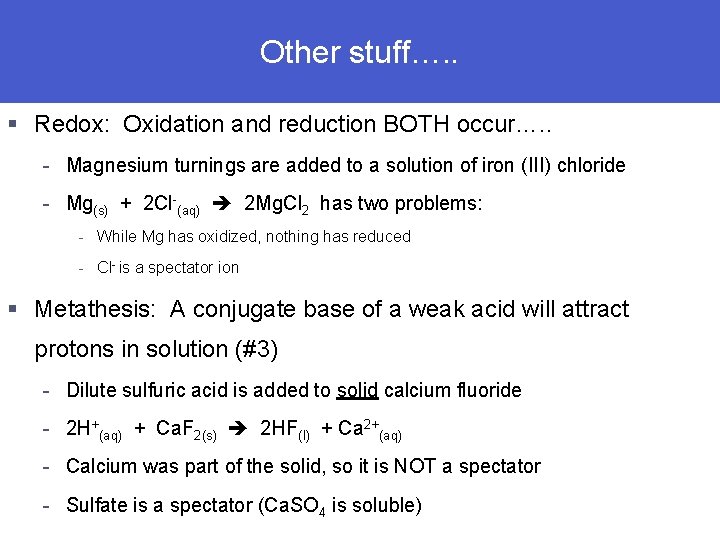
Section 4. 4 Other stuff…. . Types of Chemical Reactions § Redox: Oxidation and reduction BOTH occur…. . - Magnesium turnings are added to a solution of iron (III) chloride - Mg(s) + 2 Cl-(aq) 2 Mg. Cl 2 has two problems: - While Mg has oxidized, nothing has reduced - Cl- is a spectator ion § Metathesis: A conjugate base of a weak acid will attract protons in solution (#3) - Dilute sulfuric acid is added to solid calcium fluoride - 2 H+(aq) + Ca. F 2(s) 2 HF(l) + Ca 2+(aq) - Calcium was part of the solid, so it is NOT a spectator - Sulfate is a spectator (Ca. SO 4 is soluble)