
Section 4 3Electron Structure The Electron Hotel The


- Slides: 29
Section 4. 3—Electron Structure
The Electron Hotel
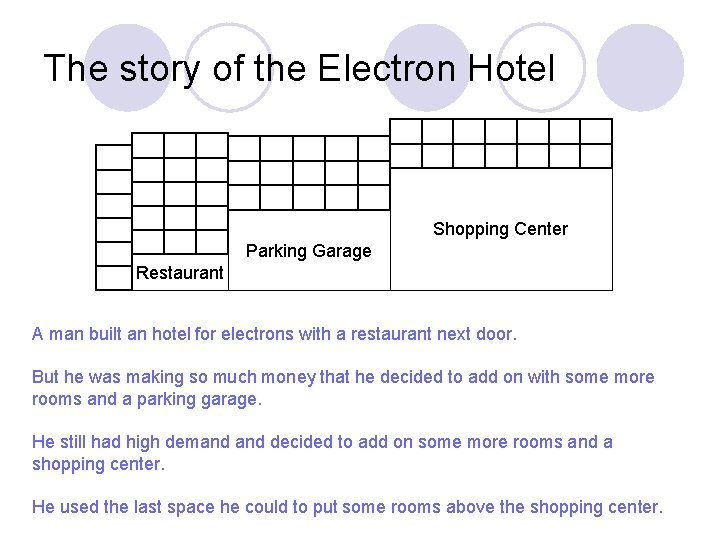
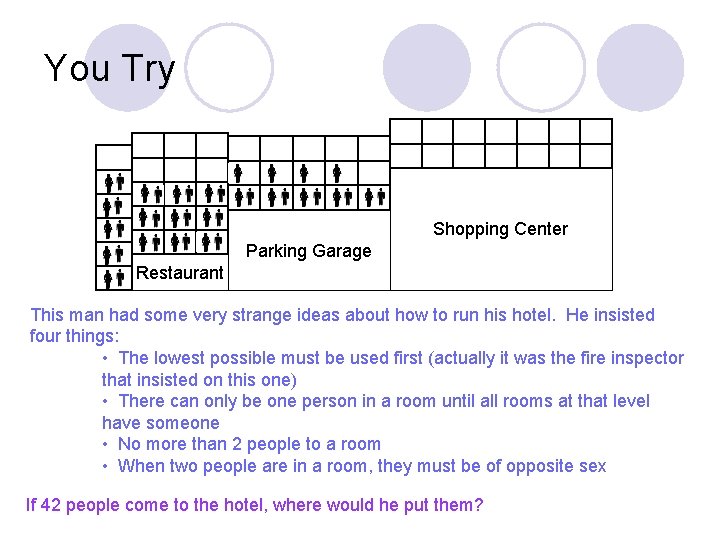
The story of the Electron Hotel Shopping Center Parking Garage Restaurant A man built an hotel for electrons with a restaurant next door. But he was making so much money that he decided to add on with some more rooms and a parking garage. He still had high demand decided to add on some more rooms and a shopping center. He used the last space he could to put some rooms above the shopping center.
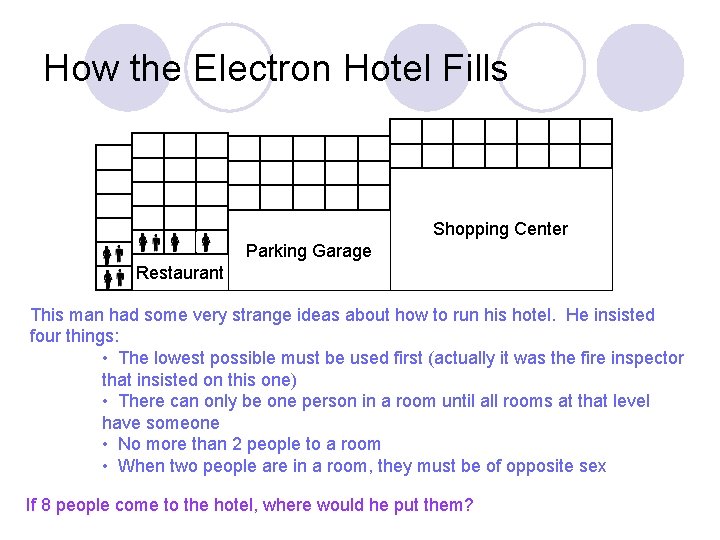
How the Electron Hotel Fills Shopping Center Parking Garage Restaurant This man had some very strange ideas about how to run his hotel. He insisted four things: • The lowest possible must be used first (actually it was the fire inspector that insisted on this one) • There can only be one person in a room until all rooms at that level have someone • No more than 2 people to a room • When two people are in a room, they must be of opposite sex If 8 people come to the hotel, where would he put them?
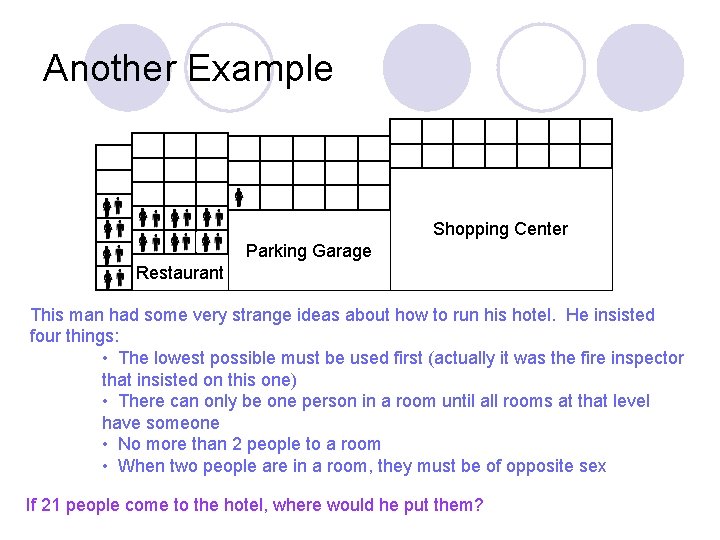
Another Example Shopping Center Parking Garage Restaurant This man had some very strange ideas about how to run his hotel. He insisted four things: • The lowest possible must be used first (actually it was the fire inspector that insisted on this one) • There can only be one person in a room until all rooms at that level have someone • No more than 2 people to a room • When two people are in a room, they must be of opposite sex If 21 people come to the hotel, where would he put them?
You Try Shopping Center Parking Garage Restaurant This man had some very strange ideas about how to run his hotel. He insisted four things: • The lowest possible must be used first (actually it was the fire inspector that insisted on this one) • There can only be one person in a room until all rooms at that level have someone • No more than 2 people to a room • When two people are in a room, they must be of opposite sex If 42 people come to the hotel, where would he put them?
Where do electrons really live?
Electron Clouds They don’t live in a hotel…They are in the area outside of the nucleus where the electrons reside.
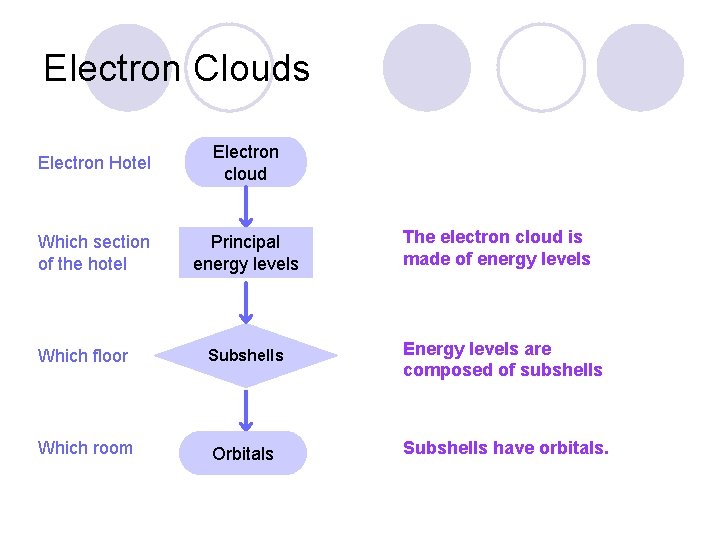
Electron Clouds Electron Hotel Electron cloud Which section of the hotel Principal energy levels The electron cloud is made of energy levels Which floor Subshells Energy levels are composed of subshells Which room Orbitals Subshells have orbitals.
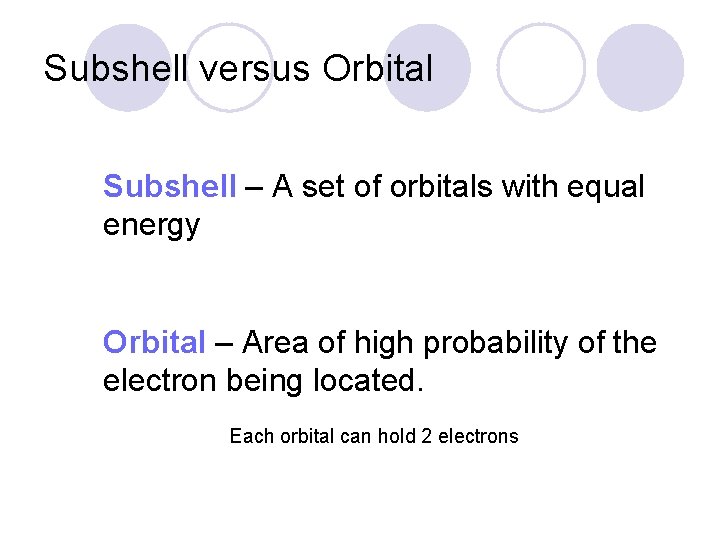
Subshell versus Orbital Subshell – A set of orbitals with equal energy Orbital – Area of high probability of the electron being located. Each orbital can hold 2 electrons
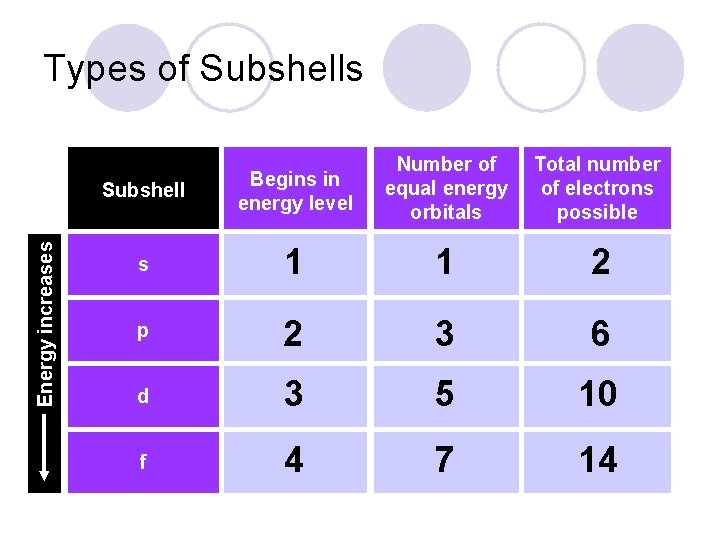
Energy increases Types of Subshells Subshell Begins in energy level Number of equal energy orbitals Total number of electrons possible s 1 1 2 p 2 3 6 d 3 5 10 f 4 7 14
Electron Configuration
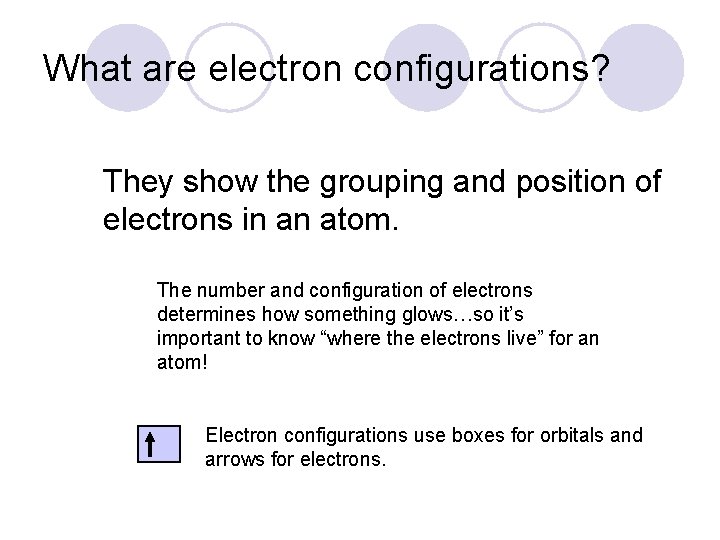
What are electron configurations? They show the grouping and position of electrons in an atom. The number and configuration of electrons determines how something glows…so it’s important to know “where the electrons live” for an atom! Electron configurations use boxes for orbitals and arrows for electrons.
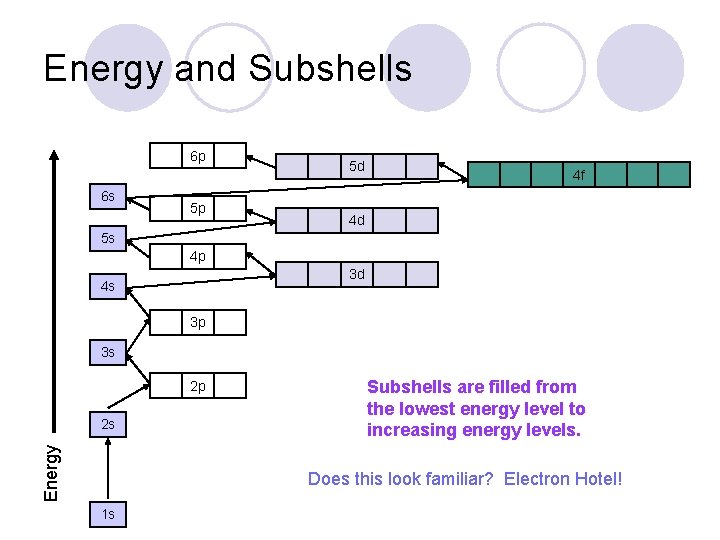
Energy and Subshells 6 p 6 s 5 p 5 d 4 f 4 d 5 s 4 p 3 d 4 s 3 p 3 s 2 p Energy 2 s Subshells are filled from the lowest energy level to increasing energy levels. Does this look familiar? Electron Hotel! 1 s
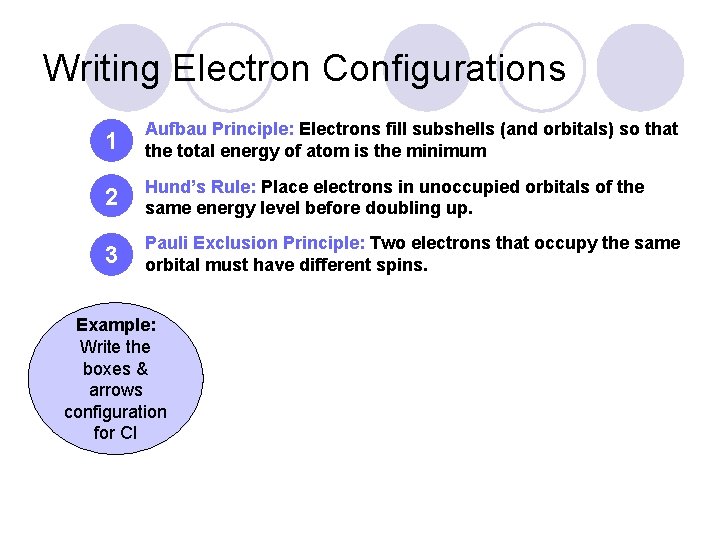
Aufbau Principle The first of 3 rules that govern electron configurations 1 Aufbau Principle: Electrons fill subshells (and orbitals) so that the total energy of atom is the minimum What does this mean? Electrons must fill the lowest available subshells and orbitals before moving on to the next higher energy subshell/orbital. Where did we see this “rule” in the Electron Hotel?
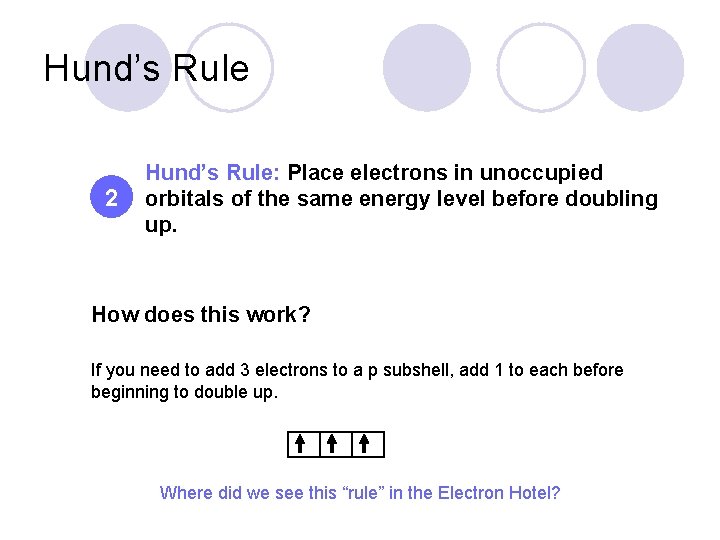
Hund’s Rule 2 Hund’s Rule: Place electrons in unoccupied orbitals of the same energy level before doubling up. How does this work? If you need to add 3 electrons to a p subshell, add 1 to each before beginning to double up. Where did we see this “rule” in the Electron Hotel?
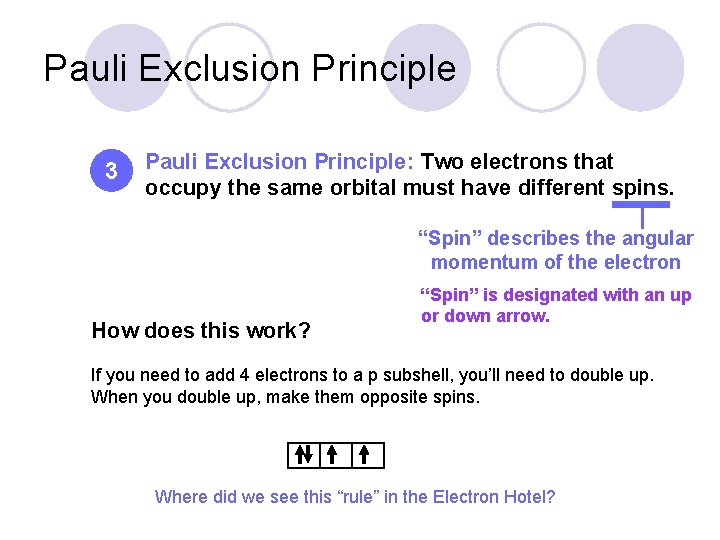
Pauli Exclusion Principle 3 Pauli Exclusion Principle: Two electrons that occupy the same orbital must have different spins. “Spin” describes the angular momentum of the electron How does this work? “Spin” is designated with an up or down arrow. If you need to add 4 electrons to a p subshell, you’ll need to double up. When you double up, make them opposite spins. Where did we see this “rule” in the Electron Hotel?
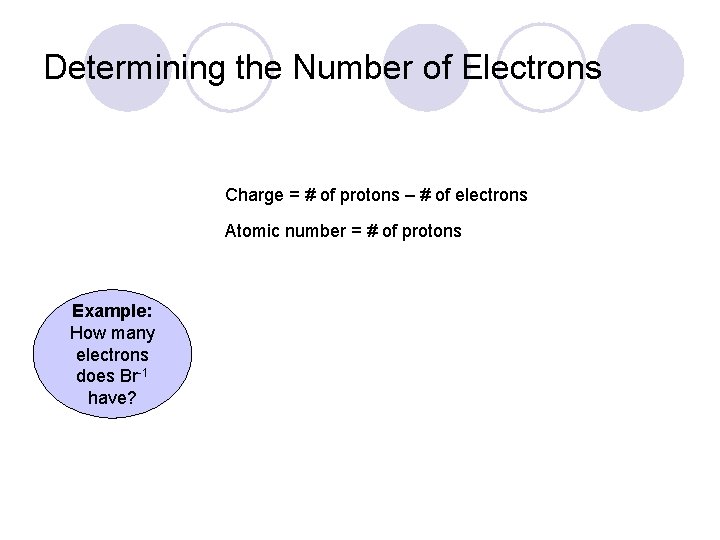
Determining the Number of Electrons Charge = # of protons – # of electrons Atomic number = # of protons Example: How many electrons does Br-1 have?
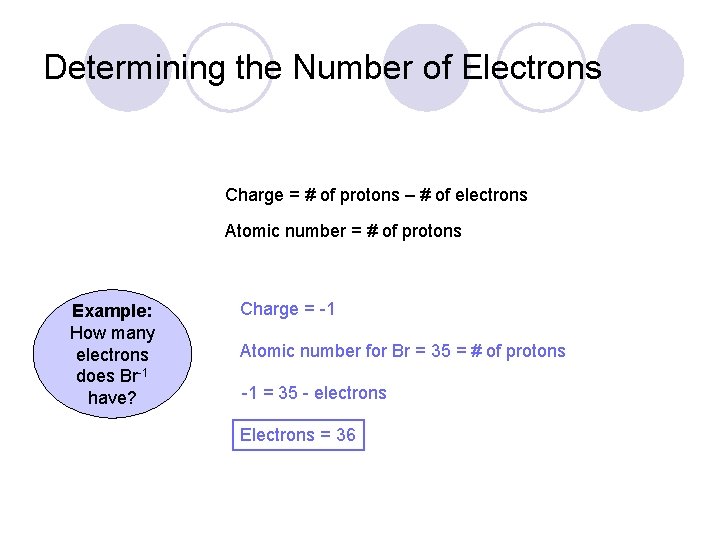
Determining the Number of Electrons Charge = # of protons – # of electrons Atomic number = # of protons Example: How many electrons does Br-1 have? Charge = -1 Atomic number for Br = 35 = # of protons -1 = 35 - electrons Electrons = 36
Writing Electron Configurations 1 Aufbau Principle: Electrons fill subshells (and orbitals) so that the total energy of atom is the minimum 2 Hund’s Rule: Place electrons in unoccupied orbitals of the same energy level before doubling up. 3 Pauli Exclusion Principle: Two electrons that occupy the same orbital must have different spins. Example: Write the boxes & arrows configuration for Cl
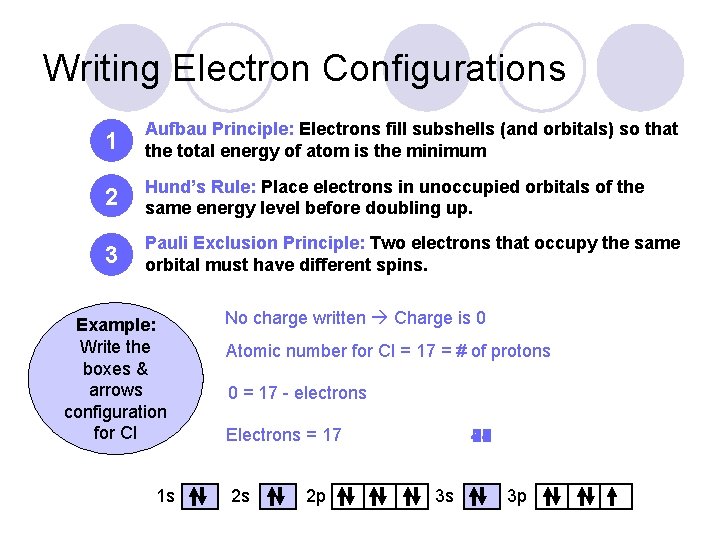
Writing Electron Configurations 1 Aufbau Principle: Electrons fill subshells (and orbitals) so that the total energy of atom is the minimum 2 Hund’s Rule: Place electrons in unoccupied orbitals of the same energy level before doubling up. 3 Pauli Exclusion Principle: Two electrons that occupy the same orbital must have different spins. Example: Write the boxes & arrows configuration for Cl 1 s No charge written Charge is 0 Atomic number for Cl = 17 = # of protons 0 = 17 - electrons Electrons = 17 2 s 2 p 4 9 70 6 5 3 2 1 8 17 16 15 14 13 12 11 3 s 3 p
Spectroscopic Notation
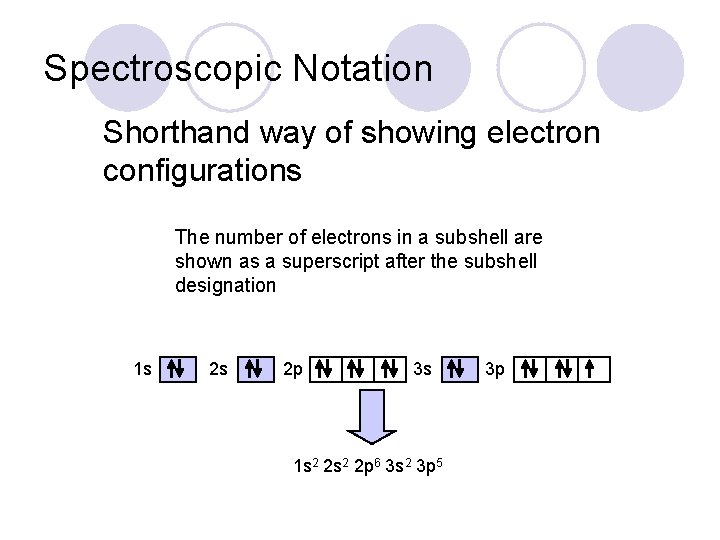
Spectroscopic Notation Shorthand way of showing electron configurations The number of electrons in a subshell are shown as a superscript after the subshell designation 1 s 2 s 2 p 3 s 1 s 2 2 p 6 3 s 2 3 p 5 3 p
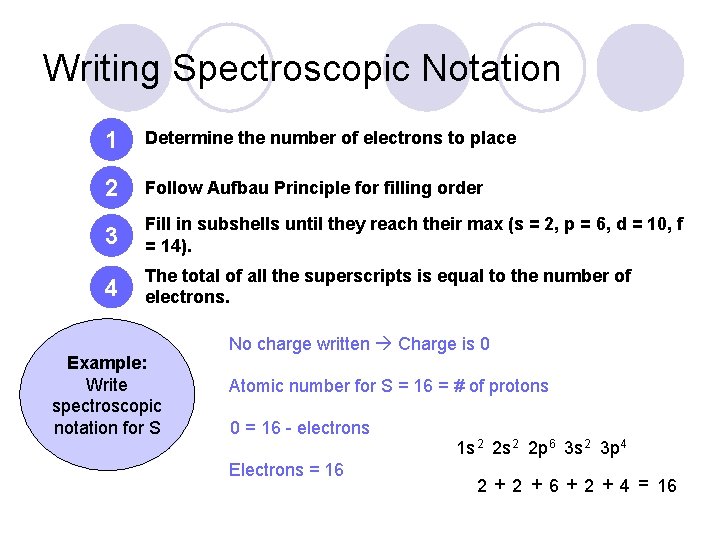
Writing Spectroscopic Notation 1 Determine the number of electrons to place 2 Follow Aufbau Principle for filling order 3 Fill in subshells until they reach their max (s = 2, p = 6, d = 10, f = 14). 4 The total of all the superscripts is equal to the number of electrons. Example: Write spectroscopic notation for S No charge written Charge is 0 Atomic number for S = 16 = # of protons 0 = 16 - electrons Electrons = 16 1 s 2 2 p 6 3 s 2 3 p 4 2 + 6 + 2 + 4 = 16
Noble Gas Configuration
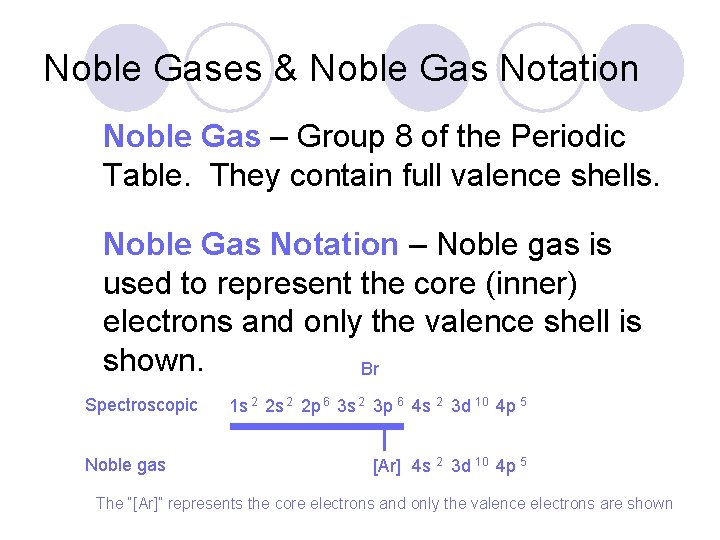
Noble Gases & Noble Gas Notation Noble Gas – Group 8 of the Periodic Table. They contain full valence shells. Noble Gas Notation – Noble gas is used to represent the core (inner) electrons and only the valence shell is shown. Br Spectroscopic Noble gas 1 s 2 2 p 6 3 s 2 3 p 6 4 s 2 3 d 10 4 p 5 [Ar] 4 s 2 3 d 10 4 p 5 The “[Ar]” represents the core electrons and only the valence electrons are shown
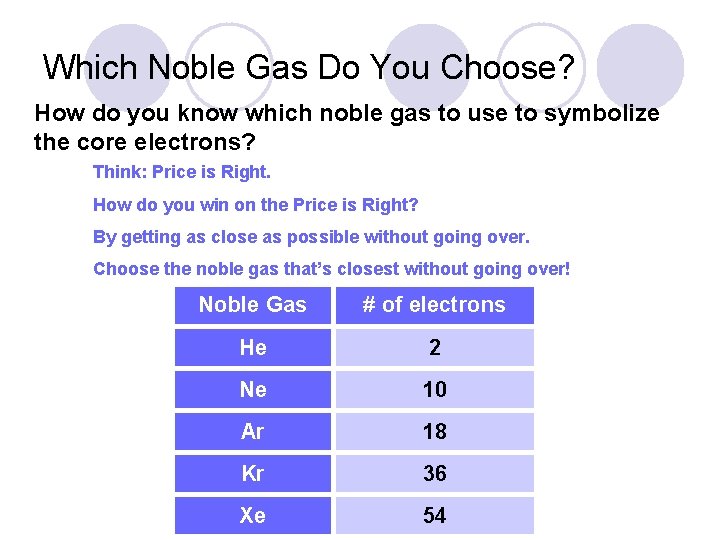
Which Noble Gas Do You Choose? How do you know which noble gas to use to symbolize the core electrons? Think: Price is Right. How do you win on the Price is Right? By getting as close as possible without going over. Choose the noble gas that’s closest without going over! Noble Gas # of electrons He 2 Ne 10 Ar 18 Kr 36 Xe 54
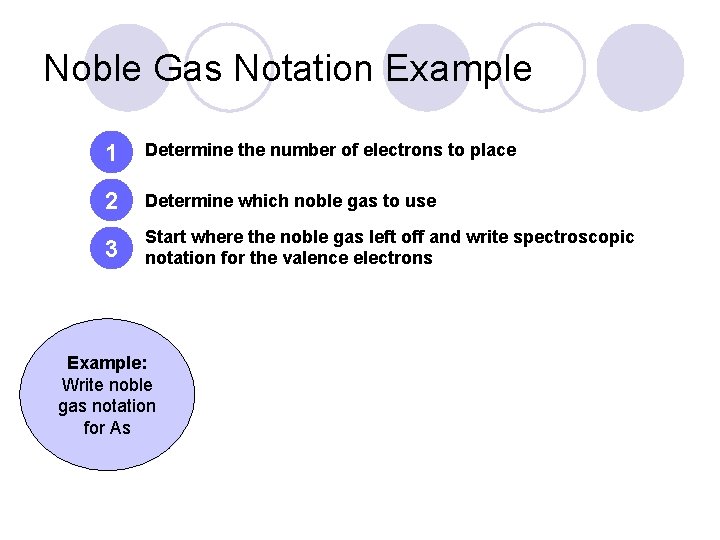
Noble Gas Notation Example 1 Determine the number of electrons to place 2 Determine which noble gas to use 3 Start where the noble gas left off and write spectroscopic notation for the valence electrons Example: Write noble gas notation for As
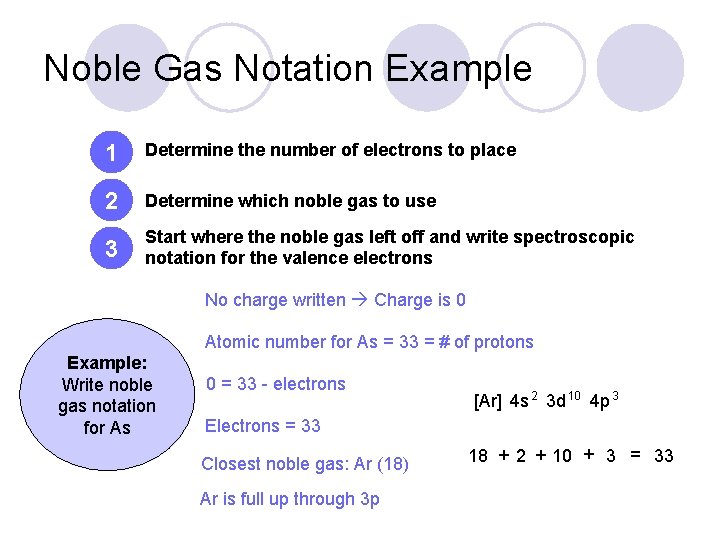
Noble Gas Notation Example 1 Determine the number of electrons to place 2 Determine which noble gas to use 3 Start where the noble gas left off and write spectroscopic notation for the valence electrons No charge written Charge is 0 Atomic number for As = 33 = # of protons Example: Write noble gas notation for As 0 = 33 - electrons [Ar] 4 s 2 3 d 10 4 p 3 Electrons = 33 Closest noble gas: Ar (18) Ar is full up through 3 p 18 + 2 + 10 + 3 = 33