
Section 4 3 Rotations Student Learning Goal Students


- Slides: 10
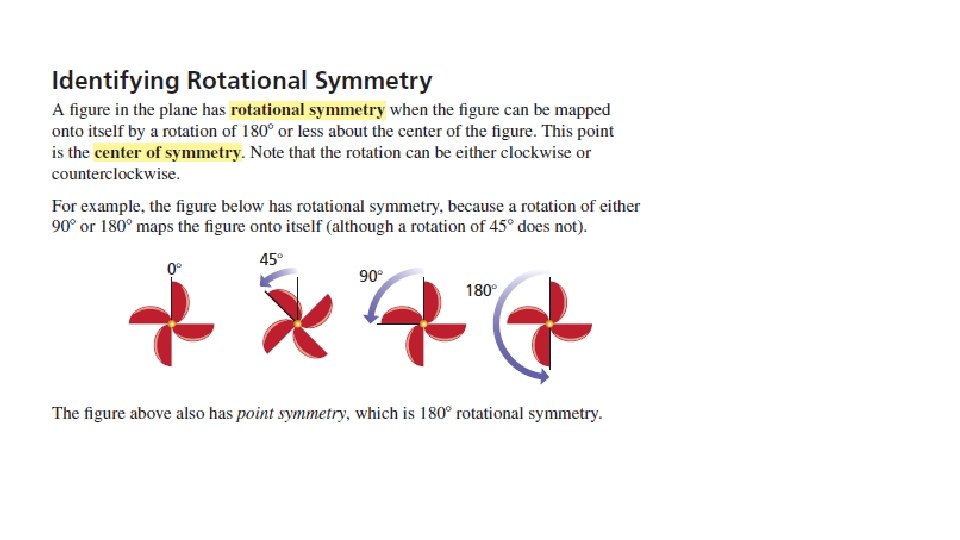
Section 4. 3 Rotations Student Learning Goal: Students will identify what a rotation is and then graph a rotation of 90, 180 or 270 degrees on a coordinate plane. Students will also be able to do composition rotations and identify rotational symmetry. Homework: Worksheet
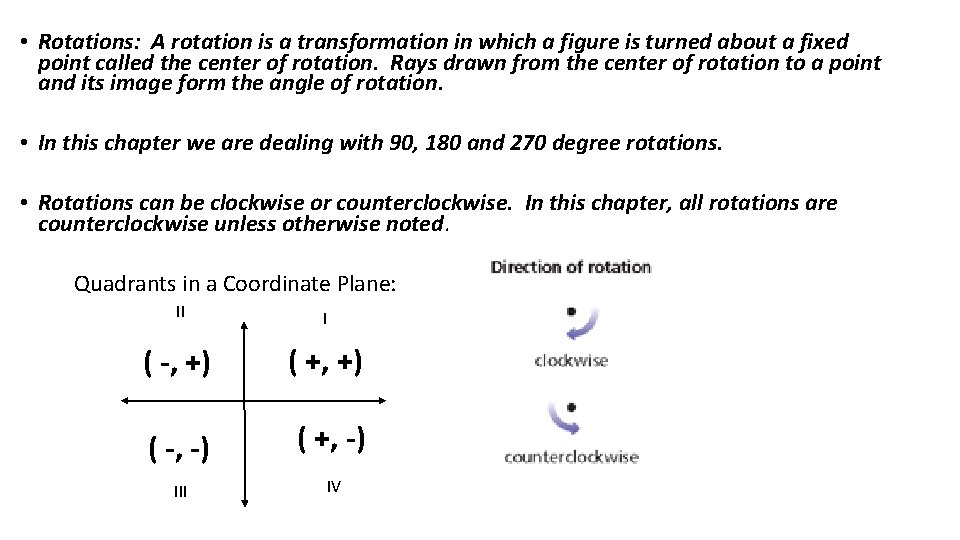
• Rotations: A rotation is a transformation in which a figure is turned about a fixed point called the center of rotation. Rays drawn from the center of rotation to a point and its image form the angle of rotation. • In this chapter we are dealing with 90, 180 and 270 degree rotations. • Rotations can be clockwise or counterclockwise. In this chapter, all rotations are counterclockwise unless otherwise noted. Quadrants in a Coordinate Plane: II I ( -, +) ( +, +) ( -, -) ( +, -) III IV
Coordinate Rules for Rotation about the Origin Rotation Original (Pre-Image) New (Image) Sample (Original to New) 90 degrees ( a , b) ( -b , a) (4, 6) to (-6, 4) 180 degrees (a , b) ( -a , -b) (4, 6) to (-4, -6) 270 degrees (a , b) (b , -a) (4, 6) to (6, -4)
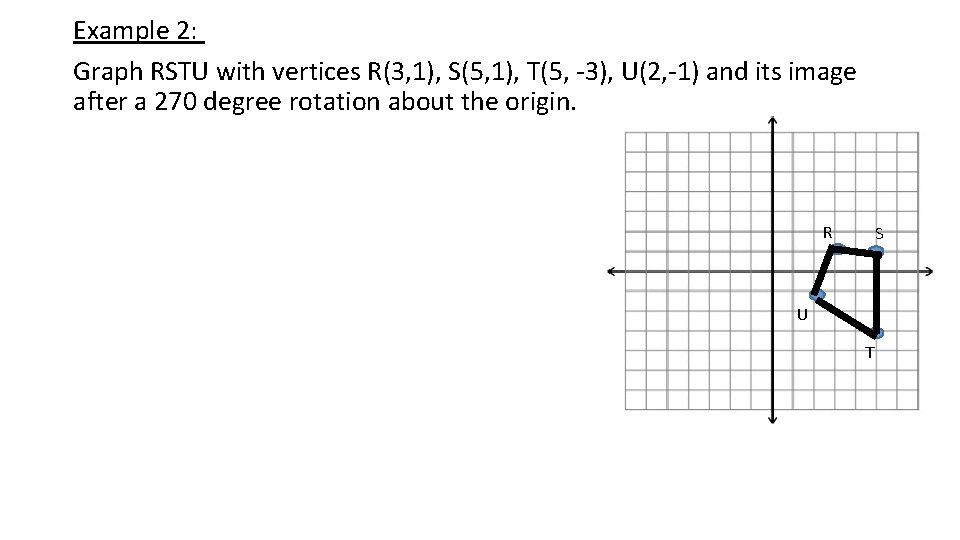
Example 2: Graph RSTU with vertices R(3, 1), S(5, 1), T(5, -3), U(2, -1) and its image after a 270 degree rotation about the origin. R S U T
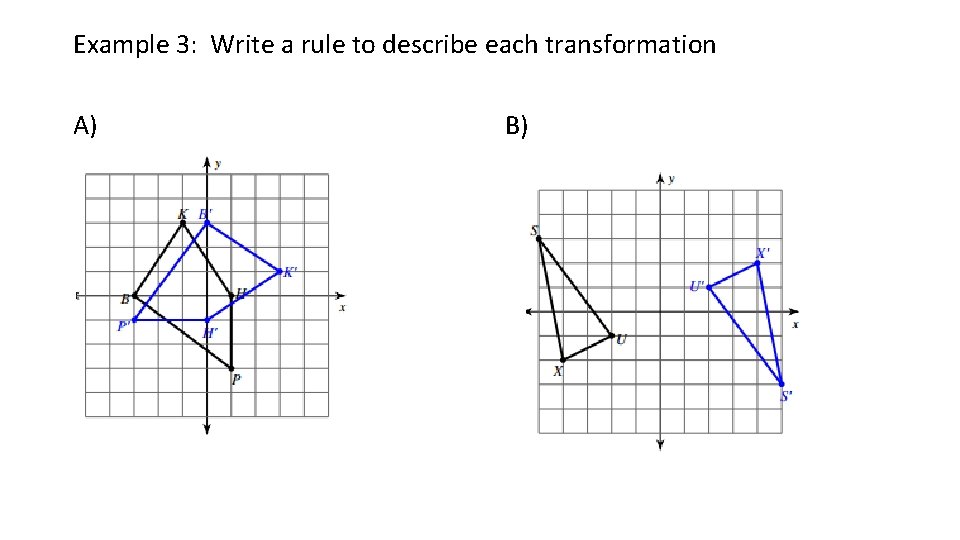
Example 3: Write a rule to describe each transformation A) B)
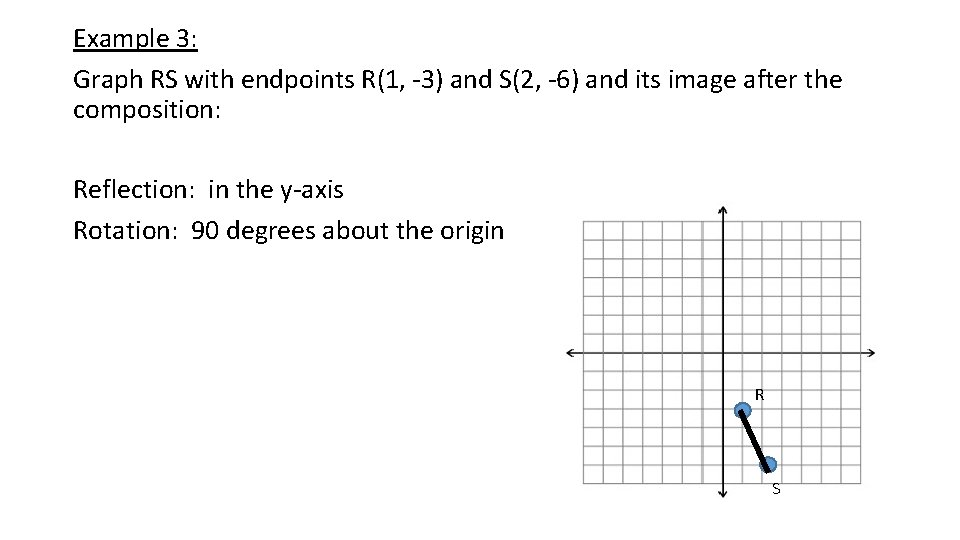
Example 3: Graph RS with endpoints R(1, -3) and S(2, -6) and its image after the composition: Reflection: in the y-axis Rotation: 90 degrees about the origin R S
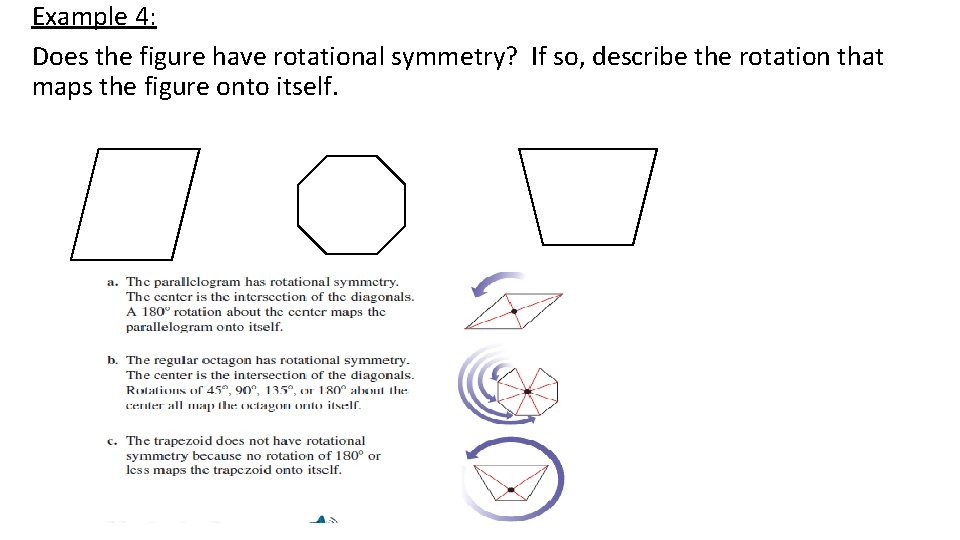
Example 4: Does the figure have rotational symmetry? If so, describe the rotation that maps the figure onto itself.
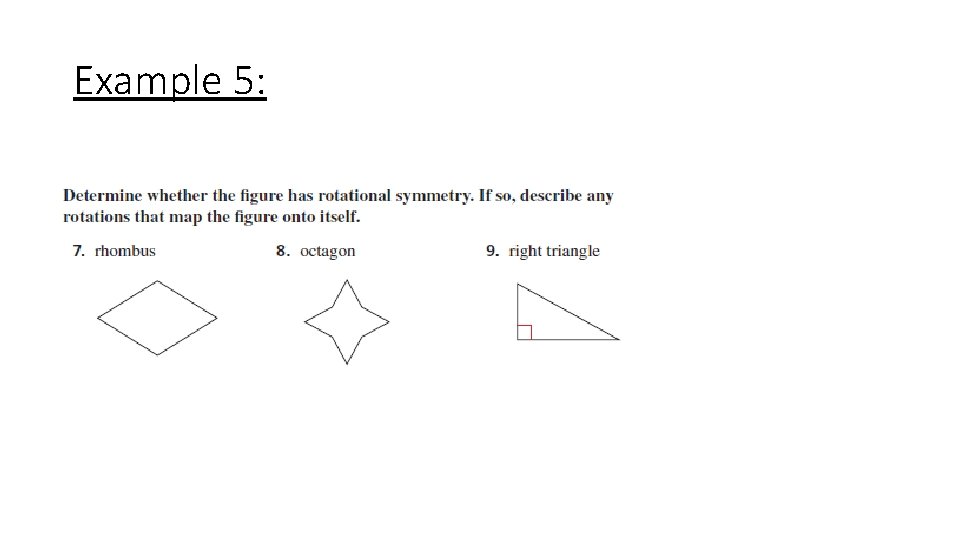
Example 5: