
Section 4 3 Polynomial Division The Remainder Theorem

- Slides: 13
Section 4. 3 Polynomial Division; The Remainder Theorem and Factor Theorem Copyright © 2017, 2013, 2009 Pearson Education, Inc.
Objectives · Perform long division with polynomials and determine whether one polynomial is a factor of another. · Use synthetic division to divide a polynomial by x c. · Use the remainder theorem to find a function value f (c). · Use the factor theorem to determine whether x c is a factor of f (x). Copyright © 2017, 2013, 2009 Pearson Education, Inc. Slide 4. 3 - 2
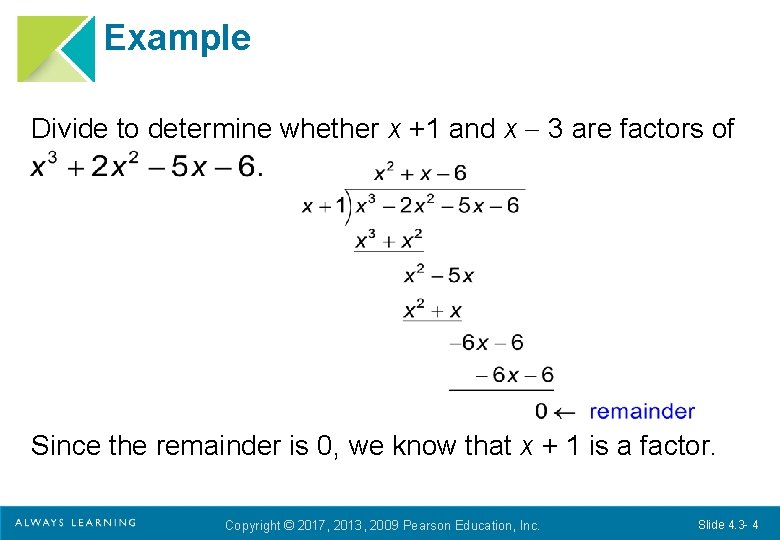
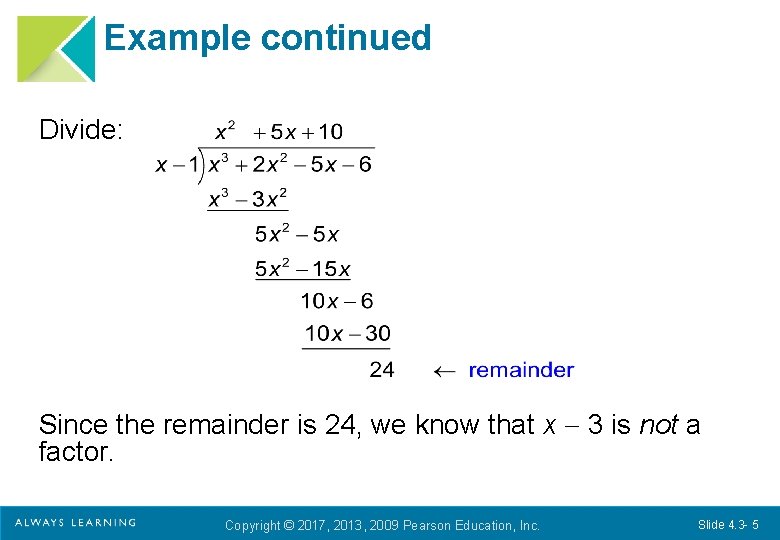
Division and Factors When we divide one polynomial by another, we obtain a quotient and a remainder. If the remainder is 0, then the divisor is a factor of the dividend. Example: Divide to determine whether x + 1 and x 3 are factors of Copyright © 2017, 2013, 2009 Pearson Education, Inc. Slide 4. 3 - 3
Example Divide to determine whether x +1 and x 3 are factors of Since the remainder is 0, we know that x + 1 is a factor. Copyright © 2017, 2013, 2009 Pearson Education, Inc. Slide 4. 3 - 4
Example continued Divide: Since the remainder is 24, we know that x 3 is not a factor. Copyright © 2017, 2013, 2009 Pearson Education, Inc. Slide 4. 3 - 5
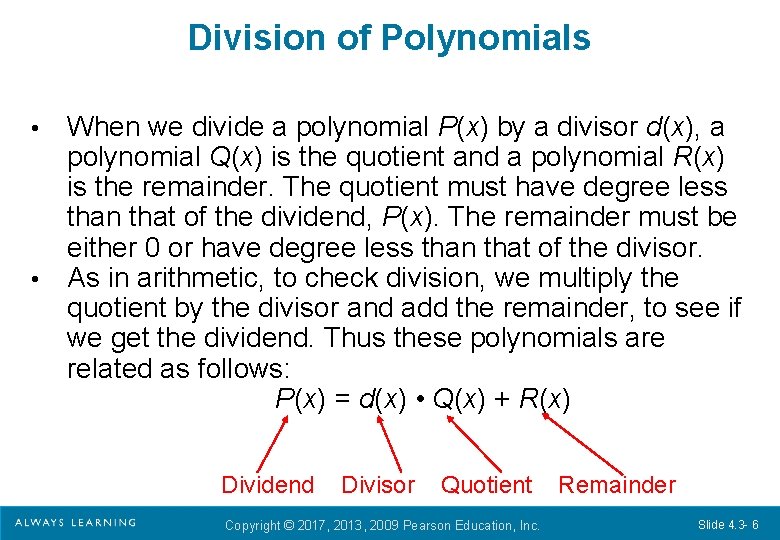
Division of Polynomials When we divide a polynomial P(x) by a divisor d(x), a polynomial Q(x) is the quotient and a polynomial R(x) is the remainder. The quotient must have degree less than that of the dividend, P(x). The remainder must be either 0 or have degree less than that of the divisor. • As in arithmetic, to check division, we multiply the quotient by the divisor and add the remainder, to see if we get the dividend. Thus these polynomials are related as follows: P(x) = d(x) • Q(x) + R(x) • Dividend Divisor Quotient Remainder Copyright © 2017, 2013, 2009 Pearson Education, Inc. Slide 4. 3 - 6
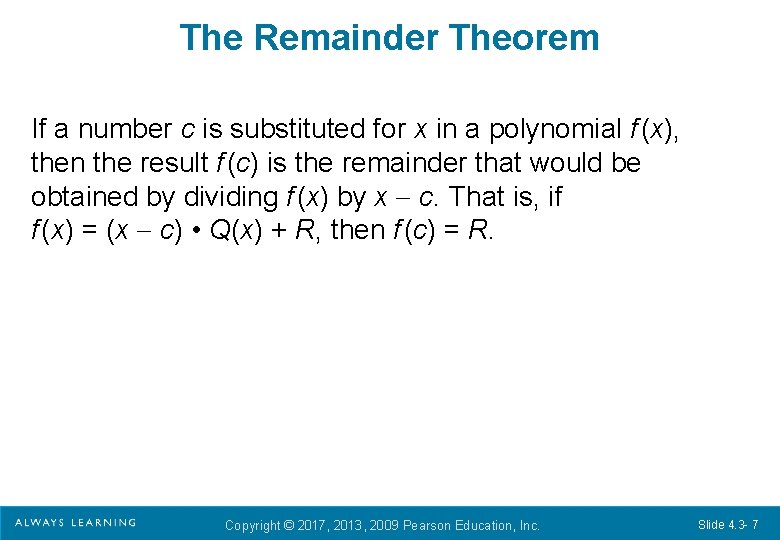
The Remainder Theorem If a number c is substituted for x in a polynomial f (x), then the result f (c) is the remainder that would be obtained by dividing f (x) by x c. That is, if f (x) = (x c) • Q(x) + R, then f (c) = R. Copyright © 2017, 2013, 2009 Pearson Education, Inc. Slide 4. 3 - 7
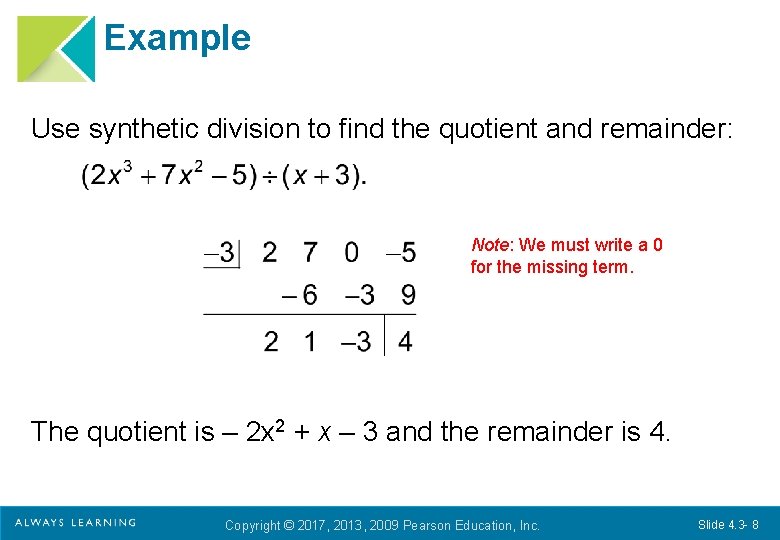
Example Use synthetic division to find the quotient and remainder: Note: We must write a 0 for the missing term. The quotient is – 2 x 2 + x – 3 and the remainder is 4. Copyright © 2017, 2013, 2009 Pearson Education, Inc. Slide 4. 3 - 8
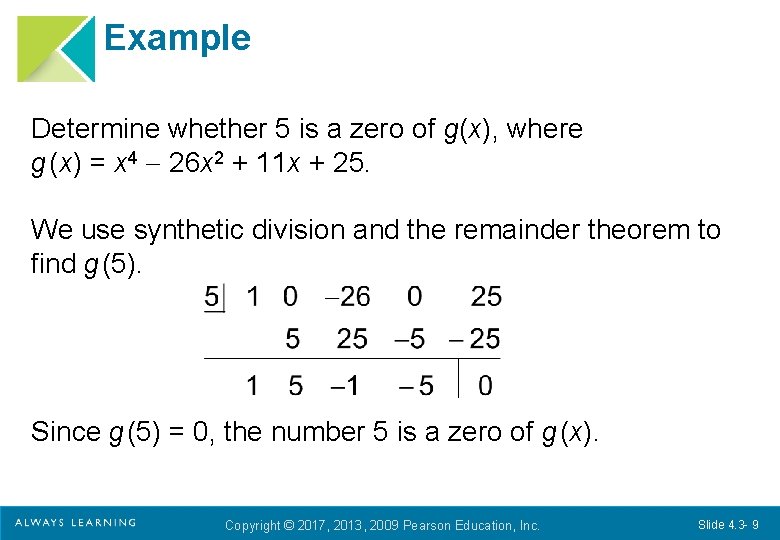
Example Determine whether 5 is a zero of g(x), where g (x) = x 4 26 x 2 + 11 x + 25. We use synthetic division and the remainder theorem to find g (5). Since g (5) = 0, the number 5 is a zero of g (x). Copyright © 2017, 2013, 2009 Pearson Education, Inc. Slide 4. 3 - 9
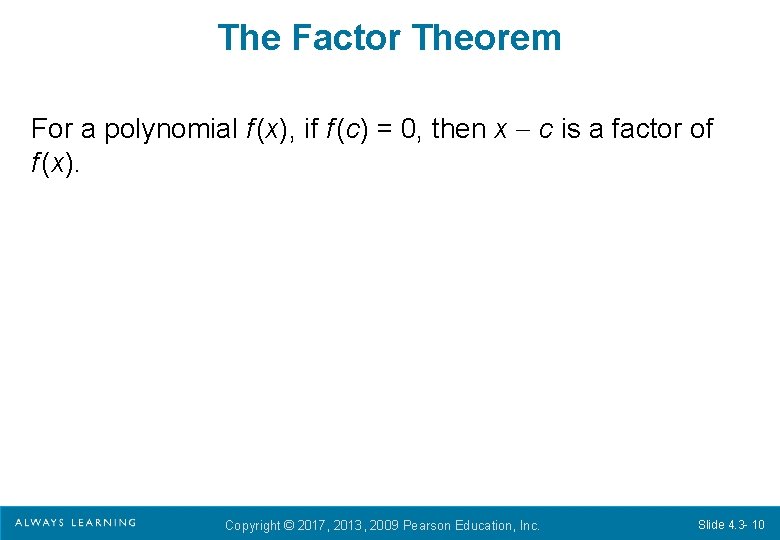
The Factor Theorem For a polynomial f (x), if f (c) = 0, then x c is a factor of f (x). Copyright © 2017, 2013, 2009 Pearson Education, Inc. Slide 4. 3 - 10
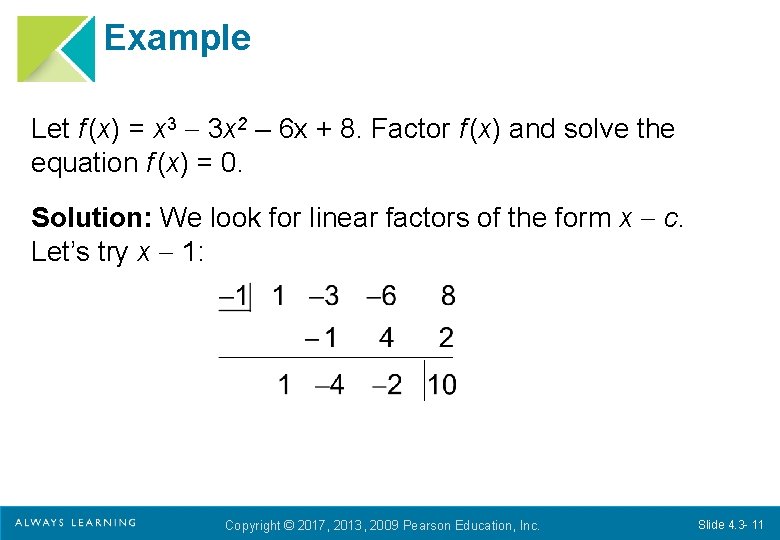
Example Let f (x) = x 3 3 x 2 – 6 x + 8. Factor f (x) and solve the equation f (x) = 0. Solution: We look for linear factors of the form x c. Let’s try x 1: Copyright © 2017, 2013, 2009 Pearson Education, Inc. Slide 4. 3 - 11
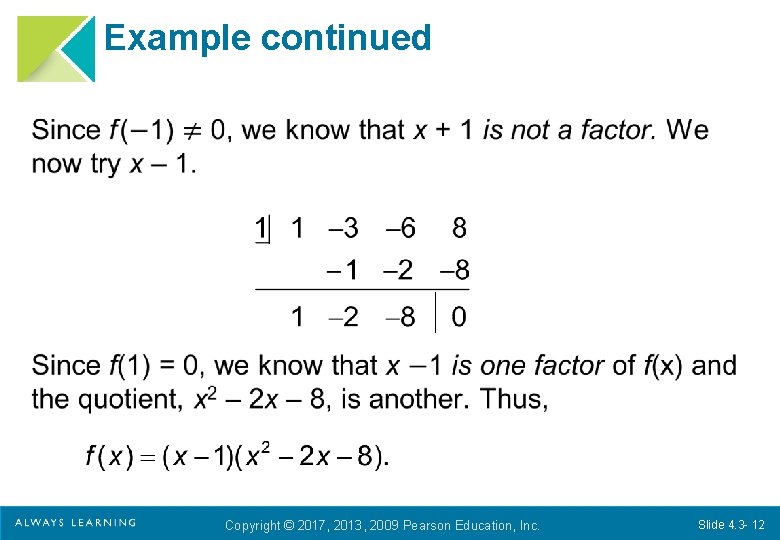
Example continued Copyright © 2017, 2013, 2009 Pearson Education, Inc. Slide 4. 3 - 12
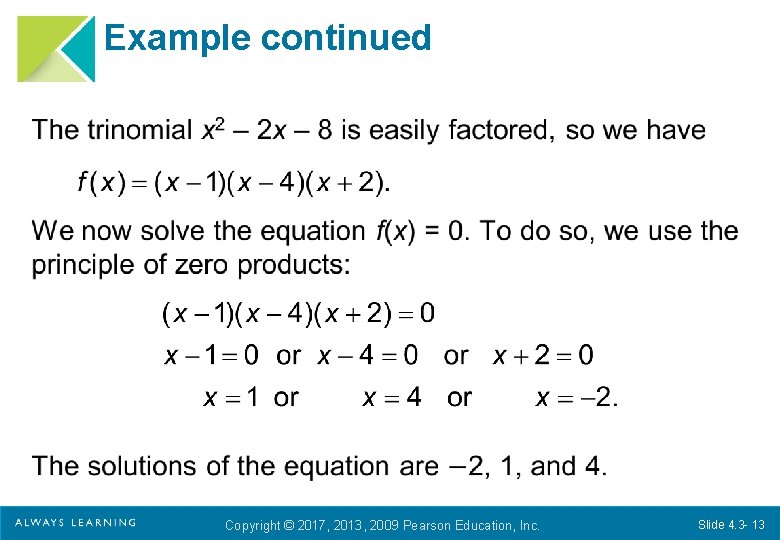
Example continued Copyright © 2017, 2013, 2009 Pearson Education, Inc. Slide 4. 3 - 13