
Section 4 2 Written Algorithms for whole number
Section 4. 2 Written Algorithms for whole number operations An algorithm is a systematic, step-by-step procedure used to find an answer, usually to a computation. The common written algorithm for addition involves two main procedures: (1) adding single digits and (2) carrying (regrouping).
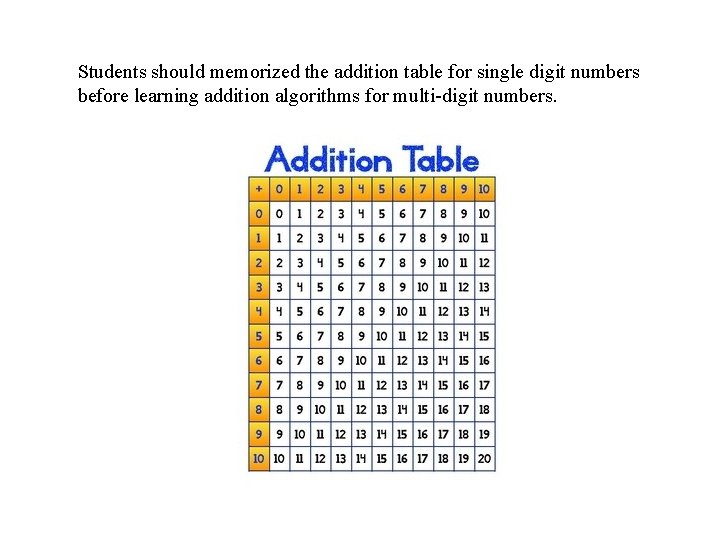
Students should memorized the addition table for single digit numbers before learning addition algorithms for multi-digit numbers.
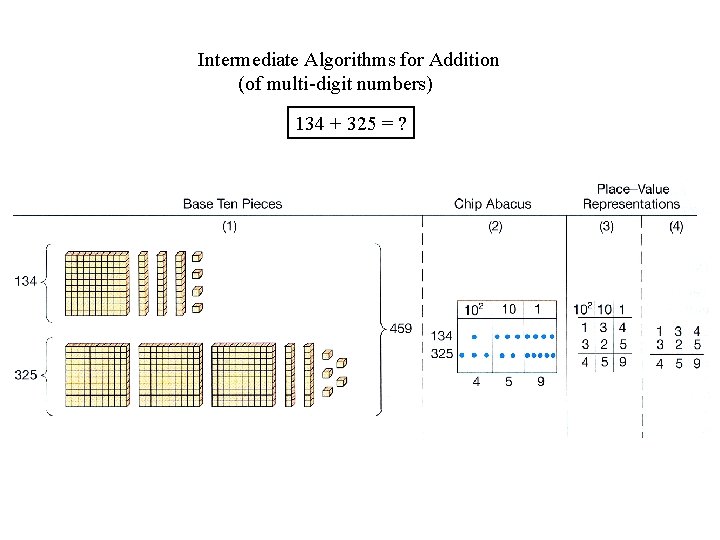
Intermediate Algorithms for Addition (of multi-digit numbers) 134 + 325 = ?
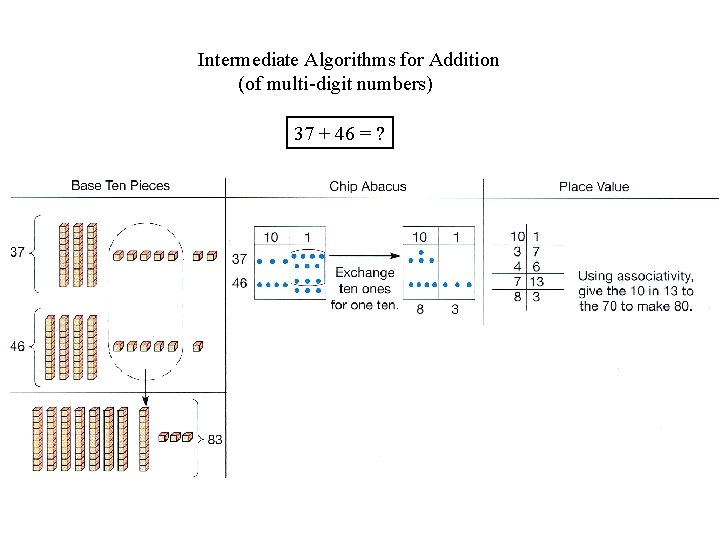
Intermediate Algorithms for Addition (of multi-digit numbers) 37 + 46 = ?
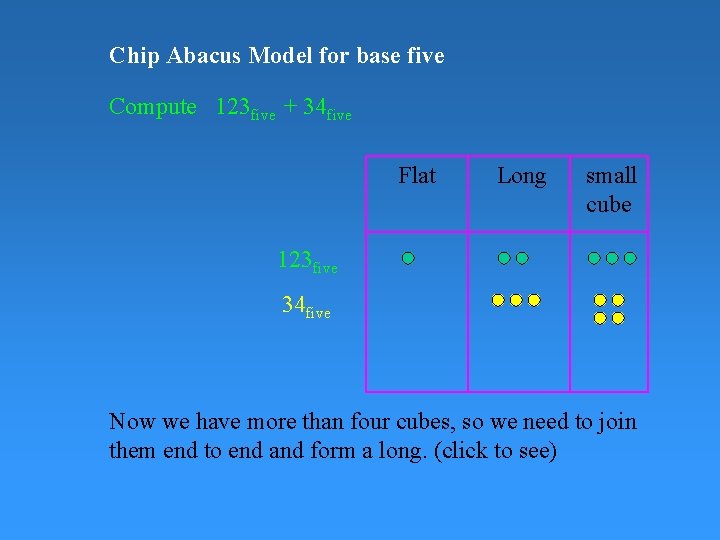
Chip Abacus Model for base five Compute 123 five + 34 five Flat Long small cube 123 five 34 five Now we have more than four cubes, so we need to join them end to end and form a long. (click to see)

Chip Abacus Model for base five Compute 123 five + 34 five Flat 123 five 34 five Long small cube
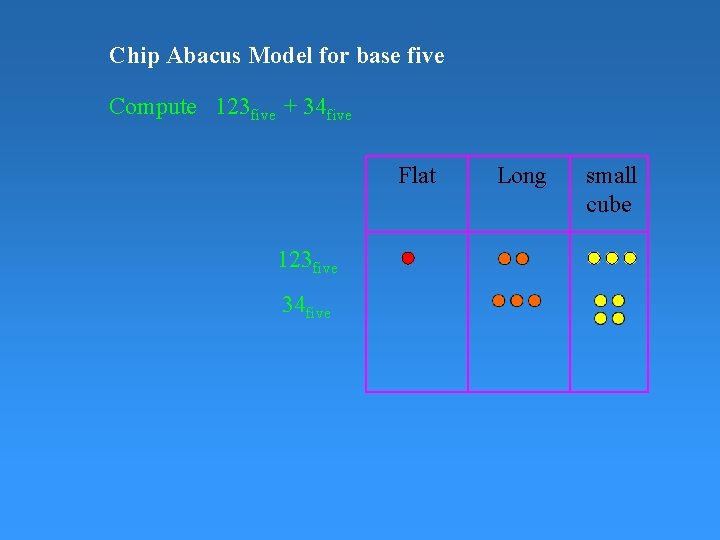
Chip Abacus Model for base five Compute 123 five + 34 five Flat 123 five 34 five Long small cube
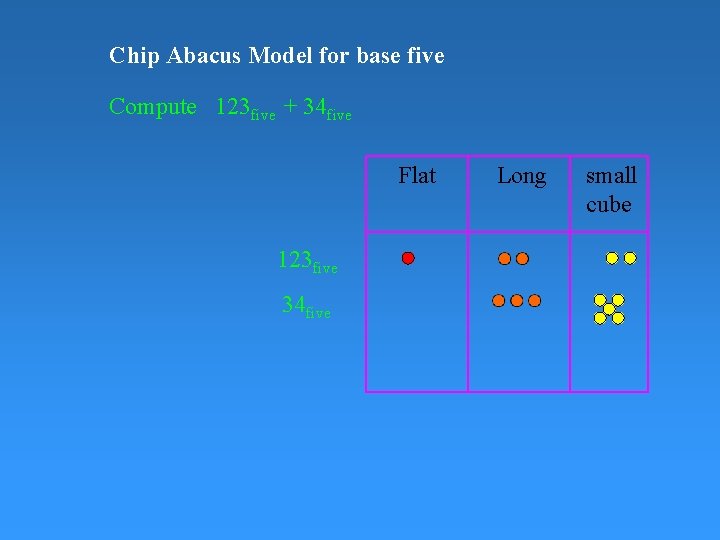
Chip Abacus Model for base five Compute 123 five + 34 five Flat 123 five 34 five Long small cube
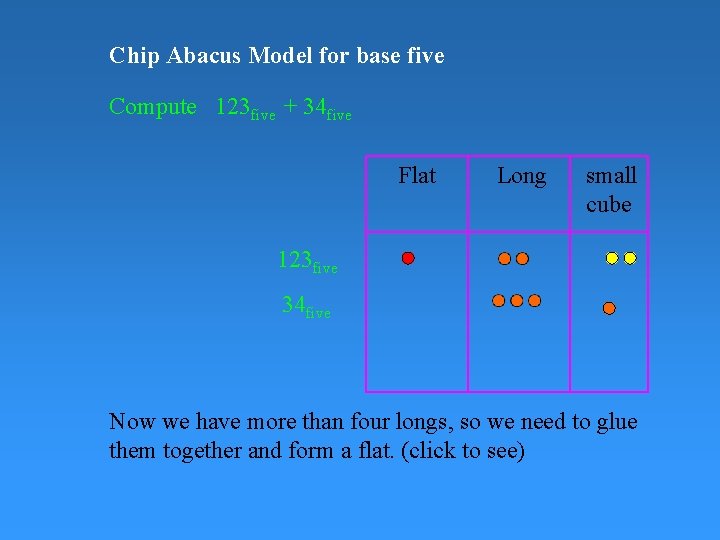
Chip Abacus Model for base five Compute 123 five + 34 five Flat Long small cube 123 five 34 five Now we have more than four longs, so we need to glue them together and form a flat. (click to see)
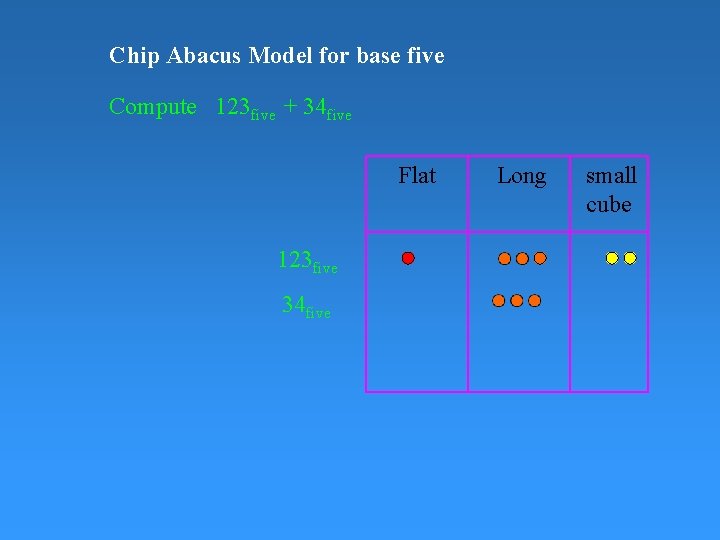
Chip Abacus Model for base five Compute 123 five + 34 five Flat 123 five 34 five Long small cube
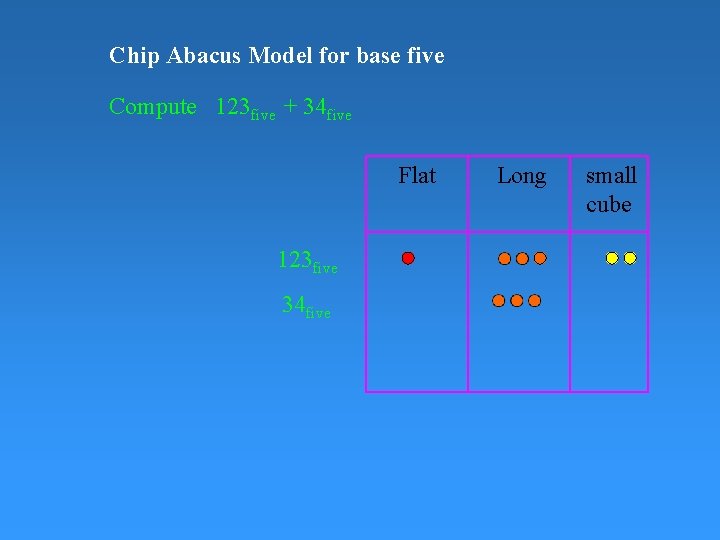
Chip Abacus Model for base five Compute 123 five + 34 five Flat 123 five 34 five Long small cube
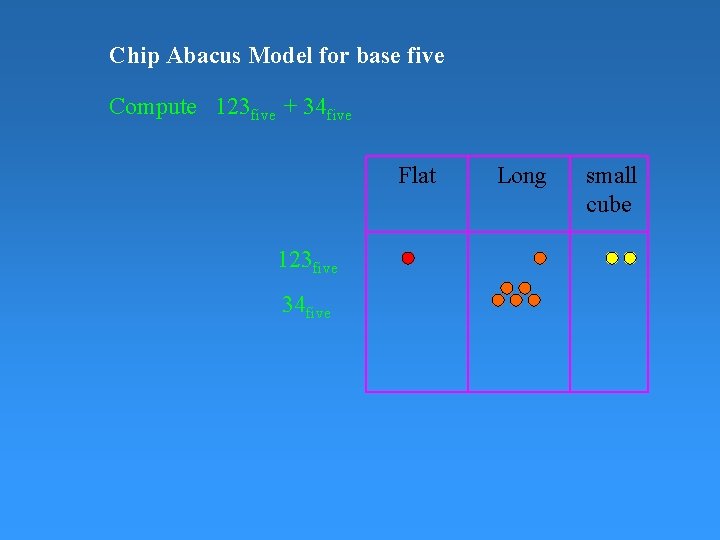
Chip Abacus Model for base five Compute 123 five + 34 five Flat 123 five 34 five Long small cube
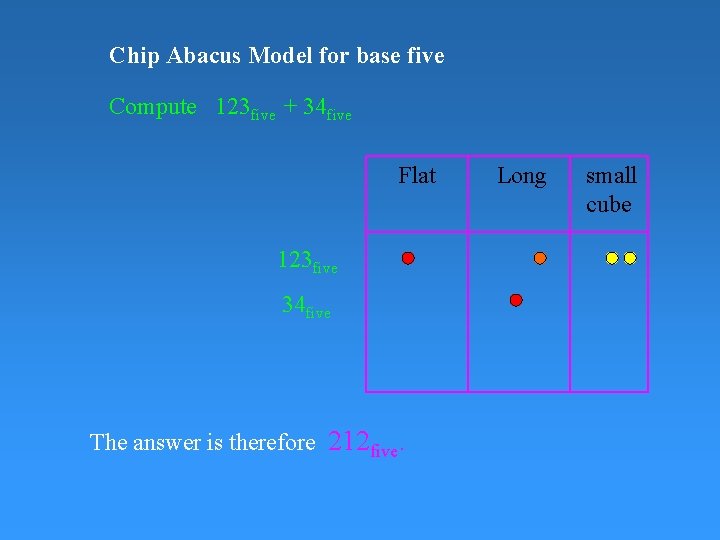
Chip Abacus Model for base five Compute 123 five + 34 five Flat 123 five 34 five The answer is therefore 212 five. Long small cube
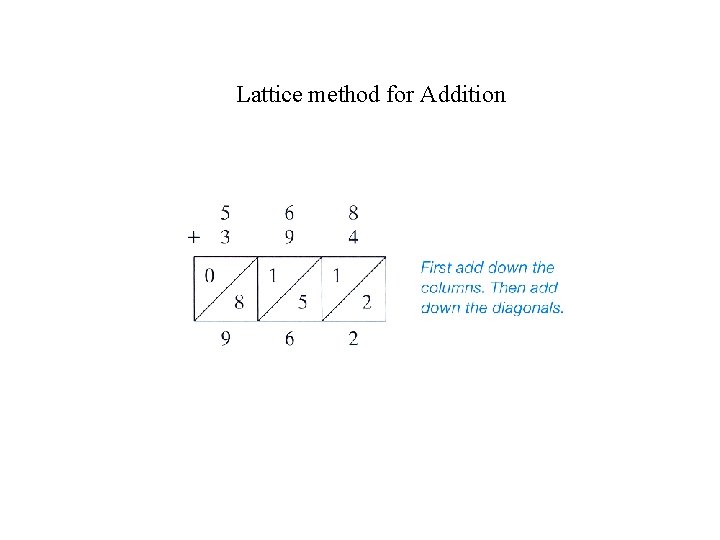
Lattice method for Addition
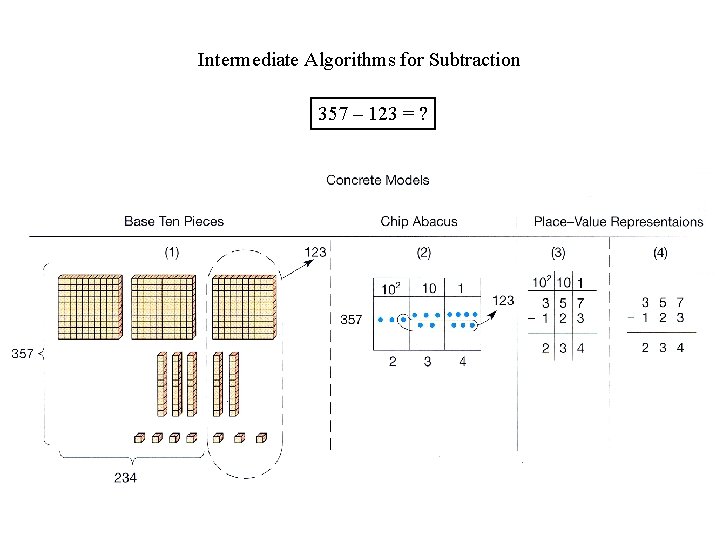
Intermediate Algorithms for Subtraction 357 – 123 = ?
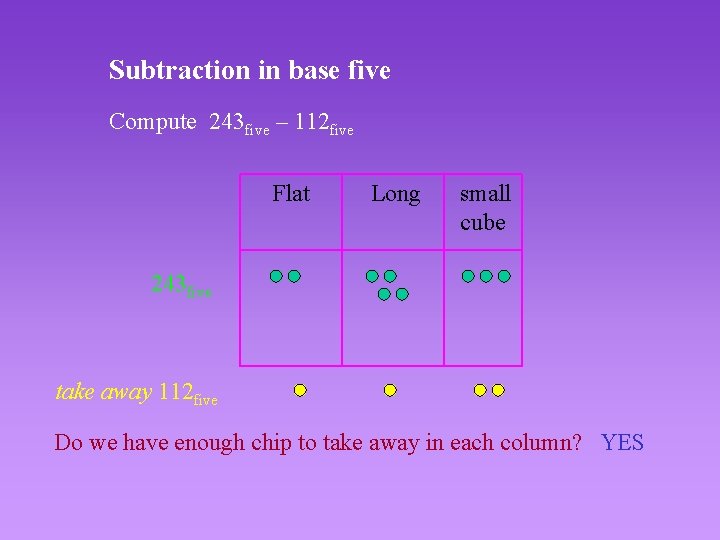
Subtraction in base five Compute 243 five – 112 five Flat Long small cube 243 five take away 112 five Do we have enough chip to take away in each column? YES
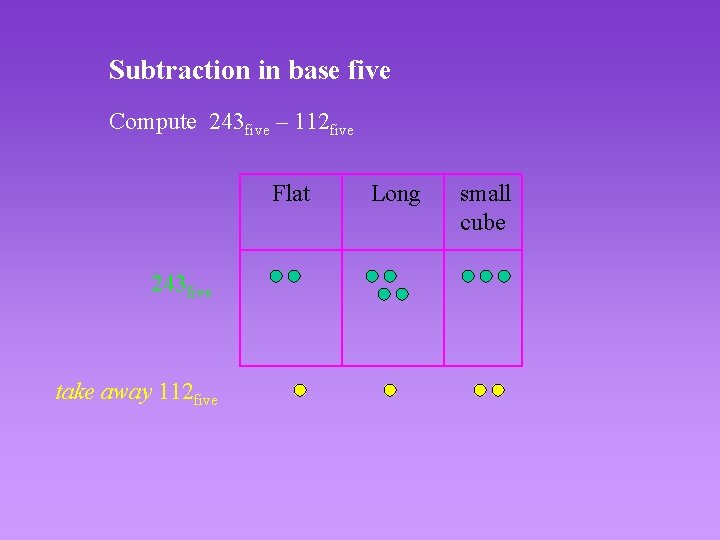
Subtraction in base five Compute 243 five – 112 five Flat 243 five take away 112 five Long small cube
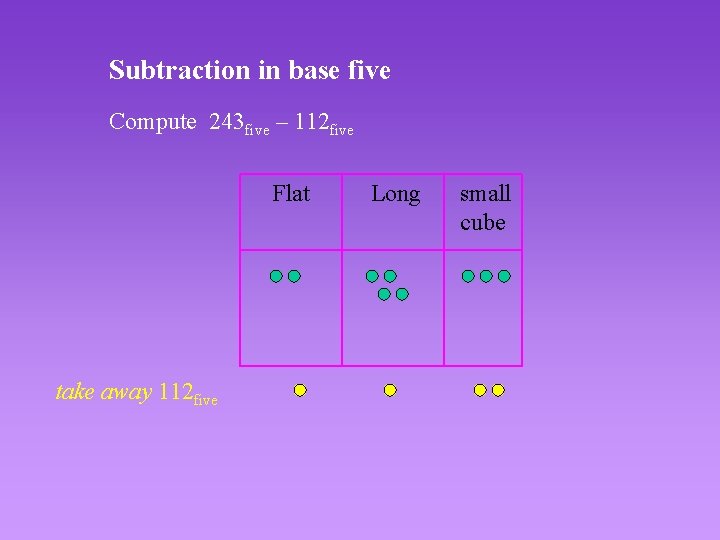
Subtraction in base five Compute 243 five – 112 five Flat take away 112 five Long small cube
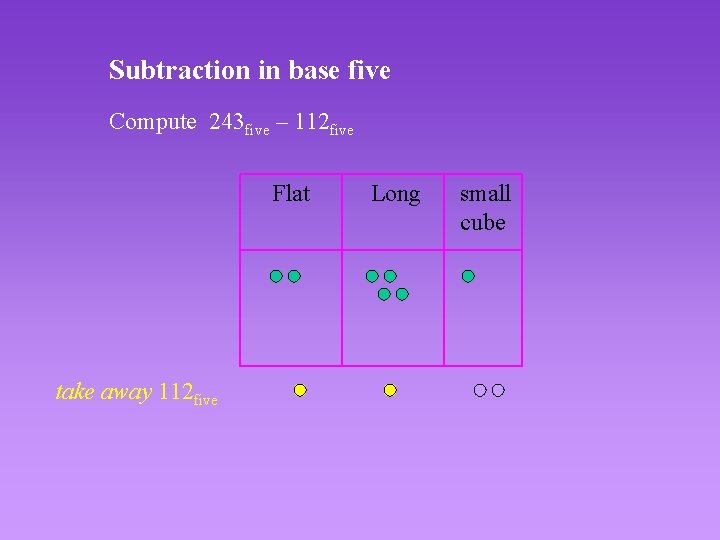
Subtraction in base five Compute 243 five – 112 five Flat take away 112 five Long small cube
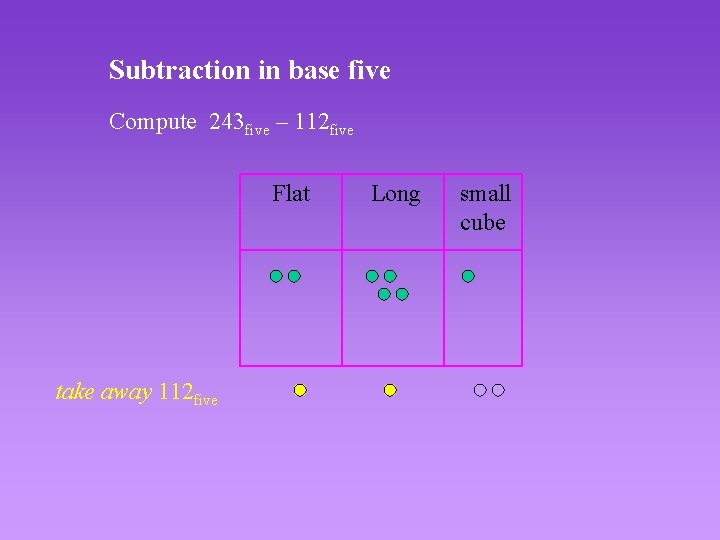
Subtraction in base five Compute 243 five – 112 five Flat take away 112 five Long small cube
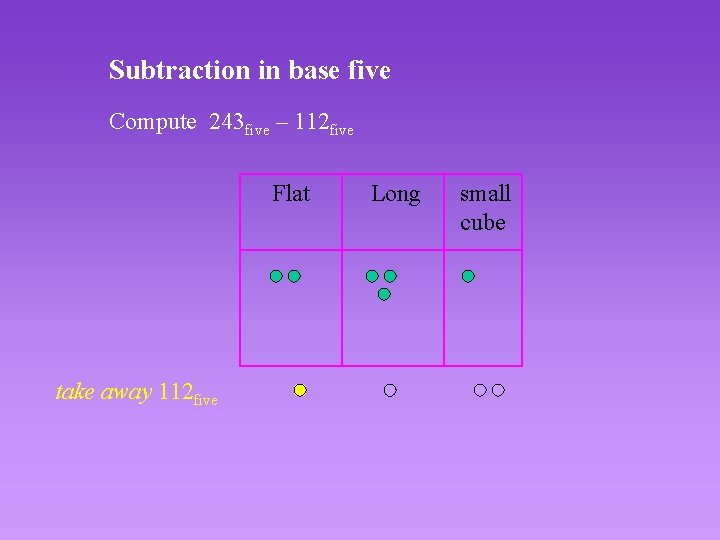
Subtraction in base five Compute 243 five – 112 five Flat take away 112 five Long small cube
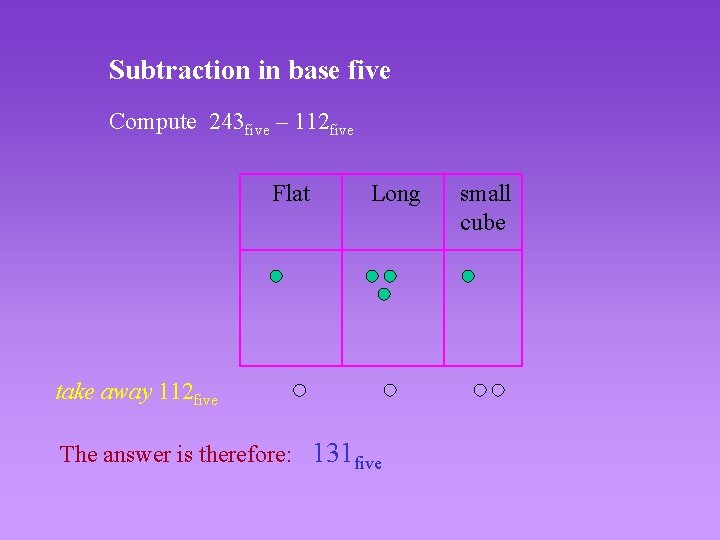
Subtraction in base five Compute 243 five – 112 five Flat Long take away 112 five The answer is therefore: 131 five small cube
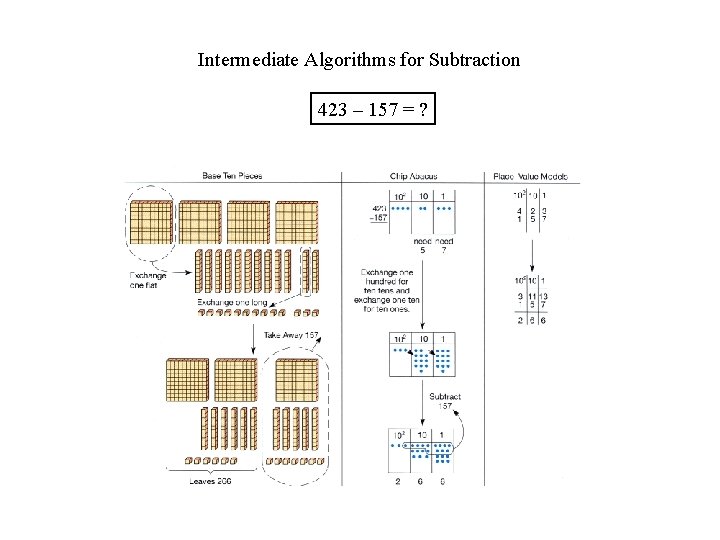
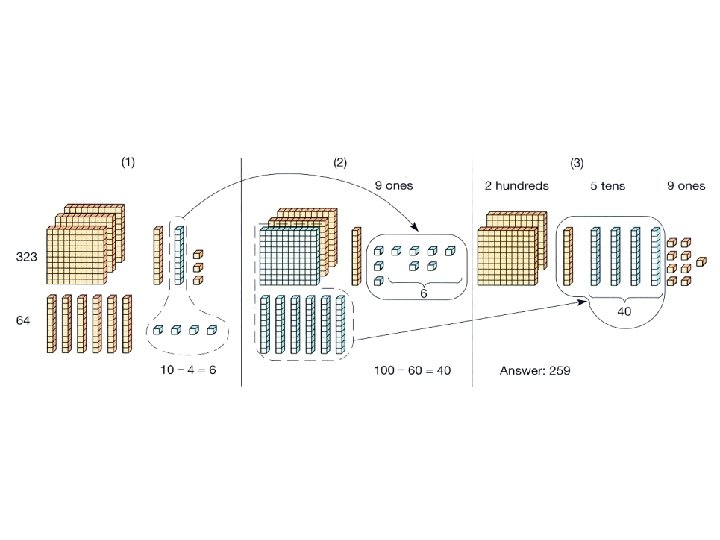
Intermediate Algorithms for Subtraction 423 – 157 = ?
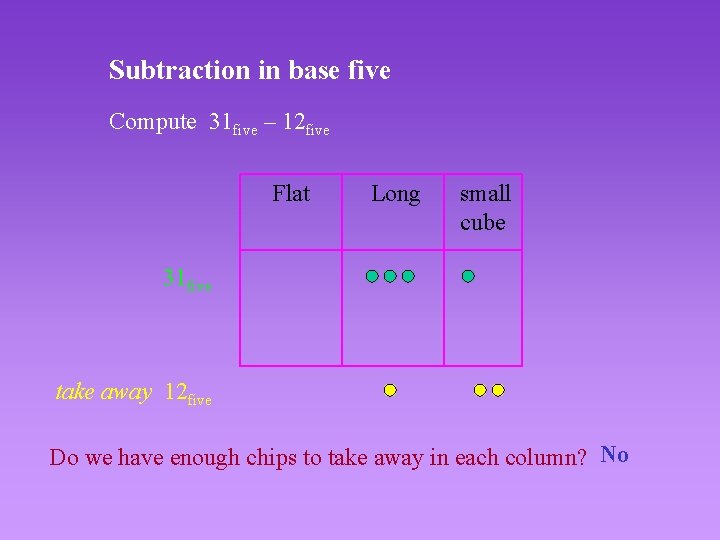
Subtraction in base five Compute 31 five – 12 five Flat Long small cube 31 five take away 12 five Do we have enough chips to take away in each column? No
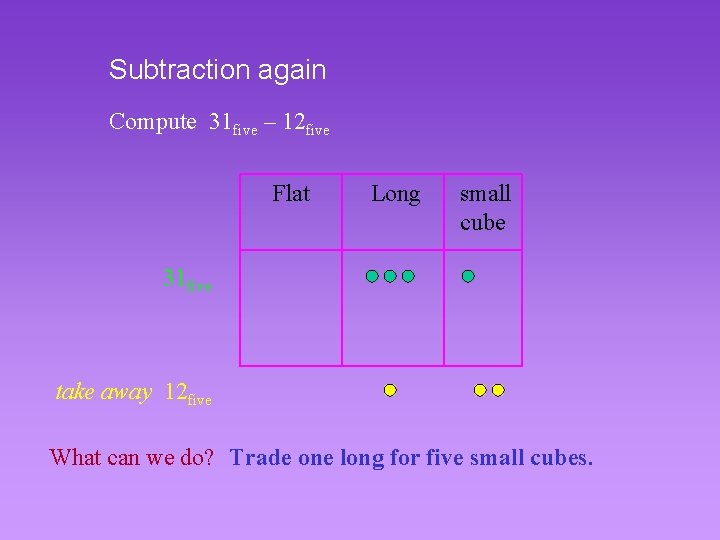
Subtraction again Compute 31 five – 12 five Flat Long small cube 31 five take away 12 five What can we do? Trade one long for five small cubes.
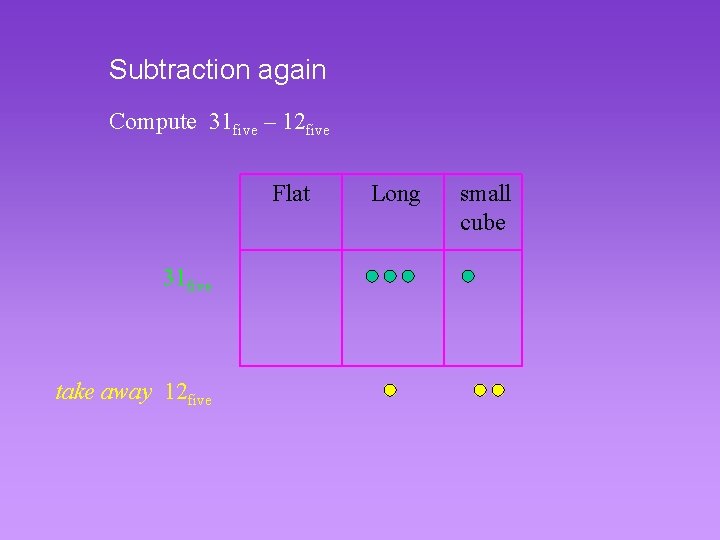
Subtraction again Compute 31 five – 12 five Flat 31 five take away 12 five Long small cube
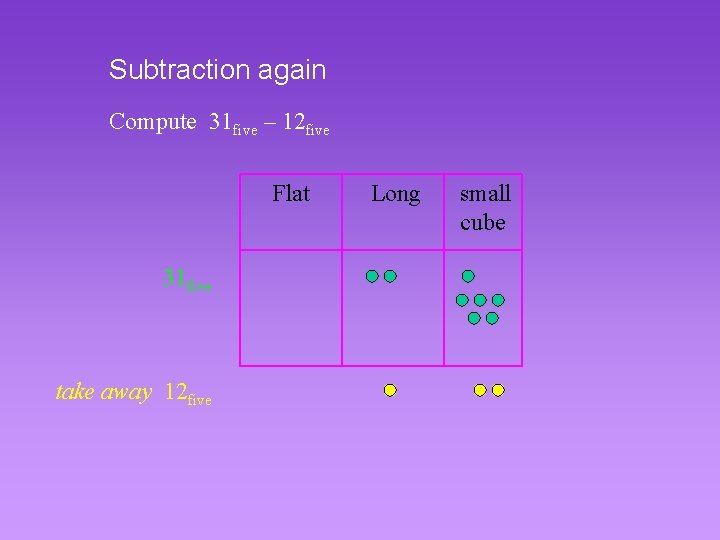
Subtraction again Compute 31 five – 12 five Flat 31 five take away 12 five Long small cube
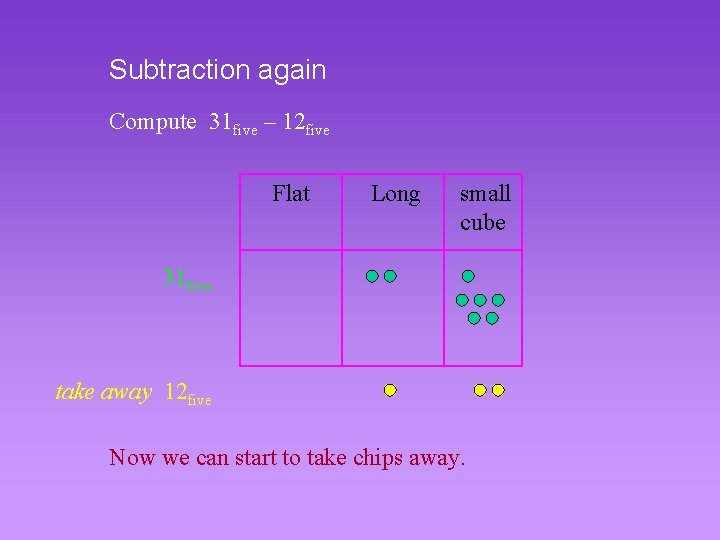
Subtraction again Compute 31 five – 12 five Flat Long small cube 31 five take away 12 five Now we can start to take chips away.
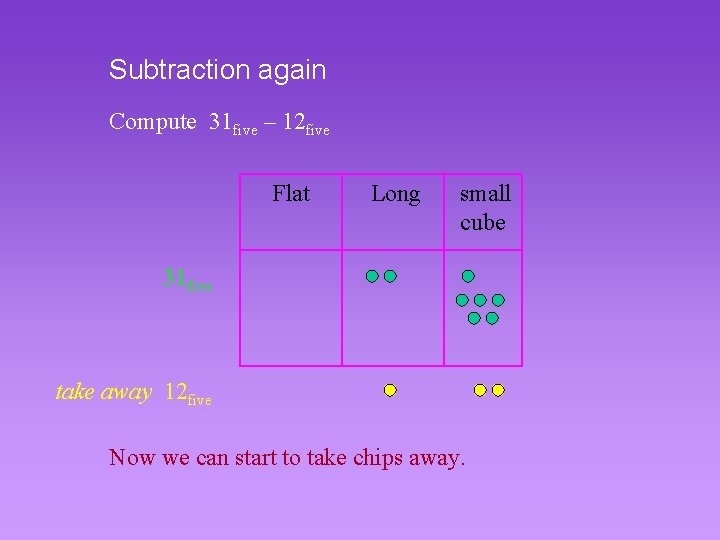
Subtraction again Compute 31 five – 12 five Flat Long small cube 31 five take away 12 five Now we can start to take chips away.
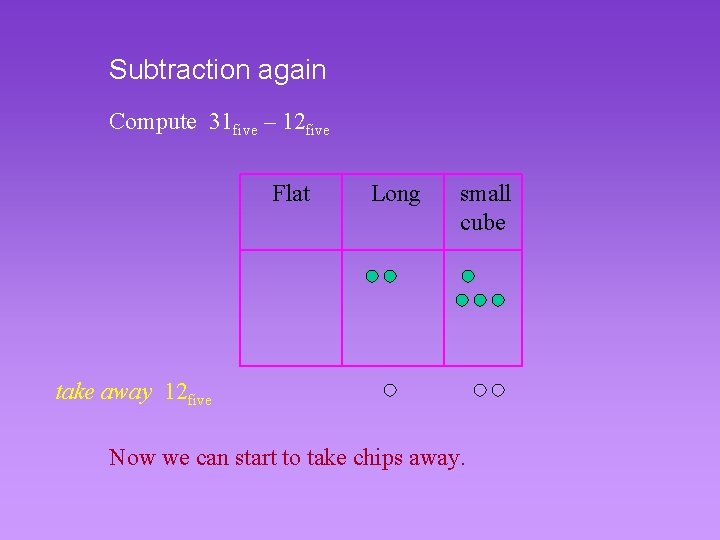
Subtraction again Compute 31 five – 12 five Flat Long small cube take away 12 five Now we can start to take chips away.
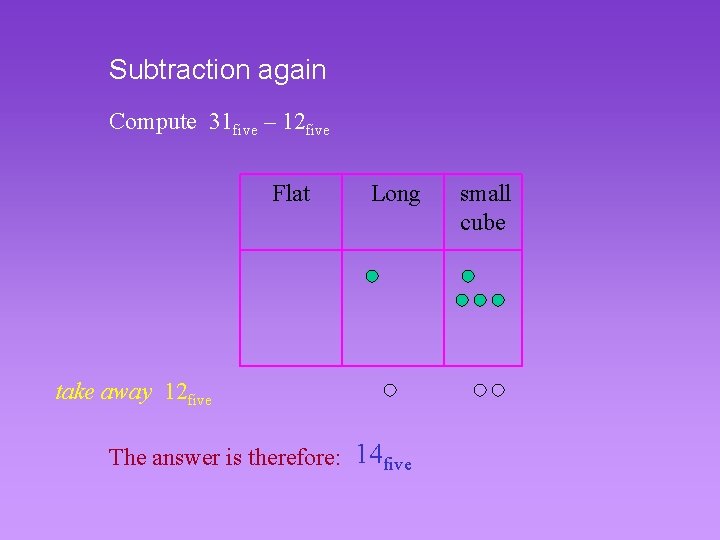
Subtraction again Compute 31 five – 12 five Flat Long take away 12 five The answer is therefore: 14 five small cube
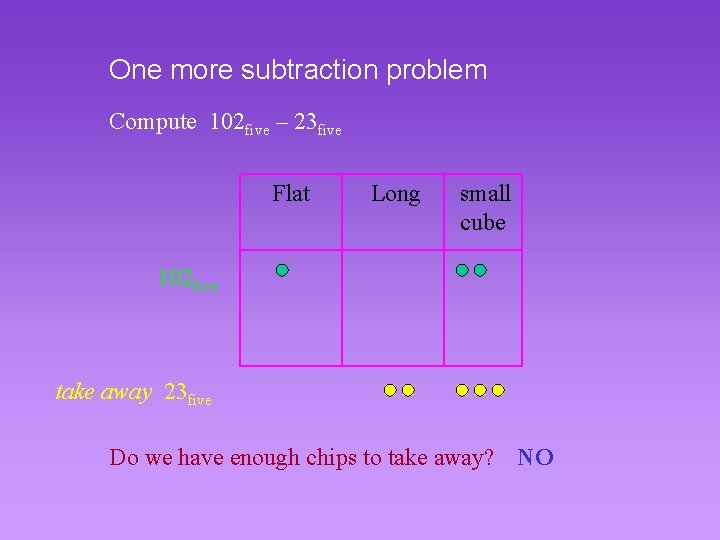
One more subtraction problem Compute 102 five – 23 five Flat Long small cube 102 five take away 23 five Do we have enough chips to take away? NO
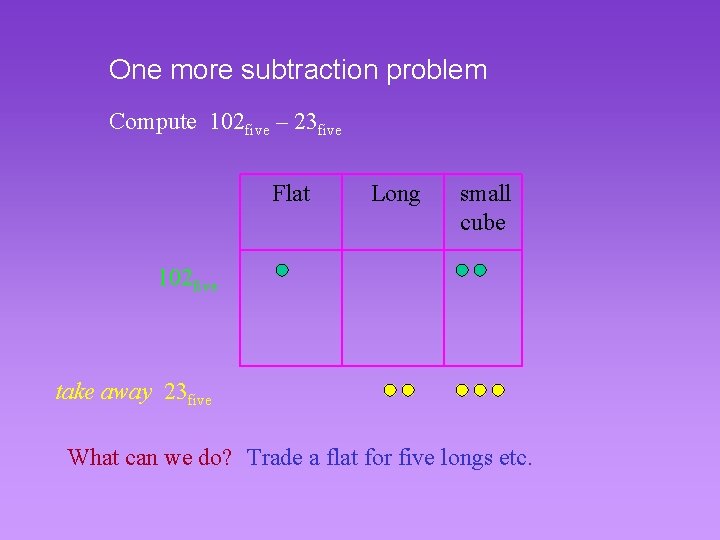
One more subtraction problem Compute 102 five – 23 five Flat Long small cube 102 five take away 23 five What can we do? Trade a flat for five longs etc.
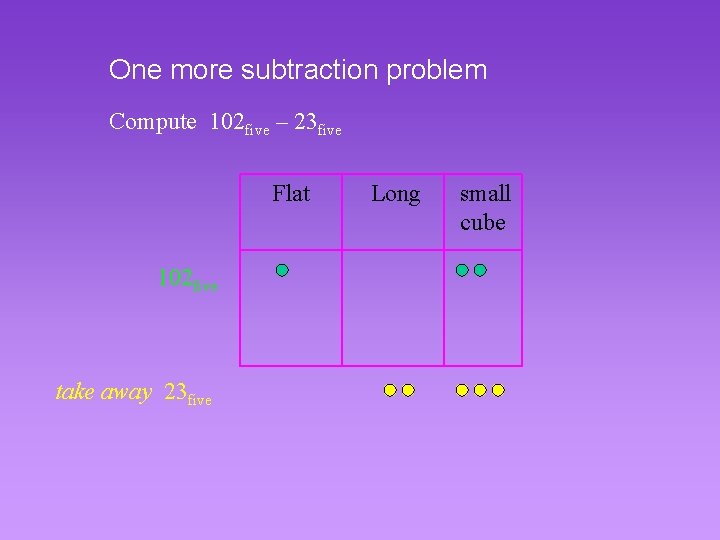
One more subtraction problem Compute 102 five – 23 five Flat 102 five take away 23 five Long small cube
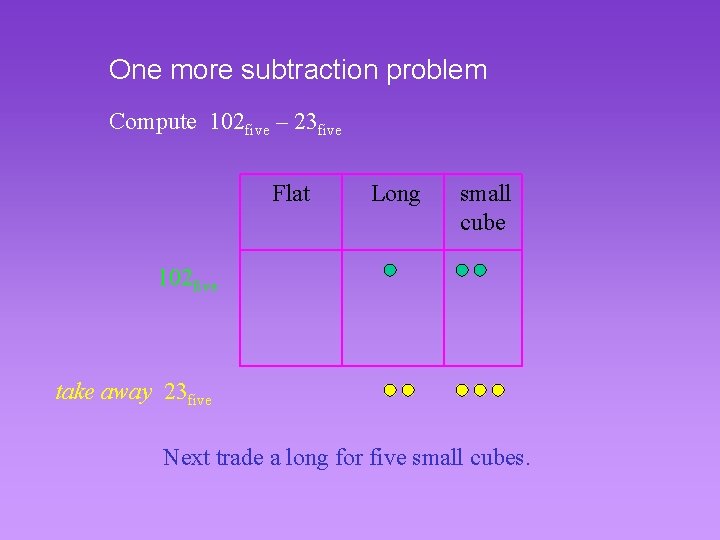
One more subtraction problem Compute 102 five – 23 five Flat Long small cube 102 five take away 23 five Next trade a long for five small cubes.
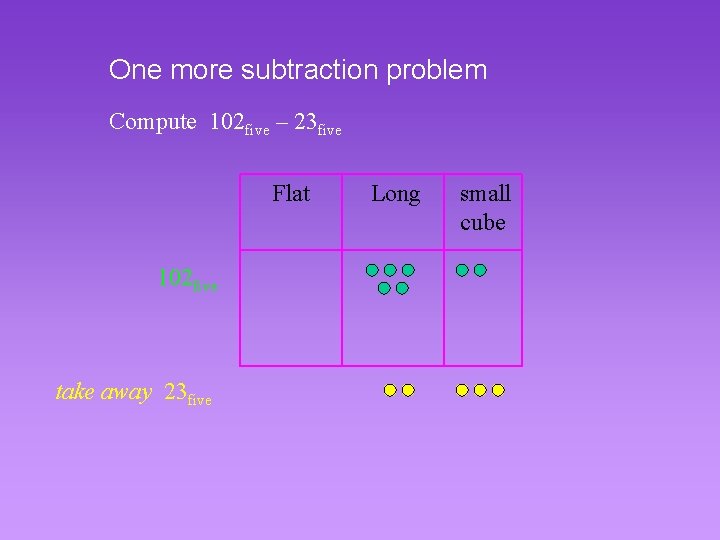
One more subtraction problem Compute 102 five – 23 five Flat 102 five take away 23 five Long small cube
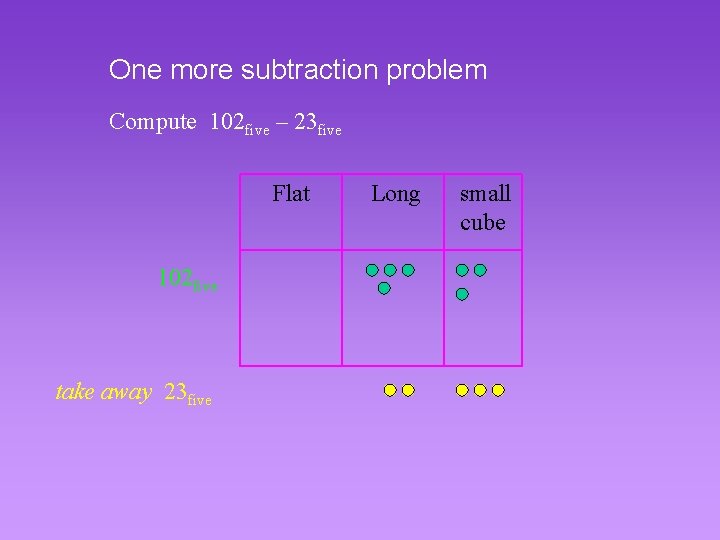
One more subtraction problem Compute 102 five – 23 five Flat 102 five take away 23 five Long small cube
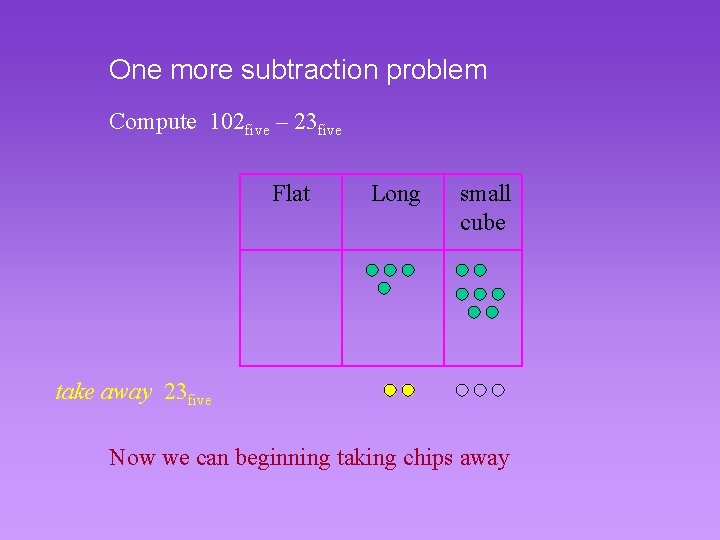
One more subtraction problem Compute 102 five – 23 five Flat Long small cube take away 23 five Now we can beginning taking chips away
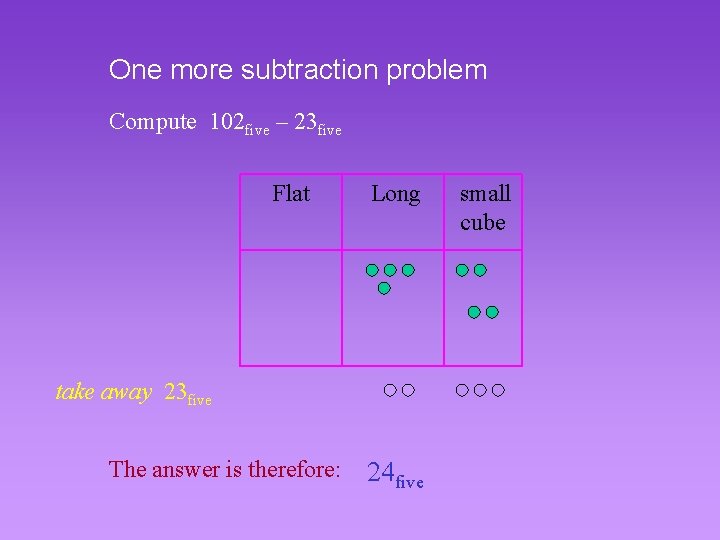
One more subtraction problem Compute 102 five – 23 five Flat Long take away 23 five The answer is therefore: 24 five small cube
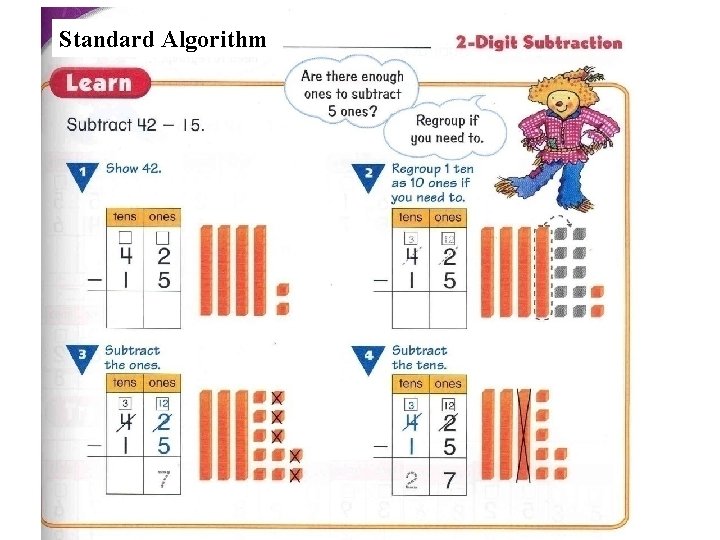
Standard Algorithm
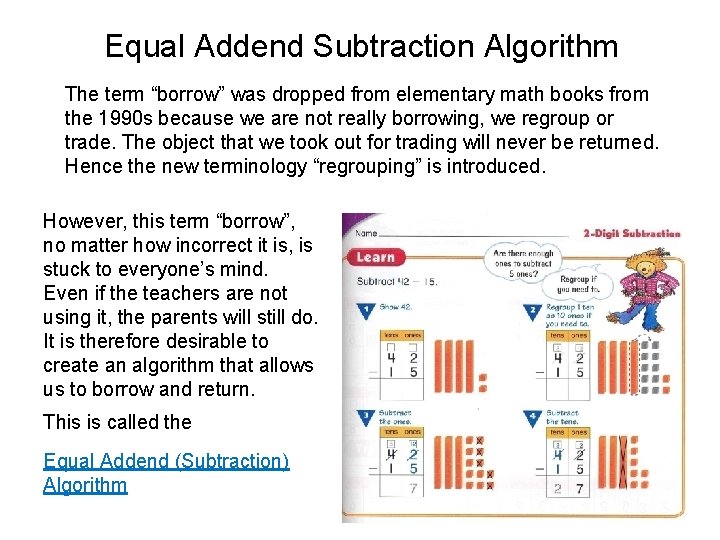
Equal Addend Subtraction Algorithm The term “borrow” was dropped from elementary math books from the 1990 s because we are not really borrowing, we regroup or trade. The object that we took out for trading will never be returned. Hence the new terminology “regrouping” is introduced. However, this term “borrow”, no matter how incorrect it is, is stuck to everyone’s mind. Even if the teachers are not using it, the parents will still do. It is therefore desirable to create an algorithm that allows us to borrow and return. This is called the Equal Addend (Subtraction) Algorithm
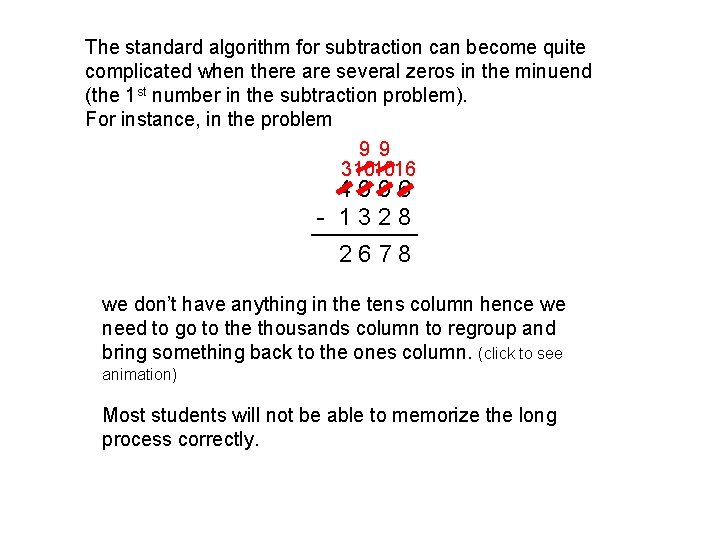
The standard algorithm for subtraction can become quite complicated when there are several zeros in the minuend (the 1 st number in the subtraction problem). For instance, in the problem 9 9 3101016 4006 - 1328 ¯¯¯¯ 26 78 we don’t have anything in the tens column hence we need to go to the thousands column to regroup and bring something back to the ones column. (click to see animation) Most students will not be able to memorize the long process correctly.
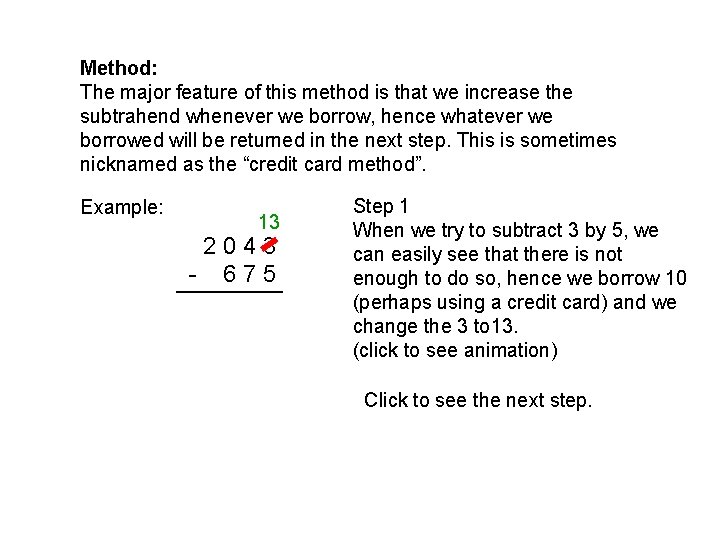
Method: The major feature of this method is that we increase the subtrahend whenever we borrow, hence whatever we borrowed will be returned in the next step. This is sometimes nicknamed as the “credit card method”. Example: 13 2043 - 675 ¯¯¯¯ Step 1 When we try to subtract 3 by 5, we can easily see that there is not enough to do so, hence we borrow 10 (perhaps using a credit card) and we change the 3 to 13. (click to see animation) Click to see the next step.
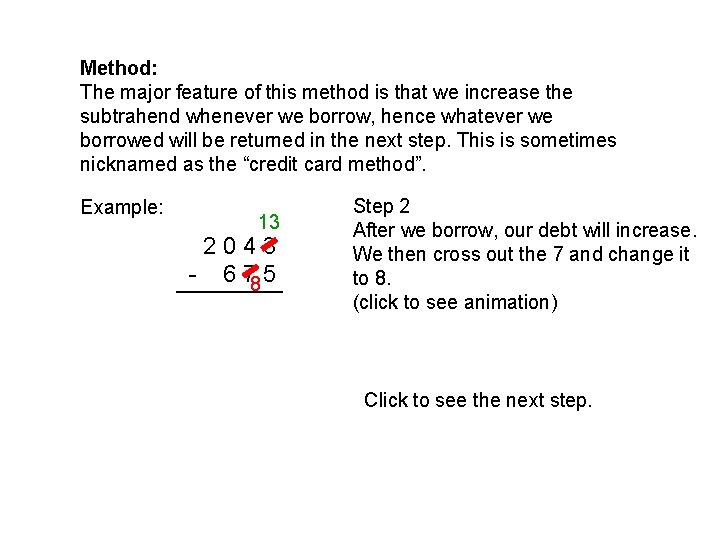
Method: The major feature of this method is that we increase the subtrahend whenever we borrow, hence whatever we borrowed will be returned in the next step. This is sometimes nicknamed as the “credit card method”. Example: 13 2043 - 6 78 5 ¯¯¯¯ Step 2 After we borrow, our debt will increase. We then cross out the 7 and change it to 8. (click to see animation) Click to see the next step.
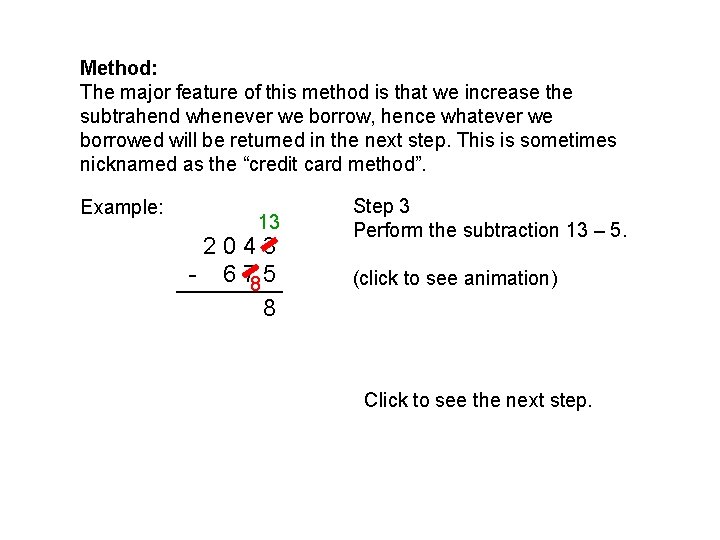
Method: The major feature of this method is that we increase the subtrahend whenever we borrow, hence whatever we borrowed will be returned in the next step. This is sometimes nicknamed as the “credit card method”. Example: 13 2043 - 6 78 5 ¯¯¯¯ 8 Step 3 Perform the subtraction 13 – 5. (click to see animation) Click to see the next step.
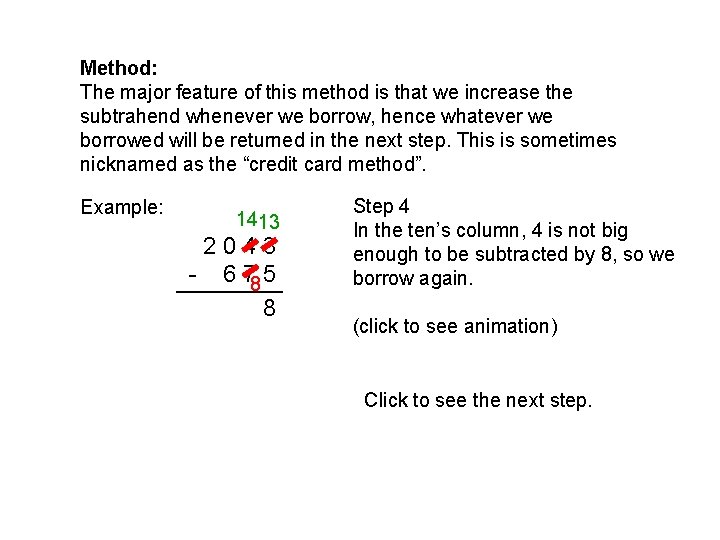
Method: The major feature of this method is that we increase the subtrahend whenever we borrow, hence whatever we borrowed will be returned in the next step. This is sometimes nicknamed as the “credit card method”. Example: 1413 2043 - 6 78 5 ¯¯¯¯ 8 Step 4 In the ten’s column, 4 is not big enough to be subtracted by 8, so we borrow again. (click to see animation) Click to see the next step.
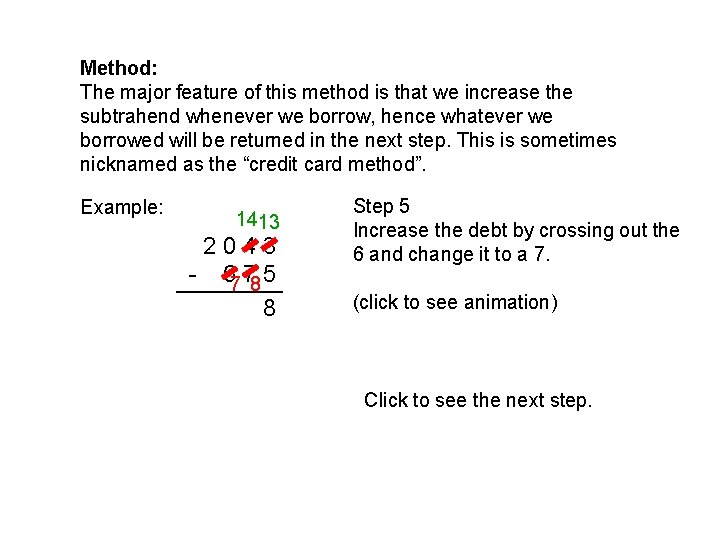
Method: The major feature of this method is that we increase the subtrahend whenever we borrow, hence whatever we borrowed will be returned in the next step. This is sometimes nicknamed as the “credit card method”. Example: 1413 2043 - 67 78 5 ¯¯¯¯ 8 Step 5 Increase the debt by crossing out the 6 and change it to a 7. (click to see animation) Click to see the next step.
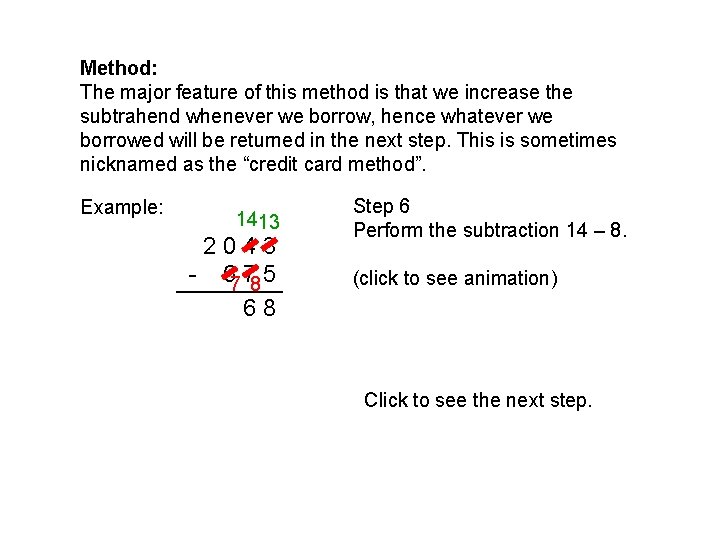
Method: The major feature of this method is that we increase the subtrahend whenever we borrow, hence whatever we borrowed will be returned in the next step. This is sometimes nicknamed as the “credit card method”. Example: 1413 2043 - 67 78 5 ¯¯¯¯ 68 Step 6 Perform the subtraction 14 – 8. (click to see animation) Click to see the next step.
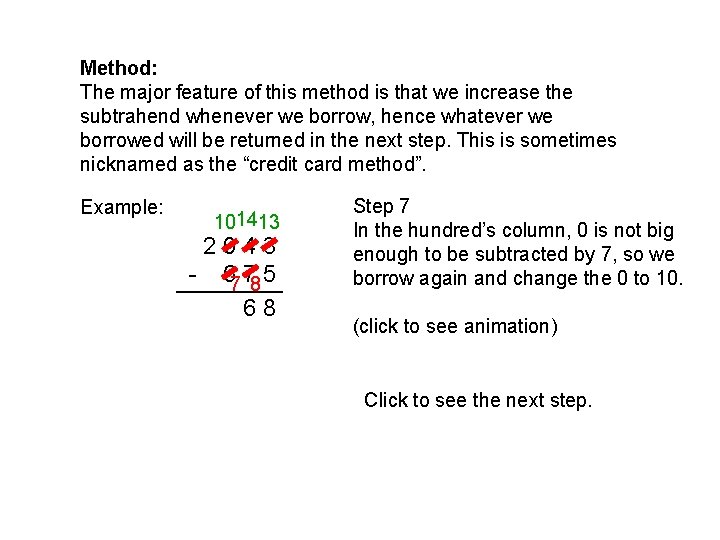
Method: The major feature of this method is that we increase the subtrahend whenever we borrow, hence whatever we borrowed will be returned in the next step. This is sometimes nicknamed as the “credit card method”. Example: 101413 2043 - 67 78 5 ¯¯¯¯ 68 Step 7 In the hundred’s column, 0 is not big enough to be subtracted by 7, so we borrow again and change the 0 to 10. (click to see animation) Click to see the next step.
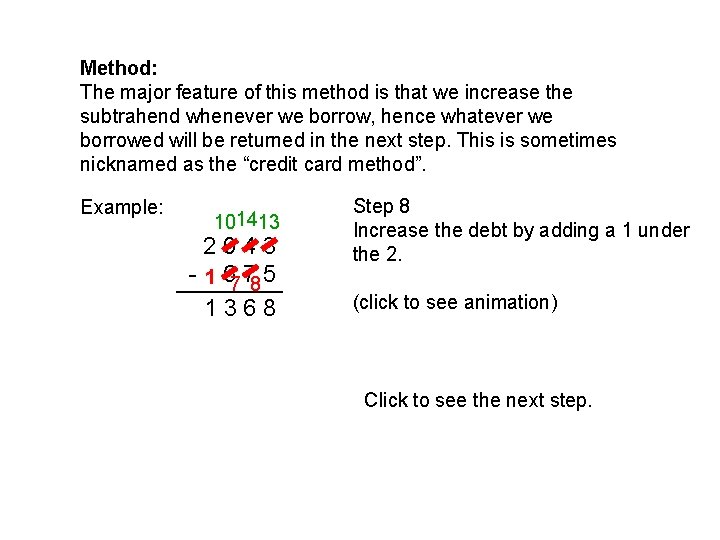
Method: The major feature of this method is that we increase the subtrahend whenever we borrow, hence whatever we borrowed will be returned in the next step. This is sometimes nicknamed as the “credit card method”. Example: 101413 2043 - 1 67 78 5 ¯¯¯¯ 1368 Step 8 Increase the debt by adding a 1 under the 2. (click to see animation) Click to see the next step.
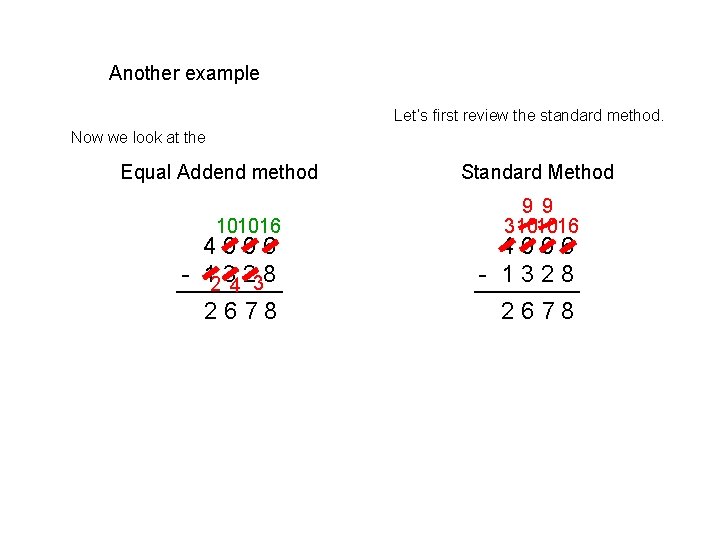
Another example Let’s first review the standard method. Now we look at the Equal Addend method 101016 4006 - 12 34 238 ¯¯¯¯ 26 78 Standard Method 9 9 3101016 4006 - 1328 ¯¯¯¯ 26 78
Conclusions: Just like learning anything new, the beginning is difficult. You may criticize this algorithm just because it is different from the one that you are familiar with. We hope you can be more open minded and give it a chance. Compare it with the standard algorithm fairly. Even if you really don’t like it, you should still thoroughly understand it just in case someday, one of your students likes it.
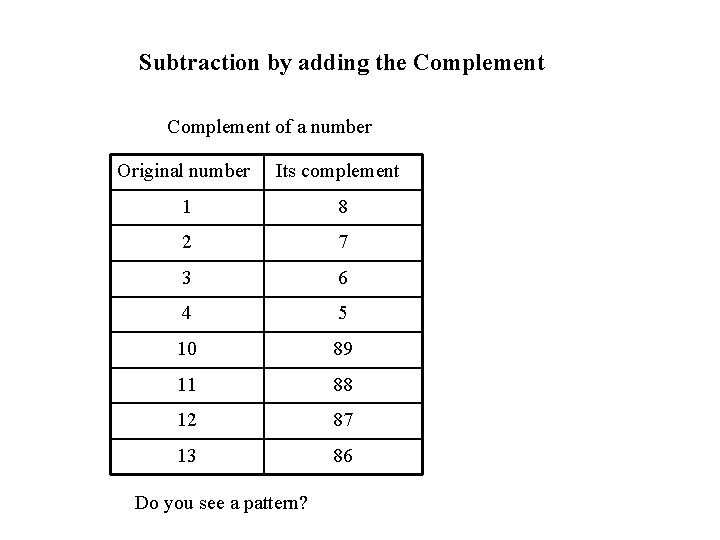
Subtraction by adding the Complement of a number Original number Its complement 1 8 2 7 3 6 4 5 10 89 11 88 12 87 13 86 Do you see a pattern?
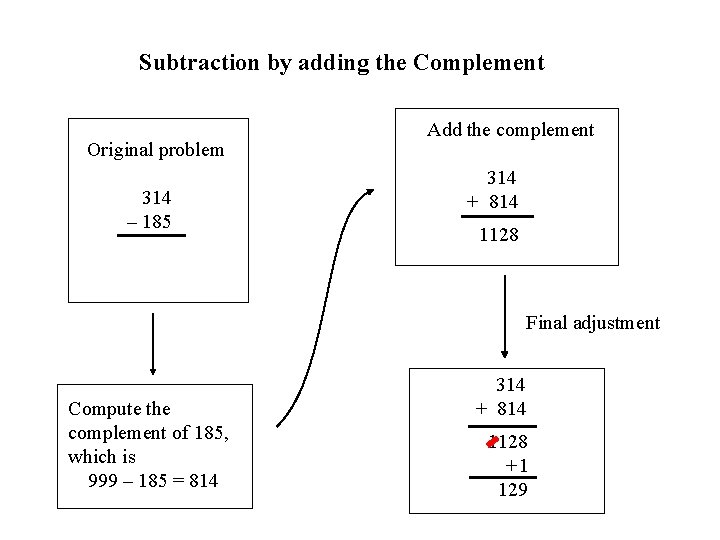
Subtraction by adding the Complement Original problem 314 – 185 Add the complement 314 + 814 1128 Final adjustment Compute the complement of 185, which is 999 – 185 = 814 314 + 814 1128 +1 129
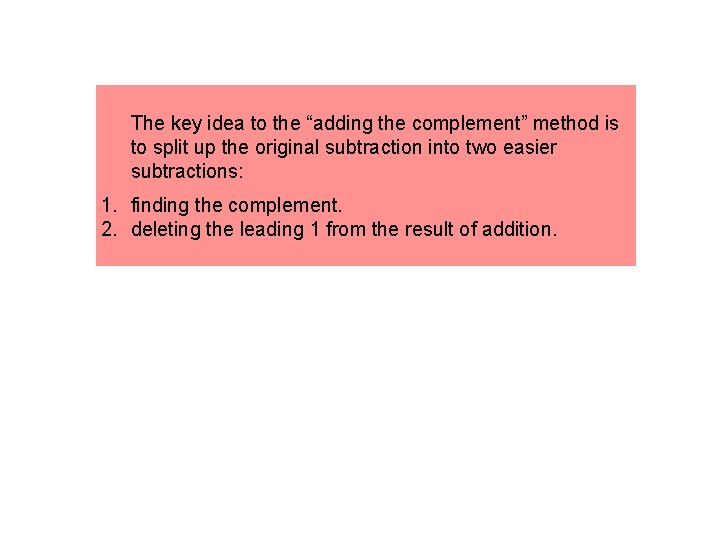
The key idea to the “adding the complement” method is to split up the original subtraction into two easier subtractions: 1. finding the complement. 2. deleting the leading 1 from the result of addition.
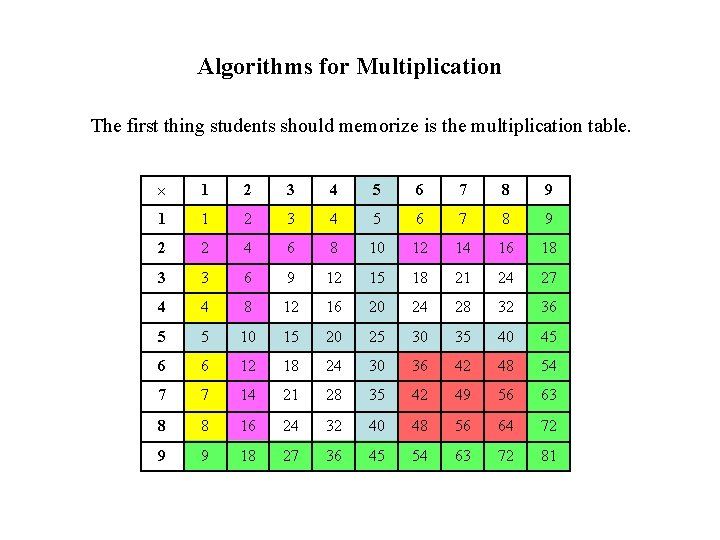
Algorithms for Multiplication The first thing students should memorize is the multiplication table. × 1 2 3 4 5 6 7 8 9 1 1 2 3 4 5 6 7 8 9 2 2 4 6 8 10 12 14 16 18 3 3 6 9 12 15 18 21 24 27 4 4 8 12 16 20 24 28 32 36 5 5 10 15 20 25 30 35 40 45 6 6 12 18 24 30 36 42 48 54 7 7 14 21 28 35 42 49 56 63 8 8 16 24 32 40 48 56 64 72 9 9 18 27 36 45 54 63 72 81
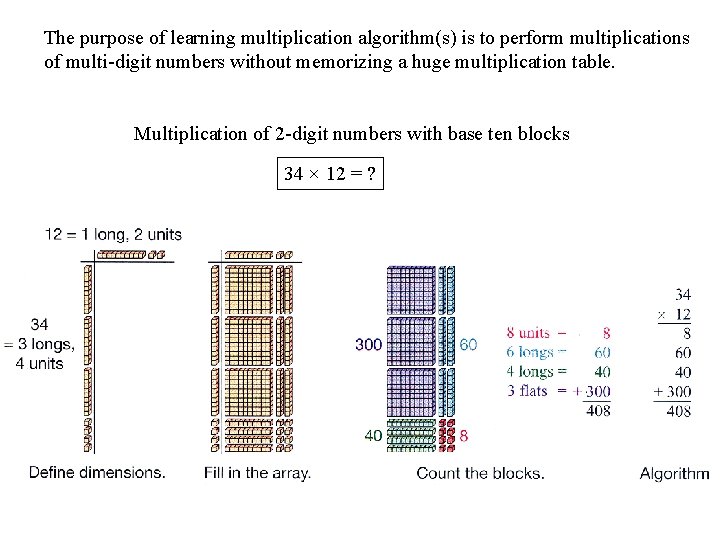
The purpose of learning multiplication algorithm(s) is to perform multiplications of multi-digit numbers without memorizing a huge multiplication table. Multiplication of 2 -digit numbers with base ten blocks 34 × 12 = ?
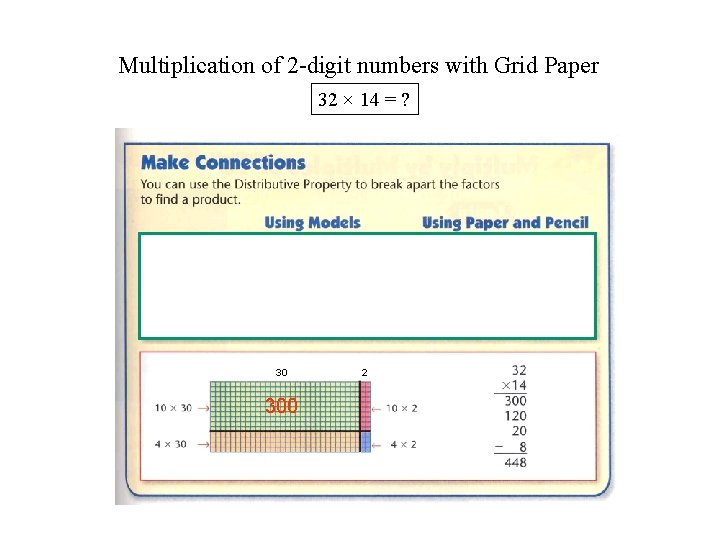
Multiplication of 2 -digit numbers with Grid Paper 32 × 14 = ? 30 300 2
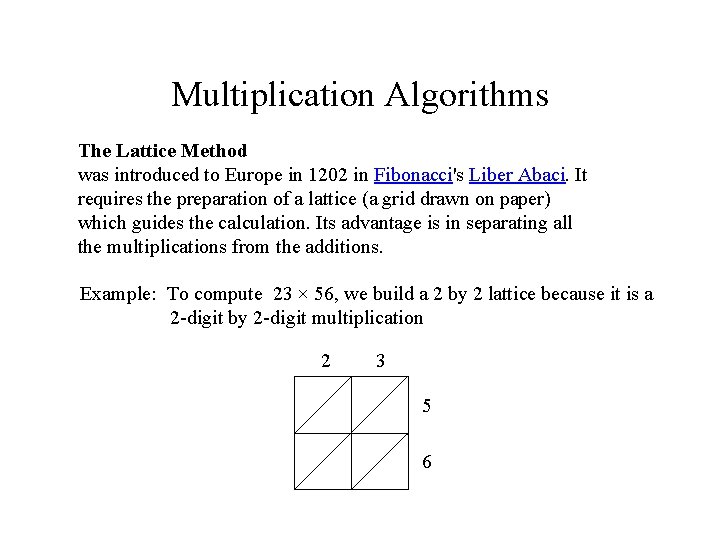
Multiplication Algorithms The Lattice Method was introduced to Europe in 1202 in Fibonacci's Liber Abaci. It requires the preparation of a lattice (a grid drawn on paper) which guides the calculation. Its advantage is in separating all the multiplications from the additions. Example: To compute 23 × 56, we build a 2 by 2 lattice because it is a 2 -digit by 2 -digit multiplication 2 3 5 6
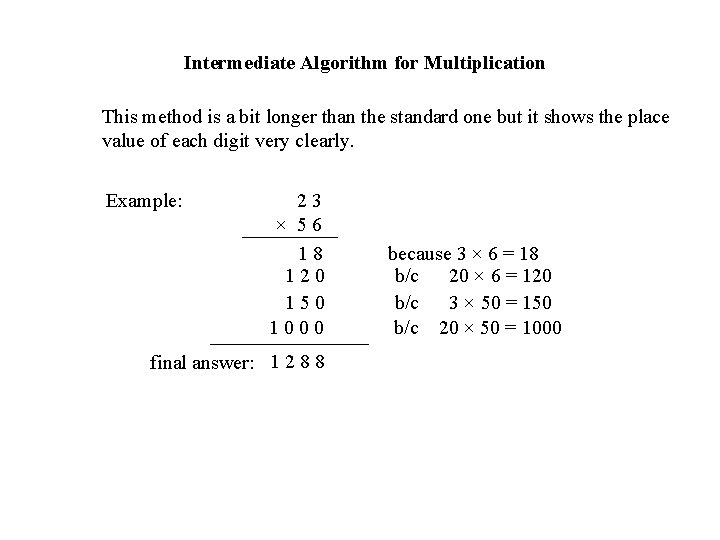
Intermediate Algorithm for Multiplication This method is a bit longer than the standard one but it shows the place value of each digit very clearly. Example: 23 × 56 18 120 150 1000 final answer: 1 2 8 8 because 3 × 6 = 18 b/c 20 × 6 = 120 b/c 3 × 50 = 150 b/c 20 × 50 = 1000
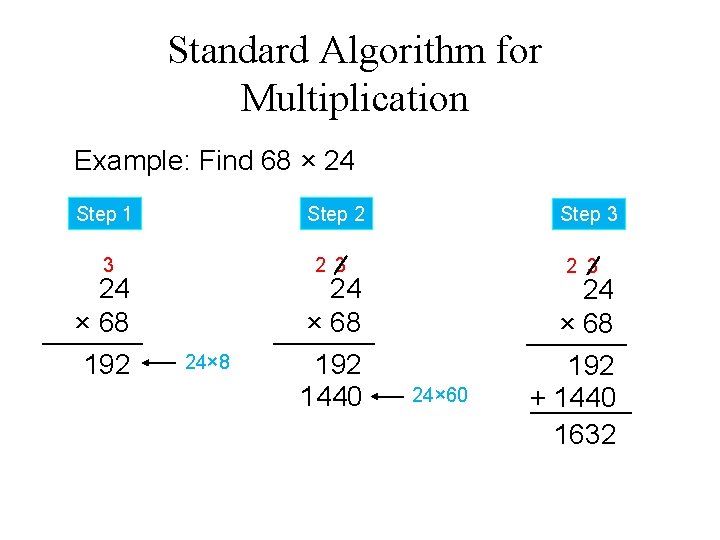
Standard Algorithm for Multiplication Example: Find 68 × 24 Step 1 Step 2 3 24 × 68 192 24× 8 24 × 68 192 1440 Step 3 24× 60 24 × 68 192 + 1440 1632
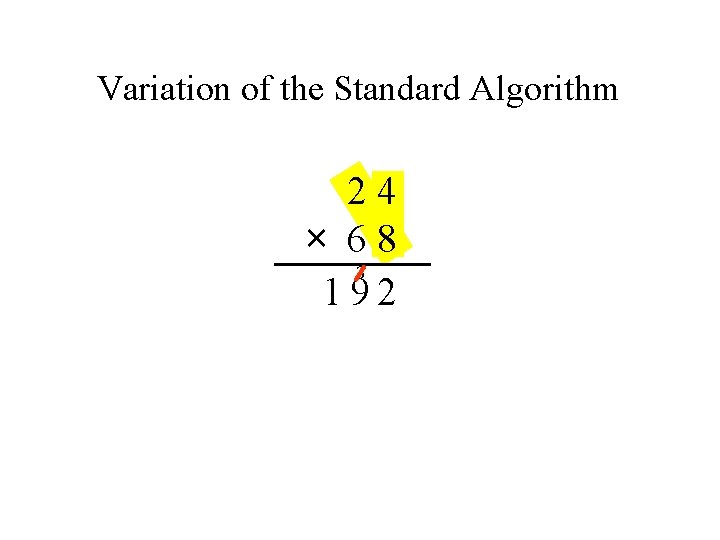
Variation of the Standard Algorithm 24 × 68 3 192
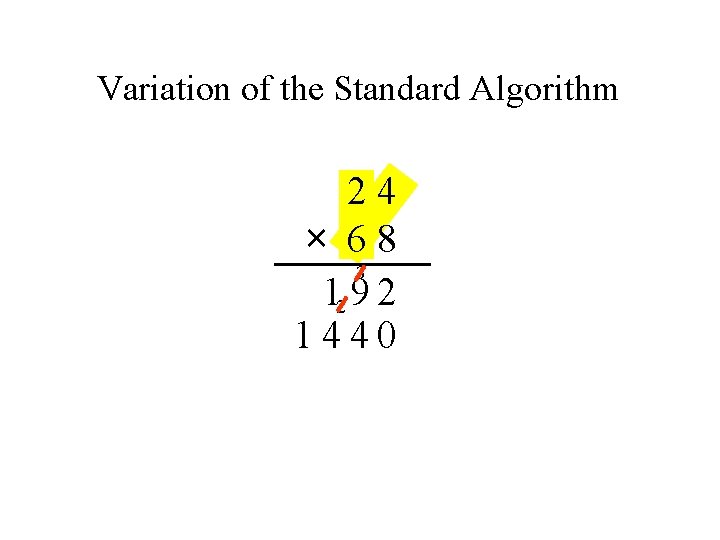
Variation of the Standard Algorithm 24 × 68 3 12 9 2 1440
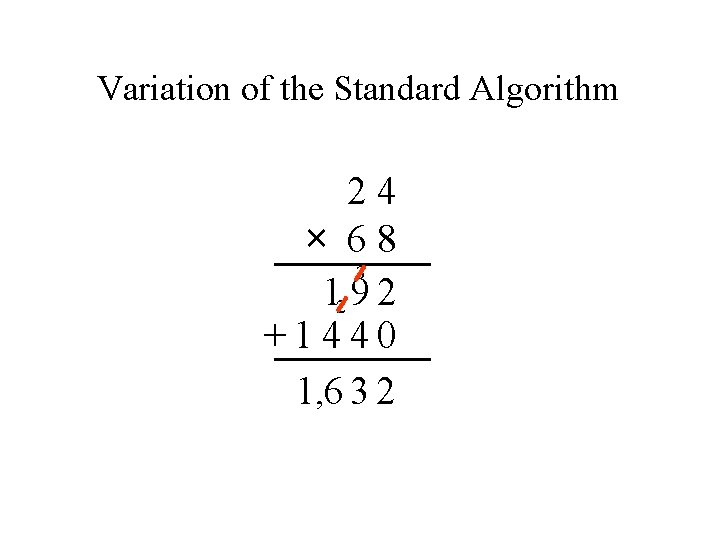
Variation of the Standard Algorithm 24 × 68 3 12 9 2 +1440 1, 6 3 2
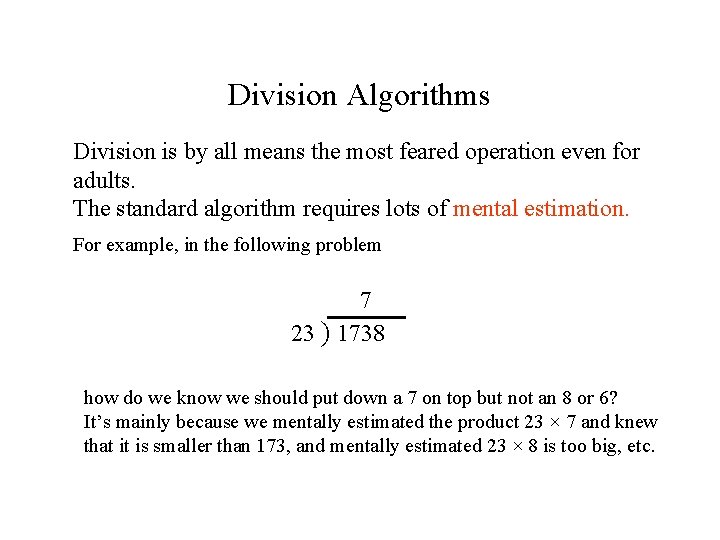
Division Algorithms Division is by all means the most feared operation even for adults. The standard algorithm requires lots of mental estimation. For example, in the following problem 7 23 ) 1738 how do we know we should put down a 7 on top but not an 8 or 6? It’s mainly because we mentally estimated the product 23 × 7 and knew that it is smaller than 173, and mentally estimated 23 × 8 is too big, etc.
Division Algorithms It is true that we no longer need to perform long division by hand in this computer age. However, we still need to learn and teach the basic principle of long division because it enables us to (1) better understand the meaning of division so that we can properly apply it in problem solving. (2) catch significant errors by estimation in the event that wrong data were fed to the calculator or the calculator malfunctioned.
Division Algorithms In this Power. Point presentation, we will introduce two steps that will help learning the long division algorithm. (I) A hands-on algorithm with the base ten blocks. (II) An intermediate written algorithm called the Scaffold Method
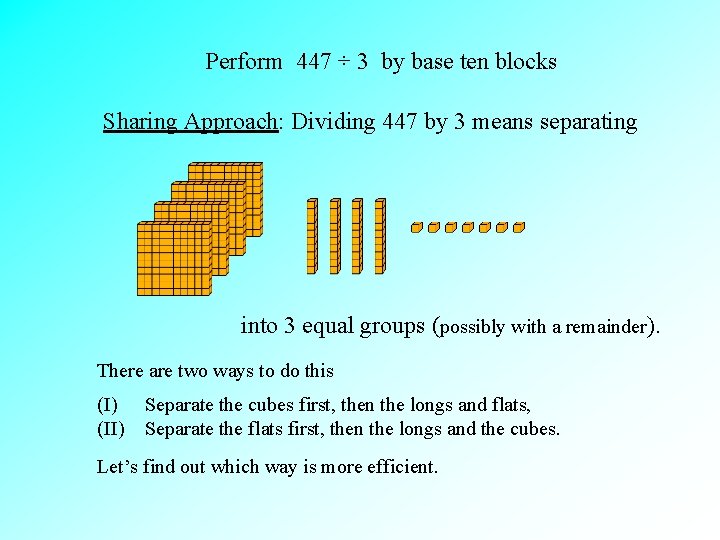
Perform 447 ÷ 3 by base ten blocks Sharing Approach: Dividing 447 by 3 means separating into 3 equal groups (possibly with a remainder). There are two ways to do this (I) (II) Separate the cubes first, then the longs and flats, Separate the flats first, then the longs and the cubes. Let’s find out which way is more efficient.
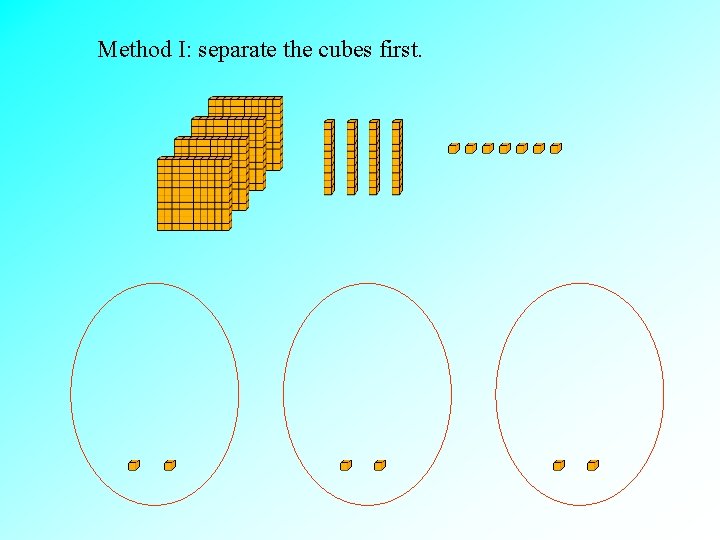
Method I: separate the cubes first.
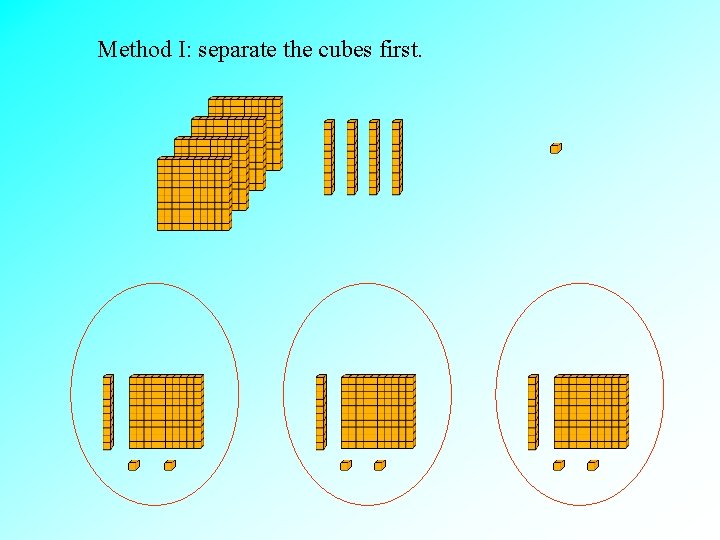
Method I: separate the cubes first.
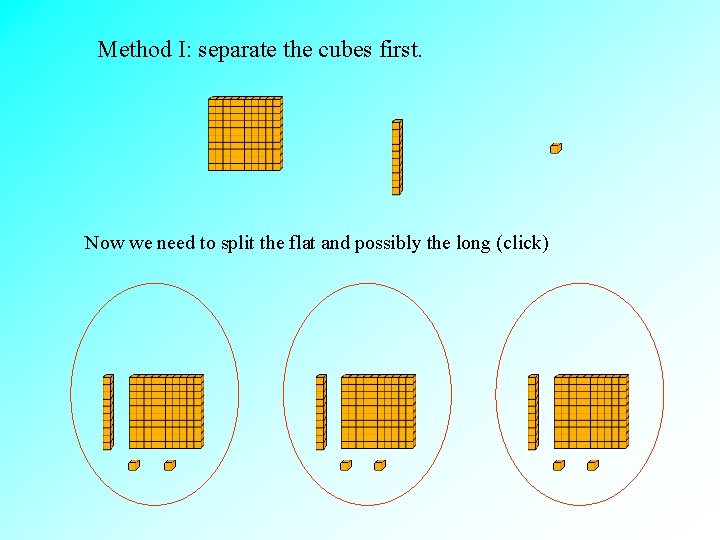
Method I: separate the cubes first. Now we need to split the flat and possibly the long (click)
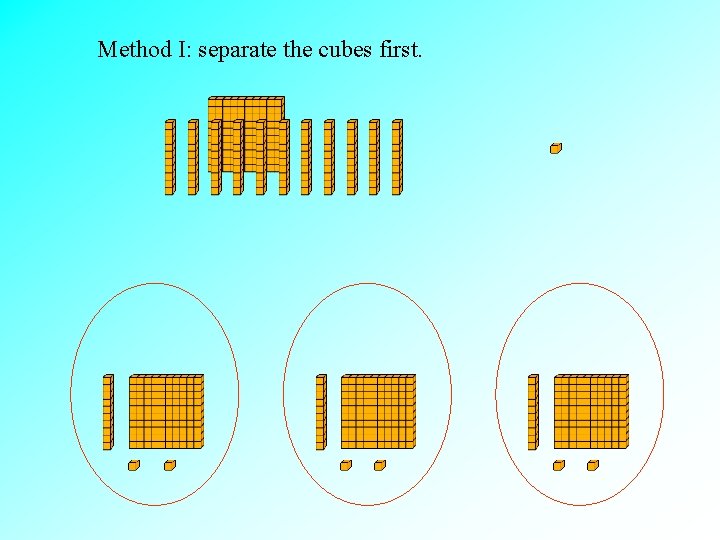
Method I: separate the cubes first.
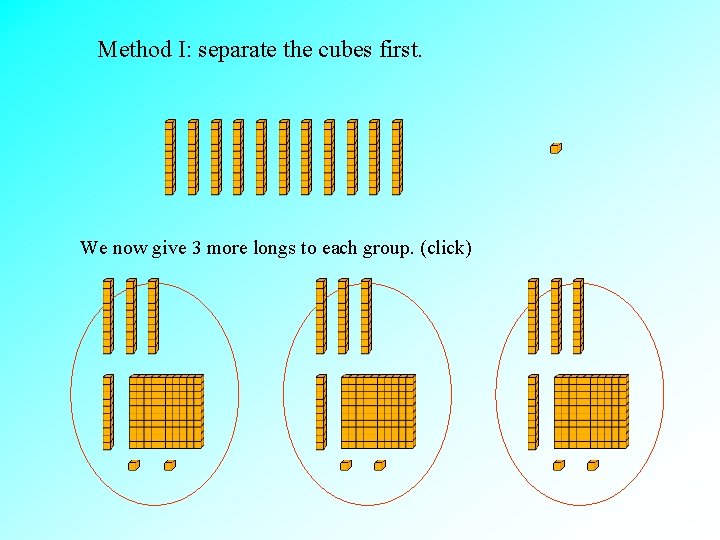
Method I: separate the cubes first. We now give 3 more longs to each group. (click)
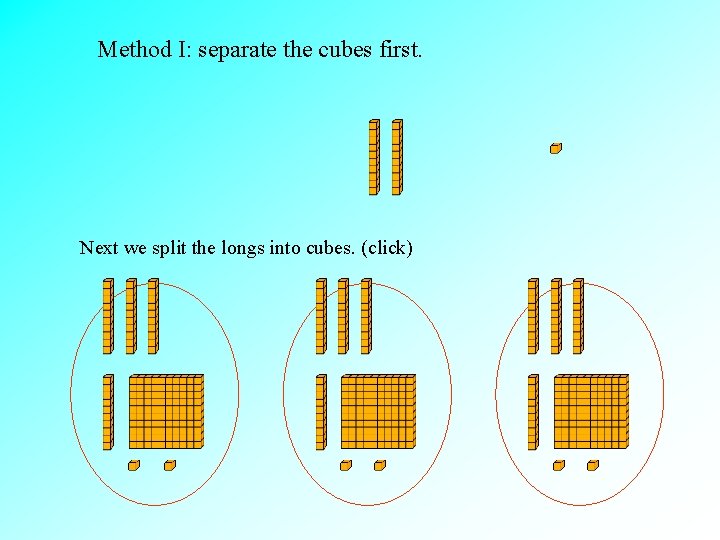
Method I: separate the cubes first. Next we split the longs into cubes. (click)
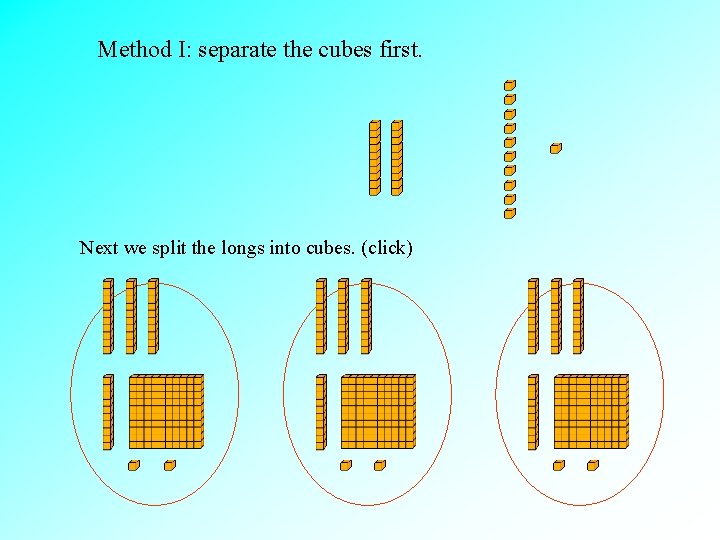
Method I: separate the cubes first. Next we split the longs into cubes. (click)
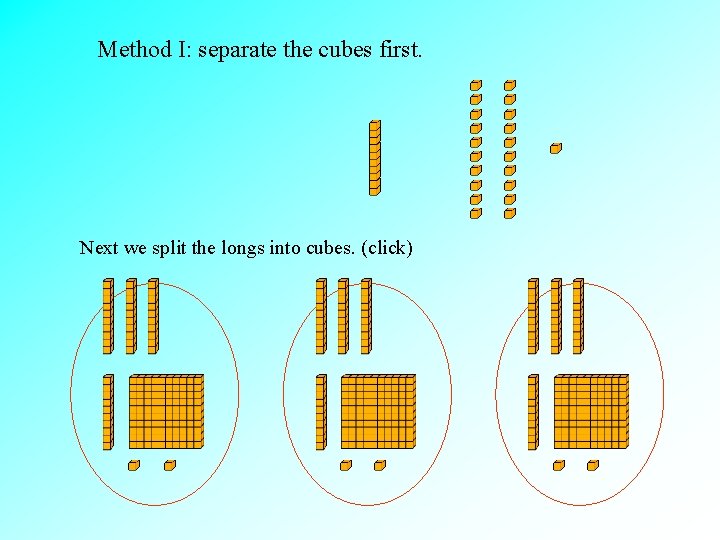
Method I: separate the cubes first. Next we split the longs into cubes. (click)
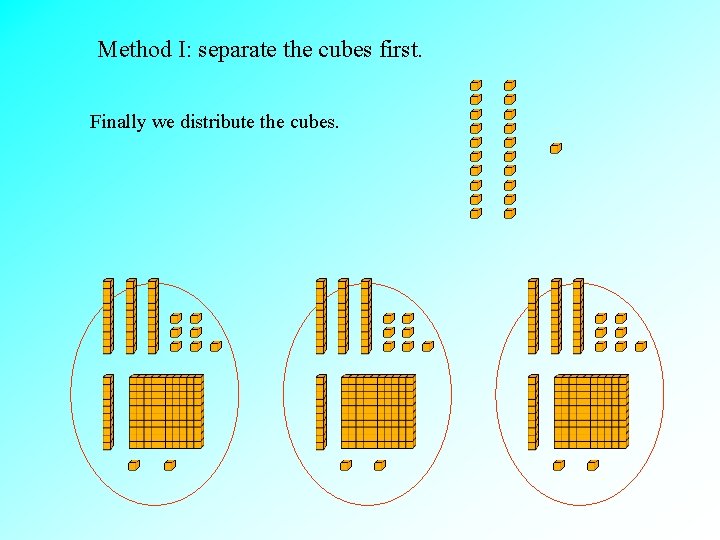
Method I: separate the cubes first. Finally we distribute the cubes.
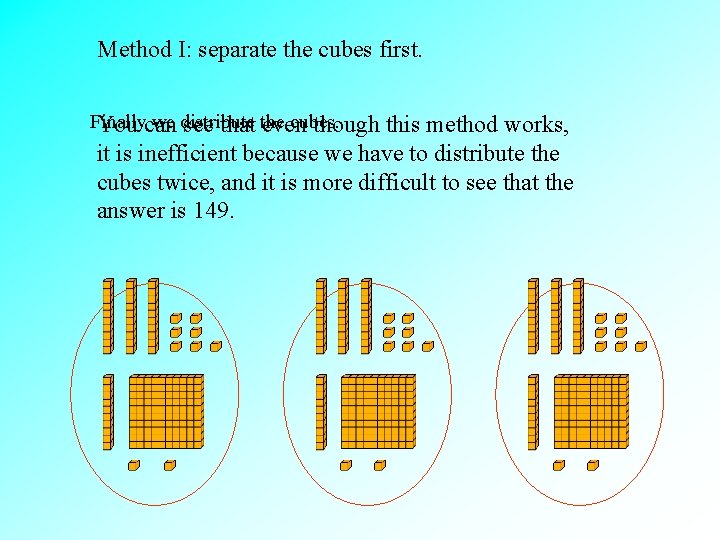
Method I: separate the cubes first. Finally we distribute cubes. You can see that the even though this method works, it is inefficient because we have to distribute the cubes twice, and it is more difficult to see that the answer is 149.
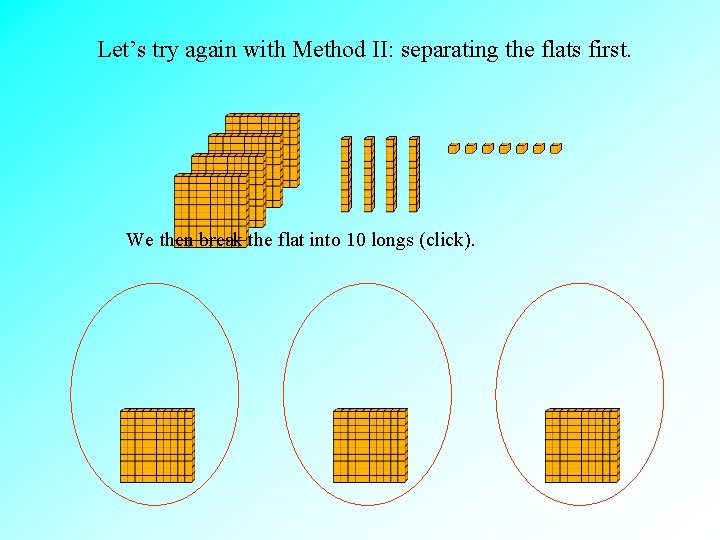
Let’s try again with Method II: separating the flats first. We then break the flat into 10 longs (click).
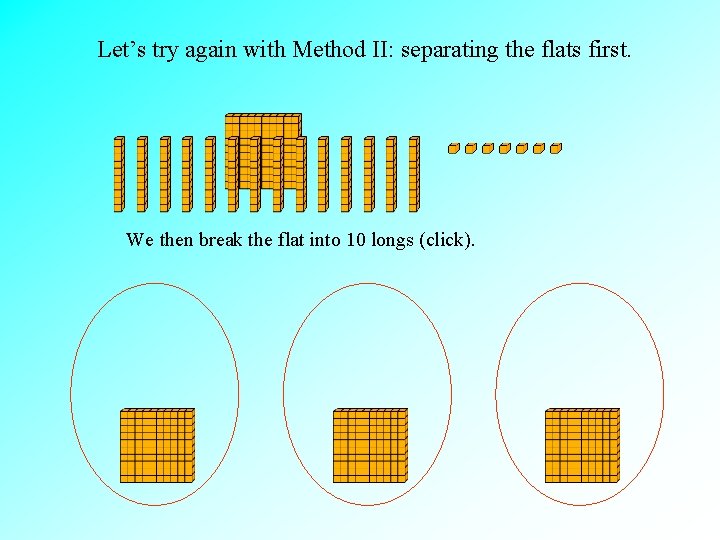
Let’s try again with Method II: separating the flats first. We then break the flat into 10 longs (click).
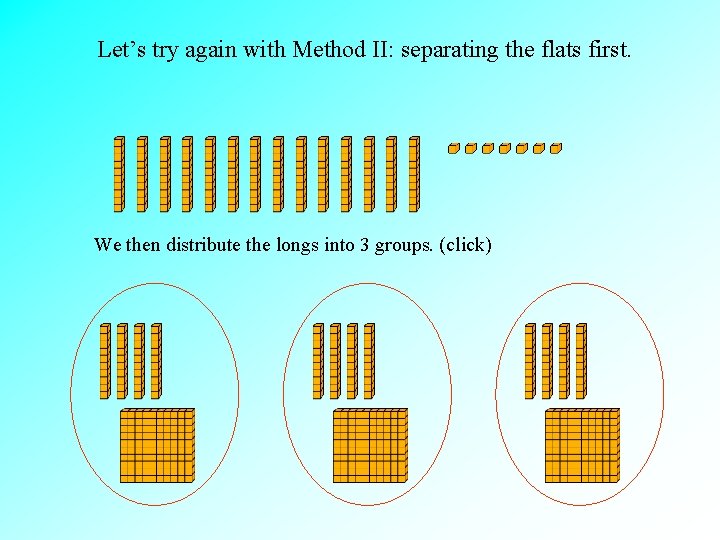
Let’s try again with Method II: separating the flats first. We then distribute the longs into 3 groups. (click)
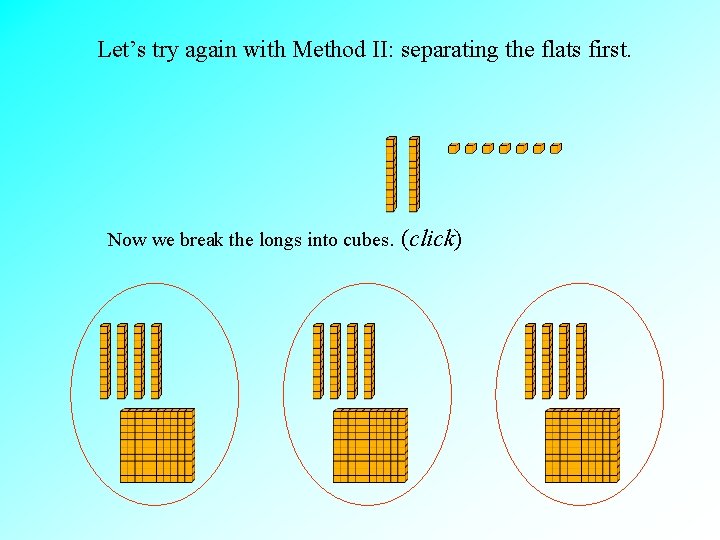
Let’s try again with Method II: separating the flats first. Now we break the longs into cubes. (click)
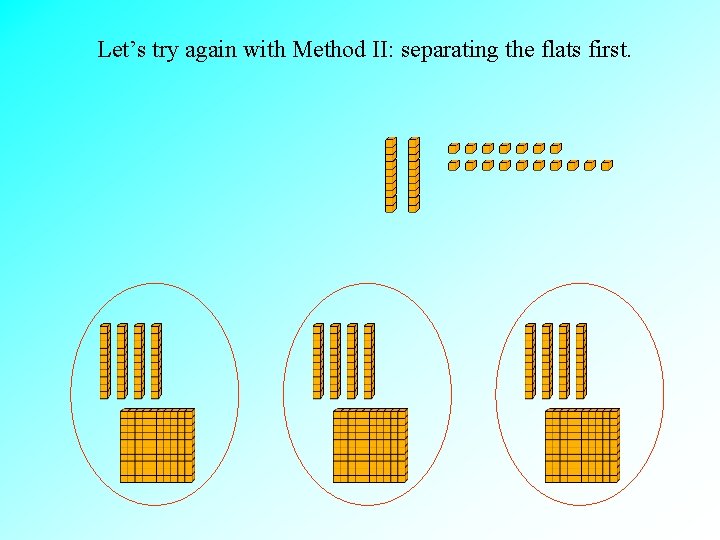
Let’s try again with Method II: separating the flats first.
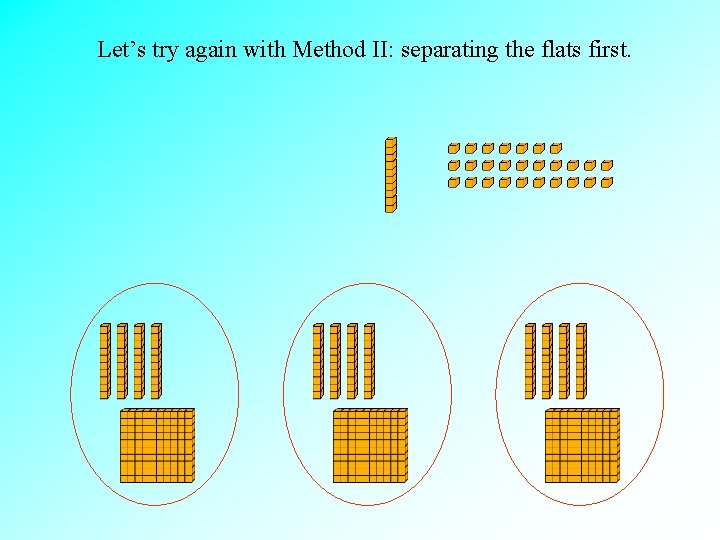
Let’s try again with Method II: separating the flats first.
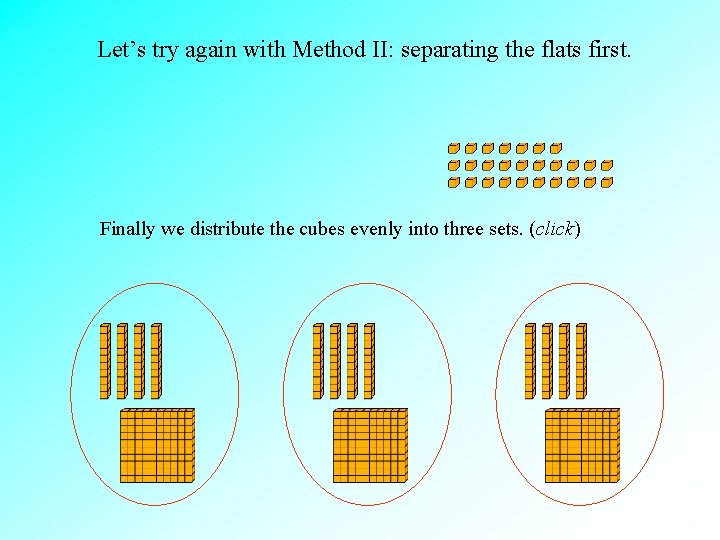
Let’s try again with Method II: separating the flats first. Finally we distribute the cubes evenly into three sets. (click)
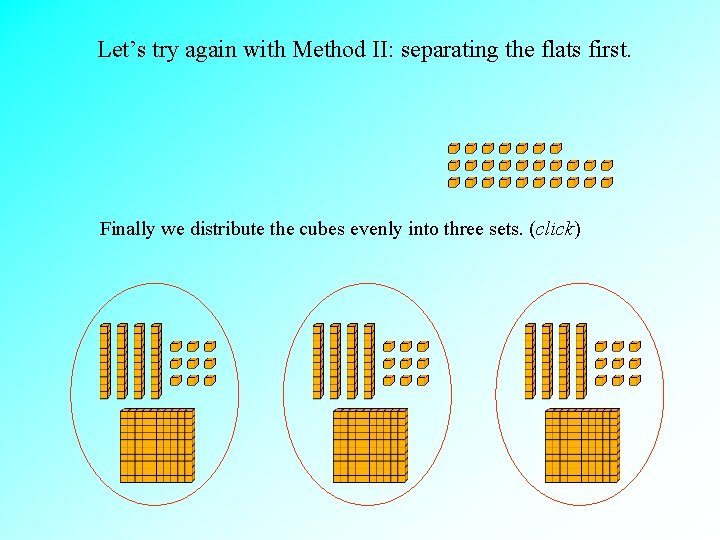
Let’s try again with Method II: separating the flats first. Finally we distribute the cubes evenly into three sets. (click)
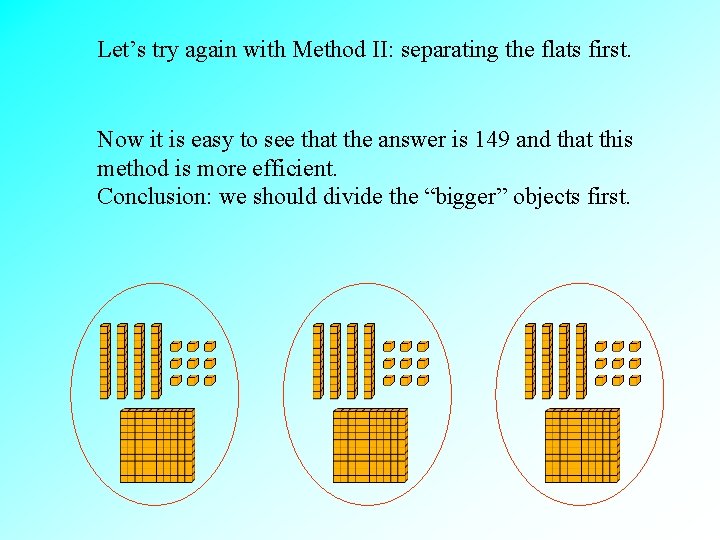
Let’s try again with Method II: separating the flats first. Now it is easy to see that the answer is 149 and that this method is more efficient. Conclusion: we should divide the “bigger” objects first.
Intermediate Algorithms for Division It is impractical to use manipulatives for large numbers, hence we have to learn some written algorithms. Let us begin with some intermediate ones that are easy to learn but may be slower than the standard one.
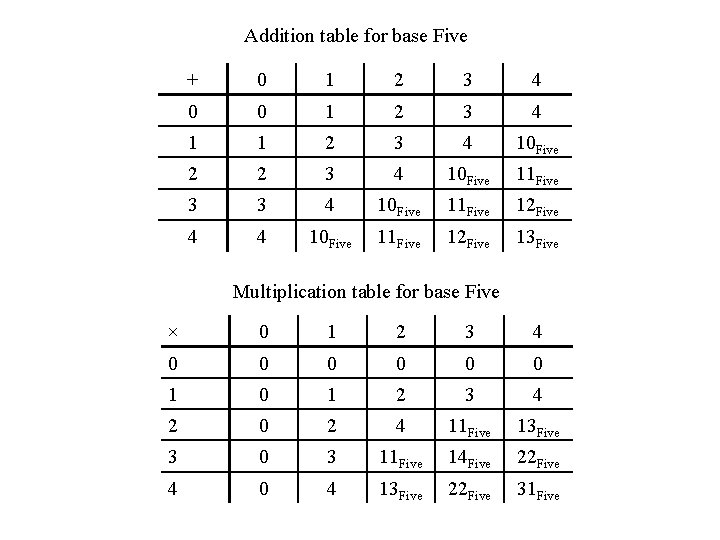
Addition table for base Five + 0 1 2 3 4 0 0 1 2 3 4 10 Five 2 2 3 4 10 Five 11 Five 3 3 4 10 Five 11 Five 12 Five 4 4 10 Five 11 Five 12 Five 13 Five Multiplication table for base Five × 0 1 2 3 4 0 0 0 1 0 1 2 3 4 2 0 2 4 11 Five 13 Five 3 0 3 11 Five 14 Five 22 Five 4 0 4 13 Five 22 Five 31 Five
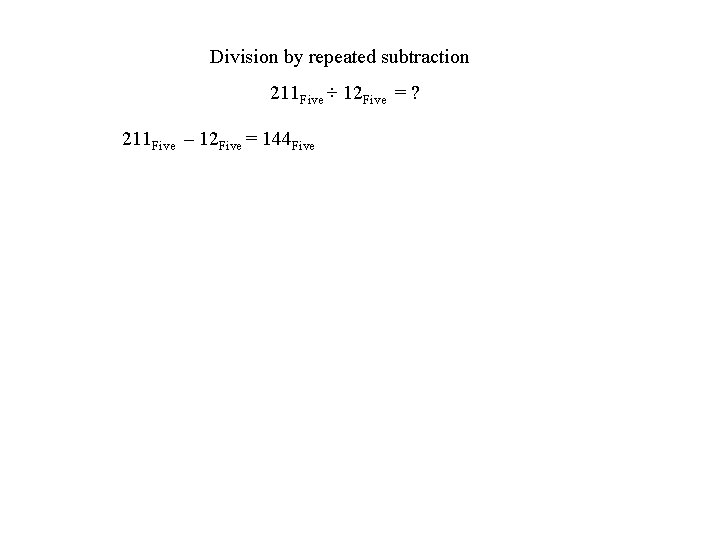
Division by repeated subtraction 211 Five ÷ 12 Five = ? 211 Five – 12 Five = 144 Five
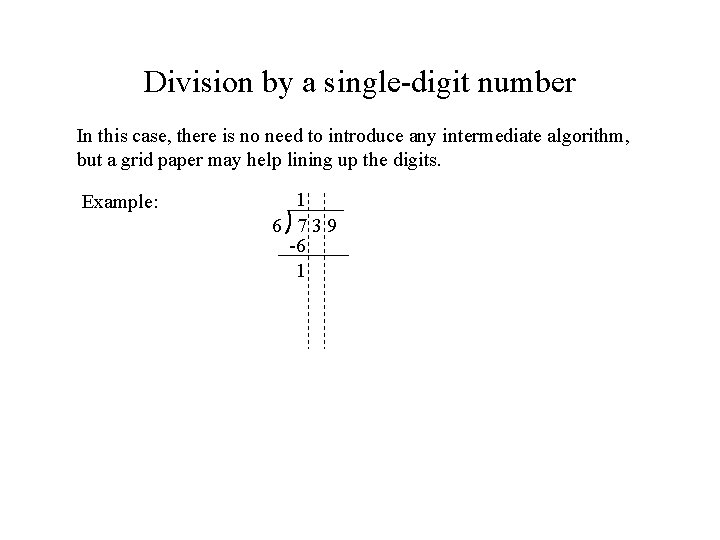
Division by a single-digit number In this case, there is no need to introduce any intermediate algorithm, but a grid paper may help lining up the digits. Example: 1 6 739 -6 1
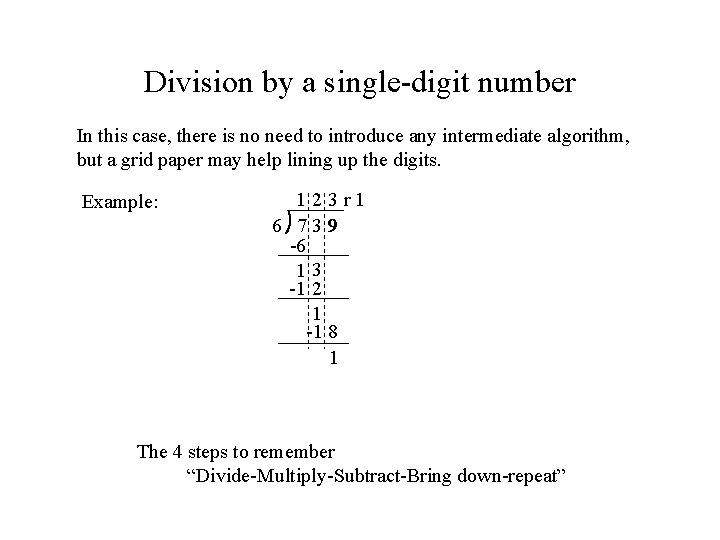
Division by a single-digit number In this case, there is no need to introduce any intermediate algorithm, but a grid paper may help lining up the digits. Example: 123 r 1 6 739 -6 13 -1 2 1 -1 8 1 The 4 steps to remember “Divide-Multiply-Subtract-Bring down-repeat”
Intermediate Algorithms for Division by a 2 -digit number The Scaffold method A scaffold is a temporary or movable platform for workers to stand or sit on when working at a height above the floor or ground level. (Click to see a picture)
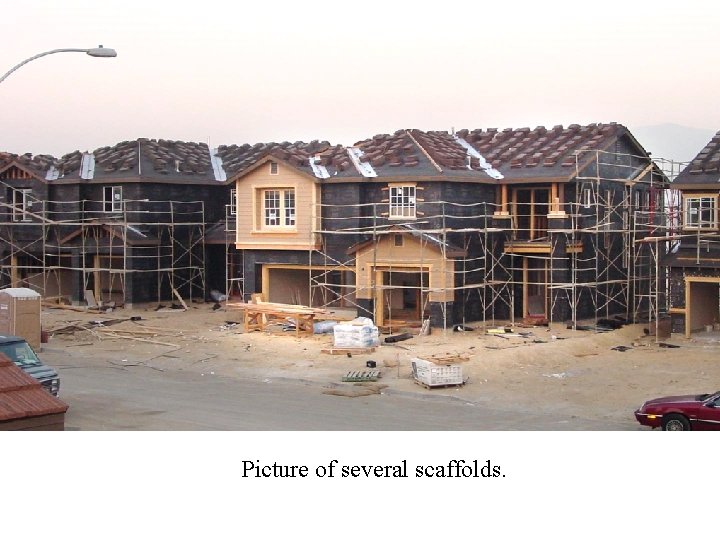
Picture of several scaffolds.
Intermediate Algorithms for Division The Scaffold method A scaffold is a temporary or movable platform for workers to stand or sit on when working at a height above the floor or ground level. We use this word for our division algorithm because (i) it is a temporary method to help us learn the standard algorithm. (ii) it has structures that look like a real scaffold.
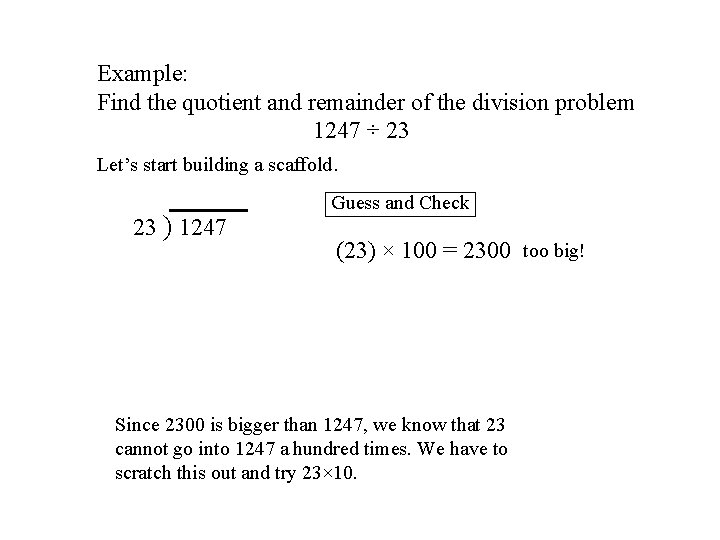
Example: Find the quotient and remainder of the division problem 1247 ÷ 23 Let’s start building a scaffold. 23 ) 1247 Guess and Check (23) × 100 = 2300 too big! Since 2300 is bigger than 1247, we know that 23 cannot go into 1247 a hundred times. We have to scratch this out and try 23× 10.
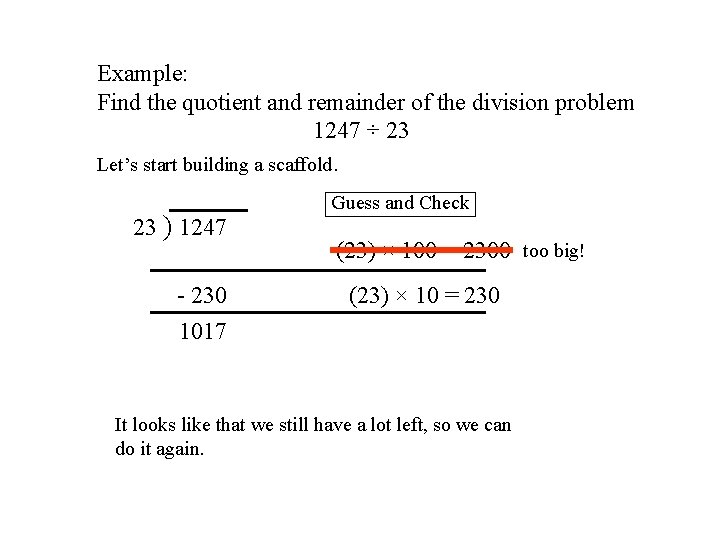
Example: Find the quotient and remainder of the division problem 1247 ÷ 23 Let’s start building a scaffold. 23 ) 1247 - 230 1017 Guess and Check (23) × 100 = 2300 too big! (23) × 10 = 230 It looks like that we still have a lot left, so we can do it again.
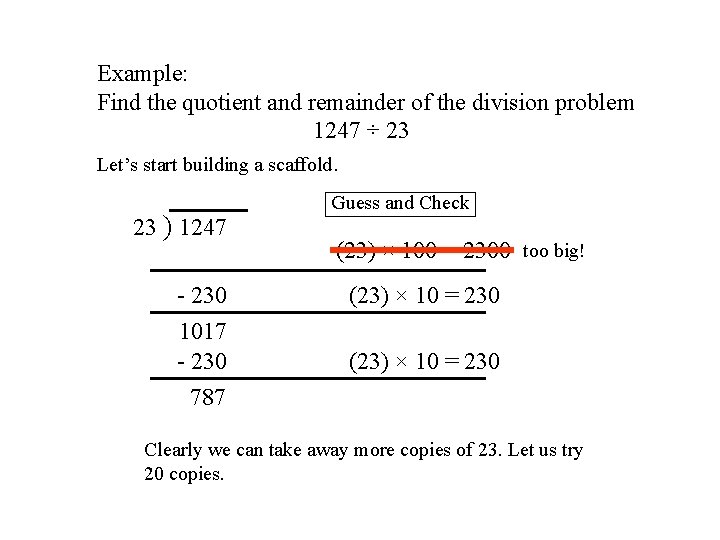
Example: Find the quotient and remainder of the division problem 1247 ÷ 23 Let’s start building a scaffold. 23 ) 1247 - 230 1017 - 230 787 Guess and Check (23) × 100 = 2300 too big! (23) × 10 = 230 Clearly we can take away more copies of 23. Let us try 20 copies.
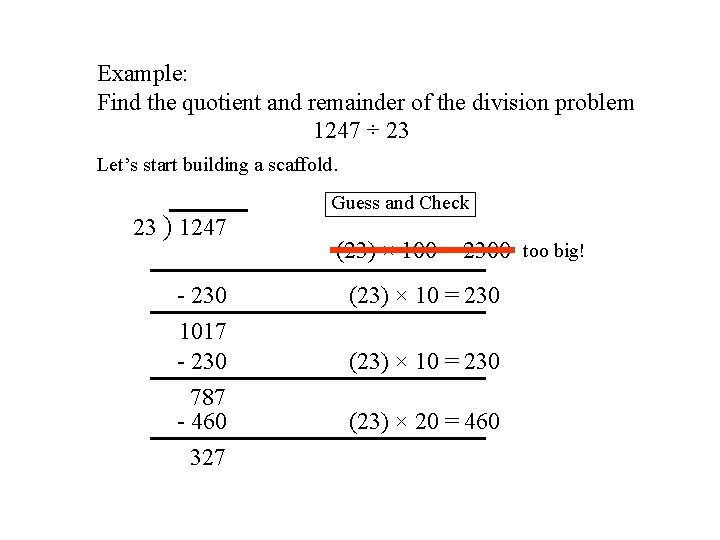
Example: Find the quotient and remainder of the division problem 1247 ÷ 23 Let’s start building a scaffold. 23 ) 1247 - 230 1017 - 230 787 - 460 327 Guess and Check (23) × 100 = 2300 too big! (23) × 10 = 230 (23) × 20 = 460
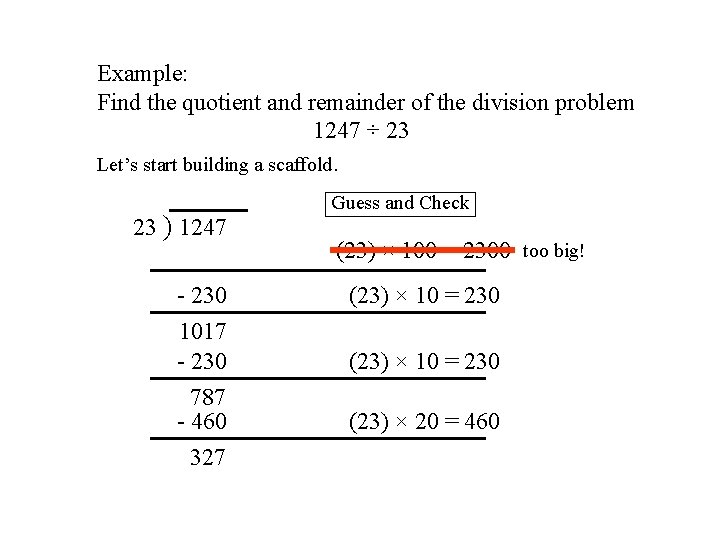
Example: Find the quotient and remainder of the division problem 1247 ÷ 23 Let’s start building a scaffold. 23 ) 1247 - 230 1017 - 230 787 - 460 327 Guess and Check (23) × 100 = 2300 too big! (23) × 10 = 230 (23) × 20 = 460
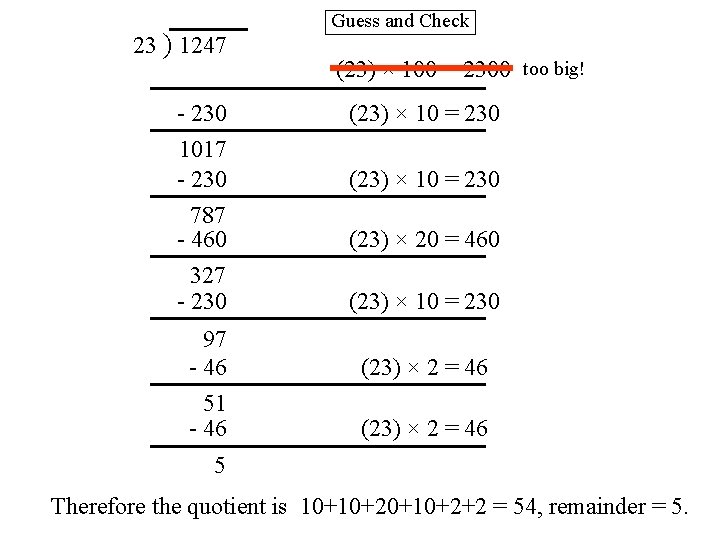
23 ) 1247 - 230 1017 - 230 787 - 460 327 - 230 Guess and Check (23) × 100 = 2300 too big! (23) × 10 = 230 (23) × 20 = 460 (23) × 10 = 230 97 - 46 (23) × 2 = 46 51 - 46 (23) × 2 = 46 5 Therefore the quotient is 10+10+2+2 = 54, remainder = 5.
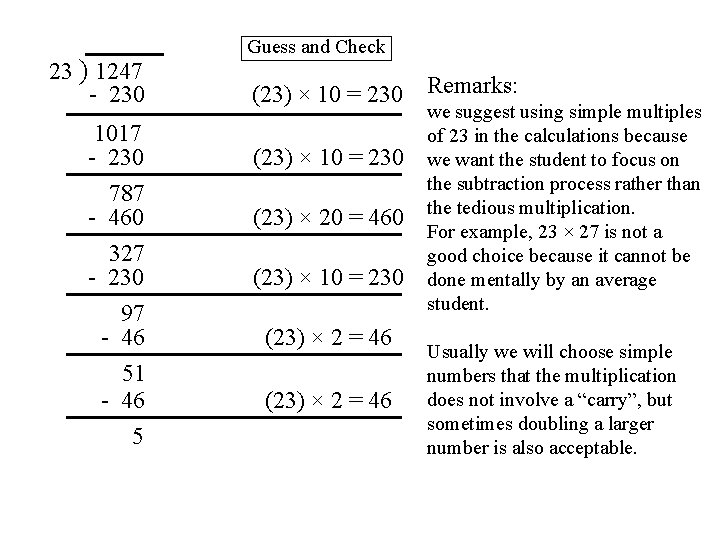
23 ) 1247 - 230 1017 - 230 787 - 460 327 - 230 97 - 46 51 - 46 5 Guess and Check (23) × 10 = 230 (23) × 20 = 460 (23) × 10 = 230 (23) × 2 = 46 Remarks: we suggest using simple multiples of 23 in the calculations because we want the student to focus on the subtraction process rather than the tedious multiplication. For example, 23 × 27 is not a good choice because it cannot be done mentally by an average student. Usually we will choose simple numbers that the multiplication does not involve a “carry”, but sometimes doubling a larger number is also acceptable.
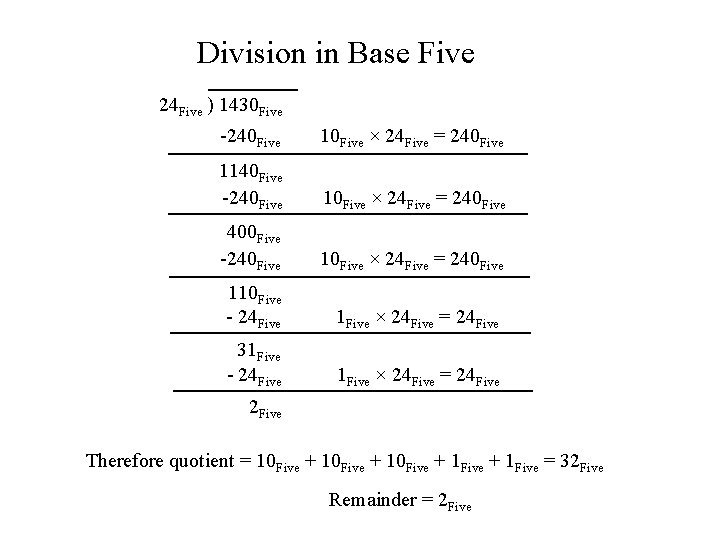
Division in Base Five 24 Five ) 1430 Five -240 Five 10 Five × 24 Five = 240 Five 1140 Five -240 Five 10 Five × 24 Five = 240 Five 400 Five -240 Five 10 Five × 24 Five = 240 Five 110 Five - 24 Five 1 Five × 24 Five = 24 Five 31 Five - 24 Five 1 Five × 24 Five = 24 Five 2 Five Therefore quotient = 10 Five + 1 Five = 32 Five Remainder = 2 Five
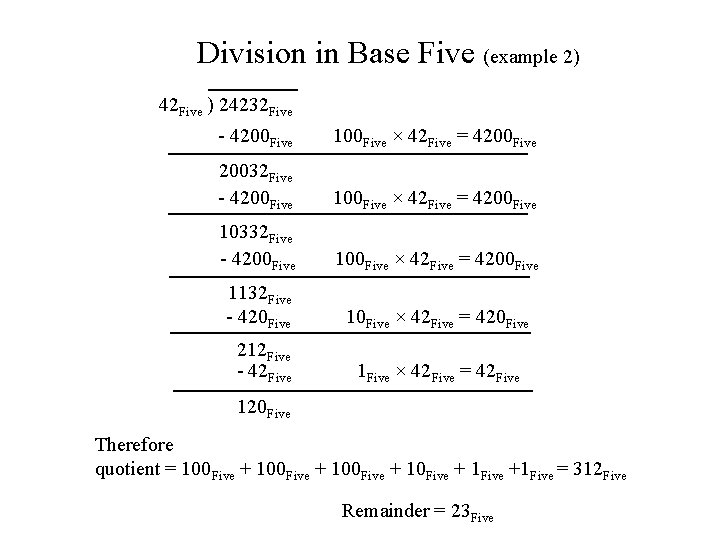
Division in Base Five (example 2) 42 Five ) 24232 Five - 4200 Five 100 Five × 42 Five = 4200 Five 20032 Five - 4200 Five 100 Five × 42 Five = 4200 Five 10332 Five - 4200 Five 100 Five × 42 Five = 4200 Five 1132 Five - 420 Five 10 Five × 42 Five = 420 Five 212 Five - 42 Five 1 Five × 42 Five = 42 Five 120 Five Therefore quotient = 100 Five + 1 Five +1 Five = 312 Five Remainder = 23 Five
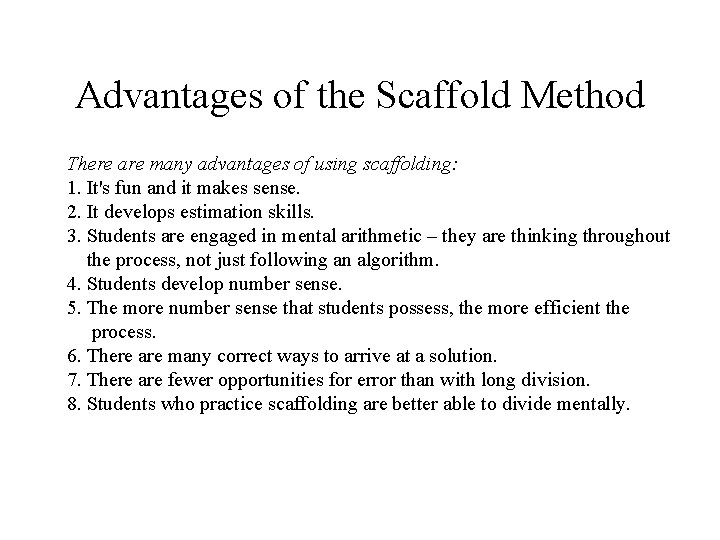
Advantages of the Scaffold Method There are many advantages of using scaffolding: 1. It's fun and it makes sense. 2. It develops estimation skills. 3. Students are engaged in mental arithmetic – they are thinking throughout the process, not just following an algorithm. 4. Students develop number sense. 5. The more number sense that students possess, the more efficient the process. 6. There are many correct ways to arrive at a solution. 7. There are fewer opportunities for error than with long division. 8. Students who practice scaffolding are better able to divide mentally.
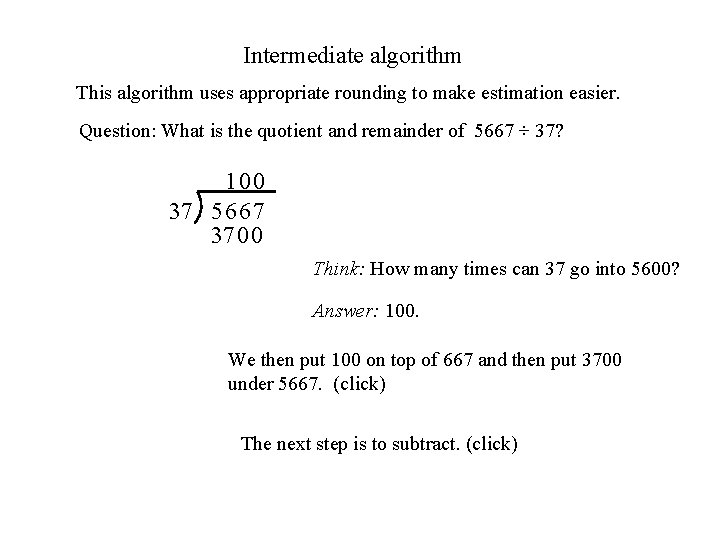
Intermediate algorithm This algorithm uses appropriate rounding to make estimation easier. Question: What is the quotient and remainder of 5667 ÷ 37? 100 37 5 6 6 7 37 0 0 Think: How many times can 37 go into 5600? Answer: 100. We then put 100 on top of 667 and then put 3700 under 5667. (click) The next step is to subtract. (click)
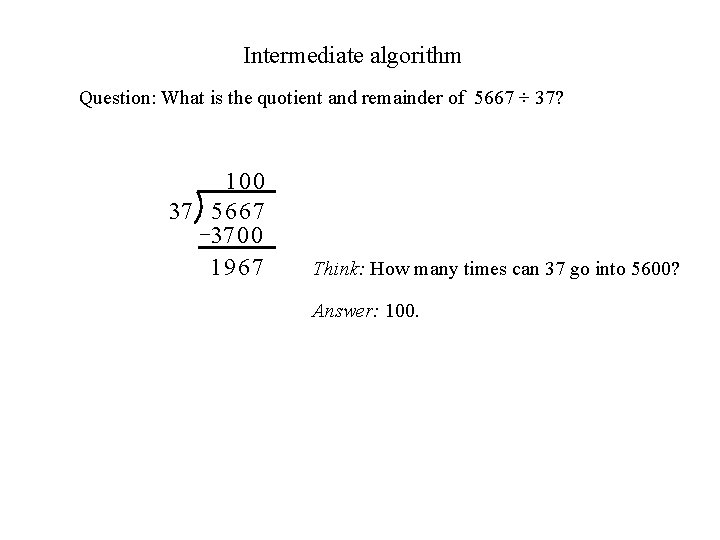
Intermediate algorithm Question: What is the quotient and remainder of 5667 ÷ 37? 100 37 5 6 6 7 – 37 0 0 1967 Think: How many times can 37 go into 5600? Answer: 100.
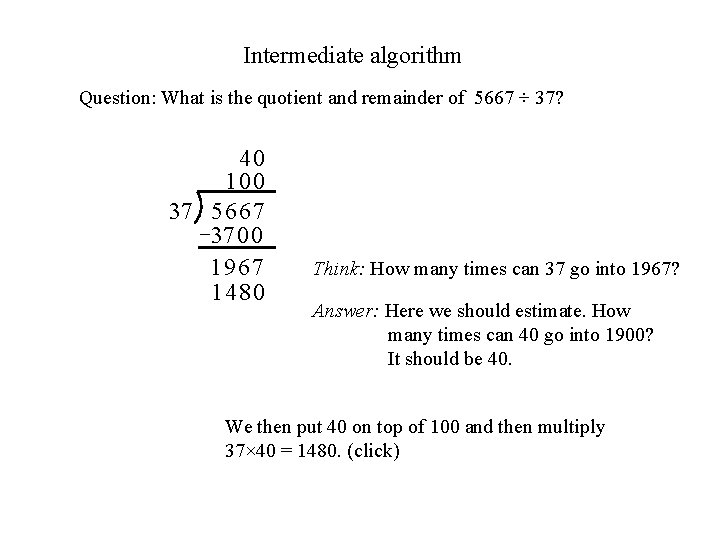
Intermediate algorithm Question: What is the quotient and remainder of 5667 ÷ 37? 40 100 37 5 6 6 7 – 37 0 0 1967 1480 Think: How many times can 37 go into 1967? Answer: Here we should estimate. How many times can 40 go into 1900? It should be 40. We then put 40 on top of 100 and then multiply 37× 40 = 1480. (click)
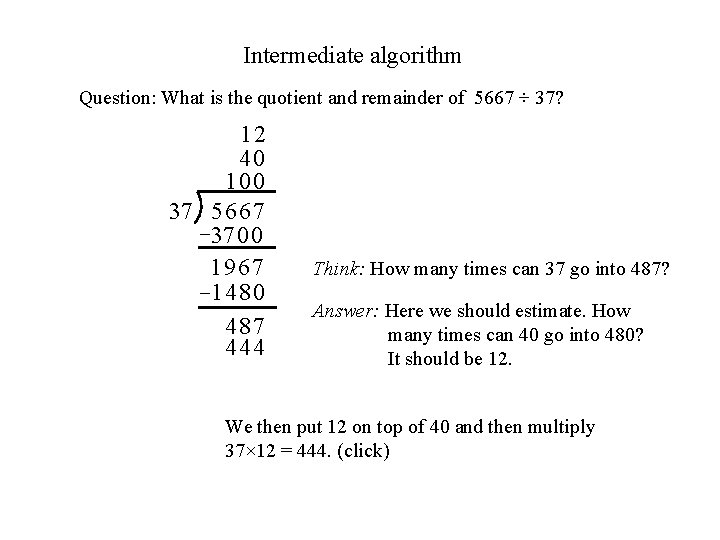
Intermediate algorithm Question: What is the quotient and remainder of 5667 ÷ 37? 12 40 100 37 5 6 6 7 – 37 0 0 1967 – 1 4 8 0 487 444 Think: How many times can 37 go into 487? Answer: Here we should estimate. How many times can 40 go into 480? It should be 12. We then put 12 on top of 40 and then multiply 37× 12 = 444. (click)
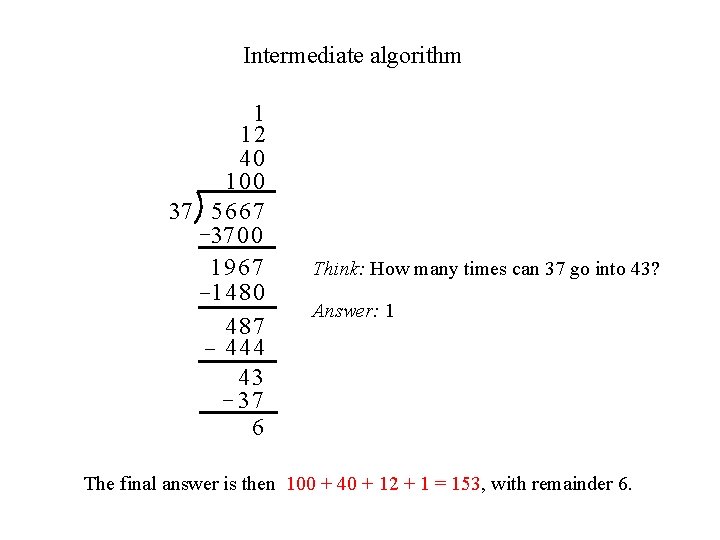
Intermediate algorithm 1 12 40 100 37 5 6 6 7 – 37 0 0 1967 – 1 4 8 0 487 – 444 43 – 37 6 Think: How many times can 37 go into 43? Answer: 1 The final answer is then 100 + 40 + 12 + 1 = 153, with remainder 6.
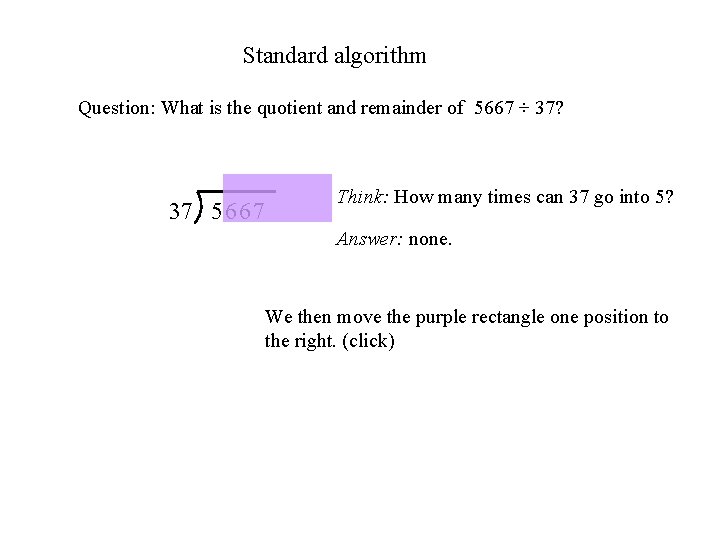
Standard algorithm Question: What is the quotient and remainder of 5667 ÷ 37? 37 5 6 6 7 Think: How many times can 37 go into 5? Answer: none. We then move the purple rectangle one position to the right. (click)
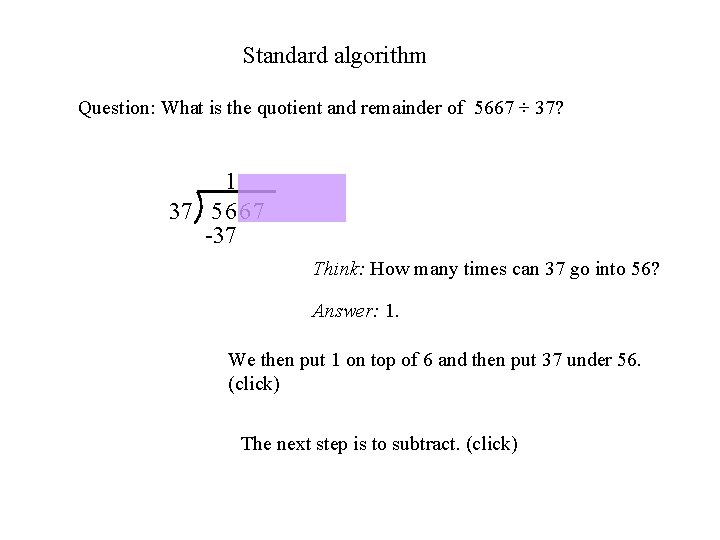
Standard algorithm Question: What is the quotient and remainder of 5667 ÷ 37? 1 37 5 6 6 7 -37 Think: How many times can 37 go into 56? Answer: 1. We then put 1 on top of 6 and then put 37 under 56. (click) The next step is to subtract. (click)
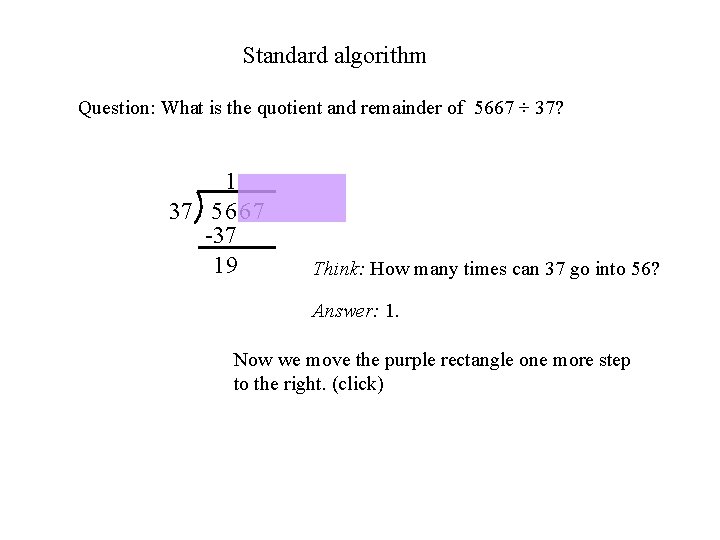
Standard algorithm Question: What is the quotient and remainder of 5667 ÷ 37? 1 37 5 6 6 7 -37 19 Think: How many times can 37 go into 56? Answer: 1. Now we move the purple rectangle one more step to the right. (click)
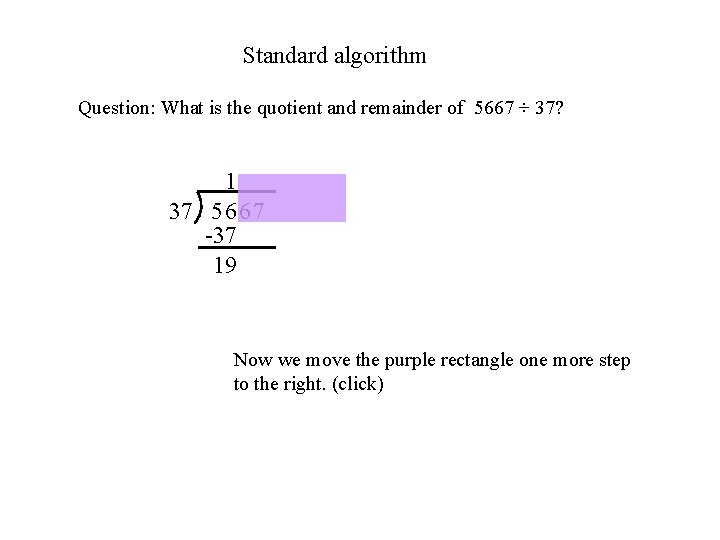
Standard algorithm Question: What is the quotient and remainder of 5667 ÷ 37? 1 37 5 6 6 7 -37 19 Now we move the purple rectangle one more step to the right. (click)
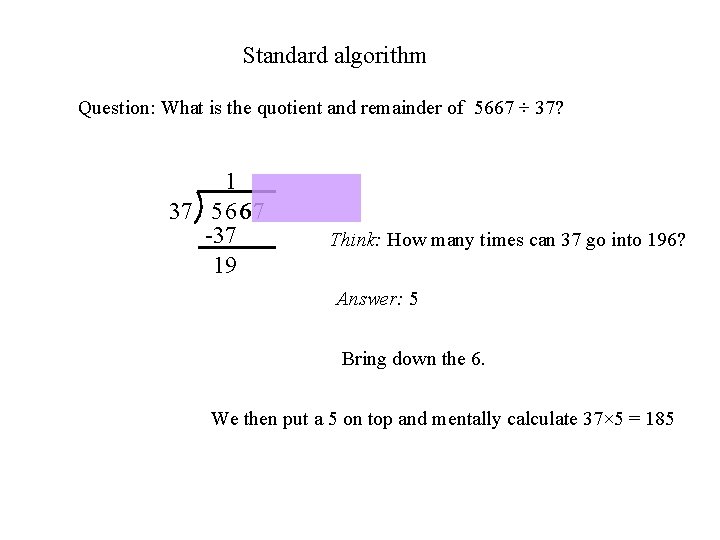
Standard algorithm Question: What is the quotient and remainder of 5667 ÷ 37? 1 37 5 6 6 7 -37 19 Think: How many times can 37 go into 196? Answer: 5 Bring down the 6. We then put a 5 on top and mentally calculate 37× 5 = 185
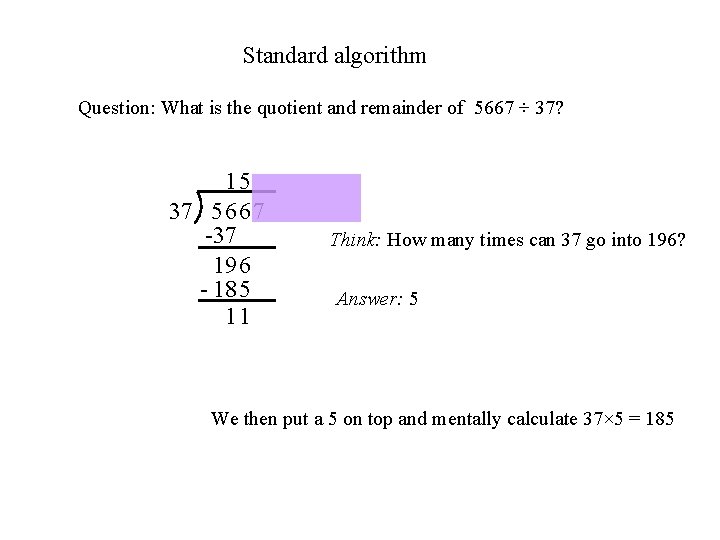
Standard algorithm Question: What is the quotient and remainder of 5667 ÷ 37? 15 37 5 6 6 7 -37 19 6 - 18 5 11 Think: How many times can 37 go into 196? Answer: 5 We then put a 5 on top and mentally calculate 37× 5 = 185
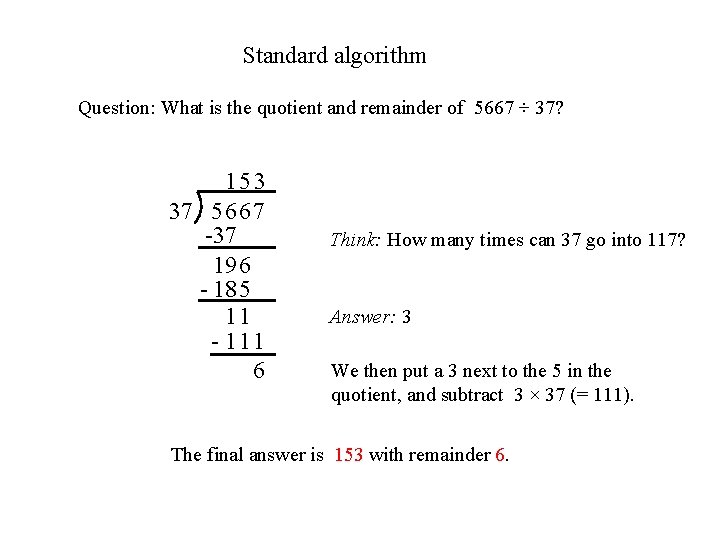
Standard algorithm Question: What is the quotient and remainder of 5667 ÷ 37? 15 3 37 5 6 6 7 -37 19 6 - 18 5 11 - 111 6 Think: How many times can 37 go into 117? Answer: 3 We then put a 3 next to the 5 in the quotient, and subtract 3 × 37 (= 111). The final answer is 153 with remainder 6.
- Slides: 118