
Section 4 2 Equivalence Relations A binary relation
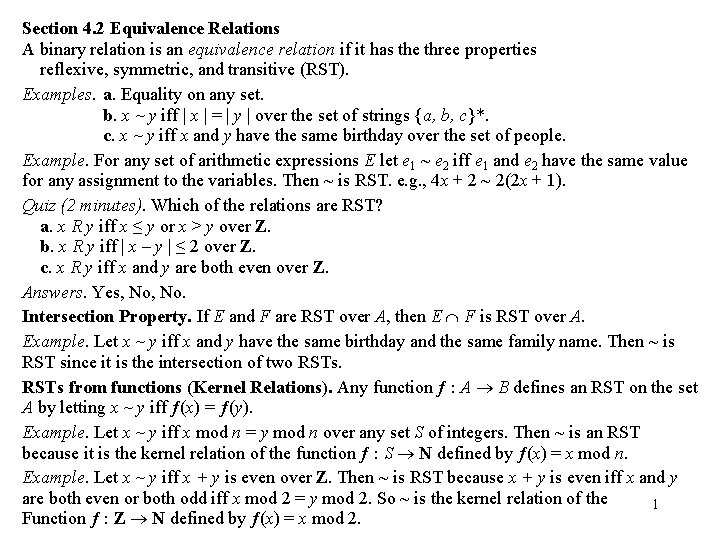
Section 4. 2 Equivalence Relations A binary relation is an equivalence relation if it has the three properties reflexive, symmetric, and transitive (RST). Examples. a. Equality on any set. b. x ~ y iff | x | = | y | over the set of strings {a, b, c}*. c. x ~ y iff x and y have the same birthday over the set of people. Example. For any set of arithmetic expressions E let e 1 ~ e 2 iff e 1 and e 2 have the same value for any assignment to the variables. Then ~ is RST. e. g. , 4 x + 2 ~ 2(2 x + 1). Quiz (2 minutes). Which of the relations are RST? a. x R y iff x ≤ y or x > y over Z. b. x R y iff | x – y | ≤ 2 over Z. c. x R y iff x and y are both even over Z. Answers. Yes, No. Intersection Property. If E and F are RST over A, then E F is RST over A. Example. Let x ~ y iff x and y have the same birthday and the same family name. Then ~ is RST since it is the intersection of two RSTs from functions (Kernel Relations). Any function ƒ : A B defines an RST on the set A by letting x ~ y iff ƒ(x) = ƒ(y). Example. Let x ~ y iff x mod n = y mod n over any set S of integers. Then ~ is an RST because it is the kernel relation of the function ƒ : S N defined by ƒ(x) = x mod n. Example. Let x ~ y iff x + y is even over Z. Then ~ is RST because x + y is even iff x and y are both even or both odd iff x mod 2 = y mod 2. So ~ is the kernel relation of the 1 Function ƒ : Z N defined by ƒ(x) = x mod 2.
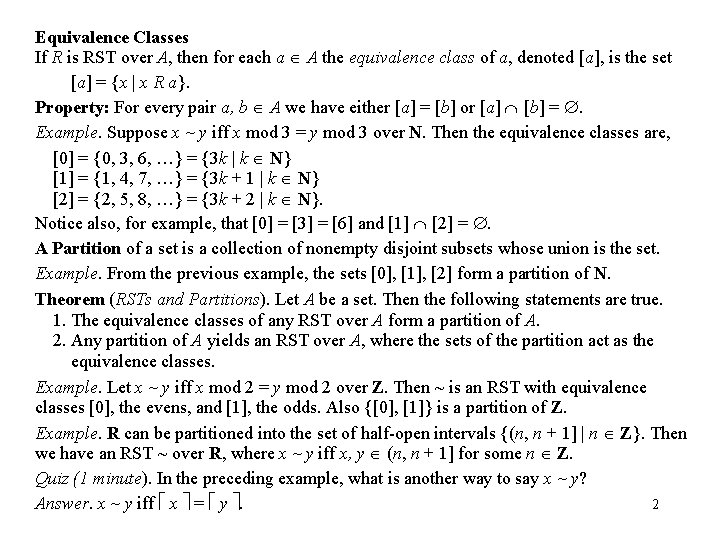
Equivalence Classes If R is RST over A, then for each a A the equivalence class of a, denoted [a], is the set [a] = {x | x R a}. Property: For every pair a, b A we have either [a] = [b] or [a] [b] = . Example. Suppose x ~ y iff x mod 3 = y mod 3 over N. Then the equivalence classes are, [0] = {0, 3, 6, …} = {3 k | k N} [1] = {1, 4, 7, …} = {3 k + 1 | k N} [2] = {2, 5, 8, …} = {3 k + 2 | k N}. Notice also, for example, that [0] = [3] = [6] and [1] [2] = . A Partition of a set is a collection of nonempty disjoint subsets whose union is the set. Example. From the previous example, the sets [0], [1], [2] form a partition of N. Theorem (RSTs and Partitions). Let A be a set. Then the following statements are true. 1. The equivalence classes of any RST over A form a partition of A. 2. Any partition of A yields an RST over A, where the sets of the partition act as the equivalence classes. Example. Let x ~ y iff x mod 2 = y mod 2 over Z. Then ~ is an RST with equivalence classes [0], the evens, and [1], the odds. Also {[0], [1]} is a partition of Z. Example. R can be partitioned into the set of half-open intervals {(n, n + 1] | n Z}. Then we have an RST ~ over R, where x ~ y iff x, y (n, n + 1] for some n Z. Quiz (1 minute). In the preceding example, what is another way to say x ~ y? 2 Answer. x ~ y iff x = y .
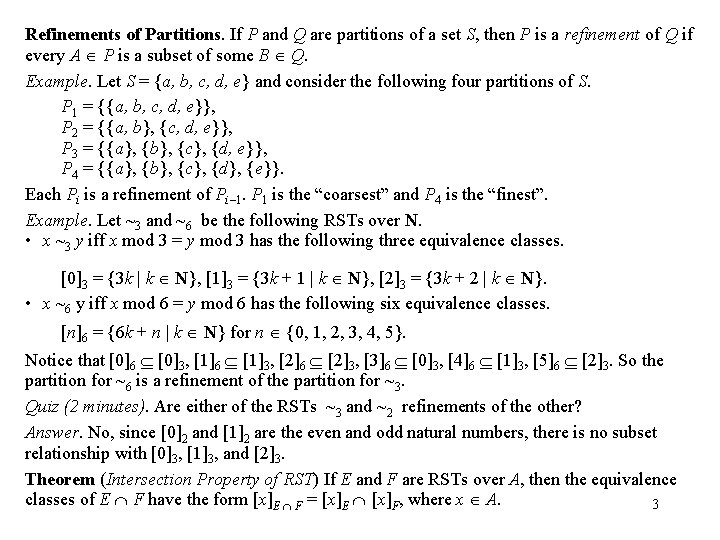
Refinements of Partitions. If P and Q are partitions of a set S, then P is a refinement of Q if every A P is a subset of some B Q. Example. Let S = {a, b, c, d, e} and consider the following four partitions of S. P 1 = {{a, b, c, d, e}}, P 2 = {{a, b}, {c, d, e}}, P 3 = {{a}, {b}, {c}, {d, e}}, P 4 = {{a}, {b}, {c}, {d}, {e}}. Each Pi is a refinement of Pi– 1. P 1 is the “coarsest” and P 4 is the “finest”. Example. Let ~3 and ~6 be the following RSTs over N. • x ~3 y iff x mod 3 = y mod 3 has the following three equivalence classes. [0]3 = {3 k | k N}, [1]3 = {3 k + 1 | k N}, [2]3 = {3 k + 2 | k N}. • x ~6 y iff x mod 6 = y mod 6 has the following six equivalence classes. [n]6 = {6 k + n | k N} for n {0, 1, 2, 3, 4, 5}. Notice that [0]6 [0]3, [1]6 [1]3, [2]6 [2]3, [3]6 [0]3, [4]6 [1]3, [5]6 [2]3. So the partition for ~6 is a refinement of the partition for ~3. Quiz (2 minutes). Are either of the RSTs ~3 and ~2 refinements of the other? Answer. No, since [0]2 and [1]2 are the even and odd natural numbers, there is no subset relationship with [0]3, [1]3, and [2]3. Theorem (Intersection Property of RST) If E and F are RSTs over A, then the equivalence classes of E F have the form [x]E F = [x]E [x]F, where x A. 3
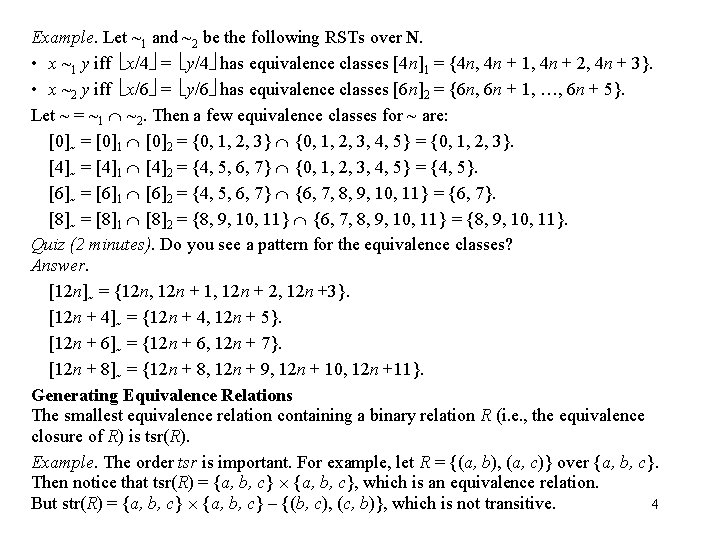
Example. Let ~1 and ~2 be the following RSTs over N. • x ~1 y iff x/4 = y/4 has equivalence classes [4 n]1 = {4 n, 4 n + 1, 4 n + 2, 4 n + 3}. • x ~2 y iff x/6 = y/6 has equivalence classes [6 n]2 = {6 n, 6 n + 1, …, 6 n + 5}. Let ~ = ~1 ~2. Then a few equivalence classes for ~ are: [0]~ = [0]1 [0]2 = {0, 1, 2, 3} {0, 1, 2, 3, 4, 5} = {0, 1, 2, 3}. [4]~ = [4]1 [4]2 = {4, 5, 6, 7} {0, 1, 2, 3, 4, 5} = {4, 5}. [6]~ = [6]1 [6]2 = {4, 5, 6, 7} {6, 7, 8, 9, 10, 11} = {6, 7}. [8]~ = [8]1 [8]2 = {8, 9, 10, 11} {6, 7, 8, 9, 10, 11} = {8, 9, 10, 11}. Quiz (2 minutes). Do you see a pattern for the equivalence classes? Answer. [12 n]~ = {12 n, 12 n + 1, 12 n + 2, 12 n +3}. [12 n + 4]~ = {12 n + 4, 12 n + 5}. [12 n + 6]~ = {12 n + 6, 12 n + 7}. [12 n + 8]~ = {12 n + 8, 12 n + 9, 12 n + 10, 12 n +11}. Generating Equivalence Relations The smallest equivalence relation containing a binary relation R (i. e. , the equivalence closure of R) is tsr(R). Example. The order tsr is important. For example, let R = {(a, b), (a, c)} over {a, b, c}. Then notice that tsr(R) = {a, b, c}, which is an equivalence relation. But str(R) = {a, b, c} – {(b, c), (c, b)}, which is not transitive. 4
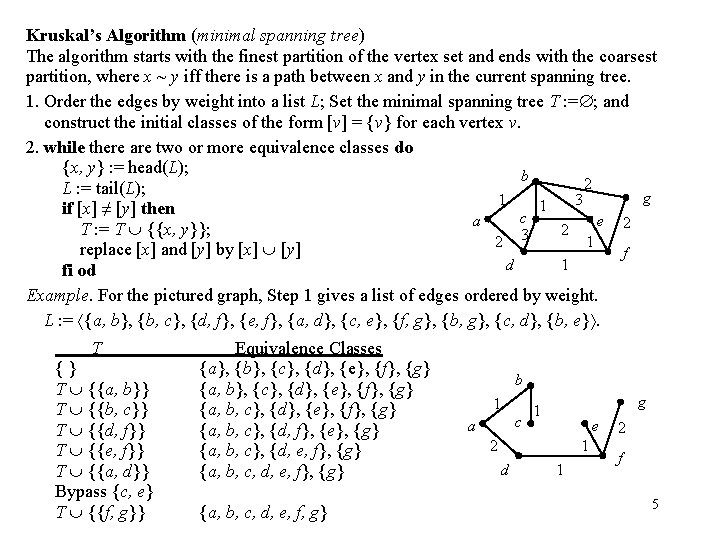
Kruskal’s Algorithm (minimal spanning tree) The algorithm starts with the finest partition of the vertex set and ends with the coarsest partition, where x ~ y iff there is a path between x and y in the current spanning tree. 1. Order the edges by weight into a list L; Set the minimal spanning tree T : = ; and construct the initial classes of the form [v] = {v} for each vertex v. 2. while there are two or more equivalence classes do {x, y} : = head(L); b 2 L : = tail(L); g 1 3 1 if [x] ≠ [y] then c a e 2 2 T : = T {{x, y}}; 2 3 1 replace [x] and [y] by [x] [y] f d 1 fi od Example. For the pictured graph, Step 1 gives a list of edges ordered by weight. L : = {a, b}, {b, c}, {d, f}, {e, f}, {a, d}, {c, e}, {f, g}, {b, g}, {c, d}, {b, e}. T {} T {{a, b}} T {{b, c}} T {{d, f}} T {{e, f}} T {{a, d}} Bypass {c, e} T {{f, g}} Equivalence Classes {a}, {b}, {c}, {d}, {e}, {f}, {g} {a, b, c}, {d, f}, {e}, {g} {a, b, c}, {d, e, f}, {g} {a, b, c, d, e, f, g} b 1 c a g 1 e 2 1 d 1 2 f 5
- Slides: 5