
Section 4 1 The Simplex Method Standard Maximization
- Slides: 12
Section 4. 1 The Simplex Method: Standard Maximization Problems
The Simplex Method The simplex method is an iterative process. Starting at some initial feasible solution (a corner point – usually the origin), each iteration moves to another corner point with an improved (or at least not worse) value of the objective function. Iteration stops when an optimal solution (if it exists) is found.
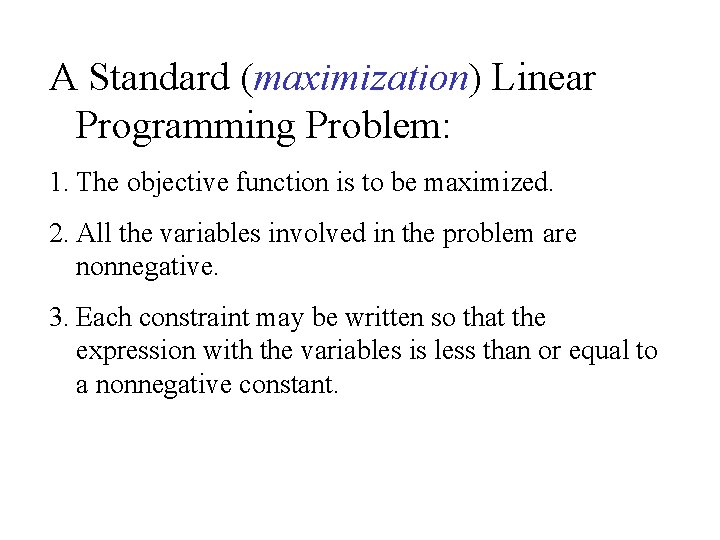
A Standard (maximization) Linear Programming Problem: 1. The objective function is to be maximized. 2. All the variables involved in the problem are nonnegative. 3. Each constraint may be written so that the expression with the variables is less than or equal to a nonnegative constant.
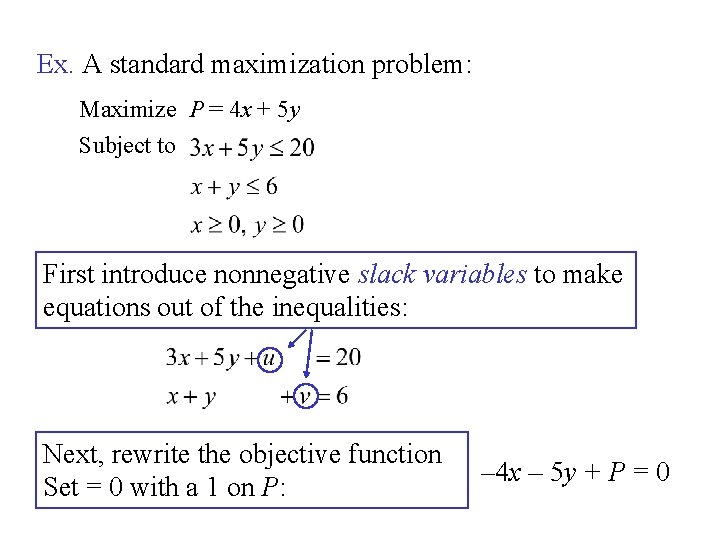
Ex. A standard maximization problem: Maximize P = 4 x + 5 y Subject to First introduce nonnegative slack variables to make equations out of the inequalities: Next, rewrite the objective function Set = 0 with a 1 on P: – 4 x – 5 y + P = 0
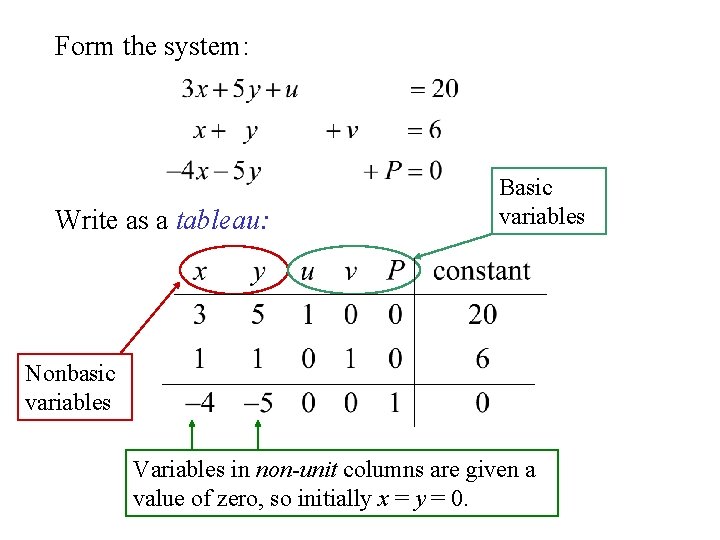
Form the system: Write as a tableau: Basic variables Nonbasic variables Variables in non-unit columns are given a value of zero, so initially x = y = 0.
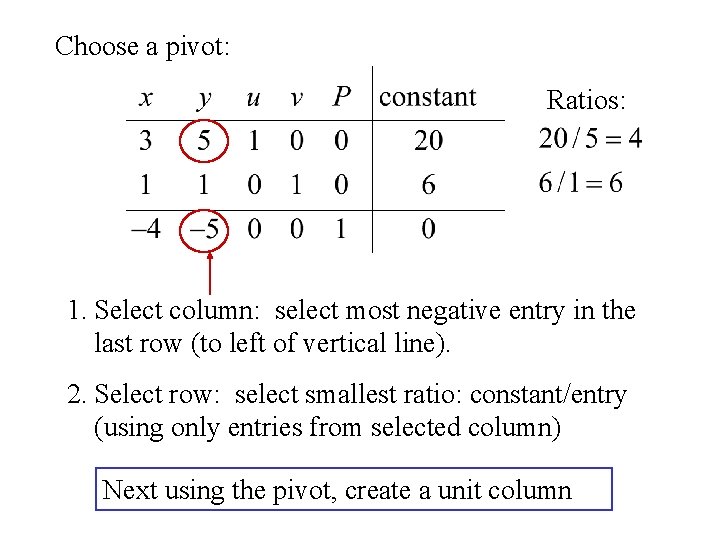
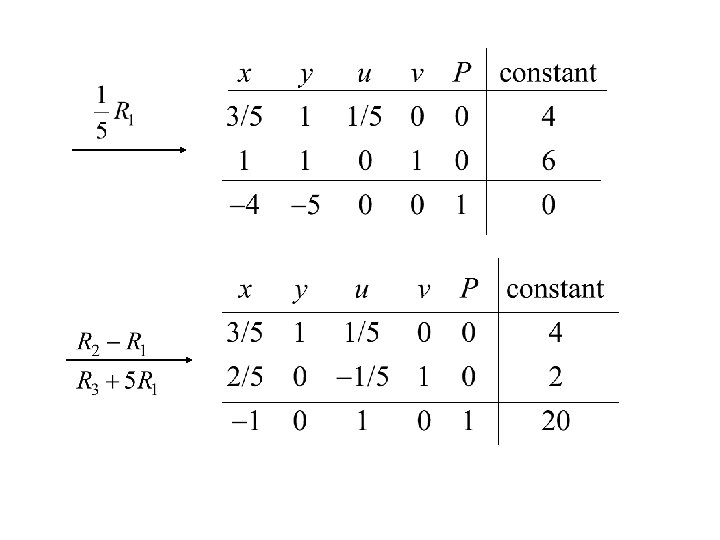
Choose a pivot: Ratios: 1. Select column: select most negative entry in the last row (to left of vertical line). 2. Select row: select smallest ratio: constant/entry (using only entries from selected column) Next using the pivot, create a unit column
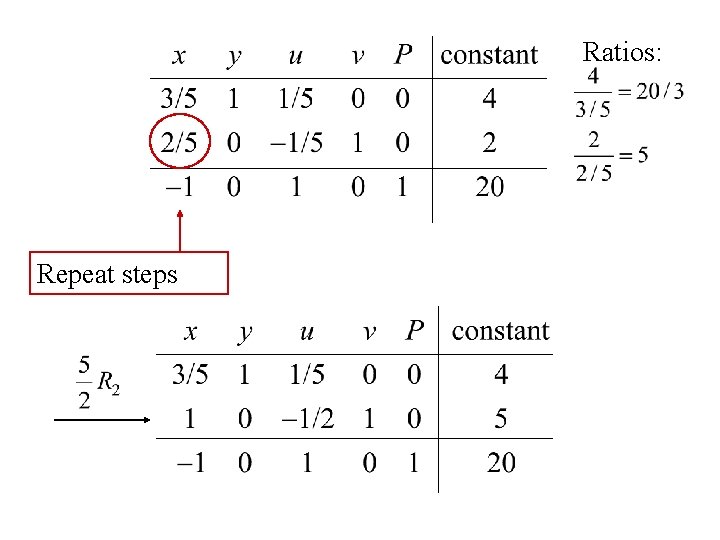
Ratios: Repeat steps
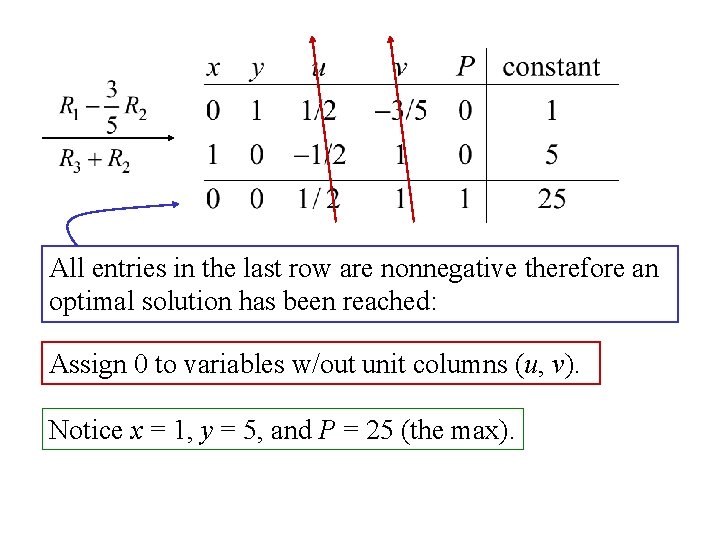
All entries in the last row are nonnegative therefore an optimal solution has been reached: Assign 0 to variables w/out unit columns (u, v). Notice x = 1, y = 5, and P = 25 (the max).
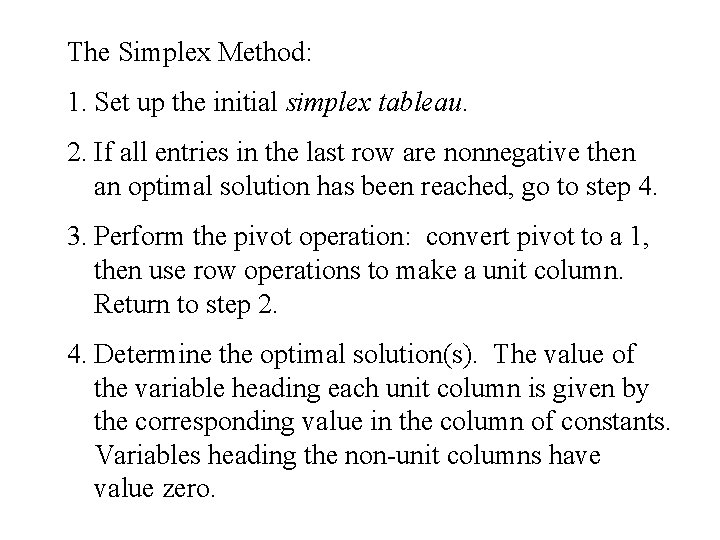
The Simplex Method: 1. Set up the initial simplex tableau. 2. If all entries in the last row are nonnegative then an optimal solution has been reached, go to step 4. 3. Perform the pivot operation: convert pivot to a 1, then use row operations to make a unit column. Return to step 2. 4. Determine the optimal solution(s). The value of the variable heading each unit column is given by the corresponding value in the column of constants. Variables heading the non-unit columns have value zero.
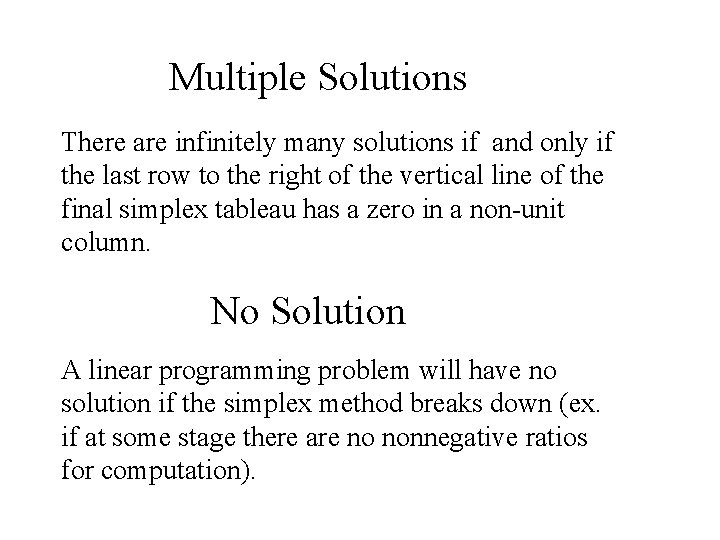
Multiple Solutions There are infinitely many solutions if and only if the last row to the right of the vertical line of the final simplex tableau has a zero in a non-unit column. No Solution A linear programming problem will have no solution if the simplex method breaks down (ex. if at some stage there are no nonnegative ratios for computation).
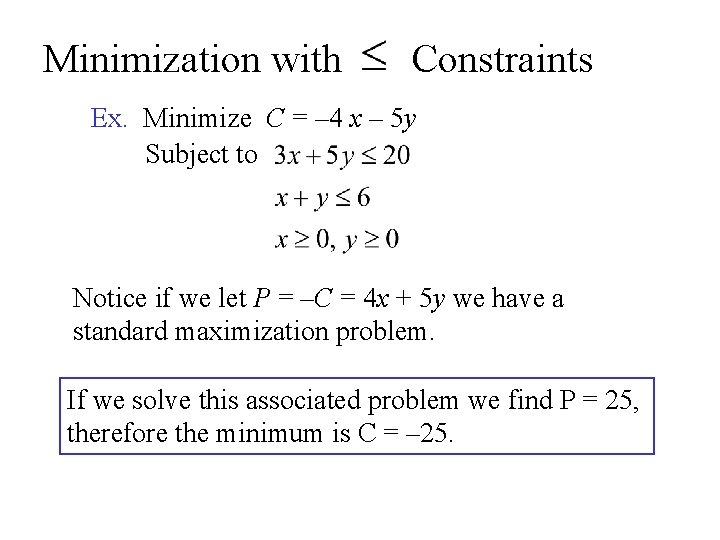
Minimization with Constraints Ex. Minimize C = – 4 x – 5 y Subject to Notice if we let P = –C = 4 x + 5 y we have a standard maximization problem. If we solve this associated problem we find P = 25, therefore the minimum is C = – 25.