
Section 4 1 Naming Binary Compounds Steven S
Section 4. 1 Naming Binary Compounds Steven S. Zumdahl Susan A. Zumdahl Donald J. De. Coste Chapter 4 Nomenclature Gretchen M. Adams • University of Illinois at Urbana-Champaign
Section 4. 1 Naming Binary Compounds Objectives 1. To learn to name binary compounds of a metal and a nonmetal 2. To learn to name binary compounds containing only nonmetals 3. To summarize the naming of all types of binary compounds
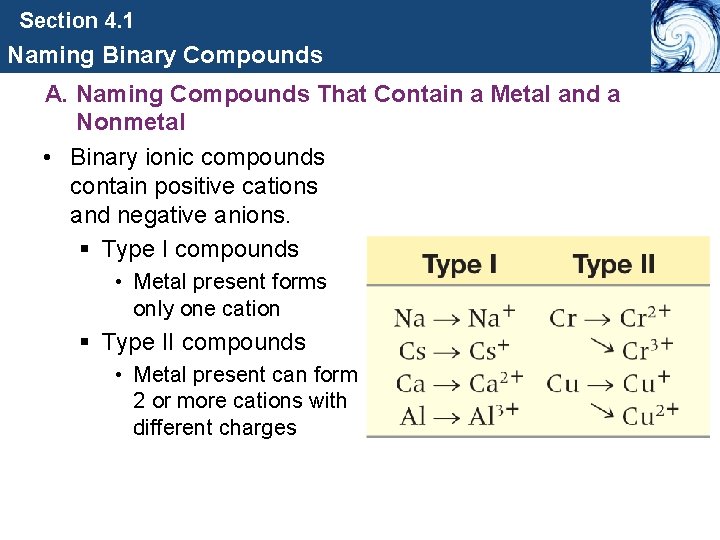
Section 4. 1 Naming Binary Compounds A. Naming Compounds That Contain a Metal and a Nonmetal • Binary ionic compounds contain positive cations and negative anions. § Type I compounds • Metal present forms only one cation § Type II compounds • Metal present can form 2 or more cations with different charges
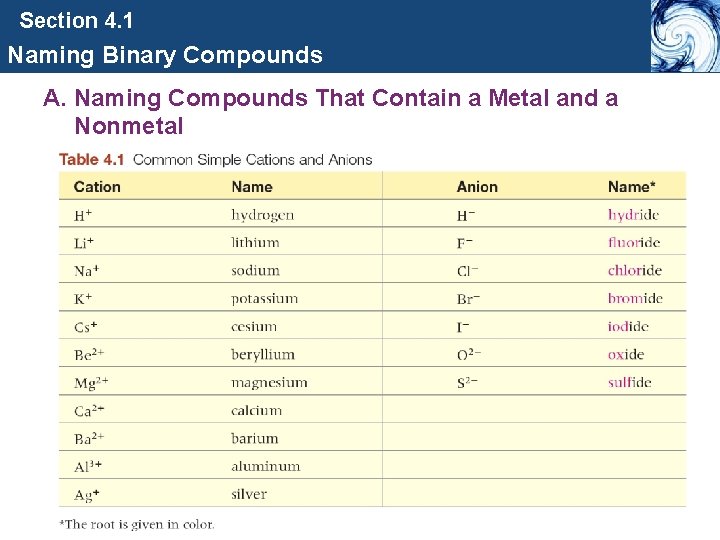
Section 4. 1 Naming Binary Compounds A. Naming Compounds That Contain a Metal and a Nonmetal
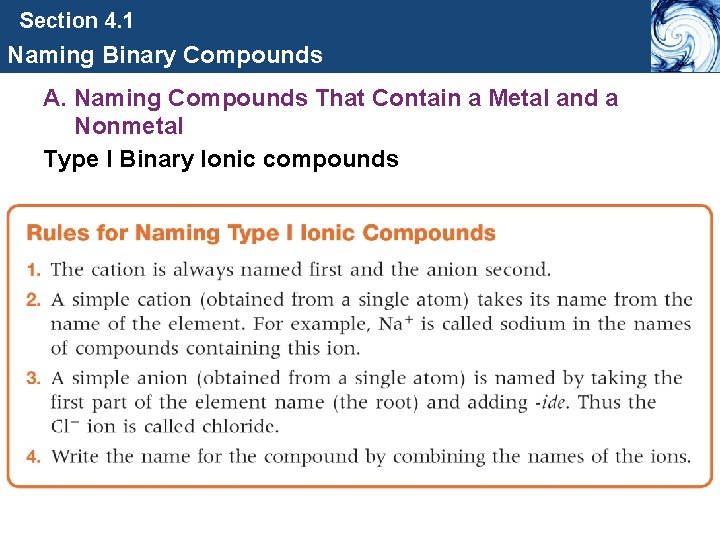
Section 4. 1 Naming Binary Compounds A. Naming Compounds That Contain a Metal and a Nonmetal Type I Binary Ionic compounds
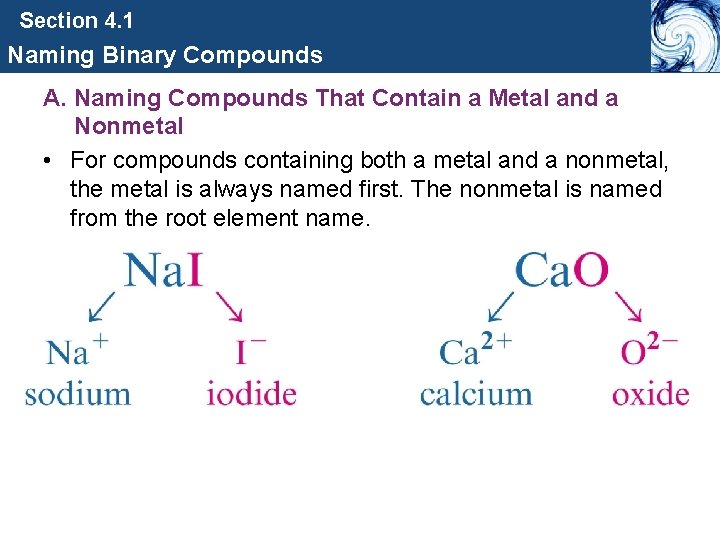
Section 4. 1 Naming Binary Compounds A. Naming Compounds That Contain a Metal and a Nonmetal • For compounds containing both a metal and a nonmetal, the metal is always named first. The nonmetal is named from the root element name.
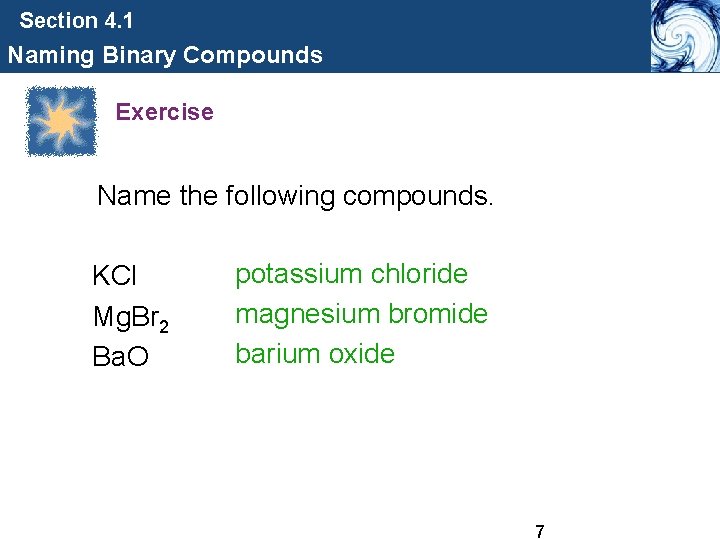
Section 4. 1 Naming Binary Compounds Exercise Name the following compounds. KCl Mg. Br 2 Ba. O potassium chloride magnesium bromide barium oxide 7
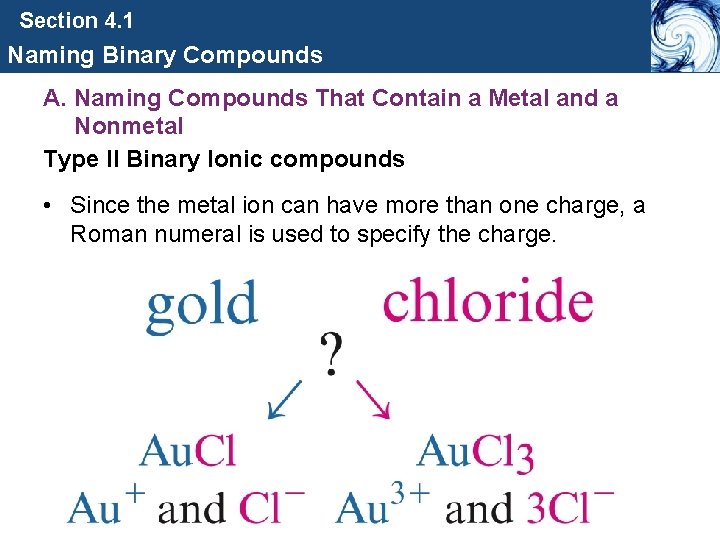
Section 4. 1 Naming Binary Compounds A. Naming Compounds That Contain a Metal and a Nonmetal Type II Binary Ionic compounds • Since the metal ion can have more than one charge, a Roman numeral is used to specify the charge.
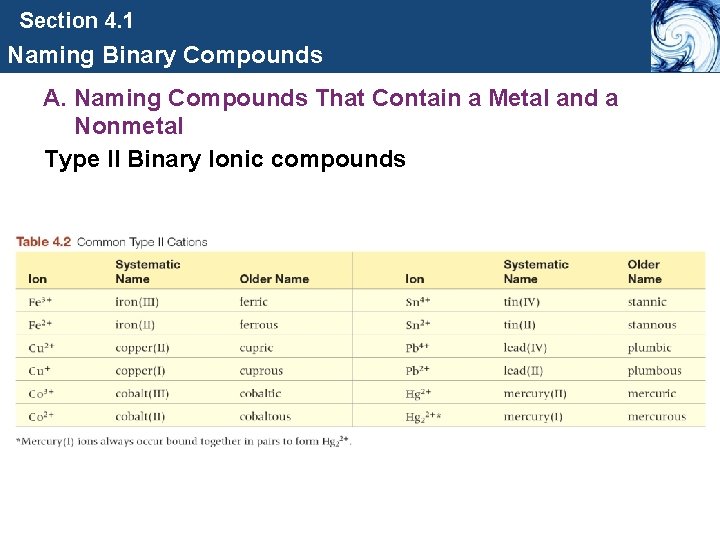
Section 4. 1 Naming Binary Compounds A. Naming Compounds That Contain a Metal and a Nonmetal Type II Binary Ionic compounds
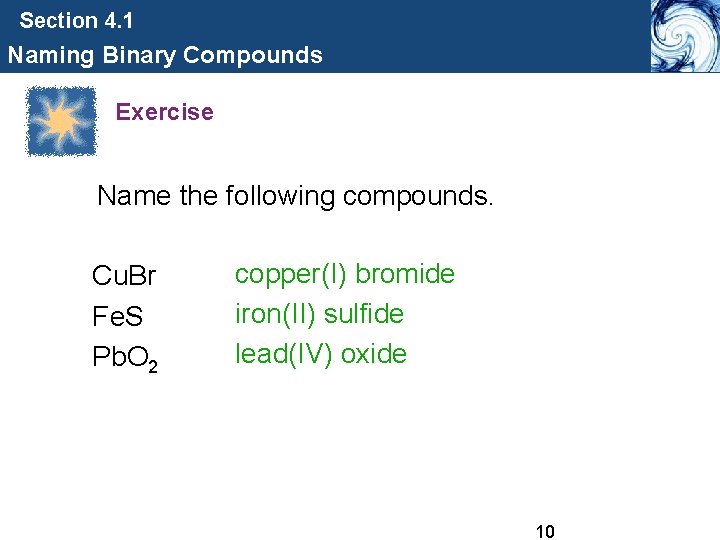
Section 4. 1 Naming Binary Compounds Exercise Name the following compounds. Cu. Br Fe. S Pb. O 2 copper(I) bromide iron(II) sulfide lead(IV) oxide 10
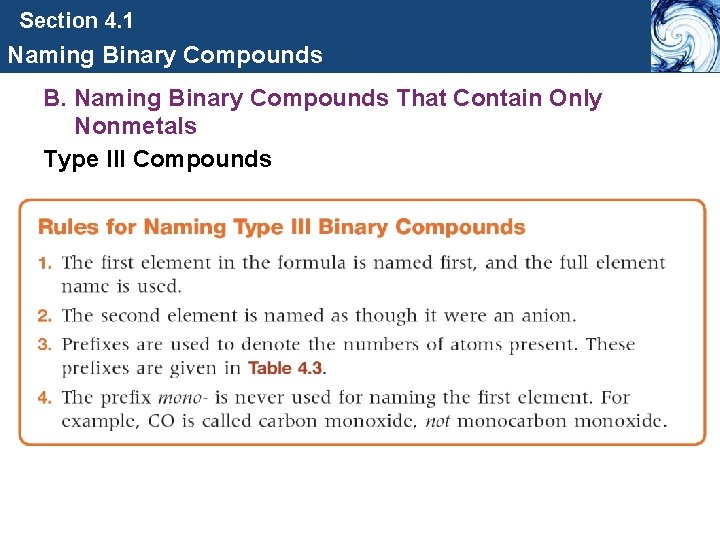
Section 4. 1 Naming Binary Compounds B. Naming Binary Compounds That Contain Only Nonmetals Type III Compounds

Section 4. 1 Naming Binary Compounds B. Naming Binary Compounds That Contain Only Nonmetals Type III Compounds
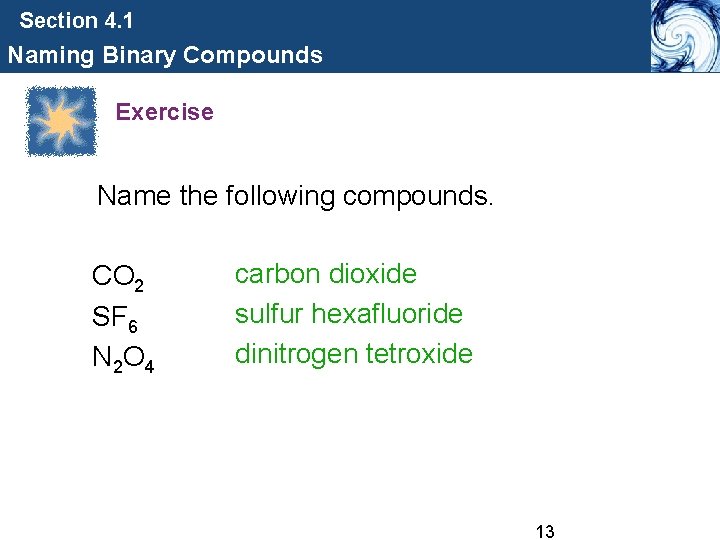
Section 4. 1 Naming Binary Compounds Exercise Name the following compounds. CO 2 SF 6 N 2 O 4 carbon dioxide sulfur hexafluoride dinitrogen tetroxide 13
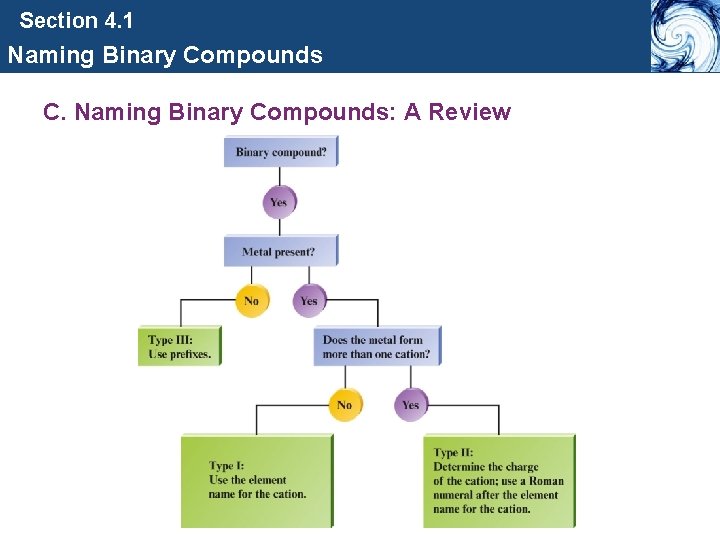
Section 4. 1 Naming Binary Compounds C. Naming Binary Compounds: A Review
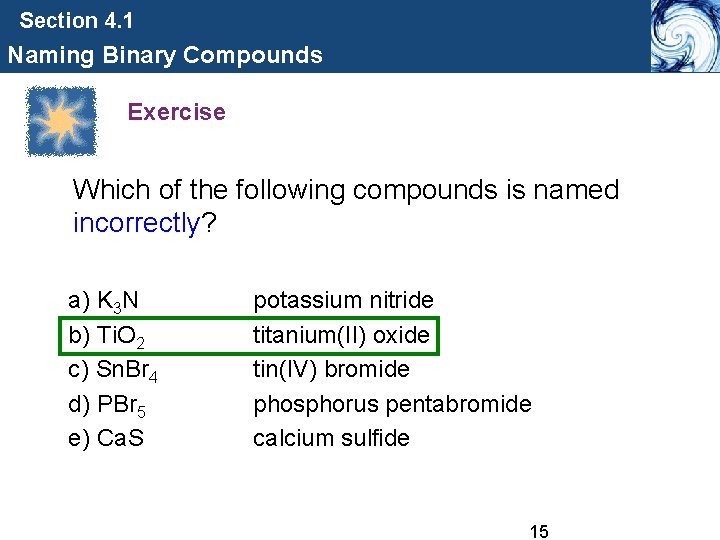
Section 4. 1 Naming Binary Compounds Exercise Which of the following compounds is named incorrectly? a) K 3 N b) Ti. O 2 c) Sn. Br 4 d) PBr 5 e) Ca. S potassium nitride titanium(II) oxide tin(IV) bromide phosphorus pentabromide calcium sulfide 15
Section 4. 2 Naming and Writing Formulas for More Complex Compounds Objectives 1. To learn the names of common polyatomic ions 2. To learn to name compounds containing polyatomic ions 3. To learn how the anion composition determines an acid’s name 4. To learn the names for common acids 5. To learn to write the formula for a compound, given its name
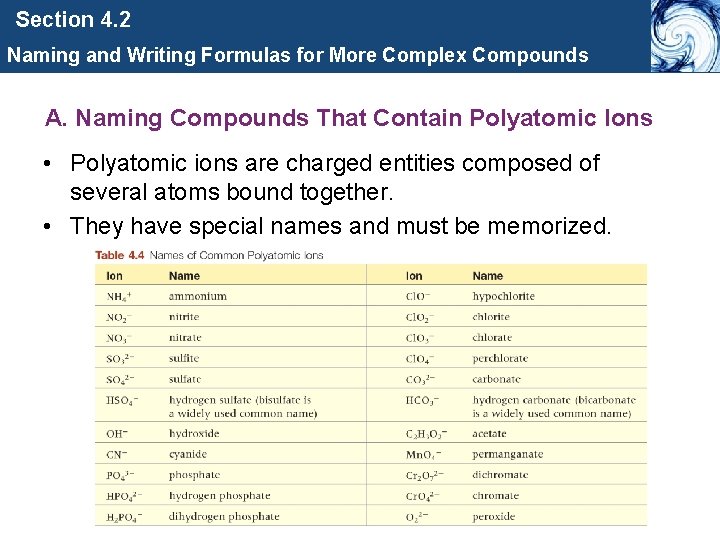
Section 4. 2 Naming and Writing Formulas for More Complex Compounds A. Naming Compounds That Contain Polyatomic Ions • Polyatomic ions are charged entities composed of several atoms bound together. • They have special names and must be memorized.
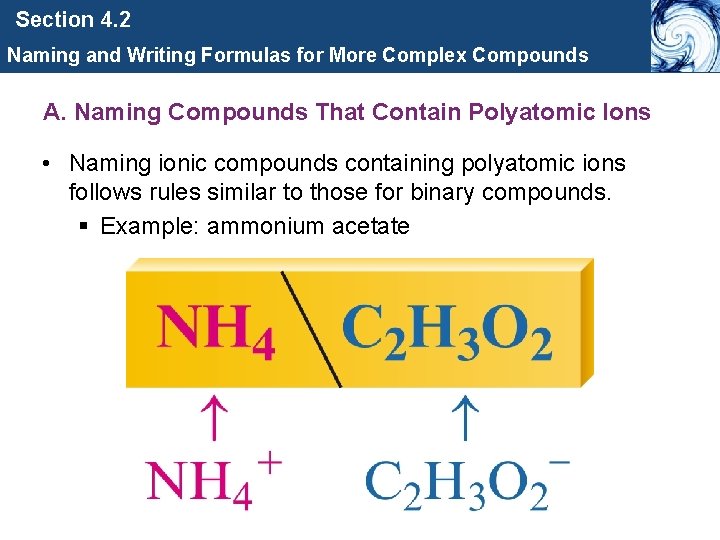
Section 4. 2 Naming and Writing Formulas for More Complex Compounds A. Naming Compounds That Contain Polyatomic Ions • Naming ionic compounds containing polyatomic ions follows rules similar to those for binary compounds. § Example: ammonium acetate
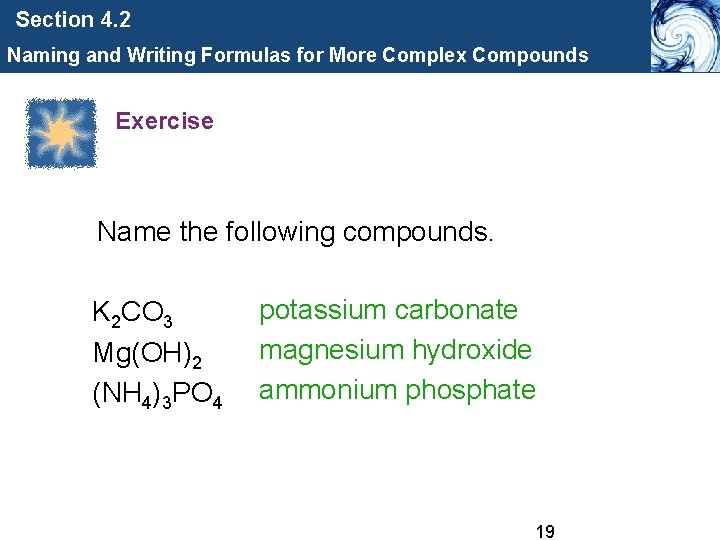
Section 4. 2 Naming and Writing Formulas for More Complex Compounds Exercise Name the following compounds. K 2 CO 3 Mg(OH)2 (NH 4)3 PO 4 potassium carbonate magnesium hydroxide ammonium phosphate 19
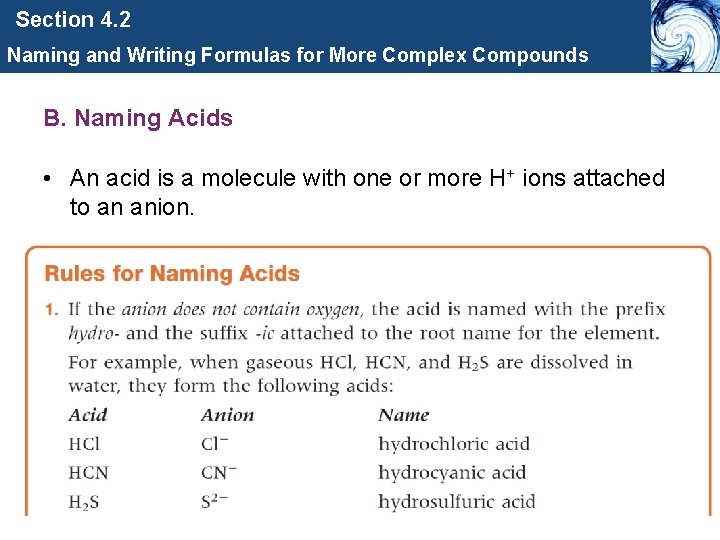
Section 4. 2 Naming and Writing Formulas for More Complex Compounds B. Naming Acids • An acid is a molecule with one or more H+ ions attached to an anion.
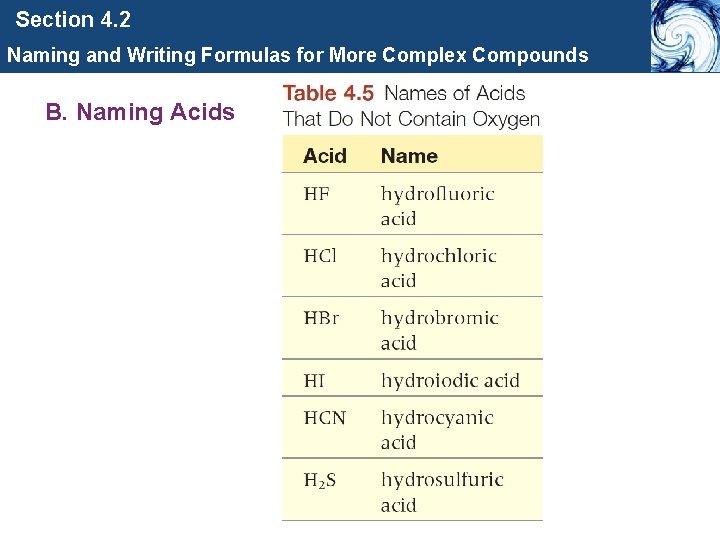
Section 4. 2 Naming and Writing Formulas for More Complex Compounds B. Naming Acids
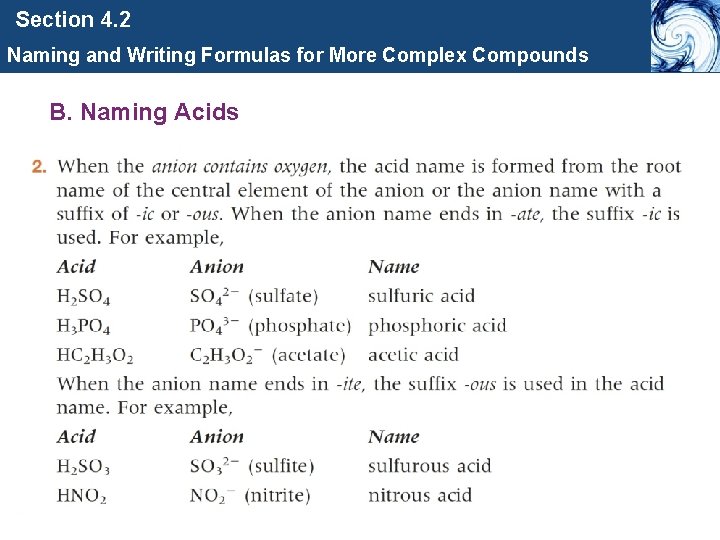
Section 4. 2 Naming and Writing Formulas for More Complex Compounds B. Naming Acids
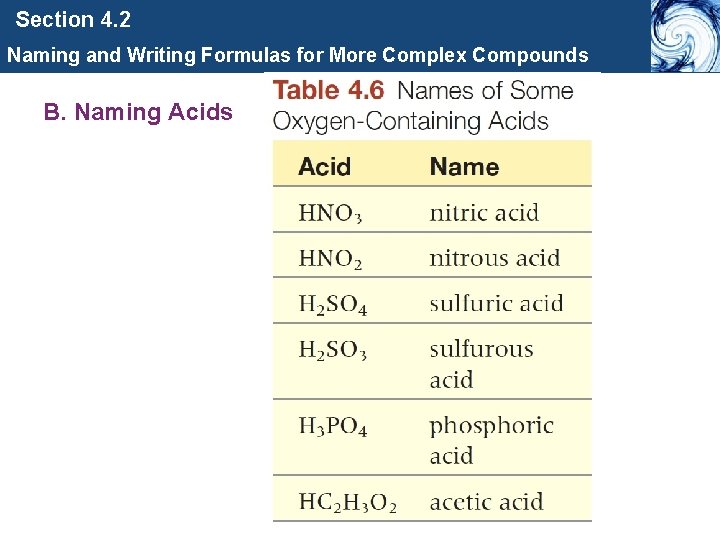
Section 4. 2 Naming and Writing Formulas for More Complex Compounds B. Naming Acids
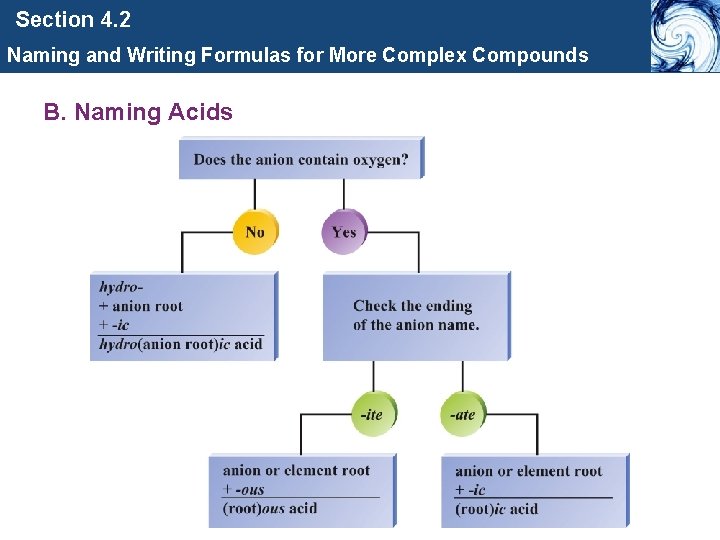
Section 4. 2 Naming and Writing Formulas for More Complex Compounds B. Naming Acids
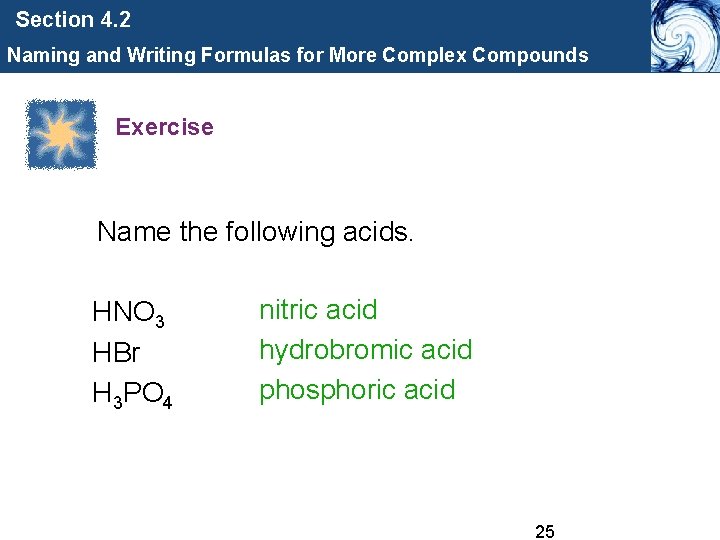
Section 4. 2 Naming and Writing Formulas for More Complex Compounds Exercise Name the following acids. HNO 3 HBr H 3 PO 4 nitric acid hydrobromic acid phosphoric acid 25
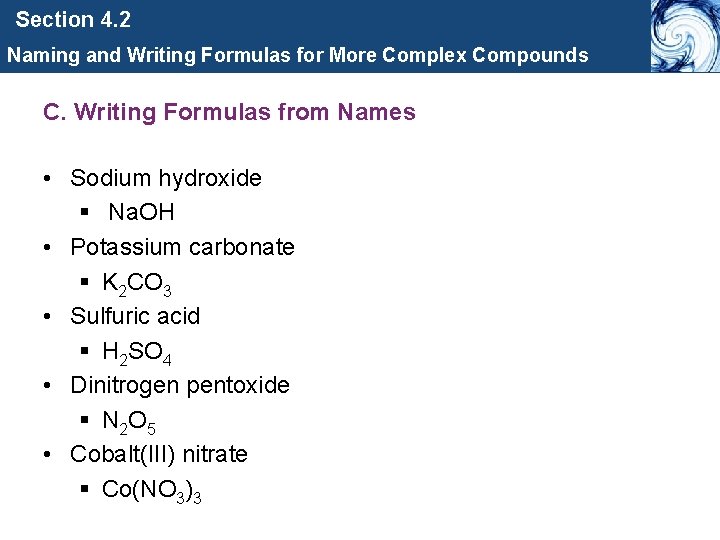
Section 4. 2 Naming and Writing Formulas for More Complex Compounds C. Writing Formulas from Names • Sodium hydroxide § Na. OH • Potassium carbonate § K 2 CO 3 • Sulfuric acid § H 2 SO 4 • Dinitrogen pentoxide § N 2 O 5 • Cobalt(III) nitrate § Co(NO 3)3
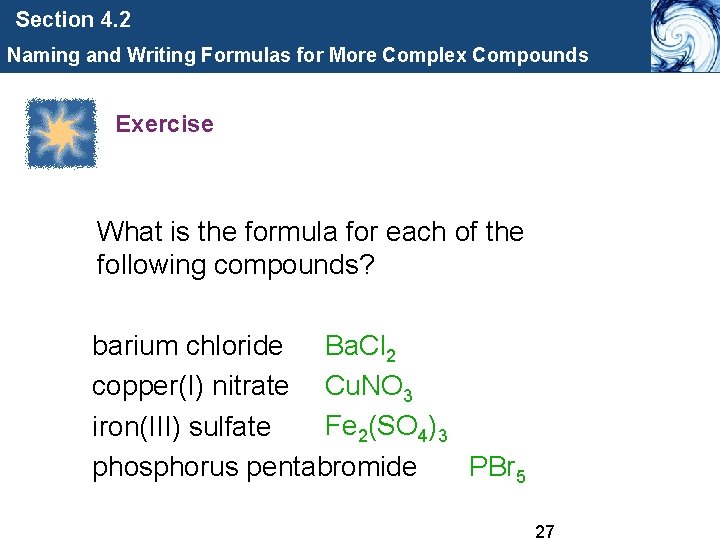
Section 4. 2 Naming and Writing Formulas for More Complex Compounds Exercise What is the formula for each of the following compounds? barium chloride Ba. Cl 2 copper(I) nitrate Cu. NO 3 Fe 2(SO 4)3 iron(III) sulfate PBr 5 phosphorus pentabromide 27
- Slides: 27