
Section 36 1 The Skeletal and Muscular Systems
- Slides: 23
Section 36 -1 The Skeletal and Muscular Systems Go to Section:
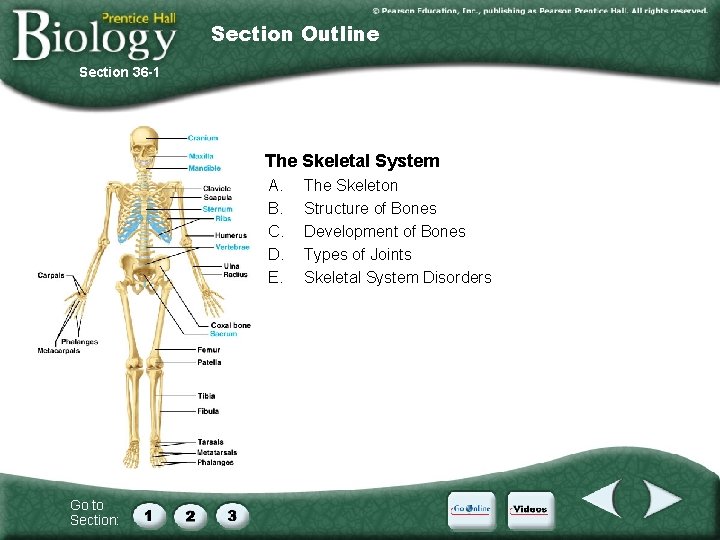
Section Outline Section 36 -1 36– 1 The Skeletal System A. B. C. D. E. Go to Section: The Skeleton Structure of Bones Development of Bones Types of Joints Skeletal System Disorders
The Skeleton Section 36 -2 • Made up of mainly bones of various shapes and sizes (206) • Function • Support the body • Protect internal organs • Provide for movement • Store mineral reserves • Provide a site for blood cell formation • Provide a system of levers for muscles to provide movement Go to Section:
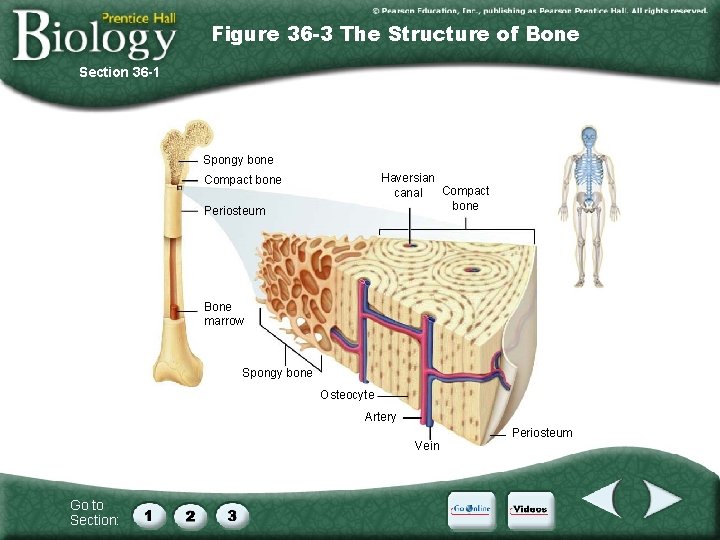
Structure of Bones Section 36 -2 • Made of bone tissue • A network of living cells and protein fibers that are surrounded by deposits of calcium salts • Bone is dense, yet not a solid structure • Contain a network of tubes and spongy bone (not squishy) • Spongy refers to the latticework shape • Contain bone marrow (2 types) – a soft tissue • Yellow – primarily fat cells • Red – produce rbc’s, some wbc’s and platelets Go to Section:
Figure 36 -3 The Structure of Bone Section 36 -1 Spongy bone Haversian Compact canal bone Compact bone Periosteum Bone marrow Spongy bone Osteocyte Artery Vein Go to Section: Periosteum
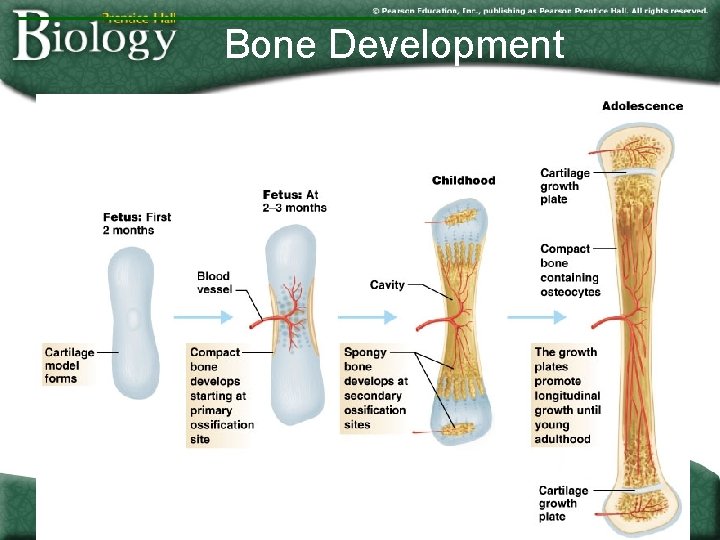
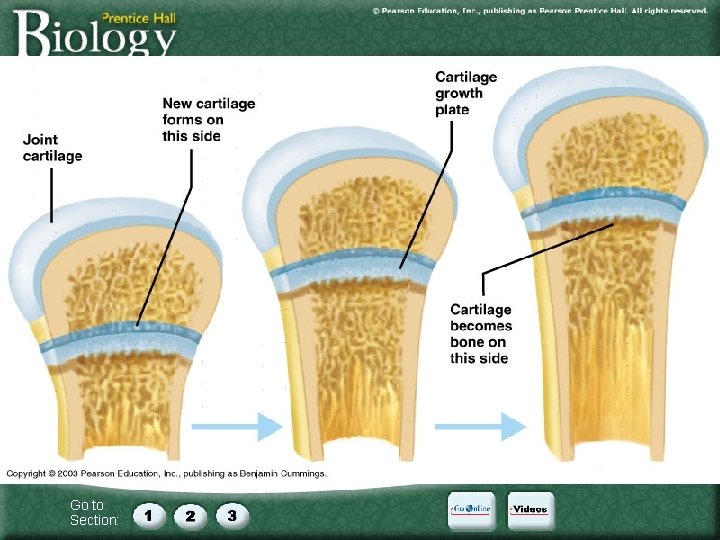
Development of Bones Section 36 -2 • Embryo skeletons are composed of cartilage • A type of connective tissue, which does not contain blood vessels, but relies on diffusion • Cartilage is replaced by bone during ossification (bone formation) • Ossification is completed by the end of adolescence when growth plates of cartilage at the end of long bones is replaced by bone tissue Go to Section:
Bone Development Go to Section: Figure 5. 2
Go to Section:
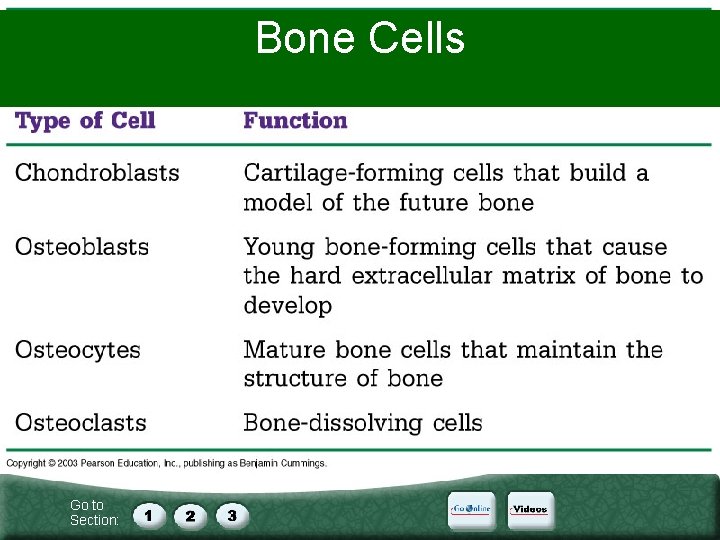
Bone Cells Go to Section:
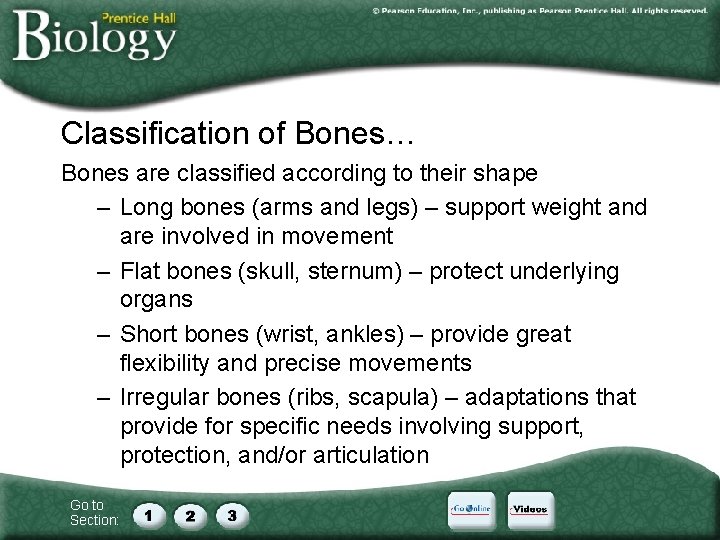
Classification of Bones… Bones are classified according to their shape – Long bones (arms and legs) – support weight and are involved in movement – Flat bones (skull, sternum) – protect underlying organs – Short bones (wrist, ankles) – provide great flexibility and precise movements – Irregular bones (ribs, scapula) – adaptations that provide for specific needs involving support, protection, and/or articulation Go to Section:
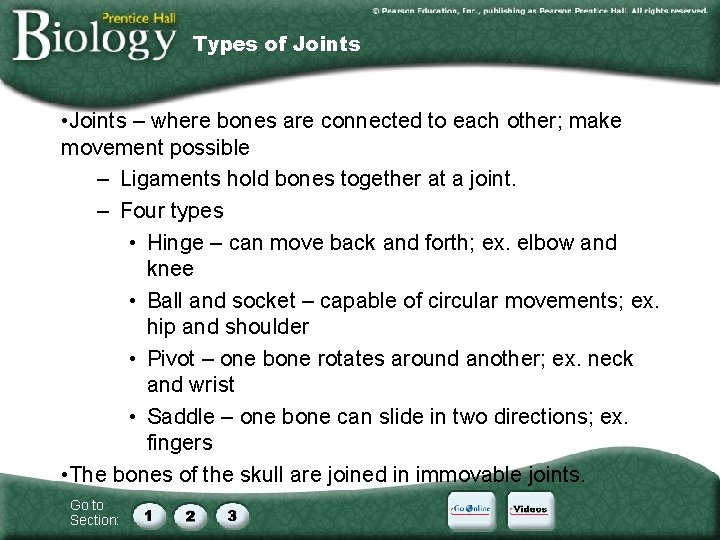
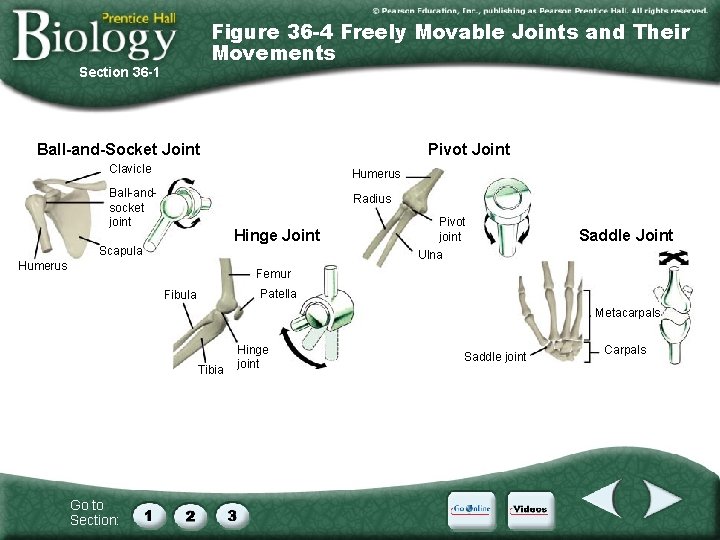
Types of Joints • Joints – where bones are connected to each other; make movement possible – Ligaments hold bones together at a joint. – Four types • Hinge – can move back and forth; ex. elbow and knee • Ball and socket – capable of circular movements; ex. hip and shoulder • Pivot – one bone rotates around another; ex. neck and wrist • Saddle – one bone can slide in two directions; ex. fingers • The bones of the skull are joined in immovable joints. Go to Section:
Figure 36 -4 Freely Movable Joints and Their Movements Section 36 -1 Ball-and-Socket Joint Pivot Joint Clavicle Humerus Ball-andsocket joint Radius Hinge Joint Scapula Pivot joint Saddle Joint Ulna Humerus Femur Patella Fibula Metacarpals Tibia Go to Section: Hinge joint Saddle joint Carpals
Skeletal System Disorders • Arthritis – Inflammation of the joints, which makes movement difficult and causes pain • Osteoporosis – Weakening of the bones which can lead to fracture; due to loss of calcium • Sprain – Ligaments or tendons get torn or pulled beyond their normal stretching range • Painful, yet still able to function • Fracture – A break in a bone • Bone is a living tissue; begins to heal almost immediately • Dislocation – When a bone is forced out of its joint • Can be serious • Bone can usually be pushed back into place by a doctor Go to Section:
Injuries to Skeleton… Sprain – Ligaments or tendons get torn or pulled beyond their normal stretching range • Painful, yet still able to function Fracture – A break in a bone • Bone is a living tissue; begins to heal almost immediately Dislocation – When a bone is forced out of its joint • Can be serious • Bone can usually be pushed back into place by a doctor Go to Section:
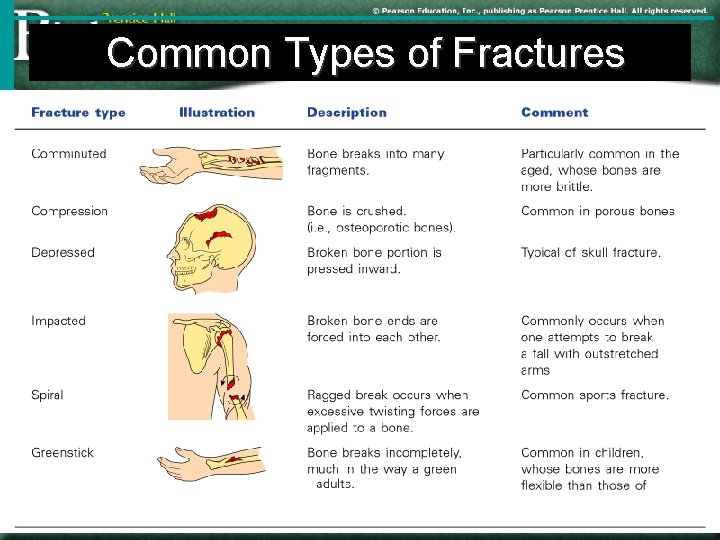
Common Types of Fractures Table 5. 2 Go to Copyright. Section: © 2003 Pearson Education, Inc. publishing as Benjamin Cummings Slide 5. 17
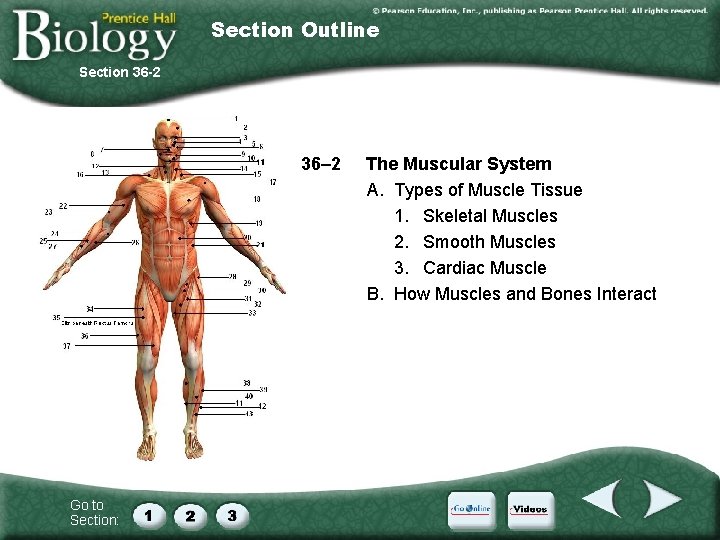
Section Outline Section 36 -2 36– 2 Go to Section: The Muscular System A. Types of Muscle Tissue 1. Skeletal Muscles 2. Smooth Muscles 3. Cardiac Muscle B. How Muscles and Bones Interact
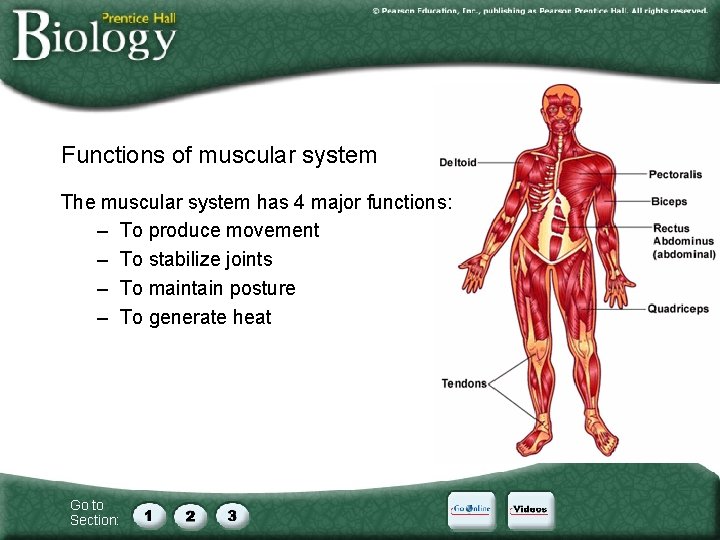
Functions of muscular system The muscular system has 4 major functions: – To produce movement – To stabilize joints – To maintain posture – To generate heat Go to Section:
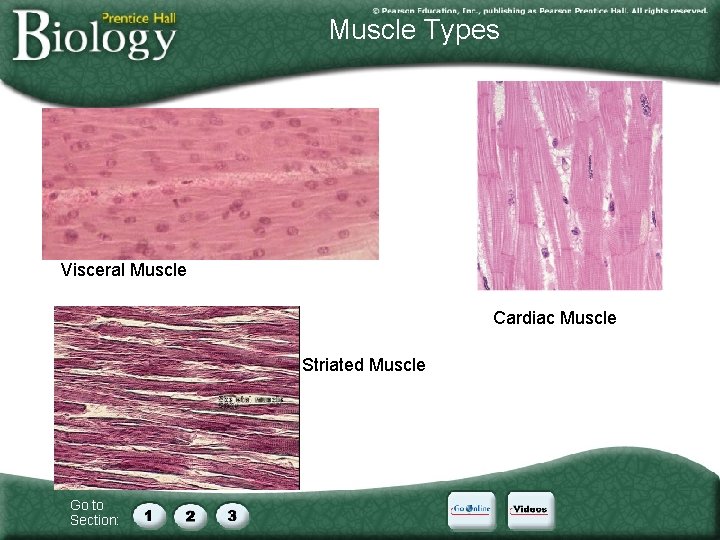
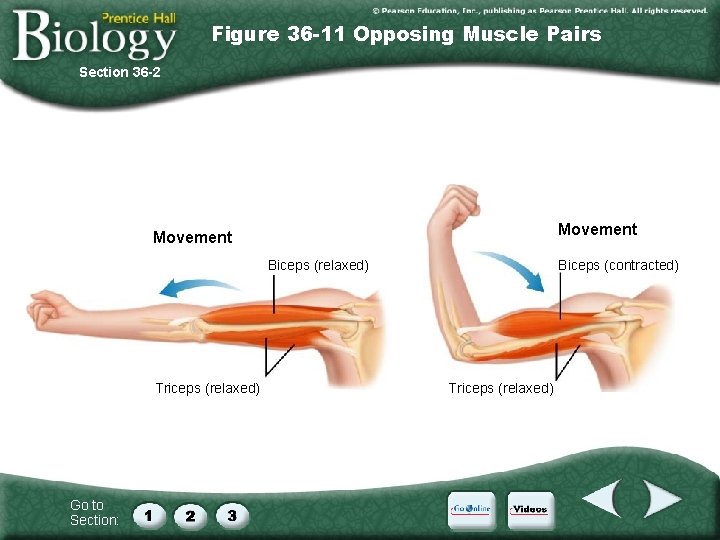
Types of Muscle Tissue • Unlike other body tissues, muscles have the ability to contract – This makes movement of the skeleton possible • Three types of muscle tissue – Skeletal – also known as voluntary or striated • Generally operate in antagonistic pairs (work in opposites) – One muscle contracts to extend the limb and the other muscle contracts to flex the limb – Smooth – also known as involuntary of visceral • Found in the walls of digestive system as well as other internal organs – Cardiac – also involuntary • Found only in the heart Go to Section:
Muscle Types Visceral Muscle Cardiac Muscle Striated Muscle Go to Section:
All-Or-None Principle • A stimulated muscle contracts a nerve impulse either completely or not at all • This means that the relation between the stimulus and the response that it sets up is all or nothing at all Go to Section:
Figure 36 -11 Opposing Muscle Pairs Section 36 -2 Movement Biceps (relaxed) Triceps (relaxed) Go to Section: Biceps (contracted) Triceps (relaxed)
How Muscles and Bones Interact • Skeletal muscles are attached to bones by connective tissues called tendons – Tough, inelastic and fibrous – They pull on bones and make them act as levers – The joint acts as the fulcrum (the fixed point) • The muscles provide the force to move the lever Go to Section:
Muscular System Disorders • Muscular dystrophy – Muscle degeneration and weakness – Inherited • ALS (Lou Gehrig’s Disease) – Motor neurons in the brain and spinal cord degenerate – When the motor neurons die, the ability of the brain to initiate and control muscle movement is lost. – Muscles then begin to atrophy (become thinner and smaller) – Patients in the later stages of the disease may become paralyzed Go to Section: