
Section 3 The Muscular System Warm Up List
- Slides: 10
Section 3 The Muscular System Warm Up List five body parts that you use when you drink a glass of water. Do you use any of those same body parts when you eat an apple? Do you use any of those same body parts when you pick up a heavy box? Record your response in your science binder. Copyright © by Holt, Rinehart and Winston. All rights reserved.
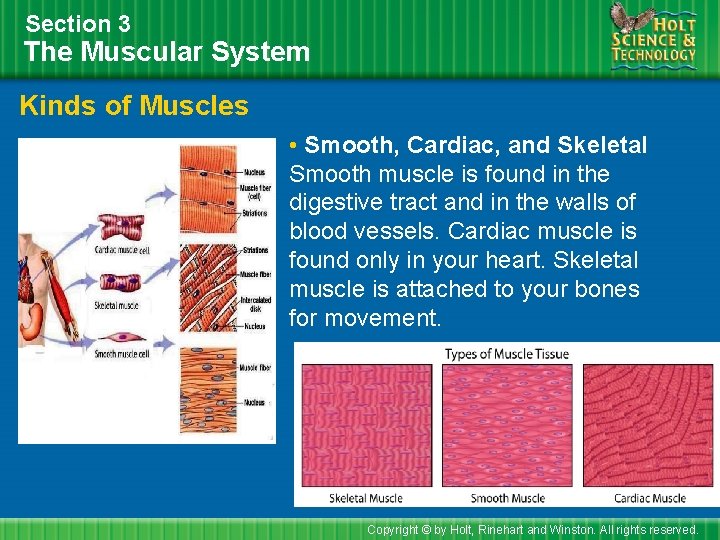
Section 3 The Muscular System Kinds of Muscles • Smooth, Cardiac, and Skeletal Smooth muscle is found in the digestive tract and in the walls of blood vessels. Cardiac muscle is found only in your heart. Skeletal muscle is attached to your bones for movement. End of Slide Copyright © by Holt, Rinehart and Winston. All rights reserved.
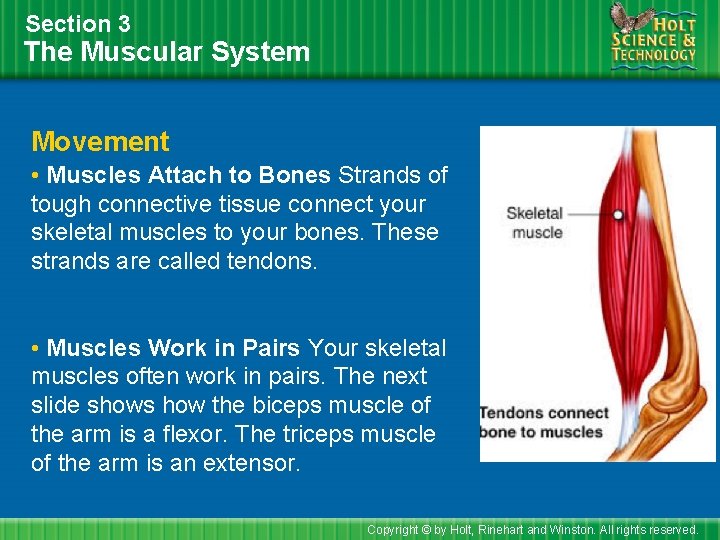
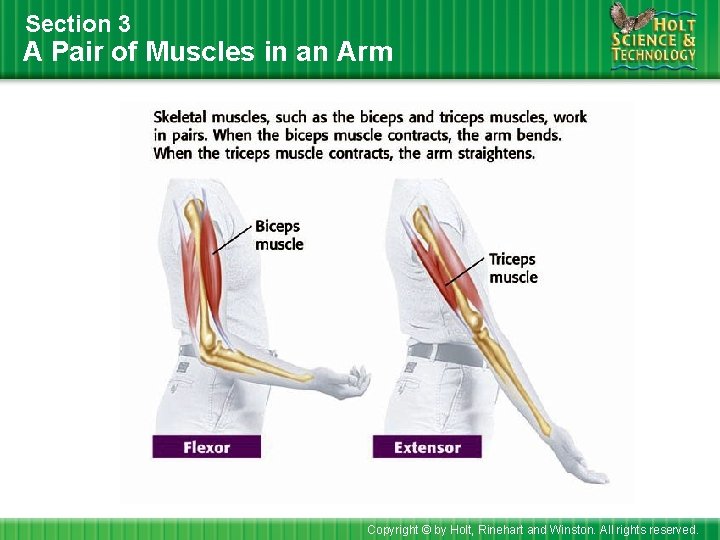
Section 3 The Muscular System Movement • Muscles Attach to Bones Strands of tough connective tissue connect your skeletal muscles to your bones. These strands are called tendons. • Muscles Work in Pairs Your skeletal muscles often work in pairs. The next slide shows how the biceps muscle of the arm is a flexor. The triceps muscle of the arm is an extensor. Copyright © by Holt, Rinehart and Winston. All rights reserved.
Section 3 A Pair of Muscles in an Arm Copyright © by Holt, Rinehart and Winston. All rights reserved.
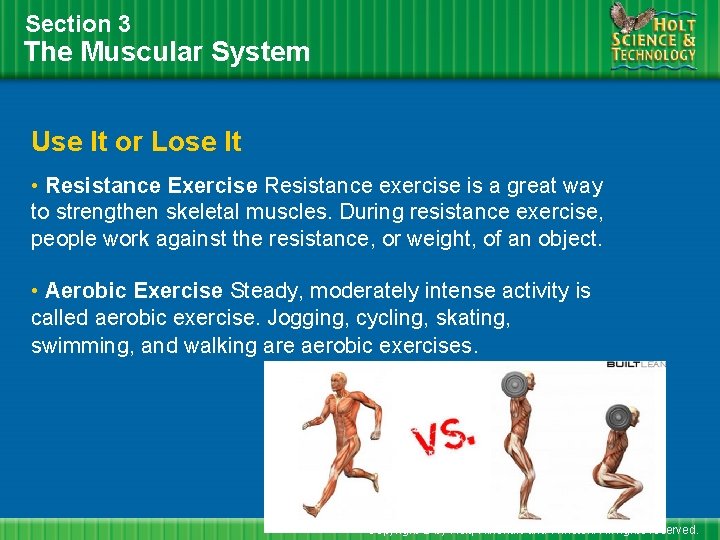
Section 3 The Muscular System Use It or Lose It • Resistance Exercise Resistance exercise is a great way to strengthen skeletal muscles. During resistance exercise, people work against the resistance, or weight, of an object. • Aerobic Exercise Steady, moderately intense activity is called aerobic exercise. Jogging, cycling, skating, swimming, and walking are aerobic exercises. End of Slide Copyright © by Holt, Rinehart and Winston. All rights reserved.
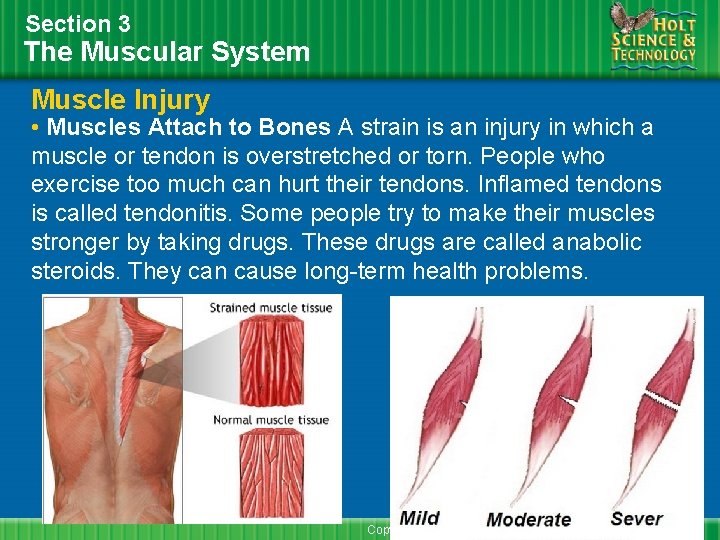
Section 3 The Muscular System Muscle Injury • Muscles Attach to Bones A strain is an injury in which a muscle or tendon is overstretched or torn. People who exercise too much can hurt their tendons. Inflamed tendons is called tendonitis. Some people try to make their muscles stronger by taking drugs. These drugs are called anabolic steroids. They can cause long-term health problems. End of Slide Copyright © by Holt, Rinehart and Winston. All rights reserved.
Section 4 The Integumentary System Functions of Skin • Staying Safe Skin protects you by keeping water in your body and foreign particles out of your body. • Keeping in Touch Nerve endings in your skin let you feel things around you. • Keeping Your Cool Skin helps regulate your body temperature. • Throwing Out the Garbage Skin helps get rid of wastes. End of Slide Copyright © by Holt, Rinehart and Winston. All rights reserved.
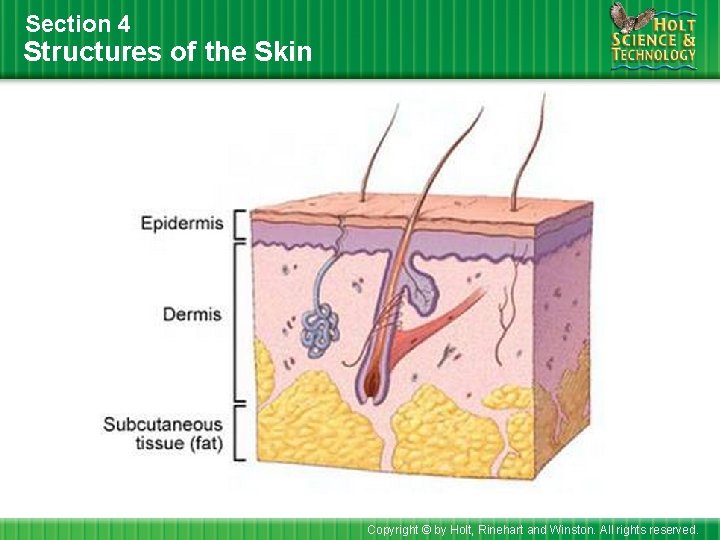
Section 4 The Integumentary System Layers of Skin • Epidermis The epidermis is the outermost layer of skin. You see the epidermis when you look at your skin. • Dermis The thicker layer of skin that lies beneath the epidermis is the dermis. You can see the other parts of your skin in the next slide. End of Slide Copyright © by Holt, Rinehart and Winston. All rights reserved.
Section 4 Structures of the Skin Copyright © by Holt, Rinehart and Winston. All rights reserved.
Section 4 The Integumentary System Hair and Nails • Dead Cells A hair forms at the bottom of a tiny sac called a hair follicle. The hair grows as new cells are added at the hair follicle. A nail grows from living cells in the nail root at the base of the nail. Skin Injuries • Skin Deep Skin is often damaged. Fortunately, your skin can repair itself. However, damage to the genetic material in skin cells can cause skin cancer. End of Slide Copyright © by Holt, Rinehart and Winston. All rights reserved.