
Section 3 The Growth of European Kingdoms What

- Slides: 29
Section 3 The Growth of European Kingdoms
What Groups Invaded England? England has a long history of invasion. During the time of the Romans, southern Britain (south of Hadrian’s Wall) was ruled by the Romans. As Rome’ s difficulties increased they withdrew from England. In the Fifth Century the Angles and Saxons invaded England.
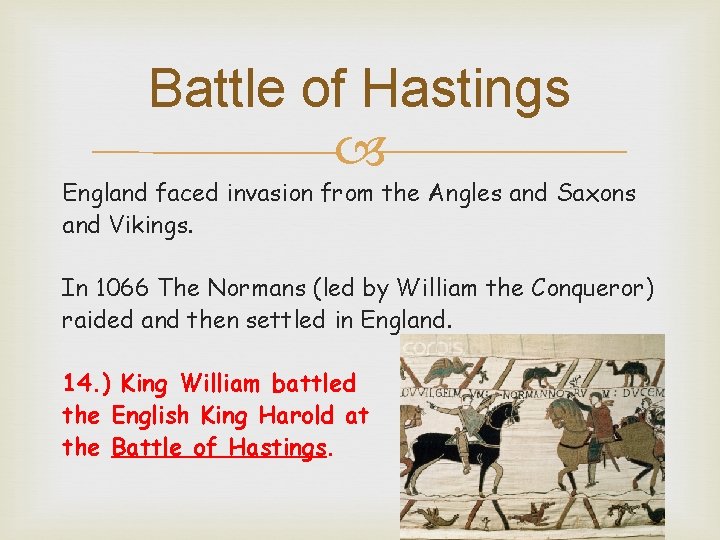
Battle of Hastings England faced invasion from the Angles and Saxons and Vikings. In 1066 The Normans (led by William the Conqueror) raided and then settled in England. 14. ) King William battled the English King Harold at the Battle of Hastings.
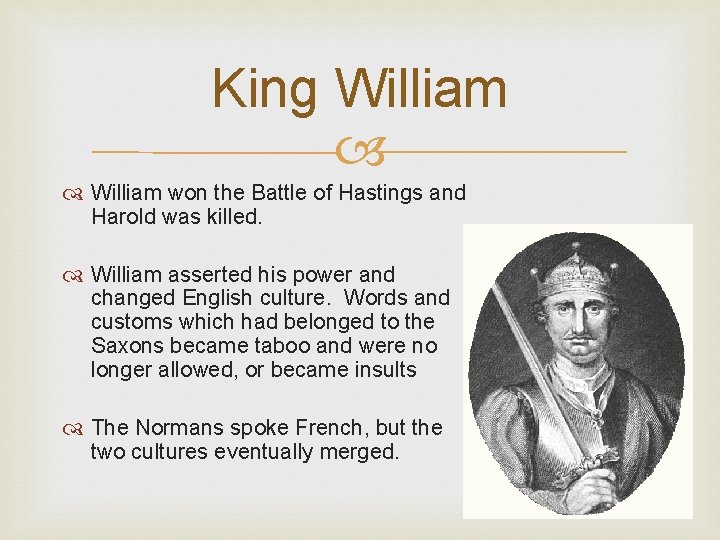
King William won the Battle of Hastings and Harold was killed. William asserted his power and changed English culture. Words and customs which had belonged to the Saxons became taboo and were no longer allowed, or became insults The Normans spoke French, but the two cultures eventually merged.
Vocabulary The vocabulary of England took on new words which came from the Norman people. The English language evolved to include Latin as well as Germanic influences.
Government William wanted to establish firm control over his new territory. He used a feudal form of government, distributing lands to his nobles and making them swear loyalty to him. He made sure none of them was powerful enough to defeat him. He maintained the Anglo-Saxon divisions of Shires which were ruled by a Sheriff.
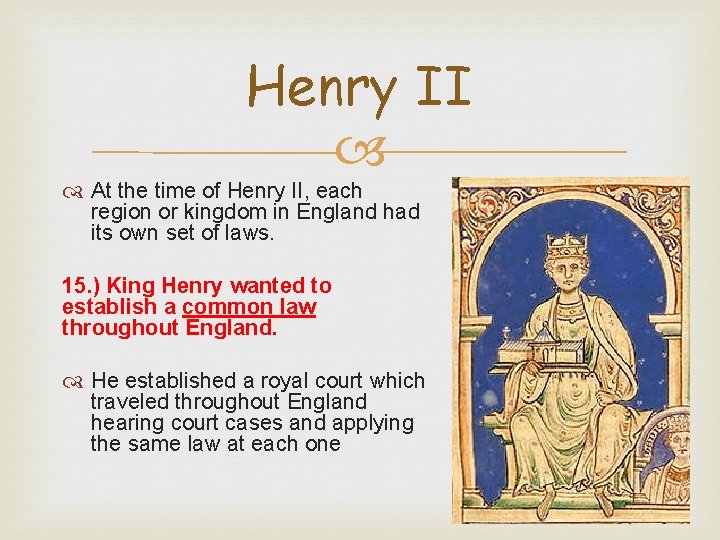
Henry II At the time of Henry II, each region or kingdom in England had its own set of laws. 15. ) King Henry wanted to establish a common law throughout England. He established a royal court which traveled throughout England hearing court cases and applying the same law at each one
Common Law 16. ) Common Law were rules that applied to the whole kingdom. When Henry’s judges heard cases they recorded their decisions which established legal precedent. Later decisions were based on that precedent, similar to what our courts do today.
Thomas Beckett Henry II wanted his new system of common law to apply to all of England, including the Church. This brought him into conflict with his one-time friend Thomas Beckett, the Archbishop and Canterbury (the highest ranking Catholic official in England).
Thomas vs. Henry became frustrated by Beckett’s refusal to accept royal legal authority. It is believed that Henry II said in anger one day at court, “Will no one rid me of this meddlesome priest!” Four of Henry’s barons took him seriously and rode off to Canterbury Cathedral
The Murder of Thomas Beckett • Beckett was murdered while standing at the altar of the Cathedral. • Henry was horrified by the act and did penance for his words by walking barefoot through the streets of Canterbury and being flogged, but in the end he got what he wanted, Church courts became subject to English law.
King John (The king who flushed his kingdom down the John) Henry’s son became king. 17. ) King John was highly corrupt and made many mistakes during his reign. He threw people in jail without a trial. He also placed heavy taxes on his barons, much to their resentment.
Losses to France John waged a war with King Philip II (Philip Augustus) of France. In this war he lost the lands that England still controlled in that country. John attempted to regain these lands, but failed.
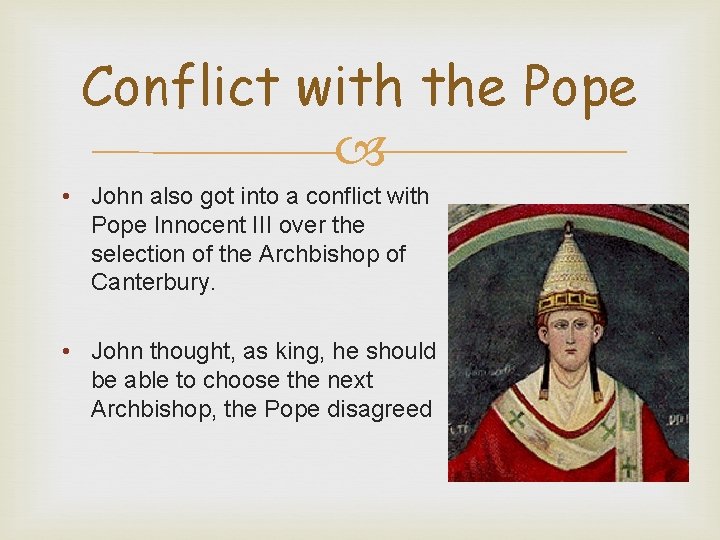
Conflict with the Pope • John also got into a conflict with Pope Innocent III over the selection of the Archbishop of Canterbury. • John thought, as king, he should be able to choose the next Archbishop, the Pope disagreed
“Weapons” of the Church The church had powerful weapons that it could use against rulers of Europe. People believed they needed to receive the sacraments of the Catholic Church in order to achieve salvation. These sacraments included: Communion, Marriage, Holy Orders, Baptism, Extreme Unction (last rights), Confirmation, and Anointing of the sick.
John Begs Forgiveness The Pope placed an interdict on England, which meant the people could not receive the sacraments. John was forced to beg the Pope forgiveness and pledge to make England a Fief of the Catholic Church. After that England owed a fee to the Church every year. In this case, the Pope won out over the power of the monarch.
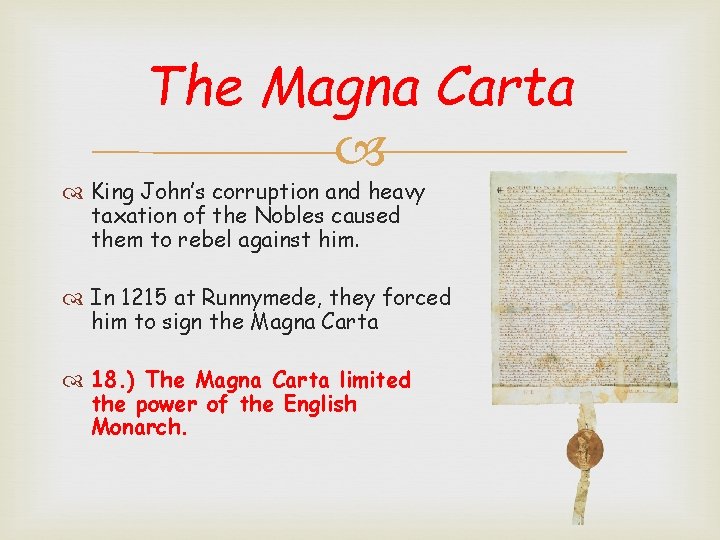
The Magna Carta King John’s corruption and heavy taxation of the Nobles caused them to rebel against him. In 1215 at Runnymede, they forced him to sign the Magna Carta 18. ) The Magna Carta limited the power of the English Monarch.
Ideas in the Magna Carta The Magna Carta required the King to proclaim certain rights (pertaining to freemen), respect certain legal procedures, and accept that his will could be bound by the law The Magna Carta also instituted the idea of Habeas Corpus, which meant you could not be held in jail without due cause.
Video https: //www. youtube. com/watch? v=s. Gzaq. Et. JCok http: //youtu. be/s. Gzaq. Et. JCok
King Edward I 19. ) During the reign of King Edward I we see the evolution of the idea of Parliament. From the French parler (to speak) it began as an advisory board for the king. Later, this body the “power of the purse” because it was believed that “what touches all should be approved by all”
Early Parliament The Parliament eventually evolved into two houses The House of Lords Made up of Bishops and Nobles The House of Commons Made up of Knights and Burghers (City Dwellers)
The French Kingdom After the death of Charlemagne the western part of his empire (which became France, faced many challenges. There were heirs fighting for the crown, Vikings invasions, attacks from Spanish Muslims and so there was no centralized power. The Lords of the Carolingian family were unable to hold the throne and so the Great Lords of France decided to appoint a king.
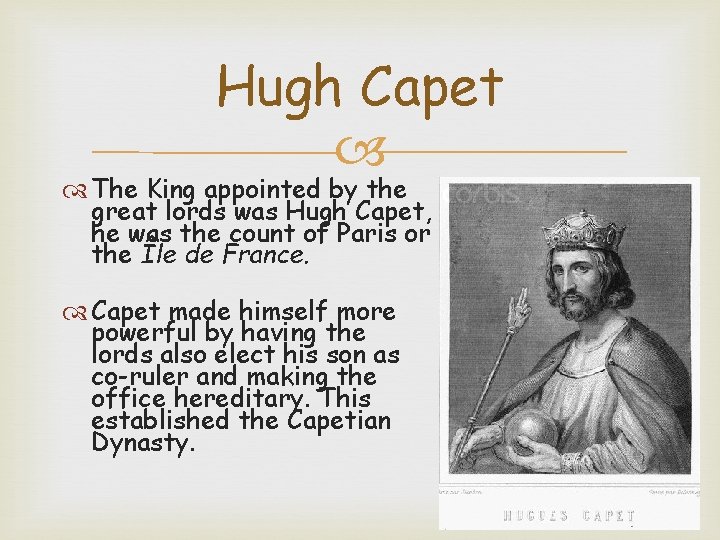
Hugh Capet The King appointed by the great lords was Hugh Capet, he was the count of Paris or the Île de France. Capet made himself more powerful by having the lords also elect his son as co-ruler and making the office hereditary. This established the Capetian Dynasty.
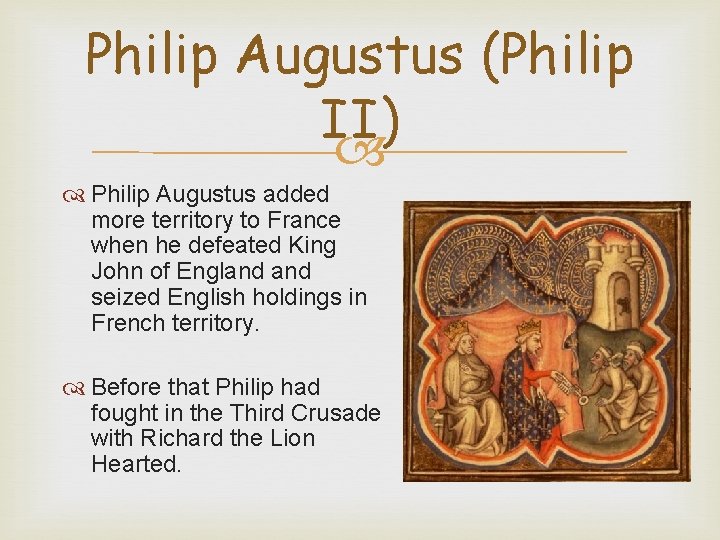
Philip Augustus (Philip II) Philip Augustus added more territory to France when he defeated King John of England seized English holdings in French territory. Before that Philip had fought in the Third Crusade with Richard the Lion Hearted.
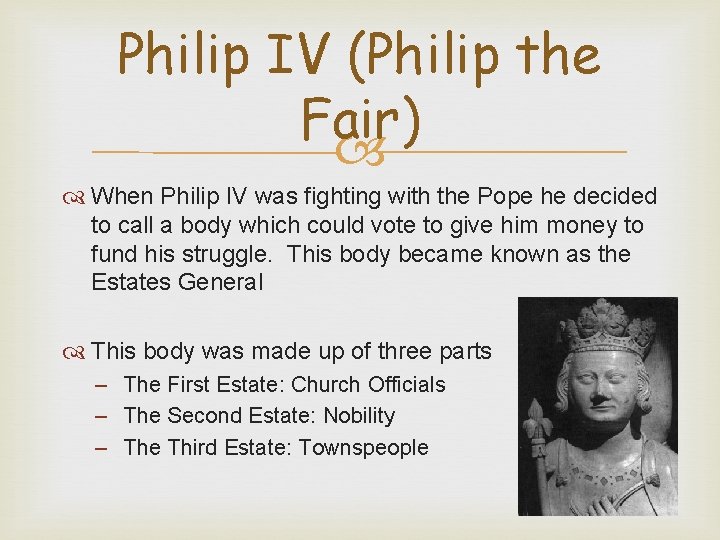
Philip IV (Philip the Fair) When Philip IV was fighting with the Pope he decided to call a body which could vote to give him money to fund his struggle. This body became known as the Estates General This body was made up of three parts – The First Estate: Church Officials – The Second Estate: Nobility – The Third Estate: Townspeople
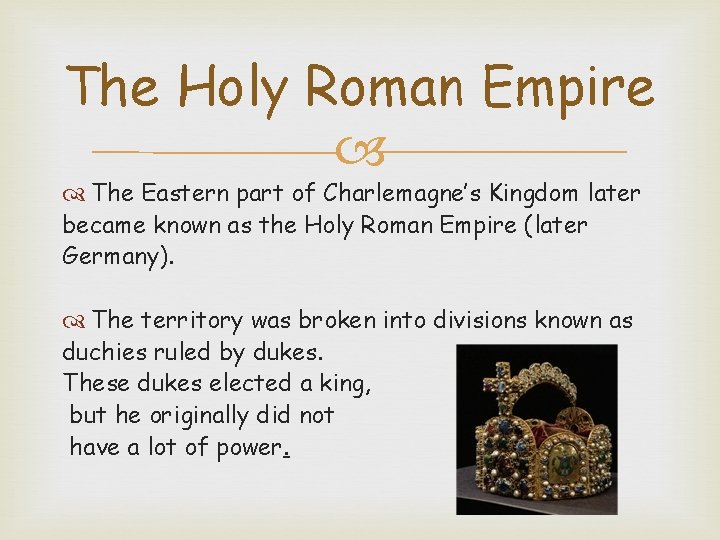
The Holy Roman Empire The Eastern part of Charlemagne’s Kingdom later became known as the Holy Roman Empire (later Germany). The territory was broken into divisions known as duchies ruled by dukes. These dukes elected a king, but he originally did not have a lot of power.
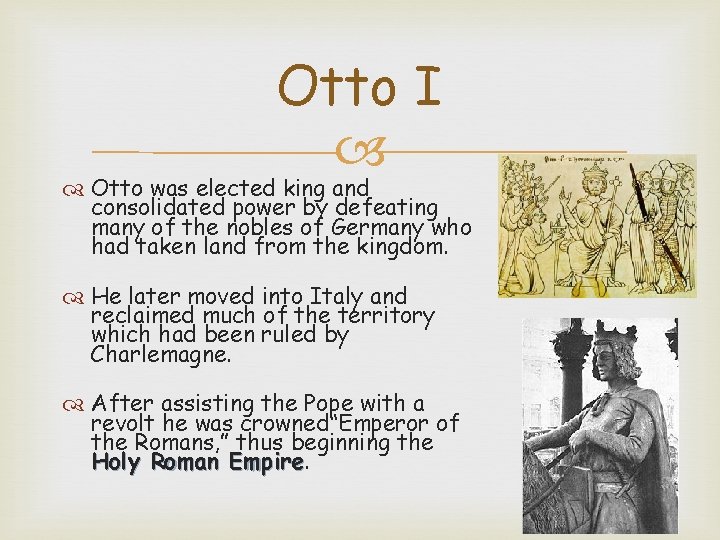
Otto I Otto was elected king and consolidated power by defeating many of the nobles of Germany who had taken land from the kingdom. He later moved into Italy and reclaimed much of the territory which had been ruled by Charlemagne. After assisting the Pope with a revolt he was crowned“Emperor of the Romans, ” thus beginning the Holy Roman Empire
Struggles With Italy Later Holy Roman Emperors wanted to assert their power in Italy. Otto I had been very involved with the development of the Church in his Empire and later Holy Roman Emperors had done the same thing. The Pope viewed this as wanting too much power that should have been his
Two of the Holy Roman Emperors Frederick I and Frederick II were involved in conflicts with the Pope in Italy. While away in Italy, the German Nobles rebelled at home and the two kings lost a lot of their power. Because of its involvement in the struggle for power in Italy, the Holy Roman Empire was not able to achieve the political unity which was to develop in France, England, and later, Spain. Germany and Italy were not united under single leadership until the 19 th Century.