
Section 3 The Diversity of Living Things I
- Slides: 11
Section 3 The Diversity of Living Things
I. The Six Kingdoms A. All living organisms are classified into one of six kingdoms based on: 1. How they obtain food 2. The type of cells they are made of
II. The six kingdoms A. Bacteria: 1. Single celled organisms 2. Lack a nucleus 3. Reproduce through cell division 4. Two kingdoms: a. Archaebacteria b. Eubacteria
5. Archaebacteria – live in extreme environments such as swamps and hot springs. 6. Eubacteria – bacteria that cause disease, live in the soil, help in digestion, etc…
B. Fungi Kingdom: 1. Multicellular 2. Cells have a cell wall & nucleus 3. Heterotrophic (cannot make own food) 4. Examples – mushrooms & yeast
C. Protista (Protists): 1. Single celled organisms 2. Microscopic 3. Extremely diverse 4. Can cause disease – plasmodium 5. Green algae – a plant like protist 6. Amoeba – animal like protist
D. Plant Kingdom 1. Multicellular 2. Cells have a cell wall & nucleus 3. Autotrophic (makes own food) 4. Produce oxygen 5. Divided into three groups:
a. Seedless Plants – ferns and moss non-vascular plants b. Gymnosperms (conifers)– pine trees reproduce using cones (non-fruit bearing plants) reproduce by releasing pollen c. Angiosperms – flowering plants. Reproduce by releasing pollen
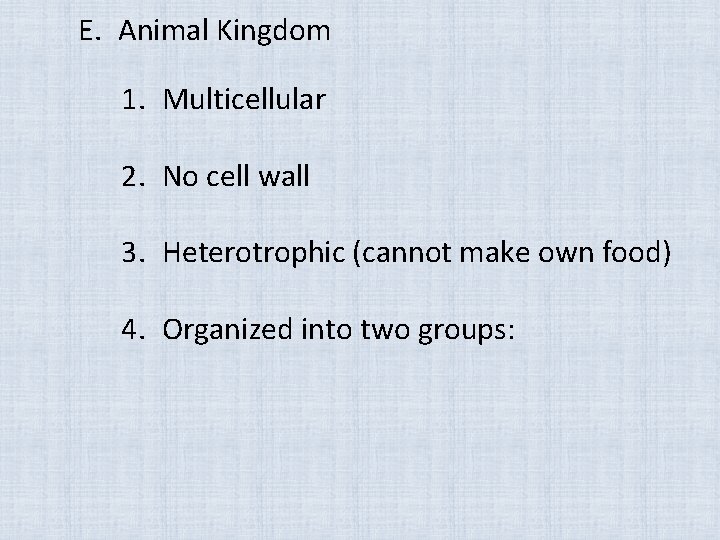
E. Animal Kingdom 1. Multicellular 2. No cell wall 3. Heterotrophic (cannot make own food) 4. Organized into two groups:
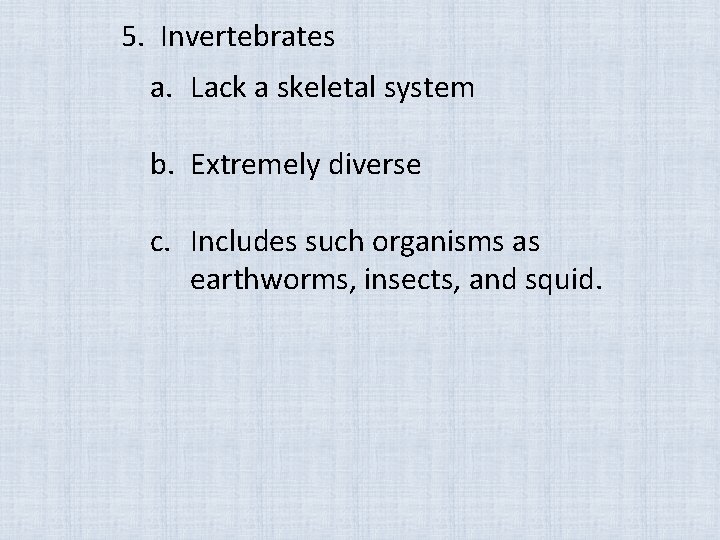
5. Invertebrates a. Lack a skeletal system b. Extremely diverse c. Includes such organisms as earthworms, insects, and squid.
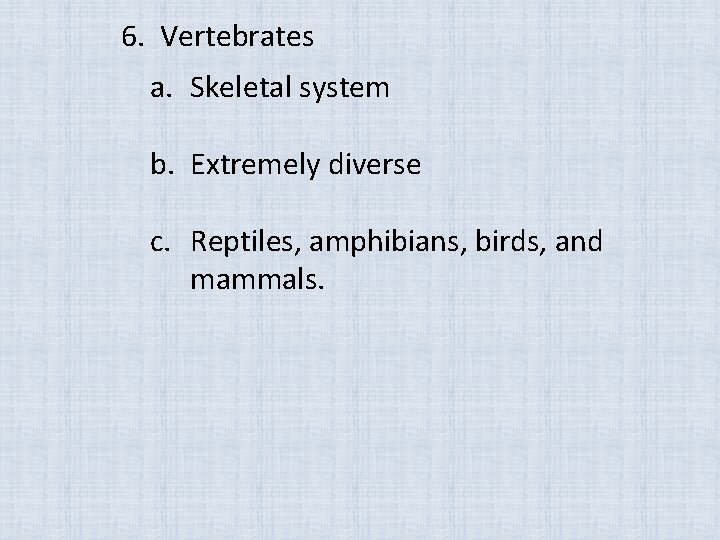
6. Vertebrates a. Skeletal system b. Extremely diverse c. Reptiles, amphibians, birds, and mammals.