
Section 3 Prior to the Industrial Revolution there
- Slides: 8
Section 3 Prior to the Industrial Revolution, there were only two main social classes: nobles and peasants. This changed in the 1800 s. Three social classes emerged by the late 1800 s. 1. The new upper class, a mix of aristocrats and wealthy entrepreneurs 2. The growing middle class and lower middle class 3. Workers and peasants Changing Attitudes and Values
Section 3 The modern middle class developed its own tastes and values, and the role of women changed. • A code of etiquette guided behavior, childrearing, and dress. • Women had previously helped to run family businesses, but now men went off to work. • A cult of domesticity emerged to encourage women to stay home. Changing Attitudes and Values
Section 3 Some women worked to change the restrictions placed upon them. • They sought fairness in marriage, divorce, and property laws. • Many women’s groups also supported the temperance movement. The struggle for political rights, including women’s suffrage, posed the biggest challenge. Elizabeth Cady Stanton and Sojourner Truth were two of the leaders of the movement. Changing Attitudes and Values
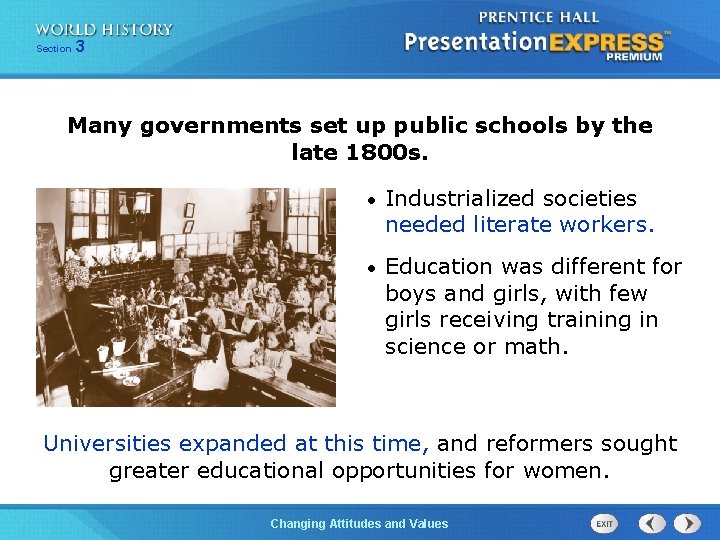
Section 3 Many governments set up public schools by the late 1800 s. • Industrialized societies needed literate workers. • Education was different for boys and girls, with few girls receiving training in science or math. Universities expanded at this time, and reformers sought greater educational opportunities for women. Changing Attitudes and Values
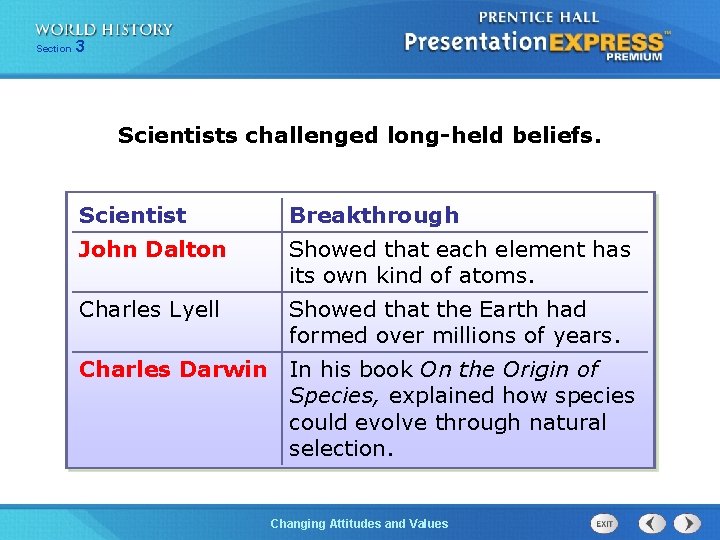
Section 3 Scientists challenged long-held beliefs. Scientist Breakthrough John Dalton Showed that each element has its own kind of atoms. Charles Lyell Showed that the Earth had formed over millions of years. Charles Darwin In his book On the Origin of Species, explained how species could evolve through natural selection. Changing Attitudes and Values
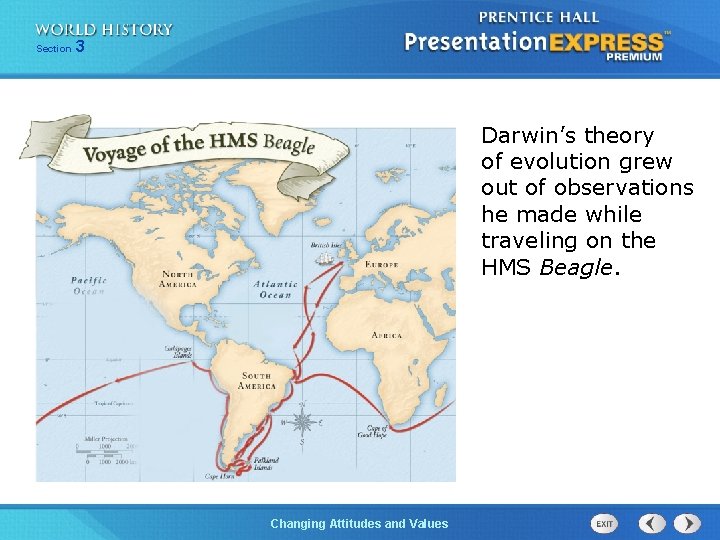
Section 3 Darwin’s theory of evolution grew out of observations he made while traveling on the HMS Beagle. Changing Attitudes and Values
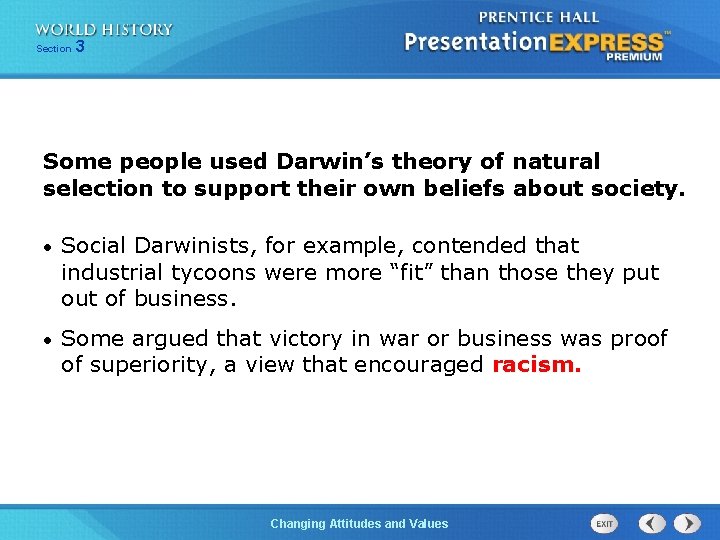
Section 3 Some people used Darwin’s theory of natural selection to support their own beliefs about society. • Social Darwinists, for example, contended that industrial tycoons were more “fit” than those they put of business. • Some argued that victory in war or business was proof of superiority, a view that encouraged racism. Changing Attitudes and Values
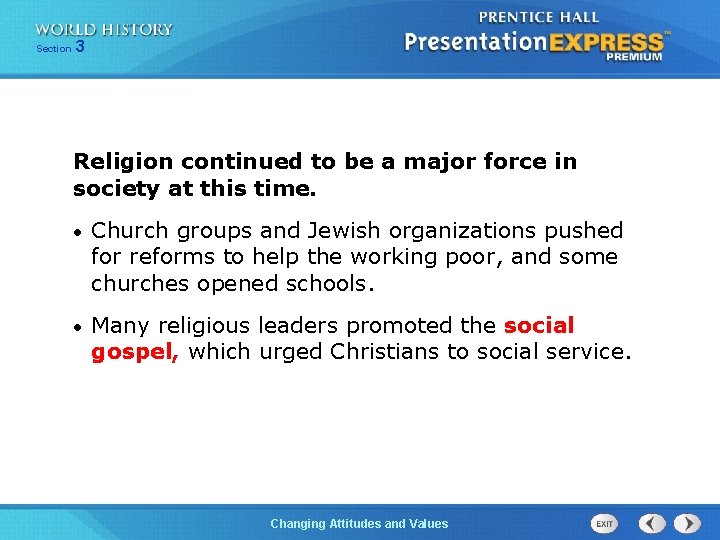
Section 3 Religion continued to be a major force in society at this time. • Church groups and Jewish organizations pushed for reforms to help the working poor, and some churches opened schools. • Many religious leaders promoted the social gospel, which urged Christians to social service. Changing Attitudes and Values