
Section 3 Examples of Evolution Objectives Identify four
Section 3 Examples of Evolution Objectives • Identify four elements in the process of natural selection • Describe how natural selection has affected the bacteria that cause tuberculosis • Relate natural selection to the beak size of finches • Summarize the process of species formation Chapter menu Resources Copyright © by Holt, Rinehart and Winston. All rights reserved.
Section 2 How Populations Evolve Objectives • Identify the Hardy-Weinberg principle • Describe the five forces that cause genetic change in a population • Identify why selection against unfavorable recessive traits is slow • Contrast directional and stabilizing selection Chapter menu Resources Copyright © by Holt, Rinehart and Winston. All rights reserved.
New Vocabulary Section 13 -3 • Divergence • Speciation • Subspecies Section 15 -2 • Hardy-Weinberg principle • Gene flow • Nonrandom mating • Genetic drift • Normal distribution • Directional selection • Stabilizing selection Chapter menu Resources Copyright © by Holt, Rinehart and Winston. All rights reserved.
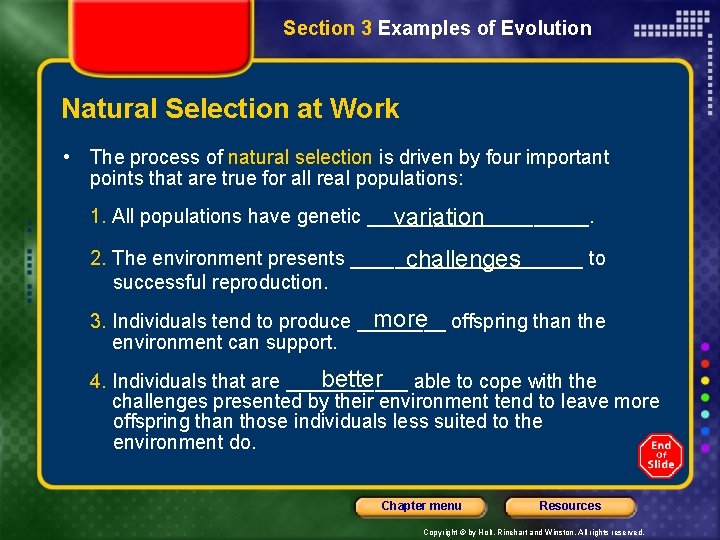
Section 3 Examples of Evolution Natural Selection at Work • The process of natural selection is driven by four important points that are true for all real populations: 1. All populations have genetic __________. variation 2. The environment presents ___________ to challenges successful reproduction. more offspring than the 3. Individuals tend to produce ____ environment can support. better able to cope with the 4. Individuals that are ______ challenges presented by their environment tend to leave more offspring than those individuals less suited to the environment do. Chapter menu Resources Copyright © by Holt, Rinehart and Winston. All rights reserved.
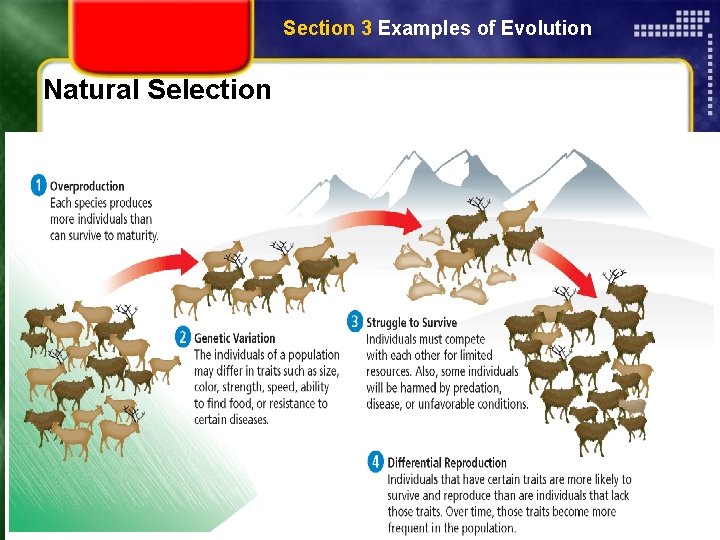
Section 3 Examples of Evolution Natural Selection Chapter menu Resources Copyright © by Holt, Rinehart and Winston. All rights reserved.
• In some instances, natural selection can be observed in ______ periods of time short – When small organisms with short life spans, like bacteria insects _______ or _______ become resistant to _______ or _______ antibiotics insecticide – When organisms are exposed to different environments ________ Chapter menu Resources Copyright © by Holt, Rinehart and Winston. All rights reserved.
Section 3 Examples of Evolution Antibiotic Resistance • The lung disease tuberculosis (TB) is caused by the bacterium _________. Mycobacterium tuberculosis • antibiotics In the 1950 s, two effective _________, isoniazid and rifampin, became available to treat TB. • 1980 s however, _______ new strains of In the late _______, M. tuberculosis that are largely or completely resistant ________ to isoniazid and rifampin appeared…. Chapter menu Resources Copyright © by Holt, Rinehart and Winston. All rights reserved.
Section 3 Examples of Evolution of Antibiotic Resistance • Rifampin normally kills bacteria cells by binding to RNA polymerase, which will prevent transcription _______ • However, TB bacteria began passing on a mutation ________ that prevents rifampin from binding to the polymerase. • So, TB bacteria with the mutation were able to survive _______ treatment with the antibiotic, leading to the evolution of rifampin resistance in M. tuberculosis. Chapter menu Resources Copyright © by Holt, Rinehart and Winston. All rights reserved.
Section 3 Examples of Evolution in Darwin’s Finches • Darwin collected 31 specimens of finches from three ______ when he visited the Galápagos Islands. islands • All in all, he collected nine different species that were all very similar except for their _____ beaks • Darwin suggested that they all evolved from an original ________ species that changed as different populations commonaccumulated adaptations to different ______ sources. food Chapter menu Resources Copyright © by Holt, Rinehart and Winston. All rights reserved.
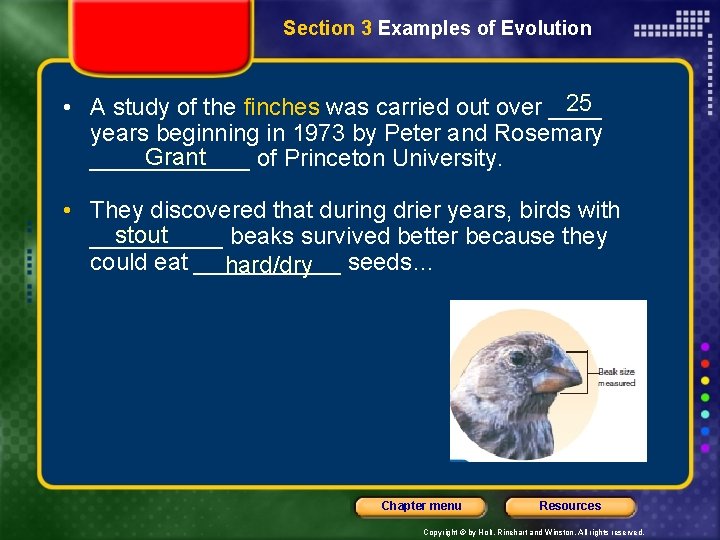
Section 3 Examples of Evolution 25 • A study of the finches was carried out over ____ years beginning in 1973 by Peter and Rosemary Grant ______ of Princeton University. • They discovered that during drier years, birds with stout _____ beaks survived better because they could eat ______ hard/dry seeds… Chapter menu Resources Copyright © by Holt, Rinehart and Winston. All rights reserved.
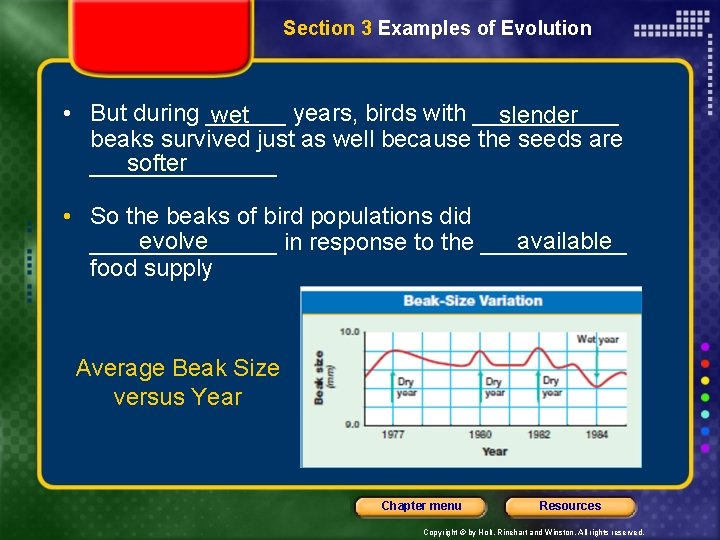
Section 3 Examples of Evolution • But during ______ years, birds with ______ wet slender beaks survived just as well because the seeds are softer _______ • So the beaks of bird populations did evolve available _______ in response to the ______ food supply Average Beak Size versus Year Chapter menu Resources Copyright © by Holt, Rinehart and Winston. All rights reserved.
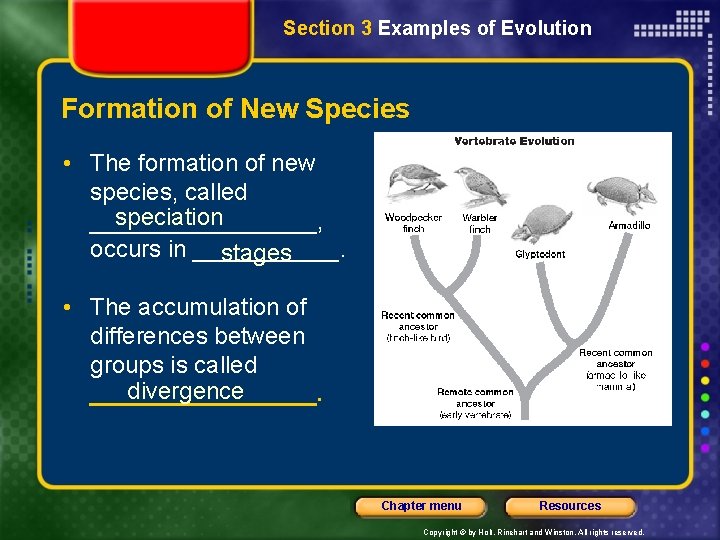
Section 3 Examples of Evolution Formation of New Species • The formation of new species, called speciation _________, occurs in ______. stages • The accumulation of differences between groups is called divergence _________. Chapter menu Resources Copyright © by Holt, Rinehart and Winston. All rights reserved.
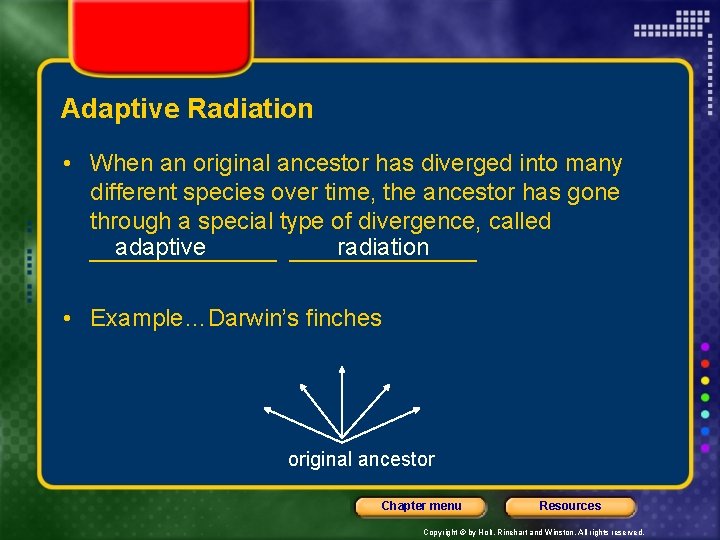
Adaptive Radiation • When an original ancestor has diverged into many different species over time, the ancestor has gone through a special type of divergence, called adaptive radiation ______________ • Example…Darwin’s finches original ancestor Chapter menu Resources Copyright © by Holt, Rinehart and Winston. All rights reserved.
Chapter 13 Section 3 Examples of Evolution Forming Subspecies • Divergence occurs as populations of the same genetically species differ ________ because of conditions adaptations to different living _______ – This leads to the evolution of ________, subspecies interbreed which can still ________, but they represent the first steps towards speciation Chapter menu Resources Copyright © by Holt, Rinehart and Winston. All rights reserved.
• Remember, separate species cannot interbreed…. – This might mean that they… • _______ cannot mate physically viable • Do not produce _______ offspring • Are isolated because they have different ______ seasons mating infertile • Produce _______ offspring Chapter menu Resources Copyright © by Holt, Rinehart and Winston. All rights reserved.
• Example…. – The offspring of a donkey and a horse is called a mule ______ sterile • This hybrid offspring is _______, so donkeys and horses are considered separate species • Example… – A similar situation applies to lions and tigers • The offspring of a male lion and female tiger is liger called a _____ • The offspring of a male tiger and female lion is called a _______ tigon Chapter menu Resources Copyright © by Holt, Rinehart and Winston. All rights reserved.
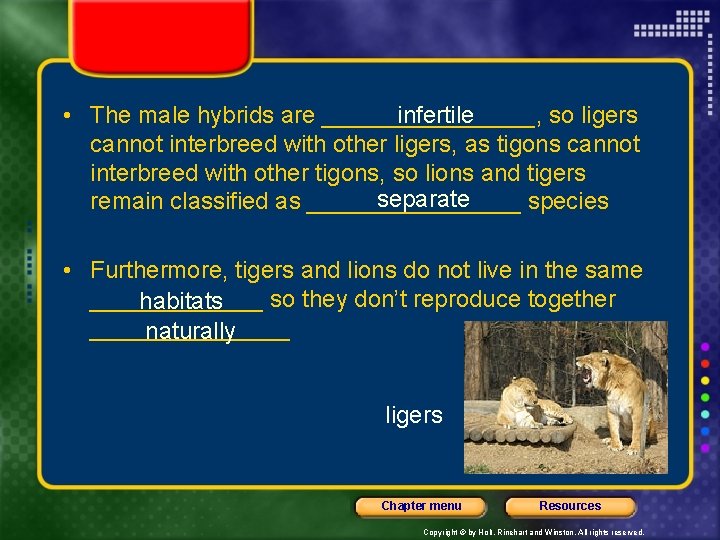
infertile • The male hybrids are ________, so ligers cannot interbreed with other ligers, as tigons cannot interbreed with other tigons, so lions and tigers separate remain classified as ________ species • Furthermore, tigers and lions do not live in the same _______ so they don’t reproduce together habitats ________ naturally ligers Chapter menu Resources Copyright © by Holt, Rinehart and Winston. All rights reserved.
Hardy-Weinberg Principle • After studying Mendel’s work regarding genetics, scientists wondered if dominant traits would randomly or ________ spontaneously replace recessive alleles in a population • In 1908, an English mathematician named G. H. Hardy _______ and a German physician named Weinberg devised a mathematical Wilhelm _______ equation that allows us to keep track of the alleles ________ in a population Chapter menu Resources Copyright © by Holt, Rinehart and Winston. All rights reserved.
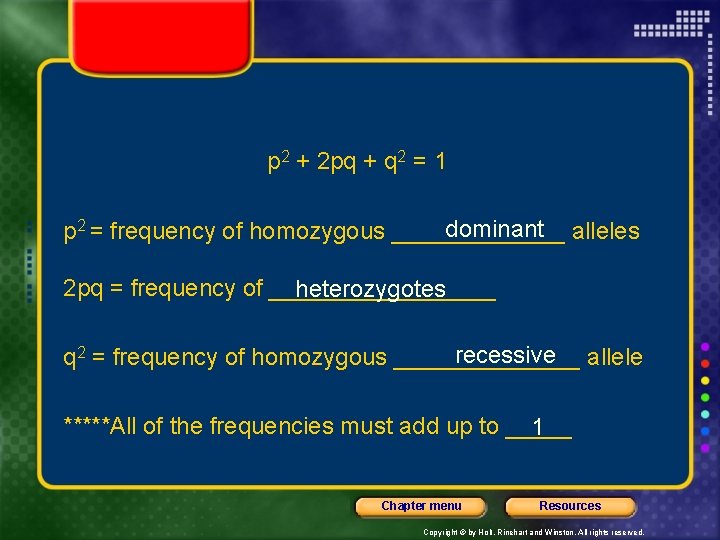
p 2 + 2 pq + q 2 = 1 dominant alleles p 2 = frequency of homozygous _______ 2 pq = frequency of _________ heterozygotes recessive allele q 2 = frequency of homozygous _______ *****All of the frequencies must add up to _____ 1 Chapter menu Resources Copyright © by Holt, Rinehart and Winston. All rights reserved.
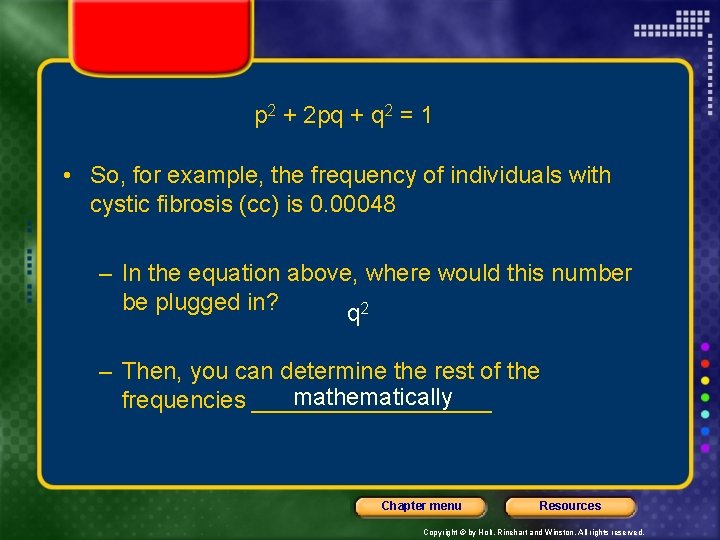
p 2 + 2 pq + q 2 = 1 • So, for example, the frequency of individuals with cystic fibrosis (cc) is 0. 00048 – In the equation above, where would this number be plugged in? q 2 – Then, you can determine the rest of the mathematically frequencies _________ Chapter menu Resources Copyright © by Holt, Rinehart and Winston. All rights reserved.
• Hardy and Weinberg determined that allele frequencies do _____ not change from population to population, unless the population is acted on by a process that ______ particular alleles favors • So for example, a lethal dominant allele does not become more ______ just because it is common dominant • This discovery, called the Hardy-Weinberg _______, states that allele frequencies do principle not change unless __________ forces act evolutionary on a population Chapter menu Resources Copyright © by Holt, Rinehart and Winston. All rights reserved.
• Five evolutionary forces frequently act upon the all of the genes in a population called a gene _______ pool • These forces are… mutations – _________________ Gene flow Nonrandom mating – _________ Genetic drift – _________ Natural selection – _________ Chapter menu Resources Copyright © by Holt, Rinehart and Winston. All rights reserved.
Mutations • Mutations in _____ DNA affect the codons in m. RNA produced during ________ transcription • Recall, however, that several codons code for the same amino acid, so not all mutations affect _______ synthesis protein • Mutations rates in populations are usually very slow _______, but they still provide new variation in a population Chapter menu Resources Copyright © by Holt, Rinehart and Winston. All rights reserved.
Gene Flow migration • Gene flow is the movement or _______ of alleles into or out of a population enter – Immigration = new alleles ______ a population leave – Emigration = alleles ______ a population • Example… – If tall individuals leave a population, what kind of alleles will be left? short Chapter menu Resources Copyright © by Holt, Rinehart and Winston. All rights reserved.
Nonrandom Mating • Nonrandom mating occurs when organisms chose their mates based on certain ______ traits • In animals, for example, females often select males based on their…. – _____ size – _____ color food – Ability to gather ____ or provide shelter _______ Chapter menu Resources Copyright © by Holt, Rinehart and Winston. All rights reserved.
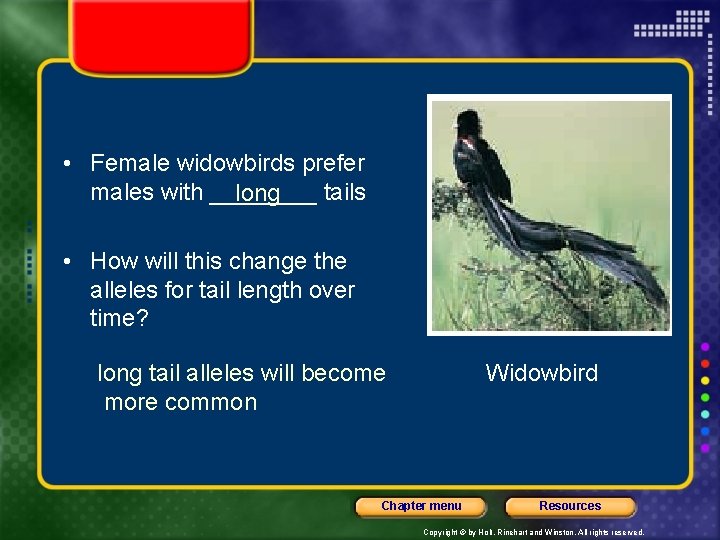
• Female widowbirds prefer males with ____ tails long • How will this change the alleles for tail length over time? long tail alleles will become more common Widowbird Chapter menu Resources Copyright © by Holt, Rinehart and Winston. All rights reserved.
Genetic Drift • Occurs when the allelic frequencies in a population are altered by _____ chance events • The effects of genetic drift are seen more often in small ________ populations because their gene pool is ________ smaller • Example… – Imagine that there is a bird population containing 90 red birds and 10 white birds… Chapter menu Resources Copyright © by Holt, Rinehart and Winston. All rights reserved.
• A hurricane blows 10 birds off of the mainland which end up on an island…. 3 of these birds are red and _____ 7 – ____ are white – Due to chance, the allele frequencies of the 10 ______ “founder” birds of the new island population are drastically different from birds on the mainland – This type of genetic drift is often called the founder ________ effect Chapter menu Resources Copyright © by Holt, Rinehart and Winston. All rights reserved.
Natural Selection • Favorable traits are caused by genes, but natural selection acts upon the _____ which is a trait phenotype • So, for example, natural selection cannot eliminate a _______ disease like cystic fibrosis, because recessive heterozygous carriers have the same ___________ as homozygous phenotype dominant individuals Chapter menu Resources Copyright © by Holt, Rinehart and Winston. All rights reserved.
types • There also different _____ of natural selection that affect gene pools differently – ________ selection directional stabilizing – ________ selection – Disruptive selection Chapter menu Resources Copyright © by Holt, Rinehart and Winston. All rights reserved.
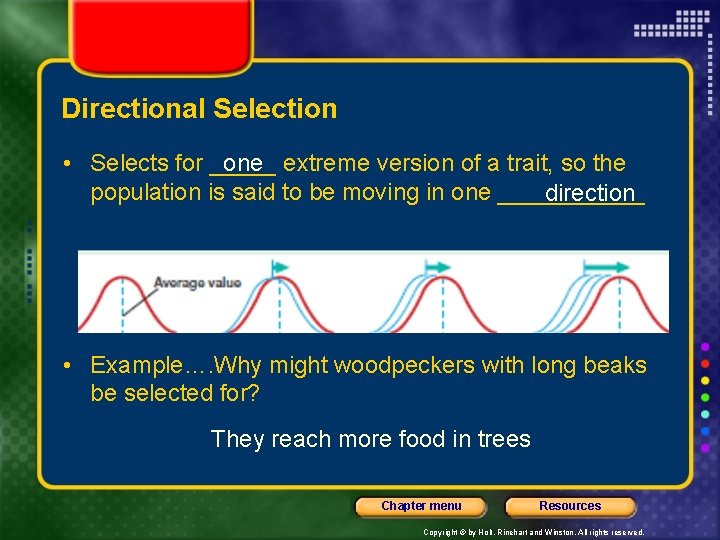
Directional Selection • Selects for _____ one extreme version of a trait, so the population is said to be moving in one ______ direction • Example…. Why might woodpeckers with long beaks be selected for? They reach more food in trees Chapter menu Resources Copyright © by Holt, Rinehart and Winston. All rights reserved.
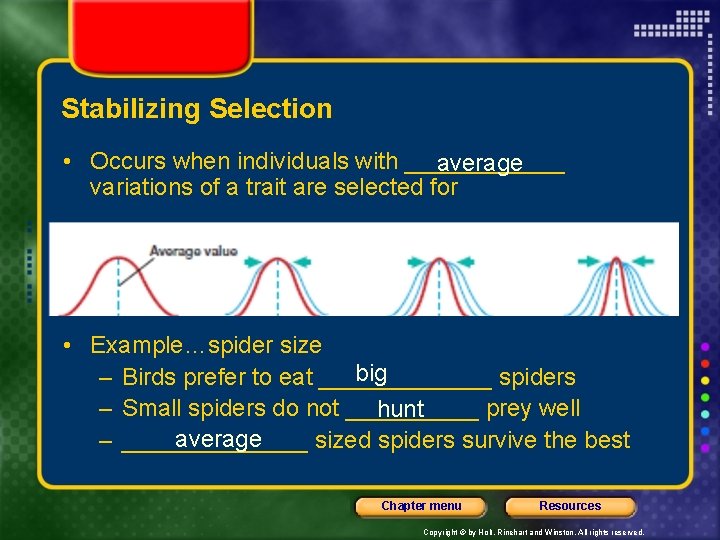
Stabilizing Selection • Occurs when individuals with ______ average variations of a trait are selected for • Example…spider size big – Birds prefer to eat _______ spiders – Small spiders do not _____ prey well hunt average – _______ sized spiders survive the best Chapter menu Resources Copyright © by Holt, Rinehart and Winston. All rights reserved.
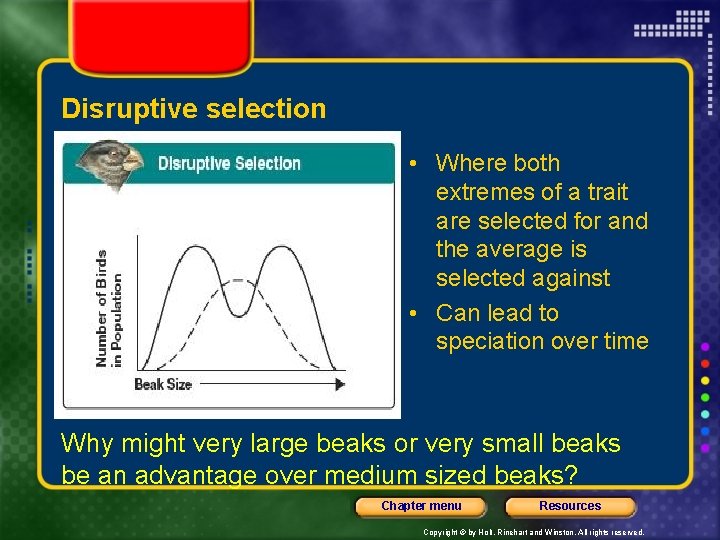
Disruptive selection • Where both extremes of a trait are selected for and the average is selected against • Can lead to speciation over time Why might very large beaks or very small beaks be an advantage over medium sized beaks? Chapter menu Resources Copyright © by Holt, Rinehart and Winston. All rights reserved.
Section 3 Examples of Evolution Objective 1 • Identify four elements in the process of natural selection – __________ of offspring Overproduction – ________ variation Genetic – ________ to survive Struggle Differential – ________ reproduction Chapter menu Resources Copyright © by Holt, Rinehart and Winston. All rights reserved.
Section 3 Examples of Evolution Objective 2 • Describe how natural selection has affected the bacteria that cause tuberculosis Bacteria resistant to antibiotics are selected for Chapter menu Resources Copyright © by Holt, Rinehart and Winston. All rights reserved.
Section 3 Examples of Evolution Objective 3 • Relate natural selection to the beak size of finches… • Which type of beak enabled survival in dry environments stout • Did beak type affect survival during wet/rainy years? no Chapter menu Resources Copyright © by Holt, Rinehart and Winston. All rights reserved.
Section 3 Examples of Evolution Objective 4 • Summarize the process of species formation… – What is different about subspecies versus separate species? Subspecies may still interbreed Chapter menu Resources Copyright © by Holt, Rinehart and Winston. All rights reserved.
Section 2 How Populations Evolve Objective 5 • Identify the Hardy-Weinberg principle… Allele frequencies do not change unless __________ forces act on a population evolutionary Chapter menu Resources Copyright © by Holt, Rinehart and Winston. All rights reserved.
Section 2 How Populations Evolve Objective 6 • Describe the five forces that cause genetic change in a population – Mutations affect protein synthesis, usually slow – Gene flow alleles migrate into or out of a population – Nonrandom mating Mates are picked due to certain traits – Genetic Drift Chance events affect gene pools – Natural Selection Selects for favorable traits, Directional, disruptive, or stabilizing Chapter menu Resources Copyright © by Holt, Rinehart and Winston. All rights reserved.
Section 2 How Populations Evolve Objective 7 • Identify why selection against unfavorable recessive traits is slow Because natural selection acts on phenotypes, so heterozygous individuals still pass on recessive alleles Chapter menu Resources Copyright © by Holt, Rinehart and Winston. All rights reserved.
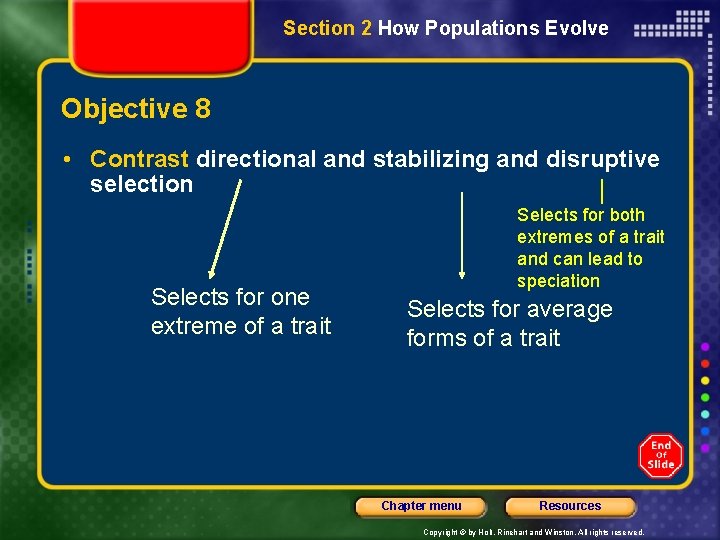
Section 2 How Populations Evolve Objective 8 • Contrast directional and stabilizing and disruptive selection Selects for one extreme of a trait Selects for both extremes of a trait and can lead to speciation Selects for average forms of a trait Chapter menu Resources Copyright © by Holt, Rinehart and Winston. All rights reserved.
- Slides: 41