
Section 3 Classical Greece Greek Achievements Main Idea
- Slides: 13
Section 3 Classical Greece Greek Achievements Main Idea The ancient Greeks made great achievements in philosophy, literature, art, and architecture that influenced the development of later cultures and ideas. • How did Greek philosophy influence later thinking? • What types of literature did the Greeks create?
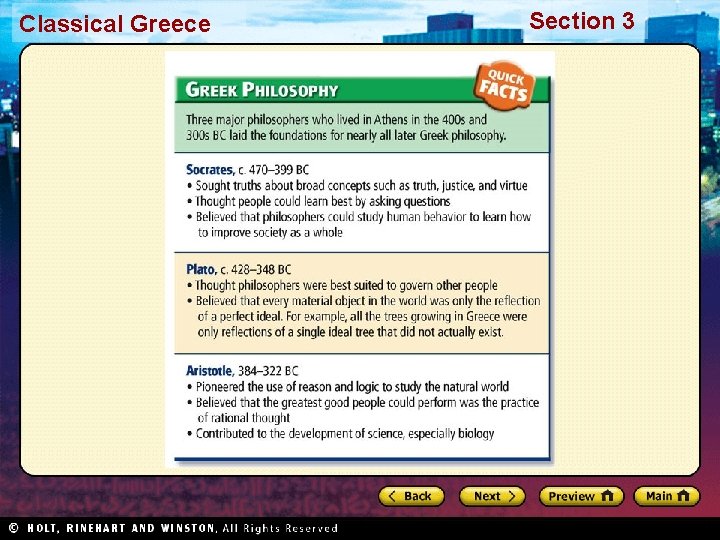
Section 3 Classical Greece Philosophy of Socrates Asking Questions Socratic Method • Socrates believed philosophers could learn what made good people, societies by asking questions • By working through series of questions, Socrates thought people could discover basic nature of life • Started with basic questions, like “What is truth? ” • Method of learning through questions called the Socratic method • Socrates followed up with more questions • Socrates interested in broad concepts of human life—truth, justice, virtue
Classical Greece Section 3 Plato • One of Socrates’ students, became great philosopher in own right • Left behind great number of writings that record ideas on wide variety of topics, from nature of truth to ideal form of government • The Republic argues that government should be led by philosophers Theory of Government • Philosophers most qualified to make good decisions • Did not support Athenian democracy in which all men could take part • Plato wanted to make philosopher’s education more formal • Founded the Academy, which in Plato’s lifetime became most important site for Greek philosophers to do their work
Section 3 Classical Greece Aristotle Third Philosopher • Aristotle was among students who studied at the Academy • More concerned with nature of world that surrounded him • Tried to apply philosophical principles to every kind of knowledge Emphasis on Reason and Logic • Emphasis on reason, logic • Reason, clear and ordered thinking; use reason to learn about world • Observe carefully, think rationally about what one has seen Inferring New Facts • Aristotle also helped develop field of logic, process of making inferences • Example: birds have feathers, lay eggs; owls have feathers, lay eggs; therefore, owl must be a type of bird
Classical Greece Section 3
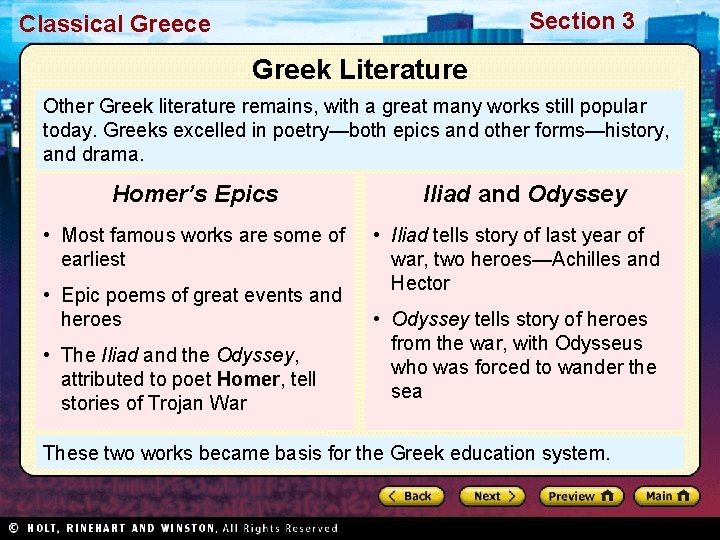
Section 3 Classical Greece Greek Literature Other Greek literature remains, with a great many works still popular today. Greeks excelled in poetry—both epics and other forms—history, and drama. Homer’s Epics • Most famous works are some of earliest • Epic poems of great events and heroes • The Iliad and the Odyssey, attributed to poet Homer, tell stories of Trojan War Iliad and Odyssey • Iliad tells story of last year of war, two heroes—Achilles and Hector • Odyssey tells story of heroes from the war, with Odysseus who was forced to wander the sea These two works became basis for the Greek education system.
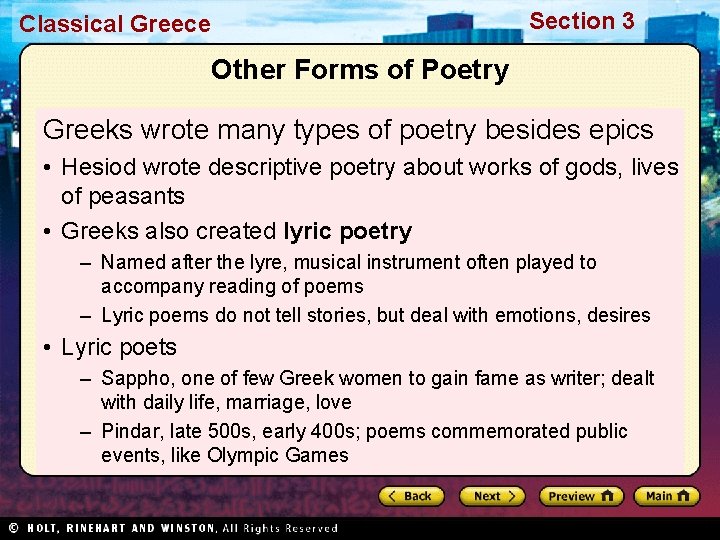
Section 3 Classical Greece Other Forms of Poetry Greeks wrote many types of poetry besides epics • Hesiod wrote descriptive poetry about works of gods, lives of peasants • Greeks also created lyric poetry – Named after the lyre, musical instrument often played to accompany reading of poems – Lyric poems do not tell stories, but deal with emotions, desires • Lyric poets – Sappho, one of few Greek women to gain fame as writer; dealt with daily life, marriage, love – Pindar, late 500 s, early 400 s; poems commemorated public events, like Olympic Games
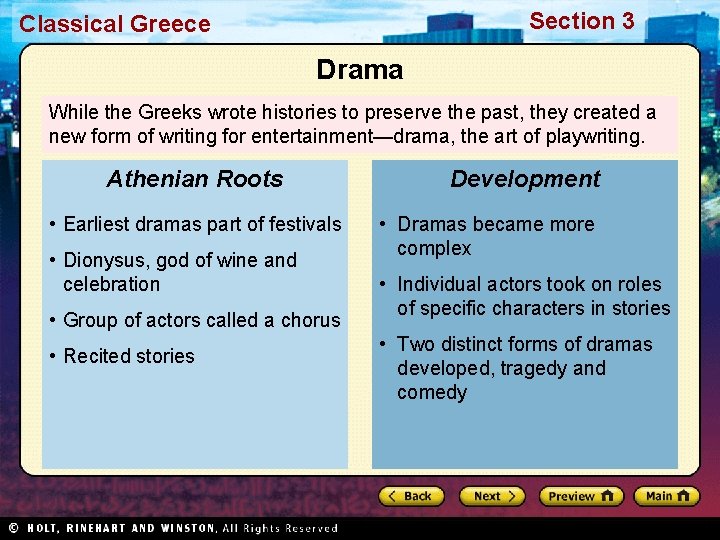
Section 3 Classical Greece Drama While the Greeks wrote histories to preserve the past, they created a new form of writing for entertainment—drama, the art of playwriting. Athenian Roots • Earliest dramas part of festivals • Dionysus, god of wine and celebration • Group of actors called a chorus • Recited stories Development • Dramas became more complex • Individual actors took on roles of specific characters in stories • Two distinct forms of dramas developed, tragedy and comedy
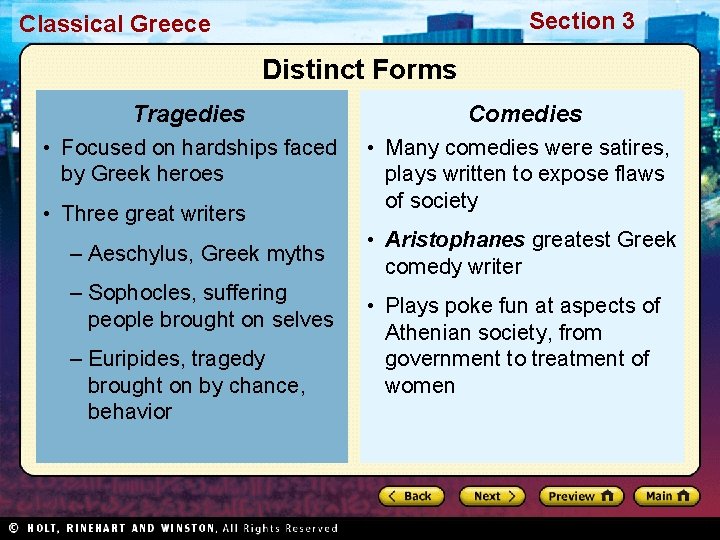
Section 3 Classical Greece Distinct Forms Tragedies Comedies • Focused on hardships faced by Greek heroes • Many comedies were satires, plays written to expose flaws of society • Three great writers – Aeschylus, Greek myths – Sophocles, suffering people brought on selves – Euripides, tragedy brought on by chance, behavior • Aristophanes greatest Greek comedy writer • Plays poke fun at aspects of Athenian society, from government to treatment of women
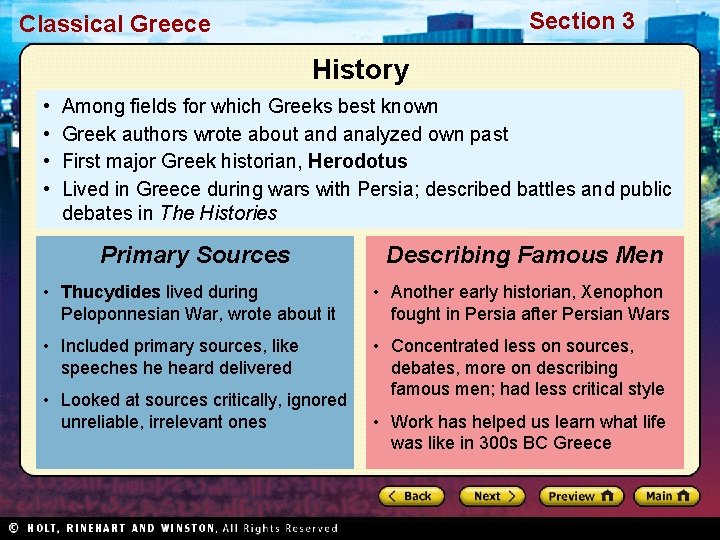
Section 3 Classical Greece History • • Among fields for which Greeks best known Greek authors wrote about and analyzed own past First major Greek historian, Herodotus Lived in Greece during wars with Persia; described battles and public debates in The Histories Primary Sources Describing Famous Men • Thucydides lived during Peloponnesian War, wrote about it • Another early historian, Xenophon fought in Persia after Persian Wars • Included primary sources, like speeches he heard delivered • Concentrated less on sources, debates, more on describing famous men; had less critical style • Looked at sources critically, ignored unreliable, irrelevant ones • Work has helped us learn what life was like in 300 s BC Greece
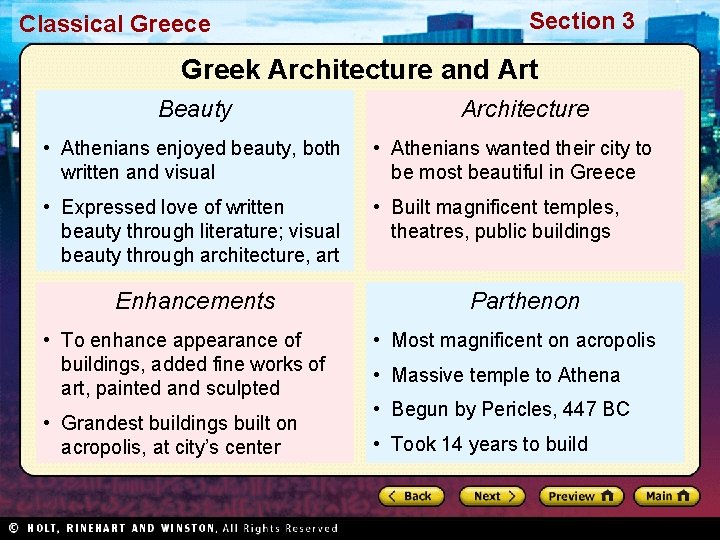
Classical Greece Section 3 Greek Architecture and Art Beauty Architecture • Athenians enjoyed beauty, both written and visual • Athenians wanted their city to be most beautiful in Greece • Expressed love of written beauty through literature; visual beauty through architecture, art • Built magnificent temples, theatres, public buildings Enhancements • To enhance appearance of buildings, added fine works of art, painted and sculpted • Grandest buildings built on acropolis, at city’s center Parthenon • Most magnificent on acropolis • Massive temple to Athena • Begun by Pericles, 447 BC • Took 14 years to build
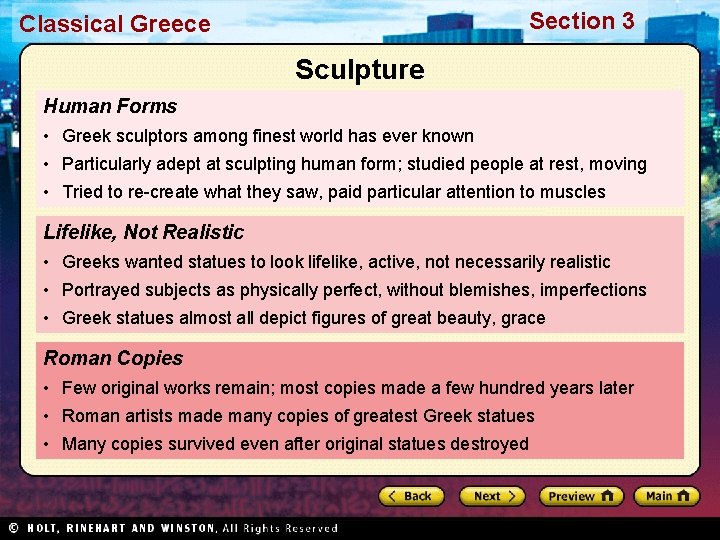
Section 3 Classical Greece Sculpture Human Forms • Greek sculptors among finest world has ever known • Particularly adept at sculpting human form; studied people at rest, moving • Tried to re-create what they saw, paid particular attention to muscles Lifelike, Not Realistic • Greeks wanted statues to look lifelike, active, not necessarily realistic • Portrayed subjects as physically perfect, without blemishes, imperfections • Greek statues almost all depict figures of great beauty, grace Roman Copies • Few original works remain; most copies made a few hundred years later • Roman artists made many copies of greatest Greek statues • Many copies survived even after original statues destroyed
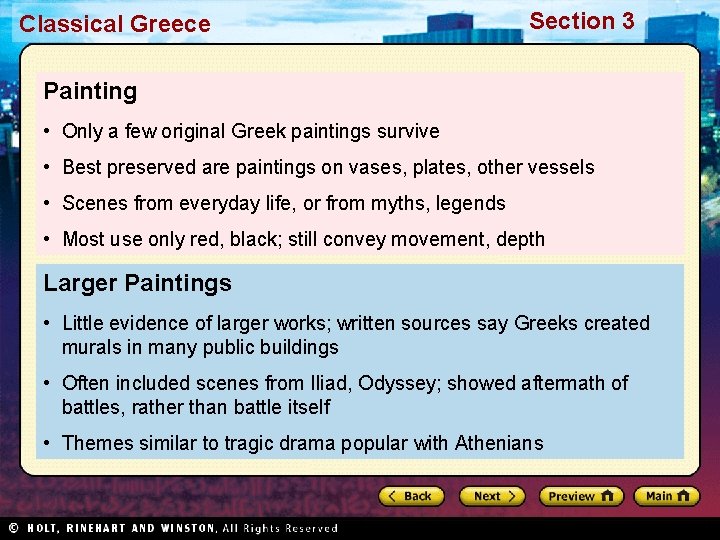
Classical Greece Section 3 Painting • Only a few original Greek paintings survive • Best preserved are paintings on vases, plates, other vessels • Scenes from everyday life, or from myths, legends • Most use only red, black; still convey movement, depth Larger Paintings • Little evidence of larger works; written sources say Greeks created murals in many public buildings • Often included scenes from Iliad, Odyssey; showed aftermath of battles, rather than battle itself • Themes similar to tragic drama popular with Athenians