
Section 3 Basic Maneuvering Tasks Low Moderate Complex
Section 3 Basic Maneuvering Tasks: Low , Moderate & Complex Risk Driving Environments
Bell Ringer Write a half a page red to red. Imagine you’re heading into Harrisonburg and you approach an intersection. What steps would you take in order to safely make it through the intersection. n (Use SEEit to explain the steps. ) n

Day 3 Objectives • • The students will understand different methods of communicating while driving The students will be able to define and understand importance of staggered stop lines The students will be able to define and understand importance of shared left turn lanes The students will recognize and understand the characteristics for hills and curves The students will understand different characteristics of multiple c lane roadways The students will be able to identify and define the names and n meanings of roadways The students will be able to identify and define the 4 types of interchanges The students will recognize and understand the function of common expressway signs Related SOL: DE. 4, DE. 5, DE. 6, DE. 7, and DE. 12
Communication

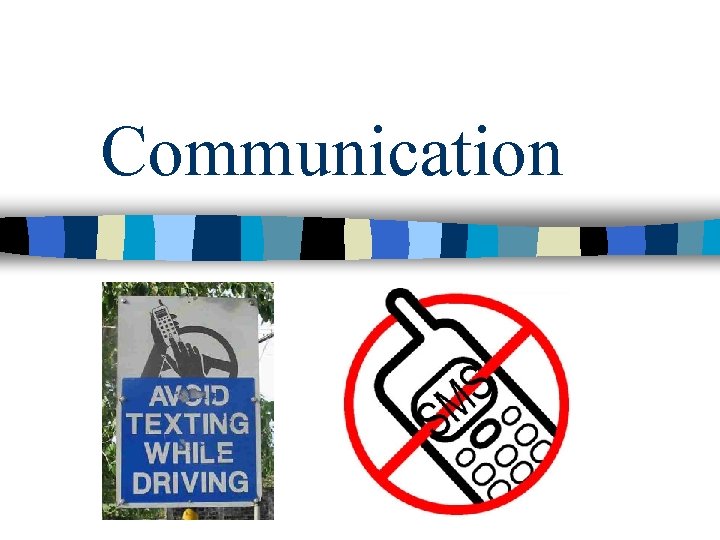
Some ways to communicate: n n n n Signals— Headlights— Brake Lights— Horn— Hand Signals— Position of Vehicle— Speed— Driver Actions—
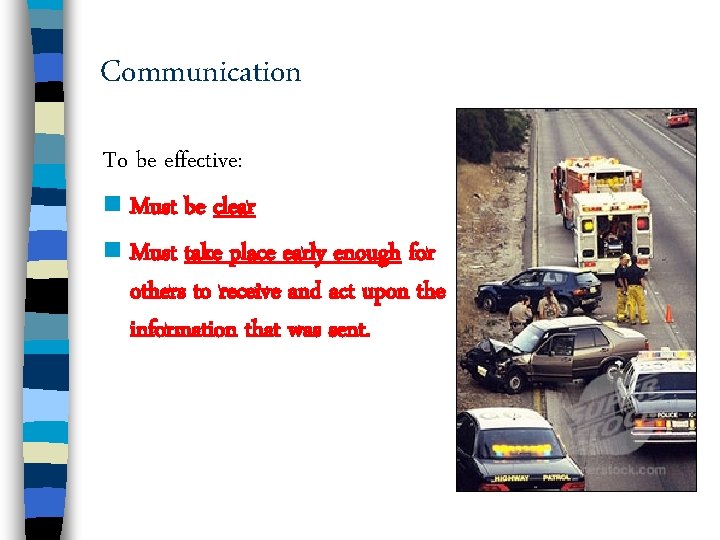
Communication To be effective: n Must be clear n Must take place early enough for others to receive and act upon the information that was sent.

Staggered stops

Staggered Stops • Improves visibility and creates space for a truck making a left turn. Stop your vehicle (RED car) behind the white(black) stop bar Select Lane Position 3 to give the truck as much space as possible

Shared Left Turn Lane

Shared Left Turn Lane- Turn from Moving Traffic Check for vehicles already stopped or if anyone will be entering lane n Check traffic to rear and signal intention to turn left n

Shared Left Turn Lane- Turn from Moving Traffic Brake to a stop if a gap is not available n Should not drive more than 150 feet in a shared left lane. n
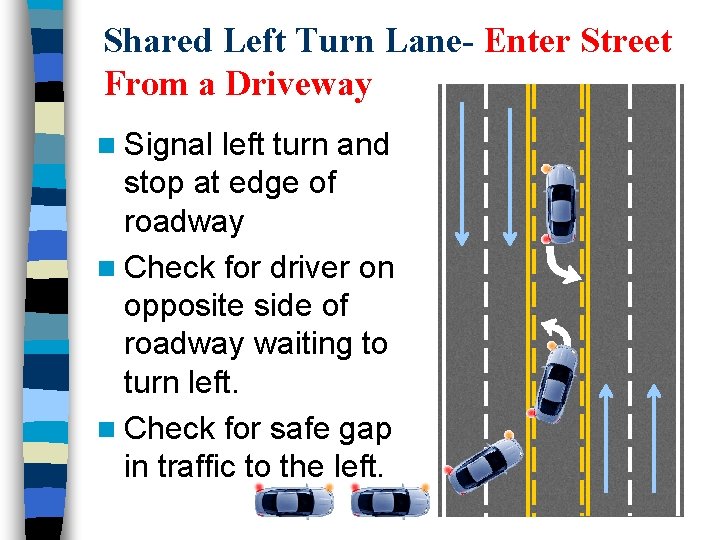
Shared Left Turn Lane- Enter Street From a Driveway n Signal left turn and stop at edge of roadway n Check for driver on opposite side of roadway waiting to turn left. n Check for safe gap in traffic to the left.
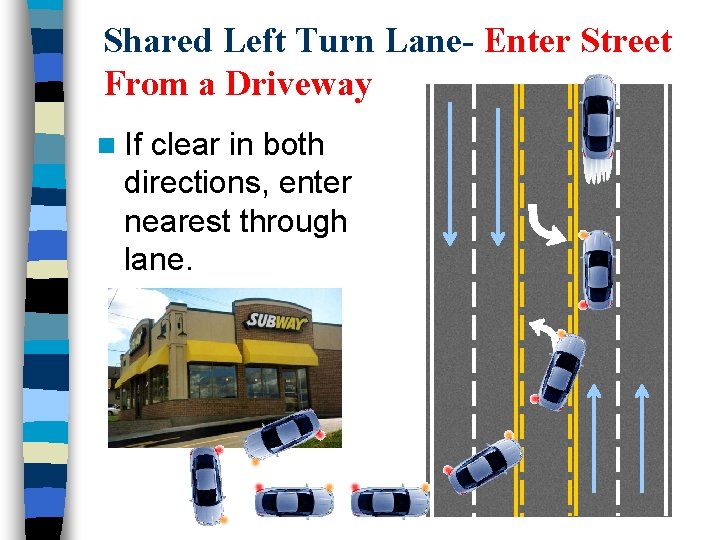
Shared Left Turn Lane- Enter Street From a Driveway n If clear in both directions, enter nearest through lane.
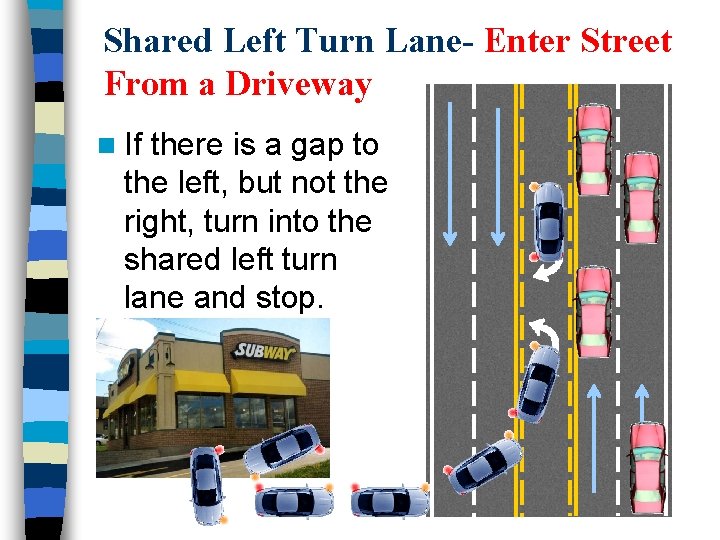
Shared Left Turn Lane- Enter Street From a Driveway n If there is a gap to the left, but not the right, turn into the shared left turn lane and stop.

Shared Left Turn Lane- Enter Street From a Driveway n Signal for a right turn. n When traffic is clear to the right, accelerate and steer into nearest traffic lane.
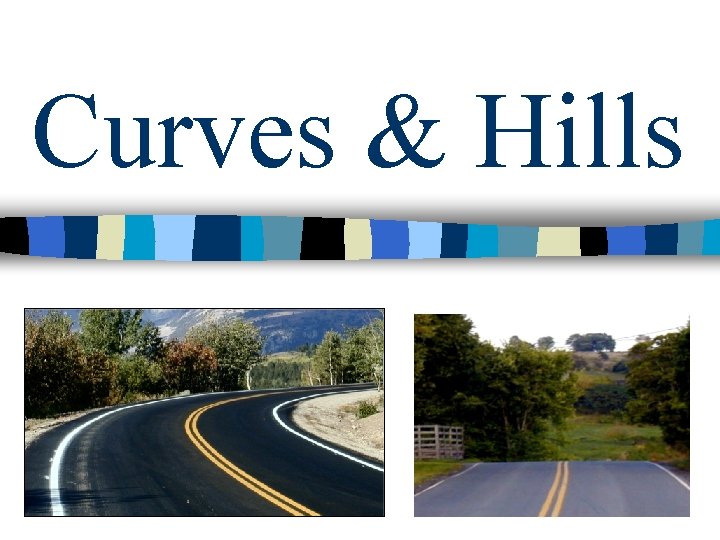
Curves & Hills
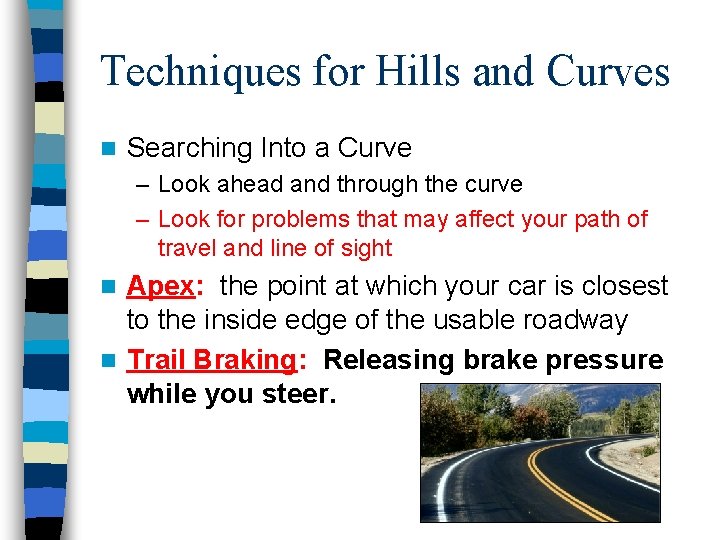
Techniques for Hills and Curves n Searching Into a Curve – Look ahead and through the curve – Look for problems that may affect your path of travel and line of sight Apex: the point at which your car is closest to the inside edge of the usable roadway n Trail Braking: Releasing brake pressure while you steer. n
Things to ask yourself when driving through curves n n n n Does the roadway curve left or right? Can the exit of the curve be seen ahead? What is the sharpness of the curve? What is the lane width, shoulder conditions, posted speed, or traffic volume? Is the curve on grade, up or down hill? Is the field of view restricted? Can an apex point for exiting the curve be determined? Do not write this slide
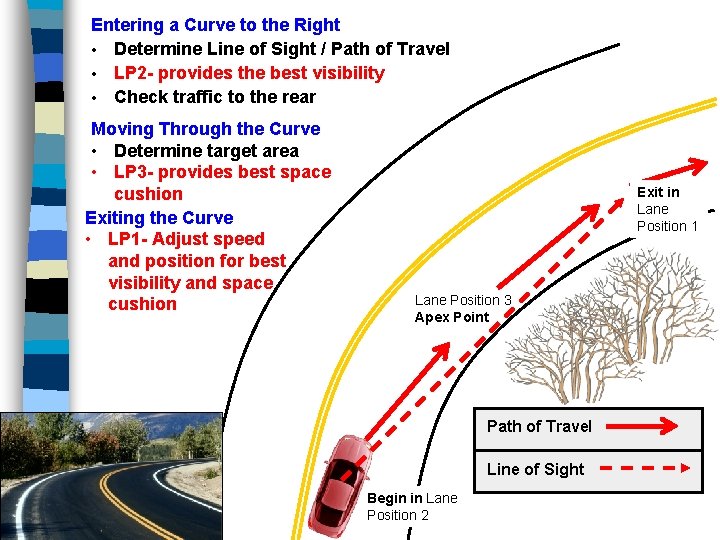
Entering a Curve to the Right • Determine Line of Sight / Path of Travel • LP 2 - provides the best visibility • Check traffic to the rear Moving Through the Curve • Determine target area • LP 3 - provides best space cushion Exiting the Curve • LP 1 - Adjust speed and position for best visibility and space cushion Exit in Lane Position 1 Lane Position 3 Apex Point Path of Travel Line of Sight Begin in Lane Position 2

Entering a Curve to the Left • Determine Line of Sight/Path of Travel • LP 3 provides the best visibility • Check traffic to the rear Begin in Lane Position 3 Moving Through the Curve • Determine target area • LP 2 - provides best space cushion (Apex) Exiting the Curve Adjust LP 1 - speed and position for best visibility and space cushion Exit in Lane Position 1 Lane Position 2 Apex Point Path of Travel Line of Sight

Reduce Speed When: 1. 2. 3. 4. 5. 6. Approaching and crossing intersections where cross traffic is not required to stop by traffic control devices Approaching and crossing railroad grade crossings Approaching and going around curves or hills Traveling on narrow or winding roads Approaching pedestrians or other traffic Encountering bad weather or dangerous highway conditions

Speed in a Curve n You should reduce speed going into a curve. n Squeeze the brake on entry and trail off the brake until the apex or exit point is determined n Once apex is reached, use light acceleration to pull the car out of the curve through the exit
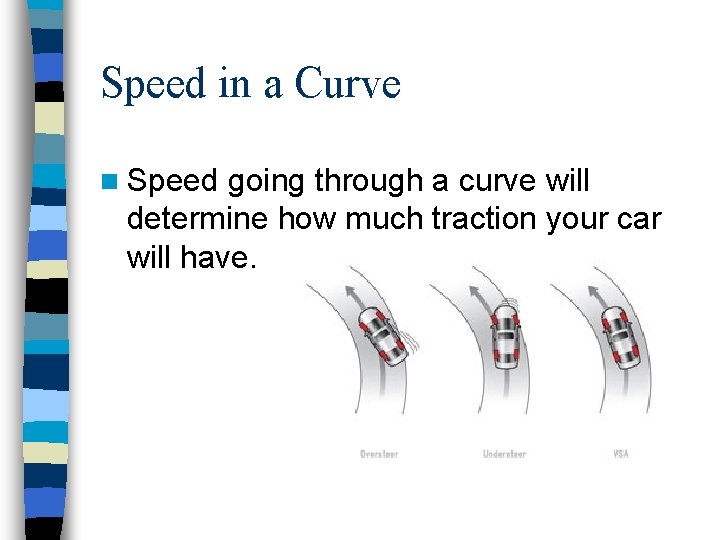
Speed in a Curve n Speed going through a curve will determine how much traction your car will have.
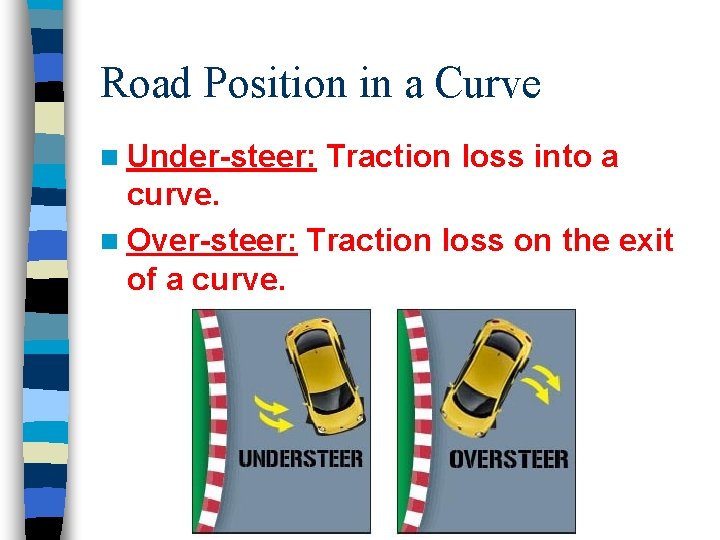
Road Position in a Curve n Under-steer: Traction loss into a curve. n Over-steer: Traction loss on the exit of a curve.
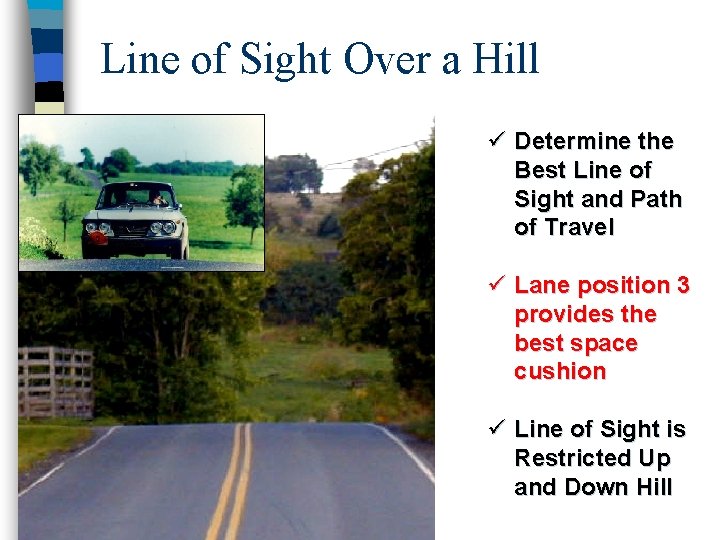
Line of Sight Over a Hill ü Determine the Best Line of Sight and Path of Travel ü Lane position 3 provides the best space cushion ü Line of Sight is Restricted Up and Down Hill
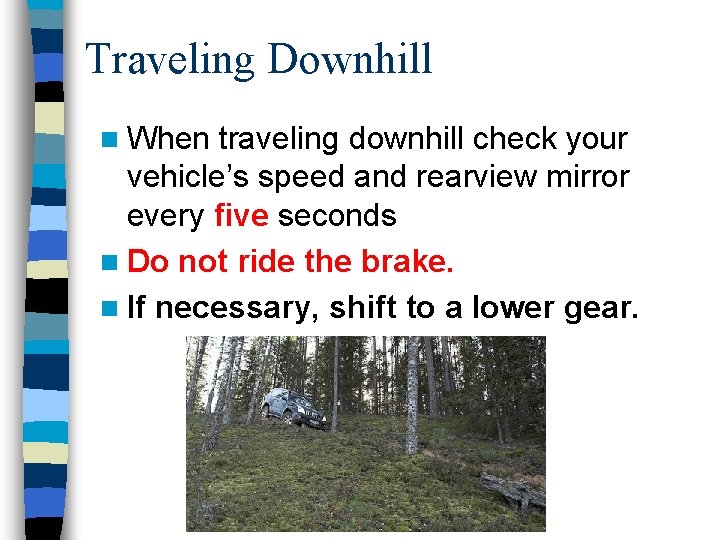
Traveling Downhill n When traveling downhill check your vehicle’s speed and rearview mirror every five seconds n Do not ride the brake. n If necessary, shift to a lower gear.
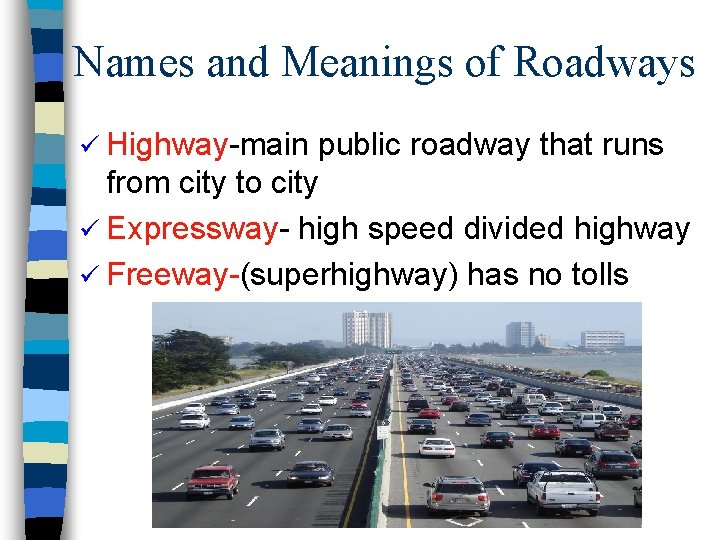
Names and Meanings of Roadways ü Highway-main public roadway that runs from city to city ü Expressway- high speed divided highway ü Freeway-(superhighway) has no tolls
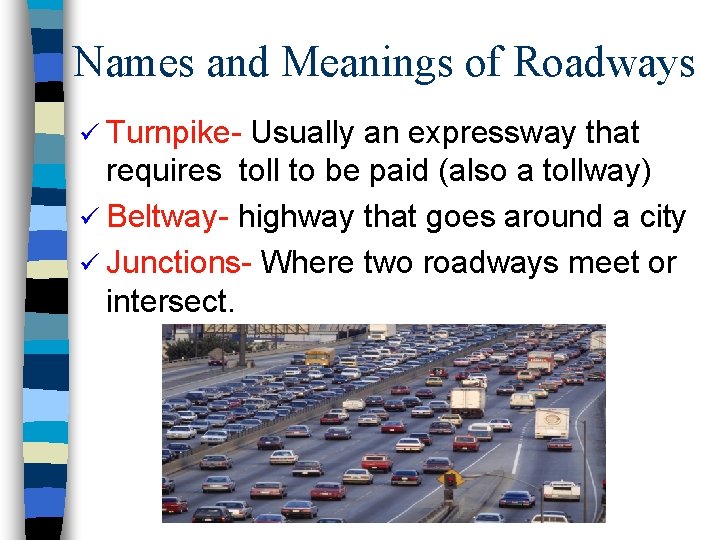
Names and Meanings of Roadways ü Turnpike- Usually an expressway that requires toll to be paid (also a tollway) ü Beltway- highway that goes around a city ü Junctions- Where two roadways meet or intersect.
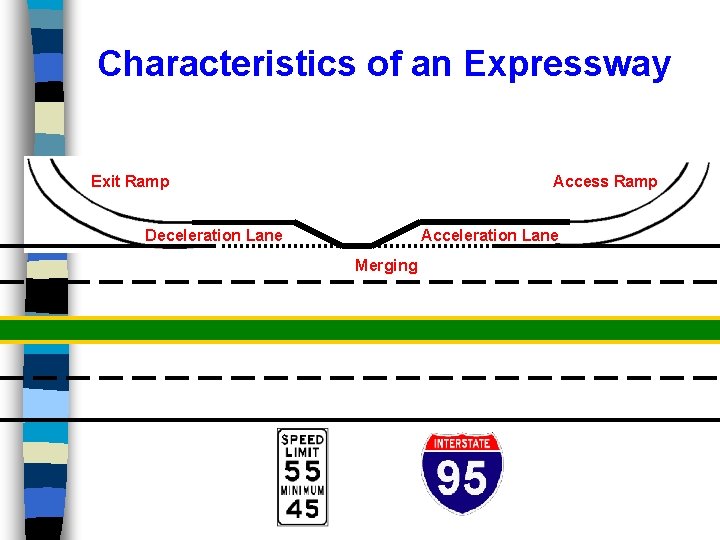
Characteristics of an Expressway Exit Ramp Access Ramp Deceleration Lane Acceleration Lane Merging
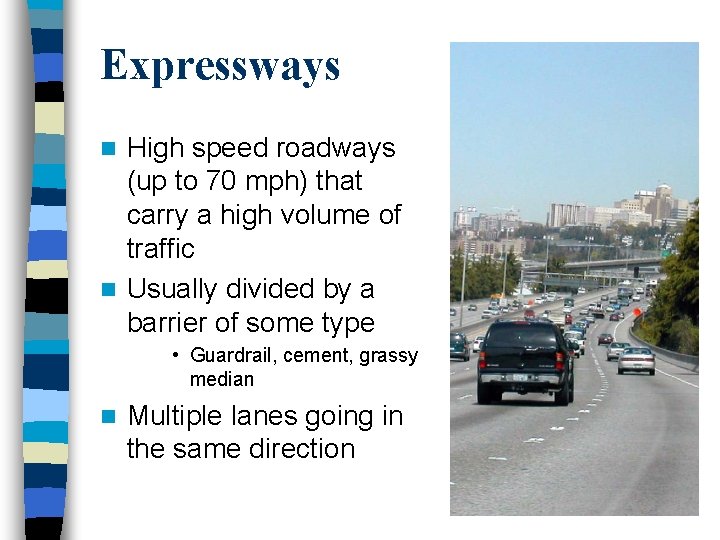
Expressways High speed roadways (up to 70 mph) that carry a high volume of traffic n Usually divided by a barrier of some type n • Guardrail, cement, grassy median n Multiple lanes going in the same direction
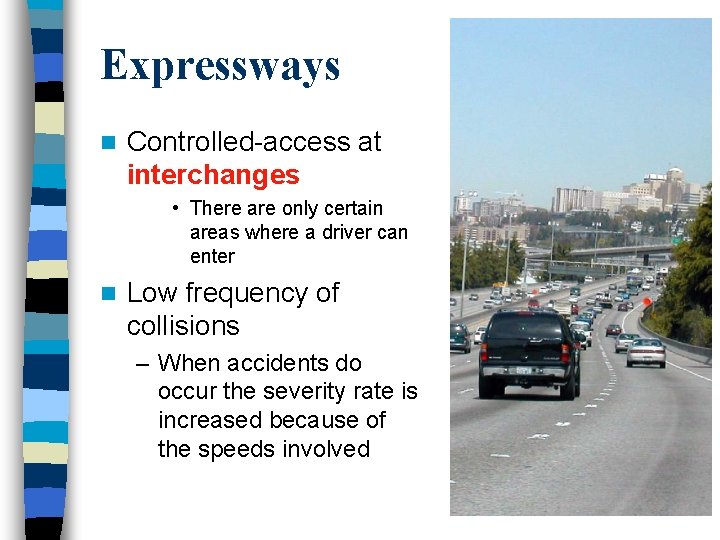
Expressways n Controlled-access at interchanges • There are only certain areas where a driver can enter n Low frequency of collisions – When accidents do occur the severity rate is increased because of the speeds involved

Types of Interchanges
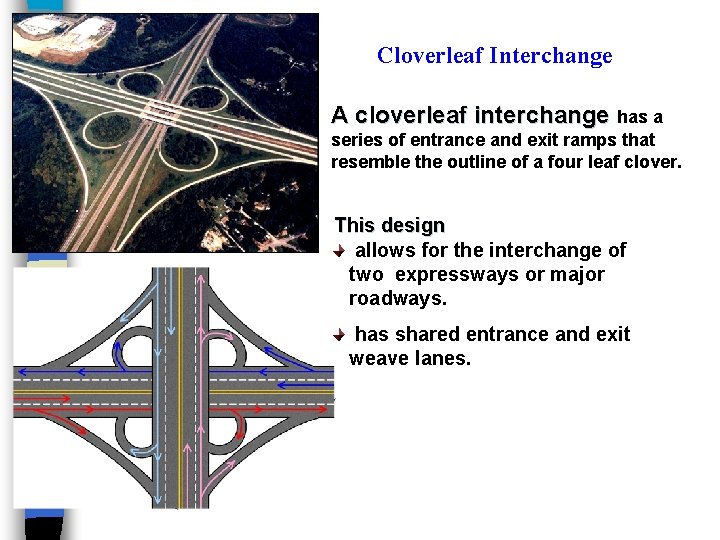
Cloverleaf Interchange A cloverleaf interchange has a series of entrance and exit ramps that resemble the outline of a four leaf clover. This design allows for the interchange of two expressways or major roadways. has shared entrance and exit weave lanes.
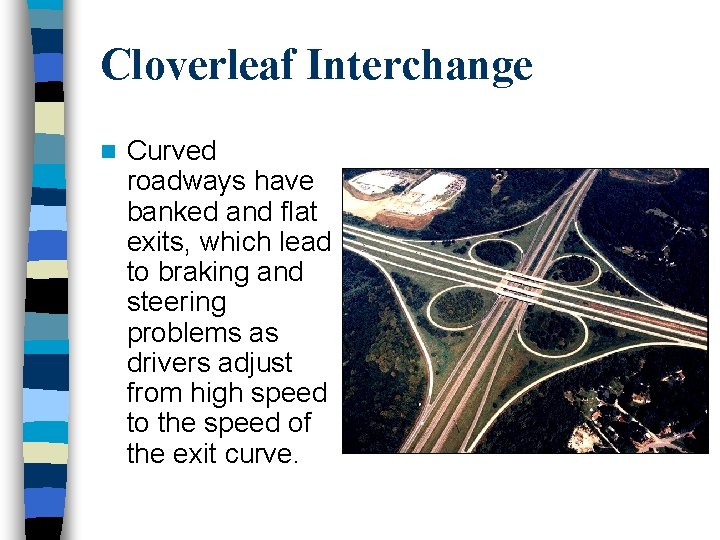
Cloverleaf Interchange n Curved roadways have banked and flat exits, which lead to braking and steering problems as drivers adjust from high speed to the speed of the exit curve.
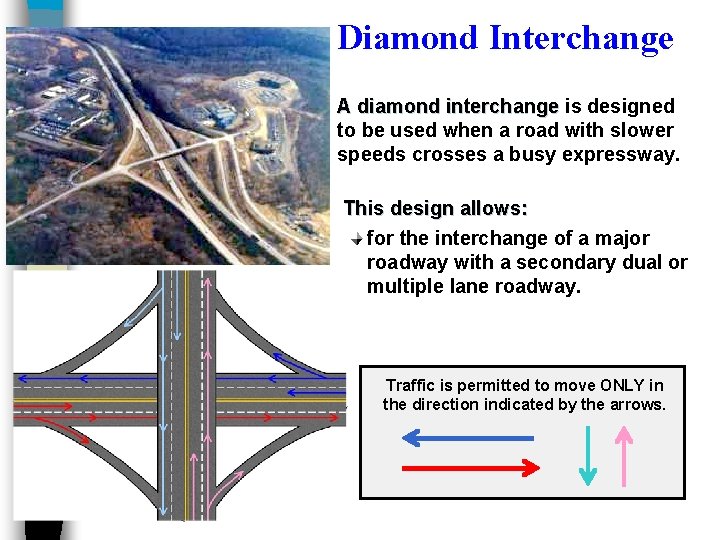
Diamond Interchange A diamond interchange is designed to be used when a road with slower speeds crosses a busy expressway. This design allows: for the interchange of a major roadway with a secondary dual or multiple lane roadway. Traffic is permitted to move ONLY in the direction indicated by the arrows.
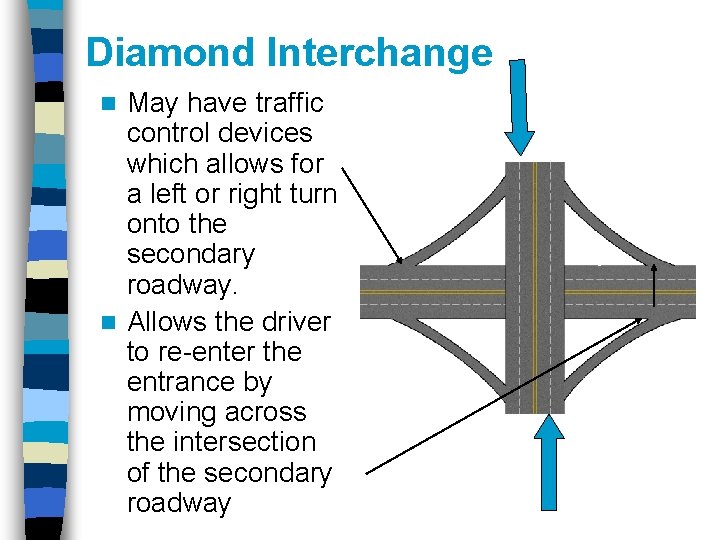
Diamond Interchange May have traffic control devices which allows for a left or right turn onto the secondary roadway. n Allows the driver to re-enter the entrance by moving across the intersection of the secondary roadway n
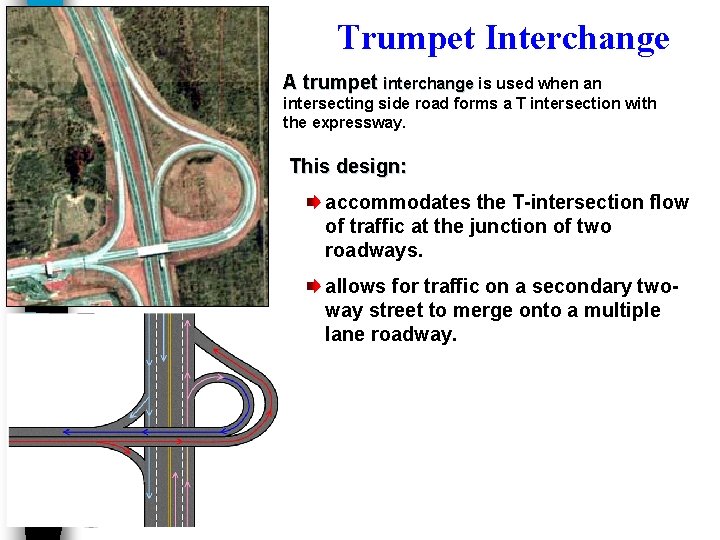
Trumpet Interchange A trumpet interchange is used when an intersecting side road forms a T intersection with the expressway. This design: accommodates the T-intersection flow of traffic at the junction of two roadways. allows for traffic on a secondary twoway street to merge onto a multiple lane roadway.

Frontage Interchange Frontage Road Interchanges allow vehicles using parallel secondary two-way or oneway roadways to merge onto a major multiple lane roadway. This design allows: drivers to exit a multiple lane roadway and use the parallel frontage road. secondary road traffic flows to mix efficiently with higher speed traffic flows on the multiple lane roadway. Traffic is permitted to move ONLY in the direction indicated by the arrows.

Common Expressway Signs
Common Expressway Signs ØA major contributor to your decision as to how you will maintain a safe path of travel, proper lane position, and your lane choice, is based on the information provided by the road signs and lane markings.
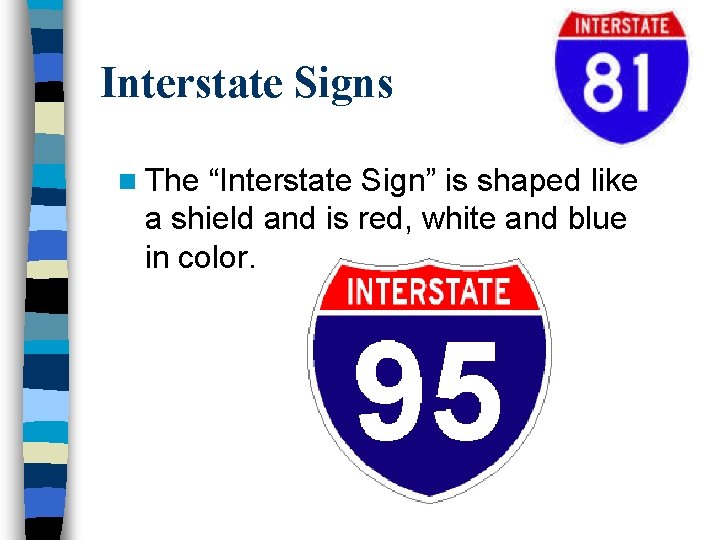
Interstate Signs n The “Interstate Sign” is shaped like a shield and is red, white and blue in color.
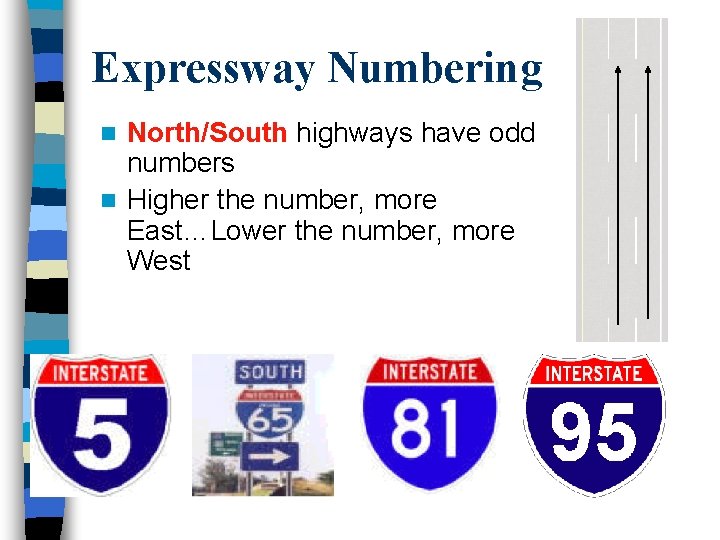
Expressway Numbering North/South highways have odd numbers n Higher the number, more East…Lower the number, more West n
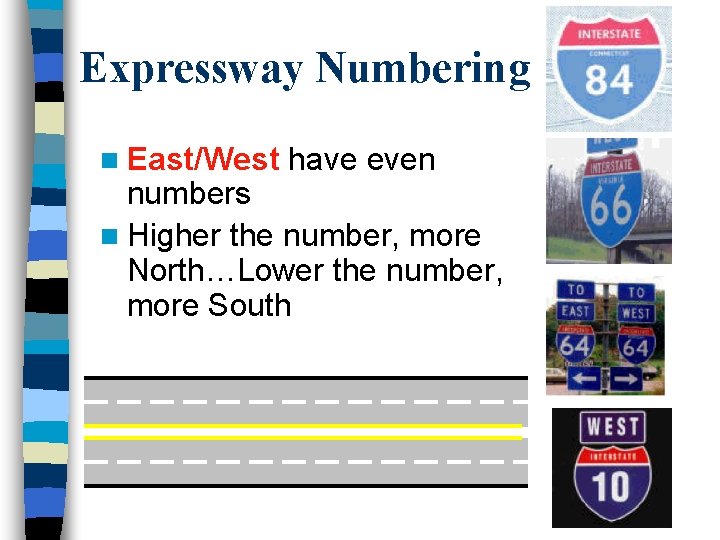
Expressway Numbering n East/West have even numbers n Higher the number, more North…Lower the number, more South
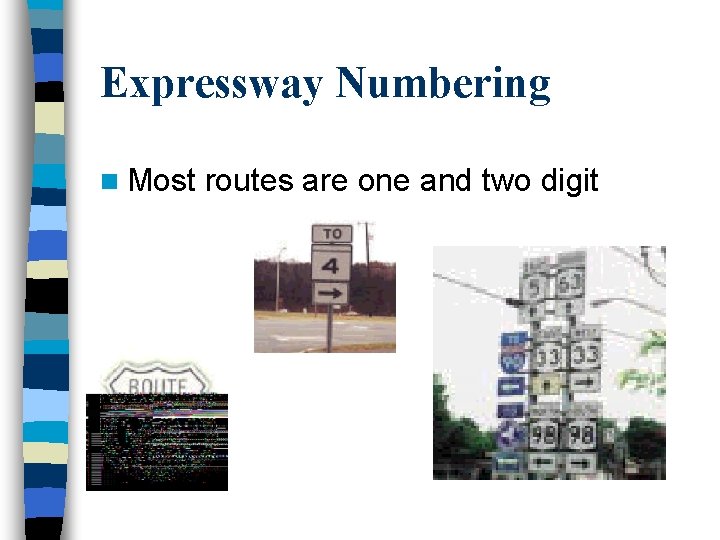
Expressway Numbering n Most routes are one and two digit
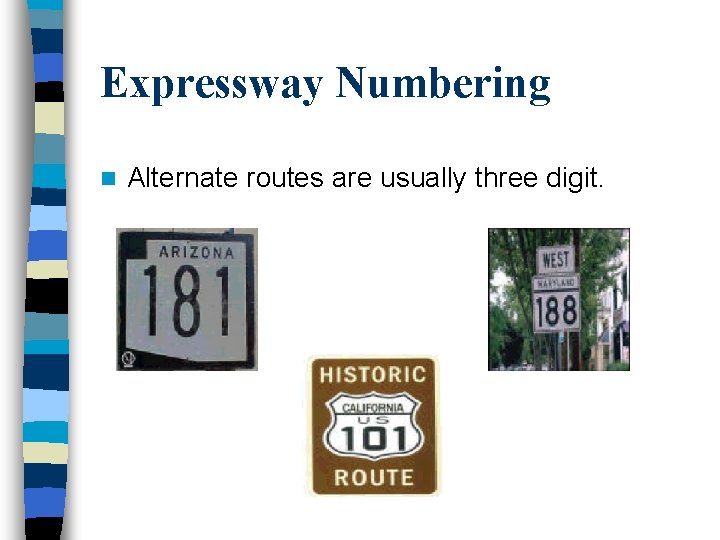
Expressway Numbering n Alternate routes are usually three digit.
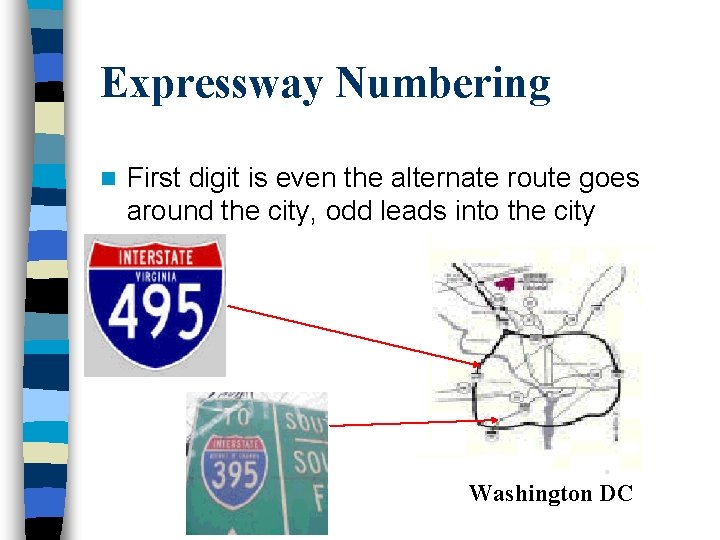
Expressway Numbering n First digit is even the alternate route goes around the city, odd leads into the city Washington DC
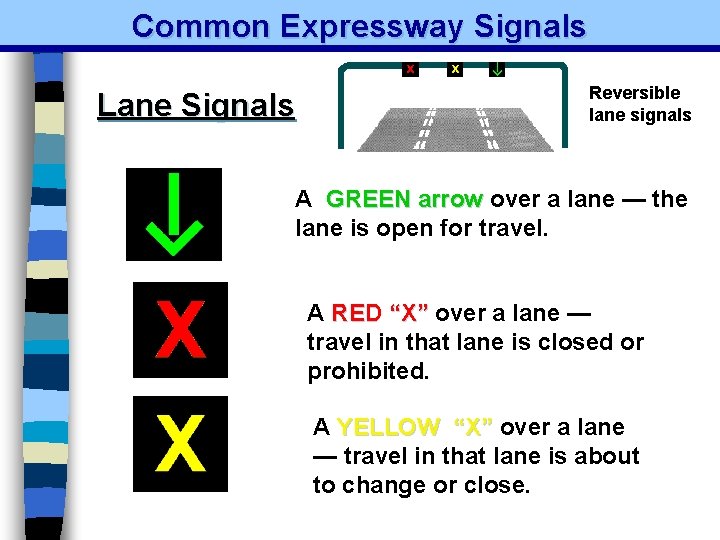
Common Expressway Signals Lane Signals Reversible lane signals A GREEN arrow over a lane — the lane is open for travel. A RED “X” over a lane — travel in that lane is closed or prohibited. A YELLOW “X” over a lane — travel in that lane is about to change or close.
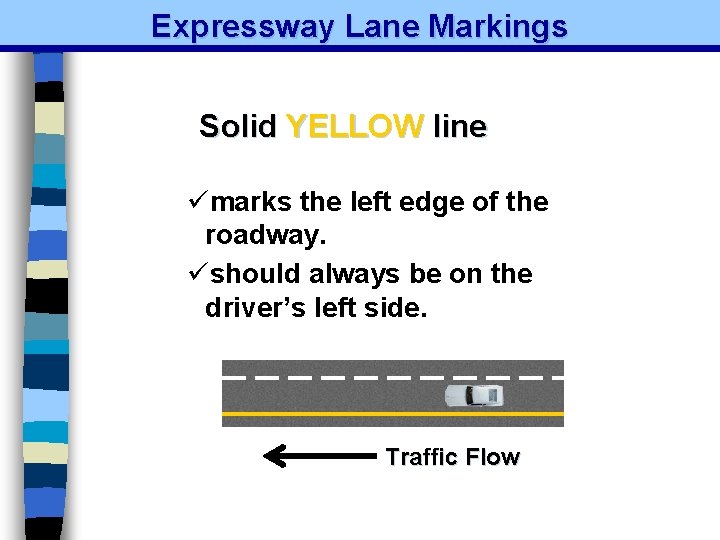
Expressway Lane Markings Solid YELLOW line ümarks the left edge of the roadway. üshould always be on the driver’s left side. Traffic Flow
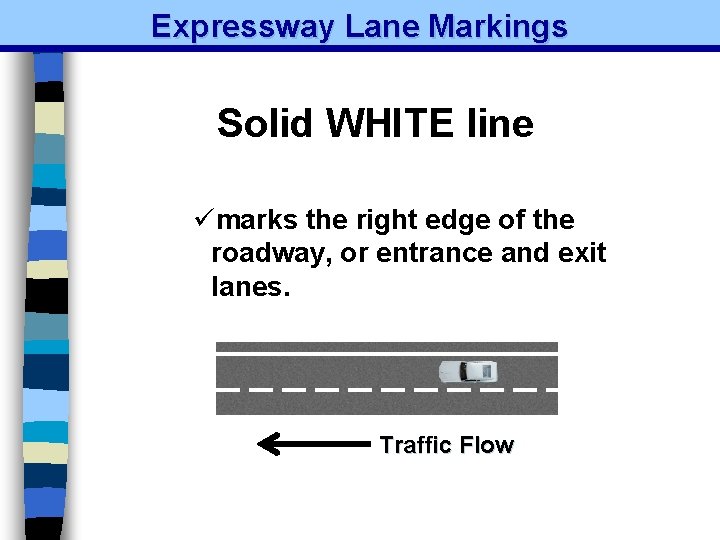
Expressway Lane Markings Solid WHITE line ümarks the right edge of the roadway, or entrance and exit lanes. Traffic Flow
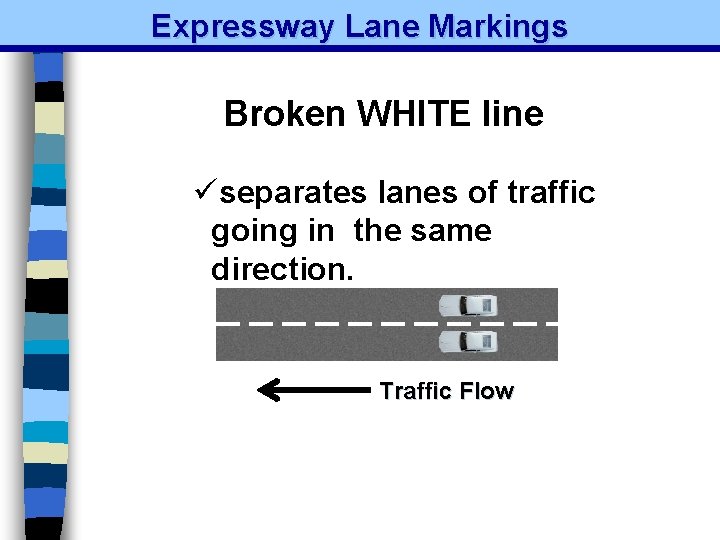
Expressway Lane Markings Broken WHITE line üseparates lanes of traffic going in the same direction. Traffic Flow

Expressway Lane Markings HOV lanes (high occupancy vehicle) üare marked with a white diamond. ürequire a minimum number of passengers in the vehicle.
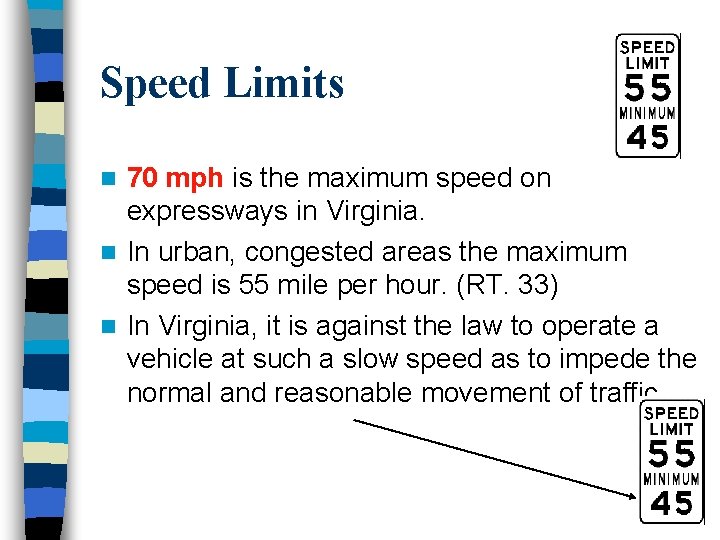
Speed Limits 70 mph is the maximum speed on expressways in Virginia. n In urban, congested areas the maximum speed is 55 mile per hour. (RT. 33) n In Virginia, it is against the law to operate a vehicle at such a slow speed as to impede the normal and reasonable movement of traffic n

Class Work Read pages: 263 -266 Answers questions 1 -4 on page 266
- Slides: 53