
Section 3 4 Solving Rational Equations and Radical
- Slides: 14
Section 3. 4 Solving Rational Equations and Radical Equations Copyright © 2013, 2009, 2006, 2001 Pearson Education, Inc.
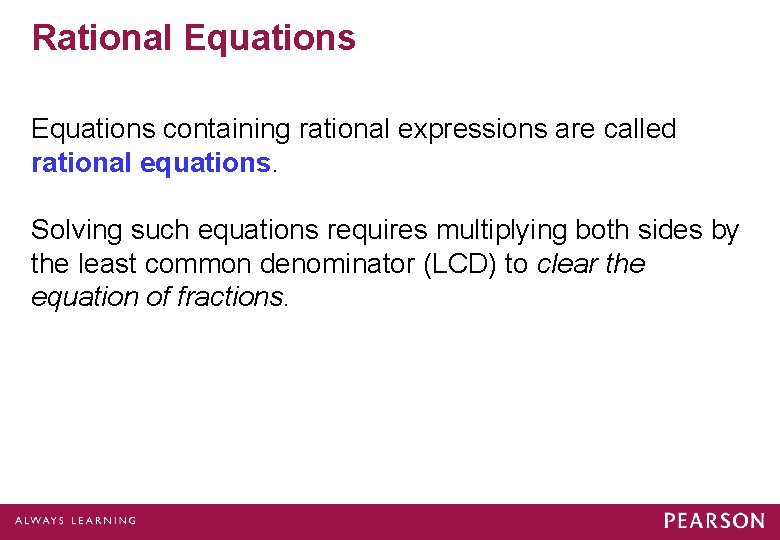
Objectives · · Solve rational equations. Solve radical equations.
Rational Equations containing rational expressions are called rational equations. Solving such equations requires multiplying both sides by the least common denominator (LCD) to clear the equation of fractions.
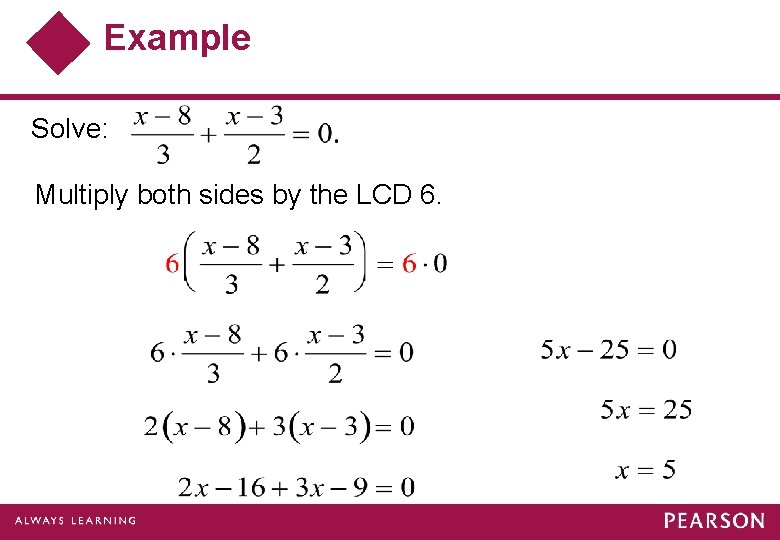
Example Solve: Multiply both sides by the LCD 6.
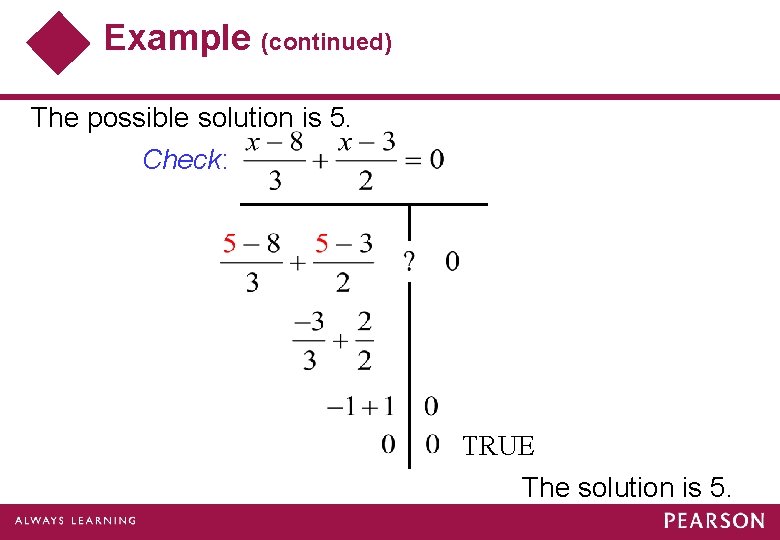
Example (continued) The possible solution is 5. Check: TRUE The solution is 5.
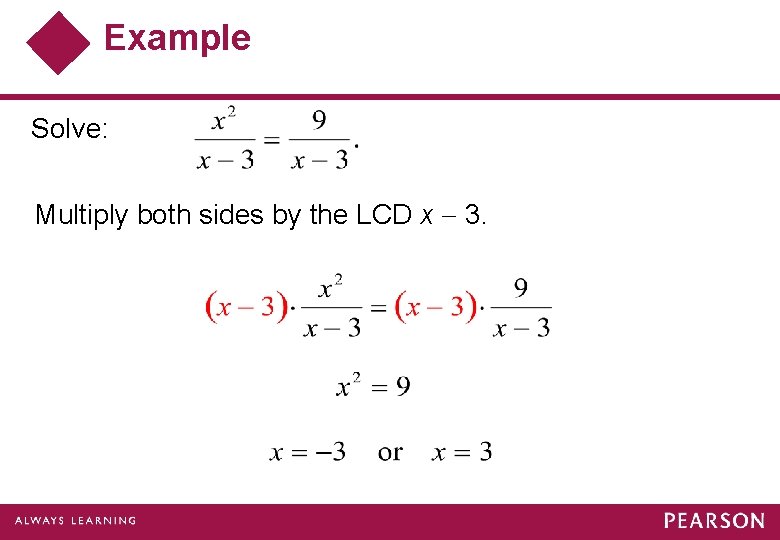
Example Solve: Multiply both sides by the LCD x 3.
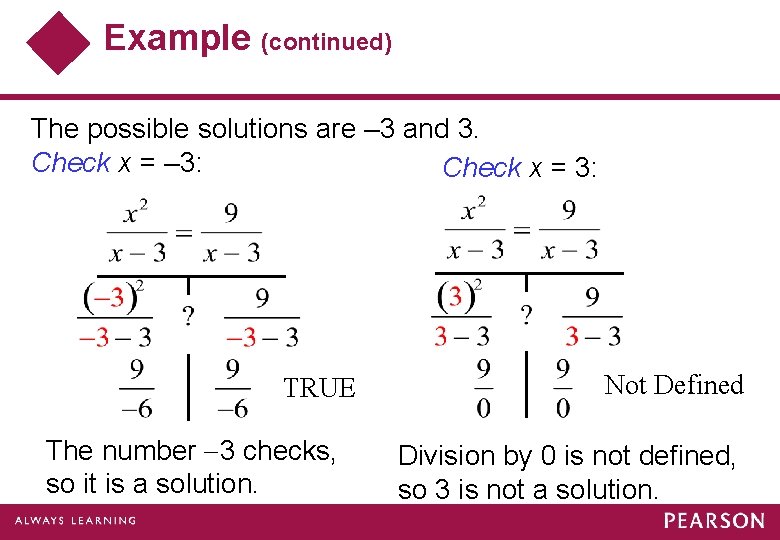
Example (continued) The possible solutions are – 3 and 3. Check x = – 3: Check x = 3: TRUE The number 3 checks, so it is a solution. Not Defined Division by 0 is not defined, so 3 is not a solution.
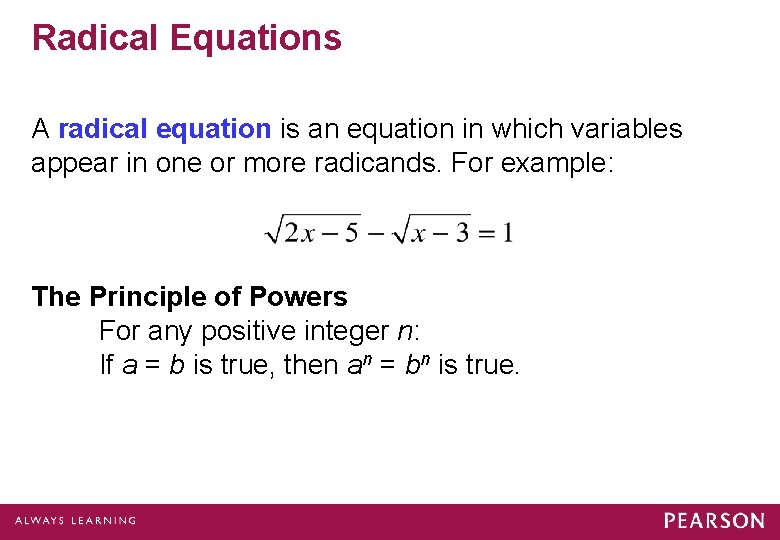
Radical Equations A radical equation is an equation in which variables appear in one or more radicands. For example: The Principle of Powers For any positive integer n: If a = b is true, then an = bn is true.
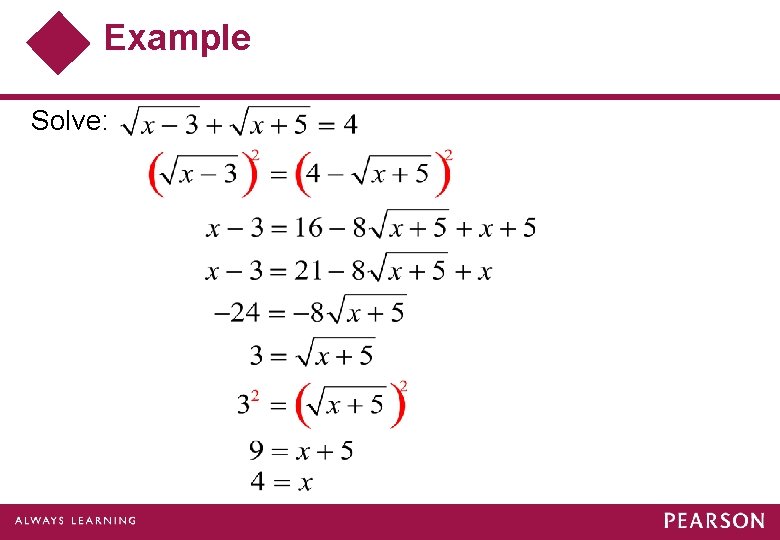
Solving Radical Equations To solve a radical equation we must first isolate the radical on one side of the equation. Then apply the Principle of Powers. When a radical equation has two radical terms on one side, we isolate one of them and then use the principle of powers. If, after doing so, a radical terms remains, we repeat these steps.
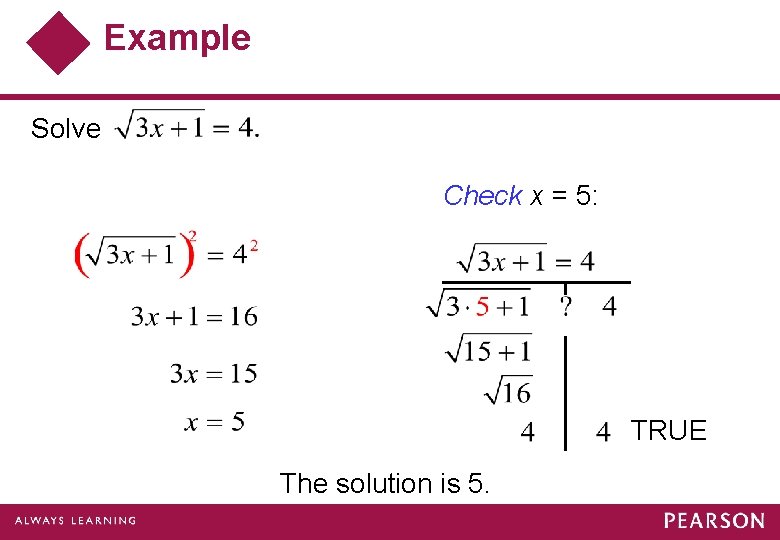
Example Solve Check x = 5: TRUE The solution is 5.
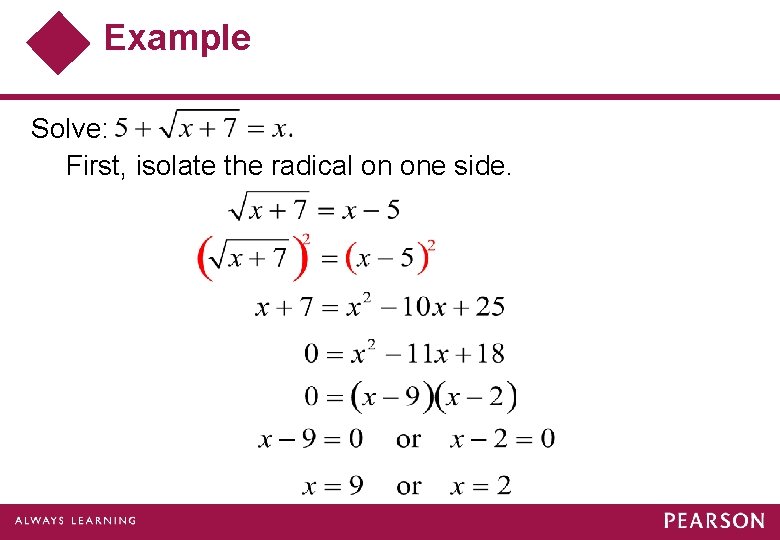
Example Solve: First, isolate the radical on one side.
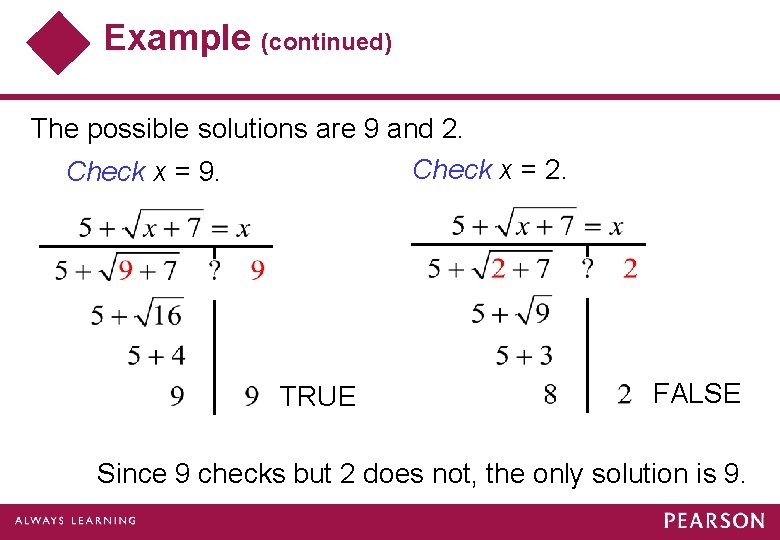
Example (continued) The possible solutions are 9 and 2. Check x = 9. TRUE FALSE Since 9 checks but 2 does not, the only solution is 9.
Example Solve:
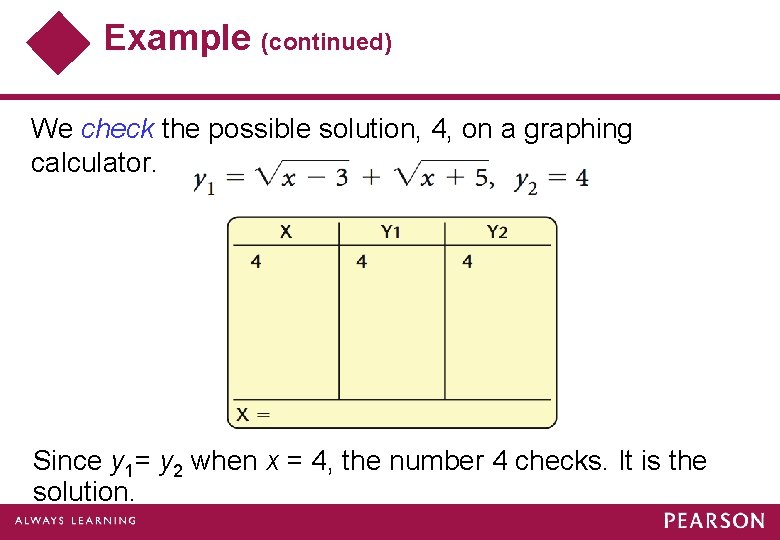
Example (continued) We check the possible solution, 4, on a graphing calculator. Since y 1= y 2 when x = 4, the number 4 checks. It is the solution.