
Section 3 3 Quadratic Functions Xintercept form Quadratic

- Slides: 10
Section 3. 3 Quadratic Functions: X-intercept form
Quadratic Functions • Objetives – Define and use three forms of the quadratic function. – Find the vertex and intercepts of a quadratic function and sketch its graph. – Convert one form of a quadratic function to another
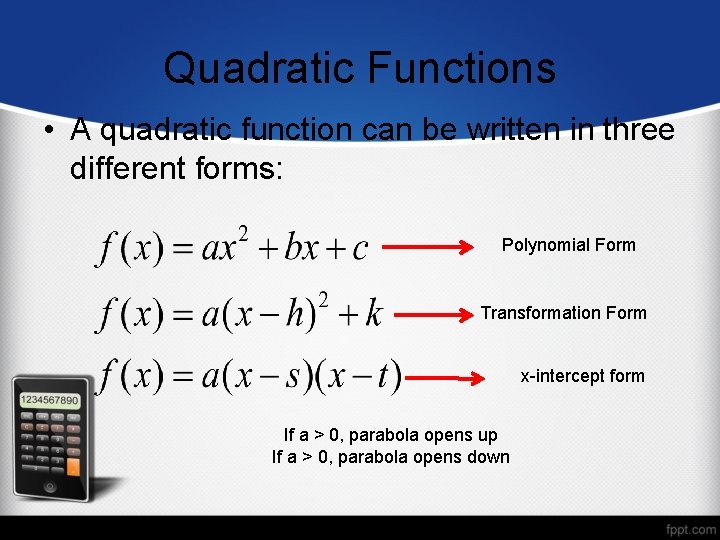
Quadratic Functions • A quadratic function can be written in three different forms: Polynomial Form Transformation Form x-intercept form If a > 0, parabola opens up If a > 0, parabola opens down
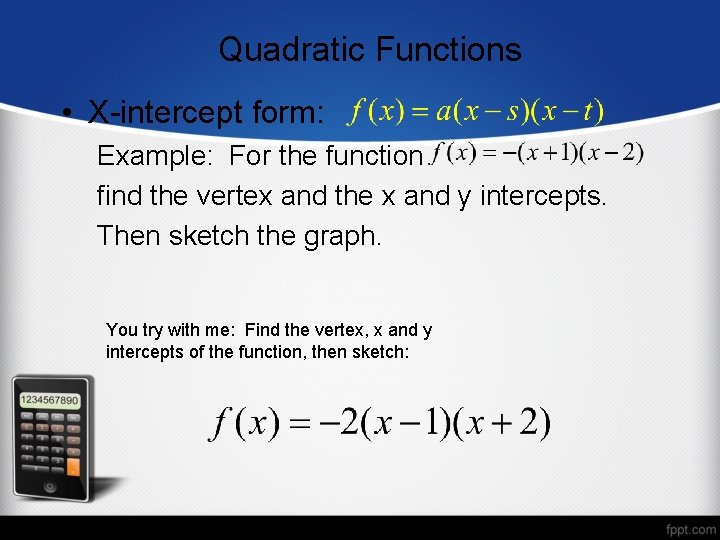
Quadratic Functions • X-intercept form: Example: For the function find the vertex and the x and y intercepts. Then sketch the graph. You try with me: Find the vertex, x and y intercepts of the function, then sketch:
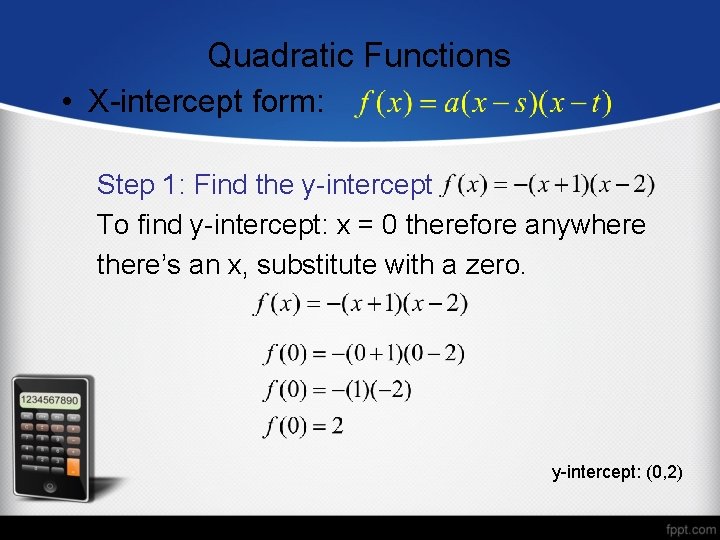
Quadratic Functions • X-intercept form: Step 1: Find the y-intercept To find y-intercept: x = 0 therefore anywhere there’s an x, substitute with a zero. y-intercept: (0, 2)
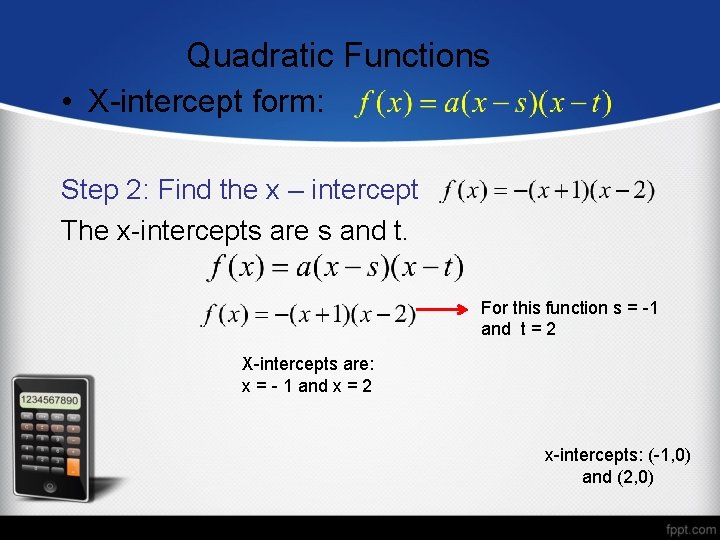
Quadratic Functions • X-intercept form: Step 2: Find the x – intercept The x-intercepts are s and t. For this function s = -1 and t = 2 X-intercepts are: x = - 1 and x = 2 x-intercepts: (-1, 0) and (2, 0)
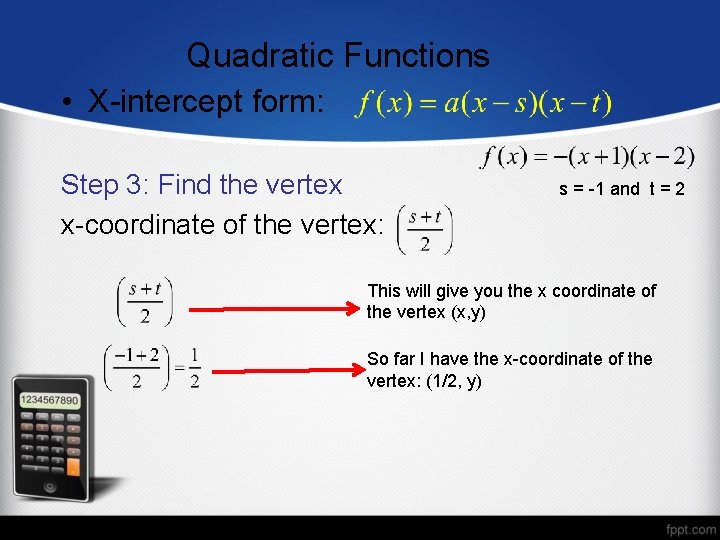
Quadratic Functions • X-intercept form: Step 3: Find the vertex x-coordinate of the vertex: s = -1 and t = 2 This will give you the x coordinate of the vertex (x, y) So far I have the x-coordinate of the vertex: (1/2, y)
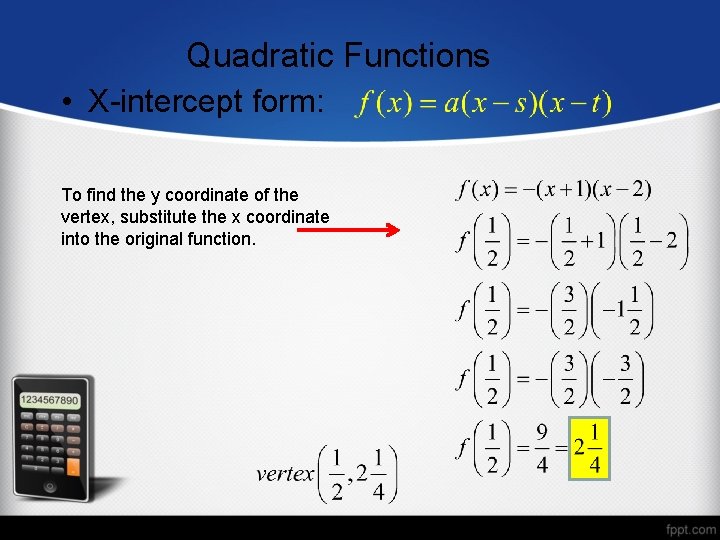
Quadratic Functions • X-intercept form: To find the y coordinate of the vertex, substitute the x coordinate into the original function.
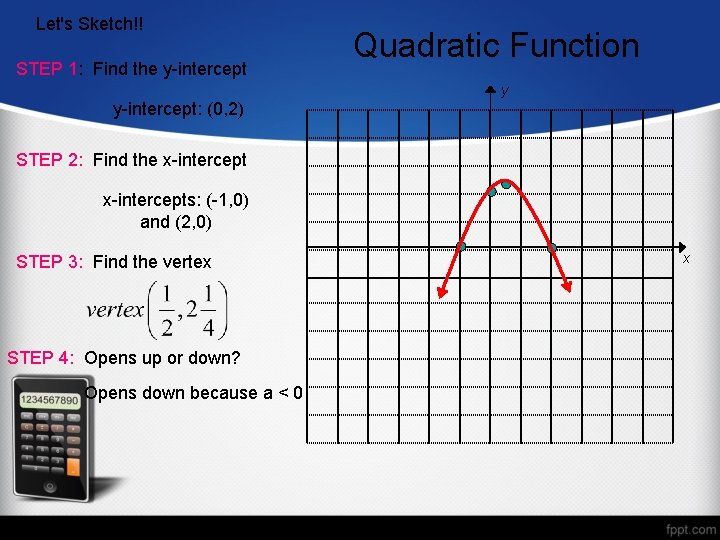
Let's Sketch!! STEP 1: Find the y-intercept: (0, 2) Quadratic Function y STEP 2: Find the x-intercepts: (-1, 0) and (2, 0) STEP 3: Find the vertex STEP 4: Opens up or down? Opens down because a < 0 x
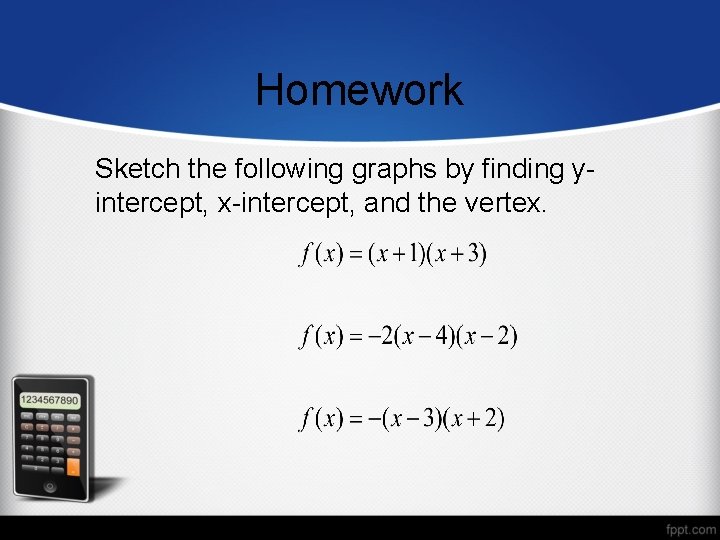
Homework Sketch the following graphs by finding yintercept, x-intercept, and the vertex.