
Section 3 3 Cell Membrane Todays Objectives 1
Section 3 -3 “Cell Membrane”
Today’s Objectives 1. Describe the structure of the cell membrane 2. Summarize how chemical signals are transmitted across the cell membrane.
Cell Membrane Cells need protection from the outside environment, but they also need to be able to respond to their surroundings. Cells are constantly taking in and getting rid of various molecules. The structure of the cell membrane allows cells to perform their functions by carefully controlling what goes in and out of the cell.
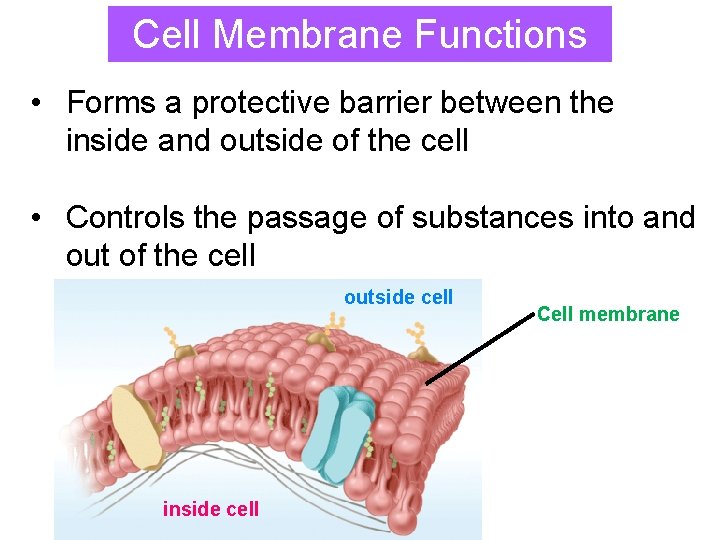
Cell Membrane Functions • Forms a protective barrier between the inside and outside of the cell • Controls the passage of substances into and out of the cell outside cell inside cell Cell membrane
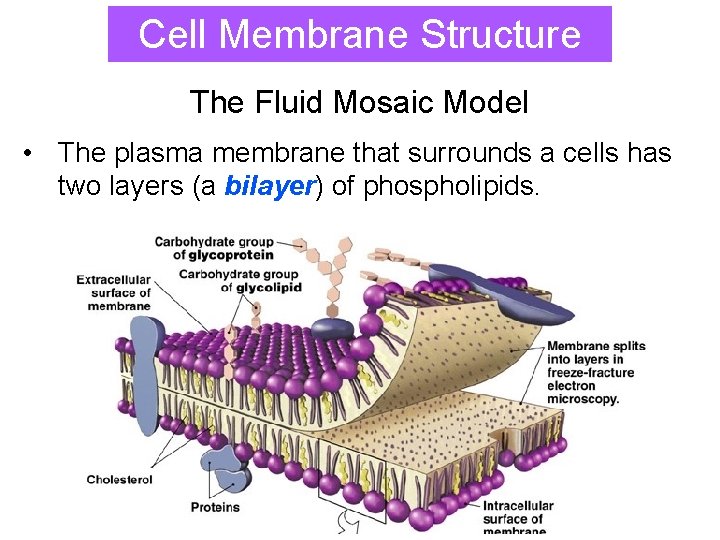
Cell Membrane Structure The Fluid Mosaic Model • The plasma membrane that surrounds a cells has two layers (a bilayer) of phospholipids.
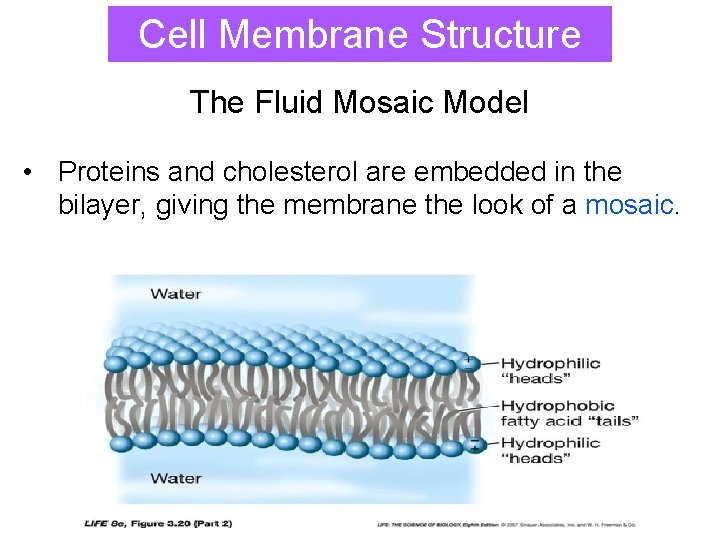
Cell Membrane Structure The Fluid Mosaic Model • Proteins and cholesterol are embedded in the bilayer, giving the membrane the look of a mosaic.
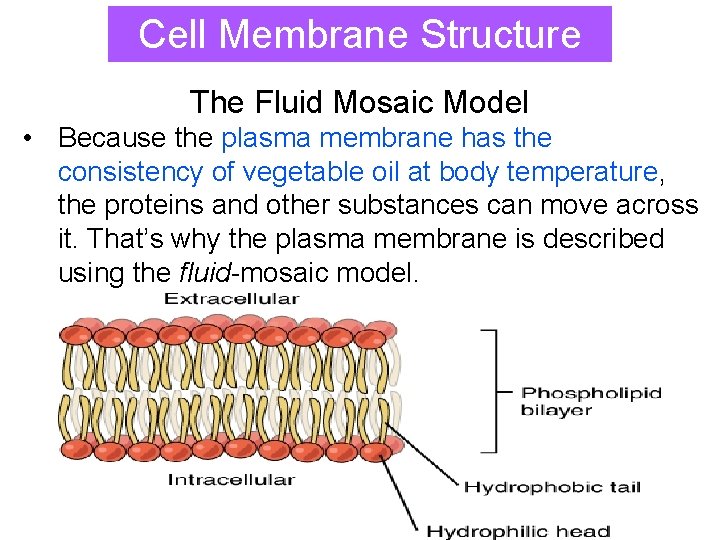
Cell Membrane Structure The Fluid Mosaic Model • Because the plasma membrane has the consistency of vegetable oil at body temperature, the proteins and other substances can move across it. That’s why the plasma membrane is described using the fluid-mosaic model.
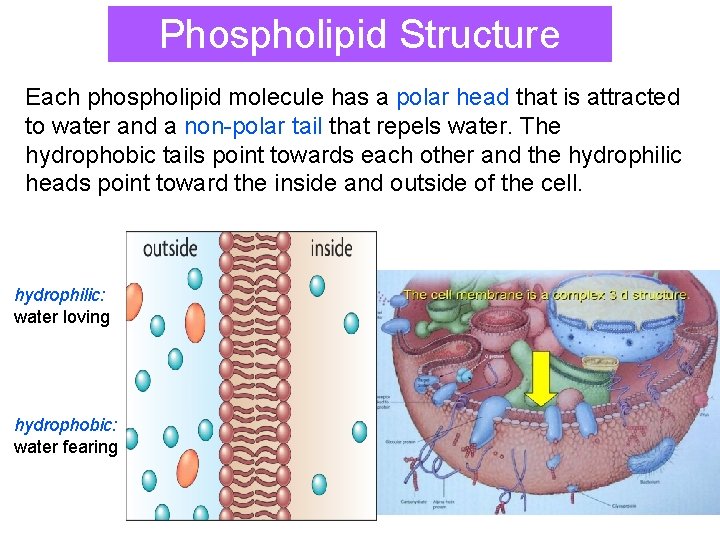
Phospholipid Structure Each phospholipid molecule has a polar head that is attracted to water and a non-polar tail that repels water. The hydrophobic tails point towards each other and the hydrophilic heads point toward the inside and outside of the cell. hydrophilic: water loving hydrophobic: water fearing
Why do the fatty acid tails of phospholipids point towards each other in the membrane?
Why do the fatty acid tails of phospholipids point towards each other in the membrane? 1. They are non-polar, so they are hydrophilic. 2. They are non-polar, so they are hydrophobic. 3. They are polar, so they are hydrophilic. 4. They are polar, so they are hydrophobic.
Why do the fatty acid tails of phospholipids point towards each other in the membrane? Because cells reside in a watery solution (extracellular fluid), and they contain a watery solution inside of them (cytoplasm), the plasma membrane forms a circle around each cell so that the water-loving heads are in contact with the fluid, and the water-fearing tails are protected on the inside.
Function of Other Molecules in the Cell Membrane • Protects the cell from becoming rigid in cold temperatures • Protects cell from splitting open in hot temperatures Cholesterol – strengthens membrane
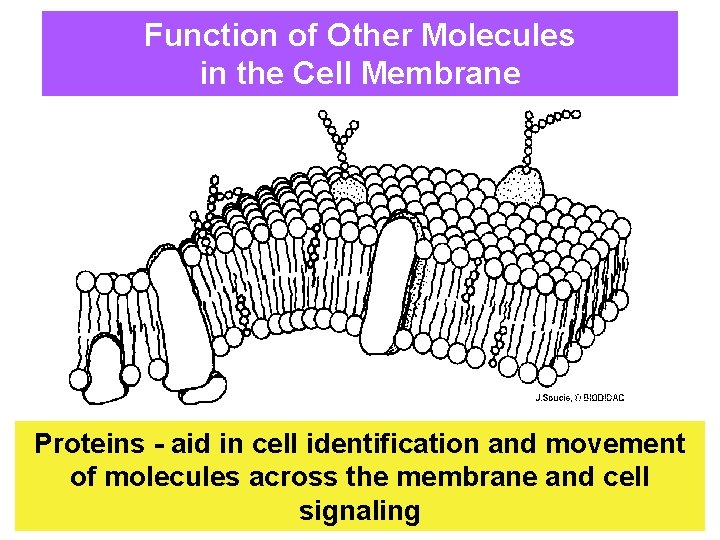
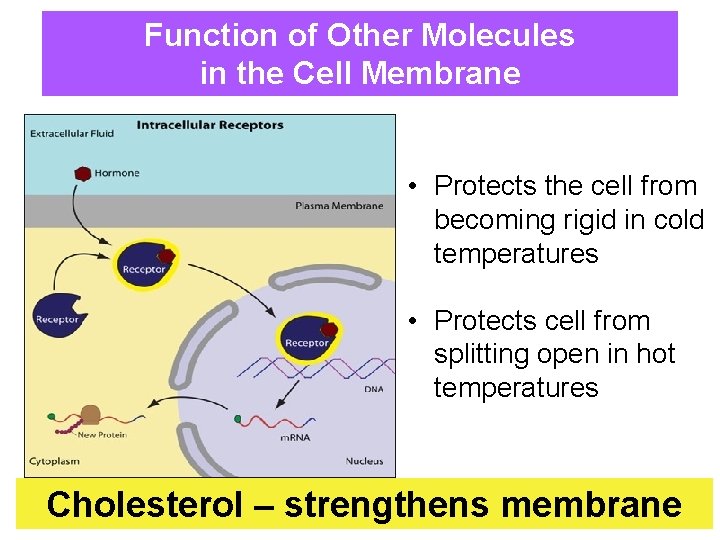
Function of Other Molecules in the Cell Membrane Proteins - aid in cell identification and movement of molecules across the membrane and cell signaling
Function of Other Molecules in the Cell Membrane • Aid in cell to cell recognition – distinguish one type of cell from another • Identify “foreign” cells to be removed by immune system. Carbohydrates – cell identification
Selective Permeability Cell membrane allows only certain substances to pass through. • Small non-polar molecules pass easily. • Small polar molecules pass through proteins. • Large molecules pass through in vesicles.
Cell Communication Cells Communicate With and Respond To Chemical Signals Cells communicate by sending and receiving chemical signals. Signals may come from the environment, or they may come from other cells. In order to trigger a response, these signals must be transmitted across the cell membrane. Sometimes the chemical signal itself can cross the cell membrane.
Cell To Cell Communication • Other times the chemical signal works by interacting with receptor proteins on the surface of the cell membrane. • In this case, only cells that have the correct receptor proteins on their surfaces will respond to the signal.
Cell To Cell Communication Two main types of receptor proteins • Membrane receptor proteins o Bind to chemical signals on the surface of the cell membrane • Intracellular receptor proteins o Bind to chemical signals inside the cell, after the signal has passed through the cell membrane
Cell To Cell Communication Membrane receptor proteins Example: Insulin Glucose too high? Insulin released from pancreas cells to stimulate uptake of glucose into fat cells. Glucose too low? Glucagon is released from pancreas cells and causes liver cells to release glucose into the blood.
Cell To Cell Communication Intracellular Receptor Proteins Example: Estrogen / Testosterone • Steroid passes through the cell membrane. • Steroid binds to the intracellular receptor protein. • Receptor protein transports steroid into the nucleus. • Steroid causes DNA to produce RNA molecules, which will be used to make proteins by ribosomes.


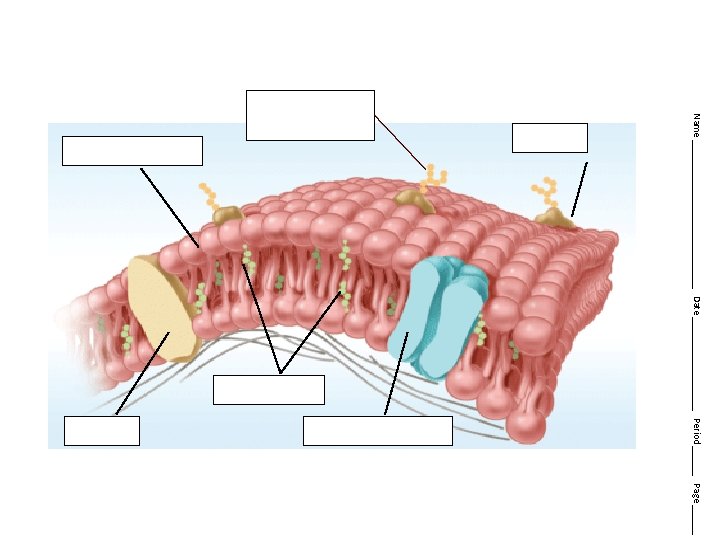
cholesterol protein channel Name _______________ Date __________ Period ______ Page ______ cell membrane protein carbohydrate chain
- Slides: 23