
Section 3 2 Using Vectors on Motion Diagrams
- Slides: 37
Section 3. 2 Using Vectors on Motion Diagrams (cont. ) © 2015 Pearson Education, Inc.
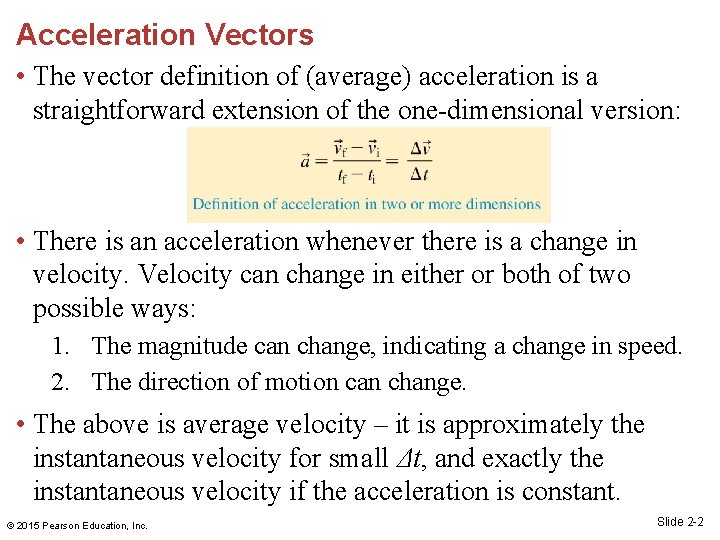
Acceleration Vectors • The vector definition of (average) acceleration is a straightforward extension of the one-dimensional version: • There is an acceleration whenever there is a change in velocity. Velocity can change in either or both of two possible ways: 1. The magnitude can change, indicating a change in speed. 2. The direction of motion can change. • The above is average velocity – it is approximately the instantaneous velocity for small Δt, and exactly the instantaneous velocity if the acceleration is constant. © 2015 Pearson Education, Inc. Slide 2 -2
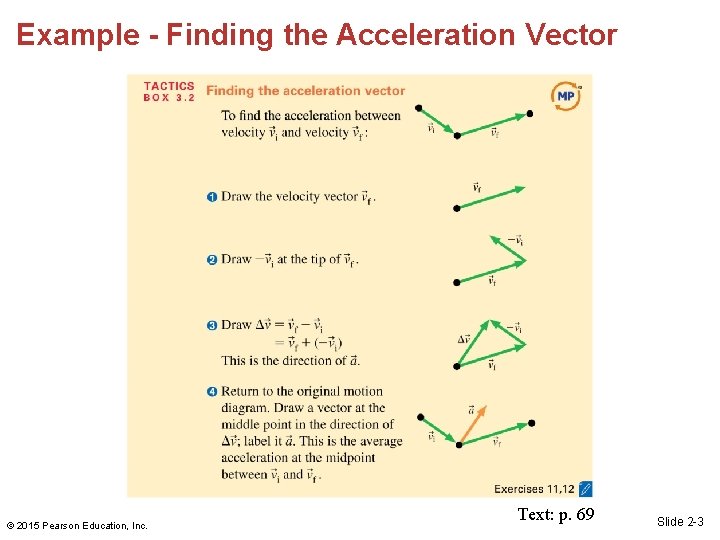
Example - Finding the Acceleration Vector © 2015 Pearson Education, Inc. Text: p. 69 Slide 2 -3
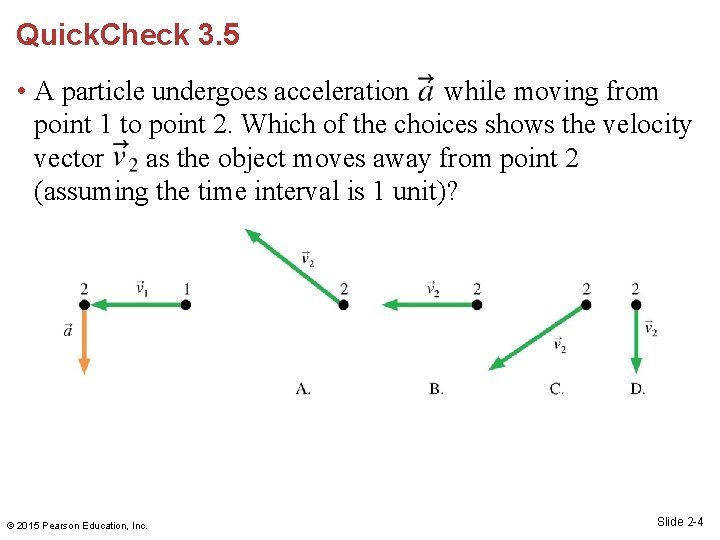
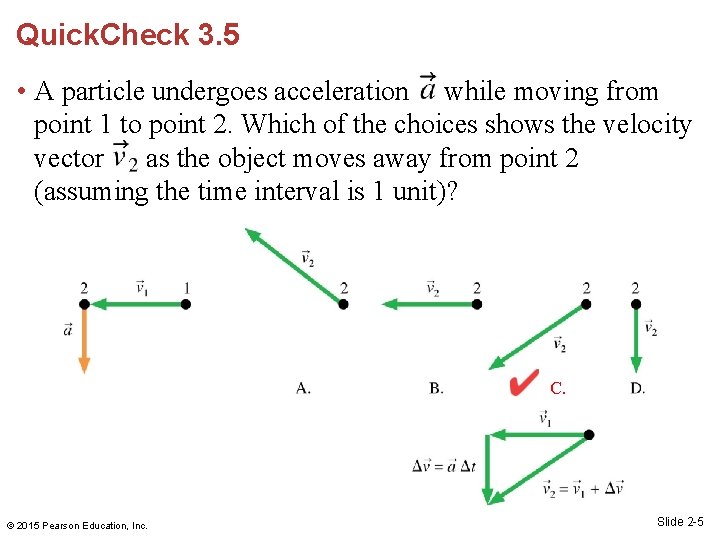
Quick. Check 3. 5 • A particle undergoes acceleration while moving from point 1 to point 2. Which of the choices shows the velocity vector as the object moves away from point 2 (assuming the time interval is 1 unit)? © 2015 Pearson Education, Inc. Slide 2 -4
Quick. Check 3. 5 • A particle undergoes acceleration while moving from point 1 to point 2. Which of the choices shows the velocity vector as the object moves away from point 2 (assuming the time interval is 1 unit)? C. © 2015 Pearson Education, Inc. Slide 2 -5
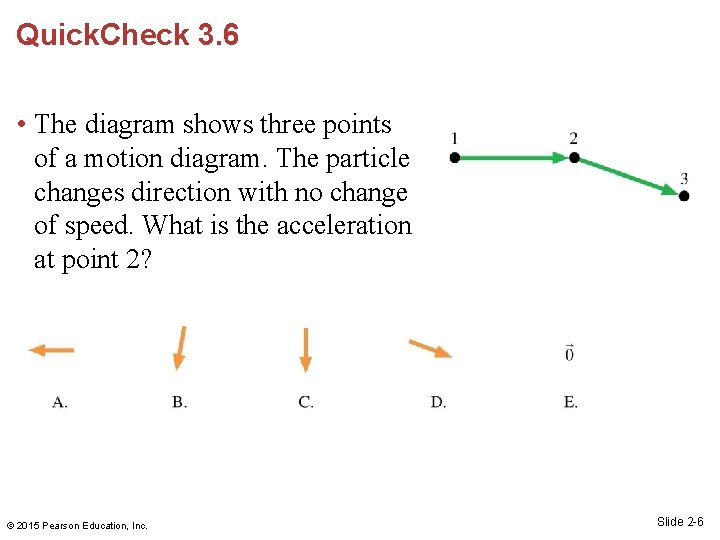
Quick. Check 3. 6 • The diagram shows three points of a motion diagram. The particle changes direction with no change of speed. What is the acceleration at point 2? © 2015 Pearson Education, Inc. Slide 2 -6
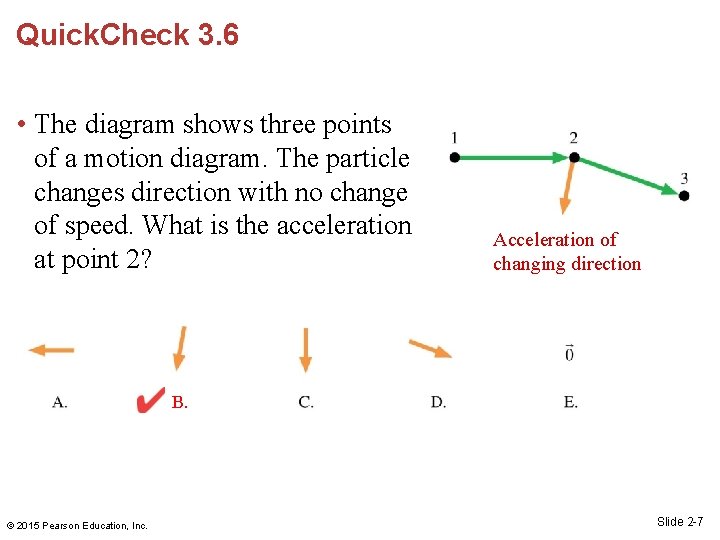
Quick. Check 3. 6 • The diagram shows three points of a motion diagram. The particle changes direction with no change of speed. What is the acceleration at point 2? Acceleration of changing direction B. © 2015 Pearson Education, Inc. Slide 2 -7
Section 3. 3 Coordinate Systems and Vector Components © 2015 Pearson Education, Inc.
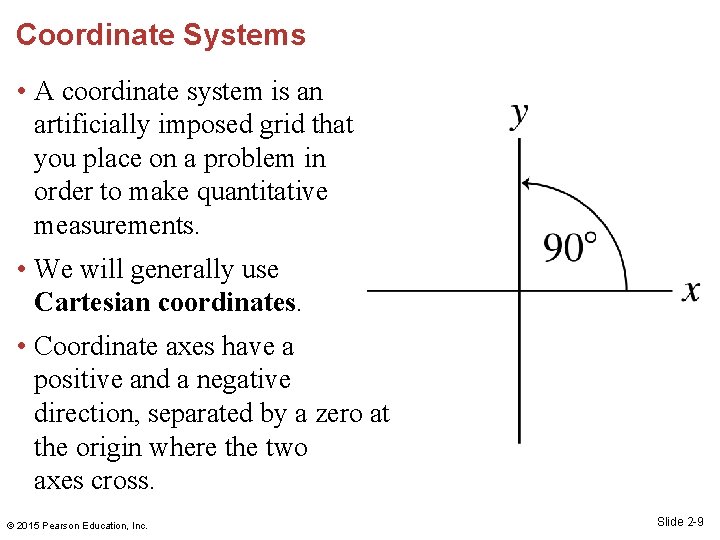
Coordinate Systems • A coordinate system is an artificially imposed grid that you place on a problem in order to make quantitative measurements. • We will generally use Cartesian coordinates. • Coordinate axes have a positive and a negative direction, separated by a zero at the origin where the two axes cross. © 2015 Pearson Education, Inc. Slide 2 -9
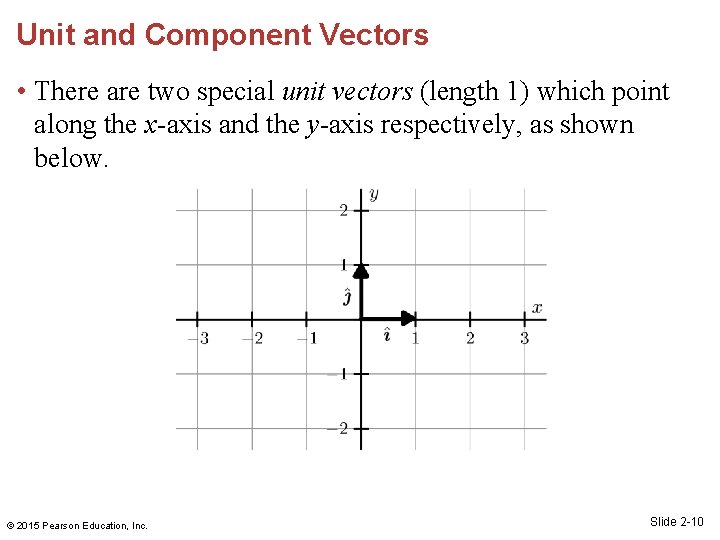
Unit and Component Vectors • There are two special unit vectors (length 1) which point along the x-axis and the y-axis respectively, as shown below. © 2015 Pearson Education, Inc. Slide 2 -10
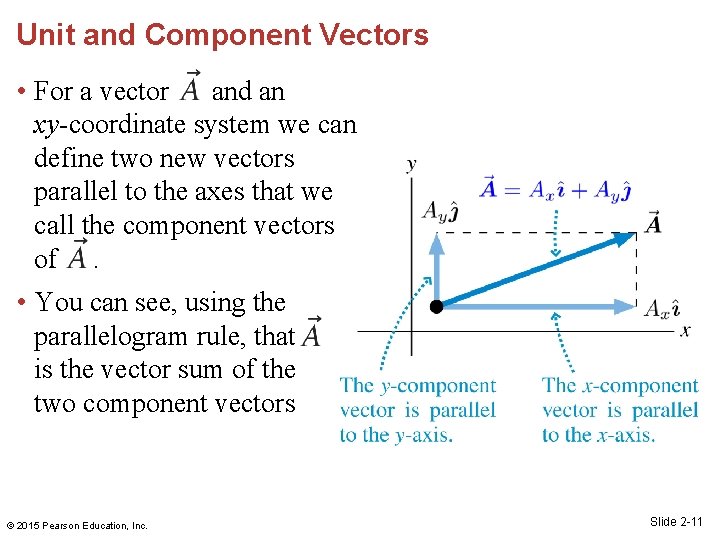
Unit and Component Vectors • For a vector and an xy-coordinate system we can define two new vectors parallel to the axes that we call the component vectors of. . • You can see, using the parallelogram rule, that is the vector sum of the two component vectors © 2015 Pearson Education, Inc. Slide 2 -11
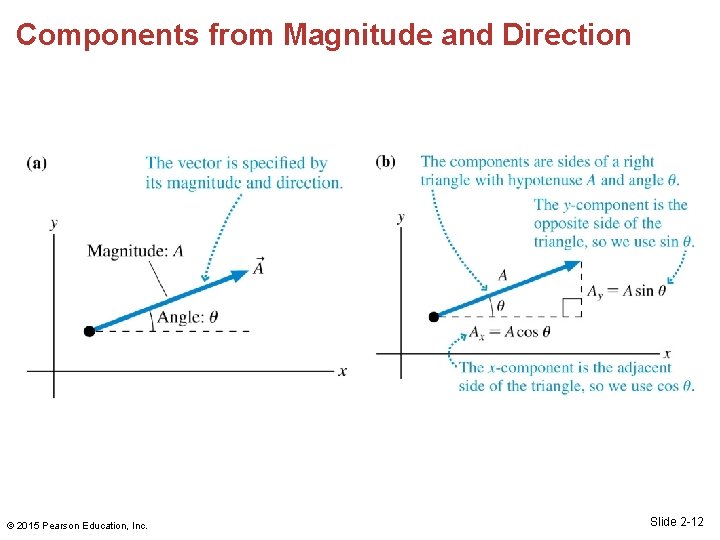
Components from Magnitude and Direction © 2015 Pearson Education, Inc. Slide 2 -12
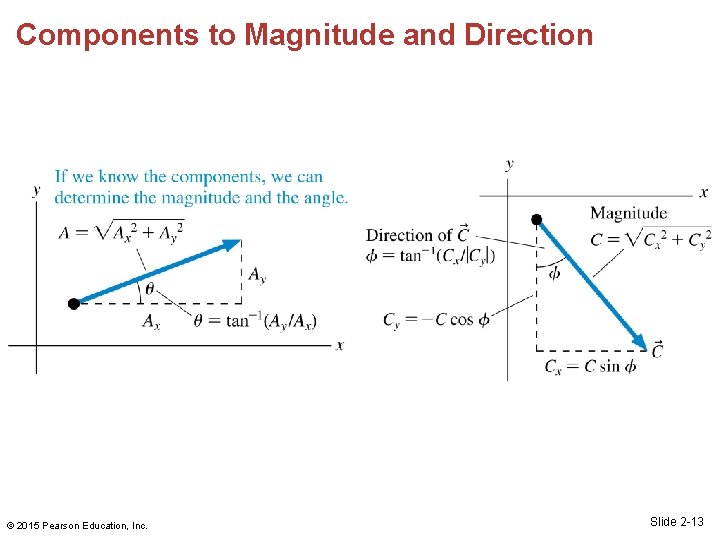
Components to Magnitude and Direction © 2015 Pearson Education, Inc. Slide 2 -13
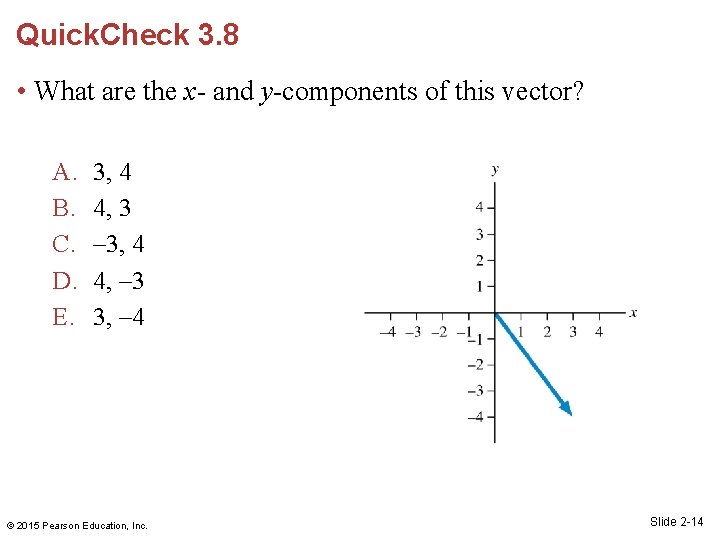
Quick. Check 3. 8 • What are the x- and y-components of this vector? A. B. C. D. E. 3, 4 4, 3 – 3, 4 4, – 3 3, – 4 © 2015 Pearson Education, Inc. Slide 2 -14
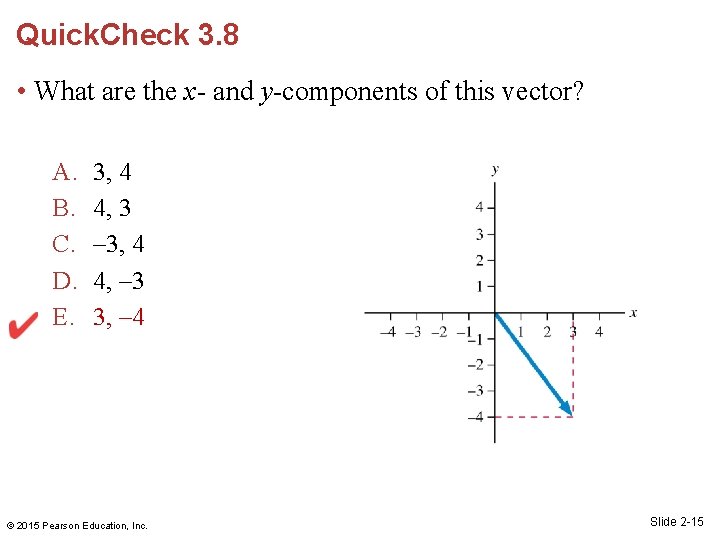
Quick. Check 3. 8 • What are the x- and y-components of this vector? A. B. C. D. E. 3, 4 4, 3 – 3, 4 4, – 3 3, – 4 © 2015 Pearson Education, Inc. Slide 2 -15
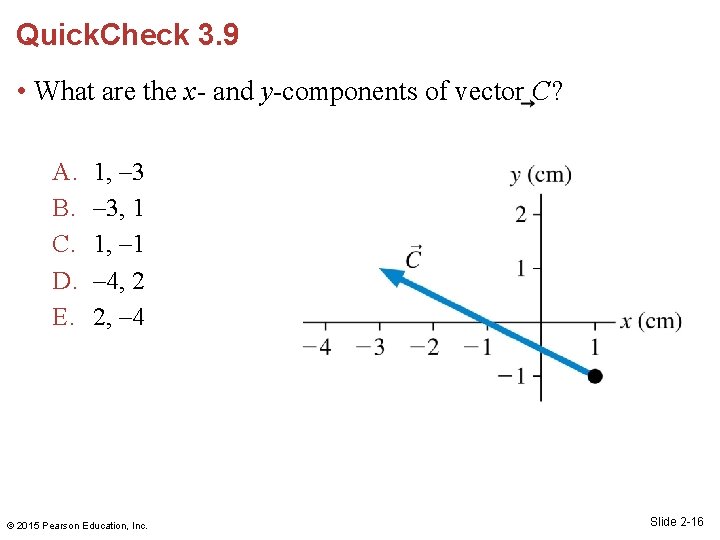
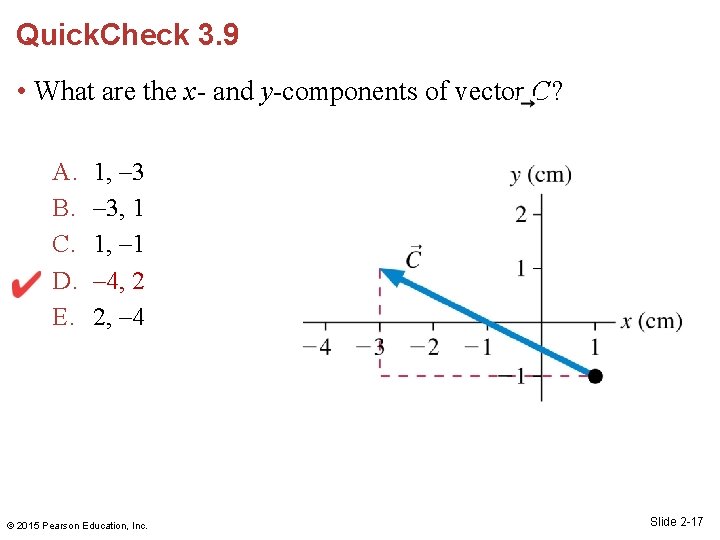
Quick. Check 3. 9 • What are the x- and y-components of vector C? A. B. C. D. E. 1, – 3, 1 1, – 1 – 4, 2 2, – 4 © 2015 Pearson Education, Inc. Slide 2 -16
Quick. Check 3. 9 • What are the x- and y-components of vector C? A. B. C. D. E. 1, – 3, 1 1, – 1 – 4, 2 2, – 4 © 2015 Pearson Education, Inc. Slide 2 -17
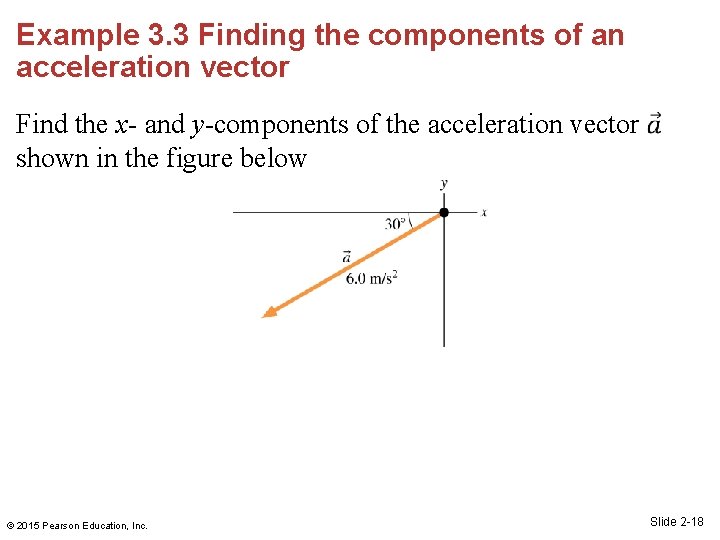
Example 3. 3 Finding the components of an acceleration vector Find the x- and y-components of the acceleration vector shown in the figure below © 2015 Pearson Education, Inc. Slide 2 -18
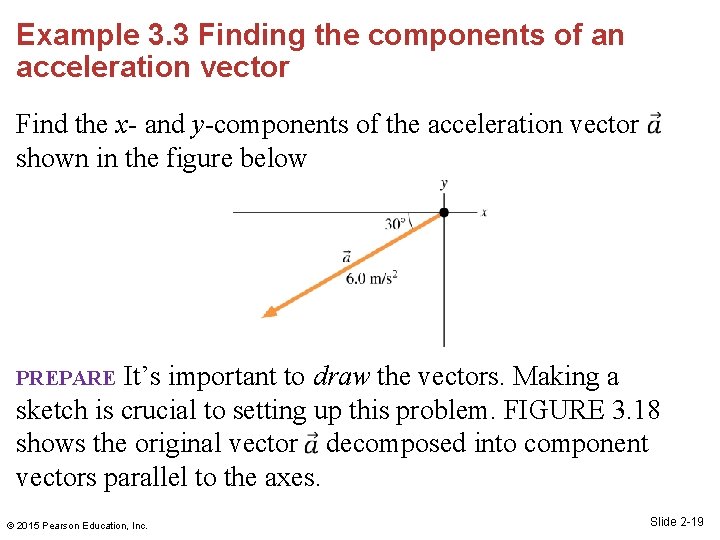
Example 3. 3 Finding the components of an acceleration vector Find the x- and y-components of the acceleration vector shown in the figure below It’s important to draw the vectors. Making a sketch is crucial to setting up this problem. FIGURE 3. 18 shows the original vector decomposed into component vectors parallel to the axes. PREPARE © 2015 Pearson Education, Inc. Slide 2 -19
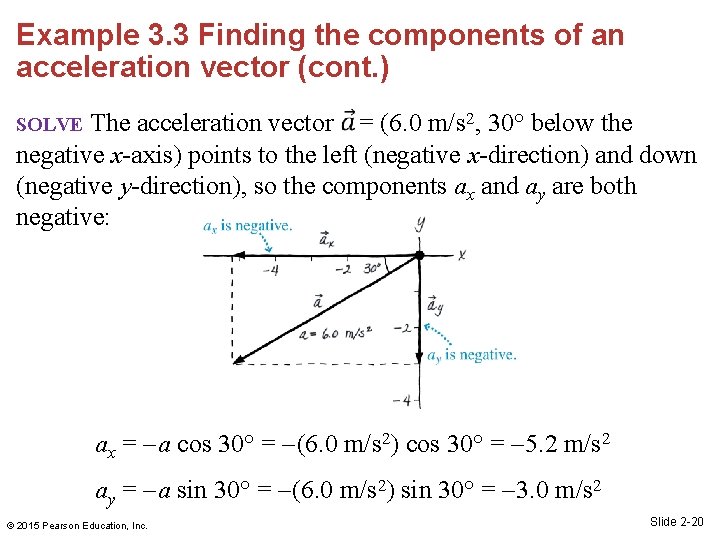
Example 3. 3 Finding the components of an acceleration vector (cont. ) The acceleration vector = (6. 0 m/s 2, 30° below the negative x-axis) points to the left (negative x-direction) and down (negative y-direction), so the components ax and ay are both negative: SOLVE ax = a cos 30° = (6. 0 m/s 2) cos 30° = 5. 2 m/s 2 ay = a sin 30° = (6. 0 m/s 2) sin 30° = 3. 0 m/s 2 © 2015 Pearson Education, Inc. Slide 2 -20
Example 3. 3 Finding the components of an acceleration vector (cont. ) The magnitude of the y-component is less than that of the x-component, as seems to be the case in Figure 3. 18, a good check on our work. The units of ax and ay are the same as the units of vector. Notice that we had to insert the minus signs manually by observing that the vector points down and to the left. ASSESS © 2015 Pearson Education, Inc. Slide 2 -21
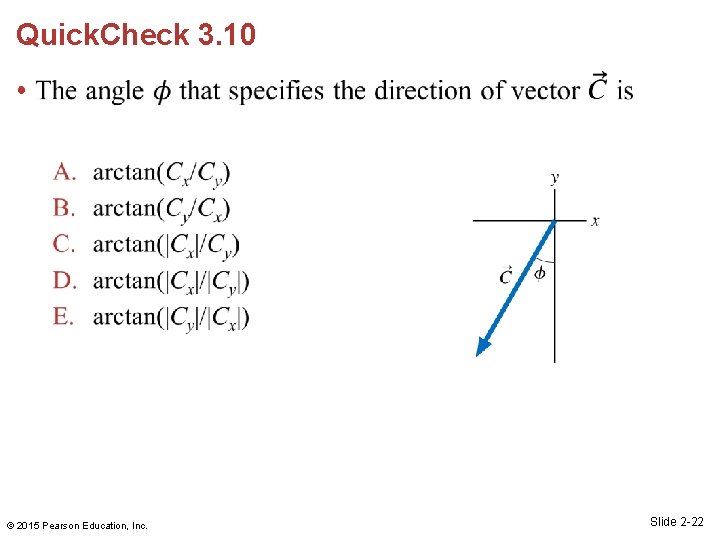
Quick. Check 3. 10 • © 2015 Pearson Education, Inc. Slide 2 -22
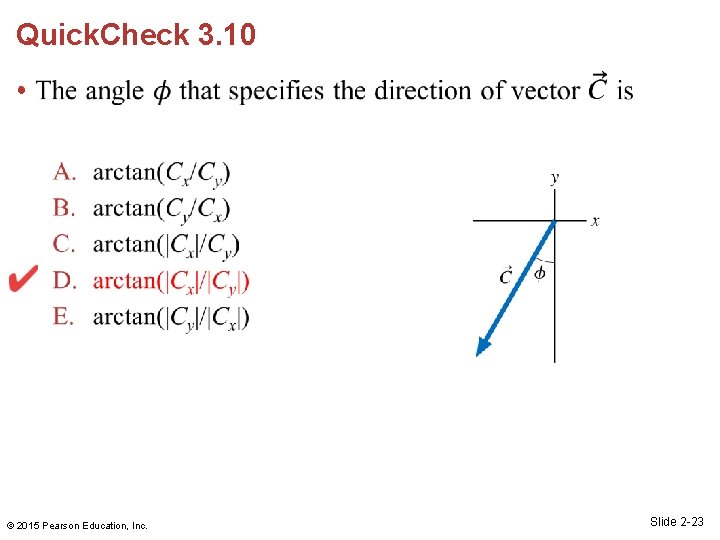
Quick. Check 3. 10 • © 2015 Pearson Education, Inc. Slide 2 -23
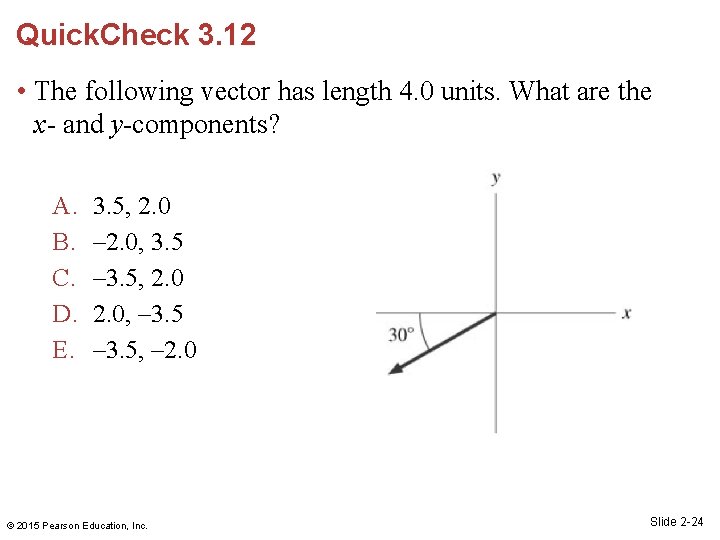
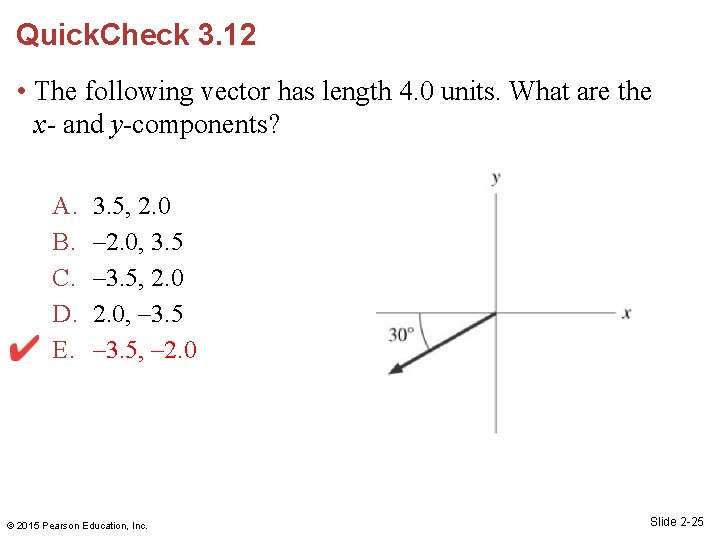
Quick. Check 3. 12 • The following vector has length 4. 0 units. What are the x- and y-components? A. B. C. D. E. 3. 5, 2. 0 – 2. 0, 3. 5 – 3. 5, 2. 0, – 3. 5, – 2. 0 © 2015 Pearson Education, Inc. Slide 2 -24
Quick. Check 3. 12 • The following vector has length 4. 0 units. What are the x- and y-components? A. B. C. D. E. 3. 5, 2. 0 – 2. 0, 3. 5 – 3. 5, 2. 0, – 3. 5, – 2. 0 © 2015 Pearson Education, Inc. Slide 2 -25
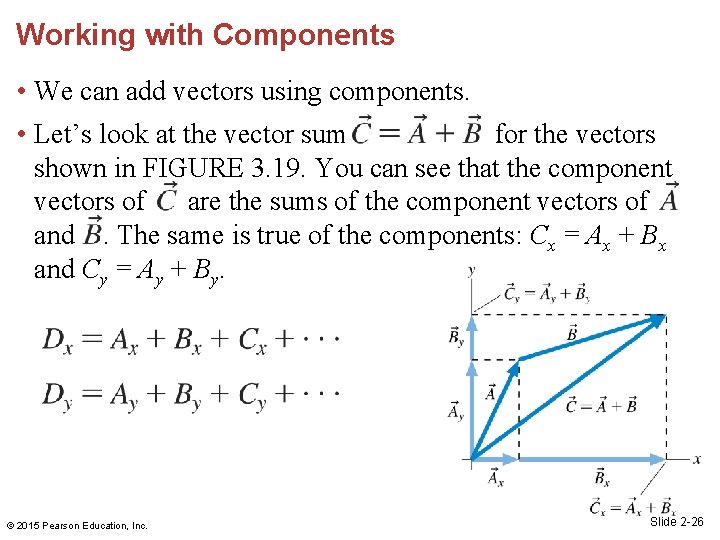
Working with Components • We can add vectors using components. • Let’s look at the vector sum for the vectors shown in FIGURE 3. 19. You can see that the component vectors of are the sums of the component vectors of and. The same is true of the components: Cx = Ax + Bx and Cy = Ay + By. © 2015 Pearson Education, Inc. Slide 2 -26
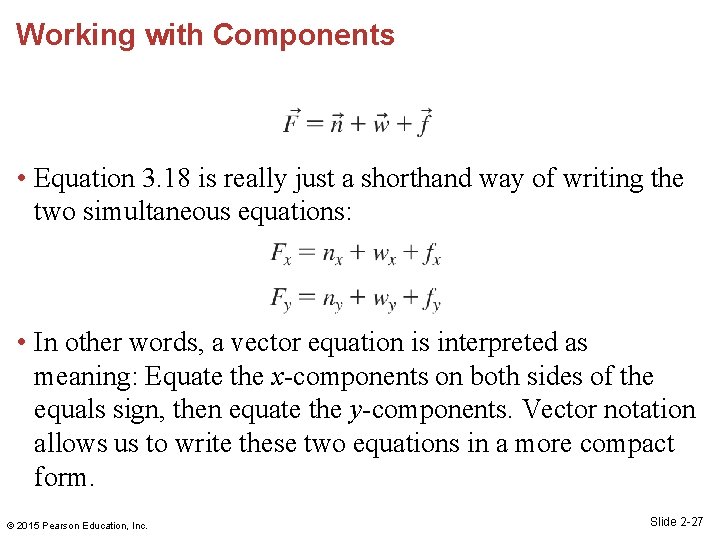
Working with Components • Equation 3. 18 is really just a shorthand way of writing the two simultaneous equations: • In other words, a vector equation is interpreted as meaning: Equate the x-components on both sides of the equals sign, then equate the y-components. Vector notation allows us to write these two equations in a more compact form. © 2015 Pearson Education, Inc. Slide 2 -27
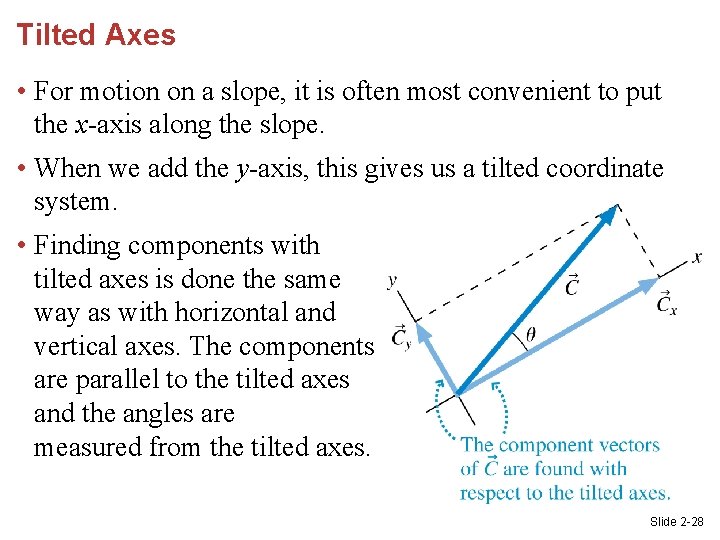
Tilted Axes • For motion on a slope, it is often most convenient to put the x-axis along the slope. • When we add the y-axis, this gives us a tilted coordinate system. • Finding components with tilted axes is done the same way as with horizontal and vertical axes. The components are parallel to the tilted axes and the angles are measured from the tilted axes. Slide 2 -28
Section 3. 4 Motion on a Ramp © 2015 Pearson Education, Inc.
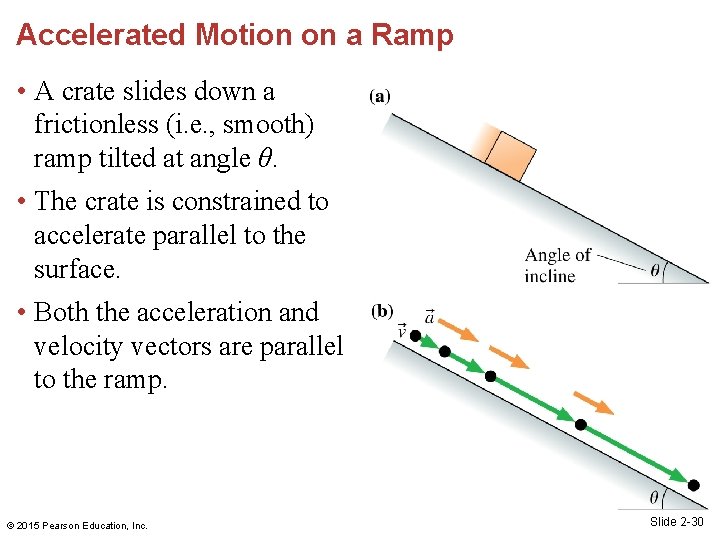
Accelerated Motion on a Ramp • A crate slides down a frictionless (i. e. , smooth) ramp tilted at angle θ. • The crate is constrained to accelerate parallel to the surface. • Both the acceleration and velocity vectors are parallel to the ramp. © 2015 Pearson Education, Inc. Slide 2 -30
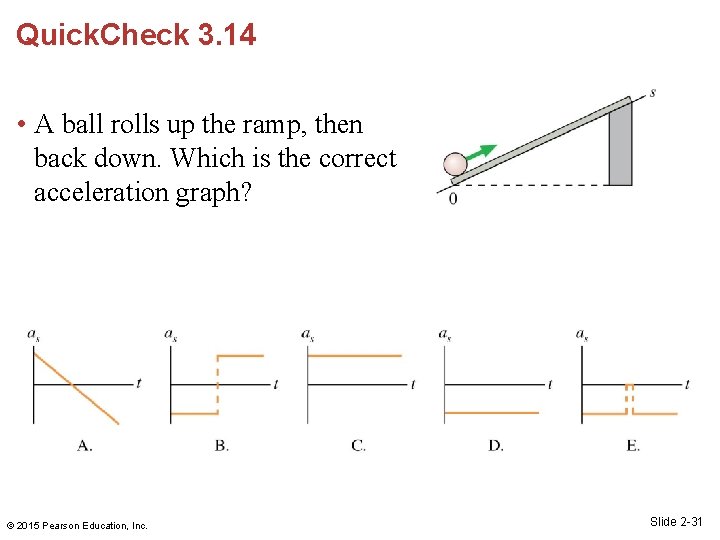
Quick. Check 3. 14 • A ball rolls up the ramp, then back down. Which is the correct acceleration graph? © 2015 Pearson Education, Inc. Slide 2 -31
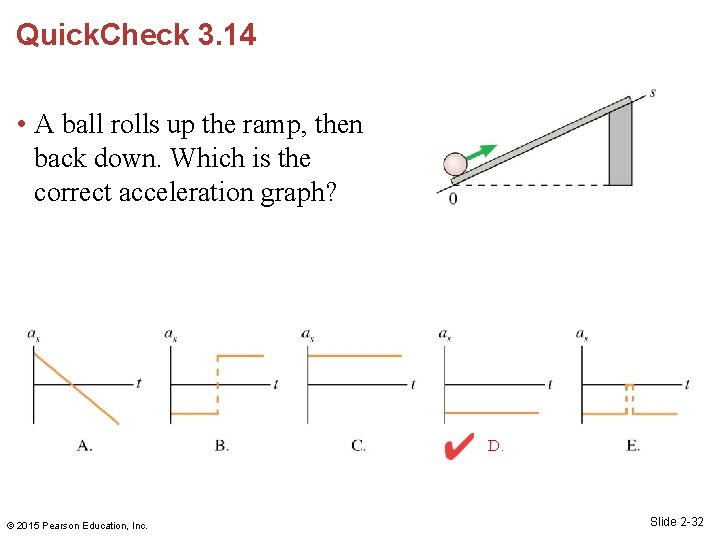
Quick. Check 3. 14 • A ball rolls up the ramp, then back down. Which is the correct acceleration graph? D. © 2015 Pearson Education, Inc. Slide 2 -32
Example 3. 6 Maximum possible speed for a skier The Willamette Pass ski area in Oregon was the site of the 1993 U. S. National Speed Skiing Competition. The skiers started from rest and then accelerated down a stretch of the mountain with a reasonably constant slope, aiming for the highest possible speed at the end of this run. During this acceleration phase, the skiers traveled 360 m while dropping a vertical distance of 170 m. What is the fastest speed a skier could achieve at the end of this run? © 2015 Pearson Education, Inc. Slide 2 -33
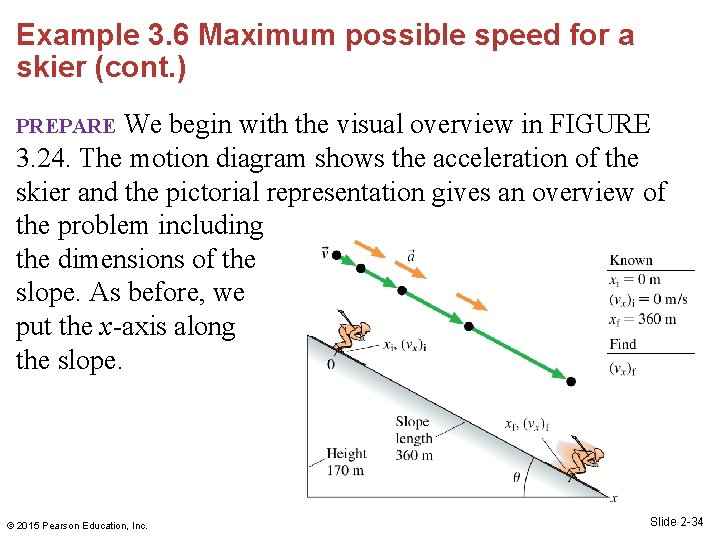
Example 3. 6 Maximum possible speed for a skier (cont. ) We begin with the visual overview in FIGURE 3. 24. The motion diagram shows the acceleration of the skier and the pictorial representation gives an overview of the problem including the dimensions of the slope. As before, we put the x-axis along the slope. PREPARE © 2015 Pearson Education, Inc. Slide 2 -34
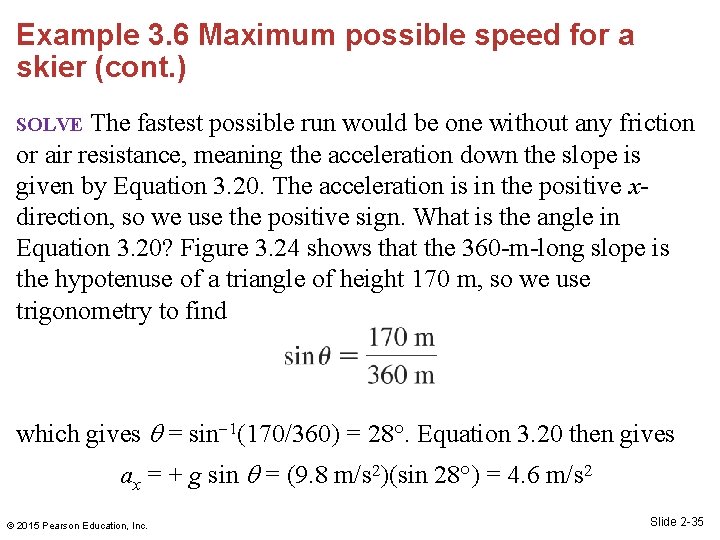
Example 3. 6 Maximum possible speed for a skier (cont. ) The fastest possible run would be one without any friction or air resistance, meaning the acceleration down the slope is given by Equation 3. 20. The acceleration is in the positive xdirection, so we use the positive sign. What is the angle in Equation 3. 20? Figure 3. 24 shows that the 360 -m-long slope is the hypotenuse of a triangle of height 170 m, so we use trigonometry to find SOLVE which gives = sin 1(170/360) = 28°. Equation 3. 20 then gives ax = + g sin = (9. 8 m/s 2)(sin 28°) = 4. 6 m/s 2 © 2015 Pearson Education, Inc. Slide 2 -35
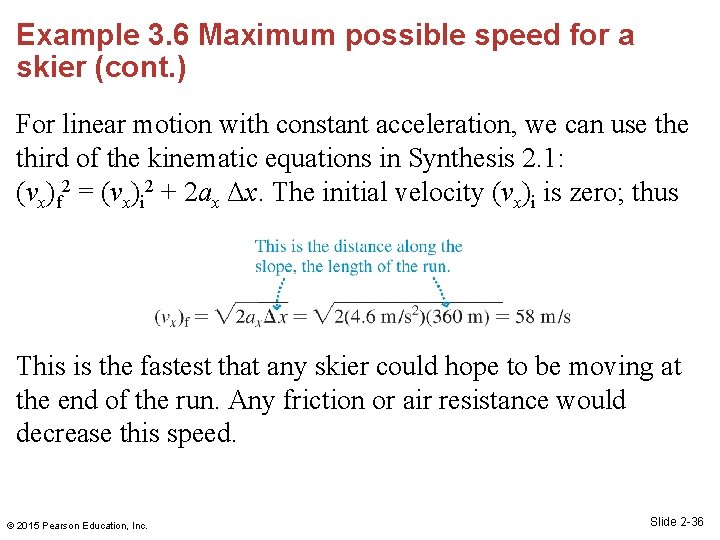
Example 3. 6 Maximum possible speed for a skier (cont. ) For linear motion with constant acceleration, we can use third of the kinematic equations in Synthesis 2. 1: (vx)f 2 = (vx)i 2 + 2 ax Δx. The initial velocity (vx)i is zero; thus This is the fastest that any skier could hope to be moving at the end of the run. Any friction or air resistance would decrease this speed. © 2015 Pearson Education, Inc. Slide 2 -36
Example 3. 6 Maximum possible speed for a skier (cont. ) The final speed we calculated is 58 m/s, which is about 130 mph, reasonable because we expect a high speed for this sport. In the competition noted, the actual winning speed was 111 mph, not much slower than the result we calculated. Obviously, efforts to minimize friction and air resistance are working! ASSESS © 2015 Pearson Education, Inc. Slide 2 -37