
Section 3 2 Direct Variation Remember Linear relationship
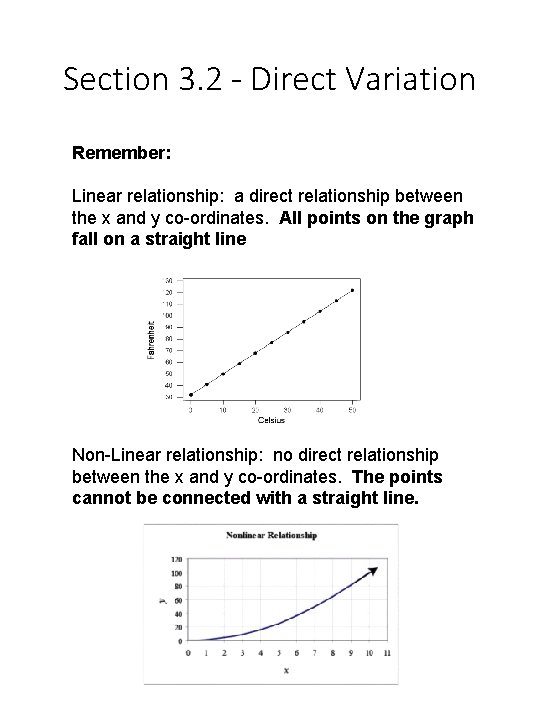
Section 3. 2 - Direct Variation Remember: Linear relationship: a direct relationship between the x and y co-ordinates. All points on the graph fall on a straight line Non-Linear relationship: no direct relationship between the x and y co-ordinates. The points cannot be connected with a straight line.
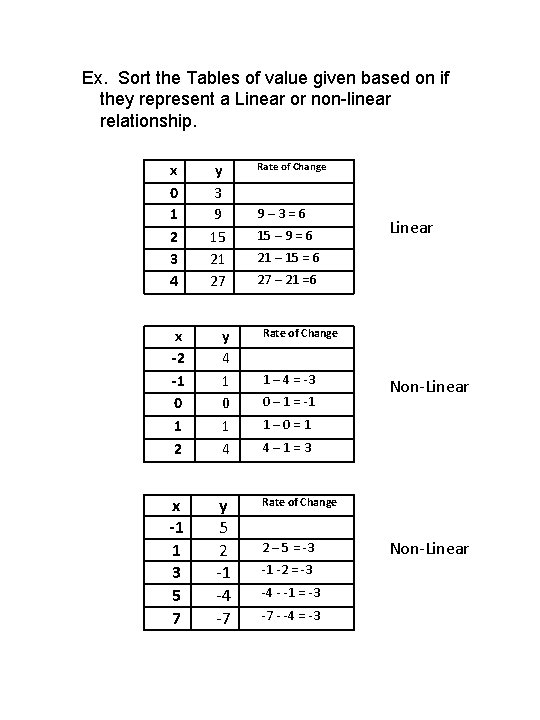
Ex. Sort the Tables of value given based on if they represent a Linear or non-linear relationship. x 0 1 2 3 4 y 3 9 15 21 27 Rate of Change 9– 3=6 15 – 9 = 6 Linear 21 – 15 = 6 27 – 21 =6 x -2 -1 0 1 2 y 4 1 0 1 4 Rate of Change x -1 1 3 5 7 y 5 2 -1 -4 -7 Rate of Change 1 – 4 = -3 0 – 1 = -1 Non-Linear 1– 0=1 4– 1=3 2 – 5 = -3 -1 -2 = -3 -4 - -1 = -3 -7 - -4 = -3 Non-Linear
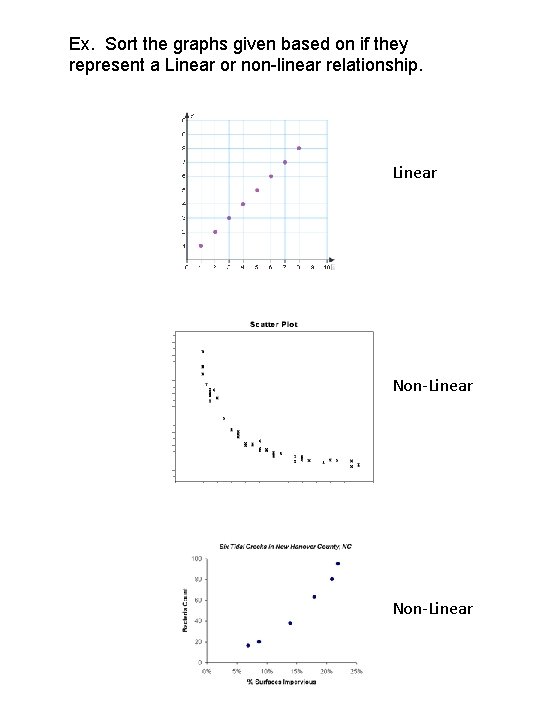
Ex. Sort the graphs given based on if they represent a Linear or non-linear relationship. Linear Non-Linear
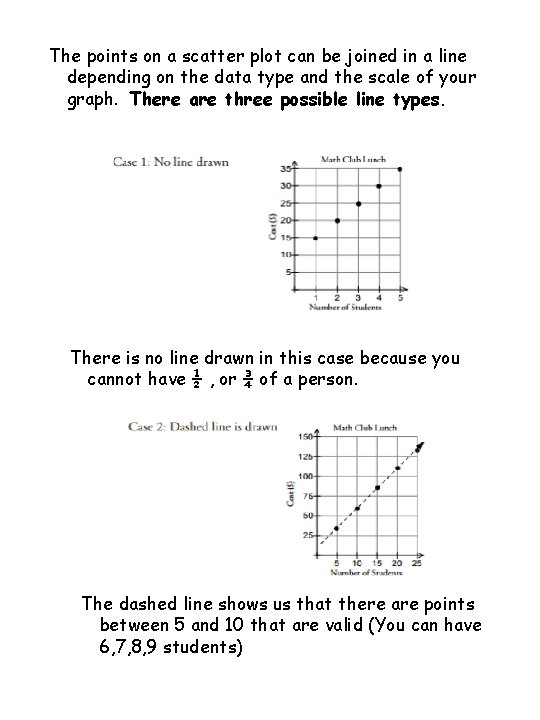
The points on a scatter plot can be joined in a line depending on the data type and the scale of your graph. There are three possible line types. There is no line drawn in this case because you cannot have ½ , or ¾ of a person. The dashed line shows us that there are points between 5 and 10 that are valid (You can have 6, 7, 8, 9 students)
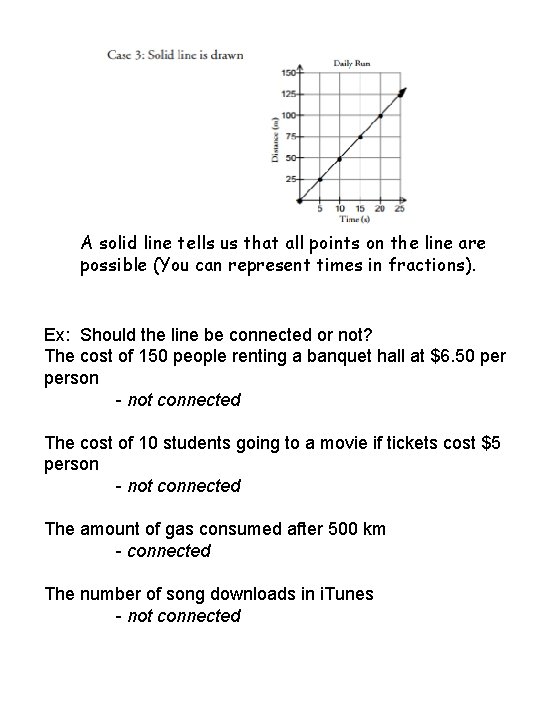
A solid line tells us that all points on the line are possible (You can represent times in fractions). Ex: Should the line be connected or not? The cost of 150 people renting a banquet hall at $6. 50 person - not connected The cost of 10 students going to a movie if tickets cost $5 person - not connected The amount of gas consumed after 500 km - connected The number of song downloads in i. Tunes - not connected
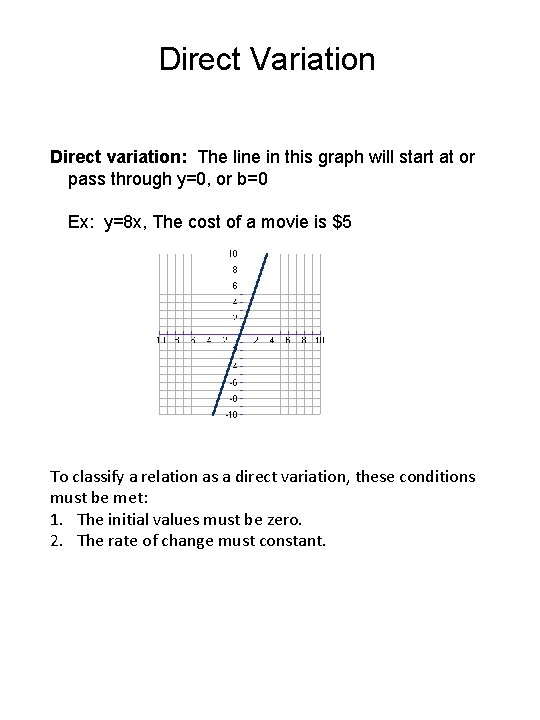
Direct Variation Direct variation: The line in this graph will start at or pass through y=0, or b=0 Ex: y=8 x, The cost of a movie is $5 To classify a relation as a direct variation, these conditions must be met: 1. The initial values must be zero. 2. The rate of change must constant.
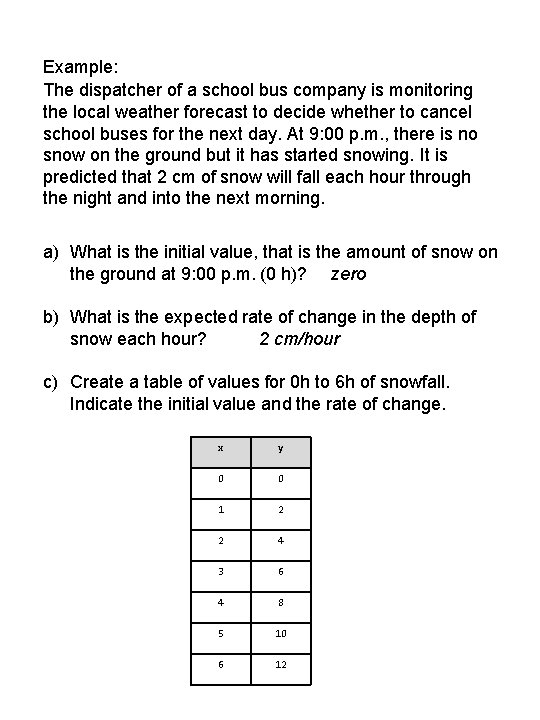
Example: The dispatcher of a school bus company is monitoring the local weather forecast to decide whether to cancel school buses for the next day. At 9: 00 p. m. , there is no snow on the ground but it has started snowing. It is predicted that 2 cm of snow will fall each hour through the night and into the next morning. a) What is the initial value, that is the amount of snow on the ground at 9: 00 p. m. (0 h)? zero b) What is the expected rate of change in the depth of snow each hour? 2 cm/hour c) Create a table of values for 0 h to 6 h of snowfall. Indicate the initial value and the rate of change. x y 0 0 1 2 2 4 3 6 4 8 5 10 6 12
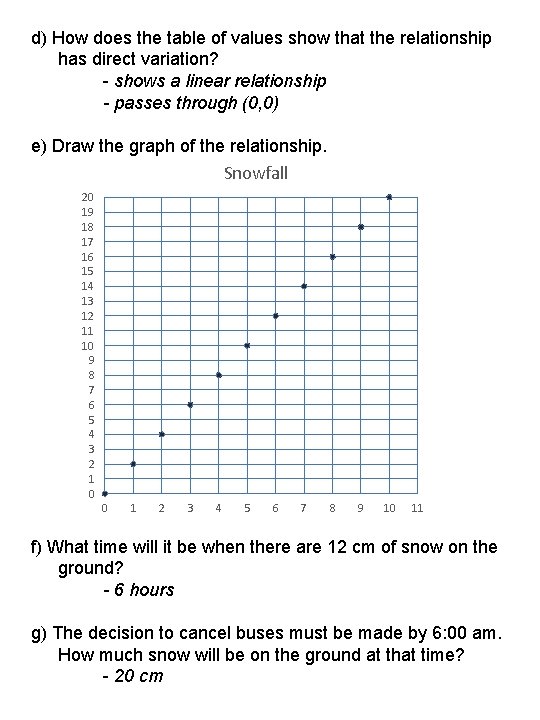
d) How does the table of values show that the relationship has direct variation? - shows a linear relationship - passes through (0, 0) e) Draw the graph of the relationship. Snowfall 20 19 18 17 16 15 14 13 12 11 10 9 8 7 6 5 4 3 2 1 0 0 1 2 3 4 5 6 7 8 9 10 11 f) What time will it be when there are 12 cm of snow on the ground? - 6 hours g) The decision to cancel buses must be made by 6: 00 am. How much snow will be on the ground at that time? - 20 cm
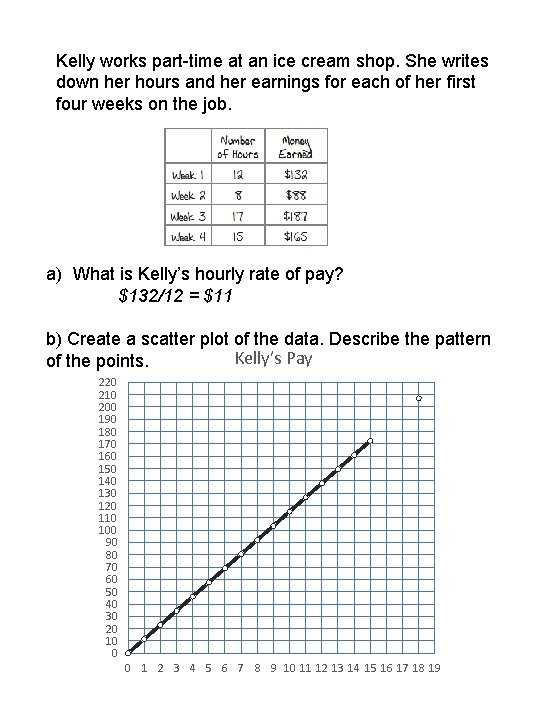
Kelly works part-time at an ice cream shop. She writes down her hours and her earnings for each of her first four weeks on the job. a) What is Kelly’s hourly rate of pay? $132/12 = $11 b) Create a scatter plot of the data. Describe the pattern Kelly’s Pay of the points. 220 210 200 190 180 170 160 150 140 130 120 110 100 90 80 70 60 50 40 30 20 10 0 0 1 2 3 4 5 6 7 8 9 10 11 12 13 14 15 16 17 18 19
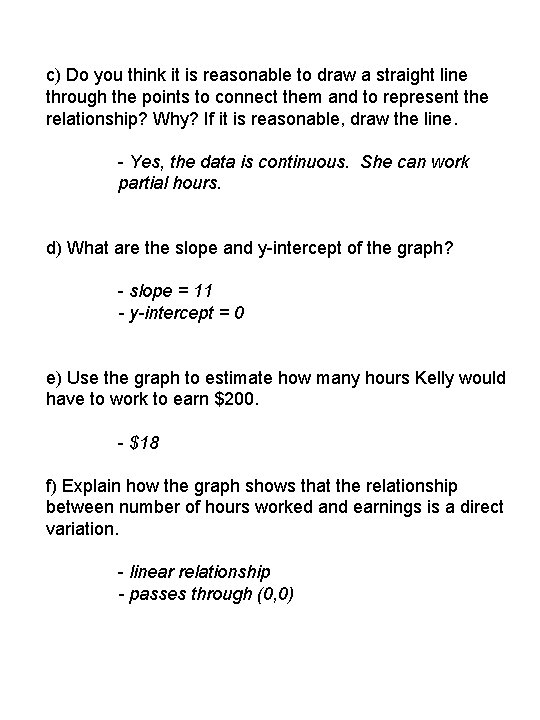
c) Do you think it is reasonable to draw a straight line through the points to connect them and to represent the relationship? Why? If it is reasonable, draw the line. - Yes, the data is continuous. She can work partial hours. d) What are the slope and y-intercept of the graph? - slope = 11 - y-intercept = 0 e) Use the graph to estimate how many hours Kelly would have to work to earn $200. - $18 f) Explain how the graph shows that the relationship between number of hours worked and earnings is a direct variation. - linear relationship - passes through (0, 0)
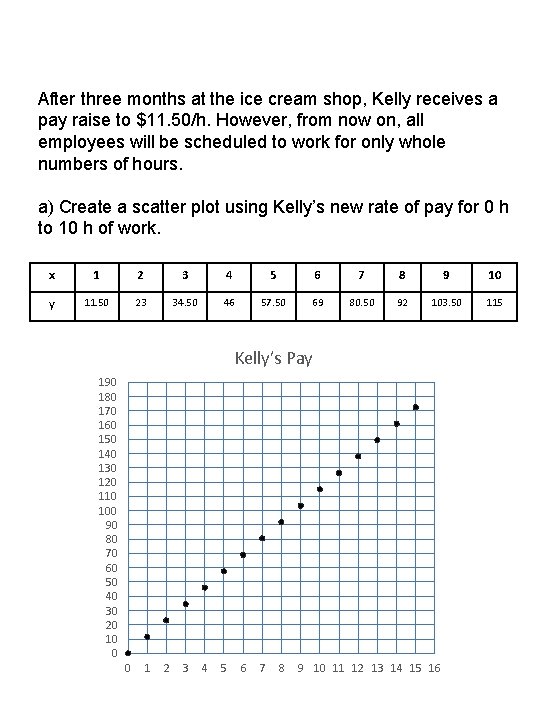
After three months at the ice cream shop, Kelly receives a pay raise to $11. 50/h. However, from now on, all employees will be scheduled to work for only whole numbers of hours. a) Create a scatter plot using Kelly’s new rate of pay for 0 h to 10 h of work. x 1 2 3 4 5 6 7 8 9 10 y 11. 50 23 34. 50 46 57. 50 69 80. 50 92 103. 50 115 Kelly’s Pay 190 180 170 160 150 140 130 120 110 100 90 80 70 60 50 40 30 20 10 0 0 1 2 3 4 5 6 7 8 9 10 11 12 13 14 15 16
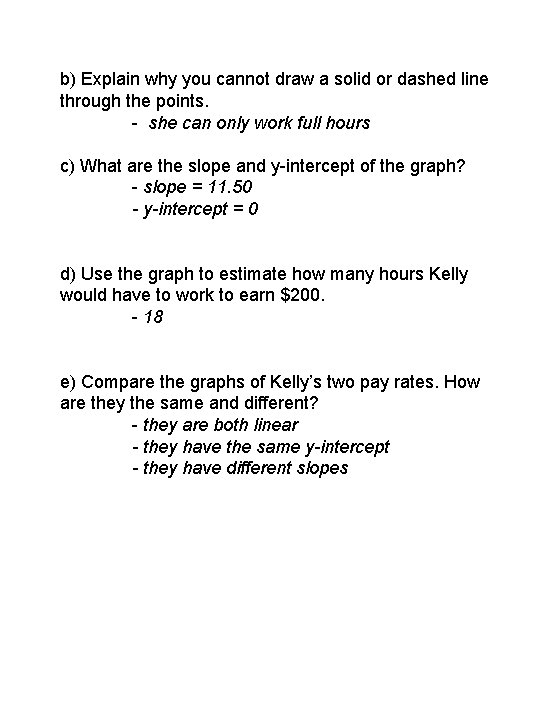
b) Explain why you cannot draw a solid or dashed line through the points. - she can only work full hours c) What are the slope and y-intercept of the graph? - slope = 11. 50 - y-intercept = 0 d) Use the graph to estimate how many hours Kelly would have to work to earn $200. - 18 e) Compare the graphs of Kelly’s two pay rates. How are they the same and different? - they are both linear - they have the same y-intercept - they have different slopes
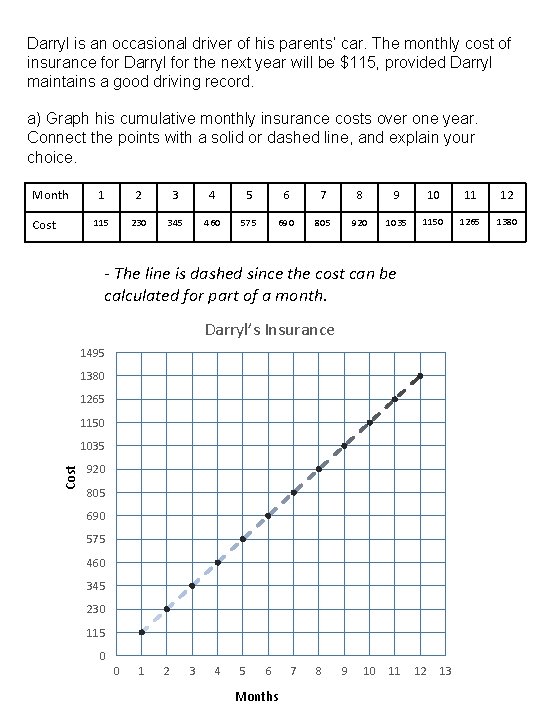
Darryl is an occasional driver of his parents’ car. The monthly cost of insurance for Darryl for the next year will be $115, provided Darryl maintains a good driving record. a) Graph his cumulative monthly insurance costs over one year. Connect the points with a solid or dashed line, and explain your choice. Month Cost 1 2 3 4 5 6 7 8 9 10 11 12 115 230 345 460 575 690 805 920 1035 1150 1265 1380 - The line is dashed since the cost can be calculated for part of a month. Darryl’s Insurance 1495 1380 1265 1150 Cost 1035 920 805 690 575 460 345 230 115 0 0 1 2 3 4 5 6 Months 7 8 9 10 11 12 13
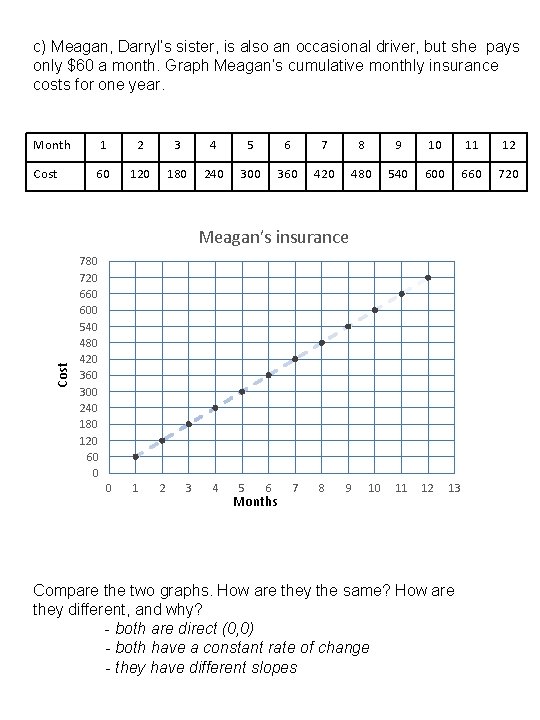
c) Meagan, Darryl’s sister, is also an occasional driver, but she pays only $60 a month. Graph Meagan’s cumulative monthly insurance costs for one year. Month 1 2 3 4 5 6 7 8 9 10 11 12 Cost 60 120 180 240 300 360 420 480 540 600 660 720 Cost Meagan’s insurance 780 720 660 600 540 480 420 360 300 240 180 120 60 0 0 1 2 3 4 5 6 Months 7 8 9 10 11 12 13 Compare the two graphs. How are they the same? How are they different, and why? - both are direct (0, 0) - both have a constant rate of change - they have different slopes
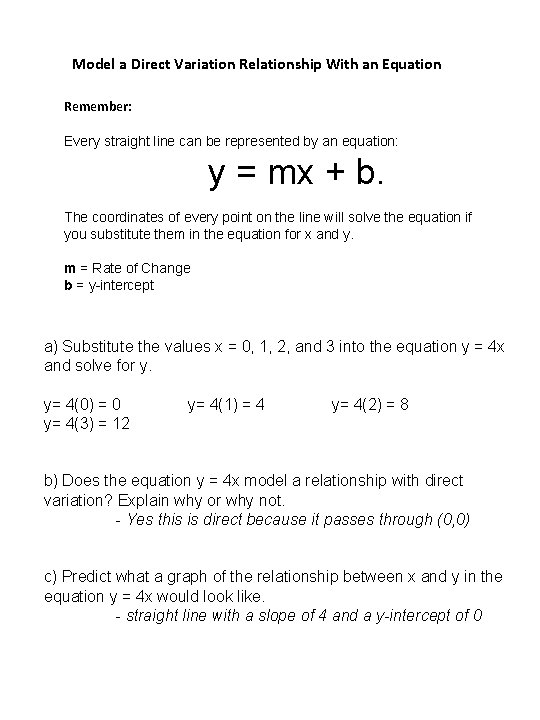
Model a Direct Variation Relationship With an Equation Remember: Every straight line can be represented by an equation: y = mx + b. The coordinates of every point on the line will solve the equation if you substitute them in the equation for x and y. m = Rate of Change b = y-intercept a) Substitute the values x = 0, 1, 2, and 3 into the equation y = 4 x and solve for y. y= 4(0) = 0 y= 4(3) = 12 y= 4(1) = 4 y= 4(2) = 8 b) Does the equation y = 4 x model a relationship with direct variation? Explain why or why not. - Yes this is direct because it passes through (0, 0) c) Predict what a graph of the relationship between x and y in the equation y = 4 x would look like. - straight line with a slope of 4 and a y-intercept of 0
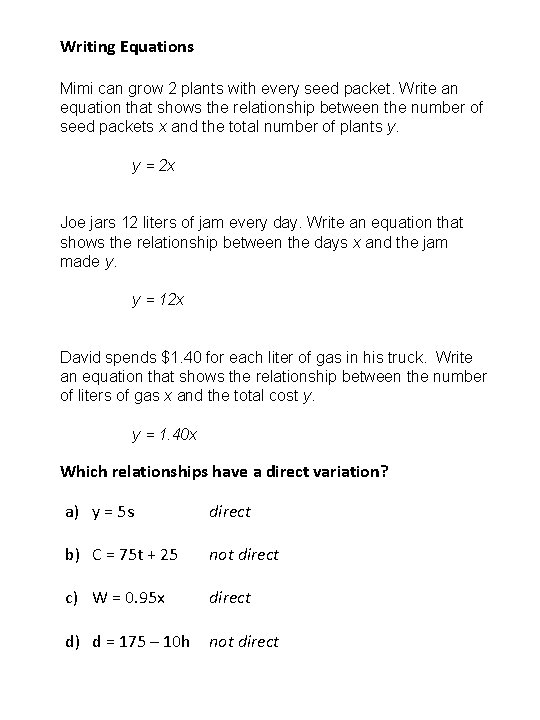
Writing Equations Mimi can grow 2 plants with every seed packet. Write an equation that shows the relationship between the number of seed packets x and the total number of plants y. y = 2 x Joe jars 12 liters of jam every day. Write an equation that shows the relationship between the days x and the jam made y. y = 12 x David spends $1. 40 for each liter of gas in his truck. Write an equation that shows the relationship between the number of liters of gas x and the total cost y. y = 1. 40 x Which relationships have a direct variation? a) y = 5 s direct b) C = 75 t + 25 not direct c) W = 0. 95 x direct d) d = 175 – 10 h not direct
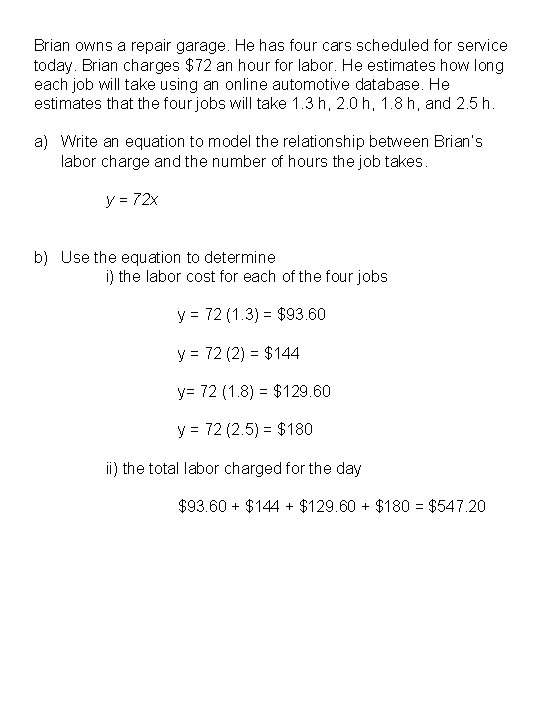
Brian owns a repair garage. He has four cars scheduled for service today. Brian charges $72 an hour for labor. He estimates how long each job will take using an online automotive database. He estimates that the four jobs will take 1. 3 h, 2. 0 h, 1. 8 h, and 2. 5 h. a) Write an equation to model the relationship between Brian’s labor charge and the number of hours the job takes. y = 72 x b) Use the equation to determine i) the labor cost for each of the four jobs y = 72 (1. 3) = $93. 60 y = 72 (2) = $144 y= 72 (1. 8) = $129. 60 y = 72 (2. 5) = $180 ii) the total labor charged for the day $93. 60 + $144 + $129. 60 + $180 = $547. 20
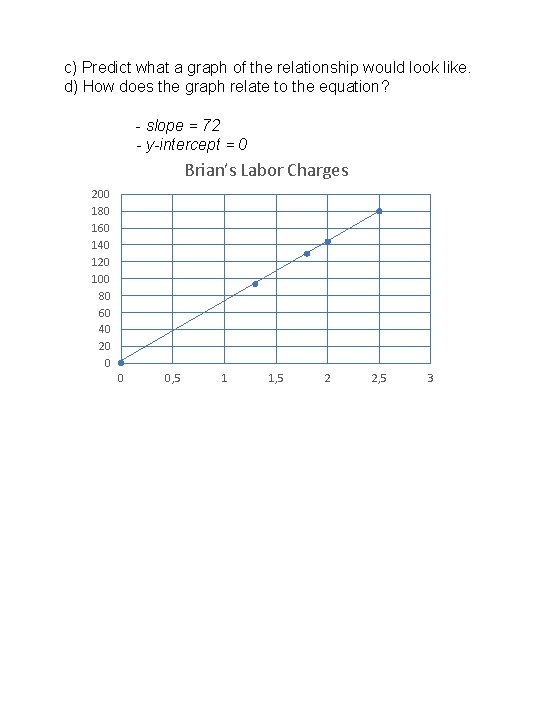
c) Predict what a graph of the relationship would look like. d) How does the graph relate to the equation? - slope = 72 - y-intercept = 0 Brian’s Labor Charges 200 180 160 140 120 100 80 60 40 20 0 0 0, 5 1 1, 5 2 2, 5 3
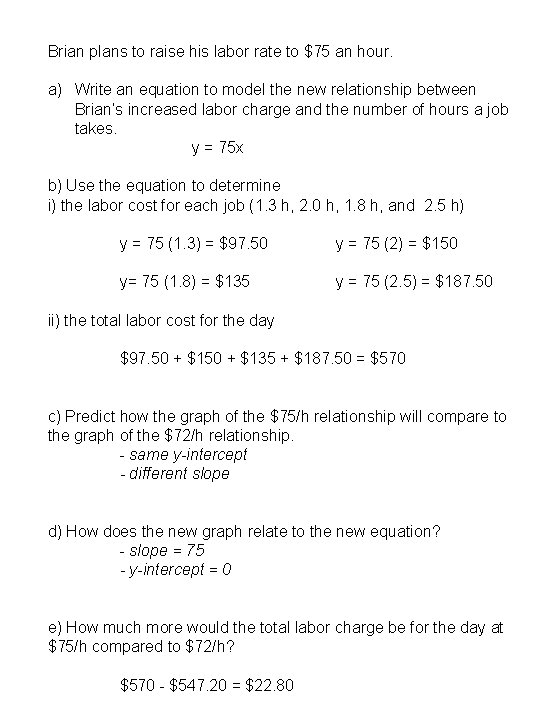
Brian plans to raise his labor rate to $75 an hour. a) Write an equation to model the new relationship between Brian’s increased labor charge and the number of hours a job takes. y = 75 x b) Use the equation to determine i) the labor cost for each job (1. 3 h, 2. 0 h, 1. 8 h, and 2. 5 h) y = 75 (1. 3) = $97. 50 y = 75 (2) = $150 y= 75 (1. 8) = $135 y = 75 (2. 5) = $187. 50 ii) the total labor cost for the day $97. 50 + $135 + $187. 50 = $570 c) Predict how the graph of the $75/h relationship will compare to the graph of the $72/h relationship. - same y-intercept - different slope d) How does the new graph relate to the new equation? - slope = 75 - y-intercept = 0 e) How much more would the total labor charge be for the day at $75/h compared to $72/h? $570 - $547. 20 = $22. 80
- Slides: 19