
Section 3 1 Statements Negations and Quantified Statements
- Slides: 9
Section 3. 1 Statements, Negations, and Quantified Statements Objectives 1. Identify English sentences that are statements. 2. Express statements using symbols. 3. Form the negation of a statement 4. Express negations using symbols. 5. Translate a negation represented by symbols into English. 6. Express quantified statements in two ways. 7. Write negations of quantified statements. 12/14/2021 Section 3. 1 1
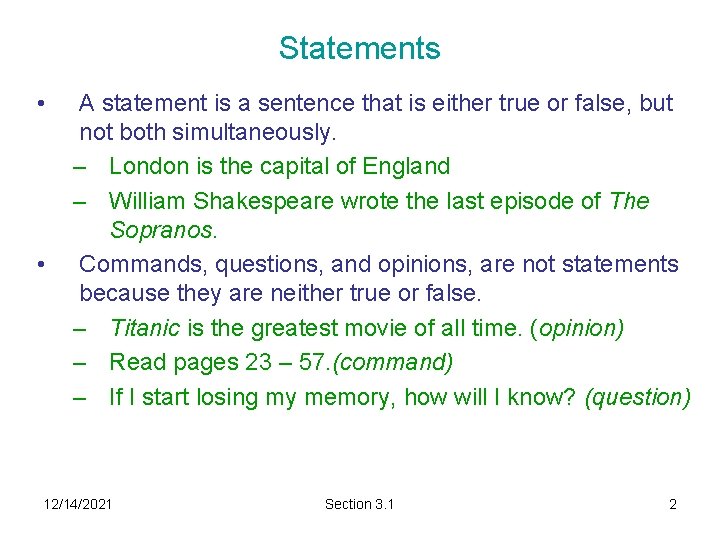
Statements • • A statement is a sentence that is either true or false, but not both simultaneously. – London is the capital of England – William Shakespeare wrote the last episode of The Sopranos. Commands, questions, and opinions, are not statements because they are neither true or false. – Titanic is the greatest movie of all time. (opinion) – Read pages 23 – 57. (command) – If I start losing my memory, how will I know? (question) 12/14/2021 Section 3. 1 2
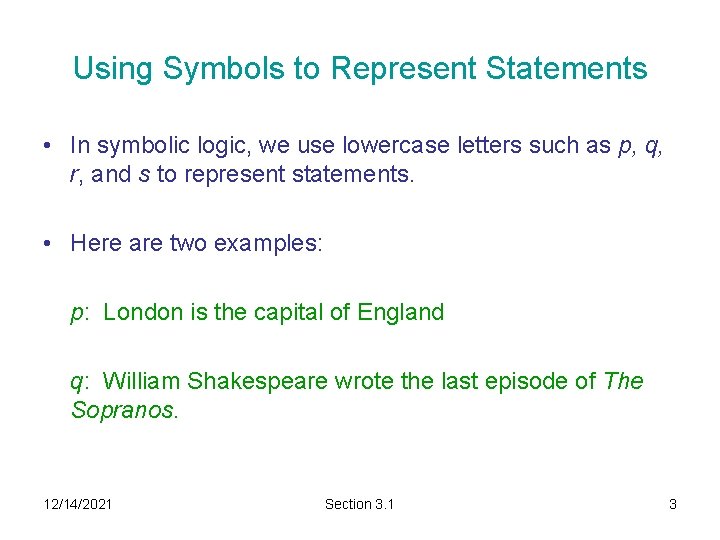
Using Symbols to Represent Statements • In symbolic logic, we use lowercase letters such as p, q, r, and s to represent statements. • Here are two examples: p: London is the capital of England q: William Shakespeare wrote the last episode of The Sopranos. 12/14/2021 Section 3. 1 3
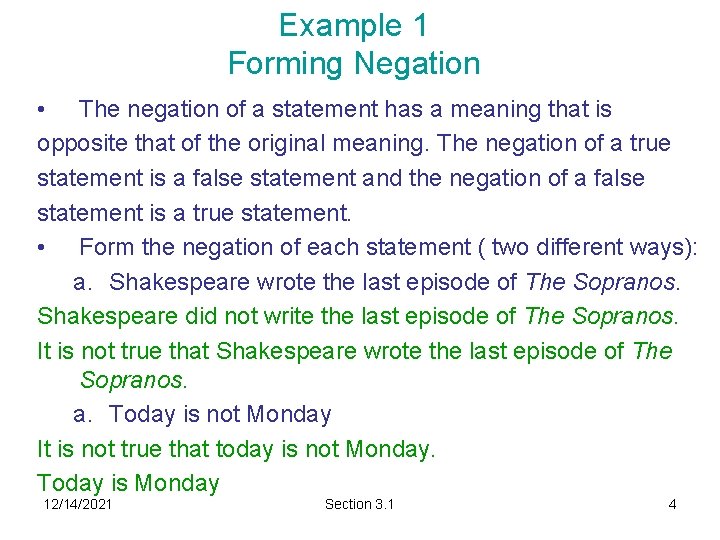
Example 1 Forming Negation • The negation of a statement has a meaning that is opposite that of the original meaning. The negation of a true statement is a false statement and the negation of a false statement is a true statement. • Form the negation of each statement ( two different ways): a. Shakespeare wrote the last episode of The Sopranos. Shakespeare did not write the last episode of The Sopranos. It is not true that Shakespeare wrote the last episode of The Sopranos. a. Today is not Monday It is not true that today is not Monday. Today is Monday 12/14/2021 Section 3. 1 4
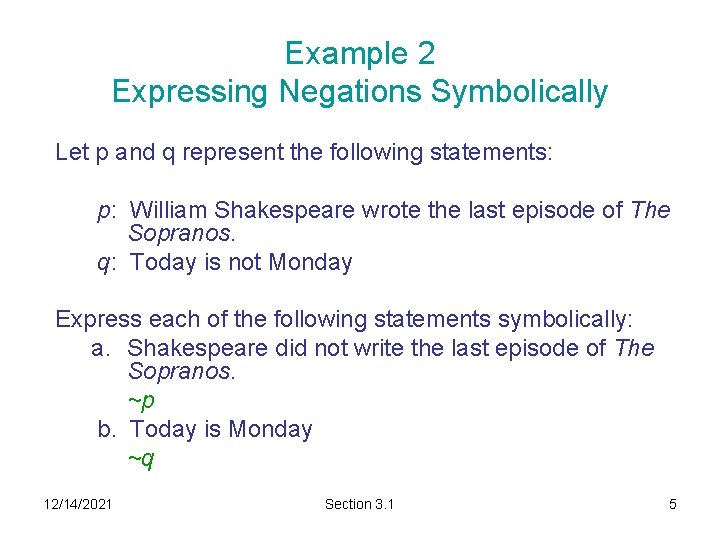
Example 2 Expressing Negations Symbolically Let p and q represent the following statements: p: William Shakespeare wrote the last episode of The Sopranos. q: Today is not Monday Express each of the following statements symbolically: a. Shakespeare did not write the last episode of The Sopranos. ~p b. Today is Monday ~q 12/14/2021 Section 3. 1 5
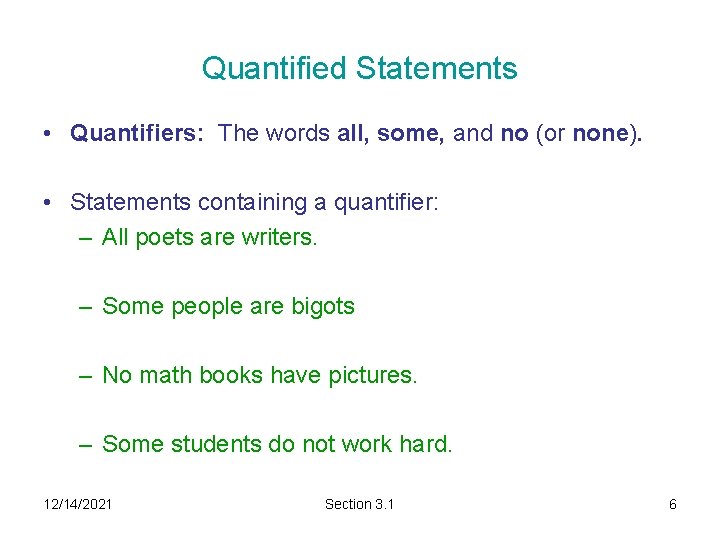
Quantified Statements • Quantifiers: The words all, some, and no (or none). • Statements containing a quantifier: – All poets are writers. – Some people are bigots – No math books have pictures. – Some students do not work hard. 12/14/2021 Section 3. 1 6
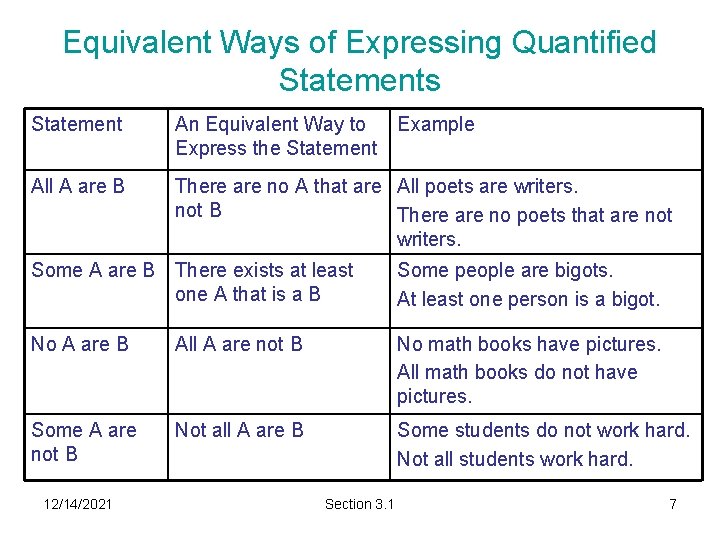
Equivalent Ways of Expressing Quantified Statements Statement An Equivalent Way to Example Express the Statement All A are B There are no A that are All poets are writers. not B There are no poets that are not writers. Some A are B There exists at least one A that is a B Some people are bigots. At least one person is a bigot. No A are B All A are not B No math books have pictures. All math books do not have pictures. Some A are not B Not all A are B Some students do not work hard. Not all students work hard. 12/14/2021 Section 3. 1 7
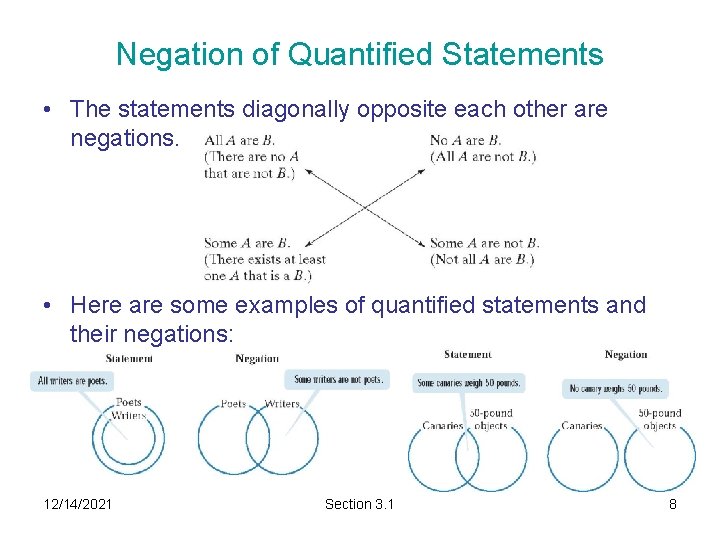
Negation of Quantified Statements • The statements diagonally opposite each other are negations. • Here are some examples of quantified statements and their negations: 12/14/2021 Section 3. 1 8
Example 3 • The mechanic told me, “All piston rings were replaced. ” I later learned that the mechanic never tells the truth. What can I conclude? • Solution: Let’s begin with the mechanic’s statement: All piston rings were replaced. Because the mechanic never tells the truth, I can conclude that the truth is the negation of what I was told. The negation of “All A are B” is “Some A are not B”. Thus, I can conclude that Some piston rings were not replaced. I can also correctly conclude that: At least one piston ring was not replaced. 12/14/2021 Section 3. 1 9