
Section 3 1 Metabolism and Energy SBI 4
Section 3. 1 Metabolism and Energy SBI 4 UP MRS. FRANKLIN
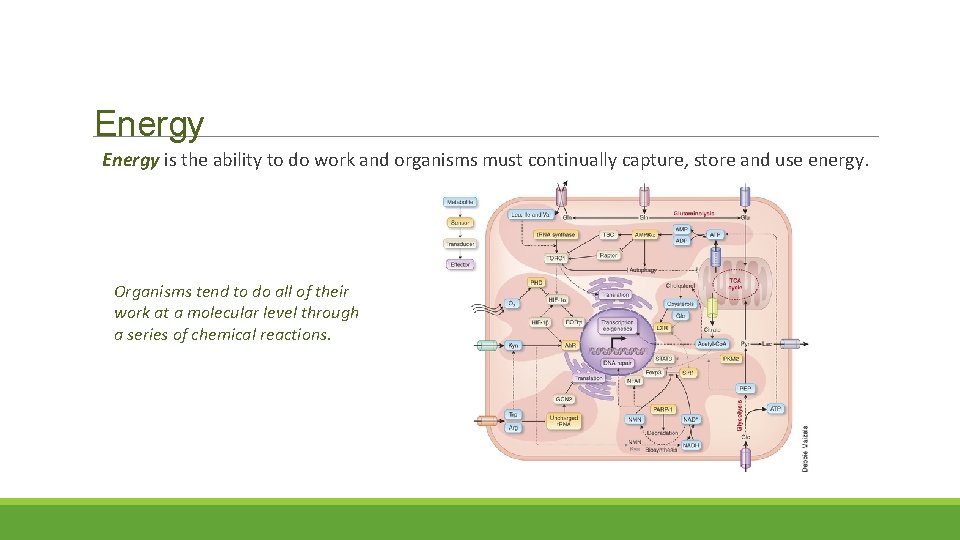
Energy is the ability to do work and organisms must continually capture, store and use energy. Organisms tend to do all of their work at a molecular level through a series of chemical reactions.
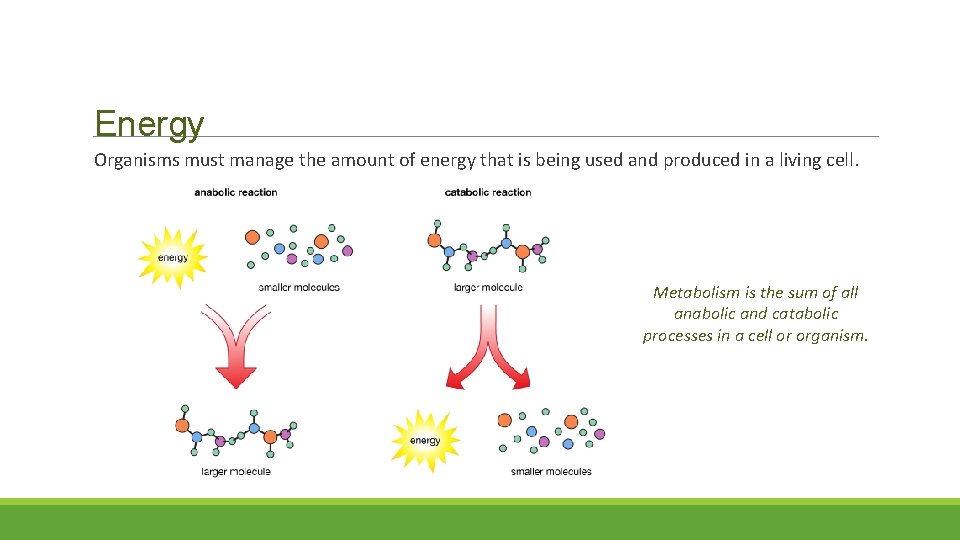
Energy Organisms must manage the amount of energy that is being used and produced in a living cell. Metabolism is the sum of all anabolic and catabolic processes in a cell or organism.
Energy Work occurs when one object applies a force on another object and changes its position or state of motion. Energy can be defined in two ways: 1) Kinetic Energy: 2) Potential Energy:
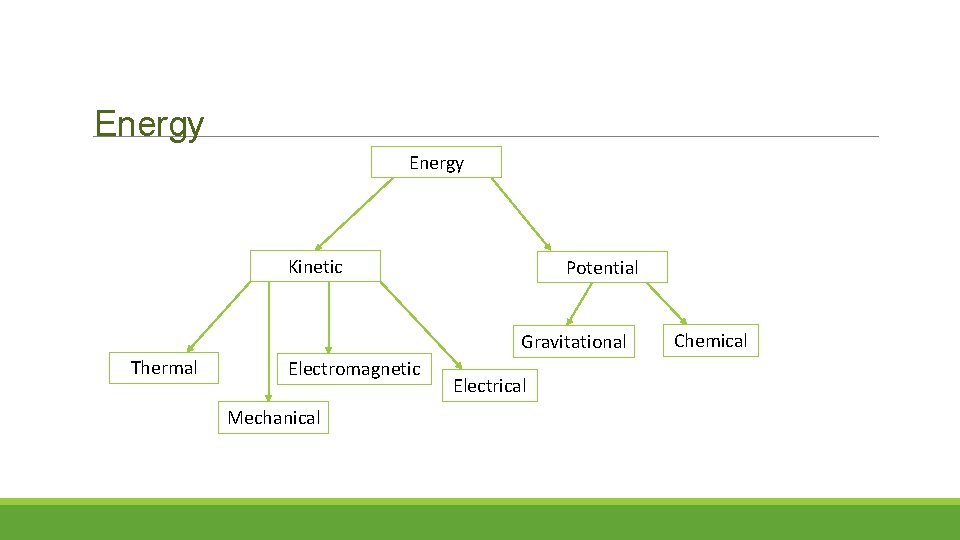
Energy Kinetic Potential Gravitational Thermal Electromagnetic Mechanical Electrical Chemical
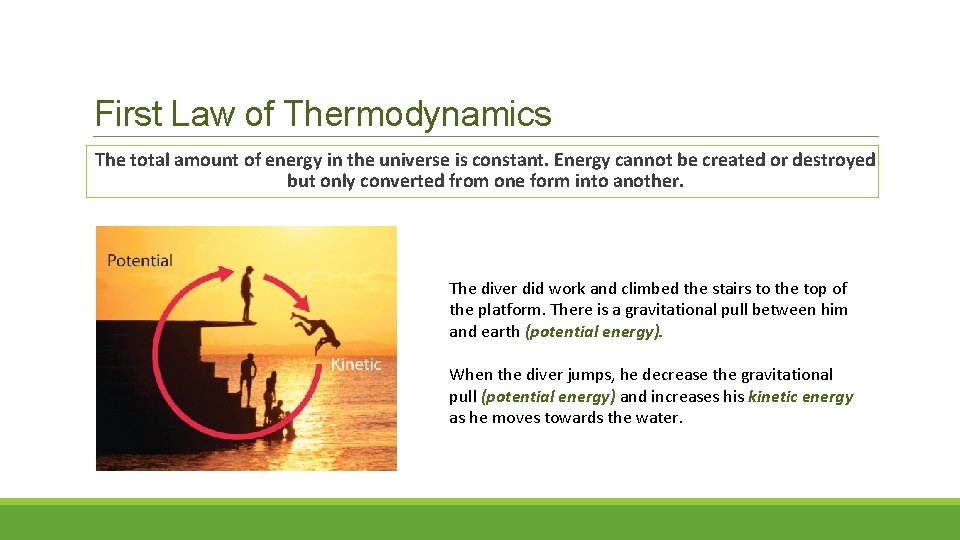
First Law of Thermodynamics The total amount of energy in the universe is constant. Energy cannot be created or destroyed but only converted from one form into another. The diver did work and climbed the stairs to the top of the platform. There is a gravitational pull between him and earth (potential energy). When the diver jumps, he decrease the gravitational pull (potential energy) and increases his kinetic energy as he moves towards the water.
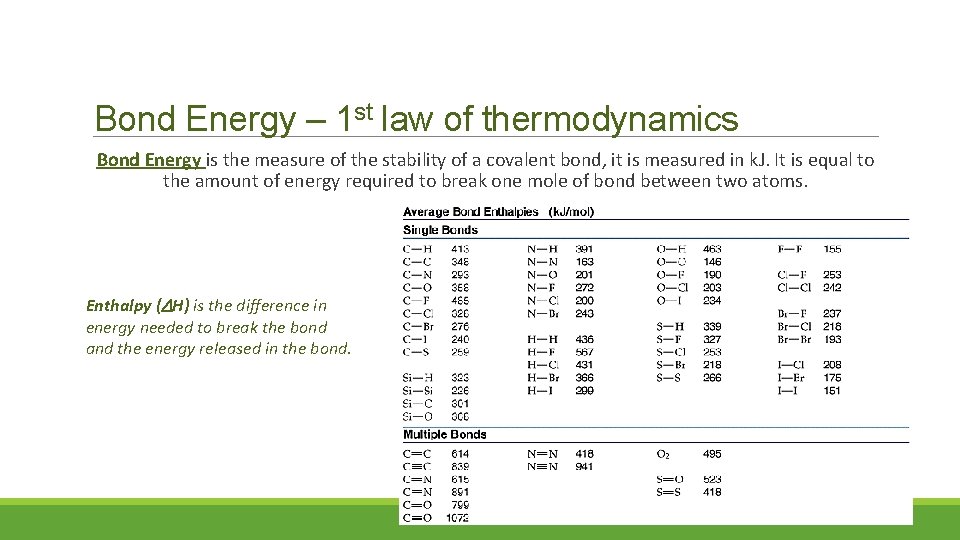
Bond Energy – 1 st law of thermodynamics Bond Energy is the measure of the stability of a covalent bond, it is measured in k. J. It is equal to the amount of energy required to break one mole of bond between two atoms. Enthalpy ( H) is the difference in energy needed to break the bond and the energy released in the bond.
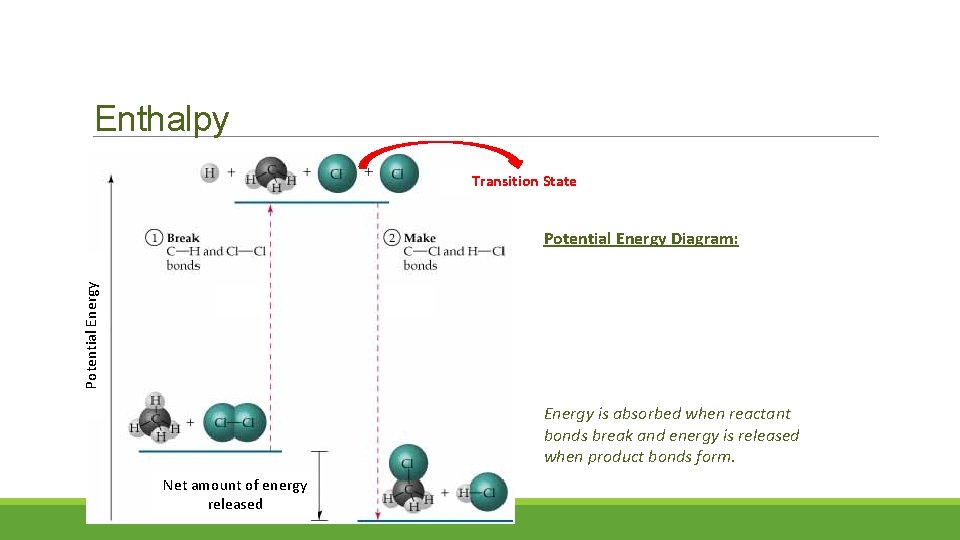
Enthalpy Transition State Potential Energy Diagram: Energy is absorbed when reactant bonds break and energy is released when product bonds form. Net amount of energy released
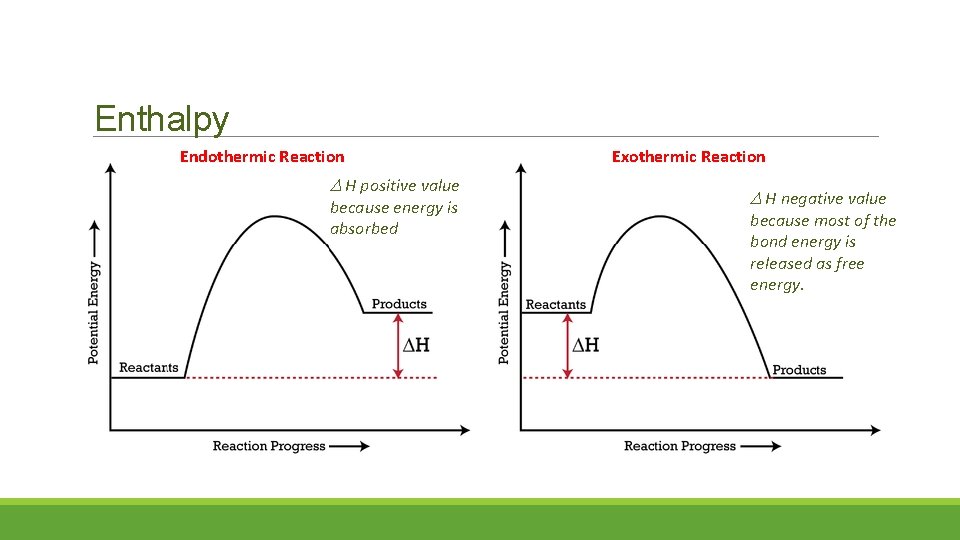
Enthalpy Endothermic Reaction H positive value because energy is absorbed Exothermic Reaction H negative value because most of the bond energy is released as free energy.
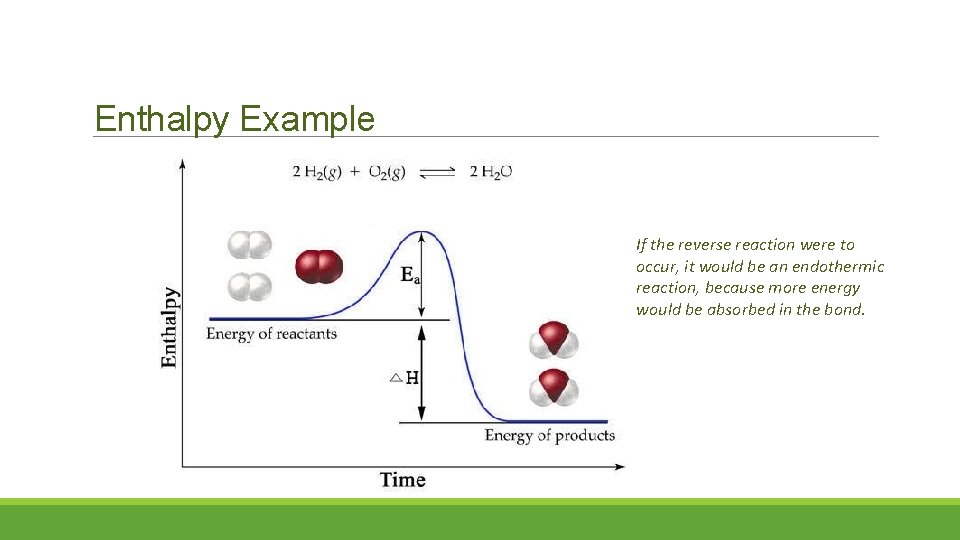
Enthalpy Example If the reverse reaction were to occur, it would be an endothermic reaction, because more energy would be absorbed in the bond.
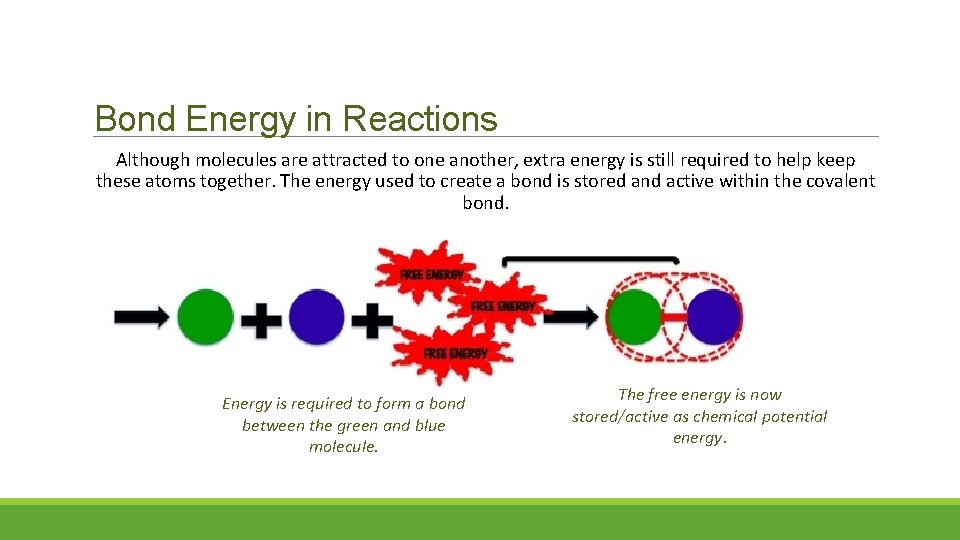
Bond Energy in Reactions Although molecules are attracted to one another, extra energy is still required to help keep these atoms together. The energy used to create a bond is stored and active within the covalent bond. Energy is required to form a bond between the green and blue molecule. The free energy is now stored/active as chemical potential energy.
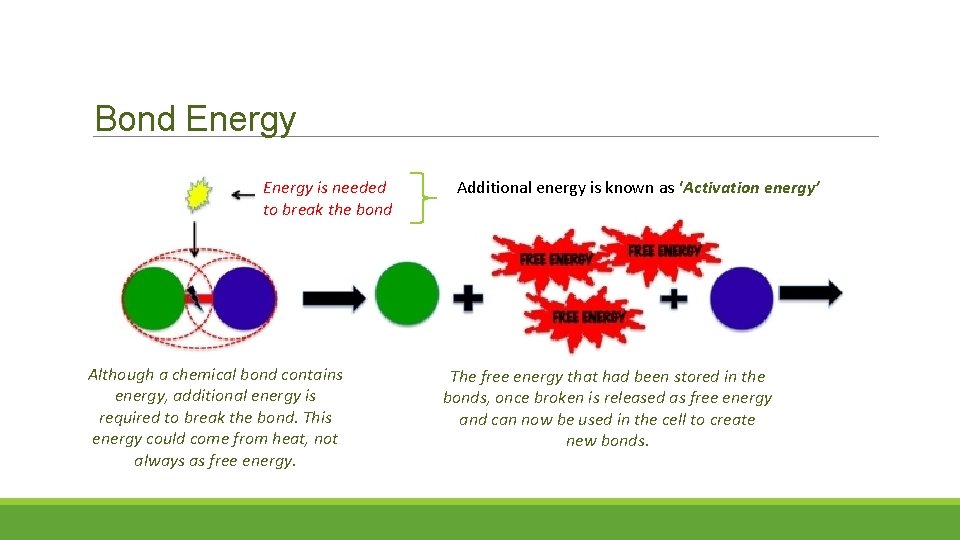
Bond Energy is needed to break the bond Although a chemical bond contains energy, additional energy is required to break the bond. This energy could come from heat, not always as free energy. Additional energy is known as ‘Activation energy’ The free energy that had been stored in the bonds, once broken is released as free energy and can now be used in the cell to create new bonds.
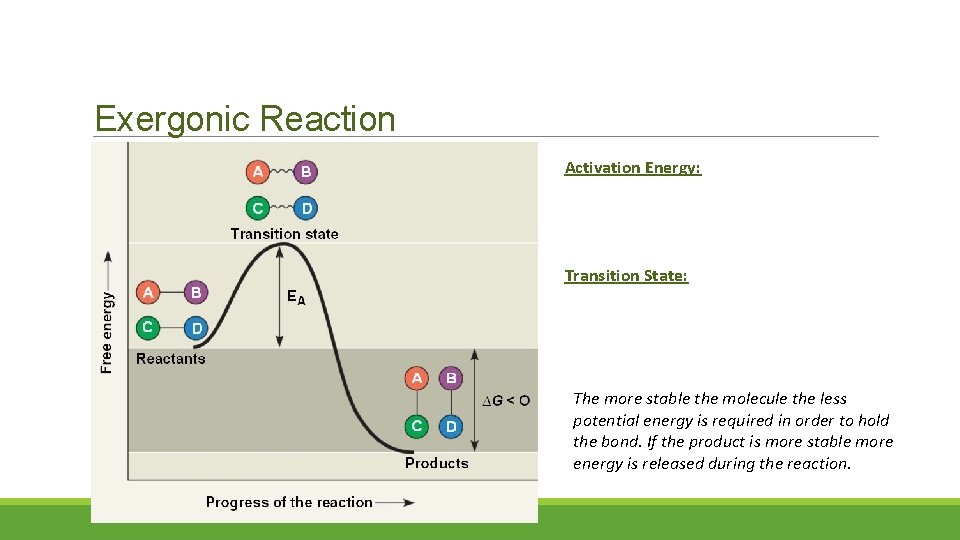
Exergonic Reaction Activation Energy: Transition State: The more stable the molecule the less potential energy is required in order to hold the bond. If the product is more stable more energy is released during the reaction.
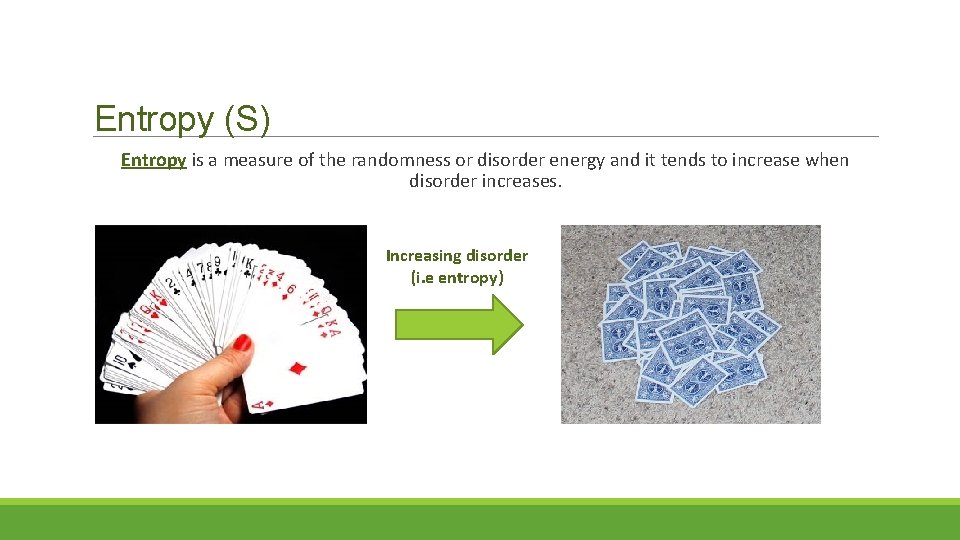
Entropy (S) Entropy is a measure of the randomness or disorder energy and it tends to increase when disorder increases. Increasing disorder (i. e entropy)
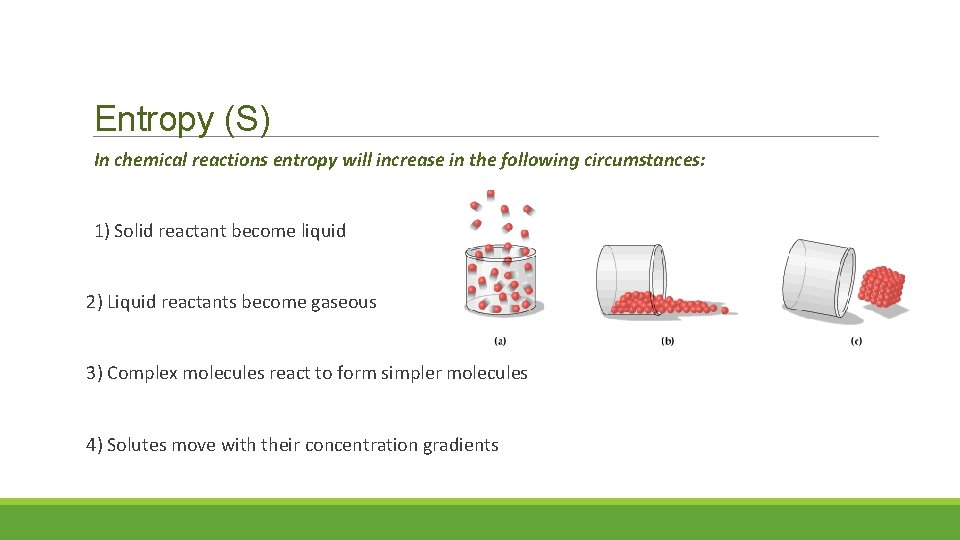
Entropy (S) In chemical reactions entropy will increase in the following circumstances: 1) Solid reactant become liquid 2) Liquid reactants become gaseous 3) Complex molecules react to form simpler molecules 4) Solutes move with their concentration gradients
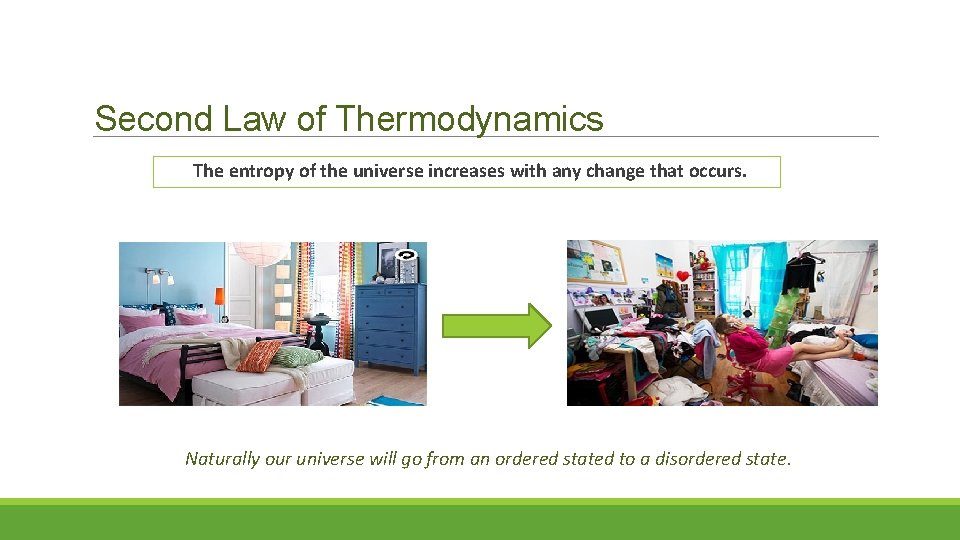
Second Law of Thermodynamics The entropy of the universe increases with any change that occurs. Naturally our universe will go from an ordered stated to a disordered state.
Gibb’s Free Energy Remember… o when a molecule is broken down in a catabolic reaction, energy is released ( H is negative) and entropy increases ( S increases). This is an exothermic reaction and a spontaneous process. o In living systems, cells seem to create a more ordered state through anabolic reactions by building molecules. Although it seems to violate the second law of thermodynamics, scientists believe that these reactions are always coupled to catabolic reactions that is favoured in the universe.
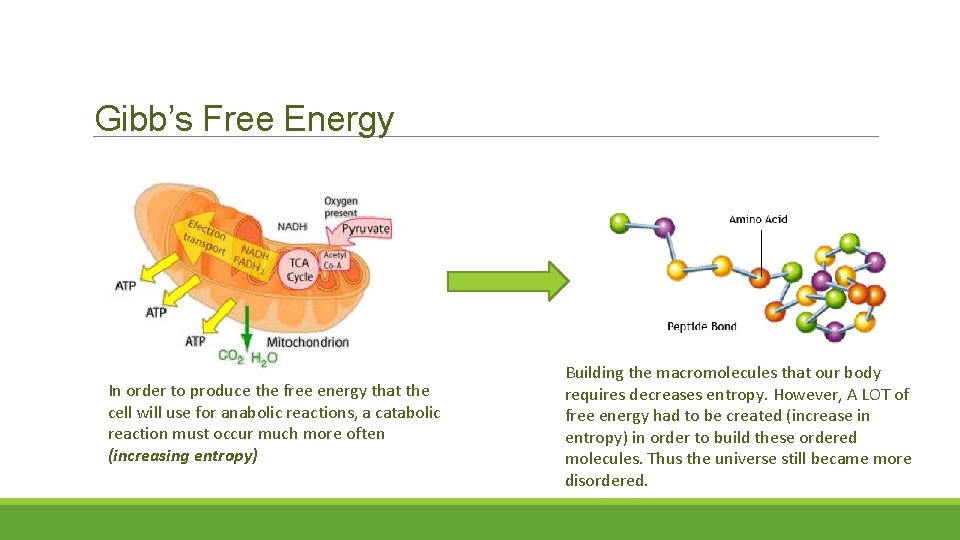
Gibb’s Free Energy In order to produce the free energy that the cell will use for anabolic reactions, a catabolic reaction must occur much more often (increasing entropy) Building the macromolecules that our body requires decreases entropy. However, A LOT of free energy had to be created (increase in entropy) in order to build these ordered molecules. Thus the universe still became more disordered.
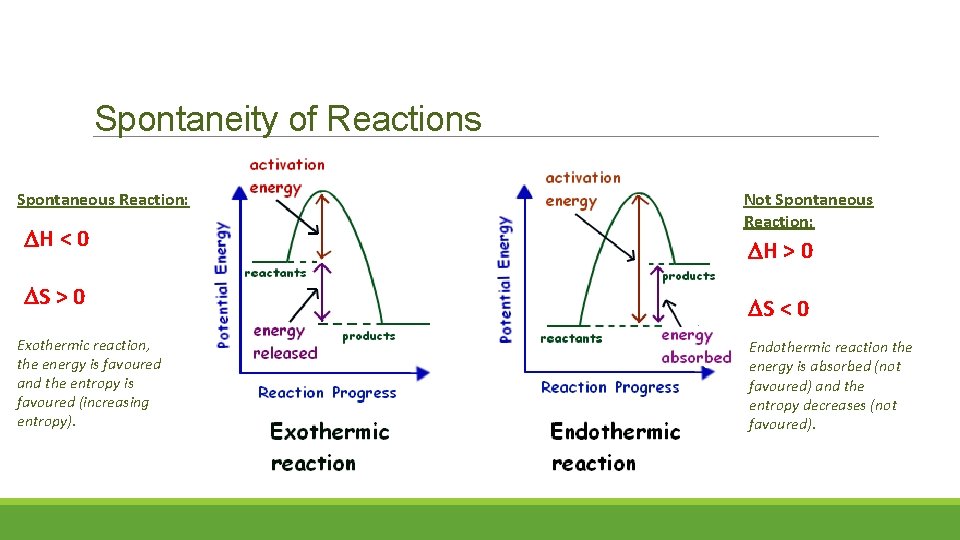
Spontaneity of Reactions Spontaneous Reaction: H < 0 S > 0 Exothermic reaction, the energy is favoured and the entropy is favoured (increasing entropy). Not Spontaneous Reaction: H > 0 S < 0 Endothermic reaction the energy is absorbed (not favoured) and the entropy decreases (not favoured).
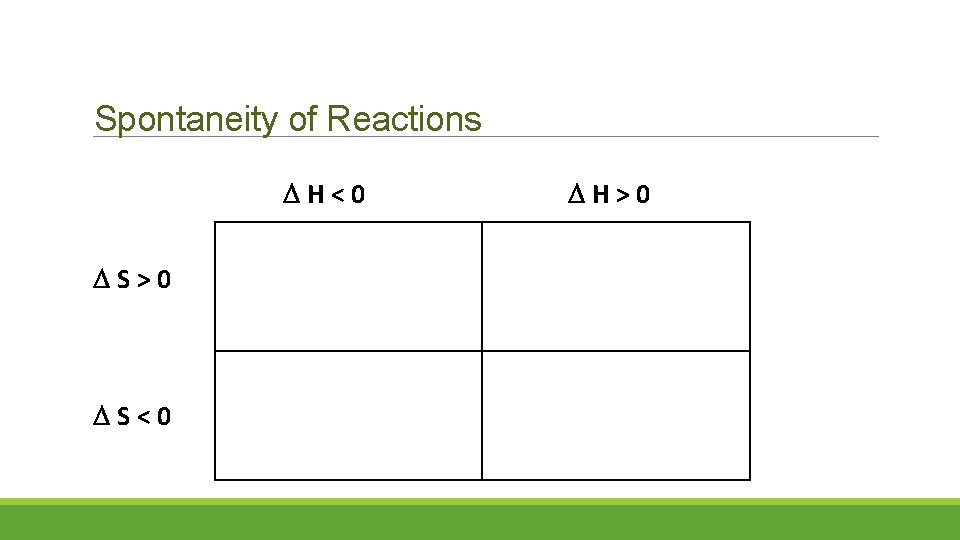
Spontaneity of Reactions H<0 S>0 S<0 H>0
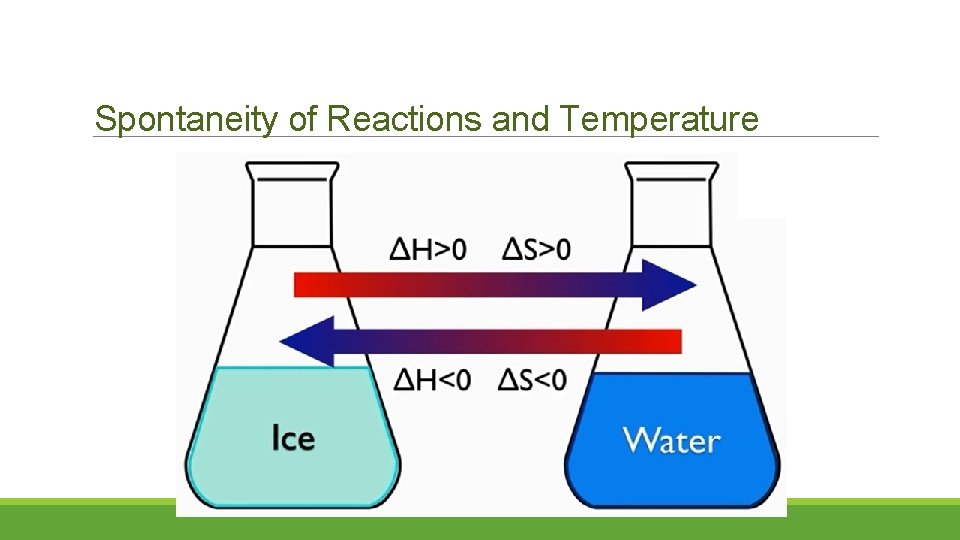
Spontaneity of Reactions and Temperature
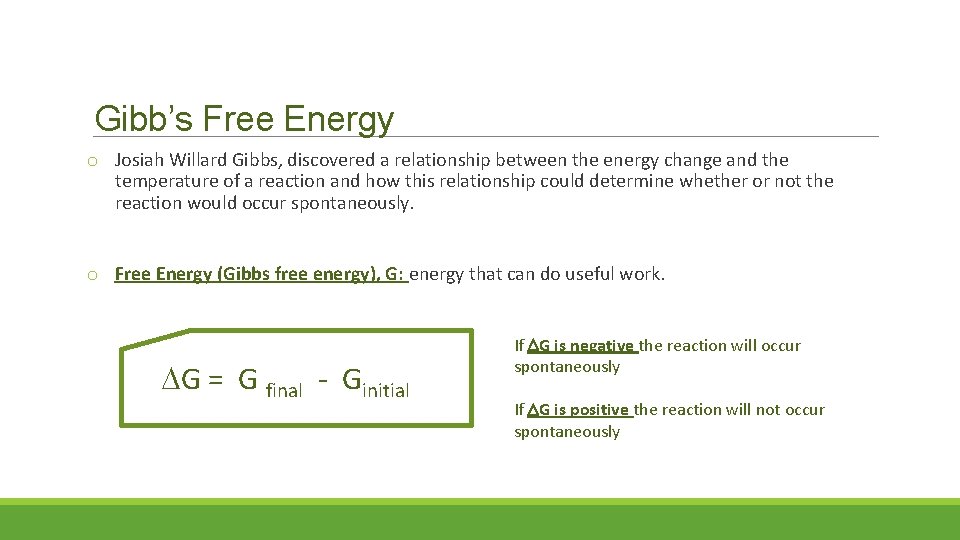
Gibb’s Free Energy o Josiah Willard Gibbs, discovered a relationship between the energy change and the temperature of a reaction and how this relationship could determine whether or not the reaction would occur spontaneously. o Free Energy (Gibbs free energy), G: energy that can do useful work. G = G final - Ginitial If G is negative the reaction will occur spontaneously If G is positive the reaction will not occur spontaneously
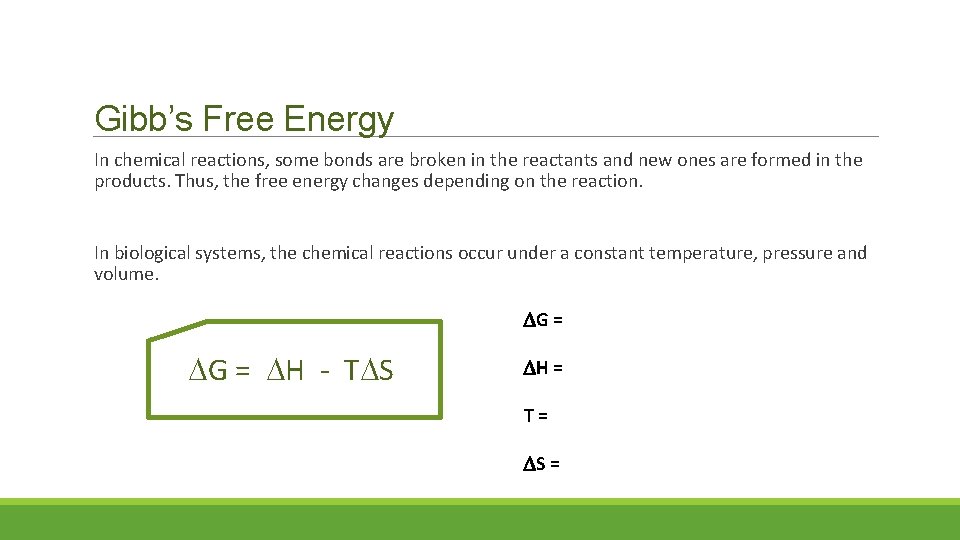
Gibb’s Free Energy In chemical reactions, some bonds are broken in the reactants and new ones are formed in the products. Thus, the free energy changes depending on the reaction. In biological systems, the chemical reactions occur under a constant temperature, pressure and volume. G = H - T S H = T= S =
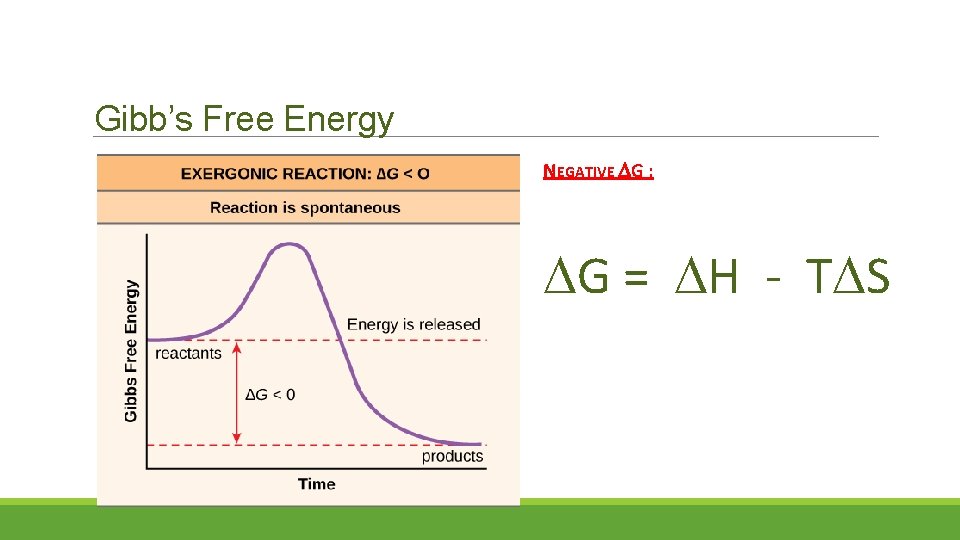
Gibb’s Free Energy NEGATIVE G : G = H - T S
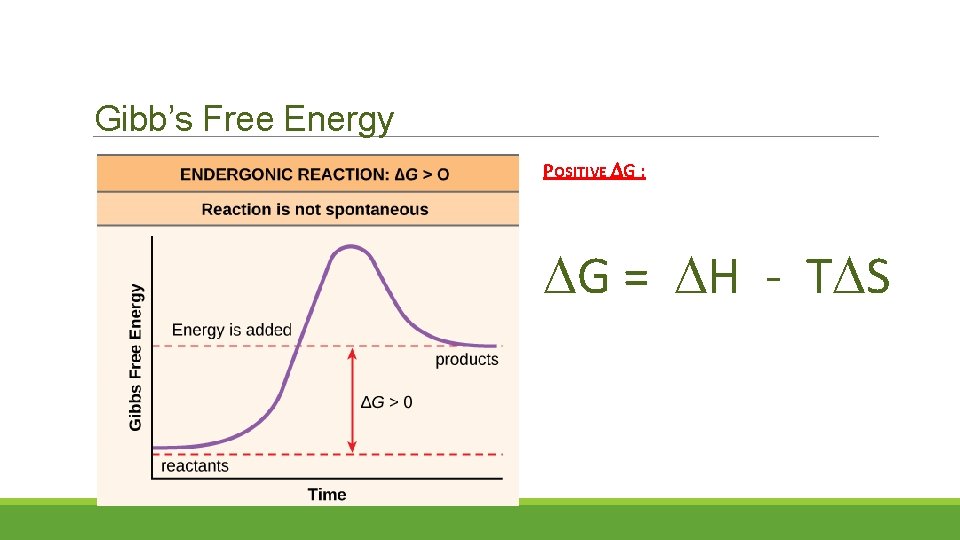
Gibb’s Free Energy POSITIVE G : G = H - T S
Example C 6 H 12 O 6 + 6 O 2 Bond Energy: Stability: Entropy: Potential Energy: 6 CO 2 + 6 H 2 O
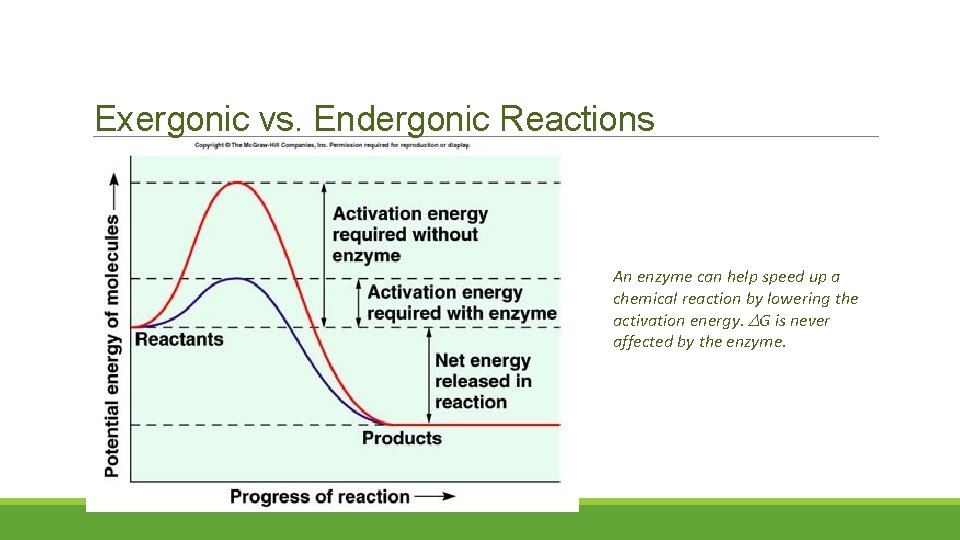
Exergonic vs. Endergonic Reactions An enzyme can help speed up a chemical reaction by lowering the activation energy. G is never affected by the enzyme.
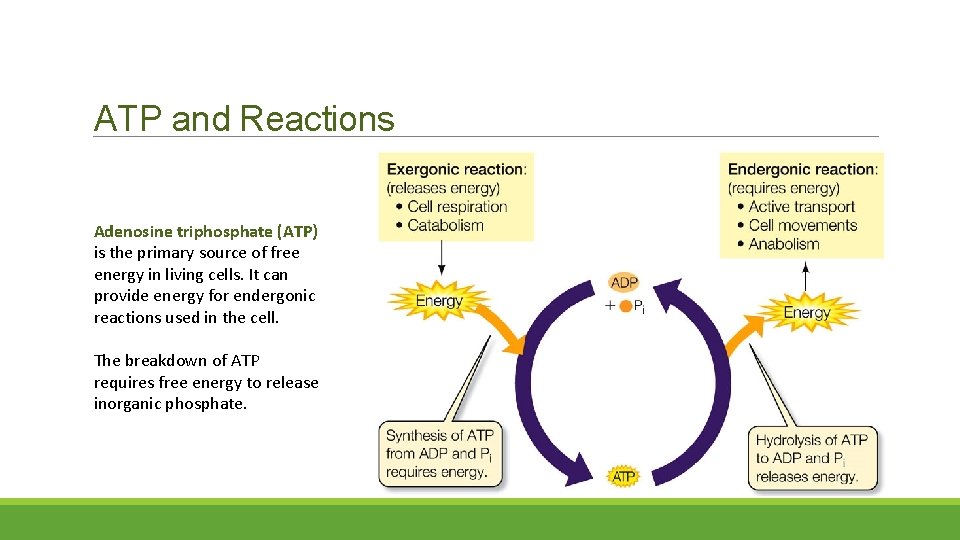
ATP and Reactions Adenosine triphosphate (ATP) is the primary source of free energy in living cells. It can provide energy for endergonic reactions used in the cell. The breakdown of ATP requires free energy to release inorganic phosphate.
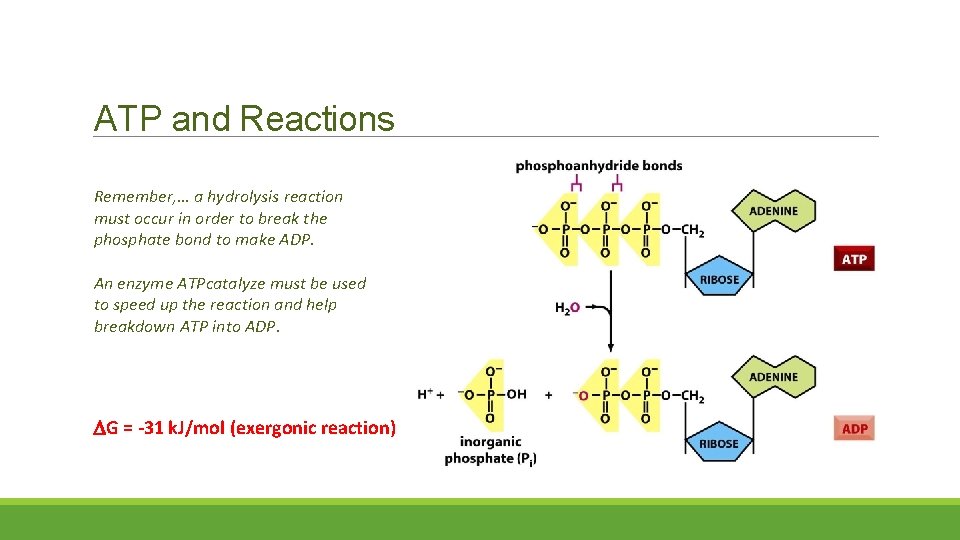
ATP and Reactions Remember, … a hydrolysis reaction must occur in order to break the phosphate bond to make ADP. An enzyme ATPcatalyze must be used to speed up the reaction and help breakdown ATP into ADP. G = -31 k. J/mol (exergonic reaction)
ADP and Inorganic Phosphate The inorganic phosphate can participate in a wide range of chemical reactions: 1)Phosphorylation: 2) Substrate level Phosphorylation: 3) Oxidative Phosphorylation:
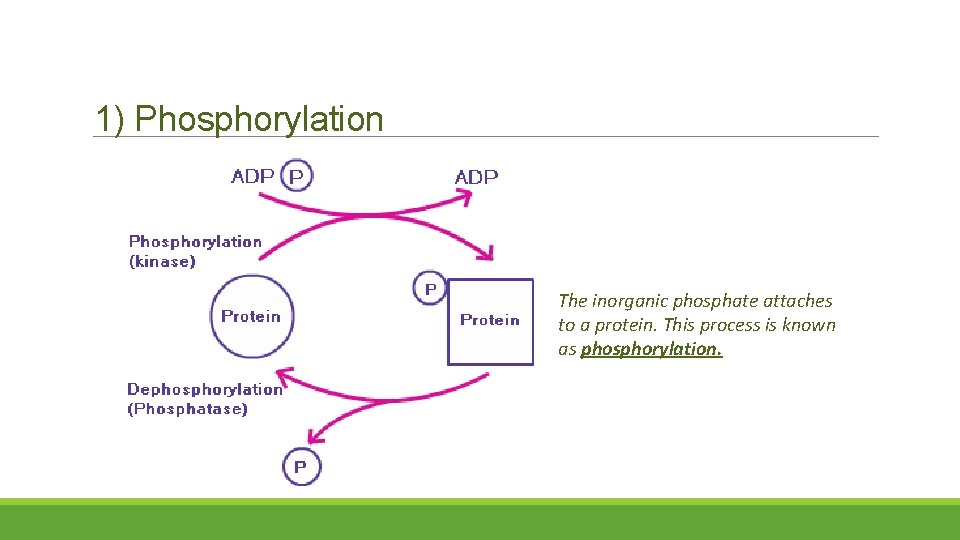
1) Phosphorylation The inorganic phosphate attaches to a protein. This process is known as phosphorylation.
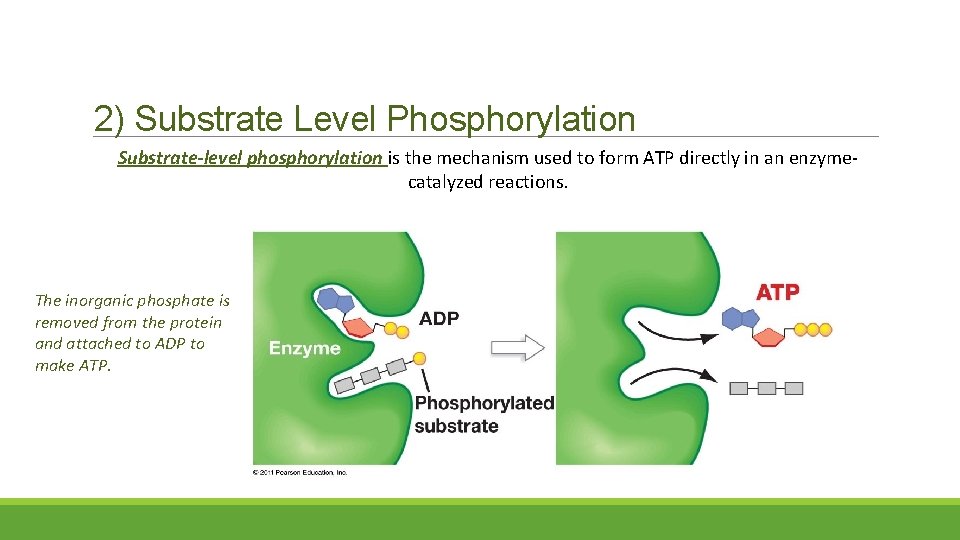
2) Substrate Level Phosphorylation Substrate-level phosphorylation is the mechanism used to form ATP directly in an enzymecatalyzed reactions. The inorganic phosphate is removed from the protein and attached to ADP to make ATP.
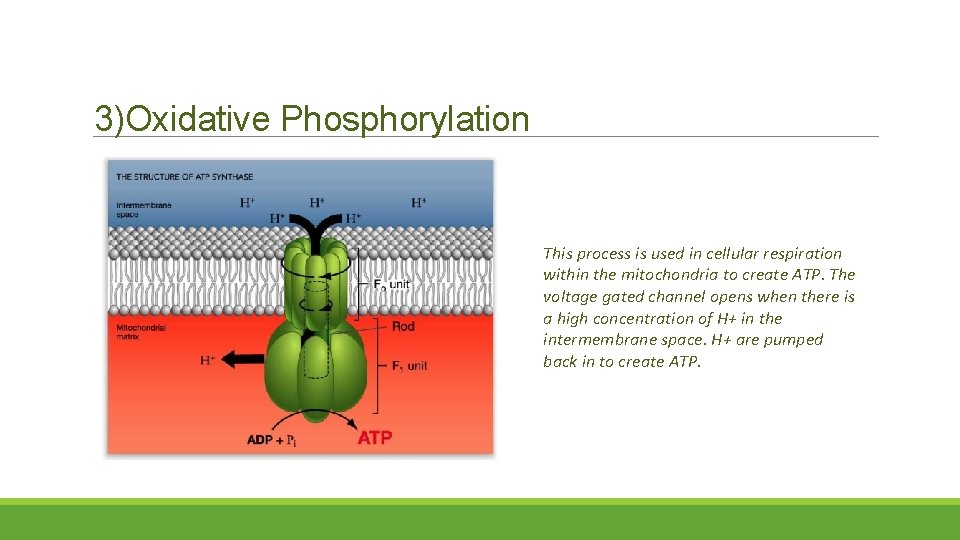
3)Oxidative Phosphorylation This process is used in cellular respiration within the mitochondria to create ATP. The voltage gated channel opens when there is a high concentration of H+ in the intermembrane space. H+ are pumped back in to create ATP.
Homework Read pg. 114 – 118 of your textbook and complete pg. 118 # 1, 2, 4 & 6
- Slides: 34