
Section 3 1 Derivatives of Polynomials and Exponential
- Slides: 22
Section 3. 1 Derivatives of Polynomials and Exponential Functions Goals • Learn formulas for the derivatives of Constant functions Power functions Exponential functions • Learn to find new derivatives from old: Constant multiples Sums and differences
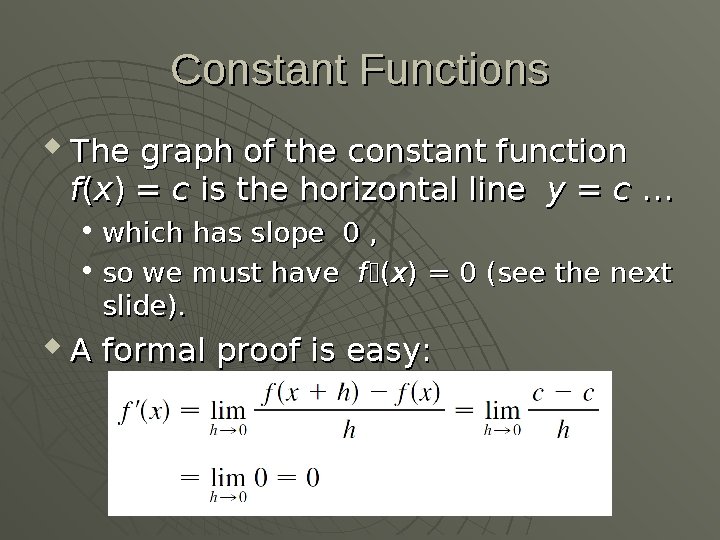
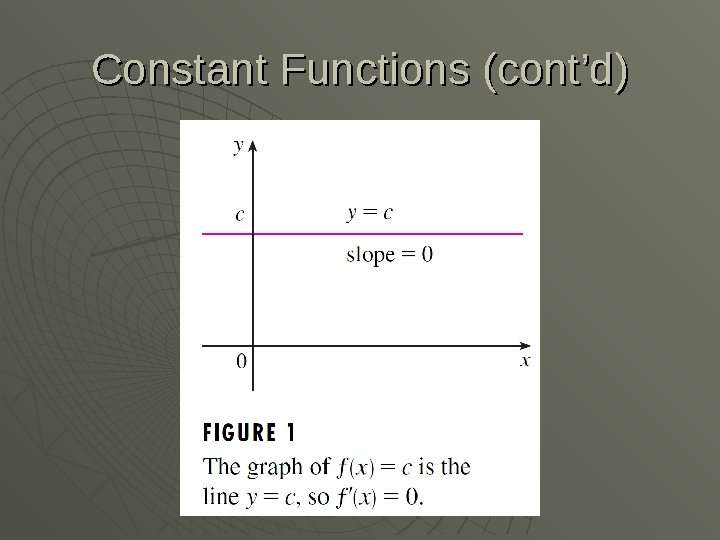
Constant Functions The graph of the constant function f(x) = c is the horizontal line y = c … • which has slope 0 , • so we must have f (x) = 0 (see the next slide). A formal proof is easy:
Constant Functions (cont’d)
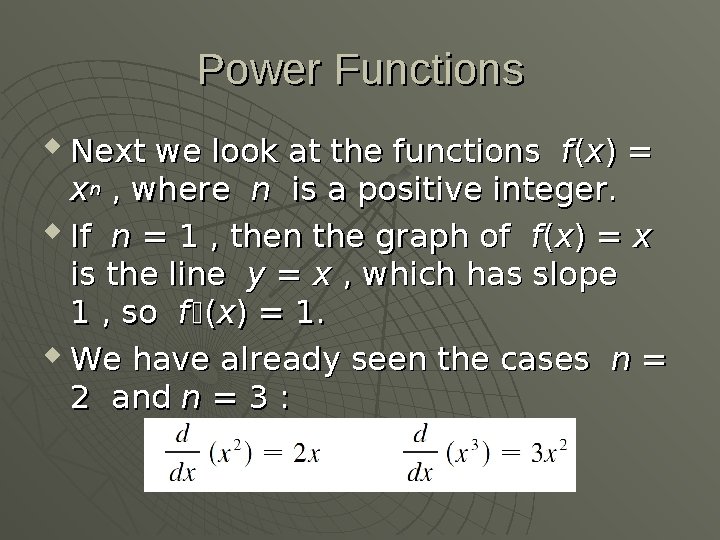
Power Functions Next we look at the functions f(x) = xn , where n is a positive integer. If n = 1 , then the graph of f(x) = x is the line y = x , which has slope 1 , so f (x) = 1. We have already seen the cases n = 2 and n = 3 :
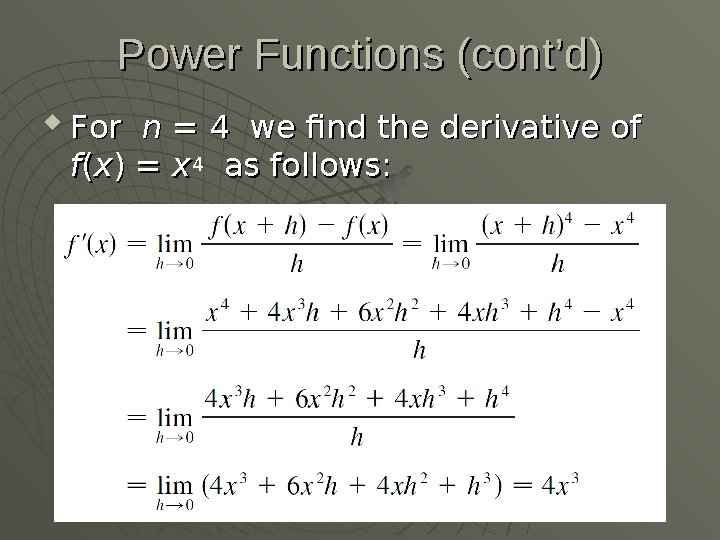
Power Functions (cont’d) For n = 4 we find the derivative of f(x) = x 4 as follows:
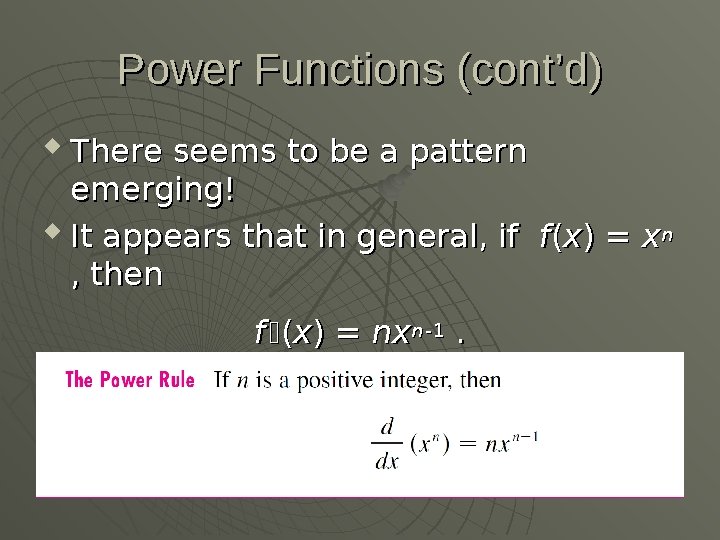
Power Functions (cont’d) There seems to be a pattern emerging! It appears that in general, if f(x) = xn , then f (x) = nxn - 1. This turns out to be the case:
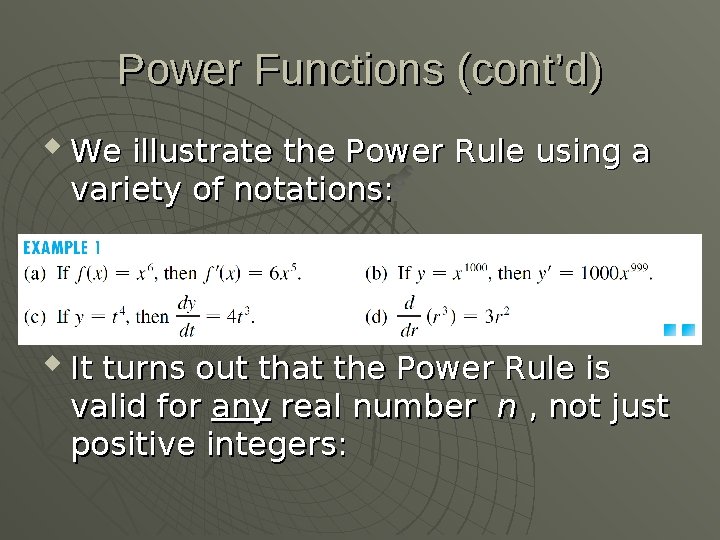
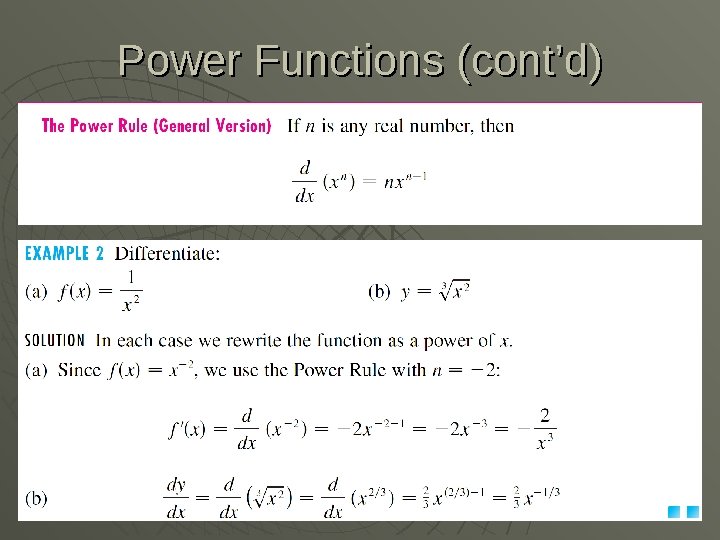
Power Functions (cont’d) We illustrate the Power Rule using a variety of notations: It turns out that the Power Rule is valid for any real number n , not just positive integers:
Power Functions (cont’d)
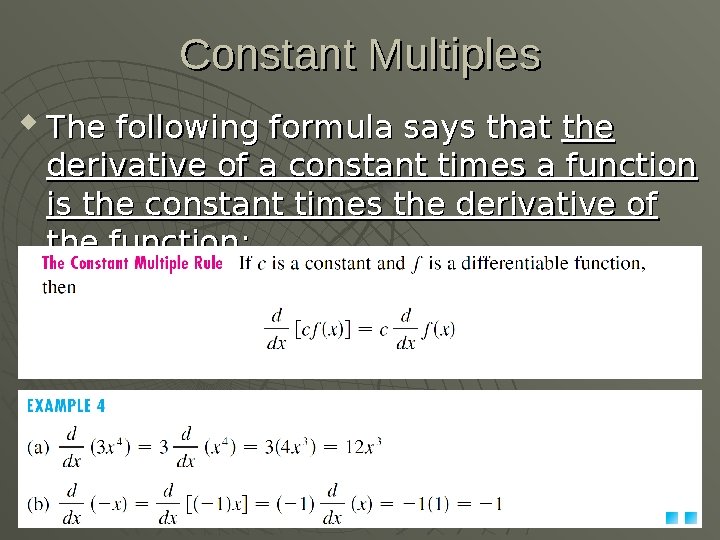
Constant Multiples The following formula says that the derivative of a constant times a function is the constant times the derivative of the function:
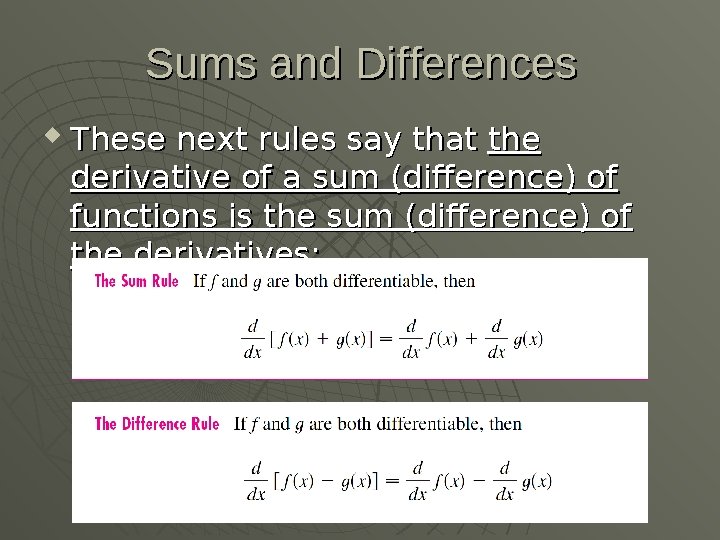
Sums and Differences These next rules say that the derivative of a sum (difference) of functions is the sum (difference) of the derivatives:
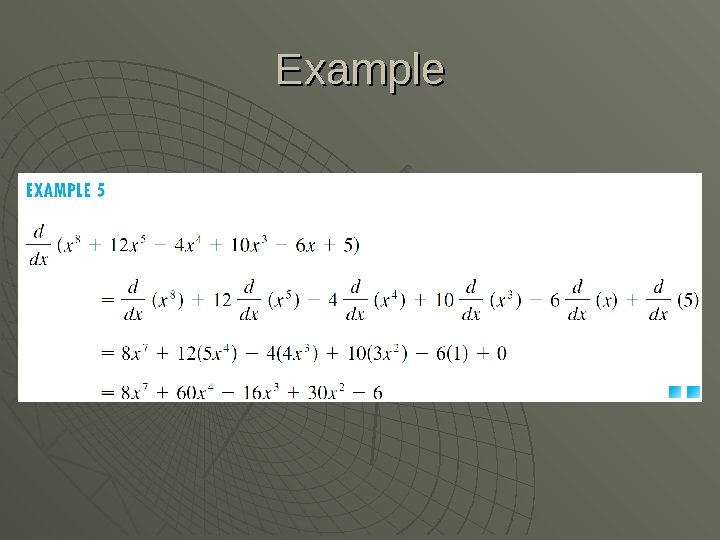
Example
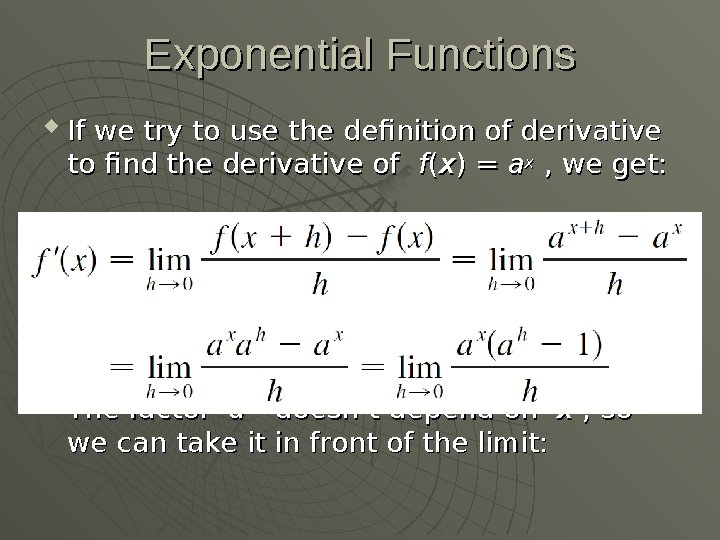
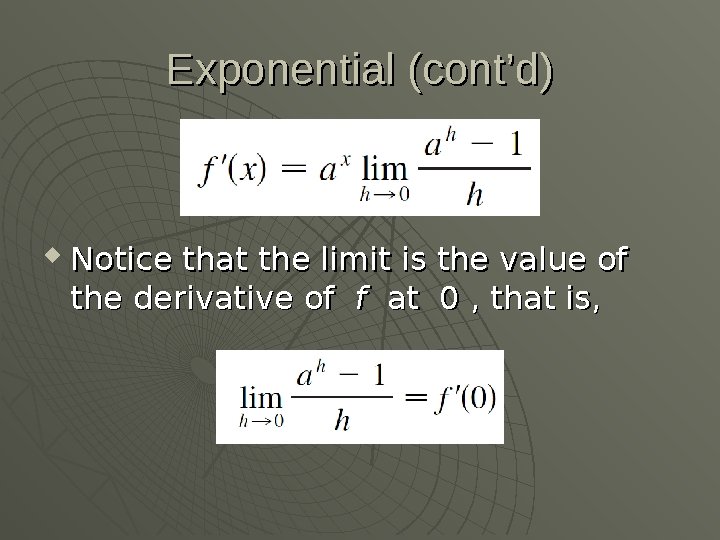
Exponential Functions If we try to use the definition of derivative to find the derivative of f(x) = ax , we get: The factor ax doesn’t depend on x , so we can take it in front of the limit:
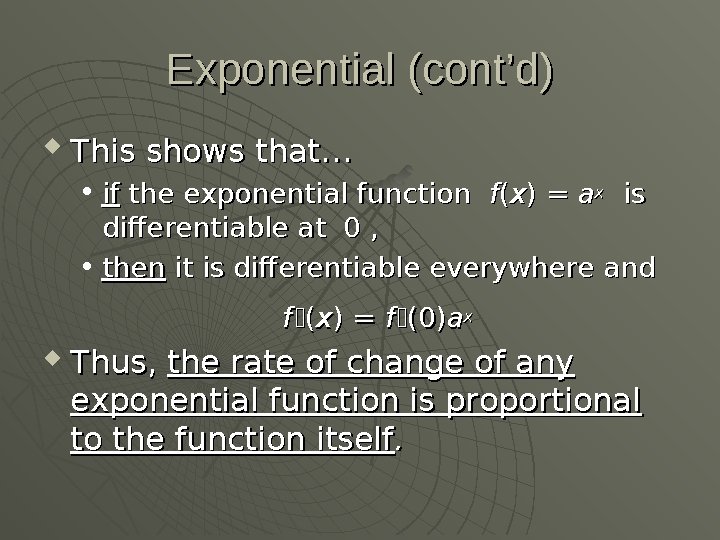
Exponential (cont’d) Notice that the limit is the value of the derivative of f at 0 , that is,
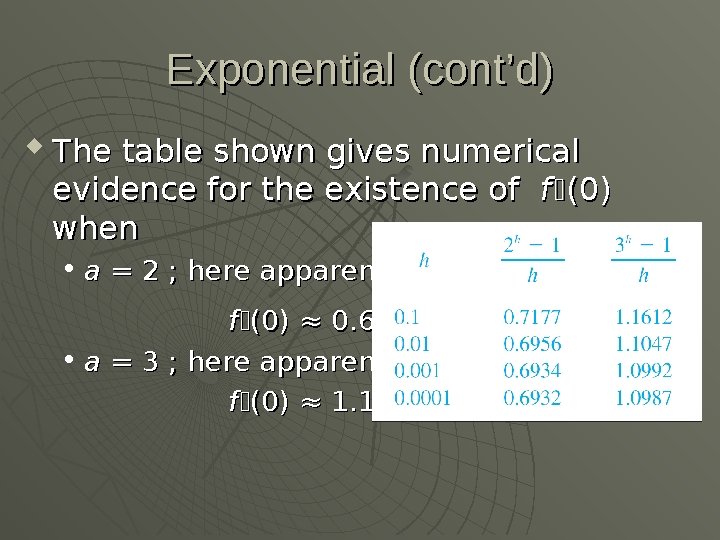
Exponential (cont’d) This shows that… • if the exponential function f(x) = ax is differentiable at 0 , • then it is differentiable everywhere and f (x) = f (0)ax Thus, the rate of change of any exponential function is proportional to the function itself.
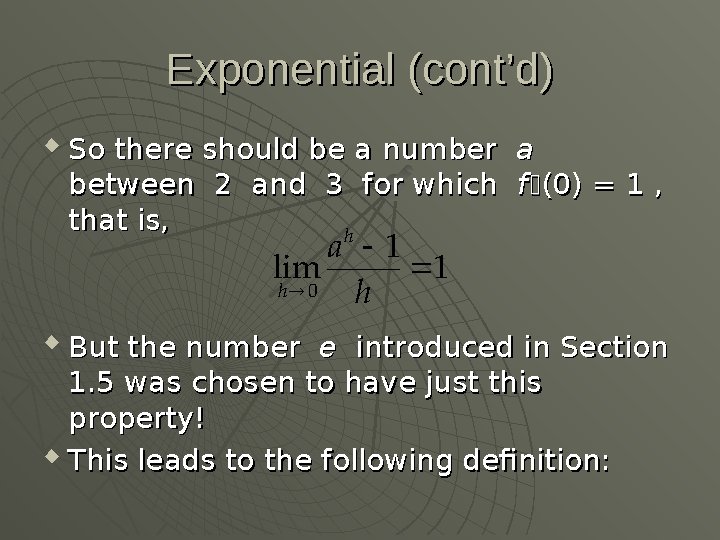
Exponential (cont’d) The table shown gives numerical evidence for the existence of f (0) when • a = 2 ; here apparently f (0) ≈ 0. 69 • a = 3 ; here apparently f (0) ≈ 1. 10
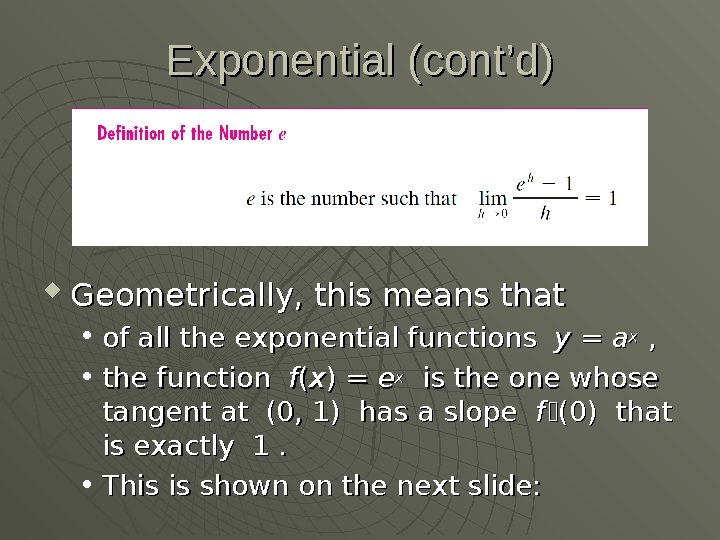
Exponential (cont’d) So there should be a number a between 2 and 3 for which f (0) = 1 , that is, h a 1 lim 1 h 0 h But the number e introduced in Section 1. 5 was chosen to have just this property! This leads to the following definition:
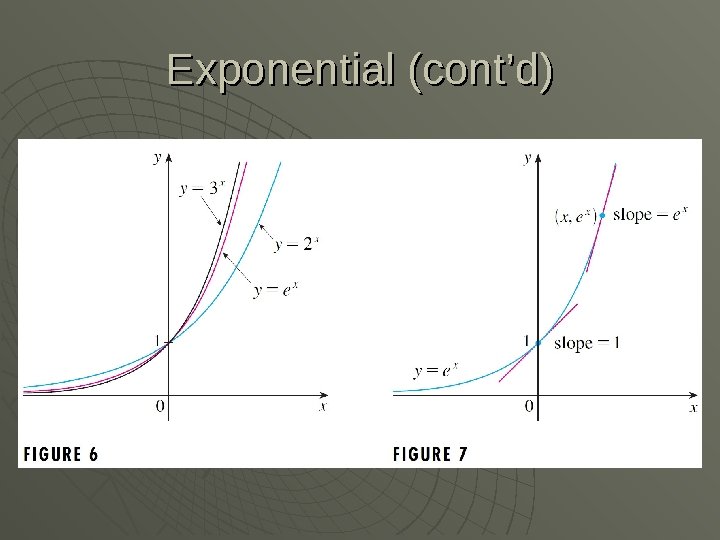
Exponential (cont’d) Geometrically, this means that • of all the exponential functions y = ax , • the function f(x) = ex is the one whose tangent at (0, 1) has a slope f (0) that is exactly 1. • This is shown on the next slide:
Exponential (cont’d)
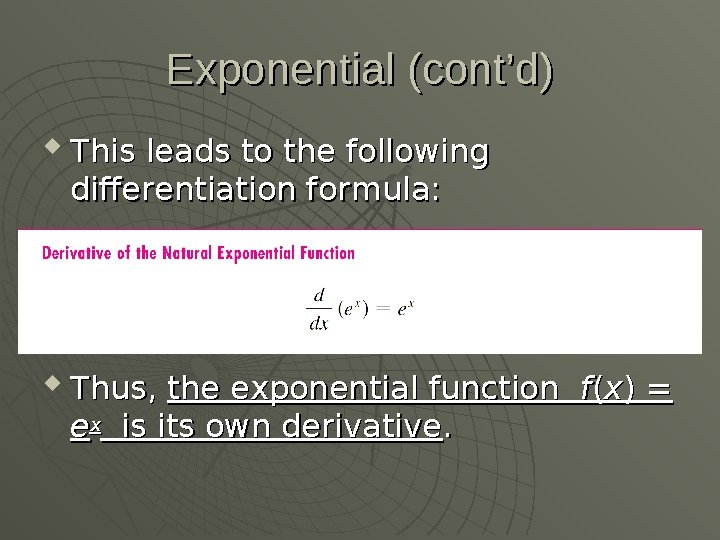
Exponential (cont’d) This leads to the following differentiation formula: Thus, the exponential function f(x) = ex is its own derivative.
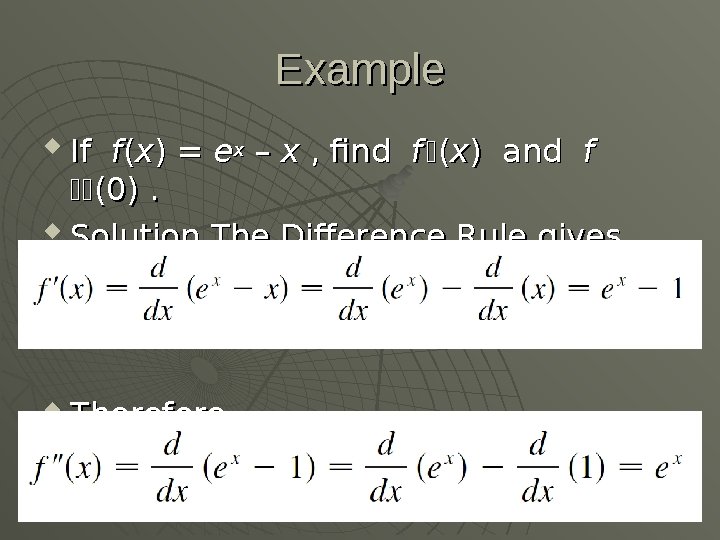
Example If f(x) = ex – x , find f (x) and f (0). Solution The Difference Rule gives Therefore
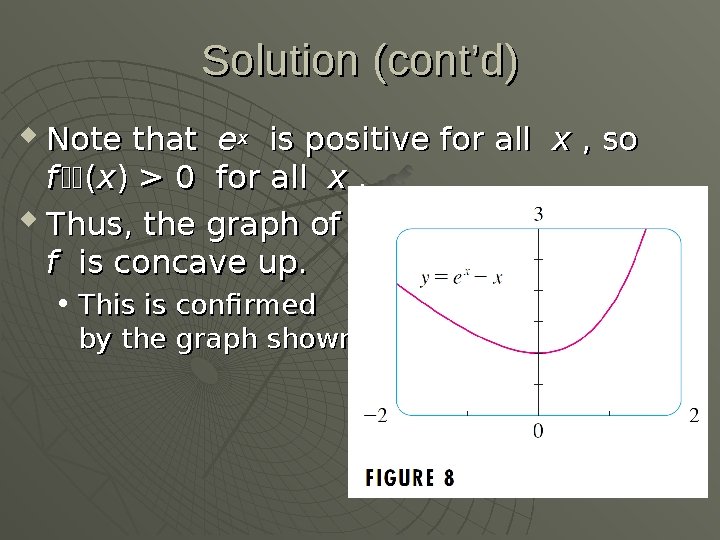
Solution (cont’d) Note that ex is positive for all x , so f (x) > 0 for all x. Thus, the graph of f is concave up. • This is confirmed by the graph shown.
Review Derivative formulas for polynomial and exponential functions Sum and Difference Rules The natural exponential function ex