
Section 3 0 Structural Strength and Stability Over
Section 3. 0 – Structural Strength and Stability Over the years many materials such as animal skins, mud, and sticks were used. Today designers have a wide variety of materials to choose from which have been discovered or invented. Today we know which material will be the best for a specific function.
3. 1 Materials and their Properties Materials Have Properties 1. Brittleness – how easily does the material break 2. Ductility – how easily can the material be made into wire 3. Hardness – how hard is the material 4. Plasticity – how easy is the material to shape 5. Resistance to heat 6. Resistance to water 7. Compression 8. Tensile strength – stretch or pulled
Other Considerations 1. Aesthetics 2. Consumer demand – who wants it? 3. Availability 4. Cost 5. Effect on the environment 6. Disposal of waste

Deformation You need materials able to withstand the forces acting on it Deformation – the change in shape in a structure or any structural component The material is unable to resist the load acting on it When to much deformation has occurred the structure has the possibility of failure

Flexibility - is the ability of a material to be bent under force without breaking Change in shape under a given load without breaking Ex: tall building or tree in the wind Homework - Check & Reflect Pg. 312
Section 3. 2 – Structural Components What is a Joint? Definition: place at which structural parts are joined (can be rigid or fixed for proper function) Examples - Human Knee/Elbow - Arm on a pair of glasses - Hinges on locker or door What is Friction? Definition: a force that results when two surfaces move/rub against each other ü The force of friction depends on roughness or smoothness of the two surfaces that are in contact with one another Example – moving a desk across the floor vs. moving the desk across the floor with a friend sitting in it
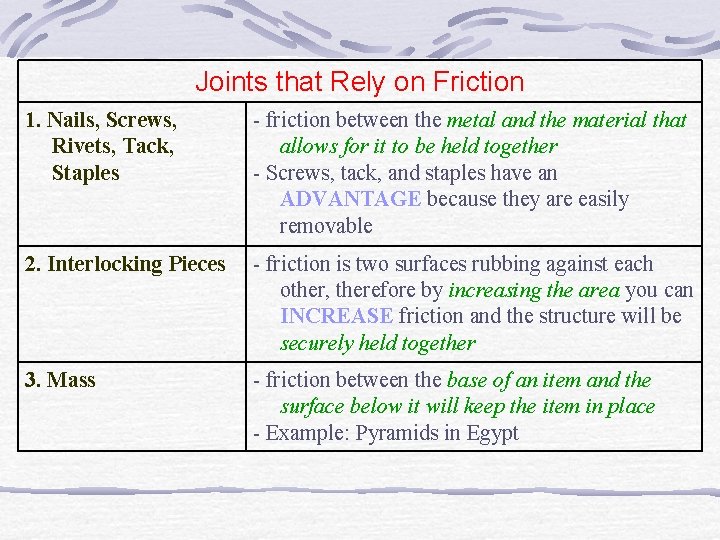
Joints that Rely on Friction 1. Nails, Screws, Rivets, Tack, Staples - friction between the metal and the material that allows for it to be held together - Screws, tack, and staples have an ADVANTAGE because they are easily removable 2. Interlocking Pieces - friction is two surfaces rubbing against each other, therefore by increasing the area you can INCREASE friction and the structure will be securely held together 3. Mass - friction between the base of an item and the surface below it will keep the item in place - Example: Pyramids in Egypt
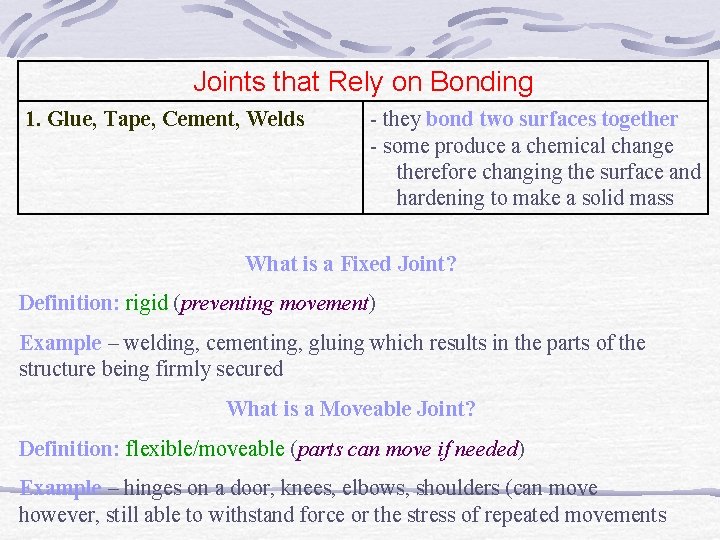
Joints that Rely on Bonding 1. Glue, Tape, Cement, Welds - they bond two surfaces together - some produce a chemical change therefore changing the surface and hardening to make a solid mass What is a Fixed Joint? Definition: rigid (preventing movement) Example – welding, cementing, gluing which results in the parts of the structure being firmly secured What is a Moveable Joint? Definition: flexible/moveable (parts can move if needed) Example – hinges on a door, knees, elbows, shoulders (can move however, still able to withstand force or the stress of repeated movements
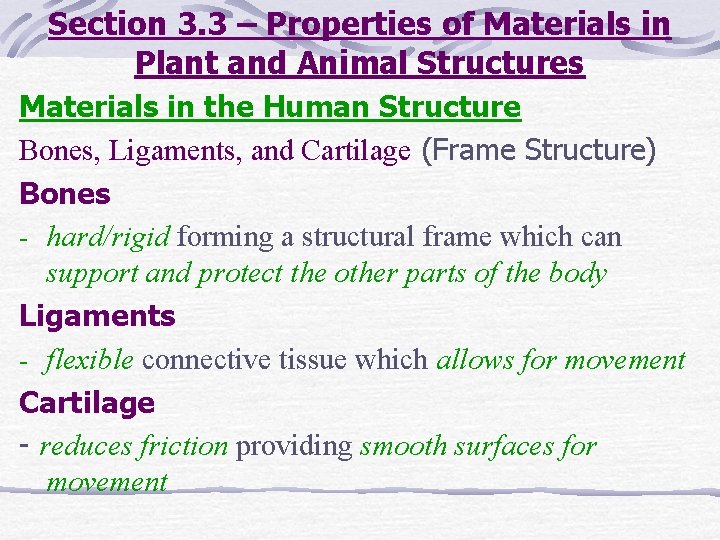
Section 3. 3 – Properties of Materials in Plant and Animal Structures Materials in the Human Structure Bones, Ligaments, and Cartilage (Frame Structure) Bones - hard/rigid forming a structural frame which can support and protect the other parts of the body Ligaments - flexible connective tissue which allows for movement Cartilage - reduces friction providing smooth surfaces for movement
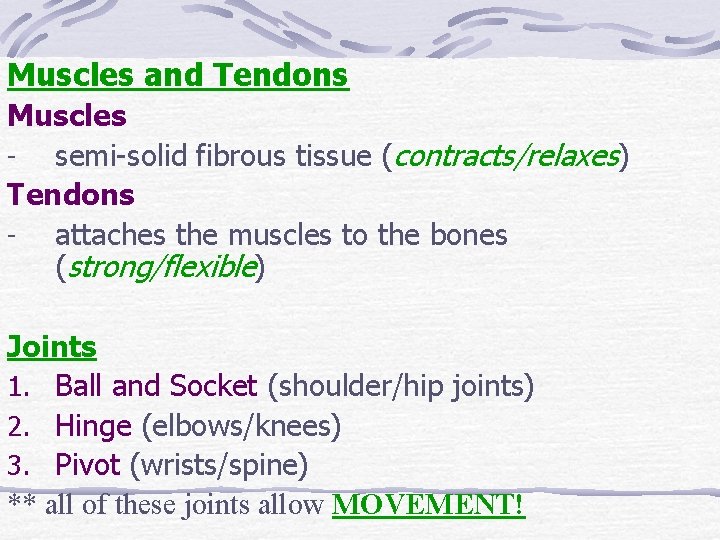
Muscles and Tendons Muscles - semi-solid fibrous tissue (contracts/relaxes) Tendons - attaches the muscles to the bones (strong/flexible) Joints 1. Ball and Socket (shoulder/hip joints) 2. Hinge (elbows/knees) 3. Pivot (wrists/spine) ** all of these joints allow MOVEMENT!
Skin (human shell) - tough, flexible (waterproofs the body and protects it from bacteria) as well it works to regulate temperature (perspire and shiver) Materials in a Tree’s Structure Draw, Label and Explain the 5 layers a tree is composed of, shown in Figure 3. 17 (pg. 321) Homework - pg. 323 Assess Your Learning Q’s 2, 3, and 5
- Slides: 11