
Section 3 0 Compounds Form According to a
- Slides: 44
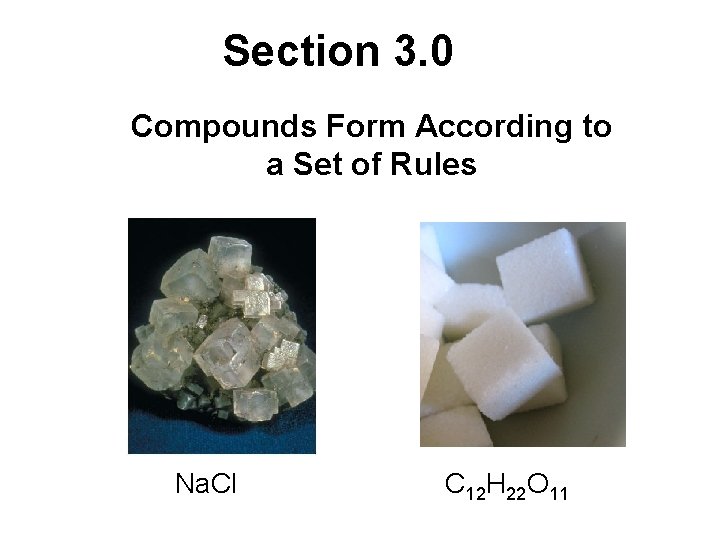
Section 3. 0 Compounds Form According to a Set of Rules Na. Cl C 12 H 22 O 11
Section 3. 1 Naming Compounds • A compound occurs when two or more elements combine chemically to produce a new substance. • Each compound has its own chemical name and formula. • Chemical formula – identifies which elements and how many of each are in a compound
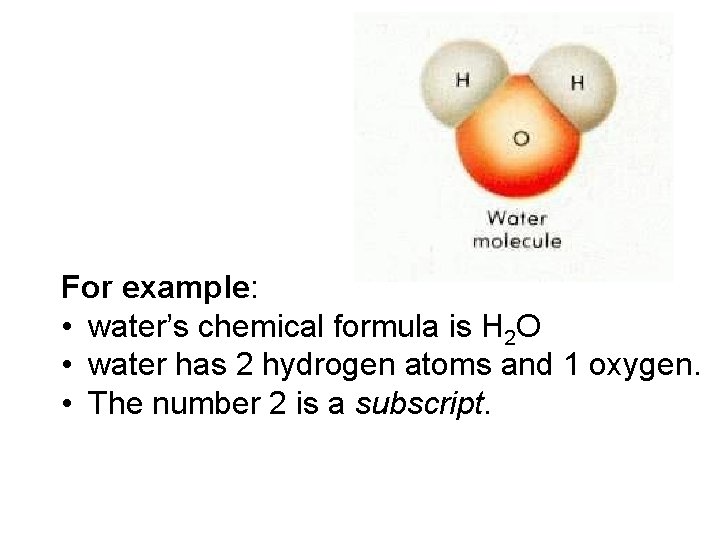
For example: • water’s chemical formula is H 2 O • water has 2 hydrogen atoms and 1 oxygen. • The number 2 is a subscript.
Nomenclature: • In 1787, Guyton de Morveau created a naming system for chemicals. • The metallic element name is written first followed by the non-metallic element. • Since 1920, the International Union of Pure and Applied Chemistry or IUPAC governs the naming of compounds.
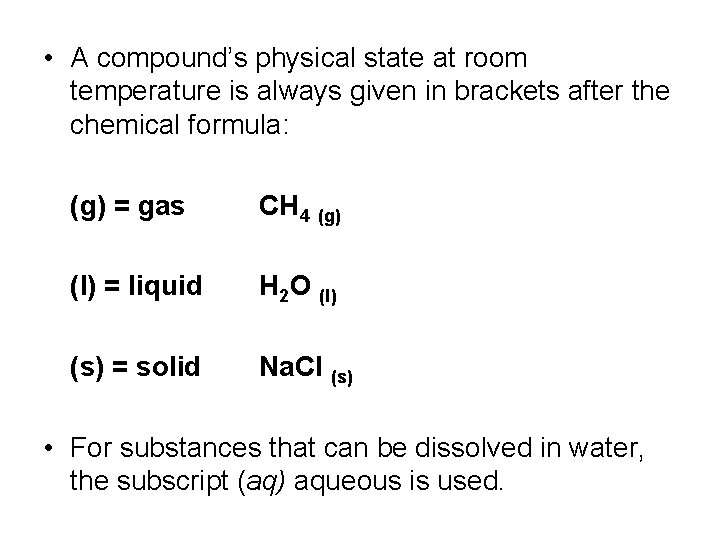
• A compound’s physical state at room temperature is always given in brackets after the chemical formula: (g) = gas CH 4 (g) (l) = liquid H 2 O (l) (s) = solid Na. Cl (s) • For substances that can be dissolved in water, the subscript (aq) aqueous is used.
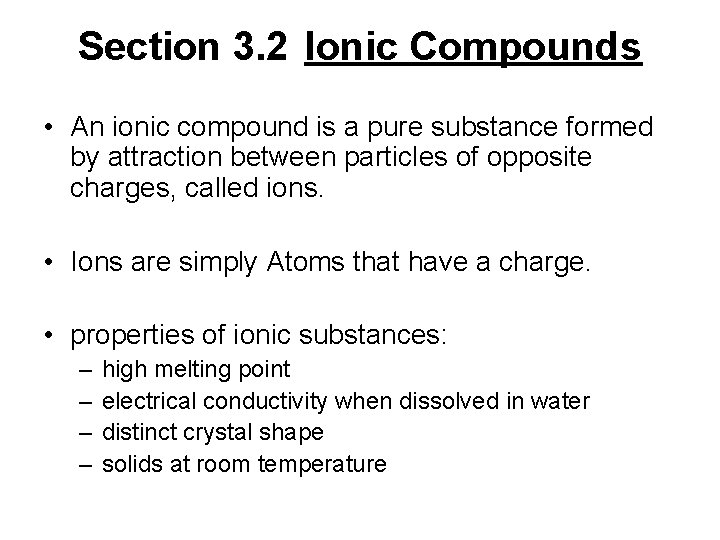
Section 3. 2 Ionic Compounds • An ionic compound is a pure substance formed by attraction between particles of opposite charges, called ions. • Ions are simply Atoms that have a charge. • properties of ionic substances: – – high melting point electrical conductivity when dissolved in water distinct crystal shape solids at room temperature
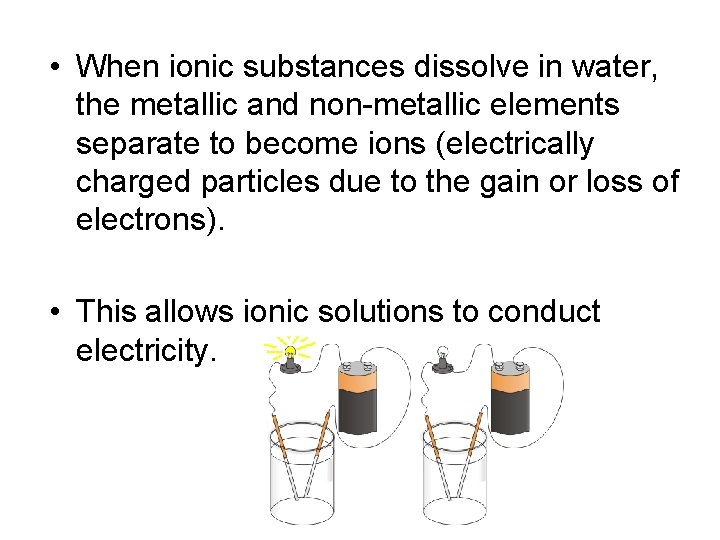
• When ionic substances dissolve in water, the metallic and non-metallic elements separate to become ions (electrically charged particles due to the gain or loss of electrons). • This allows ionic solutions to conduct electricity.
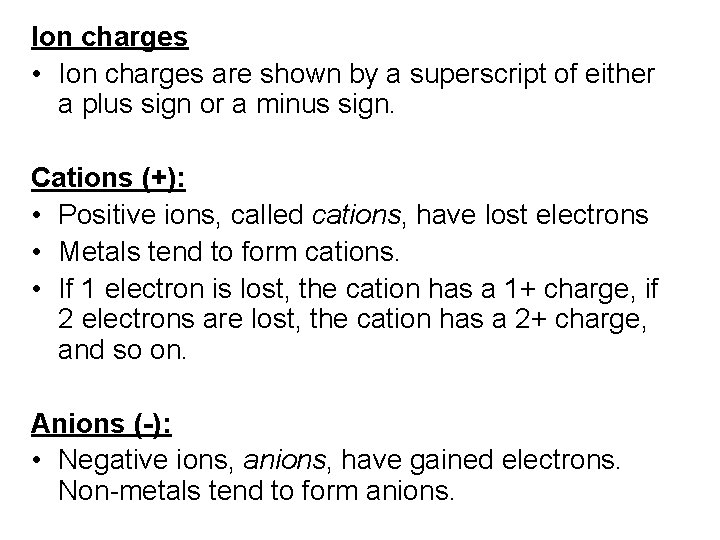
Ion charges • Ion charges are shown by a superscript of either a plus sign or a minus sign. Cations (+): • Positive ions, called cations, have lost electrons • Metals tend to form cations. • If 1 electron is lost, the cation has a 1+ charge, if 2 electrons are lost, the cation has a 2+ charge, and so on. Anions (-): • Negative ions, anions, have gained electrons. Non-metals tend to form anions.
• How do you remember which ions are positive?
• How do you remember which ions are positive? • Just remember, “Cats have Pos”!
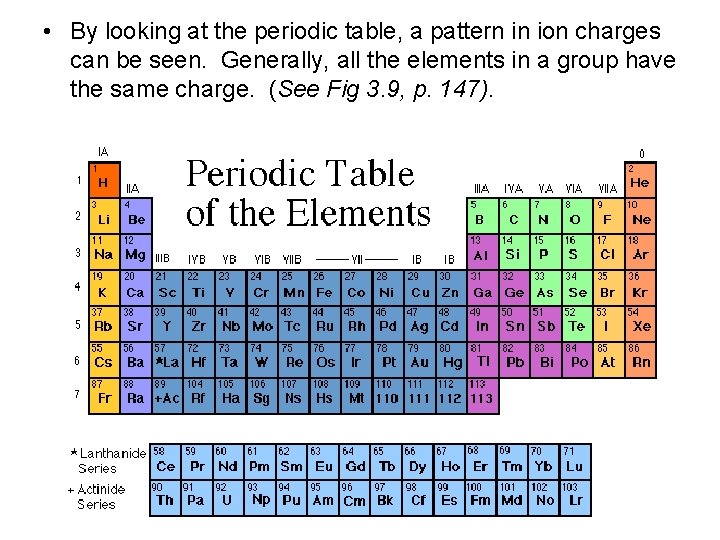
• By looking at the periodic table, a pattern in ion charges can be seen. Generally, all the elements in a group have the same charge. (See Fig 3. 9, p. 147).
Naming Ionic Compounds • Use the full name of the metal (cation) ion first • Put the name of the non-metal (anion) last and change the ending to –ide • Exception: if the anion is a polyatomic ion, its name remains unchanged • If the cation has more than 1 possible charge, indicate which ion is being used with roman numerals • eg. iron (III) oxide is a compound containing Fe 3+
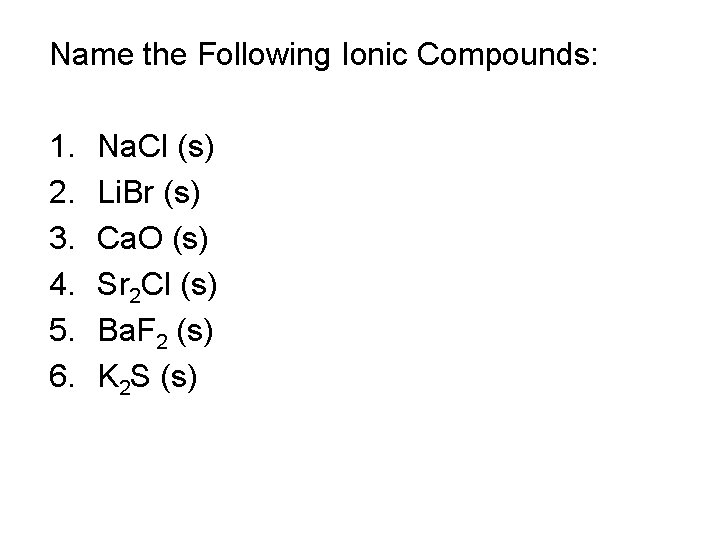
Name the Following Ionic Compounds: 1. 2. 3. 4. 5. 6. Na. Cl (s) Li. Br (s) Ca. O (s) Sr 2 Cl (s) Ba. F 2 (s) K 2 S (s)
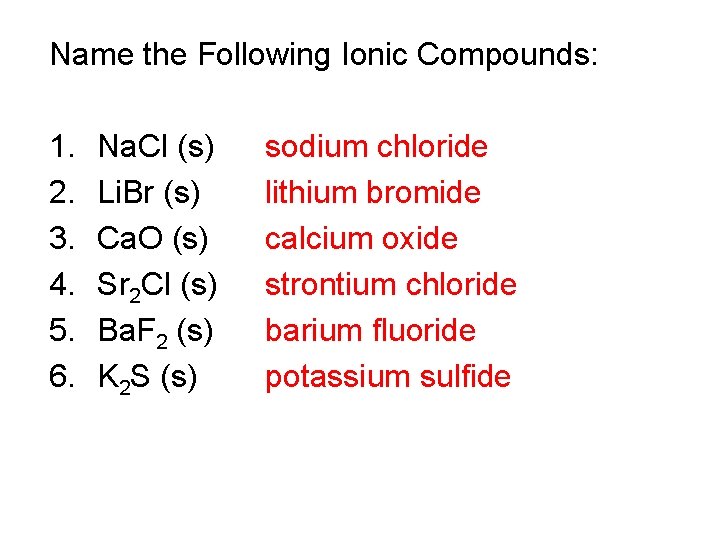
Name the Following Ionic Compounds: 1. 2. 3. 4. 5. 6. Na. Cl (s) Li. Br (s) Ca. O (s) Sr 2 Cl (s) Ba. F 2 (s) K 2 S (s) sodium chloride lithium bromide calcium oxide strontium chloride barium fluoride potassium sulfide
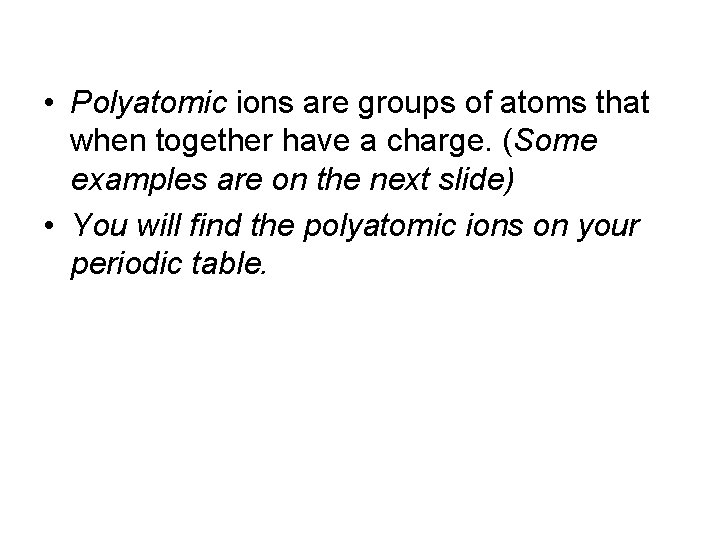
• Polyatomic ions are groups of atoms that when together have a charge. (Some examples are on the next slide) • You will find the polyatomic ions on your periodic table.
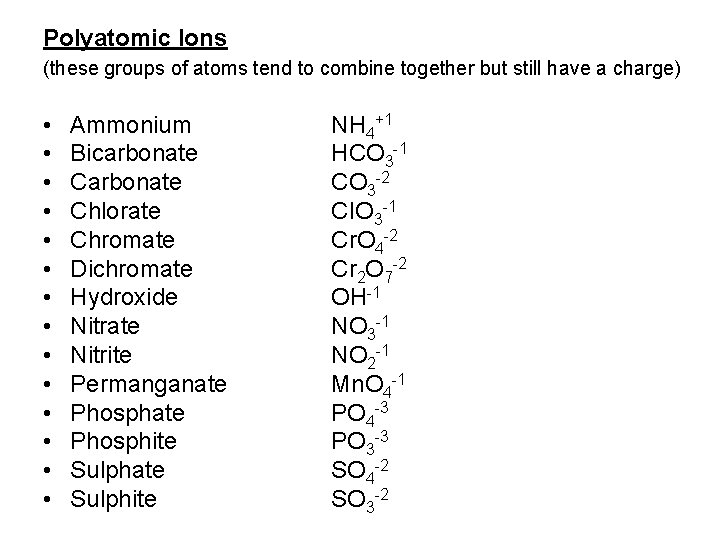
Polyatomic Ions (these groups of atoms tend to combine together but still have a charge) • • • • Ammonium Bicarbonate Chlorate Chromate Dichromate Hydroxide Nitrate Nitrite Permanganate Phosphite Sulphate Sulphite NH 4+1 HCO 3 -1 CO 3 -2 CIO 3 -1 Cr. O 4 -2 Cr 2 O 7 -2 OH-1 NO 3 -1 NO 2 -1 Mn. O 4 -1 PO 4 -3 PO 3 -3 SO 4 -2 SO 3 -2
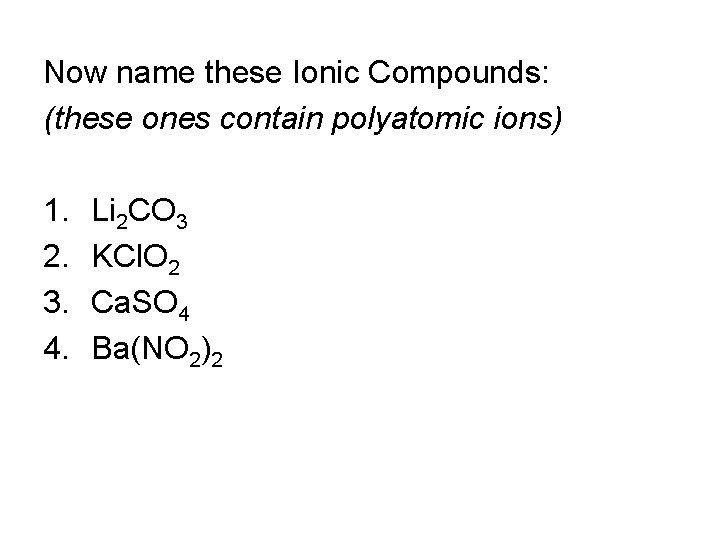
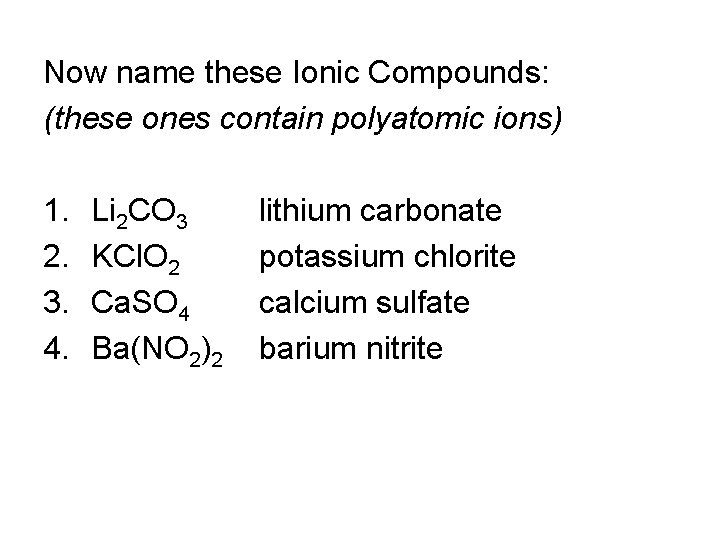
Now name these Ionic Compounds: (these ones contain polyatomic ions) 1. 2. 3. 4. Li 2 CO 3 KCl. O 2 Ca. SO 4 Ba(NO 2)2
Now name these Ionic Compounds: (these ones contain polyatomic ions) 1. 2. 3. 4. Li 2 CO 3 KCl. O 2 Ca. SO 4 Ba(NO 2)2 lithium carbonate potassium chlorite calcium sulfate barium nitrite
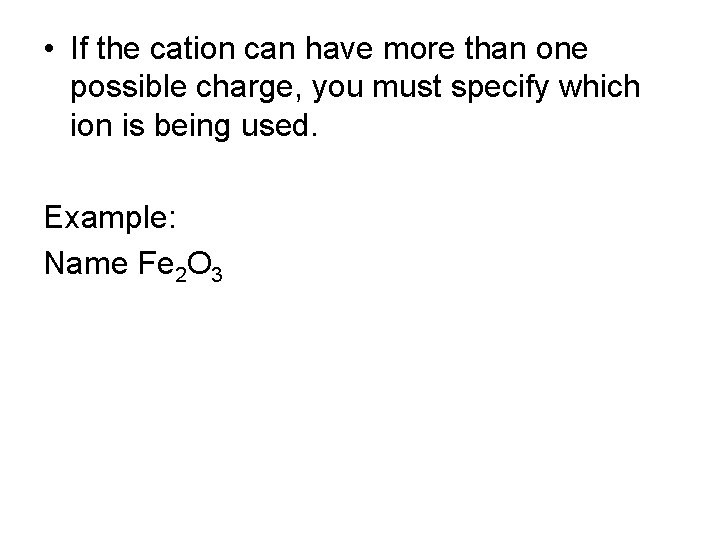
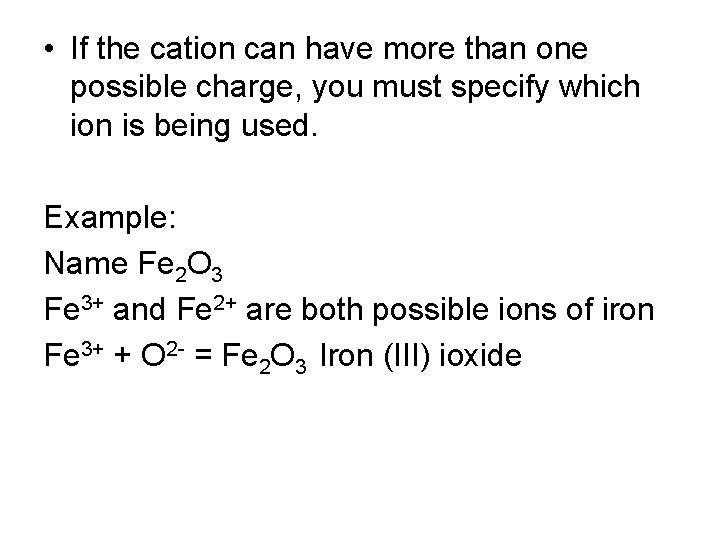
• If the cation can have more than one possible charge, you must specify which ion is being used. Example: Name Fe 2 O 3
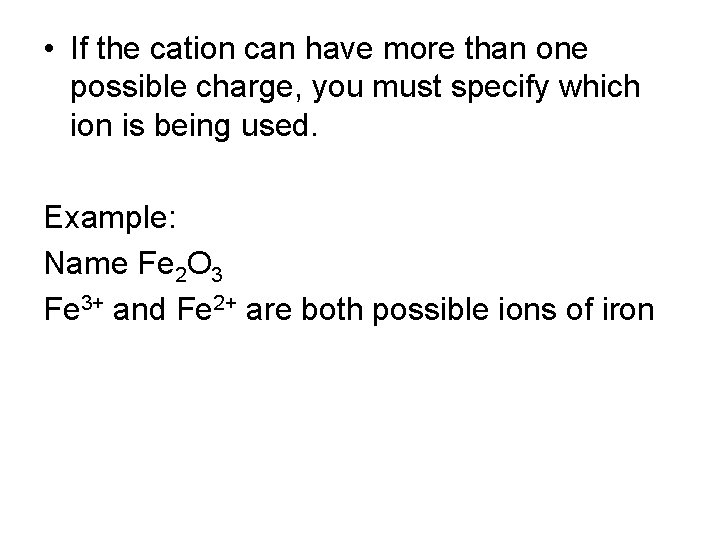
• If the cation can have more than one possible charge, you must specify which ion is being used. Example: Name Fe 2 O 3 Fe 3+ and Fe 2+ are both possible ions of iron
• If the cation can have more than one possible charge, you must specify which ion is being used. Example: Name Fe 2 O 3 Fe 3+ and Fe 2+ are both possible ions of iron Fe 3+ + O 2 - = Fe 2 O 3 Iron (III) ioxide
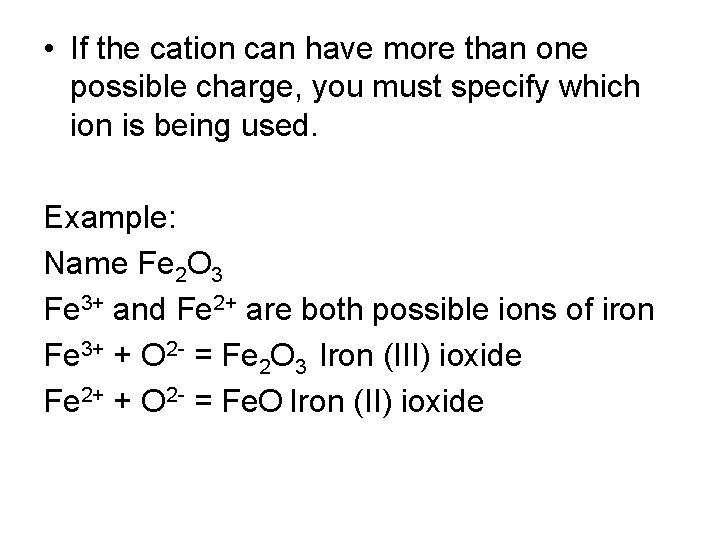
• If the cation can have more than one possible charge, you must specify which ion is being used. Example: Name Fe 2 O 3 Fe 3+ and Fe 2+ are both possible ions of iron Fe 3+ + O 2 - = Fe 2 O 3 Iron (III) ioxide Fe 2+ + O 2 - = Fe. O Iron (II) ioxide
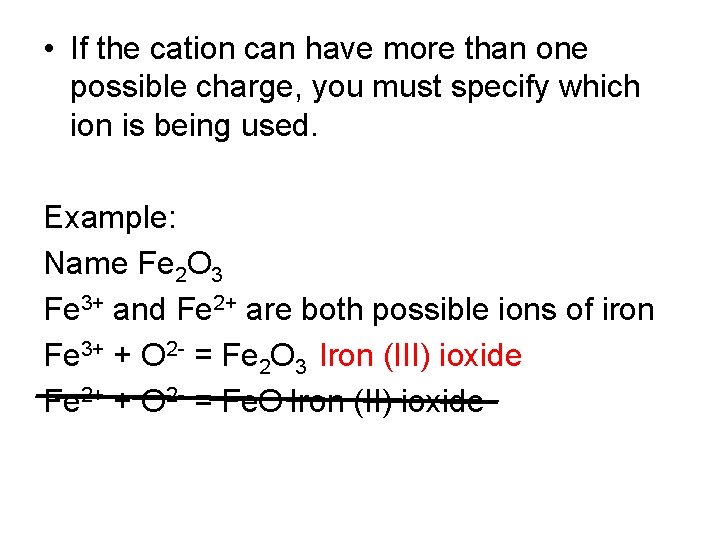
• If the cation can have more than one possible charge, you must specify which ion is being used. Example: Name Fe 2 O 3 Fe 3+ and Fe 2+ are both possible ions of iron Fe 3+ + O 2 - = Fe 2 O 3 Iron (III) ioxide Fe 2+ + O 2 - = Fe. O Iron (II) ioxide
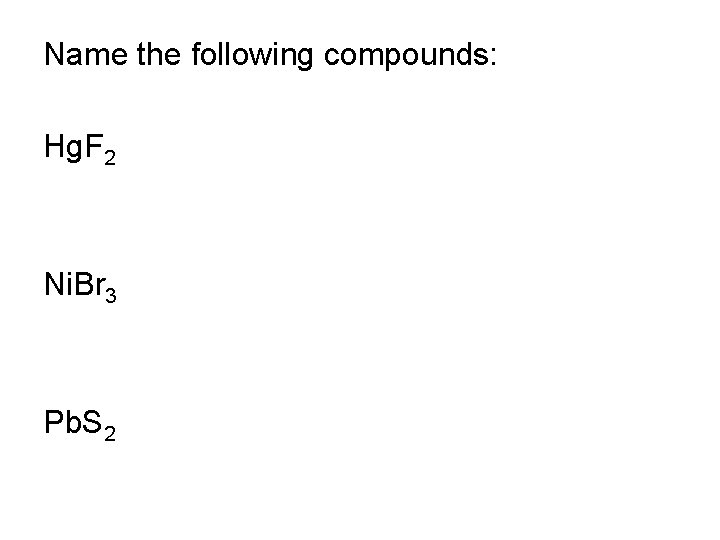
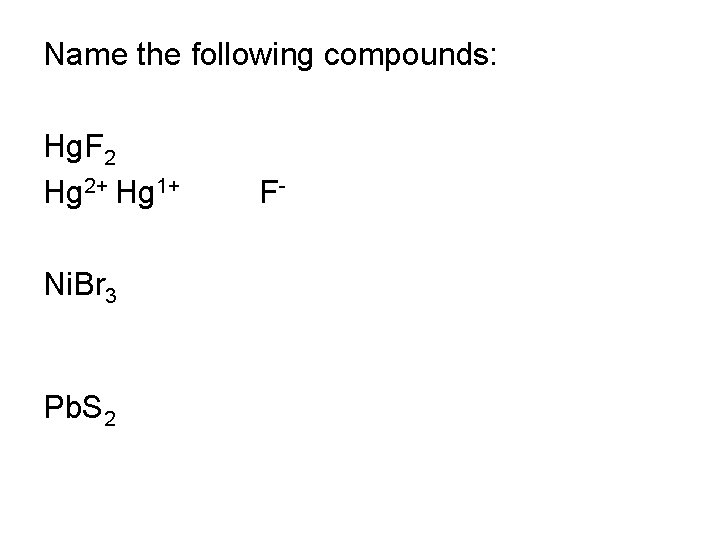
Name the following compounds: Hg. F 2 Ni. Br 3 Pb. S 2
Name the following compounds: Hg. F 2 Hg 2+ Hg 1+ Ni. Br 3 Pb. S 2 F-
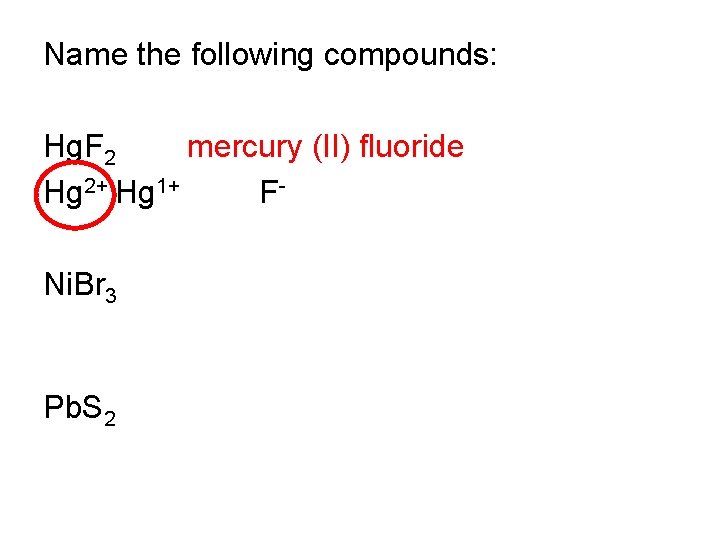
Name the following compounds: Hg. F 2 mercury (II) fluoride Hg 2+ Hg 1+ FNi. Br 3 Pb. S 2
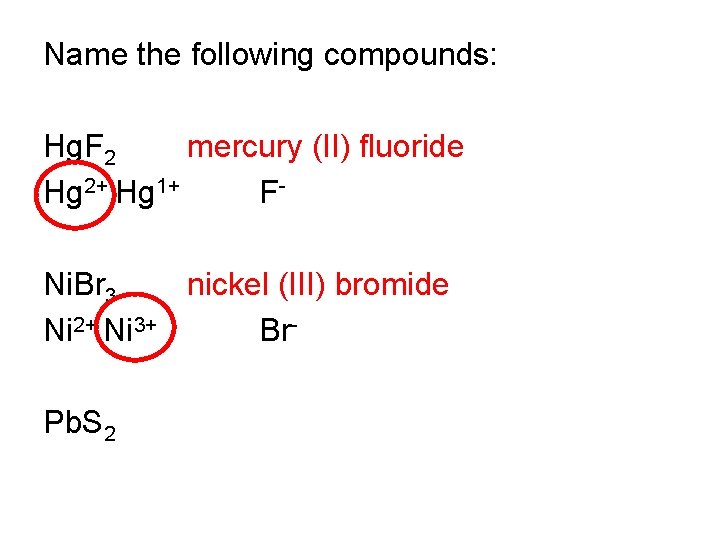
Name the following compounds: Hg. F 2 mercury (II) fluoride Hg 2+ Hg 1+ FNi. Br 3 nickel (III) bromide Ni 2+ Ni 3+ Br. Pb. S 2
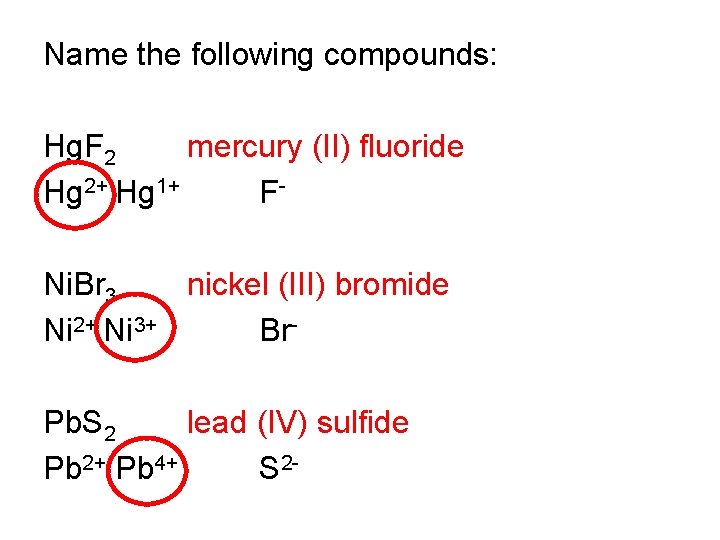
Name the following compounds: Hg. F 2 mercury (II) fluoride Hg 2+ Hg 1+ FNi. Br 3 nickel (III) bromide Ni 2+ Ni 3+ Br. Pb. S 2 lead (IV) sulfide Pb 2+ Pb 4+ S 2 -
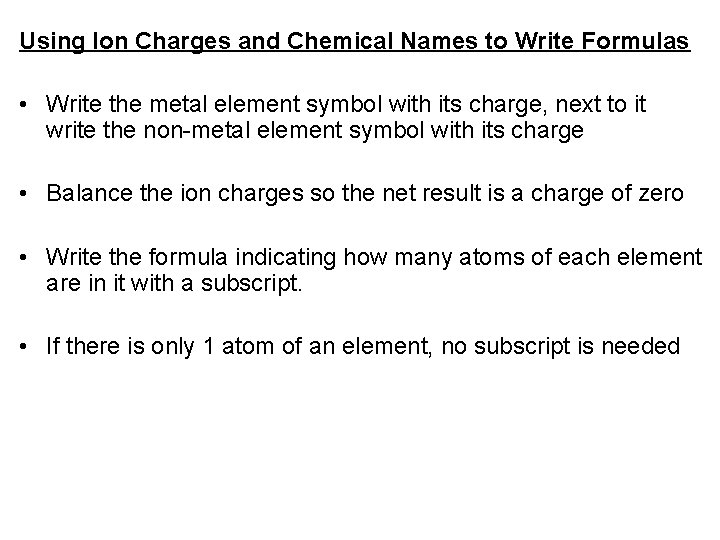
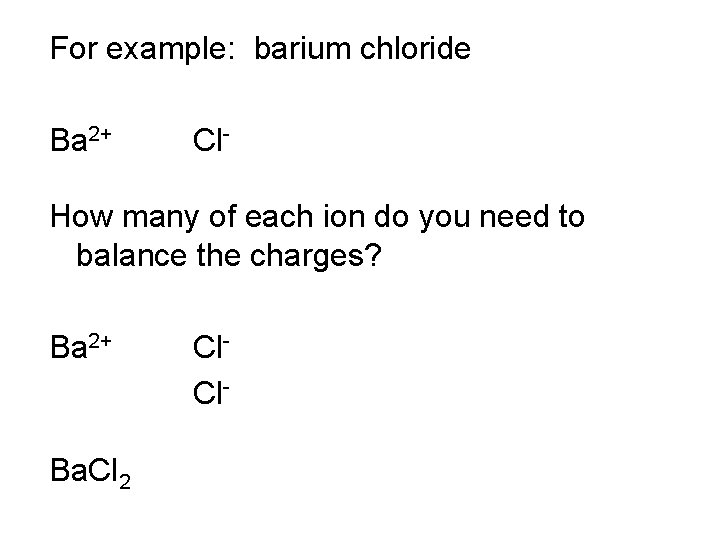
Using Ion Charges and Chemical Names to Write Formulas • Write the metal element symbol with its charge, next to it write the non-metal element symbol with its charge • Balance the ion charges so the net result is a charge of zero • Write the formula indicating how many atoms of each element are in it with a subscript. • If there is only 1 atom of an element, no subscript is needed
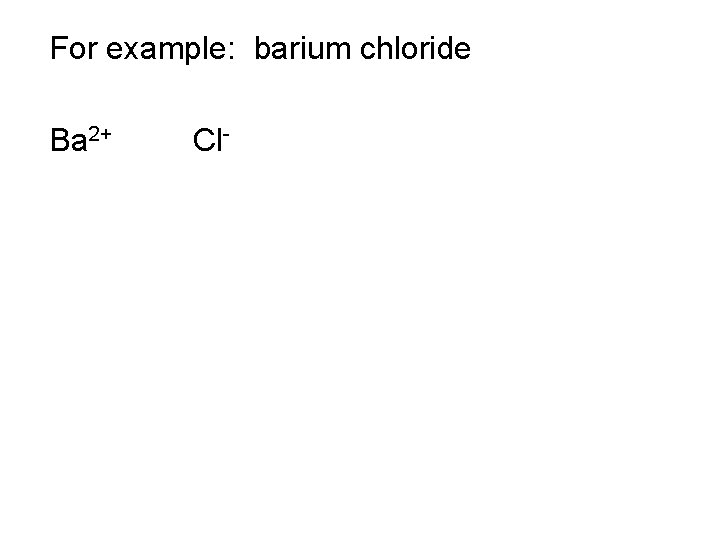
For example: barium chloride Ba 2+ Cl-
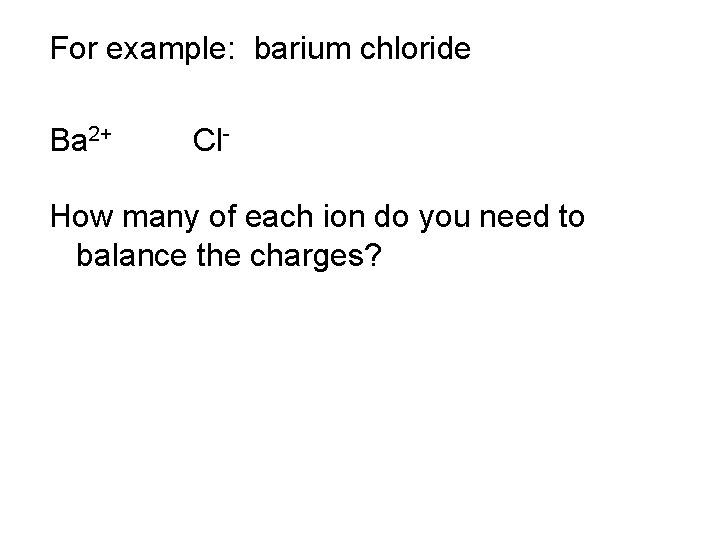
For example: barium chloride Ba 2+ Cl- How many of each ion do you need to balance the charges?
For example: barium chloride Ba 2+ Cl- How many of each ion do you need to balance the charges? Ba 2+ Cl. Cl-
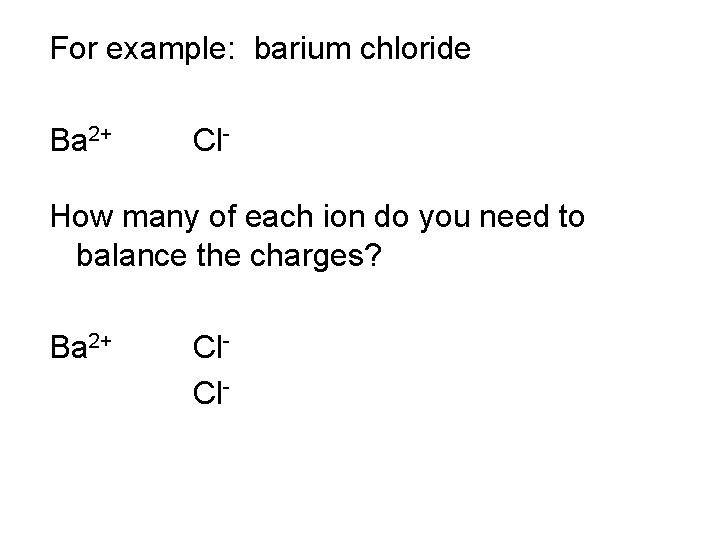
For example: barium chloride Ba 2+ Cl- How many of each ion do you need to balance the charges? Ba 2+ Ba. Cl 2 Cl. Cl-
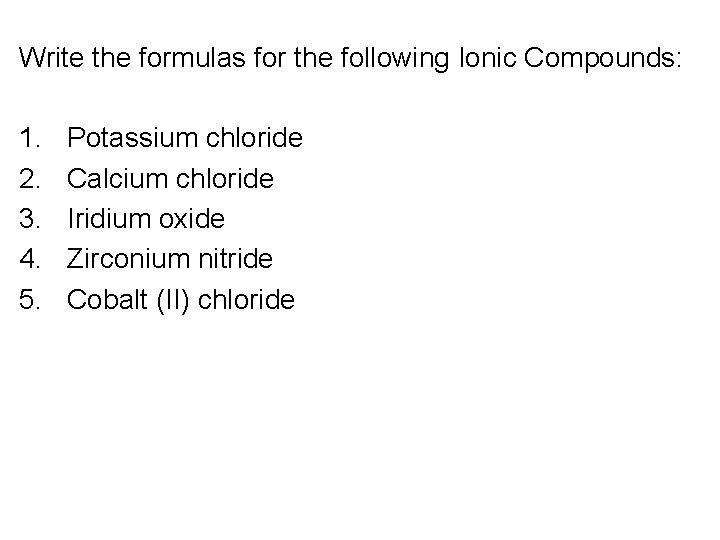
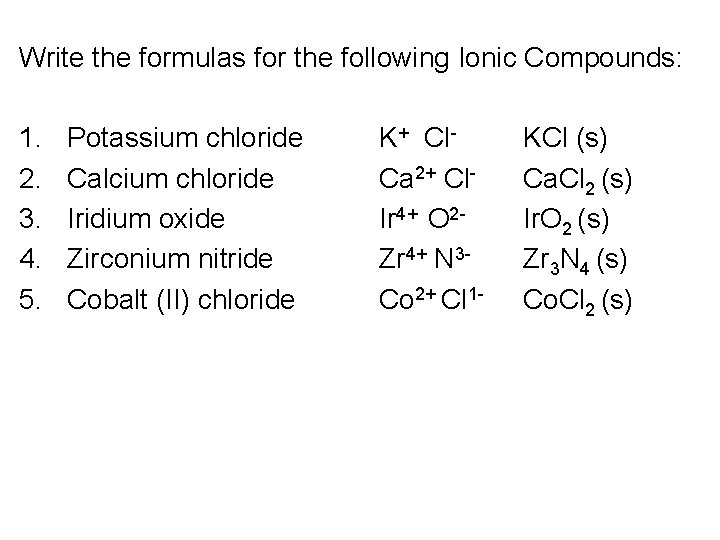
Write the formulas for the following Ionic Compounds: 1. 2. 3. 4. 5. Potassium chloride Calcium chloride Iridium oxide Zirconium nitride Cobalt (II) chloride
Write the formulas for the following Ionic Compounds: 1. 2. 3. 4. 5. Potassium chloride Calcium chloride Iridium oxide Zirconium nitride Cobalt (II) chloride K+ Cl. Ca 2+ Cl. Ir 4+ O 2 Zr 4+ N 3 Co 2+ Cl 1 - KCl (s) Ca. Cl 2 (s) Ir. O 2 (s) Zr 3 N 4 (s) Co. Cl 2 (s)
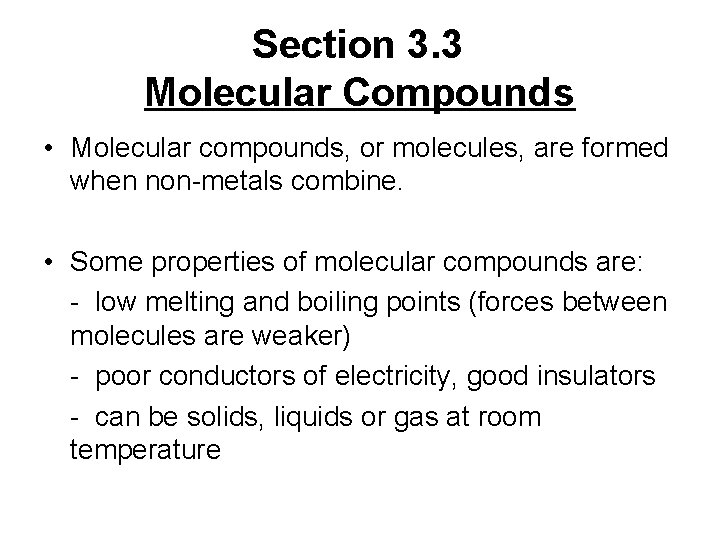
Section 3. 3 Molecular Compounds • Molecular compounds, or molecules, are formed when non-metals combine. • Some properties of molecular compounds are: - low melting and boiling points (forces between molecules are weaker) - poor conductors of electricity, good insulators - can be solids, liquids or gas at room temperature
Naming Molecular Compounds • Many molecules are known by their common names, such as water, H 2 O, and ammonia, NH 3. Others are named as follows:
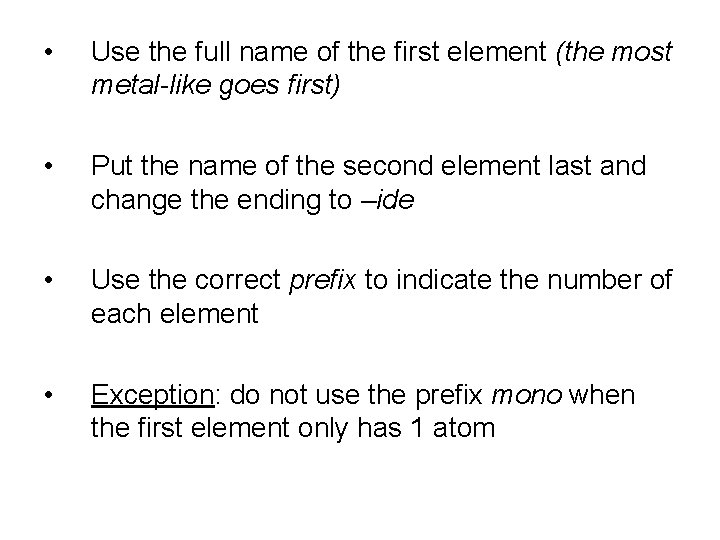
• Use the full name of the first element (the most metal-like goes first) • Put the name of the second element last and change the ending to –ide • Use the correct prefix to indicate the number of each element • Exception: do not use the prefix mono when the first element only has 1 atom
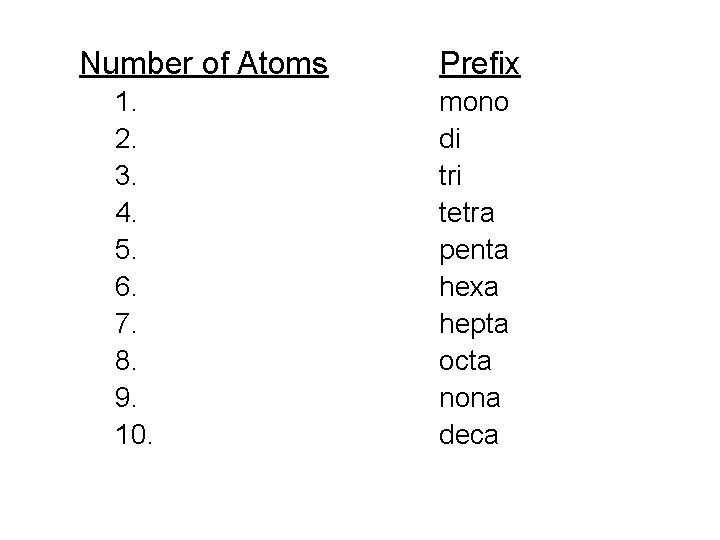
Number of Atoms 1. 2. 3. 4. 5. 6. 7. 8. 9. 10. Prefix mono di tri tetra penta hexa hepta octa nona deca
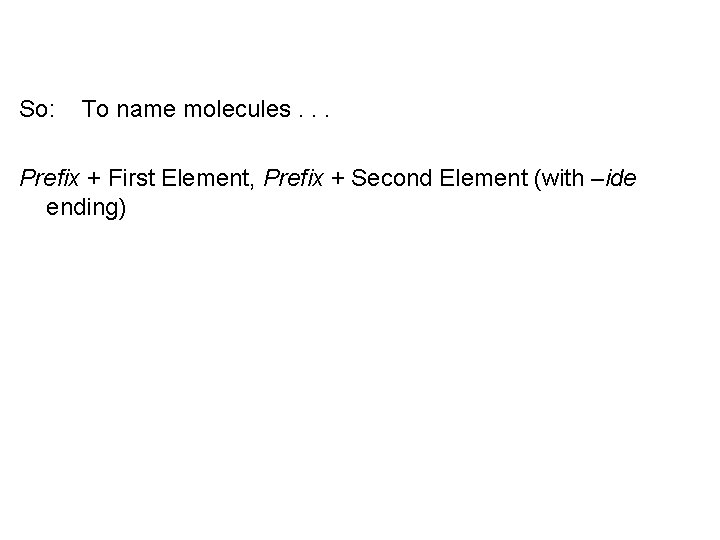
So: To name molecules. . . Prefix + First Element, Prefix + Second Element (with –ide ending)
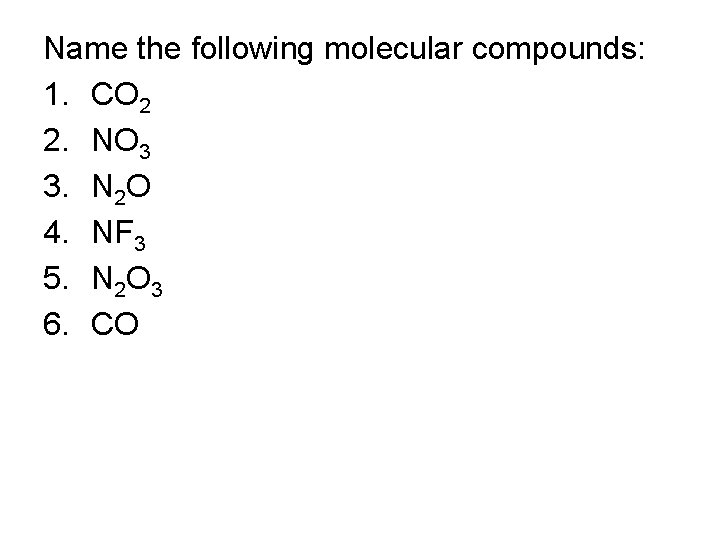
Name the following molecular compounds: 1. CO 2 2. NO 3 3. N 2 O 4. NF 3 5. N 2 O 3 6. CO
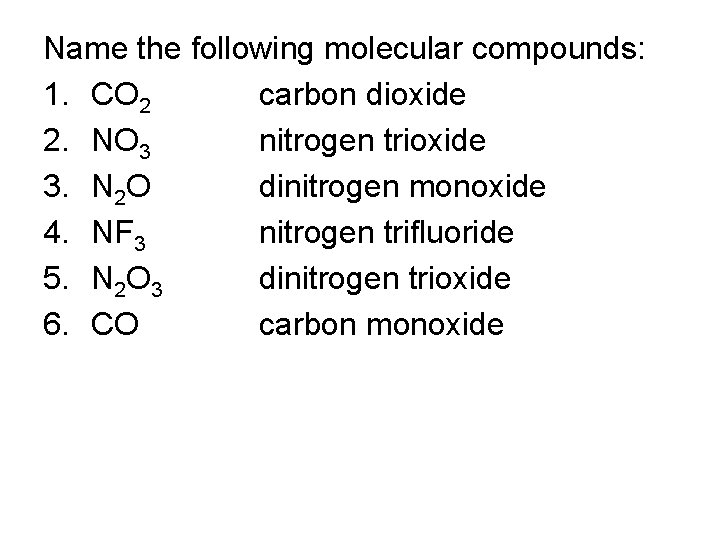
Name the following molecular compounds: 1. CO 2 carbon dioxide 2. NO 3 nitrogen trioxide 3. N 2 O dinitrogen monoxide 4. NF 3 nitrogen trifluoride 5. N 2 O 3 dinitrogen trioxide 6. CO carbon monoxide
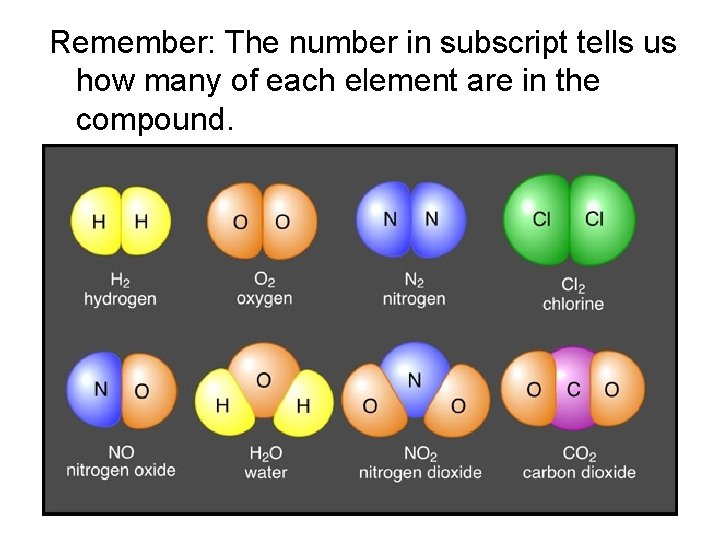
Remember: The number in subscript tells us how many of each element are in the compound.
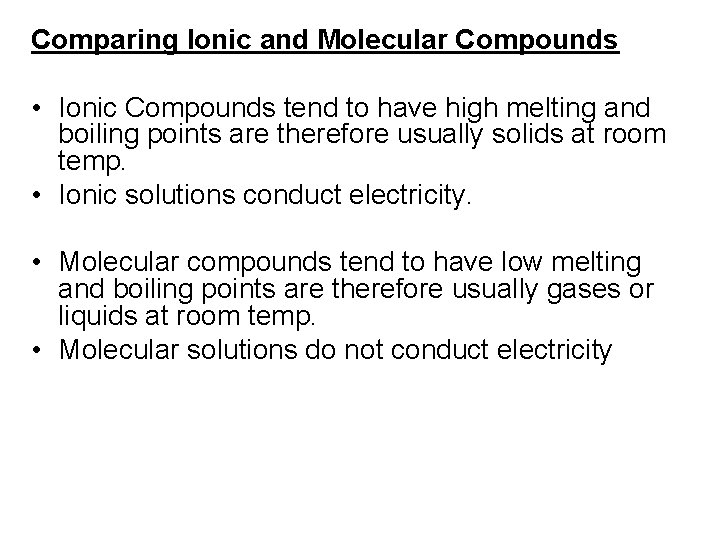
Comparing Ionic and Molecular Compounds • Ionic Compounds tend to have high melting and boiling points are therefore usually solids at room temp. • Ionic solutions conduct electricity. • Molecular compounds tend to have low melting and boiling points are therefore usually gases or liquids at room temp. • Molecular solutions do not conduct electricity