
Section 24 4 The 555 Timer Rectangular Wave
- Slides: 17
Section 24. 4 The 555 Timer
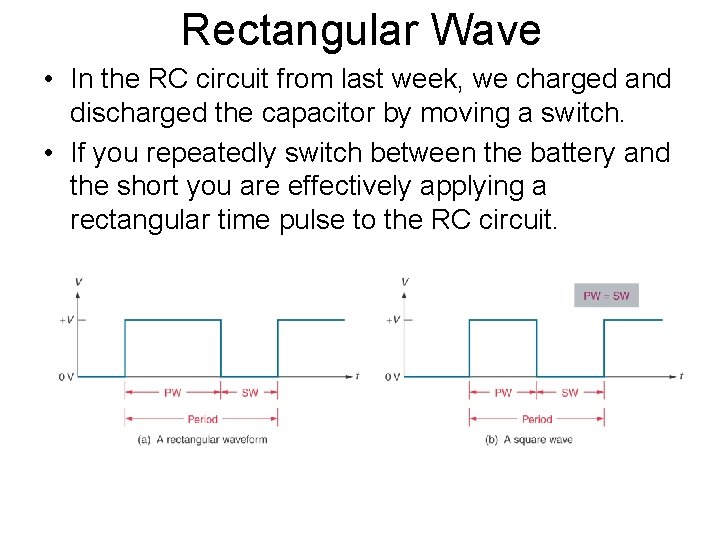
Rectangular Wave • In the RC circuit from last week, we charged and discharged the capacitor by moving a switch. • If you repeatedly switch between the battery and the short you are effectively applying a rectangular time pulse to the RC circuit.
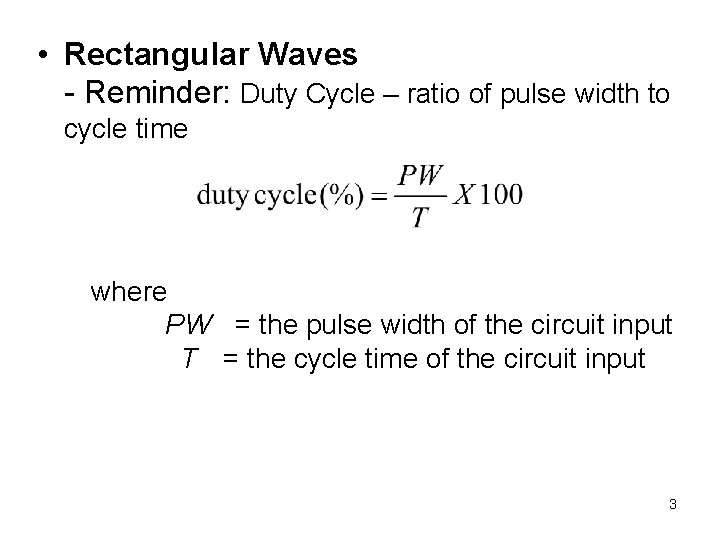
• Rectangular Waves - Reminder: Duty Cycle – ratio of pulse width to cycle time where PW = the pulse width of the circuit input T = the cycle time of the circuit input 3
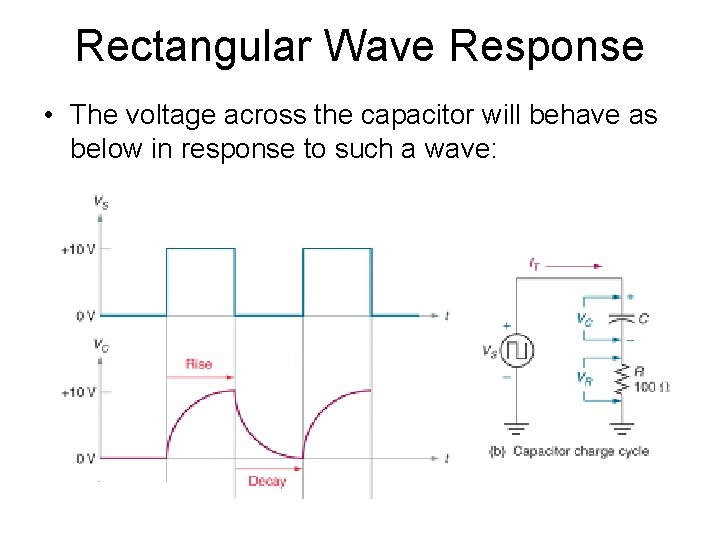
Rectangular Wave Response • The voltage across the capacitor will behave as below in response to such a wave:
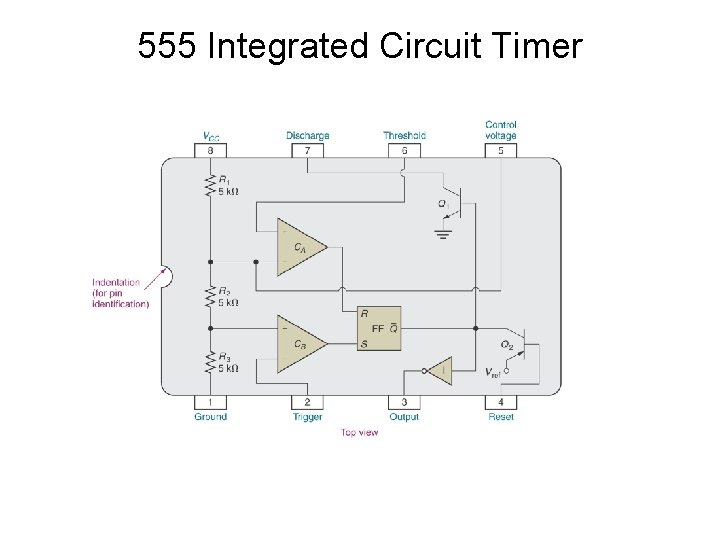
555 Integrated Circuit Timer
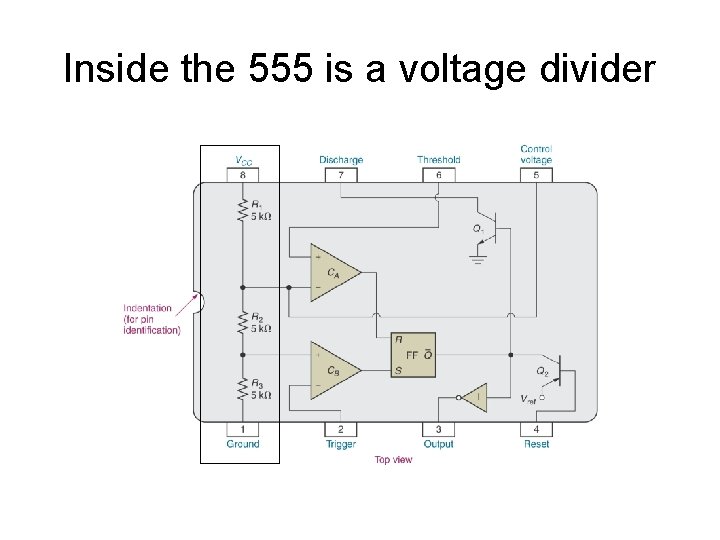
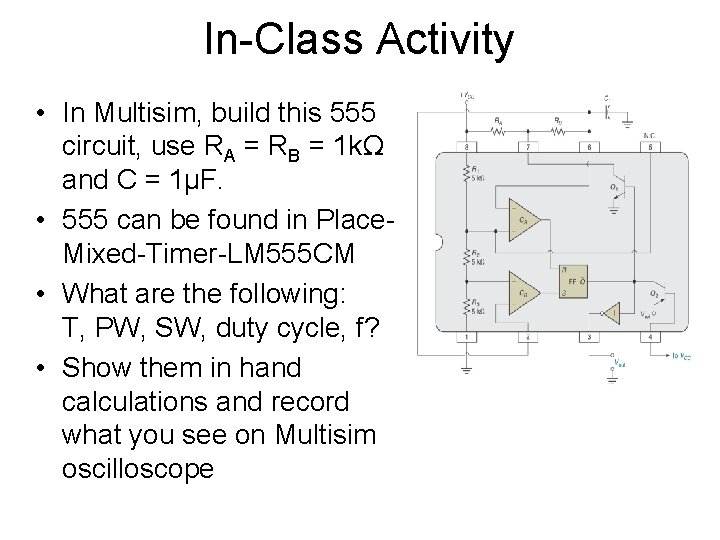
Inside the 555 is a voltage divider
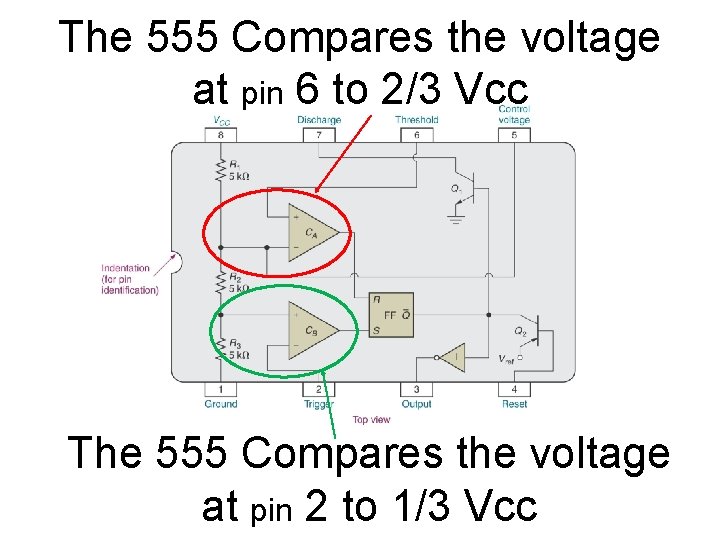
The 555 Compares the voltage at pin 6 to 2/3 Vcc The 555 Compares the voltage at pin 2 to 1/3 Vcc
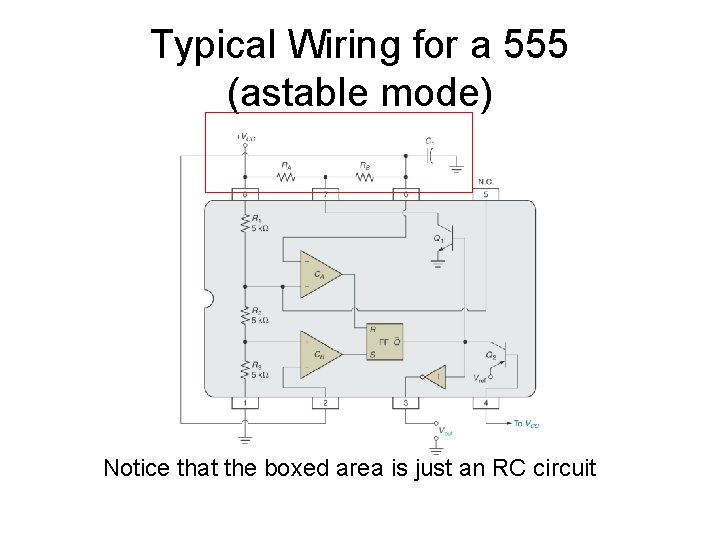
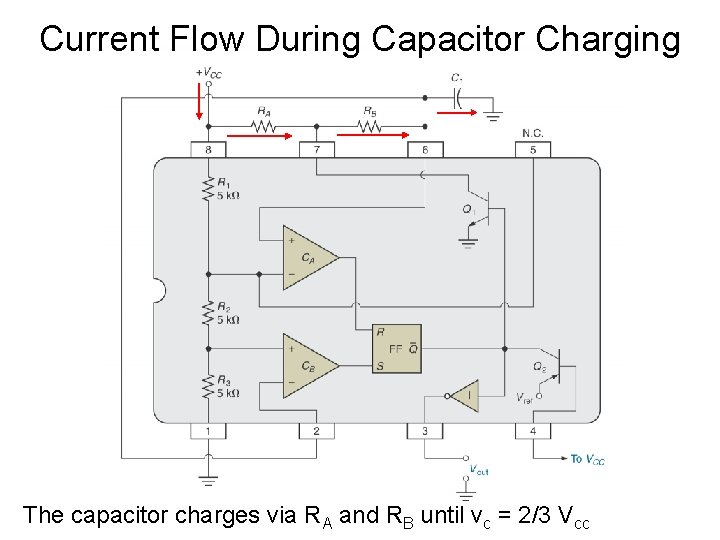
Typical Wiring for a 555 (astable mode) Notice that the boxed area is just an RC circuit
Current Flow During Capacitor Charging The capacitor charges via RA and RB until vc = 2/3 Vcc
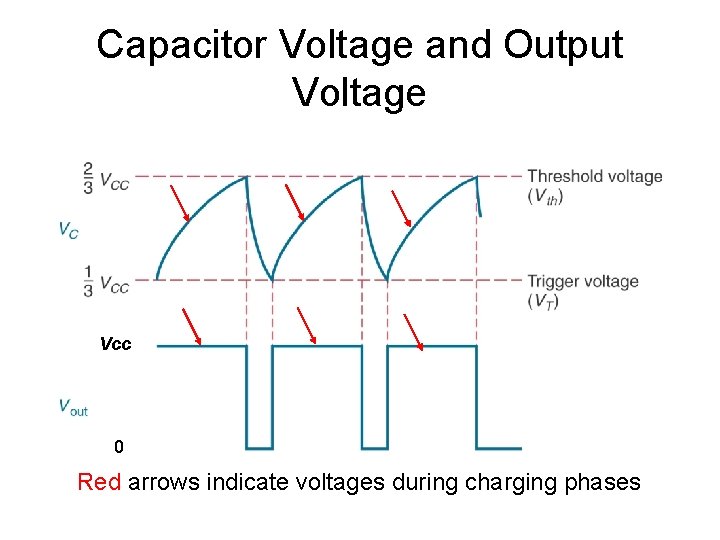
Capacitor Voltage and Output Voltage Vcc 0 Red arrows indicate voltages during charging phases
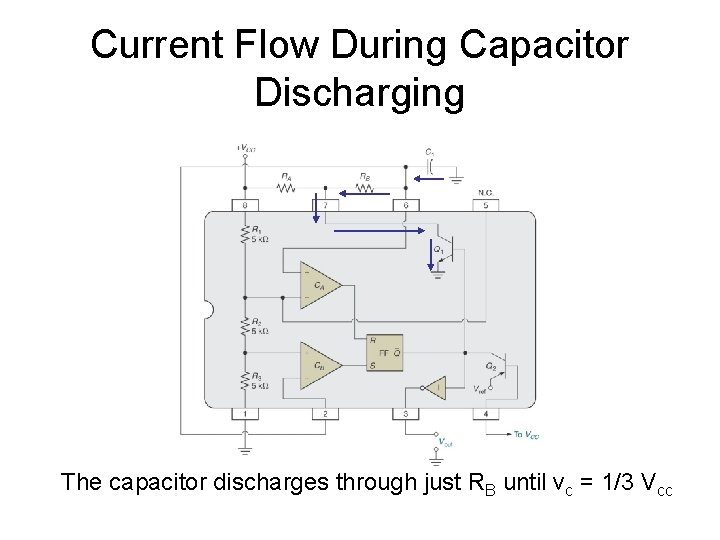
Current Flow During Capacitor Discharging The capacitor discharges through just RB until vc = 1/3 Vcc
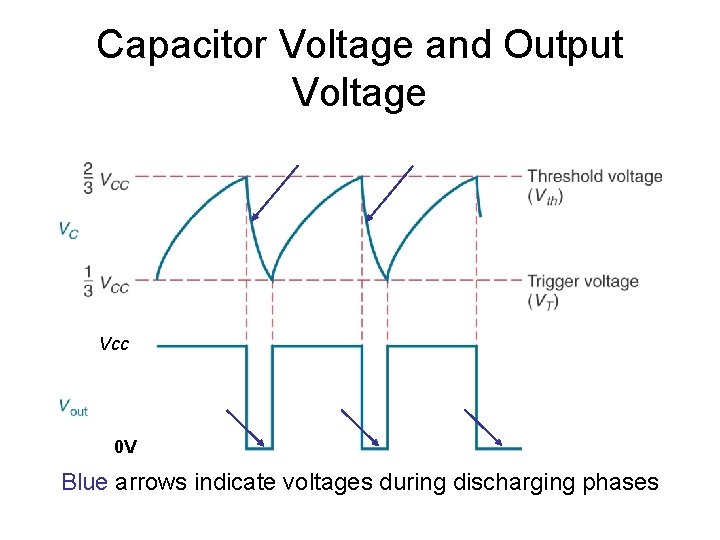
Capacitor Voltage and Output Voltage Vcc 0 V Blue arrows indicate voltages during discharging phases
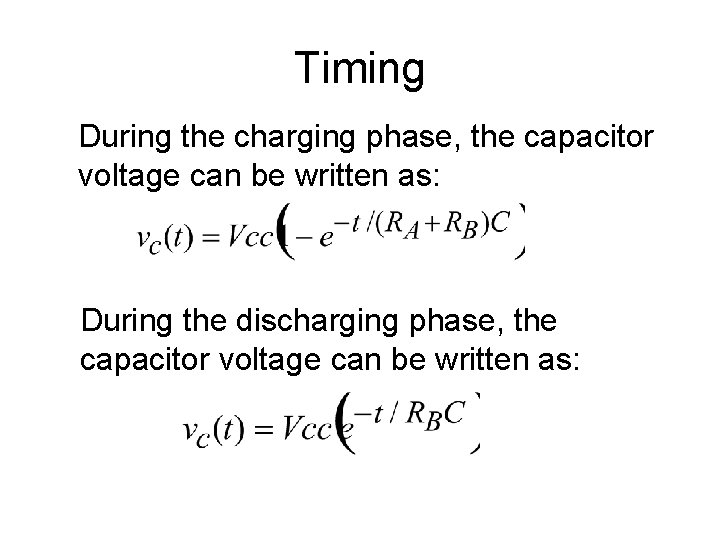
Timing During the charging phase, the capacitor voltage can be written as: During the discharging phase, the capacitor voltage can be written as:
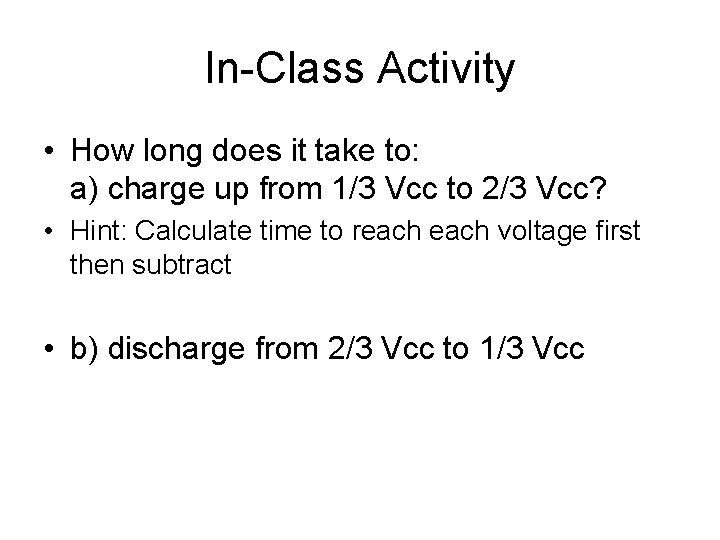
In-Class Activity • How long does it take to: a) charge up from 1/3 Vcc to 2/3 Vcc? • Hint: Calculate time to reach voltage first then subtract • b) discharge from 2/3 Vcc to 1/3 Vcc
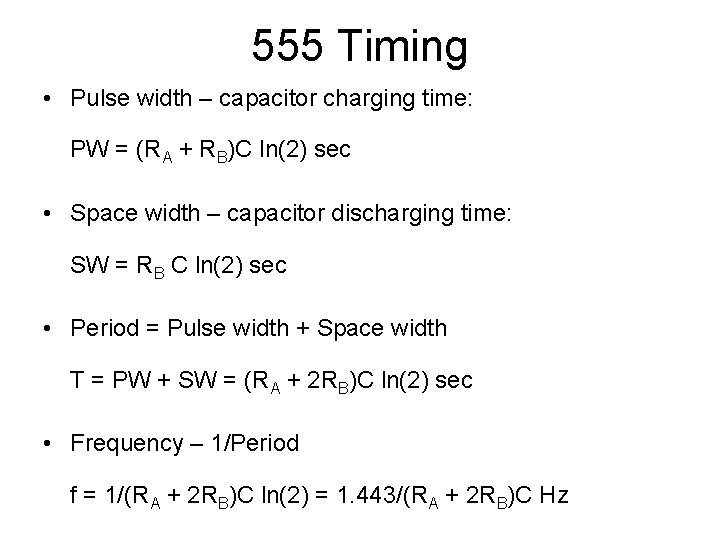
555 Timing • Pulse width – capacitor charging time: PW = (RA + RB)C ln(2) sec • Space width – capacitor discharging time: SW = RB C ln(2) sec • Period = Pulse width + Space width T = PW + SW = (RA + 2 RB)C ln(2) sec • Frequency – 1/Period f = 1/(RA + 2 RB)C ln(2) = 1. 443/(RA + 2 RB)C Hz
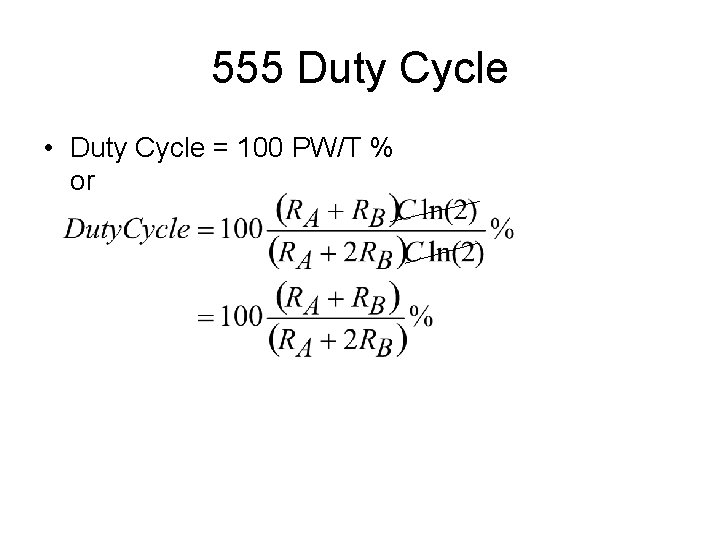
555 Duty Cycle • Duty Cycle = 100 PW/T % or
In-Class Activity • In Multisim, build this 555 circuit, use RA = RB = 1 kΩ and C = 1µF. • 555 can be found in Place. Mixed-Timer-LM 555 CM • What are the following: T, PW, SW, duty cycle, f? • Show them in hand calculations and record what you see on Multisim oscilloscope