
Section 20 4 Neutralization Reactions OBJECTIVES Define the
Section 20. 4 Neutralization Reactions • OBJECTIVES: –Define the products of an acid-base reaction.
Section 20. 4 Neutralization Reactions • OBJECTIVES: –Explain how acid-base titration is used to calculate the concentration of an acid or a base.
Section 20. 4 Neutralization Reactions • OBJECTIVES: –Explain the concept of equivalence in neutralization reactions.

Section 20. 4 Neutralization Reactions • OBJECTIVES: –Describe the relationship between equivalence point and the end point of a titration.
Acid-Base Reactions Acid + Base Water + Salt • Properties related to every day: – antacids depend on neutralization – farmers adjust the soil p. H – formation of cave stalactites – human body kidney stones from insoluble salts
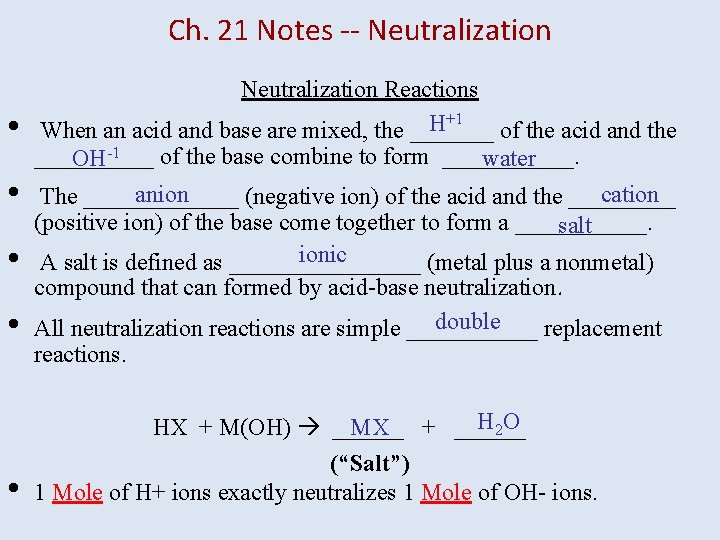
Ch. 21 Notes -- Neutralization • • • Neutralization Reactions H+1 When an acid and base are mixed, the _______ of the acid and the _____ of the base combine to form ______. OH-1 water anion cation The _______ (negative ion) of the acid and the _____ (positive ion) of the base come together to form a ______. salt ionic A salt is defined as ________ (metal plus a nonmetal) compound that can formed by acid-base neutralization. double All neutralization reactions are simple ______ replacement reactions. H 2 O HX + M(OH) ______ MX + ______ (“Salt”) 1 Mole of H+ ions exactly neutralizes 1 Mole of OH- ions.

Completing Neutralization Reactions Examples: (1) Complete the following neutralization reactions. HCl (aq) + 2 HNO 3 (aq) Na. Cl + _____ H 2 O Na. OH (aq) _____ +2 − 1 2 H 2 O Ca(NO 3)2 + Ca(OH) _____ + ____ 2 (aq) 2 H 2 O K 2 SO 4 H 2 SO 4 (aq) + 2 KOH (aq) _____ + _____ Practice Problems: See if you can complete these on your own. HNO 3 (aq) + HCl (aq) + KOH (aq) _____ + _____ Ca(OH)2 (aq) _____ + _____
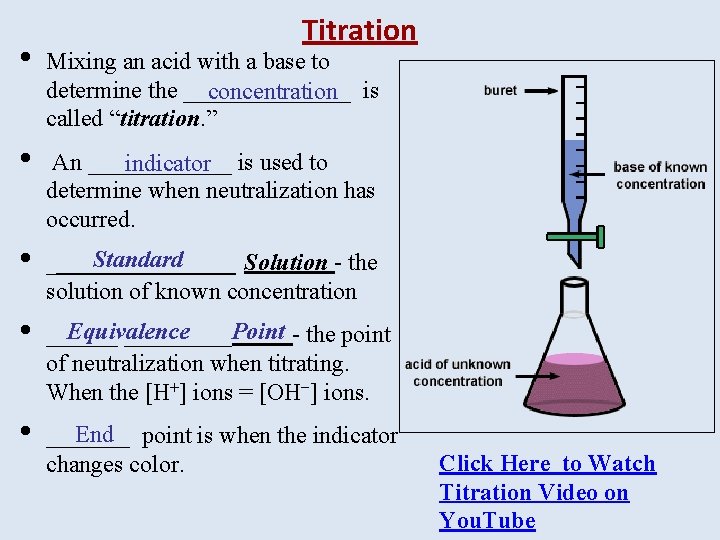
Titration • Mixing an acid with a base to determine the _______ concentration is called “titration. ” • An ______ indicator is used to determine when neutralization has occurred. • Standard ________ Solution - the solution of known concentration • Equivalence _________Point - the point of neutralization when titrating. When the [H+] ions = [OH−] ions. • End point is when the indicator _______ changes color. Click Here to Watch Titration Video on You. Tube
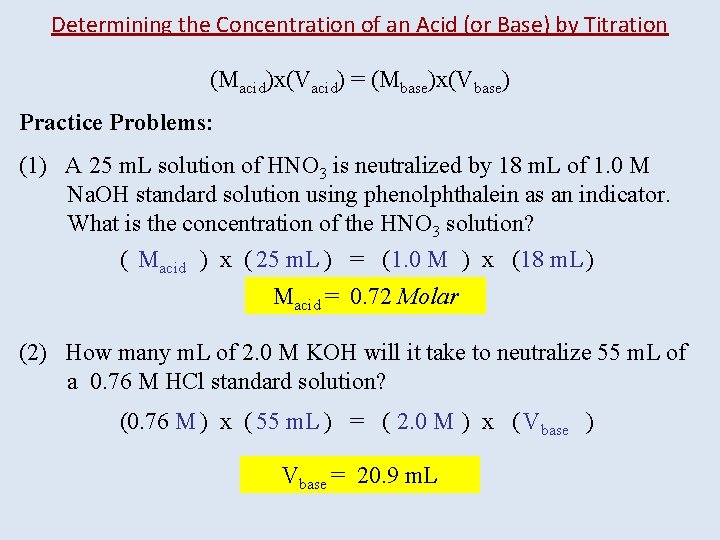
Determining the Concentration of an Acid (or Base) by Titration (Macid)x(Vacid) = (Mbase)x(Vbase) Practice Problems: (1) A 25 m. L solution of HNO 3 is neutralized by 18 m. L of 1. 0 M Na. OH standard solution using phenolphthalein as an indicator. What is the concentration of the HNO 3 solution? ( Macid ) x ( 25 m. L ) = ( 1. 0 M ) x (18 m. L ) Macid = 0. 72 Molar (2) How many m. L of 2. 0 M KOH will it take to neutralize 55 m. L of a 0. 76 M HCl standard solution? (0. 76 M ) x ( 55 m. L ) = ( 2. 0 M ) x ( Vbase ) Vbase = 20. 9 m. L
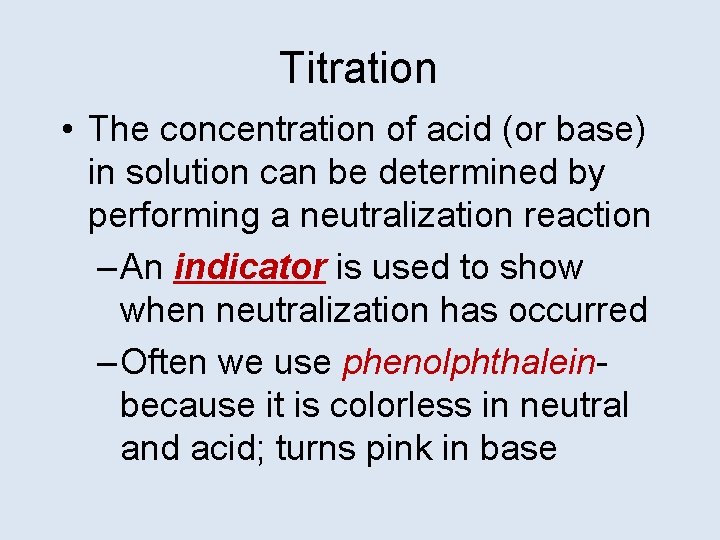
Titration • The concentration of acid (or base) in solution can be determined by performing a neutralization reaction – An indicator is used to show when neutralization has occurred – Often we use phenolphthaleinbecause it is colorless in neutral and acid; turns pink in base
Steps - Neutralization reaction #1. A measured volume of acid of unknown concentration is added to a flask #2. Several drops of indicator added #3. A base of known concentration is slowly added, until the indicator changes color; measure the volume
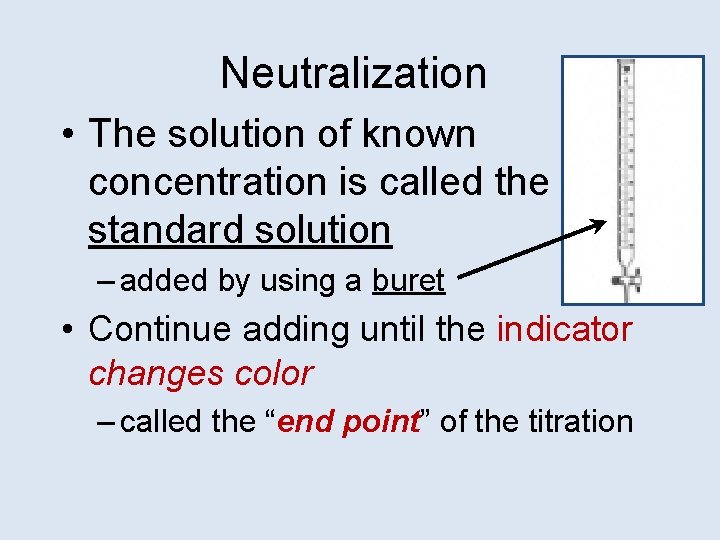
Neutralization • The solution of known concentration is called the standard solution – added by using a buret • Continue adding until the indicator changes color – called the “end point” of the titration
- Slides: 12