
Section 20 2 Unsaturated Hydrocarbons Objectives 1 To
Section 20. 2 Unsaturated Hydrocarbons Objectives 1. To learn to name hydrocarbons with double and triple bonds 2. To understand addition reactions 3. To learn about the aromatic hydrocarbons 4. To learn to name aromatic compounds
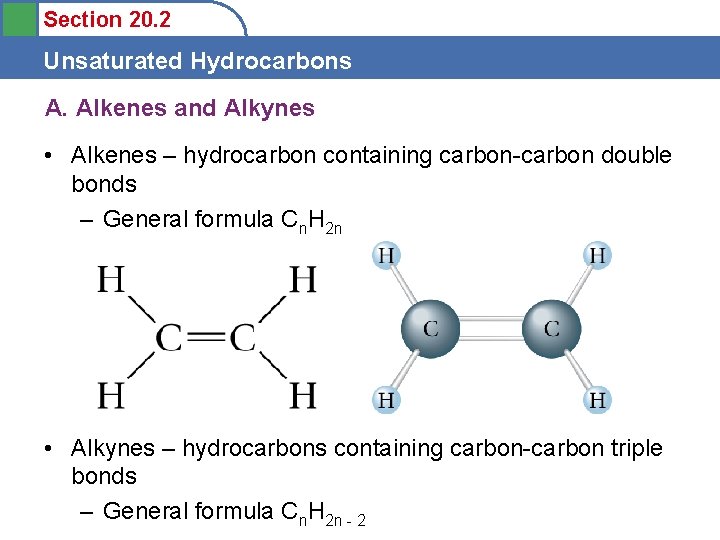
Section 20. 2 Unsaturated Hydrocarbons A. Alkenes and Alkynes • Alkenes – hydrocarbon containing carbon-carbon double bonds – General formula Cn. H 2 n • Alkynes – hydrocarbons containing carbon-carbon triple bonds – General formula Cn. H 2 n - 2
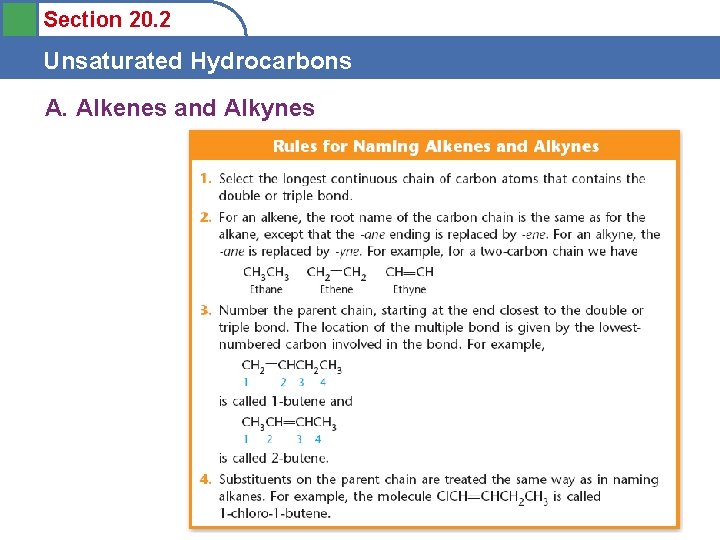
Section 20. 2 Unsaturated Hydrocarbons A. Alkenes and Alkynes
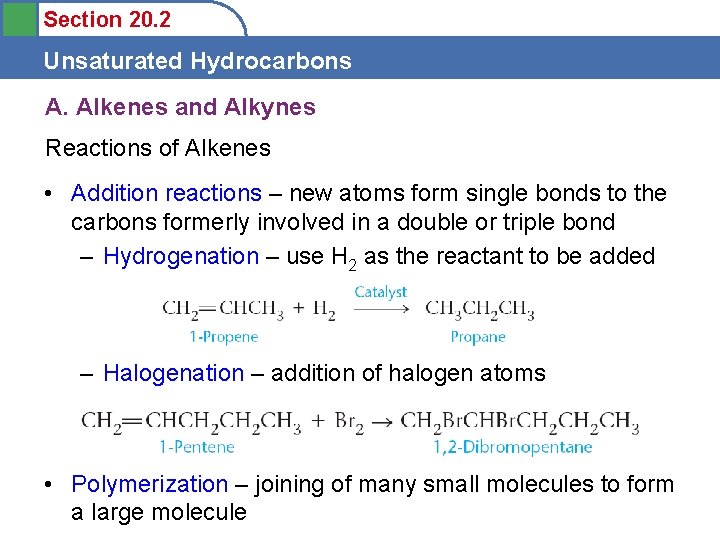
Section 20. 2 Unsaturated Hydrocarbons A. Alkenes and Alkynes Reactions of Alkenes • Addition reactions – new atoms form single bonds to the carbons formerly involved in a double or triple bond – Hydrogenation – use H 2 as the reactant to be added – Halogenation – addition of halogen atoms • Polymerization – joining of many small molecules to form a large molecule
Section 20. 2 Unsaturated Hydrocarbons B. Aromatic Hydrocarbons • Aromatic hydrocarbons – cyclic unsaturated hydrocarbons with strong aromas
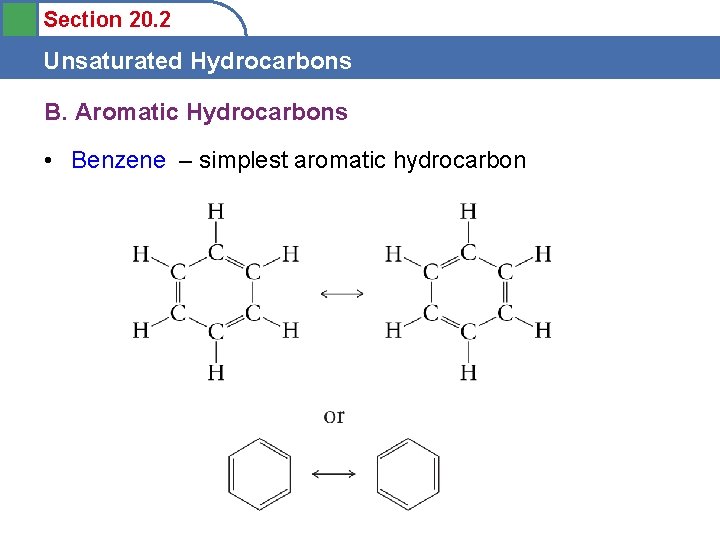
Section 20. 2 Unsaturated Hydrocarbons B. Aromatic Hydrocarbons • Benzene – simplest aromatic hydrocarbon
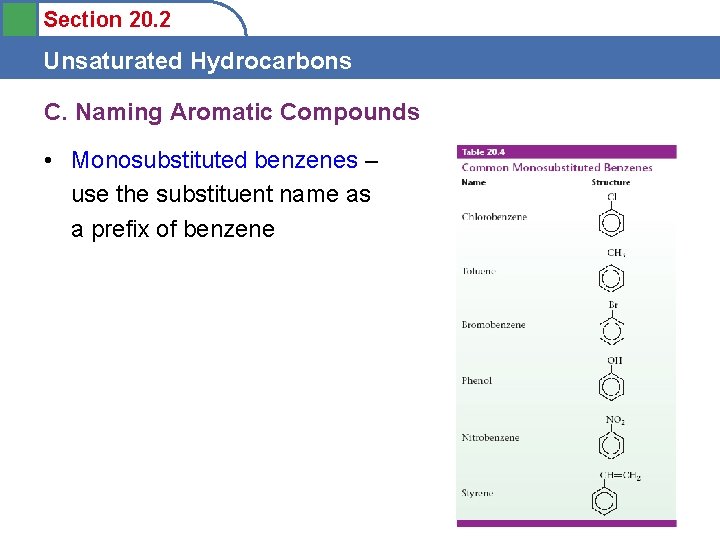
Section 20. 2 Unsaturated Hydrocarbons C. Naming Aromatic Compounds • Monosubstituted benzenes – use the substituent name as a prefix of benzene
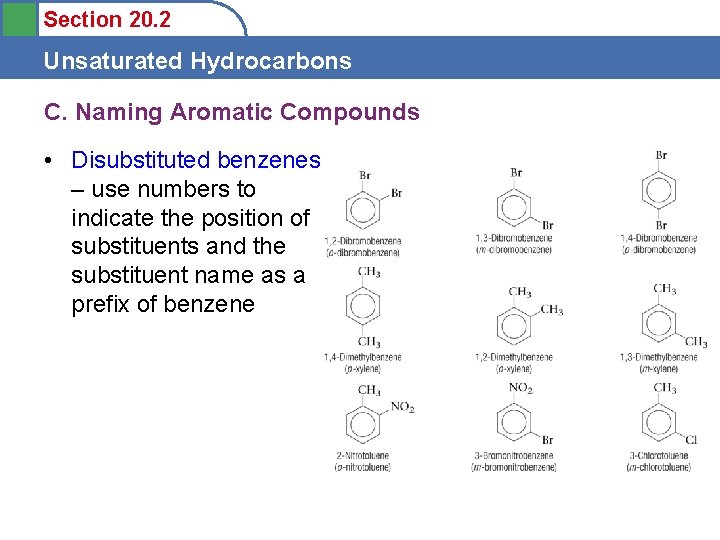
Section 20. 2 Unsaturated Hydrocarbons C. Naming Aromatic Compounds • Disubstituted benzenes – use numbers to indicate the position of substituents and the substituent name as a prefix of benzene
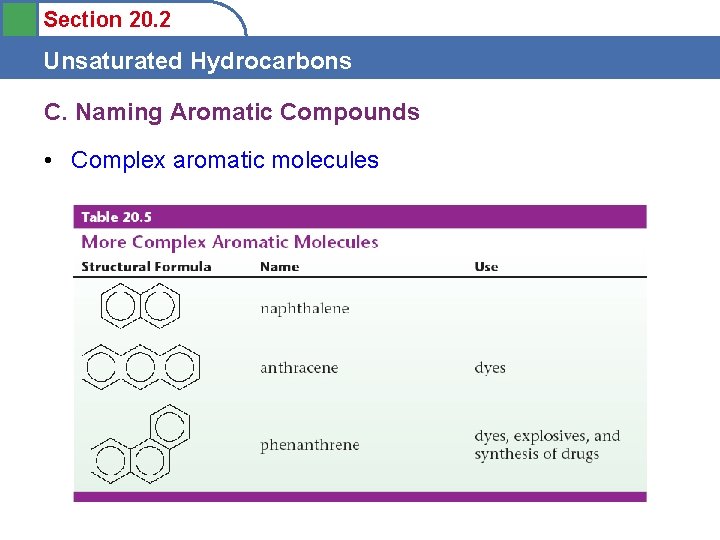
Section 20. 2 Unsaturated Hydrocarbons C. Naming Aromatic Compounds • Complex aromatic molecules
- Slides: 9