
Section 20 2 Hydrogen Ions and Acidity Hydrogen
![n n Neutral Solution- [H+] = 1 x 10 -7 M [OH-] =1 x](https://slidetodoc.com/presentation_image_h/d95fd8e353819824a7d28be44f4cb280/image-4.jpg "n n Neutral Solution- [H+] = 1 x 10 -7 M [OH-] =1 x")
![Sample Problem p 582 n If the [H+] in a solution is 1. 0](https://slidetodoc.com/presentation_image_h/d95fd8e353819824a7d28be44f4cb280/image-5.jpg "Sample Problem p 582 n If the [H+] in a solution is 1. 0")
![n n n Acidic Solution: p. H < 7 [H+] greater than 1 x](https://slidetodoc.com/presentation_image_h/d95fd8e353819824a7d28be44f4cb280/image-10.jpg "n n n Acidic Solution: p. H < 7 [H+] greater than 1 x")
![What if you are given p. H and need [H+]? Inverse of log =](https://slidetodoc.com/presentation_image_h/d95fd8e353819824a7d28be44f4cb280/image-11.jpg "What if you are given p. H and need [H+]? Inverse of log =")
![3. What is the p. H of a solution if [OH-]= 4. 0 x](https://slidetodoc.com/presentation_image_h/d95fd8e353819824a7d28be44f4cb280/image-14.jpg "3. What is the p. H of a solution if [OH-]= 4. 0 x")
![4. What is [H+] of a solution if the p. H= 3. 70?](https://slidetodoc.com/presentation_image_h/d95fd8e353819824a7d28be44f4cb280/image-15.jpg "4. What is [H+] of a solution if the p. H= 3. 70?")
- Slides: 16
Section 20. 2 Hydrogen Ions and Acidity
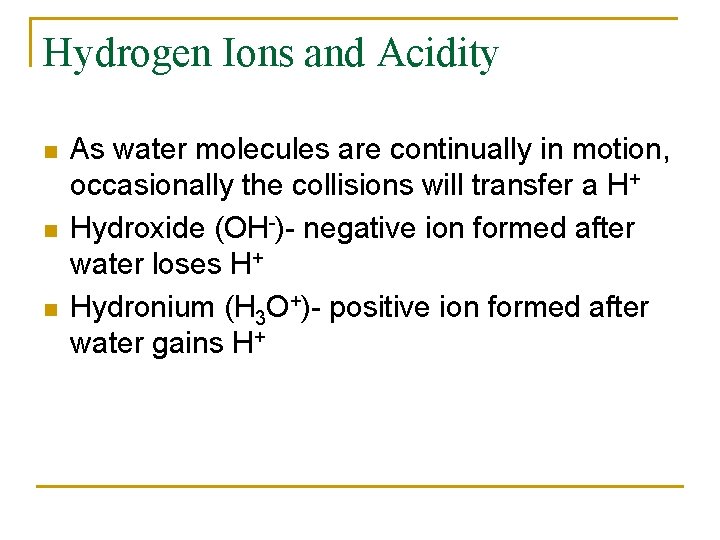
Hydrogen Ions and Acidity n n n As water molecules are continually in motion, occasionally the collisions will transfer a H+ Hydroxide (OH-)- negative ion formed after water loses H+ Hydronium (H 3 O+)- positive ion formed after water gains H+
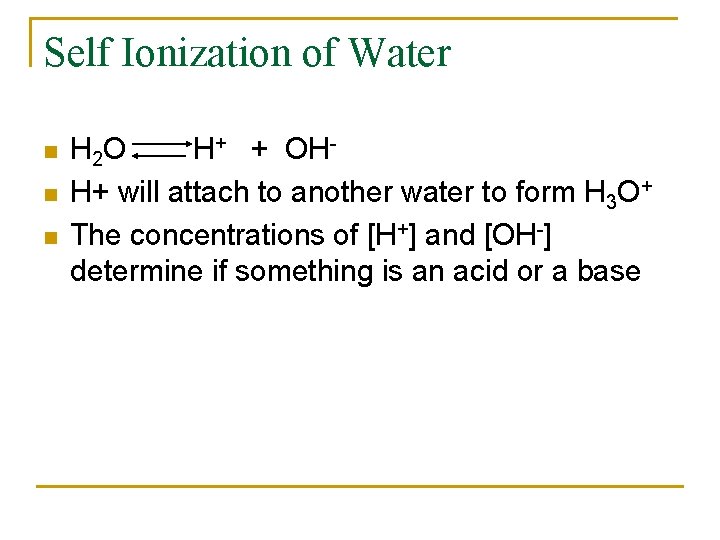
Self Ionization of Water n n n H 2 O H+ + OHH+ will attach to another water to form H 3 O+ The concentrations of [H+] and [OH-] determine if something is an acid or a base
n n Neutral Solution- [H+] = 1 x 10 -7 M [OH-] =1 x 10 -7 M Ion- product constant for water (KW) q Kw= [H+] x [OH-] = 1 x 10 -14 M 2 Acidic Solution- [H+] is greater than [OH-] n Basic Solution- [OH-] is greater than [H+] (also called alkaline solutions) n
Sample Problem p 582 n If the [H+] in a solution is 1. 0 x 10 -5 M, what is the [OH-] of the this solution? Is it acidic or basic, or neutral?
n Please do p 582 #6 and #7. Please add to #1 -5.
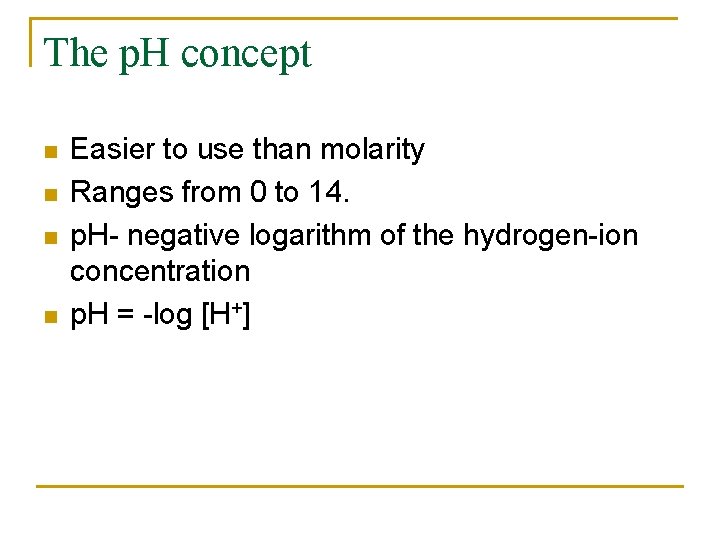
The p. H concept n n Easier to use than molarity Ranges from 0 to 14. p. H- negative logarithm of the hydrogen-ion concentration p. H = -log [H+]
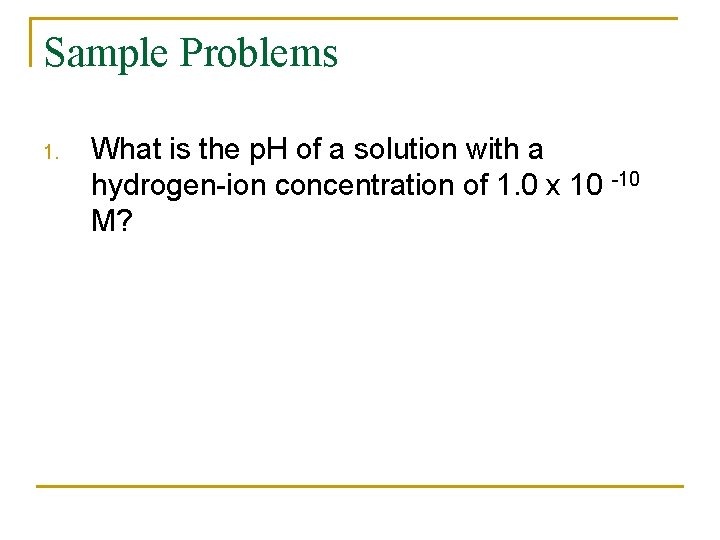
Sample Problems 1. What is the p. H of a solution with a hydrogen-ion concentration of 1. 0 x 10 -10 M?
n Please add p 586 #8, 9 to your assignment!! n Thanks.
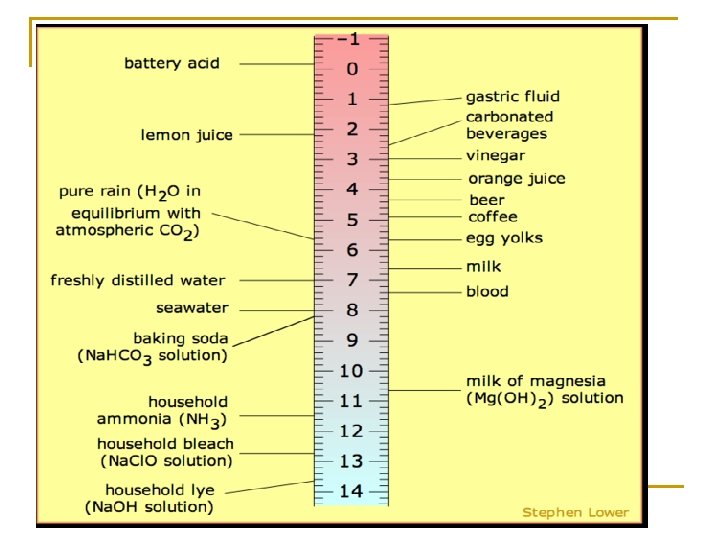
n n n Acidic Solution: p. H < 7 [H+] greater than 1 x 10 -7 M Neutral Solution: p. H= 7 [H+] equals 1 x 10 -7 M Basic Solution: p. H > 7 [H+] less than 1 x 10 -7 M p. OH = -log [OH-] p. OH + p. H = 14
What if you are given p. H and need [H+]? Inverse of log = 10 x So: [H+] = 10 -p. H [OH-] = 10 -p. OH
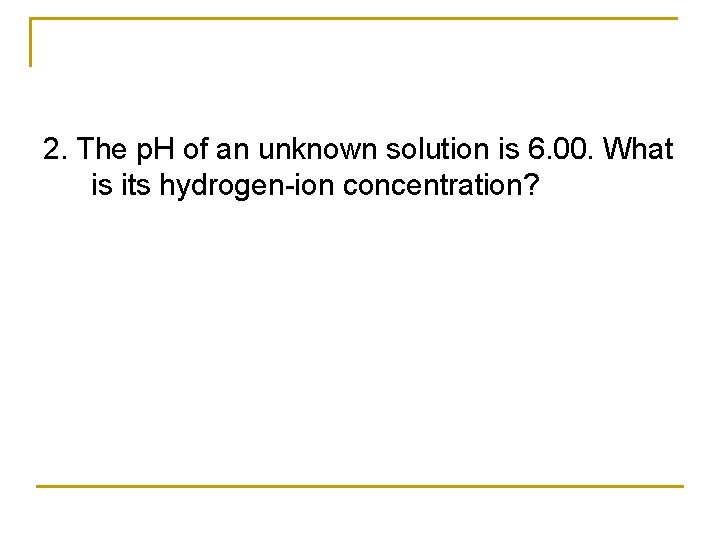
2. The p. H of an unknown solution is 6. 00. What is its hydrogen-ion concentration?
3. What is the p. H of a solution if [OH-]= 4. 0 x 10 -11 M?
4. What is [H+] of a solution if the p. H= 3. 70?
n Please add p 587 -593 #10 -18