
Section 2 What Social And Environmental Issues Exist
- Slides: 29
Section 2. What Social And Environmental Issues Exist: Strengthening Design And Implementation of REDD+ 2. 8. REDD+ Benefits Sharing USAID LEAF Regional Climate Change Curriculum Development Module: Social and Environmental Soundness (SES)
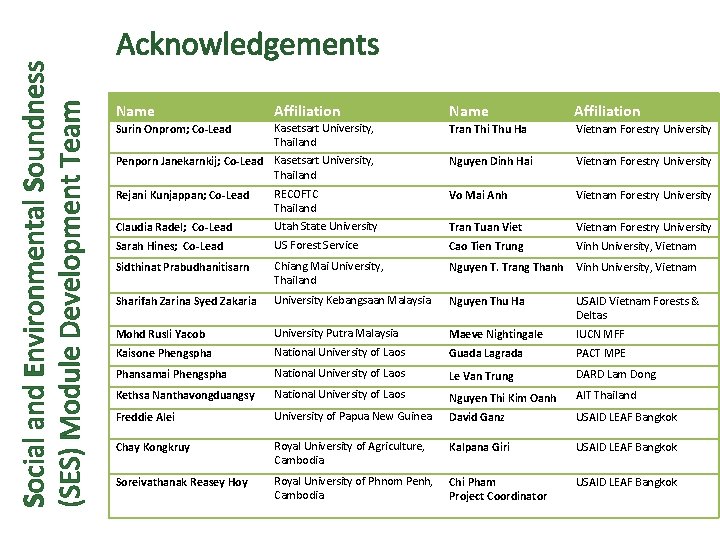
Social and Environmental Soundness (SES) Module Development Team Acknowledgements Name Affiliation Kasetsart University, Surin Onprom; Co-Lead Thailand Penporn Janekarnkij; Co-Lead Kasetsart University, Thailand Name Affiliation Tran Thi Thu Ha Vietnam Forestry University Nguyen Dinh Hai Vietnam Forestry University Rejani Kunjappan; Co-Lead RECOFTC Thailand Vo Mai Anh Vietnam Forestry University Claudia Radel; Co-Lead Utah State University Tran Tuan Vietnam Forestry University Sarah Hines; Co-Lead US Forest Service Cao Tien Trung Vinh University, Vietnam Sidthinat Prabudhanitisarn Chiang Mai University, Thailand Nguyen T. Trang Thanh Vinh University, Vietnam Sharifah Zarina Syed Zakaria University Kebangsaan Malaysia Nguyen Thu Ha USAID Vietnam Forests & Deltas Mohd Rusli Yacob University Putra Malaysia Maeve Nightingale IUCN MFF Kaisone Phengspha National University of Laos Guada Lagrada PACT MPE Phansamai Phengspha National University of Laos Le Van Trung DARD Lam Dong Kethsa Nanthavongduangsy National University of Laos Nguyen Thi Kim Oanh AIT Thailand Freddie Alei University of Papua New Guinea David Ganz USAID LEAF Bangkok Chay Kongkruy Royal University of Agriculture, Cambodia Kalpana Giri USAID LEAF Bangkok Soreivathanak Reasey Hoy Royal University of Phnom Penh, Cambodia Chi Pham Project Coordinator USAID LEAF Bangkok
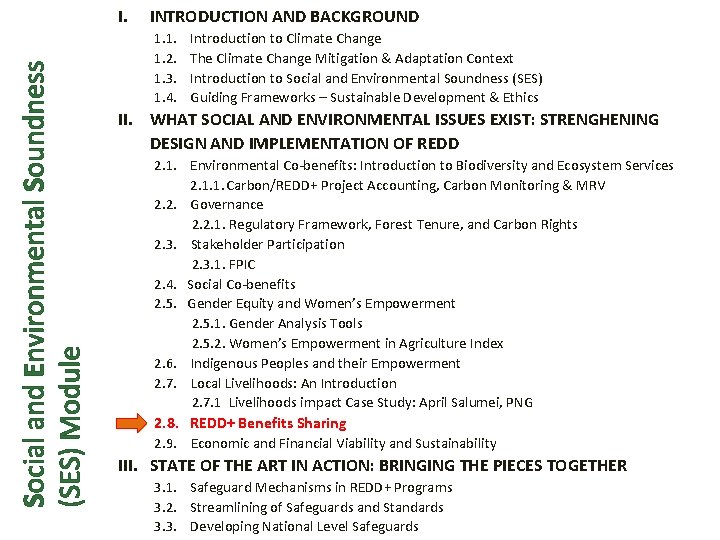
Social and Environmental Soundness (SES) Module I. INTRODUCTION AND BACKGROUND 1. 1. 1. 2. 1. 3. 1. 4. Introduction to Climate Change The Climate Change Mitigation & Adaptation Context Introduction to Social and Environmental Soundness (SES) Guiding Frameworks – Sustainable Development & Ethics II. WHAT SOCIAL AND ENVIRONMENTAL ISSUES EXIST: STRENGHENING DESIGN AND IMPLEMENTATION OF REDD 2. 1. Environmental Co-benefits: Introduction to Biodiversity and Ecosystem Services 2. 1. 1. Carbon/REDD+ Project Accounting, Carbon Monitoring & MRV 2. 2. Governance 2. 2. 1. Regulatory Framework, Forest Tenure, and Carbon Rights 2. 3. Stakeholder Participation 2. 3. 1. FPIC 2. 4. Social Co-benefits 2. 5. Gender Equity and Women’s Empowerment 2. 5. 1. Gender Analysis Tools 2. 5. 2. Women’s Empowerment in Agriculture Index 2. 6. Indigenous Peoples and their Empowerment 2. 7. Local Livelihoods: An Introduction 2. 7. 1 Livelihoods impact Case Study: April Salumei, PNG 2. 8. REDD+ Benefits Sharing 2. 9. Economic and Financial Viability and Sustainability III. STATE OF THE ART IN ACTION: BRINGING THE PIECES TOGETHER 3. 1. Safeguard Mechanisms in REDD+ Programs 3. 2. Streamlining of Safeguards and Standards 3. 3. Developing National Level Safeguards
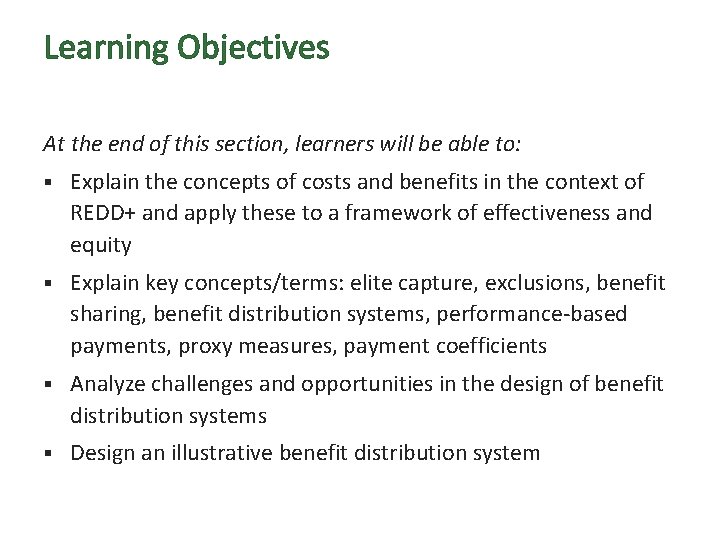
Learning Objectives At the end of this section, learners will be able to: § Explain the concepts of costs and benefits in the context of REDD+ and apply these to a framework of effectiveness and equity § Explain key concepts/terms: elite capture, exclusions, benefit sharing, benefit distribution systems, performance-based payments, proxy measures, payment coefficients § Analyze challenges and opportunities in the design of benefit distribution systems § Design an illustrative benefit distribution system
Outline (2 sessions) Session 1: Conceptual Overview § Sharing costs and benefits § Benefit distribution systems § Inclusion of women in benefit sharing § Focus on revenue § Performance-based payments § Proxy measures for performance § A method for integrating social goals into performance-based payments: Coefficients Session 2: Designing a benefit distribution system • Student Activity (30 minutes) • Approaches (15 minutes)
Methodology § Lecture or presentation of conceptual and background materials § In-class discussions § Small group activity
Pre-Class Preparation Students should read: IUCN. 2009. REDD-plus and benefit sharing: Experiences in forest conservation and other resource management sectors. International Union for Conservation of Nature. (8 pages)
REDD+ Benefits and Costs § REDD+ aims both to lower emissions and to generate co-benefits. How will those benefits be distributed or shared? § Lowering emissions also means there will be costs (opportunity costs and implementation costs). How will the costs be distributed or shared? How will those costs be compensated? § We might also consider risks (a cost with an associated probability) and opportunities (a benefit with an associated probability? ) General Principle: Two reasons to think about how the costs and benefits are distributed are: 1. Effectiveness 2. Equity
Elite Capture of Benefits Many people worry that there will be elite capture of benefits: § What does this mean? § Why do they worry about this? § For effectiveness? § For equity? Revisit REDD+ Benefits: § Various potential types of benefits § Can be monetary and non-monetary § Can be tangible and intangible
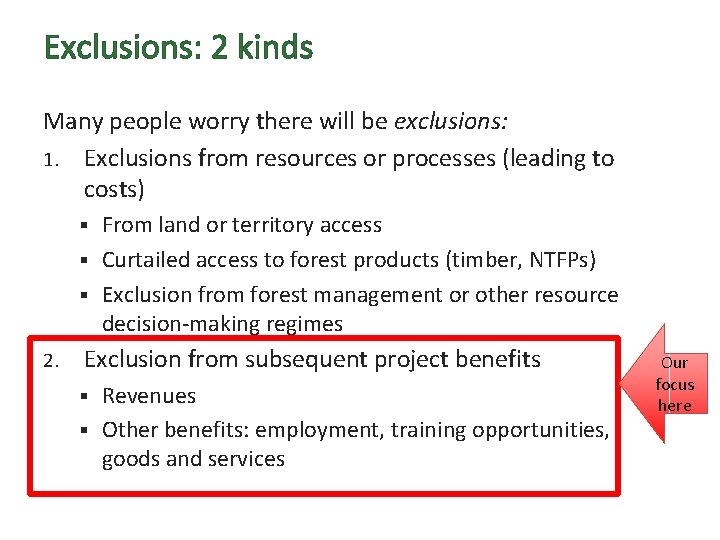
Exclusions: 2 kinds Many people worry there will be exclusions: 1. Exclusions from resources or processes (leading to costs) From land or territory access § Curtailed access to forest products (timber, NTFPs) § Exclusion from forest management or other resource decision-making regimes § 2. Exclusion from subsequent project benefits Revenues § Other benefits: employment, training opportunities, goods and services § Our focus here
Benefit Distribution Systems are designed to address these concerns: § What are benefits? § Who gets benefits? § How is this managed? How are concerns over the distribution of costs addressed?
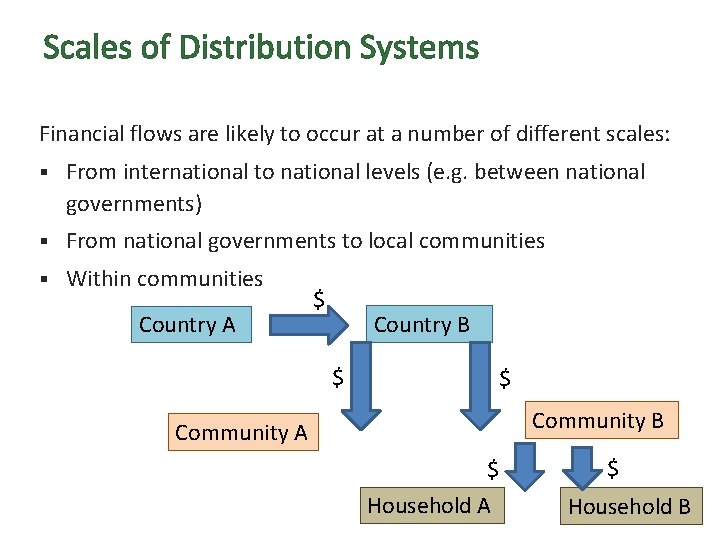
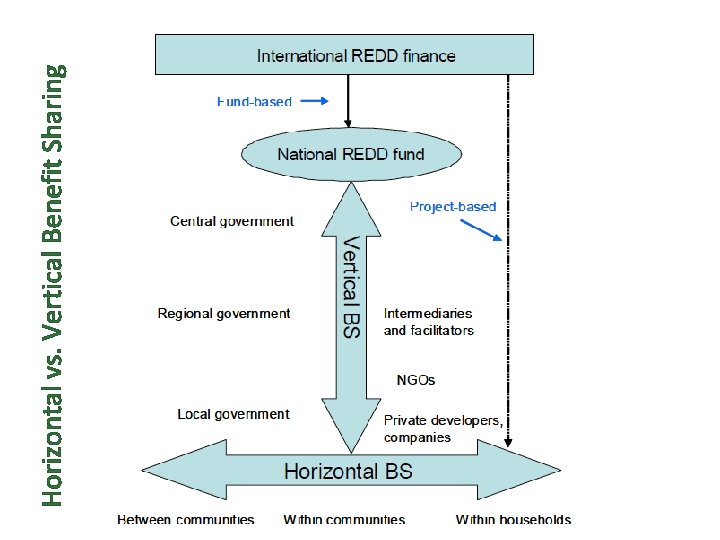
Scales of Distribution Systems Financial flows are likely to occur at a number of different scales: § From international to national levels (e. g. between national governments) § From national governments to local communities § Within communities Country A $ Country B $ $ Community B Community A $ Household B
Horizontal vs. Vertical Benefit Sharing
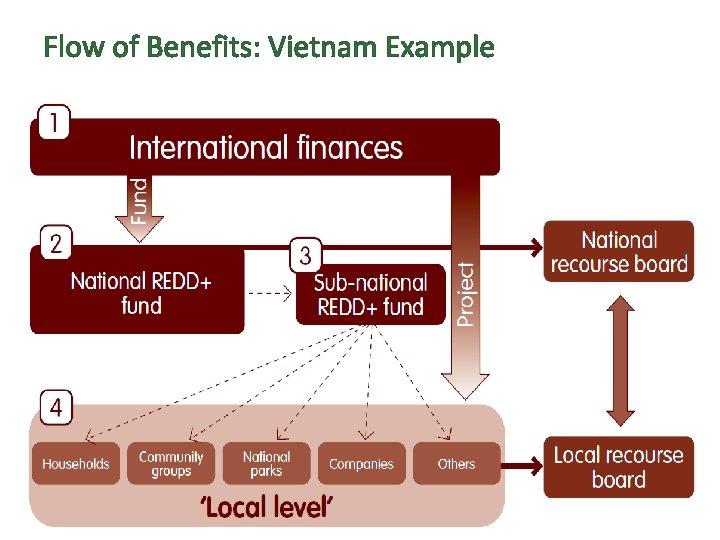
Flow of Benefits: Vietnam Example
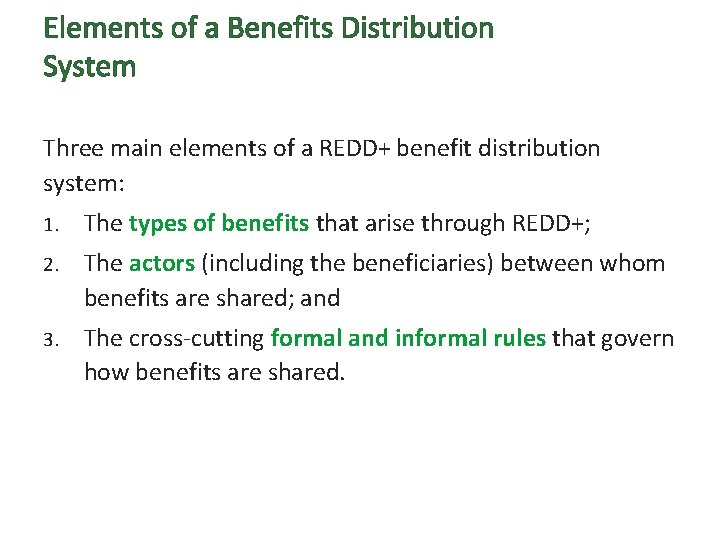
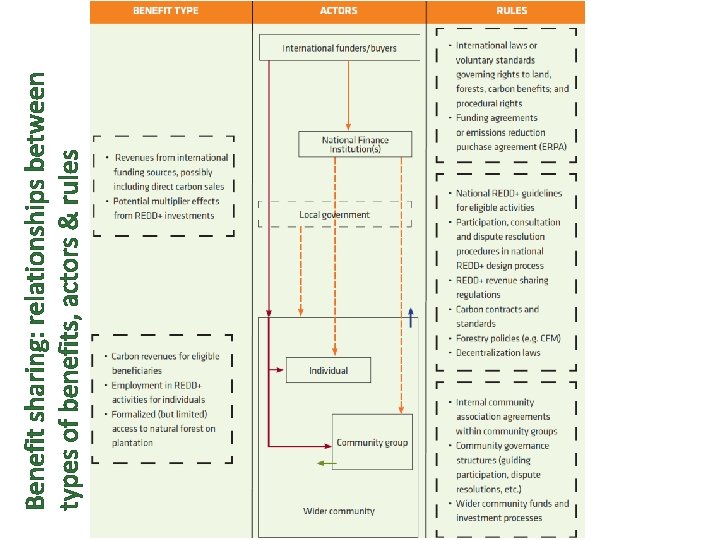
Elements of a Benefits Distribution System Three main elements of a REDD+ benefit distribution system: 1. The types of benefits that arise through REDD+; 2. The actors (including the beneficiaries) between whom benefits are shared; and 3. The cross-cutting formal and informal rules that govern how benefits are shared.
Benefit sharing: relationships between types of benefits, actors & rules
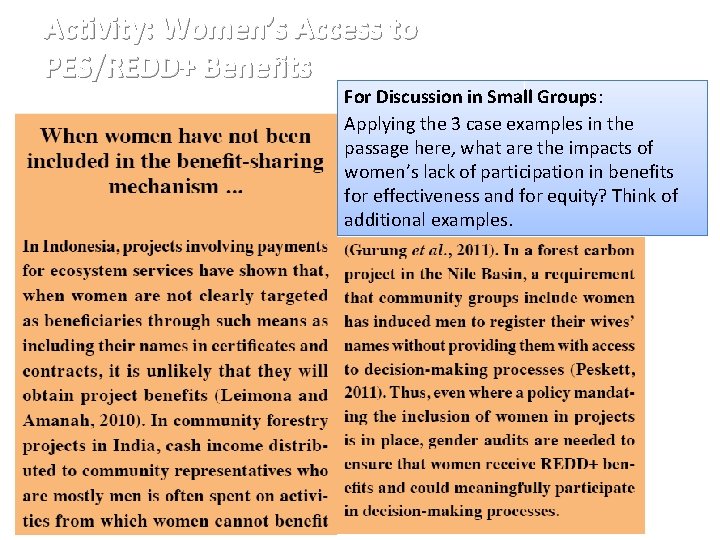
Activity: Women’s Access to PES/REDD+ Benefits For Discussion in Small Groups: Applying the 3 case examples in the passage here, what are the impacts of women’s lack of participation in benefits for effectiveness and for equity? Think of additional examples.
Let’s focus now on one particular benefit: Revenue
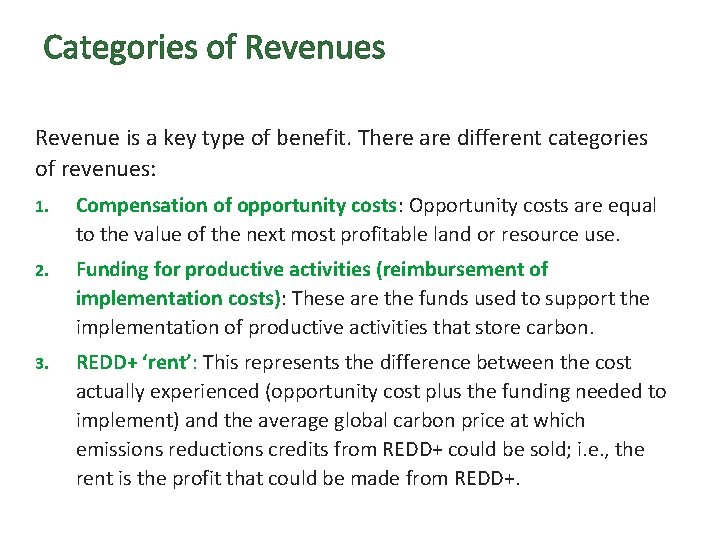
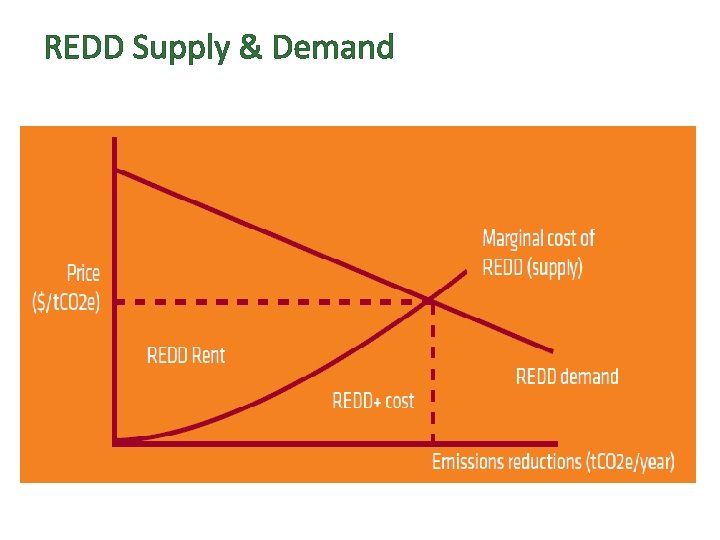
Categories of Revenues Revenue is a key type of benefit. There are different categories of revenues: 1. Compensation of opportunity costs: Opportunity costs are equal to the value of the next most profitable land or resource use. 2. Funding for productive activities (reimbursement of implementation costs): These are the funds used to support the implementation of productive activities that store carbon. 3. REDD+ ‘rent’: This represents the difference between the cost actually experienced (opportunity cost plus the funding needed to implement) and the average global carbon price at which emissions reductions credits from REDD+ could be sold; i. e. , the rent is the profit that could be made from REDD+.
REDD Supply & Demand
Performance-Based Payments § REDD+ is performance based. Revenue flows will be linked to emissions reductions. § But at “lower” scales of distribution, payments and other benefits may or may not be linked to performance: “…benefit sharing systems could be based purely on emissions metrics, with those actors who have demonstrated reductions/removals being provided a level of benefits linked to the volume of reduced emissions/enhanced removals. ” (Peskett, 2011) For Discussion: Will performance-based payments at all scales lead to an equitable distribution of benefits? Why or why not? Under what conditions would it or wouldn’t it? At which scales should distribution be performance-based?
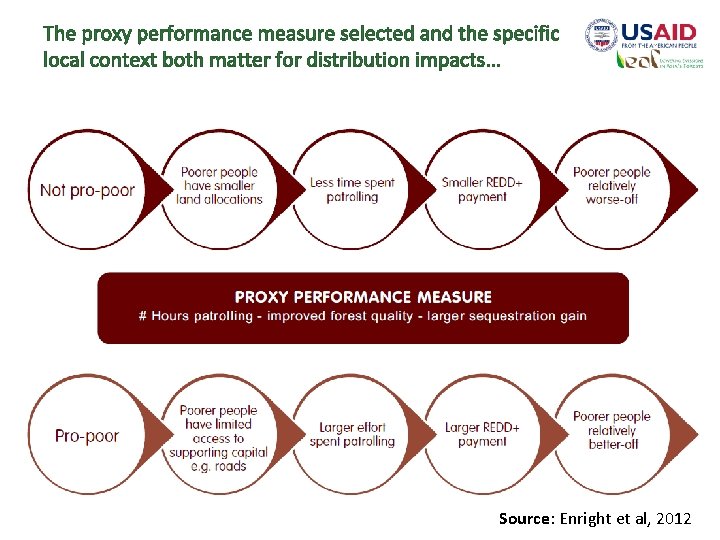
Proxy Measures for Performance § Measures something we think should be correlated with carbon reductions/removals § Could measure a different output, e. g. forest area § Could measure an input instead of output, e. g. project labor “In the case of Vietnam, for example, local consultations have suggested that the number of hours spent patrolling forested areas to protect against illegal deforestation may be an appropriate proxy measure for avoided deforestation and the resulting emissions reductions. ” (Enright et al, 2012) For Discussion: 1. What are the advantages and disadvantages of proxy measures? 2. What impact could use of a proxy measure have on revenues and other benefits?
The proxy performance measure selected and the specific local context both matter for distribution impacts… Source: Enright et al, 2012
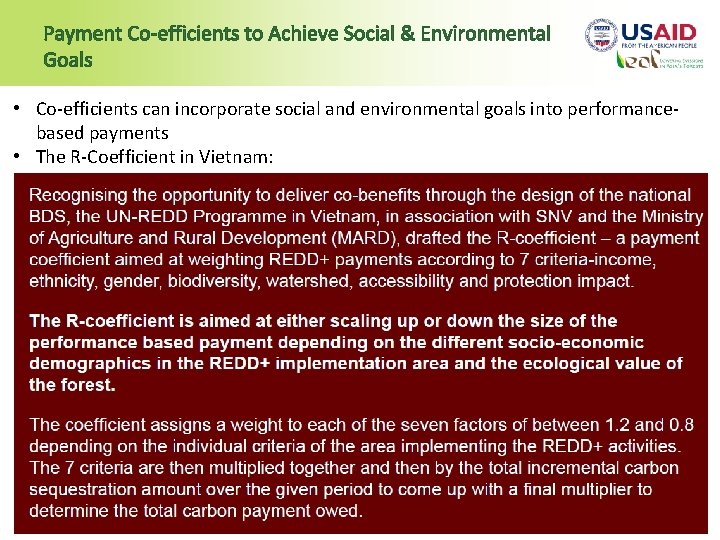
Payment Co-efficients to Achieve Social & Environmental Goals • Co-efficients can incorporate social and environmental goals into performancebased payments • The R-Coefficient in Vietnam:
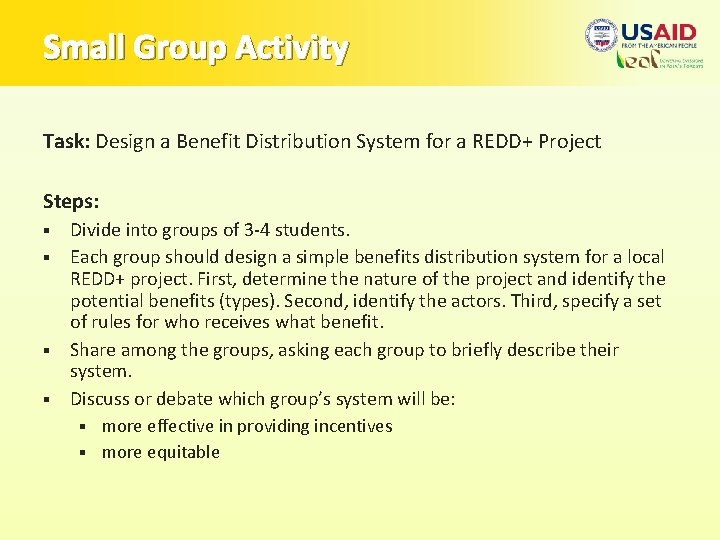
Small Group Activity Task: Design a Benefit Distribution System for a REDD+ Project Steps: Divide into groups of 3 -4 students. § Each group should design a simple benefits distribution system for a local REDD+ project. First, determine the nature of the project and identify the potential benefits (types). Second, identify the actors. Third, specify a set of rules for who receives what benefit. § Share among the groups, asking each group to briefly describe their system. § Discuss or debate which group’s system will be: § more effective in providing incentives § more equitable §
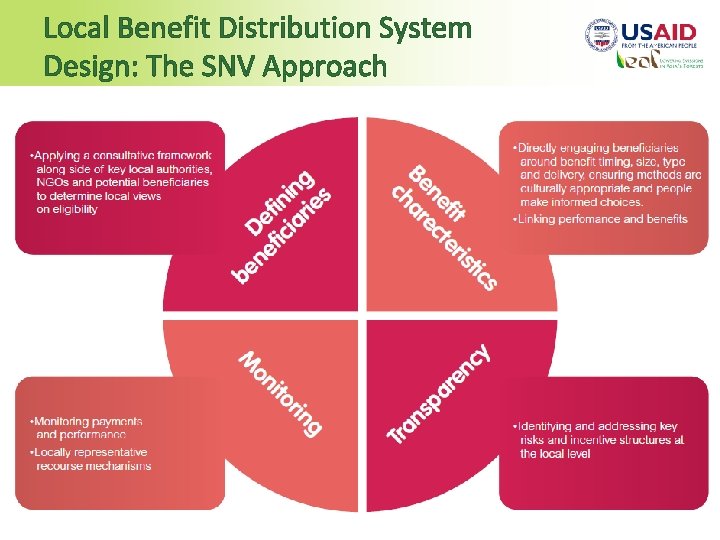
Local Benefit Distribution System Design: The SNV Approach
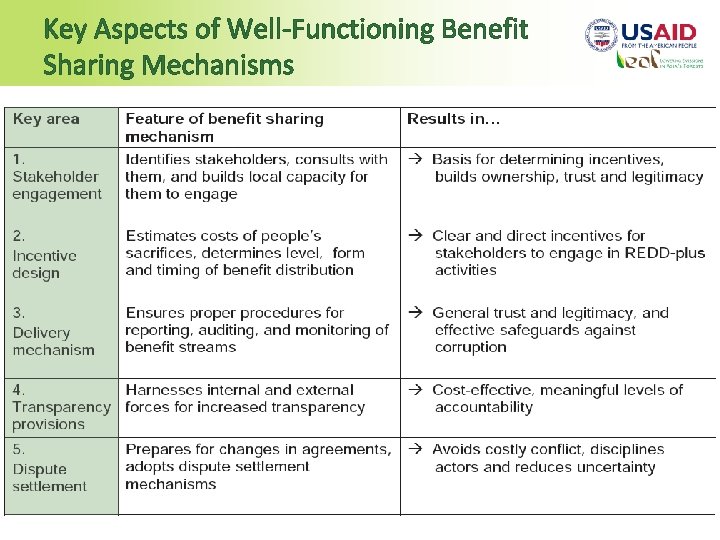
Key Aspects of Well-Functioning Benefit Sharing Mechanisms
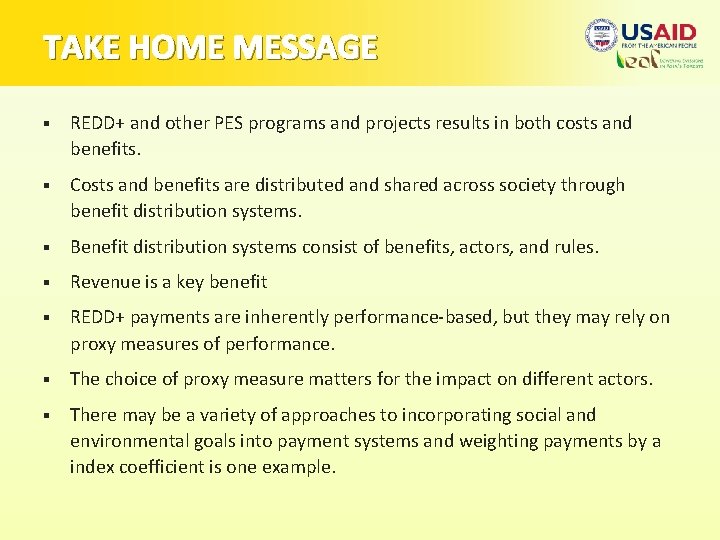
TAKE HOME MESSAGE § REDD+ and other PES programs and projects results in both costs and benefits. § Costs and benefits are distributed and shared across society through benefit distribution systems. § Benefit distribution systems consist of benefits, actors, and rules. § Revenue is a key benefit § REDD+ payments are inherently performance-based, but they may rely on proxy measures of performance. § The choice of proxy measure matters for the impact on different actors. § There may be a variety of approaches to incorporating social and environmental goals into payment systems and weighting payments by a index coefficient is one example.
References 1. 2. 3. 4. 5. 6. 7. Costenbader, J. 2011. REDD+ Benefit Sharing: A Comparative Assessment of Three National Policy Approaches. The Forest Carbon Partnership Facility and The UNREDD Programme. Enright, A. , Mc. Nally, R. , and T. Sikor. 2012. An Approach to Designing Pro-Poor Local REDD+ Benefit Distribution Systems: Lessons from Vietnam. SNV Netherlands Development Organisation, REDD+ Programme. IUCN. 2009. REDD-plus and benefit sharing: Experiences in forest conservation and other resource management sectors. International Union for Conservation of Nature. Mohammed, E. Y. 2011. Pro-poor benefit distribution in REDD+: Who gets what and why does it matter? REDD Working Paper. IIED, London. (includes Vietnam case study) Peskett, L. 2011. Benefit Sharing in REDD+: Exploring the Implications for Poor and Vulnerable People. World Bank and REDD-net. Setyowati, A. 2012. Ensuring that women benefit from REDD+. Unasylva 239, Vol. 63, 2012/1. SNV, 2012. Benefit Distribution Systems. SNV Pro Poor REDD+ Briefing Paper.