
Section 2 Velocity and Momentum Essential Questions What
- Slides: 12
Section 2 Velocity and Momentum
Essential Questions What is the difference between speed and velocity? How is the motion of two objects relative to each other described? How can an object’s momentum be calculated?
Review Vocabulary speed: rate of change of position
New Vocabulary velocity momentum
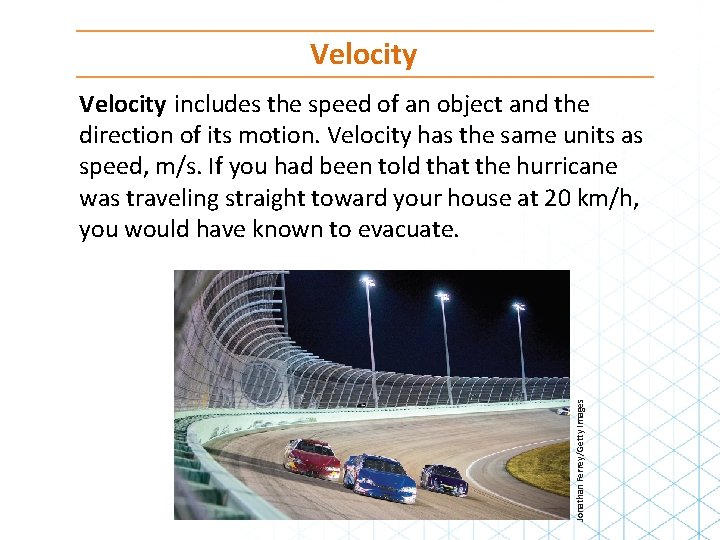
Velocity Jonathan Ferrey/Getty Images Velocity includes the speed of an object and the direction of its motion. Velocity has the same units as speed, m/s. If you had been told that the hurricane was traveling straight toward your house at 20 km/h, you would have known to evacuate.
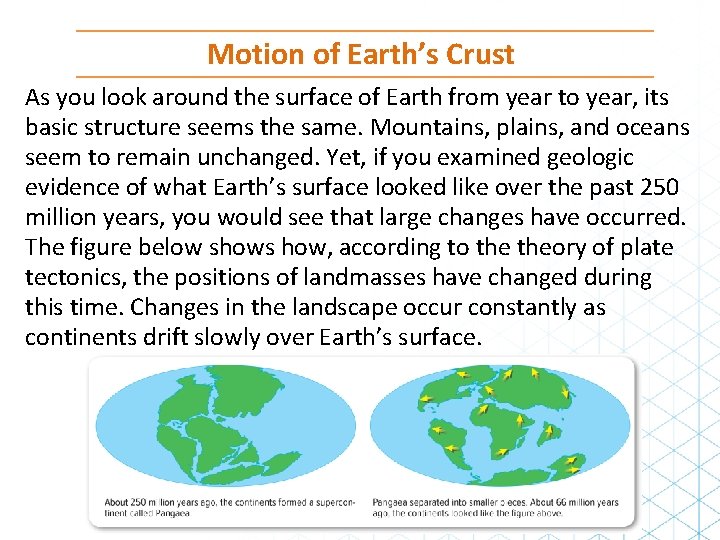
Motion of Earth’s Crust As you look around the surface of Earth from year to year, its basic structure seems the same. Mountains, plains, and oceans seem to remain unchanged. Yet, if you examined geologic evidence of what Earth’s surface looked like over the past 250 million years, you would see that large changes have occurred. The figure below shows how, according to theory of plate tectonics, the positions of landmasses have changed during this time. Changes in the landscape occur constantly as continents drift slowly over Earth’s surface.
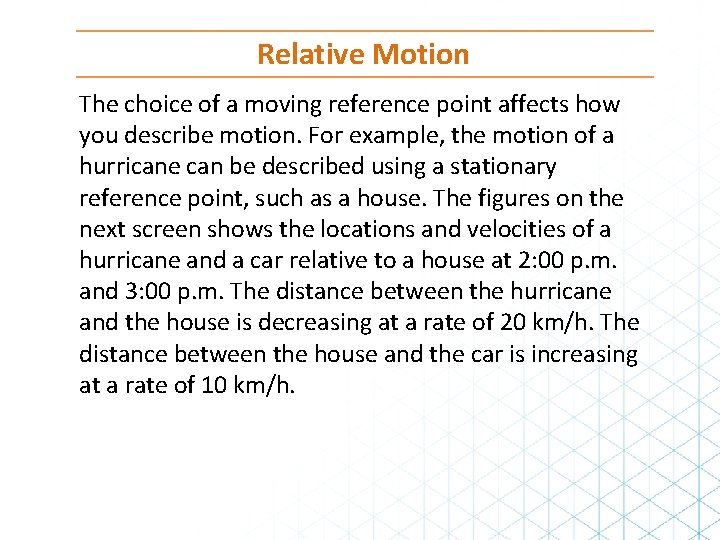
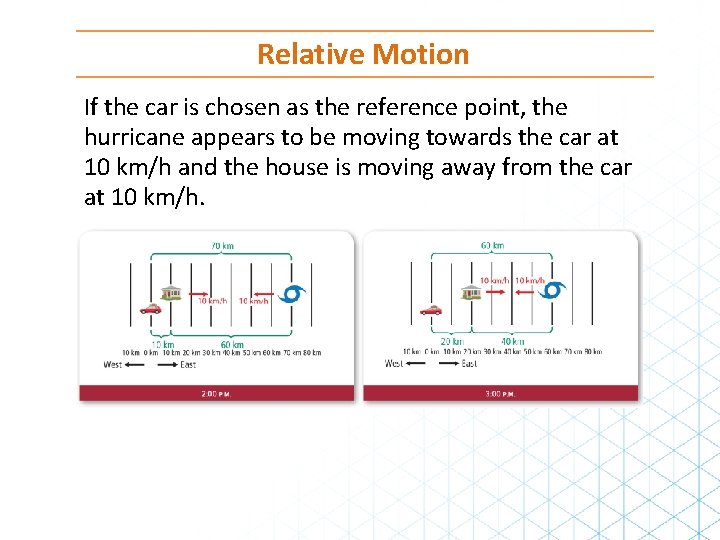
Relative Motion The choice of a moving reference point affects how you describe motion. For example, the motion of a hurricane can be described using a stationary reference point, such as a house. The figures on the next screen shows the locations and velocities of a hurricane and a car relative to a house at 2: 00 p. m. and 3: 00 p. m. The distance between the hurricane and the house is decreasing at a rate of 20 km/h. The distance between the house and the car is increasing at a rate of 10 km/h.
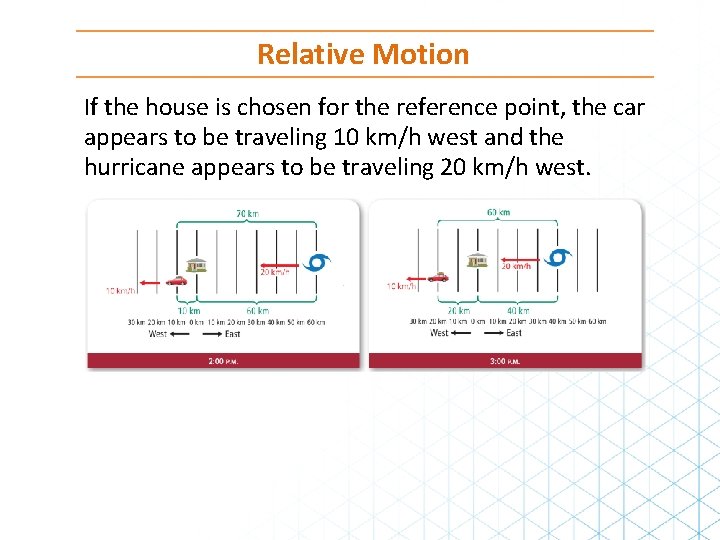
Relative Motion If the house is chosen for the reference point, the car appears to be traveling 10 km/h west and the hurricane appears to be traveling 20 km/h west.
Relative Motion If the car is chosen as the reference point, the hurricane appears to be moving towards the car at 10 km/h and the house is moving away from the car at 10 km/h.
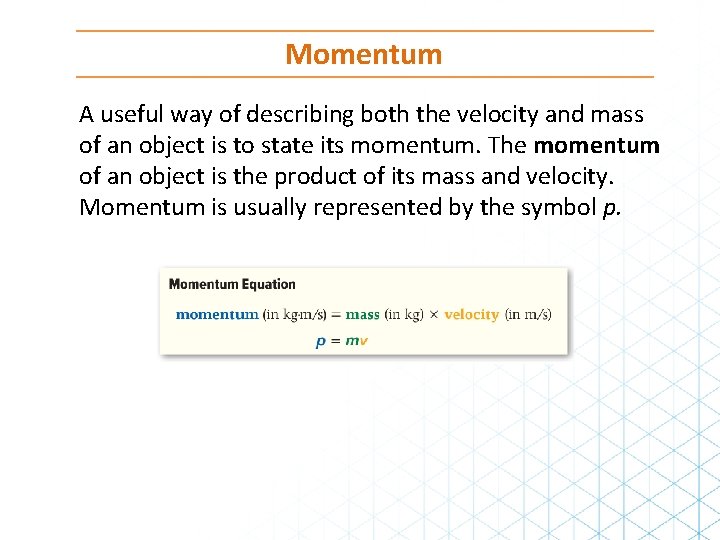
Momentum A useful way of describing both the velocity and mass of an object is to state its momentum. The momentum of an object is the product of its mass and velocity. Momentum is usually represented by the symbol p.
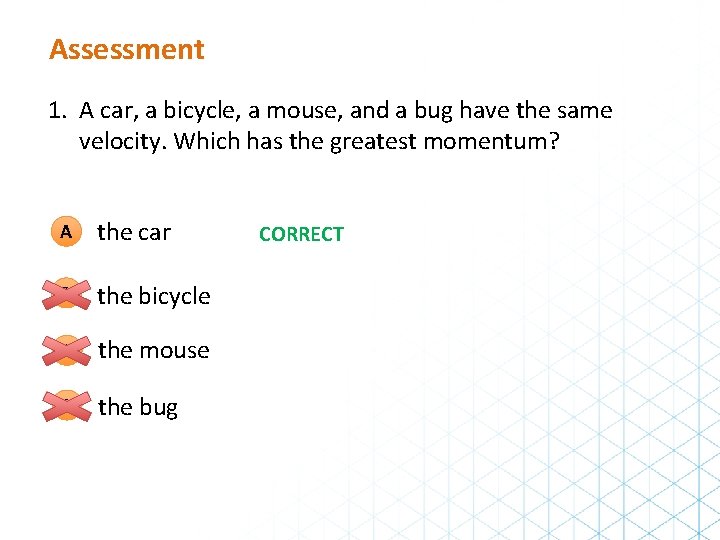
Assessment 1. A car, a bicycle, a mouse, and a bug have the same velocity. Which has the greatest momentum? A the car B the bicycle C the mouse D the bug CORRECT
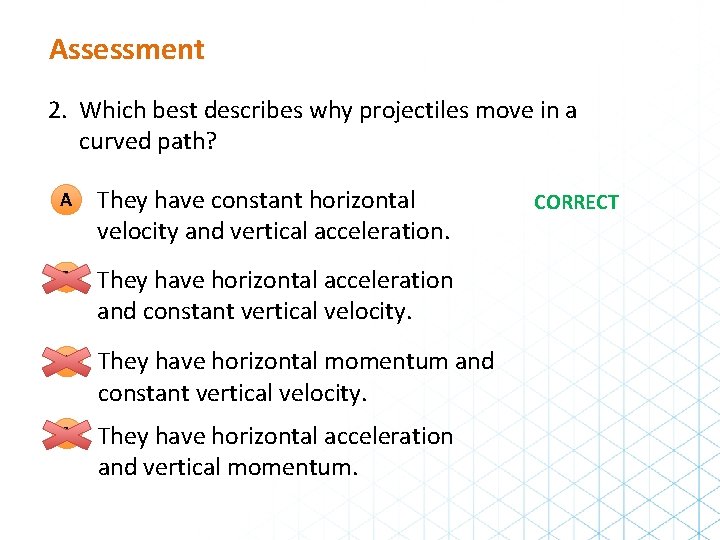
Assessment 2. Which best describes why projectiles move in a curved path? A They have constant horizontal velocity and vertical acceleration. B They have horizontal acceleration and constant vertical velocity. C They have horizontal momentum and constant vertical velocity. D They have horizontal acceleration and vertical momentum. CORRECT