
Section 2 The Use of Audit Sampling Attribute

Section 2 The Use of Audit Sampling Attribute Sampling
Definition of Audit Sampling • The application of an audit procedure to less than 100% of the items within an account balance or class of transactions for the purpose of evaluating some characteristic of the balance or class. • Extrapolation
• Representative sample • Sample projection • Aggregate all projected misstatements
Audit Risk and Sampling • Determine minimum sample need to control audit risk • How does this relate to sampling?
Defining the Population • First step • Restricted to items in the balance or class of transactions
Sampling risk • When an audit test is restricted to a sample • For testing controls or account balances this means • Sampling risk inversely related to sample size
Nonsampling risk • Covers all risks that are not specifically the result of sampling • i. e. any factor other than sample size
Determinants of Sample Size • Three factors – Acceptable level of sampling risk – How much deviation can be accepted – How much deviation there might be in the population
Acceptable Level of Sampling Risk • Must consider evidence from other procedures • Example 1: Low control risk • Example 2: High control risk
Tolerable Deviation Rate/Tolerable Misstatement • Rate of deviation from a prescribed control that can be found to exist, without causing a revision in the assessed level of control risk • Tolerable misstatement amount
• Cannot be larger than the smaller of : – The materiality amount for the individual item or – The F/S taken as a whole • As tolerable rate or misstatement increases
• Suggested range of TDR • No such guidelines for substantive testing • Usually done judgmentally based on: • Overall materiality • Account balance materiality • Type and amount of individual item in the account balance
• Designing a sample with high tolerable rate or misstatement • A large sample vs. a small sample • Highly material accounts or accounts with high likelihood of misstatement
Expected Deviation Rate/ Misstatement Amount • Impact on sample size • Commonly use prior years tests of controls
• Estimate need not be exact • Unless deviation rate is low for tests of controls, what is the alternative?
Statistical Tests of Controls • Attribute Sampling – Used to estimate the rate of occurrence of a specific quality or attribute in a population – Primarily used for
• E. g. Estimating the percentage of shipments not billed • Thus testing to see if the item was processed correctly or incorrectly • What about dollar value?
• For Attribute Sampling there is no CICA pronouncement • Three areas to look at: 1. Planning the sample 2. Selecting the sample and performing the tests 3. Evaluating the results
Audit Sampling Steps • Three sections a) Plan the sample b) Select the sample and perform audit procedures c) Evaluate the results
(a) Planning the Sample • 9 steps involved 1. State the objectives of the test • Consider the Revenue Cycle
2. Decide if audit sampling applies • Is the population appropriate? • Sampling applies when?
3. Define attributes and error conditions – Specific statement of what contributes an attribute must be made in advance – E. g. 1 A copy of a shipping document is attached to a duplicate sales invoice – E. g. 2 A foreman initials the hourly payroll time cards
4. Define the population – Must be defined in advance – E. g. 1 A copy of a shipping document is attached to a duplicate sales invoice • Population? – E. g. 2 A foreman initials the hourly payroll time cards • Population?
5. Define the sampling unit – What dictates the sampling unit? – E. g. 1 Valid sales • Sampling unit? – E. g. 2 Valid time cards • Sampling unit?
6. Specify Tolerable Deviation Rate – What does this mean? – E. g. With time cards, auditor decides that 5% is the TDR. This means? - As TDR Sample size?
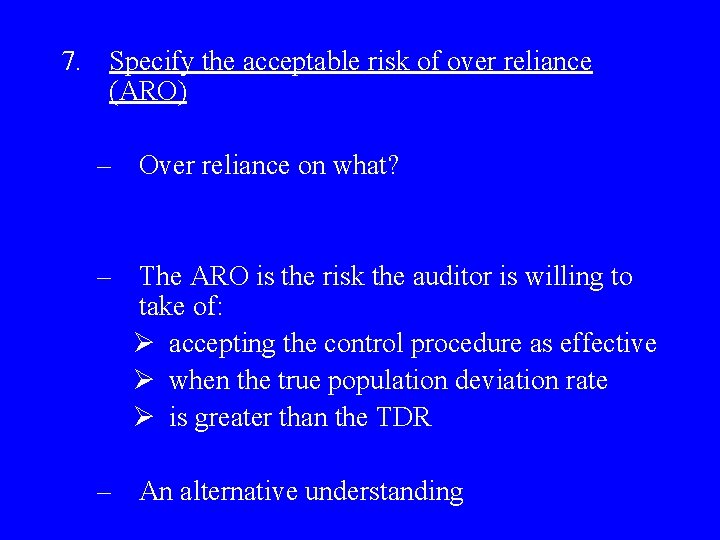
7. Specify the acceptable risk of over reliance (ARO) – Over reliance on what? – The ARO is the risk the auditor is willing to take of: Ø accepting the control procedure as effective Ø when the true population deviation rate Ø is greater than the TDR – An alternative understanding
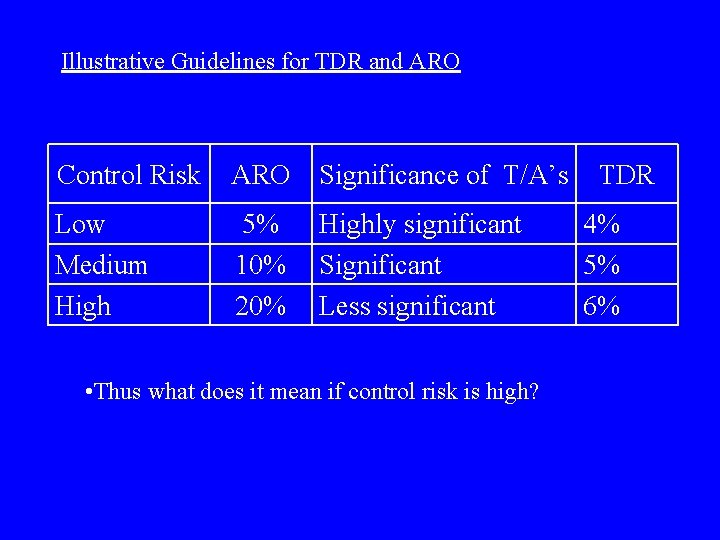
Illustrative Guidelines for TDR and ARO Control Risk ARO Significance of T/A’s Low Medium High 5% 10% 20% Highly significant Significant Less significant • Thus what does it mean if control risk is high? TDR 4% 5% 6%
8. Estimate the expected population deviation rate (EPDR) – An advanced estimate – What is typically used? – If this estimate is not available?
9. Determine the initial sample size – Why look at the initial sample size? – Will look at an illustrative example.
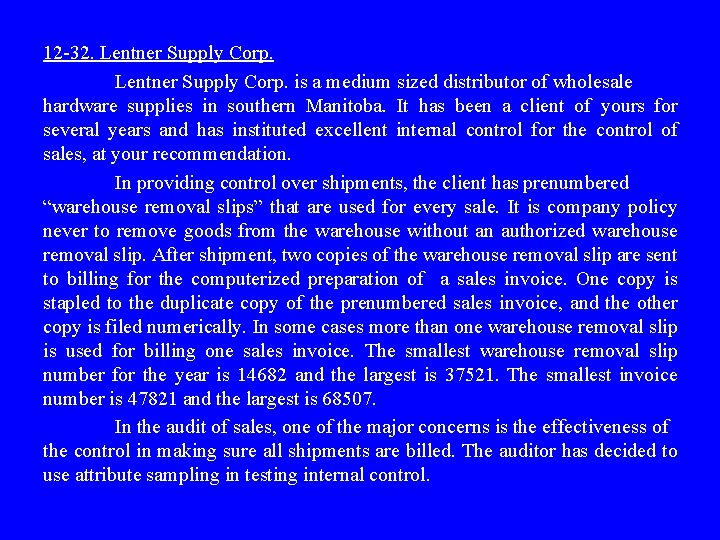
12 -32. Lentner Supply Corp. is a medium sized distributor of wholesale hardware supplies in southern Manitoba. It has been a client of yours for several years and has instituted excellent internal control for the control of sales, at your recommendation. In providing control over shipments, the client has prenumbered “warehouse removal slips” that are used for every sale. It is company policy never to remove goods from the warehouse without an authorized warehouse removal slip. After shipment, two copies of the warehouse removal slip are sent to billing for the computerized preparation of a sales invoice. One copy is stapled to the duplicate copy of the prenumbered sales invoice, and the other copy is filed numerically. In some cases more than one warehouse removal slip is used for billing one sales invoice. The smallest warehouse removal slip number for the year is 14682 and the largest is 37521. The smallest invoice number is 47821 and the largest is 68507. In the audit of sales, one of the major concerns is the effectiveness of the control in making sure all shipments are billed. The auditor has decided to use attribute sampling in testing internal control.
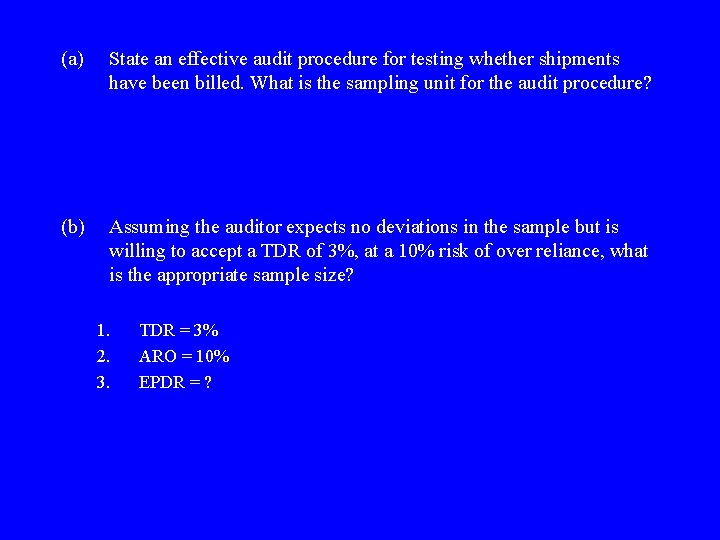
(a) State an effective audit procedure for testing whether shipments have been billed. What is the sampling unit for the audit procedure? (b) Assuming the auditor expects no deviations in the sample but is willing to accept a TDR of 3%, at a 10% risk of over reliance, what is the appropriate sample size? 1. 2. 3. TDR = 3% ARO = 10% EPDR = ?
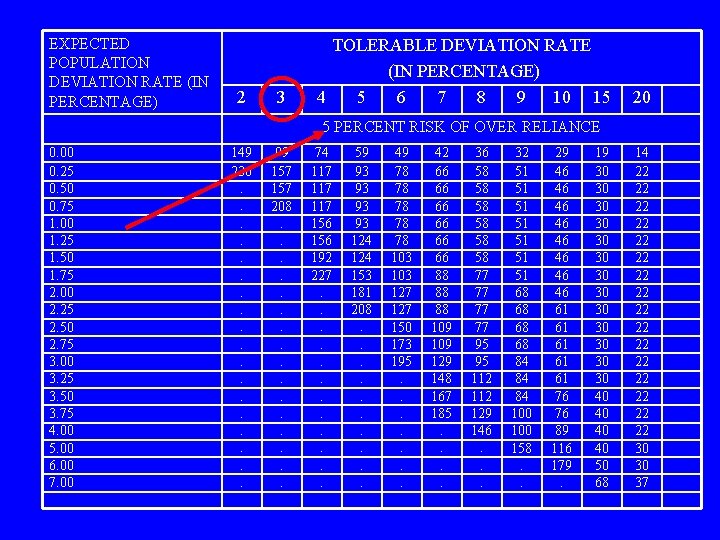
EXPECTED POPULATION DEVIATION RATE (IN PERCENTAGE) 2 3 TOLERABLE DEVIATION RATE (IN PERCENTAGE) 4 5 6 7 8 9 10 15 20 5 PERCENT RISK OF OVER RELIANCE 0. 00 0. 25 0. 50 0. 75 1. 00 1. 25 1. 50 1. 75 2. 00 2. 25 2. 50 2. 75 3. 00 3. 25 3. 50 3. 75 4. 00 5. 00 6. 00 7. 00 149 236 . . . . 99 157 208 . . . . 74 117 117 156 192 227 . . . 59 93 93 124 153 181 208 . . 49 78 78 78 103 127 150 173 195 . . . . 42 66 66 66 88 88 88 109 129 148 167 185 . . 36 58 58 58 77 77 95 95 112 129 146 . . . 32 51 51 68 68 84 84 84 100 158 . . 29 46 46 61 61 61 76 76 89 116 179 . 19 30 30 30 30 40 40 50 68 14 22 22 22 22 30 30 37
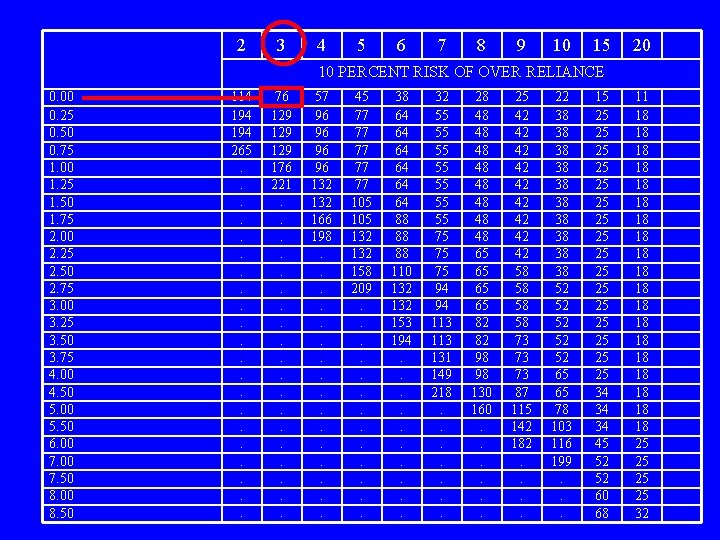
2 3 4 5 6 7 8 9 10 15 20 10 PERCENT RISK OF OVER RELIANCE 0. 00 0. 25 0. 50 0. 75 1. 00 1. 25 1. 50 1. 75 2. 00 2. 25 2. 50 2. 75 3. 00 3. 25 3. 50 3. 75 4. 00 4. 50 5. 00 5. 50 6. 00 7. 50 8. 00 8. 50 114 194 265 . . 76 129 129 176 221 . . 57 96 96 132 166 198 . . . . 45 77 77 77 105 132 158 209 . . . 38 64 64 64 88 88 88 110 132 153 194 . . 32 55 55 75 75 75 94 94 113 131 149 218 . . . . 28 48 48 65 65 82 82 98 98 130 160 . . . 25 42 42 42 58 58 73 73 73 87 115 142 182 . . 22 38 38 38 52 52 52 65 65 78 103 116 199 . . . 15 25 25 25 25 34 34 34 45 52 52 60 68 11 18 18 18 18 18 25 25 32
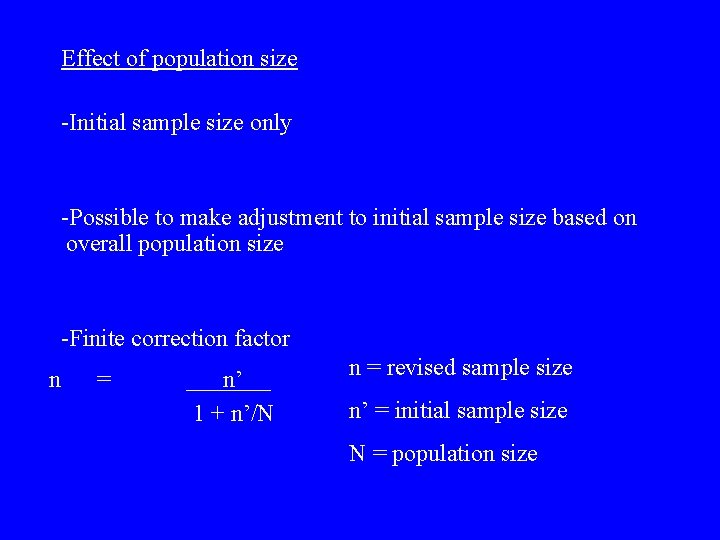
Effect of population size -Initial sample size only -Possible to make adjustment to initial sample size based on overall population size -Finite correction factor n = n’ 1 + n’/N n = revised sample size n’ = initial sample size N = population size
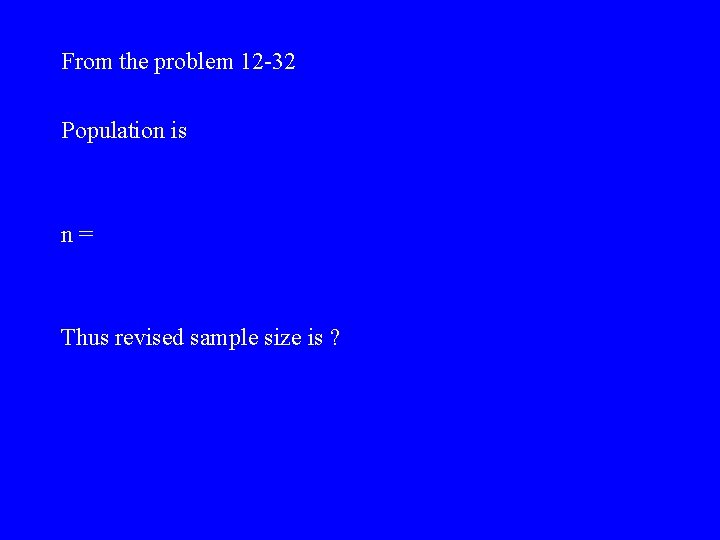
From the problem 12 -32 Population is n= Thus revised sample size is ?
(b) Select sample and perform audit procedures • Two Steps involved 10. Randomly select the sample (Requirement c of 12 -32) • Use of a random number table • A one-to-one correspondence between warehouse removal slip • How is this correspondence achieved?
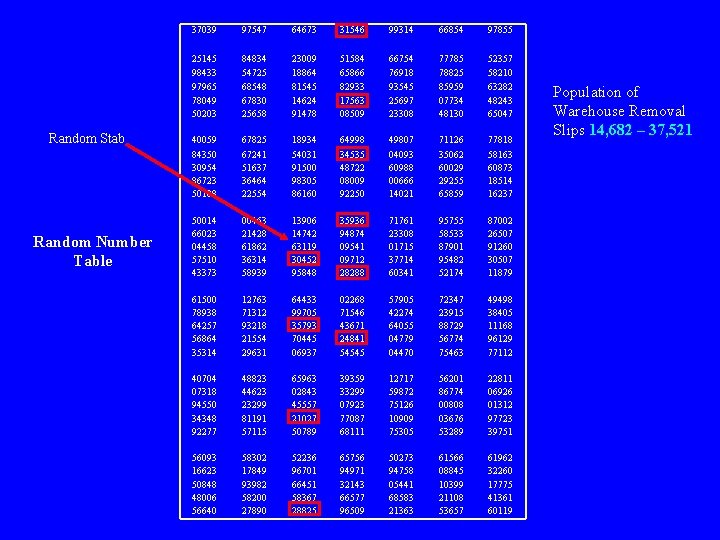
Random Stab Random Number Table 37039 97547 64673 31546 99314 66854 97855 25145 98433 97965 78049 50203 84834 54725 68548 67830 25658 23009 18864 81545 14624 91478 51584 65866 82933 17563 08509 66754 76918 93545 25697 23308 77785 78825 85959 07734 48130 52357 58210 63282 48243 65047 40059 84350 30954 86723 50188 67825 67241 51637 36464 22554 18934 54031 91500 98305 86160 64998 34535 48722 08009 92250 49807 04093 60988 00666 14021 71126 35062 60029 29255 65859 77818 58163 60873 18514 16237 50014 66023 04458 57510 43373 00463 21428 61862 36314 58939 13906 14742 63119 30452 95848 35936 94874 09541 09712 28288 71761 23308 01715 37714 60341 95755 58533 87901 95482 52174 87002 26507 91260 30507 11879 61500 78938 64257 56864 35314 12763 71312 93218 21554 29631 64433 99705 35793 70445 06937 02268 71546 43671 24841 54545 57905 42274 64055 04779 04470 72347 23915 88729 56774 75463 49498 38405 11168 96129 77112 40704 07318 94550 34348 92277 48823 44623 23299 81191 57115 65963 02843 45557 21027 50789 39359 33299 07923 77087 68111 12717 59872 75126 10909 75305 56201 86774 00808 03676 53289 22811 06926 01312 97723 39751 56093 16623 50848 48006 56640 58302 17849 93982 58200 27890 52236 96701 66451 58367 28825 65756 94971 32143 66577 96509 50273 94758 05441 68583 21363 61566 08845 10399 21108 53657 61962 32260 17775 41361 60119 Population of Warehouse Removal Slips 14, 682 – 37, 521
11. Perform the audit procedures • Requirement a of 12 -32 already done • Requirement d of 12 -32 – Other audit procedures
(c) Evaluating the results • Three steps involved – Generalize from the sample to the population (12) – Analyze deviations (13); and – Decide the acceptability of the population (14)
12. Generalize from the sample to the population • Need to calculate the sample deviation rate • SDR = Actual number of deviation Sample size • Assume in problem 12 -32 that there was 1 deviation in the sample of 76
• Sampling risk prevent auditor from • Note: ARO was 10%, and n = 76 • Calculation of CUDR
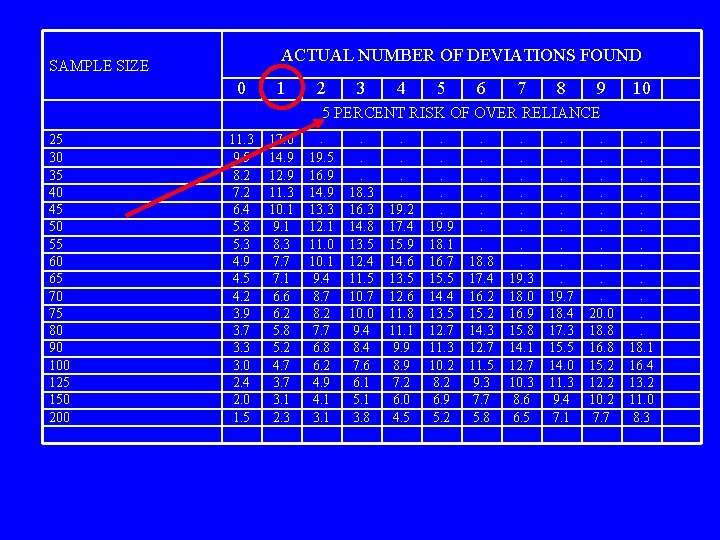
ACTUAL NUMBER OF DEVIATIONS FOUND SAMPLE SIZE 0 1 2 3 4 5 6 7 8 9 10 5 PERCENT RISK OF OVER RELIANCE 25 30 35 40 45 50 55 60 65 70 75 80 90 100 125 150 200 11. 3 9. 5 8. 2 7. 2 6. 4 5. 8 5. 3 4. 9 4. 5 4. 2 3. 9 3. 7 3. 3 3. 0 2. 4 2. 0 1. 5 17. 6 14. 9 12. 9 11. 3 10. 1 9. 1 8. 3 7. 7 7. 1 6. 6 6. 2 5. 8 5. 2 4. 7 3. 1 2. 3 . 19. 5 16. 9 14. 9 13. 3 12. 1 11. 0 10. 1 9. 4 8. 7 8. 2 7. 7 6. 8 6. 2 4. 9 4. 1 3. 1 . . . 18. 3 16. 3 14. 8 13. 5 12. 4 11. 5 10. 7 10. 0 9. 4 8. 4 7. 6 6. 1 5. 1 3. 8 . . 19. 2 17. 4 15. 9 14. 6 13. 5 12. 6 11. 8 11. 1 9. 9 8. 9 7. 2 6. 0 4. 5 . . . 19. 9 18. 1 16. 7 15. 5 14. 4 13. 5 12. 7 11. 3 10. 2 8. 2 6. 9 5. 2 . . . . 18. 8 17. 4 16. 2 15. 2 14. 3 12. 7 11. 5 9. 3 7. 7 5. 8 . . . . 19. 3 18. 0 16. 9 15. 8 14. 1 12. 7 10. 3 8. 6 6. 5 . . 19. 7 18. 4 17. 3 15. 5 14. 0 11. 3 9. 4 7. 1 . . 20. 0 18. 8 16. 8 15. 2 12. 2 10. 2 7. 7 . . . 18. 1 16. 4 13. 2 11. 0 8. 3
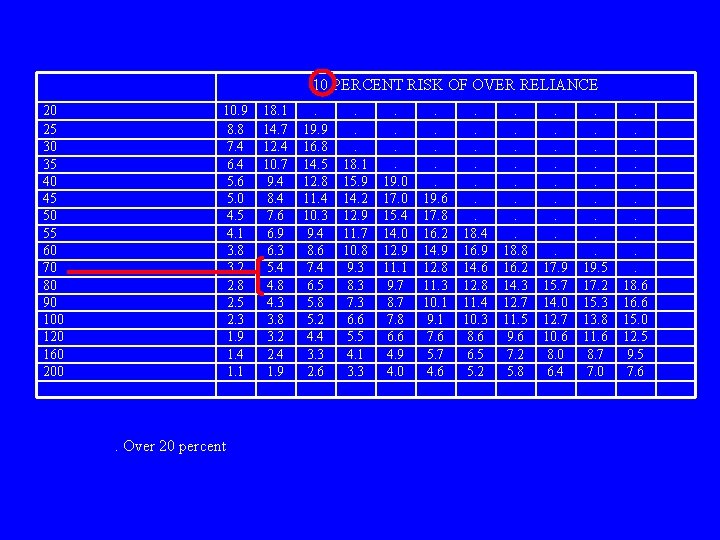
10 PERCENT RISK OF OVER RELIANCE 20 25 30 35 40 45 50 55 60 70 80 90 100 120 160 200 10. 9 8. 8 7. 4 6. 4 5. 6 5. 0 4. 5 4. 1 3. 8 3. 2 2. 8 2. 5 2. 3 1. 9 1. 4 1. 1 . Over 20 percent 18. 1 14. 7 12. 4 10. 7 9. 4 8. 4 7. 6 6. 9 6. 3 5. 4 4. 8 4. 3 3. 8 3. 2 2. 4 1. 9 . 19. 9 16. 8 14. 5 12. 8 11. 4 10. 3 9. 4 8. 6 7. 4 6. 5 5. 8 5. 2 4. 4 3. 3 2. 6 . . . 18. 1 15. 9 14. 2 12. 9 11. 7 10. 8 9. 3 8. 3 7. 3 6. 6 5. 5 4. 1 3. 3 . . 19. 0 17. 0 15. 4 14. 0 12. 9 11. 1 9. 7 8. 7 7. 8 6. 6 4. 9 4. 0 . . . 19. 6 17. 8 16. 2 14. 9 12. 8 11. 3 10. 1 9. 1 7. 6 5. 7 4. 6 . . . . 18. 4 16. 9 14. 6 12. 8 11. 4 10. 3 8. 6 6. 5 5. 2 . . . . 18. 8 16. 2 14. 3 12. 7 11. 5 9. 6 7. 2 5. 8 . . . . 17. 9 15. 7 14. 0 12. 7 10. 6 8. 0 6. 4 19. 5 17. 2 15. 3 13. 8 11. 6 8. 7 7. 0 . . 18. 6 16. 6 15. 0 12. 5 9. 5 7. 6
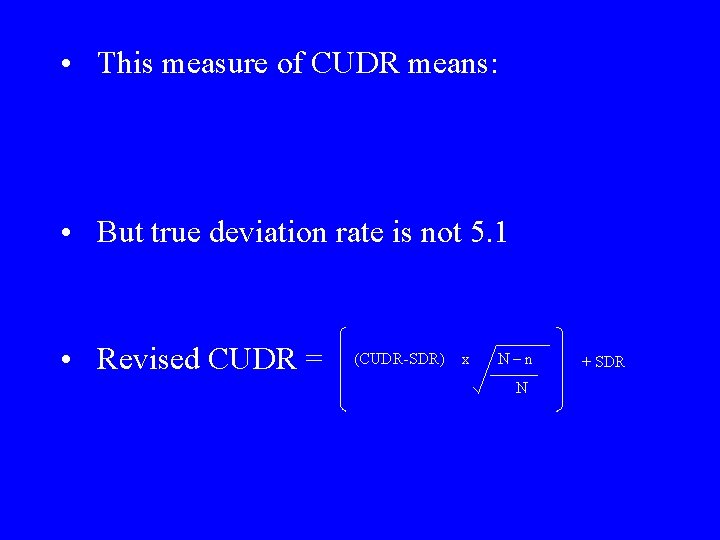
• This measure of CUDR means: • But true deviation rate is not 5. 1 • Revised CUDR = (CUDR-SDR) x N–n N + SDR
13. Analyze deviations or errors • Why? • What could have caused the deviation?
14. Decide the acceptability of the population • When can the population be considered acceptable? • From 12. 32 TDR = 3% and CUDR = 5. 1%
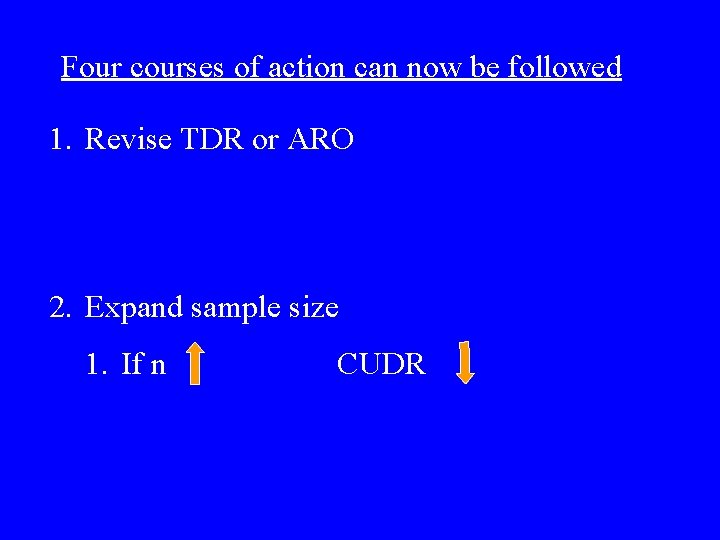
Four courses of action can now be followed 1. Revise TDR or ARO 2. Expand sample size 1. If n CUDR
3. Revise assessed control risk 4. Write a letter to management
Problem 1. 12 -33: The following is a partial audit program for the audit of cash receipts 1. Review the cash receipts journal for large and unusual transactions. 2. Trace entries from the prelisting of cash receipts to the cash receipts journal to determine if each is recorded. 3. Compare customer name, date, and amount on the prelisting with the cash receipts journal. 4. Examine the related remittance advices for entries selected from the prelisting to determine if cash discounts were approved. 5. Trace entries from the prelisting to the deposit slip to determine if each has been deposited. 6. Required: a. Identify which audit procedures could be tested using attribute sampling. b. What is the appropriate sampling unit for the tests in part (a)? c. List the attributes for testing in part (a). d. Assume an ARACR of 5 percent and a TER of 8 percent for tests of controls. The estimated population deviation rate for tests of controls is 2 percent. What is the initial sample size for each attribute?
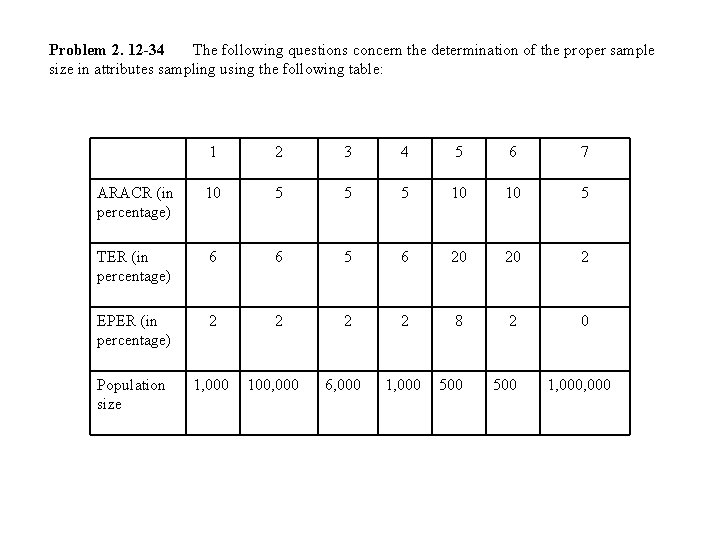
Problem 2. 12 -34 The following questions concern the determination of the proper sample size in attributes sampling using the following table: 1 2 3 4 5 6 7 ARACR (in percentage) 10 5 5 5 10 10 5 TER (in percentage) 6 6 5 6 20 20 2 EPER (in percentage) 2 2 8 2 0 Population size 1, 000 6, 000 1, 000 500 100, 000 1, 000
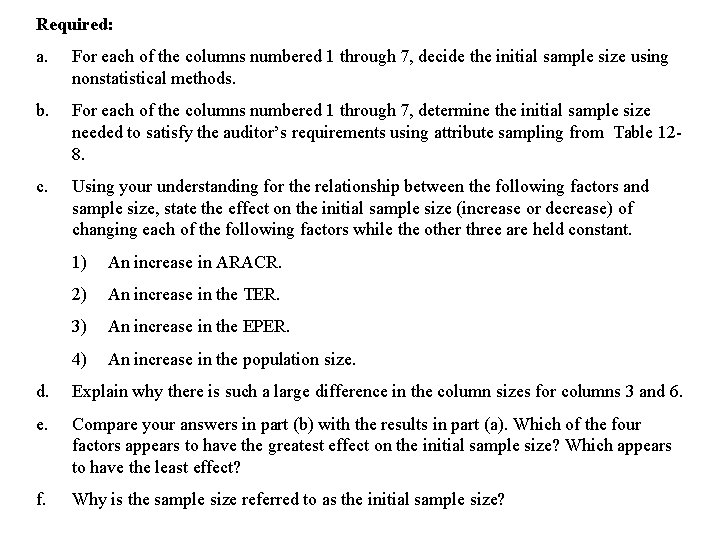
Required: a. For each of the columns numbered 1 through 7, decide the initial sample size using nonstatistical methods. b. For each of the columns numbered 1 through 7, determine the initial sample size needed to satisfy the auditor’s requirements using attribute sampling from Table 128. c. Using your understanding for the relationship between the following factors and sample size, state the effect on the initial sample size (increase or decrease) of changing each of the following factors while the other three are held constant. 1) An increase in ARACR. 2) An increase in the TER. 3) An increase in the EPER. 4) An increase in the population size. d. Explain why there is such a large difference in the column sizes for columns 3 and 6. e. Compare your answers in part (b) with the results in part (a). Which of the four factors appears to have the greatest effect on the initial sample size? Which appears to have the least effect? f. Why is the sample size referred to as the initial sample size?
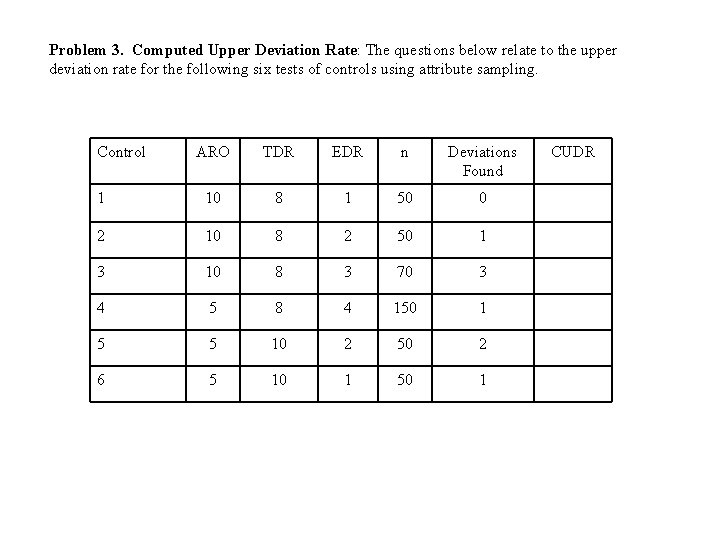
Problem 3. Computed Upper Deviation Rate: The questions below relate to the upper deviation rate for the following six tests of controls using attribute sampling. Control ARO TDR EDR n Deviations Found 1 10 8 1 50 0 2 10 8 2 50 1 3 10 8 3 70 3 4 5 8 4 150 1 5 5 10 2 50 2 6 5 10 1 50 1 CUDR
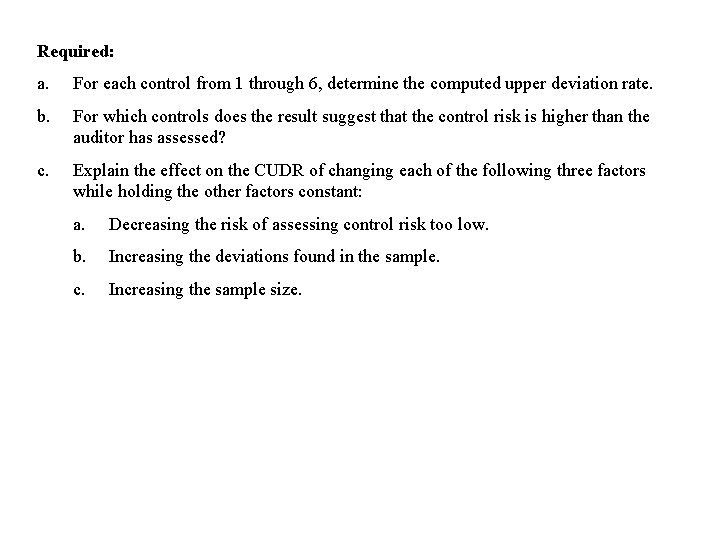
Required: a. For each control from 1 through 6, determine the computed upper deviation rate. b. For which controls does the result suggest that the control risk is higher than the auditor has assessed? c. Explain the effect on the CUDR of changing each of the following three factors while holding the other factors constant: a. Decreasing the risk of assessing control risk too low. b. Increasing the deviations found in the sample. c. Increasing the sample size.

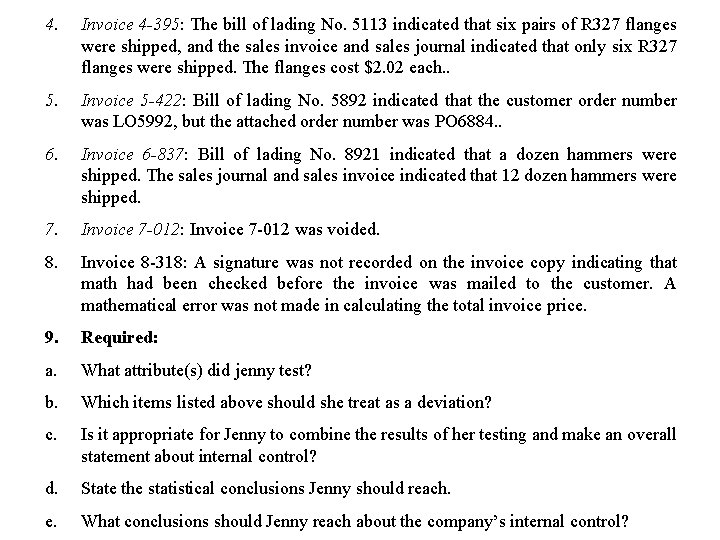
4. Invoice 4 -395: The bill of lading No. 5113 indicated that six pairs of R 327 flanges were shipped, and the sales invoice and sales journal indicated that only six R 327 flanges were shipped. The flanges cost $2. 02 each. . 5. Invoice 5 -422: Bill of lading No. 5892 indicated that the customer order number was LO 5992, but the attached order number was PO 6884. . 6. Invoice 6 -837: Bill of lading No. 8921 indicated that a dozen hammers were shipped. The sales journal and sales invoice indicated that 12 dozen hammers were shipped. 7. Invoice 7 -012: Invoice 7 -012 was voided. 8. Invoice 8 -318: A signature was not recorded on the invoice copy indicating that math had been checked before the invoice was mailed to the customer. A mathematical error was not made in calculating the total invoice price. 9. Required: a. What attribute(s) did jenny test? b. Which items listed above should she treat as a deviation? c. Is it appropriate for Jenny to combine the results of her testing and make an overall statement about internal control? d. State the statistical conclusions Jenny should reach. e. What conclusions should Jenny reach about the company’s internal control?
- Slides: 55