
Section 2 The Plasma Membrane The plasma membrane
Section 2: The Plasma Membrane The plasma membrane helps to maintain a cell’s homeostasis.
Essential Questions • • How does a cell’s plasma membrane function? What are the roles of proteins, carbohydrates, and cholesterol in the plasma membrane? Copyright © Mc. Graw-Hill Education The Plasma Membrane
Vocabulary Review New • • • ion selective permeability phospholipid bilayer transport protein fluid mosaic model
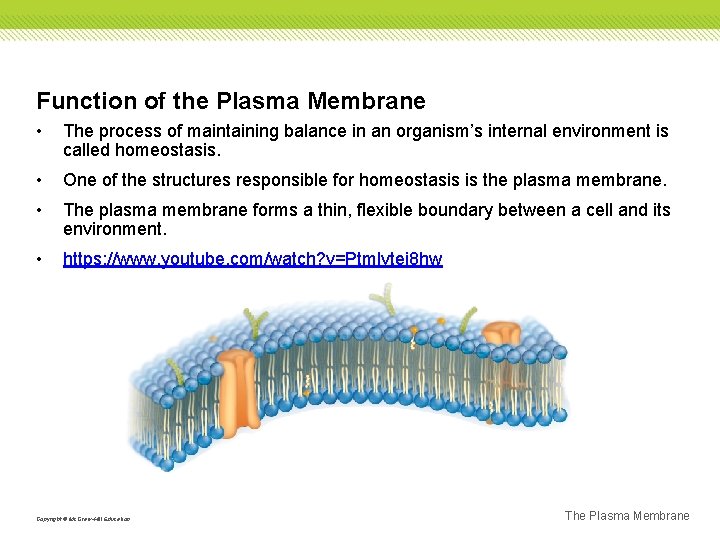
Function of the Plasma Membrane • The process of maintaining balance in an organism’s internal environment is called homeostasis. • One of the structures responsible for homeostasis is the plasma membrane. • The plasma membrane forms a thin, flexible boundary between a cell and its environment. • https: //www. youtube. com/watch? v=Ptmlvtei 8 hw Copyright © Mc. Graw-Hill Education The Plasma Membrane
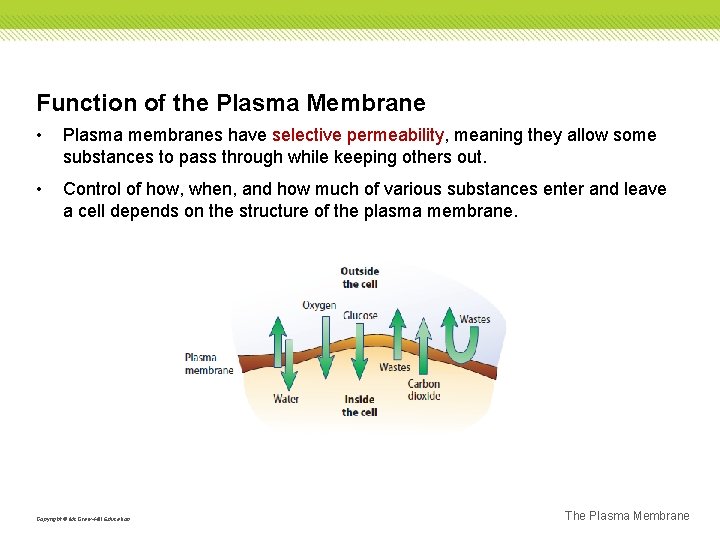
Function of the Plasma Membrane • Plasma membranes have selective permeability, meaning they allow some substances to pass through while keeping others out. • Control of how, when, and how much of various substances enter and leave a cell depends on the structure of the plasma membrane. Copyright © Mc. Graw-Hill Education The Plasma Membrane
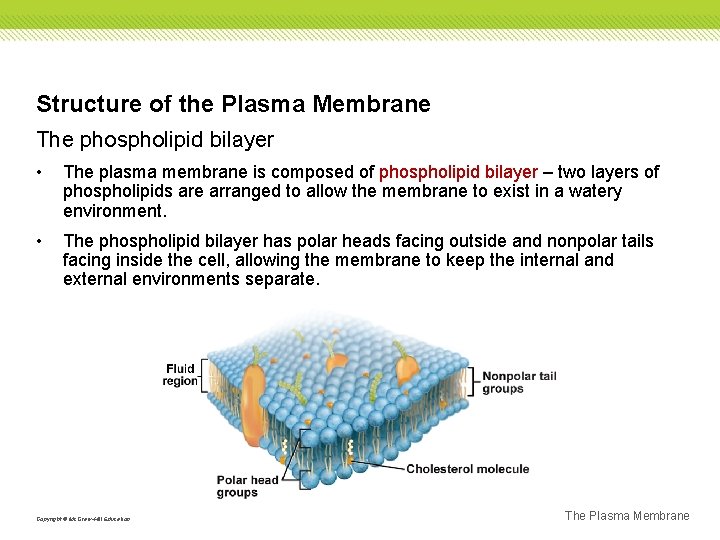
Structure of the Plasma Membrane The phospholipid bilayer • The plasma membrane is composed of phospholipid bilayer – two layers of phospholipids are arranged to allow the membrane to exist in a watery environment. • The phospholipid bilayer has polar heads facing outside and nonpolar tails facing inside the cell, allowing the membrane to keep the internal and external environments separate. Copyright © Mc. Graw-Hill Education The Plasma Membrane
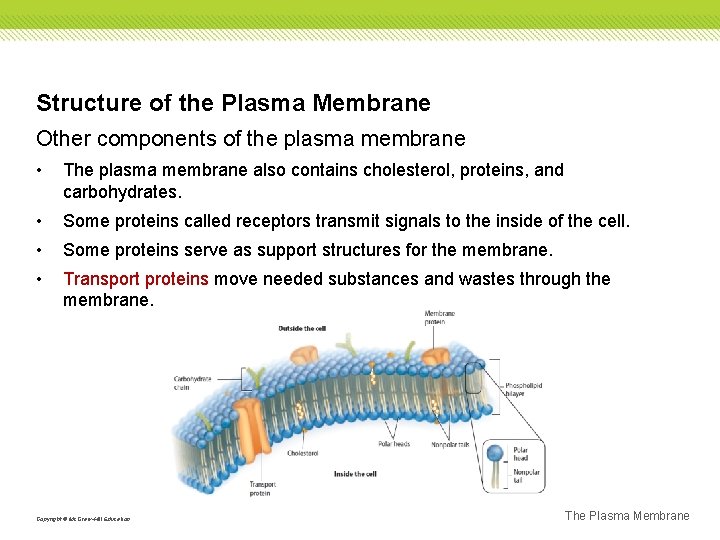
Structure of the Plasma Membrane Other components of the plasma membrane • The plasma membrane also contains cholesterol, proteins, and carbohydrates. • Some proteins called receptors transmit signals to the inside of the cell. • Some proteins serve as support structures for the membrane. • Transport proteins move needed substances and wastes through the membrane. Copyright © Mc. Graw-Hill Education The Plasma Membrane
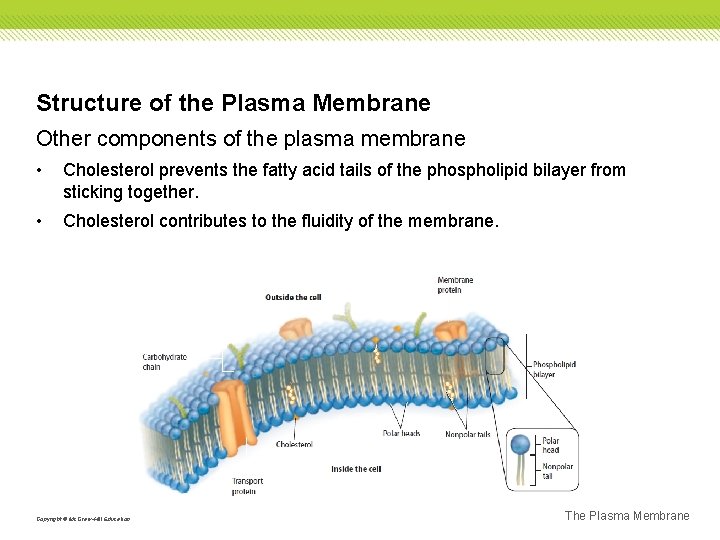
Structure of the Plasma Membrane Other components of the plasma membrane • Cholesterol prevents the fatty acid tails of the phospholipid bilayer from sticking together. • Cholesterol contributes to the fluidity of the membrane. Copyright © Mc. Graw-Hill Education The Plasma Membrane
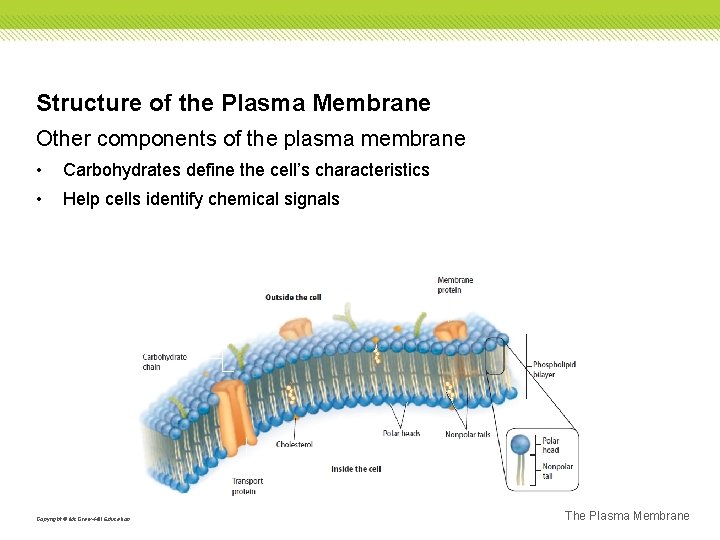
Structure of the Plasma Membrane Other components of the plasma membrane • Carbohydrates define the cell’s characteristics • Help cells identify chemical signals Copyright © Mc. Graw-Hill Education The Plasma Membrane
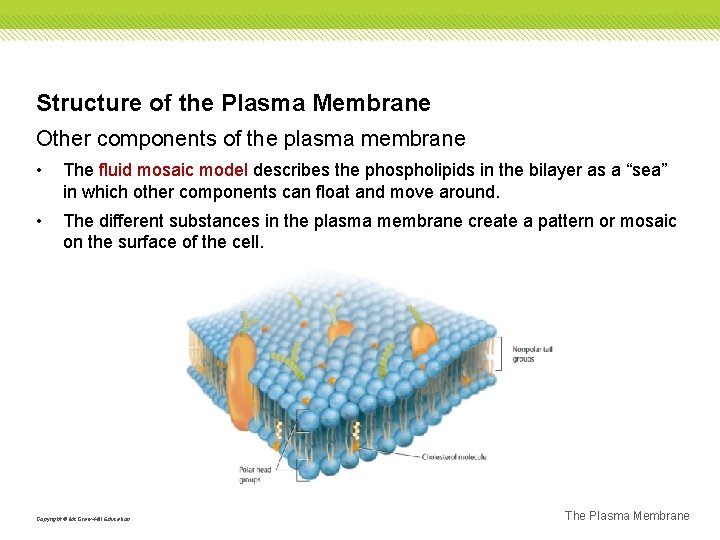
Structure of the Plasma Membrane Other components of the plasma membrane • The fluid mosaic model describes the phospholipids in the bilayer as a “sea” in which other components can float and move around. • The different substances in the plasma membrane create a pattern or mosaic on the surface of the cell. Copyright © Mc. Graw-Hill Education The Plasma Membrane
Plasma Membrane- Video (Take notes here) https: //www. youtube. com/watch? v=Qqsf_UJcf. Bc https: //www. youtube. com/watch? v=t. MKl. PDBRJ 1 E The Plasma Membrane
Review Essential Questions • How does a cell’s plasma membrane function? • What are the roles of proteins, carbohydrates, and cholesterol in the plasma membrane? Vocabulary • selective permeability • phospholipid bilayer • transport protein • fluid mosaic model The Plasma Membrane
Section 3: Structures and Organelles Eukaryotic cells contain organelles that allow the specializations and the separation of functions within the cell.
Essential Questions • What are the structures of a typical eukaryotic cell, and what are their functions? • What are the similarities and differences between plant and animal cells? Structures and Organelles
Vocabulary Review New continued • • • enzyme New • • • cytoplasm cytoskeleton ribosome nucleolus endoplasmic reticulum Golgi apparatus Copyright © Mc. Graw-Hill Education vacuole lysosome centriole mitochondrion chloroplast cell wall cilium flagellum Structures and Organelles
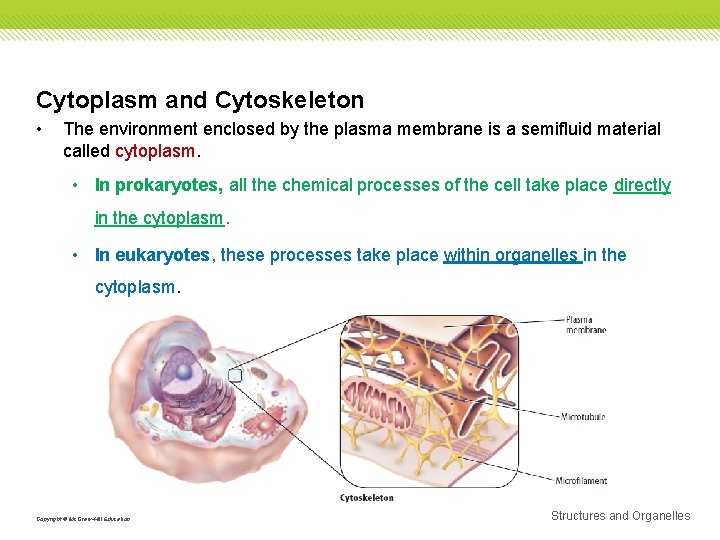
Cytoplasm and Cytoskeleton • The environment enclosed by the plasma membrane is a semifluid material called cytoplasm. • In prokaryotes, all the chemical processes of the cell take place directly in the cytoplasm. • In eukaryotes, these processes take place within organelles in the cytoplasm. Copyright © Mc. Graw-Hill Education Structures and Organelles
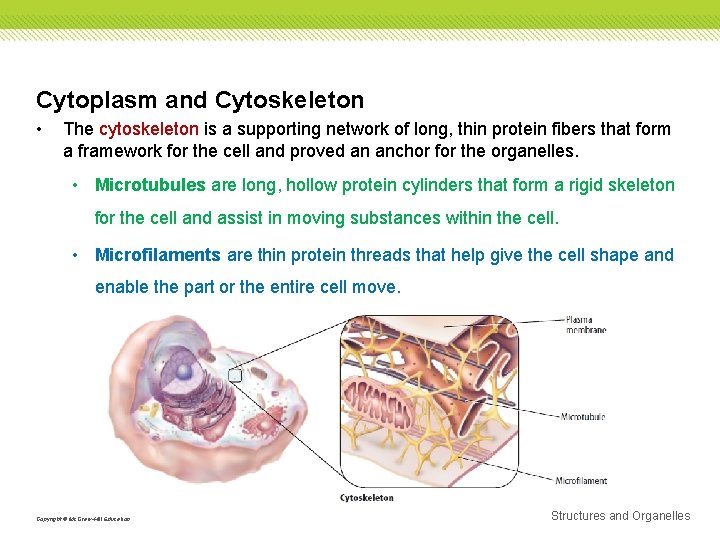
Cytoplasm and Cytoskeleton • The cytoskeleton is a supporting network of long, thin protein fibers that form a framework for the cell and proved an anchor for the organelles. • Microtubules are long, hollow protein cylinders that form a rigid skeleton for the cell and assist in moving substances within the cell. • Microfilaments are thin protein threads that help give the cell shape and enable the part or the entire cell move. Copyright © Mc. Graw-Hill Education Structures and Organelles

Visualizing Cells- Video Clip (Take Notes here) https: //www. youtube. com/watch? v=Fzc. Tgrx. Mz. Zk&list=PLIU 8 Ss 3 Dw 8 Fm. Tk. TB 0 LK-Q_bkinr. Cxo 0 YX https: //www. youtube. com/watch? v=QAmaz. VNph. Bw&list=PLIU 8 Ss 3 Dw 8 Fm. Tk. TB 0 LK-Q_bkinr. Cxo 0 YX&index=2 Structures and Organelles
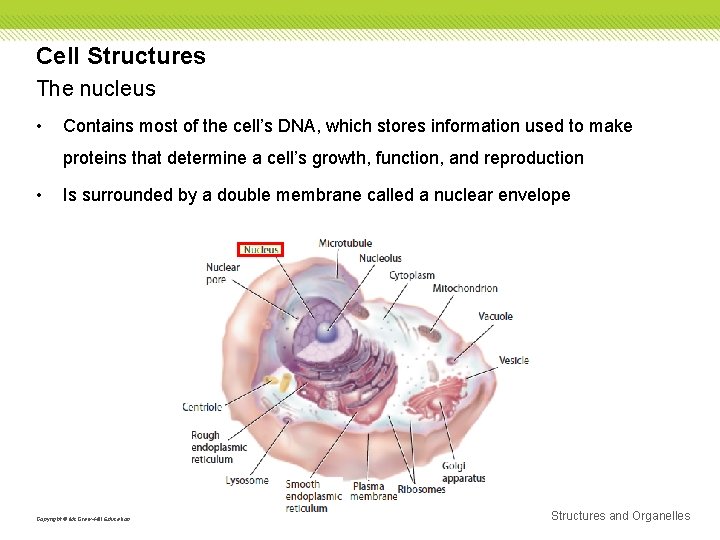
Cell Structures The nucleus • Contains most of the cell’s DNA, which stores information used to make proteins that determine a cell’s growth, function, and reproduction • Is surrounded by a double membrane called a nuclear envelope Copyright © Mc. Graw-Hill Education Structures and Organelles

The Nucleus- Movie Clip (Take Notes) https: //www. youtube. com/watch? v=Fxtrp 6 LMVCc https: //www. youtube. com/watch? v=URUJD 5 NEXC 8 Structures and Organelles
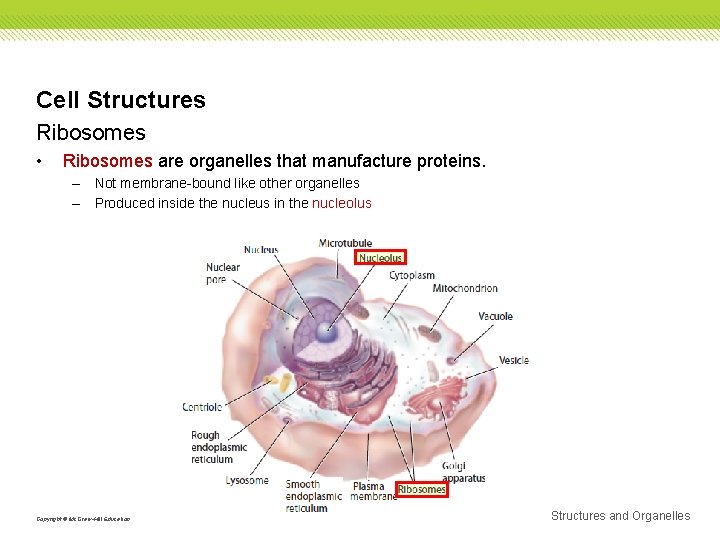
Cell Structures Ribosomes • Ribosomes are organelles that manufacture proteins. – Not membrane-bound like other organelles – Produced inside the nucleus in the nucleolus Copyright © Mc. Graw-Hill Education Structures and Organelles
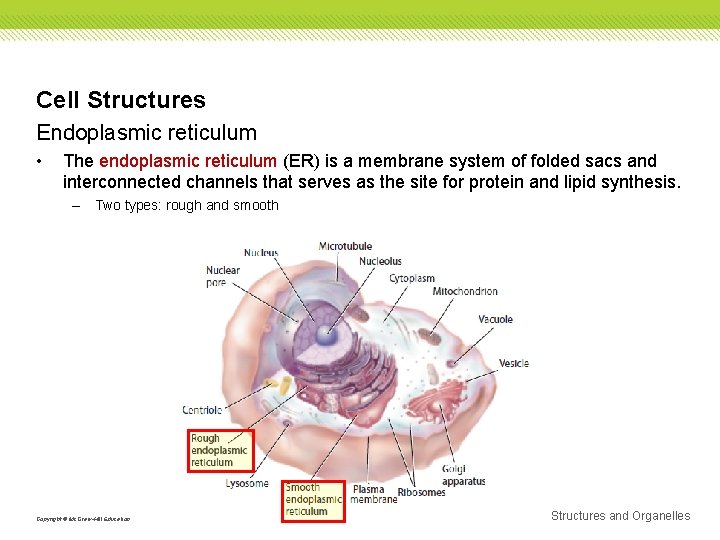
Cell Structures Endoplasmic reticulum • The endoplasmic reticulum (ER) is a membrane system of folded sacs and interconnected channels that serves as the site for protein and lipid synthesis. – Two types: rough and smooth Copyright © Mc. Graw-Hill Education Structures and Organelles
Cellular Pursuit Virtual Lab FPO Add link to Virtual Lab from page 194 (Cellular Pursuit) here. Copyright © Mc. Graw-Hill Education Structures and Organelles
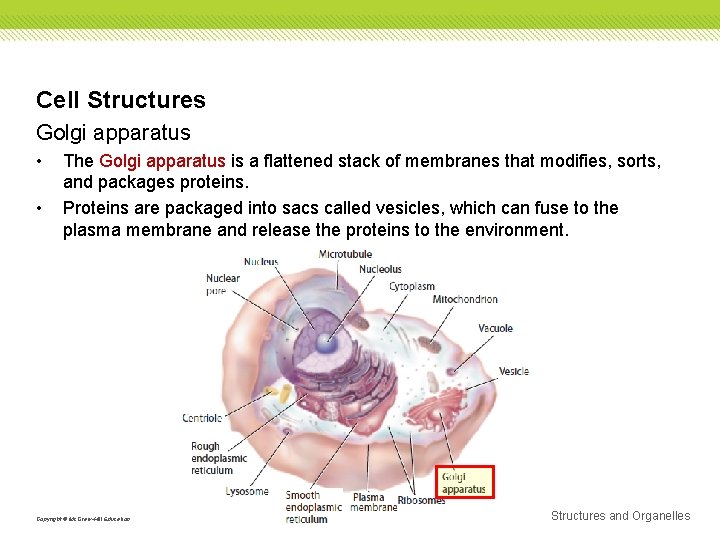
Cell Structures Golgi apparatus • • The Golgi apparatus is a flattened stack of membranes that modifies, sorts, and packages proteins. Proteins are packaged into sacs called vesicles, which can fuse to the plasma membrane and release the proteins to the environment. Copyright © Mc. Graw-Hill Education Structures and Organelles
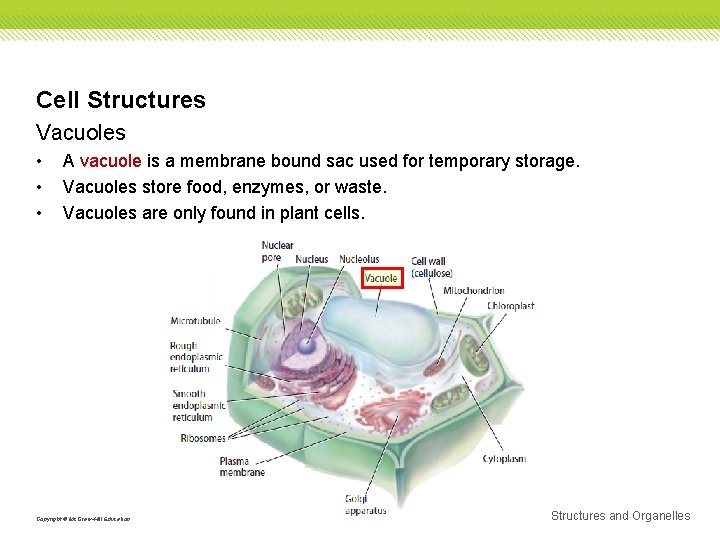
Cell Structures Vacuoles • • • A vacuole is a membrane bound sac used for temporary storage. Vacuoles store food, enzymes, or waste. Vacuoles are only found in plant cells. Copyright © Mc. Graw-Hill Education Structures and Organelles
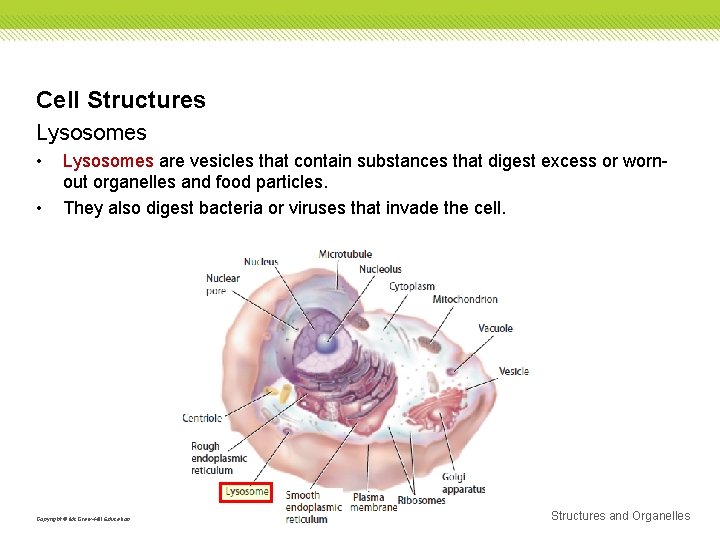
Cell Structures Lysosomes • • Lysosomes are vesicles that contain substances that digest excess or wornout organelles and food particles. They also digest bacteria or viruses that invade the cell. Copyright © Mc. Graw-Hill Education Structures and Organelles
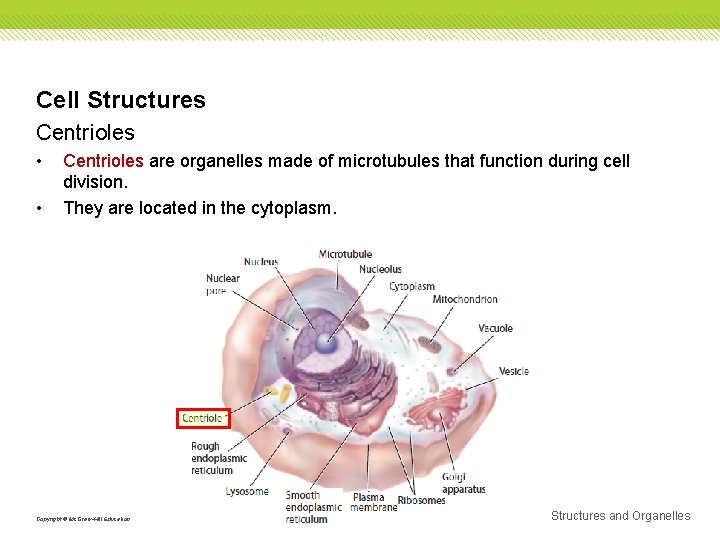
Cell Structures Centrioles • • Centrioles are organelles made of microtubules that function during cell division. They are located in the cytoplasm. Copyright © Mc. Graw-Hill Education Structures and Organelles
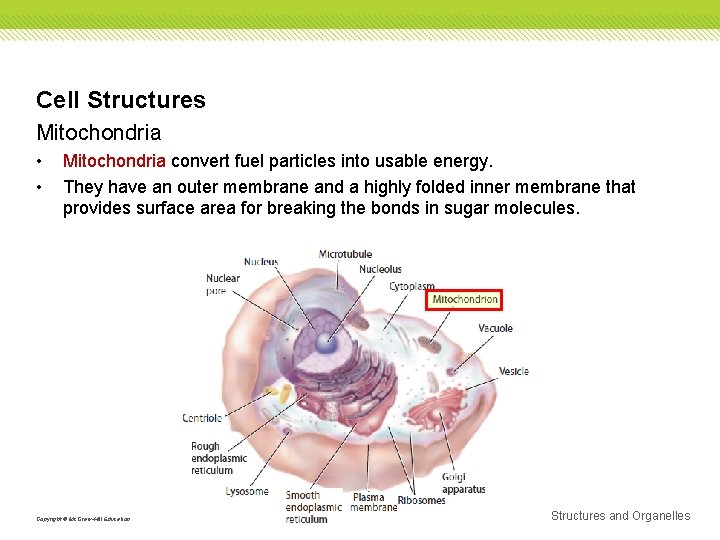
Cell Structures Mitochondria • • Mitochondria convert fuel particles into usable energy. They have an outer membrane and a highly folded inner membrane that provides surface area for breaking the bonds in sugar molecules. Copyright © Mc. Graw-Hill Education Structures and Organelles
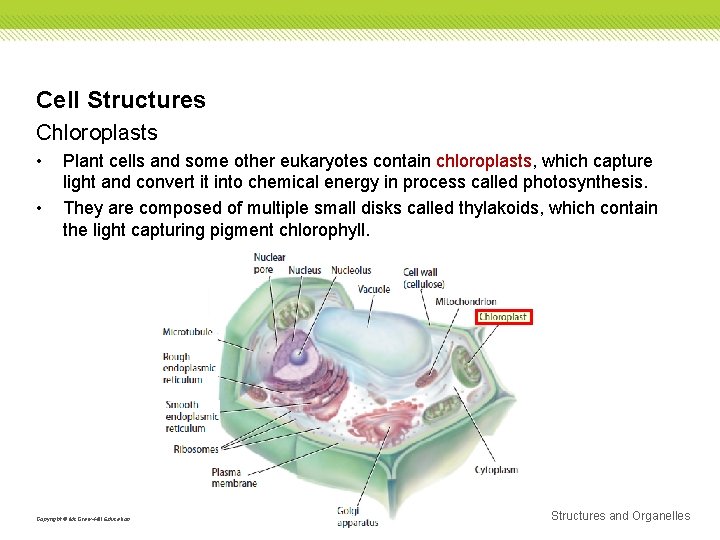
Cell Structures Chloroplasts • • Plant cells and some other eukaryotes contain chloroplasts, which capture light and convert it into chemical energy in process called photosynthesis. They are composed of multiple small disks called thylakoids, which contain the light capturing pigment chlorophyll. Copyright © Mc. Graw-Hill Education Structures and Organelles
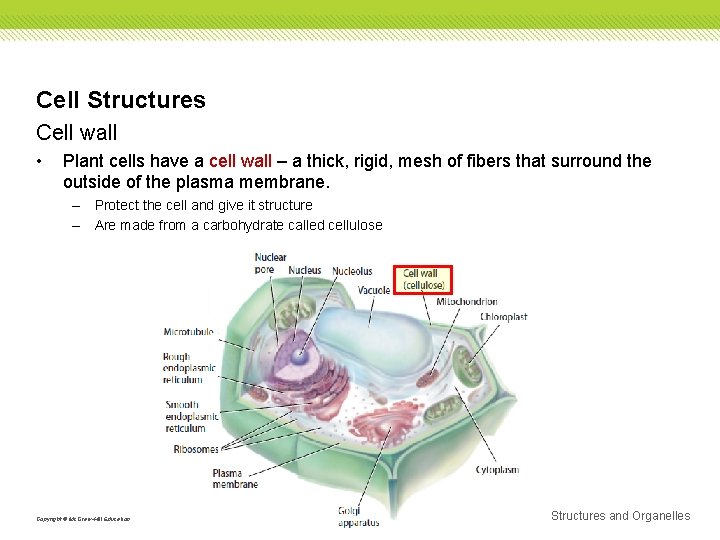
Cell Structures Cell wall • Plant cells have a cell wall – a thick, rigid, mesh of fibers that surround the outside of the plasma membrane. – Protect the cell and give it structure – Are made from a carbohydrate called cellulose Copyright © Mc. Graw-Hill Education Structures and Organelles
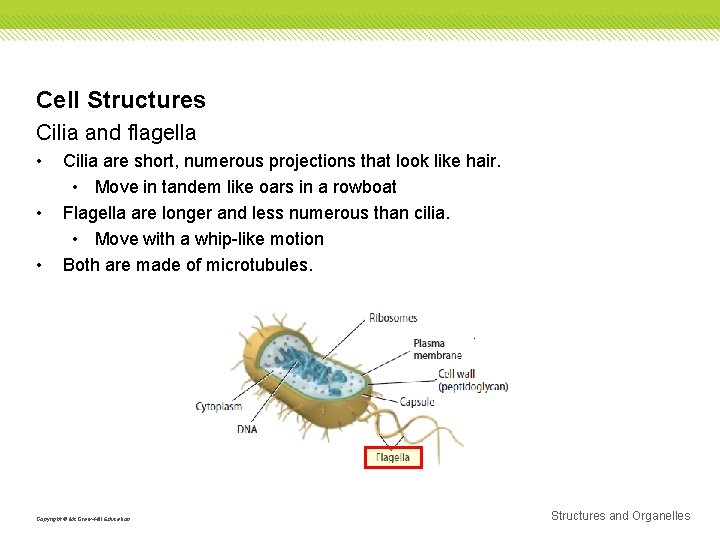
Cell Structures Cilia and flagella • • • Cilia are short, numerous projections that look like hair. • Move in tandem like oars in a rowboat Flagella are longer and less numerous than cilia. • Move with a whip-like motion Both are made of microtubules. Copyright © Mc. Graw-Hill Education Structures and Organelles
Summary of Cell Structures Interactive Table FPO Add link to interactive table from page 199 (Table 1) here. Copyright © Mc. Graw-Hill Education Structures and Organelles
Comparing Cells • Features plant cells have that animal cells generally do not: • Chloroplasts/chlorophyll • Vacuoles • Cell walls Copyright © Mc. Graw-Hill Education Structures and Organelles
Organelles at Work • • An understanding of different organelles allows for an understanding of cellular processes. Protein synthesis: • Begins in the nucleus with information contained in DNA • RNA and ribosomes leave the nucleus and produce a protein on the endoplasmic reticulum. • Proteins produced in the ER are sent to Golgi apparatus for packaging. • Packaged proteins are delivered to other organelles where they serve a variety of functions. Copyright © Mc. Graw-Hill Education Structures and Organelles
Review Essential Questions • What are the structures of a typical eukaryotic cell, and what are their functions? • What are the similarities and differences between plant and animal cells? Vocabulary • • • cytoplasm cytoskeleton ribosome nucleolus endoplasmic reticulum Copyright © Mc. Graw-Hill Education • • • Golgi apparatus vacuole lysosome centriole mitochondrion • • chloroplast cell wall cilium flagellum Structures and Organelles

Essential Questions • • • What are the processes of diffusion, facilitated diffusion, and active transport? What is the effect of a hypotonic, hypertonic, or isotonic solution on a cell? How do large particles enter and exit cells? Copyright © Mc. Graw-Hill Education Cellular Transport
Vocabulary Review New • • • homeostasis Copyright © Mc. Graw-Hill Education diffusion dynamic equilibrium facilitated diffusion osmosis isotonic solution hypertonic solution active transport endocytosis exocytosis Cellular Transport
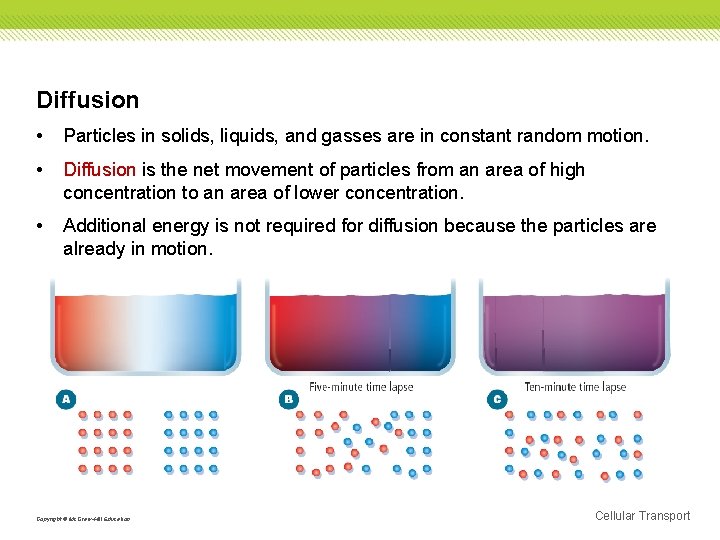
Diffusion • Particles in solids, liquids, and gasses are in constant random motion. • Diffusion is the net movement of particles from an area of high concentration to an area of lower concentration. • Additional energy is not required for diffusion because the particles are already in motion. Copyright © Mc. Graw-Hill Education Cellular Transport
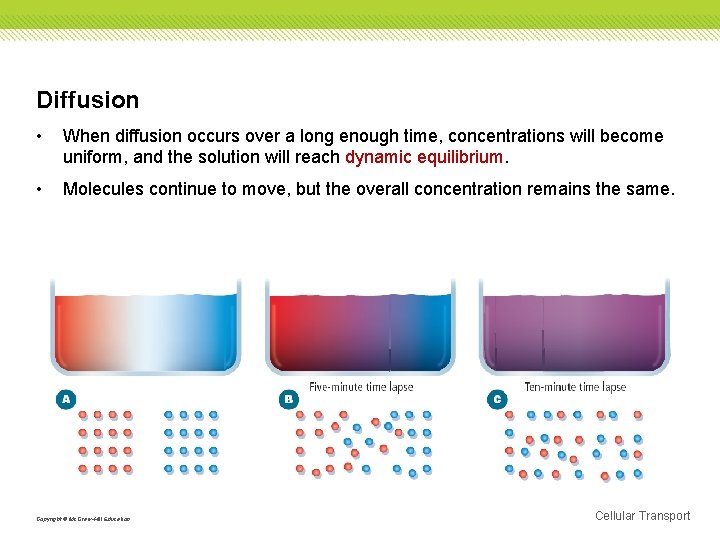
Diffusion • When diffusion occurs over a long enough time, concentrations will become uniform, and the solution will reach dynamic equilibrium. • Molecules continue to move, but the overall concentration remains the same. Copyright © Mc. Graw-Hill Education Cellular Transport
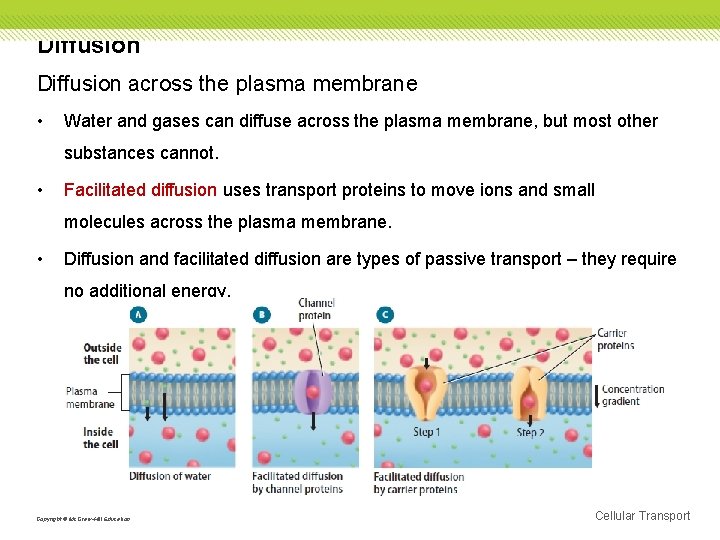
Diffusion across the plasma membrane • Water and gases can diffuse across the plasma membrane, but most other substances cannot. • Facilitated diffusion uses transport proteins to move ions and small molecules across the plasma membrane. • Diffusion and facilitated diffusion are types of passive transport – they require no additional energy. Copyright © Mc. Graw-Hill Education Cellular Transport

Facilitated Transport Cellular Transport
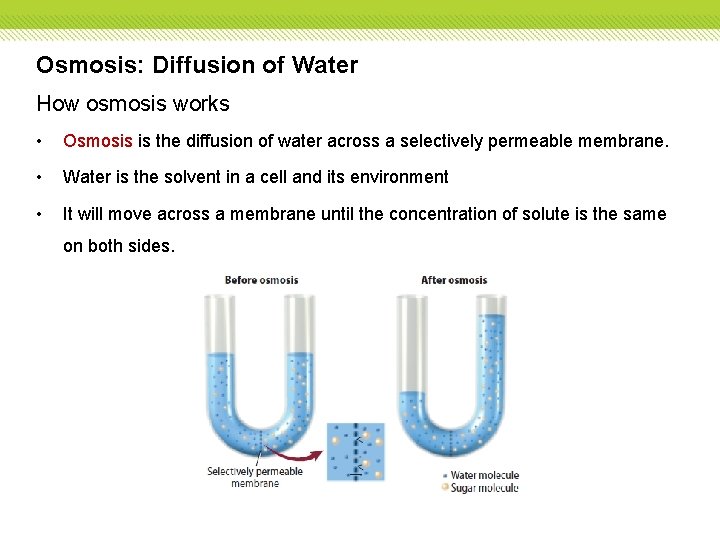
Osmosis: Diffusion of Water How osmosis works • Osmosis is the diffusion of water across a selectively permeable membrane. • Water is the solvent in a cell and its environment • It will move across a membrane until the concentration of solute is the same on both sides.
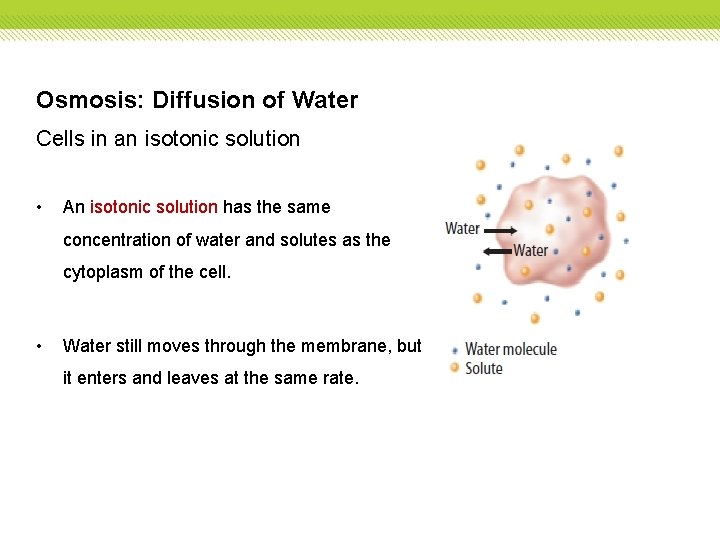
Osmosis: Diffusion of Water Cells in an isotonic solution • An isotonic solution has the same concentration of water and solutes as the cytoplasm of the cell. • Water still moves through the membrane, but it enters and leaves at the same rate.
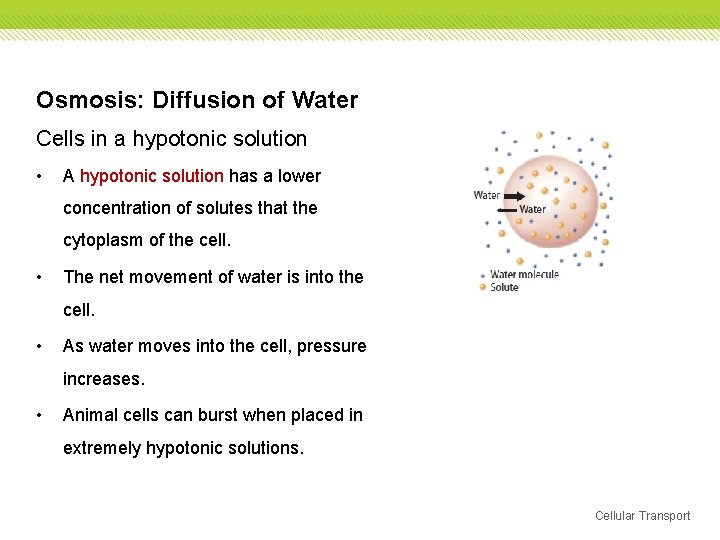
Osmosis: Diffusion of Water Cells in a hypotonic solution • A hypotonic solution has a lower concentration of solutes that the cytoplasm of the cell. • The net movement of water is into the cell. • As water moves into the cell, pressure increases. • Animal cells can burst when placed in extremely hypotonic solutions. Cellular Transport
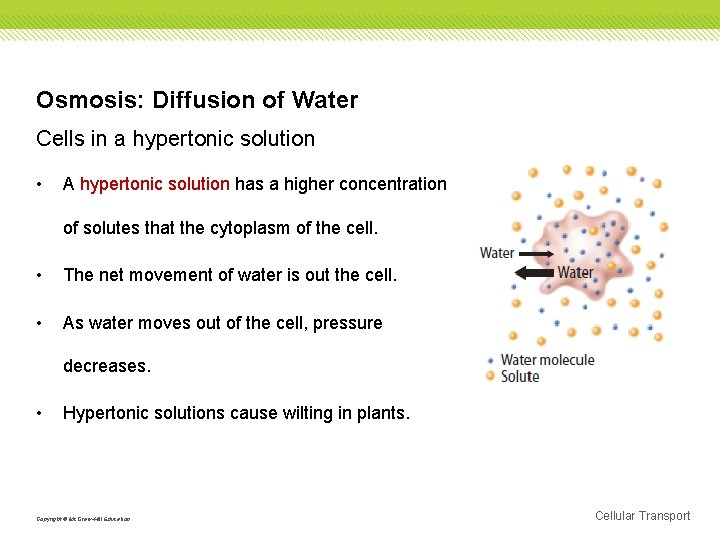
Osmosis: Diffusion of Water Cells in a hypertonic solution • A hypertonic solution has a higher concentration of solutes that the cytoplasm of the cell. • The net movement of water is out the cell. • As water moves out of the cell, pressure decreases. • Hypertonic solutions cause wilting in plants. Copyright © Mc. Graw-Hill Education Cellular Transport

Osmosis in Various Solutions Cellular Transport
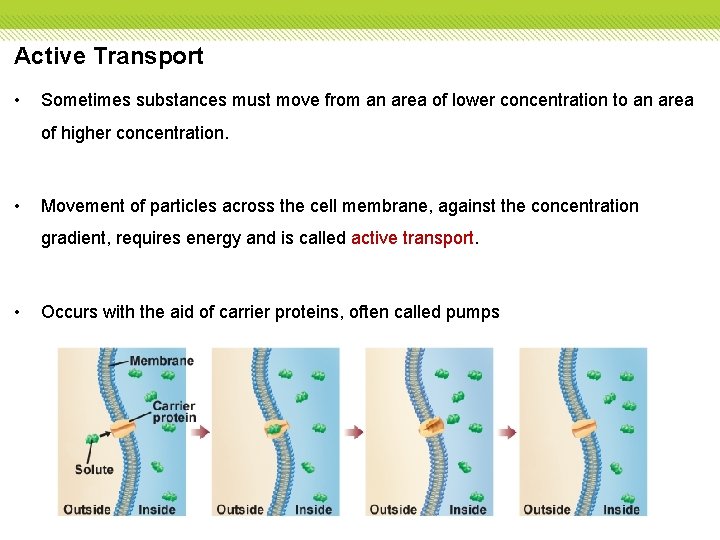
Active Transport • Sometimes substances must move from an area of lower concentration to an area of higher concentration. • Movement of particles across the cell membrane, against the concentration gradient, requires energy and is called active transport. • Occurs with the aid of carrier proteins, often called pumps
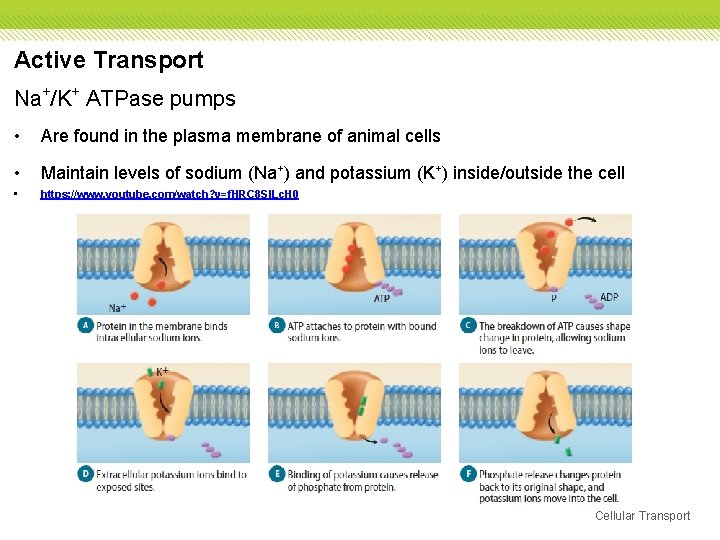
Active Transport Na+/K+ ATPase pumps • Are found in the plasma membrane of animal cells • Maintain levels of sodium (Na+) and potassium (K+) inside/outside the cell • https: //www. youtube. com/watch? v=f. HRC 8 Sl. Lc. H 0 Cellular Transport
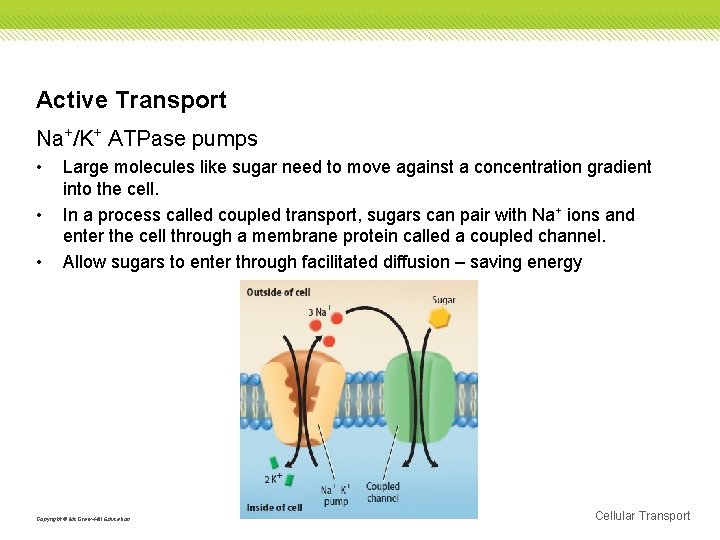
Active Transport Na+/K+ ATPase pumps • • • Large molecules like sugar need to move against a concentration gradient into the cell. In a process called coupled transport, sugars can pair with Na+ ions and enter the cell through a membrane protein called a coupled channel. Allow sugars to enter through facilitated diffusion – saving energy Copyright © Mc. Graw-Hill Education Cellular Transport

Na+/K+ ATPase Pump Video (Take Notes Here) Copyright © Mc. Graw-Hill Education Cellular Transport
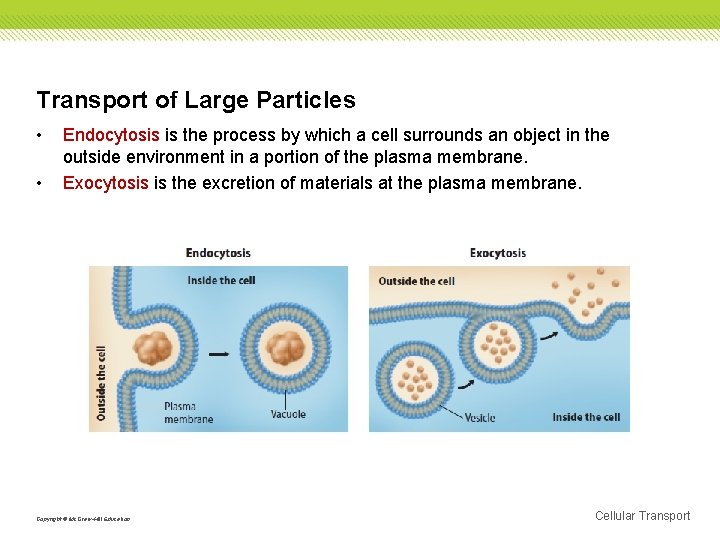
Transport of Large Particles • • Endocytosis is the process by which a cell surrounds an object in the outside environment in a portion of the plasma membrane. Exocytosis is the excretion of materials at the plasma membrane. Copyright © Mc. Graw-Hill Education Cellular Transport
Review Essential Questions • What are the processes of diffusion, facilitated diffusion, and active transport? • What is the effect of a hypotonic, hypertonic, or isotonic solution on a cell? • How do large particles enter and exit cells? Vocabulary • • diffusion dynamic equilibrium facilitated diffusion osmosis Copyright © Mc. Graw-Hill Education • isotonic solution • hypertonic solution • active transport • endocytosis • exocytosis Cellular Transport
- Slides: 53