
Section 2 The Atmosphere Preview Bellringer Objectives The

Section 2: The Atmosphere Preview • Bellringer • Objectives • The Atmosphere • Composition of the Atmosphere • Air Pressure • Layers of the Atmosphere • The Troposphere
Section 2: The Atmosphere Preview, continued • The Stratosphere • The Mesosphere • Thermosphere • Energy Transfer in the Atmosphere • Heating of the Atmosphere • The Movement of Energy in the Atmosphere • The Greenhouse Effect
Objectives • Describe the composition of the Earth’s atmosphere. • Describe the layers of the Earth’s atmosphere. • Explain three mechanisms of heat transfer in Earth’s atmosphere. • Explain the greenhouse effect.
The Atmosphere • The atmosphere is a mixture of _______that surrounds a planet, such as Earth. • Nitrogen, _______, and other gases are all parts of this mixture. • Gases can be added to and removed from the atmosphere through ______ organisms. For example, animals remove oxygen when they breathe in and add carbon dioxide when they breath out.
The Atmosphere • ___________ also add gases to the atmosphere, while _______ both add and remove gases. • The atmosphere also _______ Earth’s surface. • This insulation slows the rate at which the Earth’s surface loses heat and keeps Earth temperature at which living things can survive.

Composition of the Atmosphere • ________ makes up ______ percent of the Earth’s atmosphere, and enters the atmosphere when volcanoes erupt and when dead plants and animals ____ • ______ is the second most abundant gas in the atmosphere and is primarily produced by _________. • In addition to gases, the atmosphere contains many types of tiny, solid particles, or atmospheric dust.
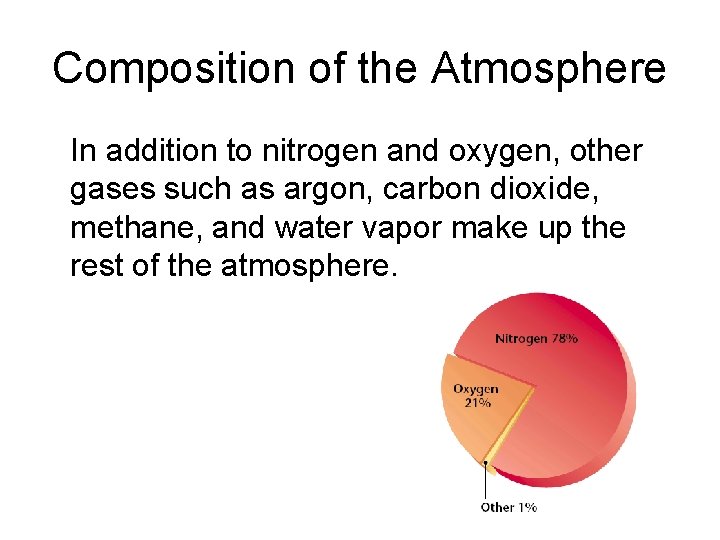
Composition of the Atmosphere • In addition to nitrogen and oxygen, other gases such as argon, carbon dioxide, methane, and water vapor make up the rest of the atmosphere.
Air Pressure • Earth’s atmosphere is pulled toward Earth’s surface by ____ and as a result, the atmosphere is denser near the Earth’s surface. • Almost the entire mass of Earth’s atmospheric gases is located within ______km of the surface. • Air also becomes _______ with elevation so breathing at higher elevations is more __________.
Layers of the Atmosphere • The atmosphere is divided into _______ layers based on _________ changes that occur at different distances above the Earth’s surface. • • The ___________________
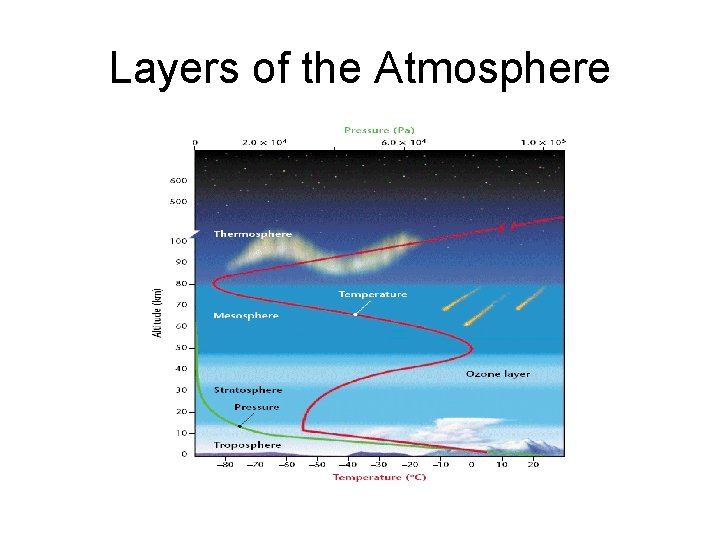
Layers of the Atmosphere
The Troposphere • The troposphere is the _________ layer of the atmosphere in which _____________ at a constant rate as _____________. • This is the part of the atmosphere where __________ conditions exist. • The troposphere is Earth’s densest atmospheric layer and extends to _________ above Earth’s surface.
The Stratosphere • The stratosphere is the layer of the atmosphere that lies immediately above the troposphere and extends from about __________ above the Earth’s surface. • _____________ as altitude increases because __________ in the stratosphere absorbs the sun’s ultraviolet (UV) energy and warms the air.
The Stratosphere • Ozone is a __________ that is made up of ____________ atoms. • Almost all of the ozone in the atmosphere is concentrated in the stratosphere. • Because ozone absorbs UV radiation, it reduces the amount of UV radiation that reaches the Earth. UV radiation that does reach Earth can damage living cells.
The Mesosphere • The layer above the stratosphere is the mesosphere. • This layer extends to an altitude of about _________. • This is the __________ layer of the atmosphere where temperatures have been measured as low as – 93ºC.
The Thermosphere • The atmospheric layer located ________ from Earth’s surface is thermosphere. • Here, _____________ absorb solar radiation resulting in temperatures measuring above 2, 000 ºC. • The air in thermosphere is so _______ that air particles rarely collide, so little heat is transferred, and would therefore not feel hot to us.
The Thermosphere • The absorption of X rays and gamma rays by nitrogen and oxygen causes atoms to become electrically charged. • Electrically charged atoms are called _______, and the lower thermosphere is called the _________. • Ions can radiate energy as light, and these lights often glow in spectacular colors in the night skies near the Earth’s ___________________
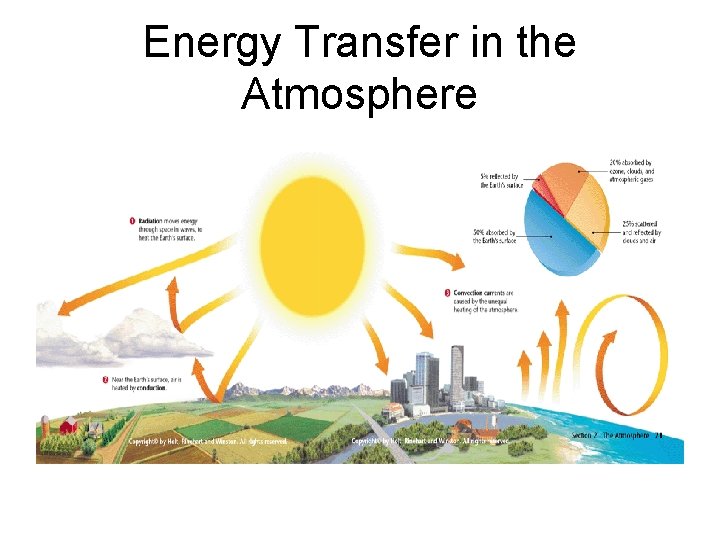
Energy Transfer in the Atmosphere • ___________ is the energy that is transferred as electromagnetic waves, such as ________ and infrared waves. • _________ is the transfer of energy as _______ through a ________. • _________ is the movement of matter due to differences in _________ that are caused by _____________ variations an can result in the transfer of energy as heat.
Energy Transfer in the Atmosphere
Heating of the Atmosphere • ________ energy reaches the Earth as electromagnetic radiation, which includes visible light, infrared radiation, and ultraviolet light. • About ________of the solar energy that enters the atmosphere passes through it and reaches the Earth’s _______, while the rest of the energy is _________ or _____________ in the atmosphere by clouds, gases, and dust or it is reflected by Earth’s surface.
Heating of the Atmosphere • The Earth does not continue to get warmer because the oceans and the land ________ the absorbed energy back into the atmosphere. • __________ objects absorb more solar radiation that light-colored objects, so dark colored objects have more energy to release as heat. • This is one reason the temperature in cities is higher than the temperature in the surrounding countryside.
The Movement of Energy in the Atmosphere • As a current of air, warmed by the Earth’s surface, _______ into the atmosphere, it begins to ________, and eventually becomes more ________ than the air around it and ________. This current then moves back toward the Earth until heated and less dense and then begins to rise again. • The continual process of ________ and ___________ and moving air in a circular motion is called a ______________.
The Greenhouse Effect • The greenhouse effect is the ________ of the ________ and lower atmosphere of Earth that occurs when __________, water vapor, and other gases in the air _________ and reradiate ____________ radiation. • Without the greenhouse effect, the Earth would be too __________ for life to exist.
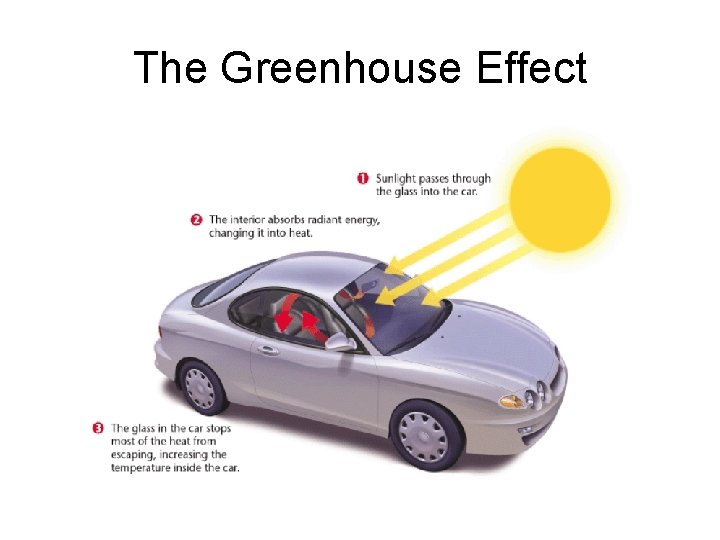
The Greenhouse Effect
The Greenhouse Effect • The gases in the atmosphere that trap and radiate heat are called __________. • The most abundant greenhouse gases are water vapor, carbon dioxide, _________, and ________, although none exist in high concentrations. • The quantities of carbon dioxide and methane in the atmosphere vary considerably as a result of natural and __________ processes.
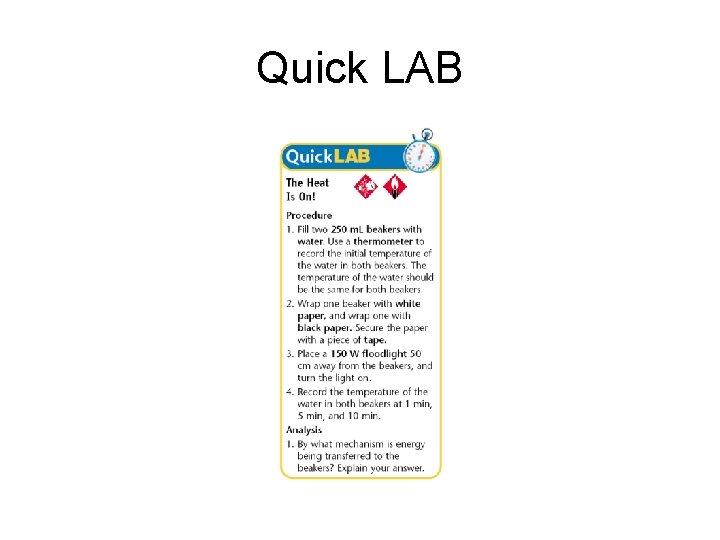
Quick LAB
- Slides: 25