
Section 2 Supply Demand Modules 5 9 Module



- Slides: 50
Section 2 Supply & Demand Modules 5 -9 Module 5 Introduction & Demand AP Macroeconomics Instructor Nancy K. Ware Gainesville High School
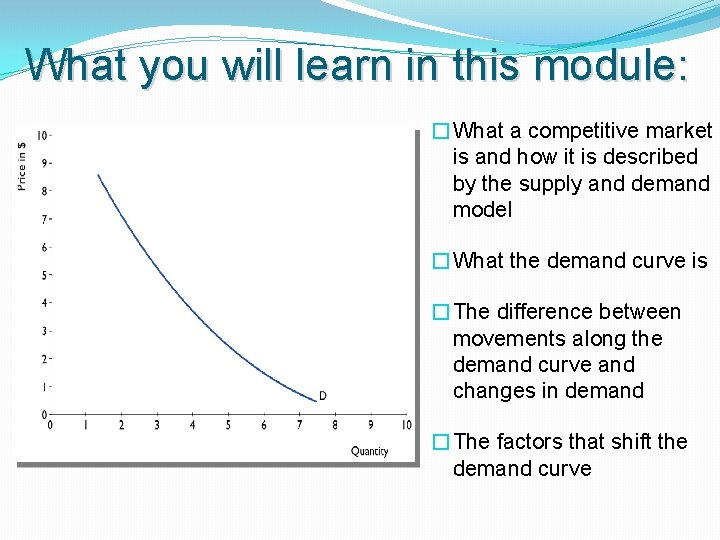
What you will learn in this module: �What a competitive market is and how it is described by the supply and demand model �What the demand curve is �The difference between movements along the demand curve and changes in demand �The factors that shift the demand curve
Information Brain Upload: What is a Competitive Market? A ______ is where consumers and producers engage in v________ e_______. 2. What is voluntary exchange? Consumer purchasing goods and services of own ___________. 3. What is a competitive market: 1. 4. Competitive markets are governed by D______ and S______. Video clip: Different types of markets
Information Brain Upload: What is a Competitive Market? A market is where consumers and producers engage in voluntary exchange. 2. What is voluntary exchange? Consumer purchasing goods and services of own free will. 3. What is a competitive market: a market where there are many buyers and sellers of the same good and service. 4. Competitive markets are governed by demand supply. 1. Video clip: Different types of markets
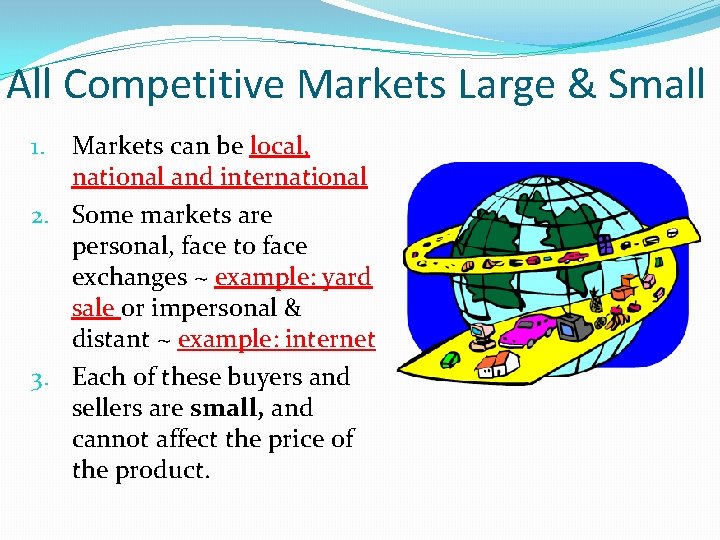
All Competitive Markets Large & Small Markets can be l______, n_____ and i________. 2. Some markets are personal, face to face exchanges ~ example: ______ or impersonal & distant ~ example: _______ 3. Each of these buyers and sellers are small, and cannot affect the price of the product. 1.
All Competitive Markets Large & Small Markets can be local, national and international 2. Some markets are personal, face to face exchanges ~ example: yard sale or impersonal & distant ~ example: internet 3. Each of these buyers and sellers are small, and cannot affect the price of the product. 1.
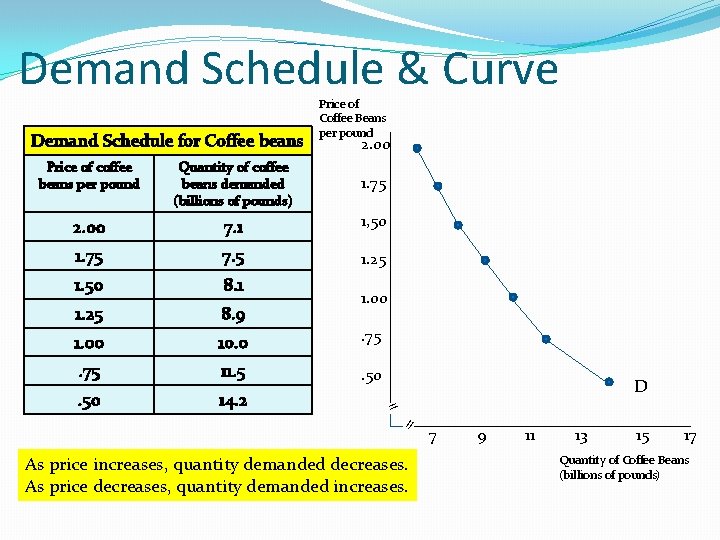
Terms to Know: The Demand Schedule & Curve Video Clip: Demand �Demand schedule: table showing how much of a good or service consumers will want to buy at different prices �Law of demand: As price rises, the quantity demanded (the actual amount consumers are willing to buy), will fall or decrease all other things being equal (ceteris paribus) �Demand Curve: the graphical illustration of the points that show this relationship between quantity demanded and price Notes
Law of Demand: Fundamental Characteristic of Human Behavior 1. Other things being equal, as the _____ increases, corresponding _____________ decreases 2. In other words, the relationship is ______ between price and quantity demanded Drawings here
Law of Demand: Fundamental Characteristic of Human Behavior 1. Other things being equal, as the price increases, corresponding quantity demanded decreases 2. In other words, the relationship is inverse between price and quantity demanded Drawings here
Demand Schedule & Curve Demand Schedule for Coffee beans Price of Coffee Beans per pound 2. 00 Price of coffee beans per pound Quantity of coffee beans demanded (billions of pounds) 1. 75 2. 00 7. 1 1, 50 1. 75 7. 5 1. 25 1. 50 8. 1 1. 25 8. 9 1. 00 10. 0 . 75 11. 5 . 50 14. 2 1. 00 D = = As price increases, quantity demanded decreases. As price decreases, quantity demanded increases. 7 9 11 13 15 17 Quantity of Coffee Beans (billions of pounds)
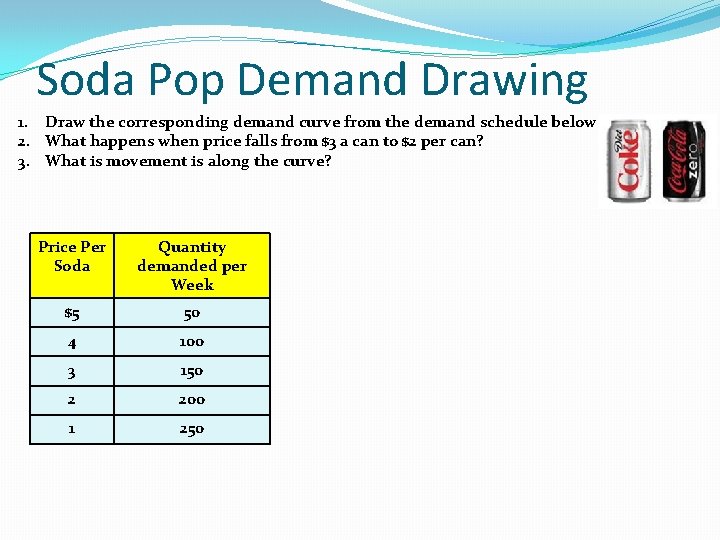
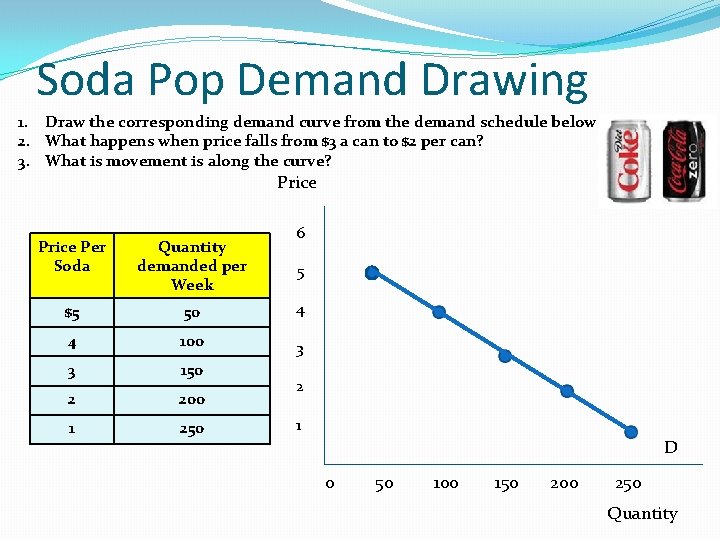
Soda Pop Demand Drawing 1. Draw the corresponding demand curve from the demand schedule below. 2. What happens when price falls from $3 a can to $2 per can? 3. What is movement is along the curve? Price Per Soda Quantity demanded per Week $5 50 4 100 3 150 2 200 1 250
Soda Pop Demand Drawing 1. Draw the corresponding demand curve from the demand schedule below. 2. What happens when price falls from $3 a can to $2 per can? 3. What is movement is along the curve? Price 6 Price Per Soda Quantity demanded per Week $5 50 4 4 100 3 3 150 2 200 1 250 5 2 1 D 0 50 100 150 200 250 Quantity
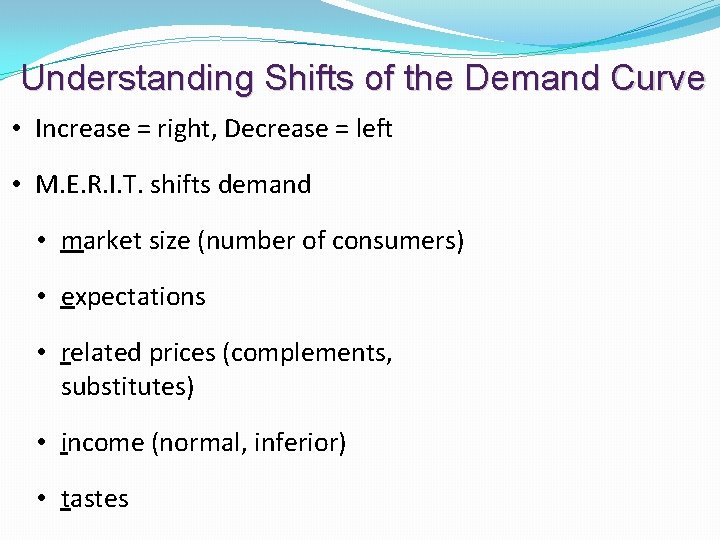
Understanding Shifts of the Demand Curve • Increase = right, Decrease = left • M. E. R. I. T. shifts demand • market size (number of consumers) • expectations • related prices (complements, substitutes) • income (normal, inferior) • tastes
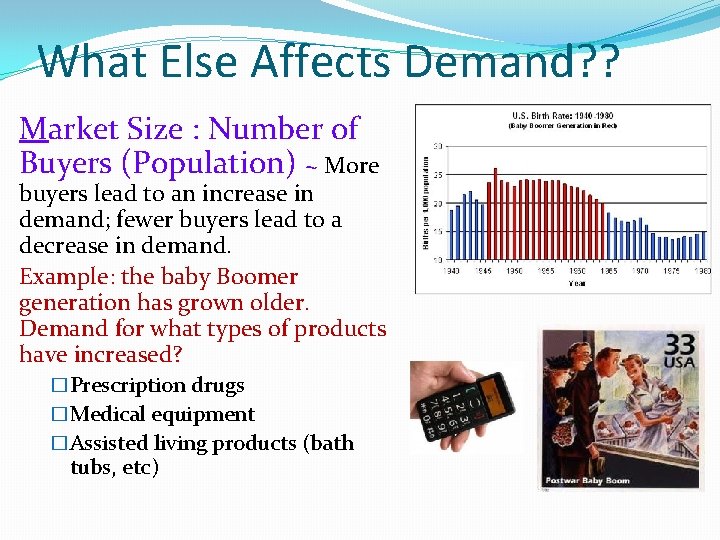
What Else Affects Demand? ? Market Size : Number of Buyers (Population) ~ More buyers lead to an increase in demand; fewer buyers lead to a decrease in demand. Example: the baby Boomer generation has grown older. Demand for what types of products have increased? �Prescription drugs �Medical equipment �Assisted living products (bath tubs, etc)
What Else Affects Demand? ? Expectations ~ Consumers have expectations about future prices, product availability, and income, and these expectations can shift demand. �WWYD? Future price of gas is going up $10. 00 per gallon tomorrow. What happens to demand? �WWYD? An item you want is going on sale next week. What happens to your current demand? What happens to your future demand?
What Else Affects Demand? ? Related Prices �Substitution Effect ~ Those goods that can be used in place of each other. Price of substitutes and demand for the other good are directly related. � If the price of Charmin goes up, the demand for Wal-Mart brand toilet paper may shift to the right. �Complementary Goods ~ Goods that are used together like tennis balls and rackets. Complementary goods have an inverse relationship between price of one and the demand for the other. � If the price of golf clubs go up, the demand for golf balls will shift to the left.
What Else Affects Demand? ? Income ~ Changes in Incomes affect demand Income increases: more n____g_____ are demanded 2. Income decreases: less n____g______ are demanded 3. What are normal goods? _________________________________________ Examples? �_______________________ �____________ 1. Income Increases (for some goods)lead to a decrease in demand for inferior goods. What is an inferior good? �_______________________________ 1. More inferior goods may be consumed when income _______ 1.
What Else Affects Demand? ? Income ~ Changes in Incomes affect demand Income increases: more normal goods are demanded 2. Income decreases: less normal goods are demanded 3. What are normal goods? Goods that are in demand when income rises. Like? �New Cars �New Clothes �National brand names 1. Income Increases (for some goods)lead to a decrease in demand for inferior goods. What is an inferior good? �Bus tickets �Second hand clothing �Used cars �Store brand instead of national brand 1. More inferior goods may be consumed when income decreases 1.
What Else Affects Demand? ? Tastes and Advertising ~ Advertising plays an important role in many trends and fads & influences demand. �Demand for a sports team’s apparel may increase when the team is winning, and decrease when it is losing. �Demand for a good may increase after consumers see a funny Superbowl commercial �Demand may increase for certain colors and designs after seeing these fashions on TV shows
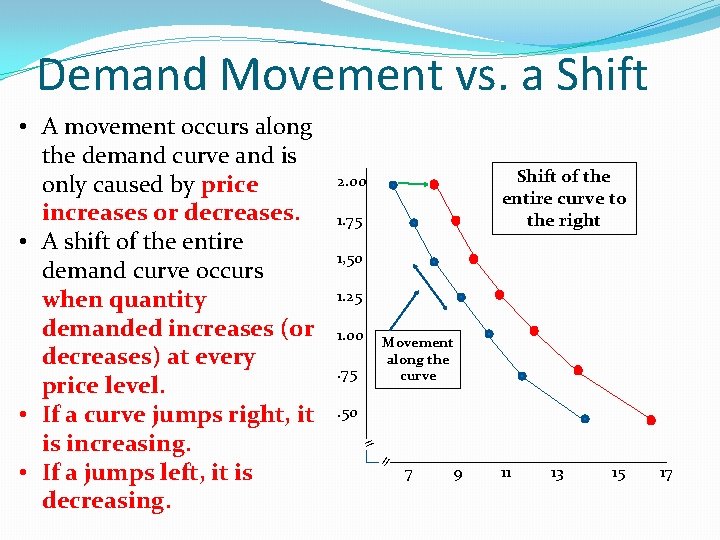
Demand Movement vs. a Shift of the entire curve to the right 2. 00 1. 75 1, 50 1. 25 1. 00 Movement along the curve . 75. 50 = = • A movement occurs along the demand curve and is only caused by price increases or decreases. • A shift of the entire demand curve occurs when quantity demanded increases (or decreases) at every price level. • If a curve jumps right, it is increasing. • If a jumps left, it is decreasing. 7 9 11 13 15 17
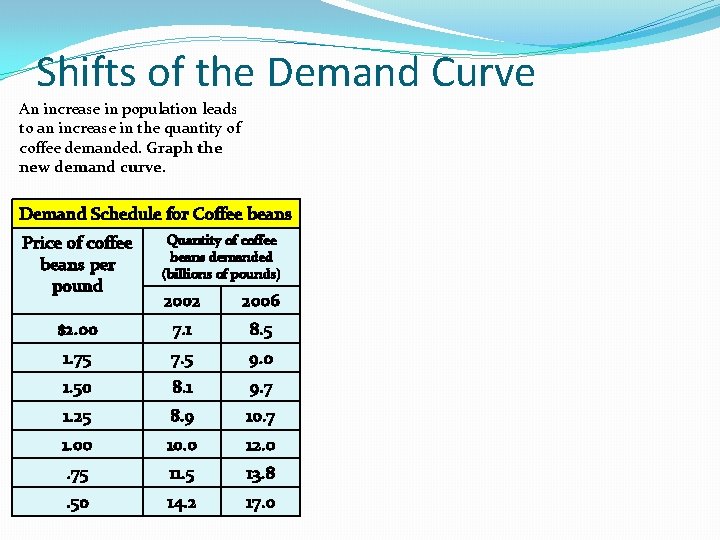
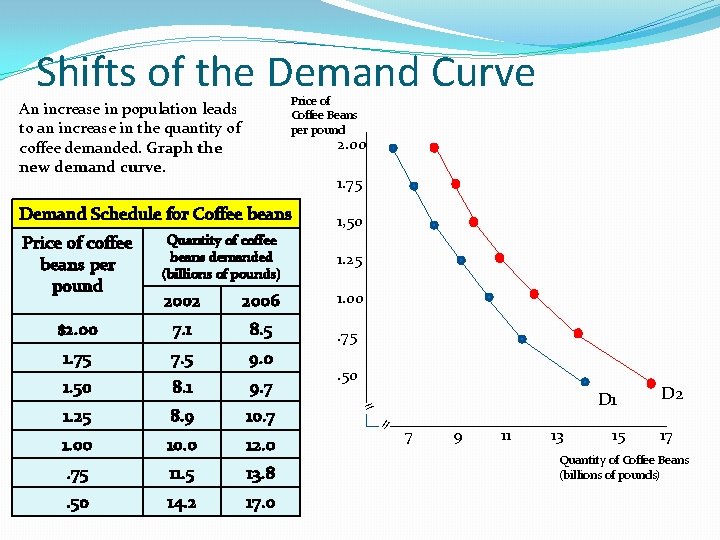
Shifts of the Demand Curve An increase in population leads to an increase in the quantity of coffee demanded. Graph the new demand curve. Demand Schedule for Coffee beans Price of coffee beans per pound Quantity of coffee beans demanded (billions of pounds) 2002 2006 $2. 00 7. 1 8. 5 1. 75 7. 5 9. 0 1. 50 8. 1 9. 7 1. 25 8. 9 10. 7 1. 00 10. 0 12. 0 . 75 11. 5 13. 8 . 50 14. 2 17. 0
Shifts of the Demand Curve Price of Coffee Beans per pound An increase in population leads to an increase in the quantity of coffee demanded. Graph the new demand curve. 2. 00 1. 75 Demand Schedule for Coffee beans 1, 50 Price of coffee beans per pound Quantity of coffee beans demanded (billions of pounds) 1. 25 2002 2006 1. 00 $2. 00 7. 1 8. 5 . 75 1. 75 7. 5 9. 0 1. 50 8. 1 9. 7 1. 25 8. 9 10. 7 1. 00 10. 0 12. 0 . 75 11. 5 13. 8 . 50 14. 2 17. 0 . 50 D 1 = = 7 9 11 13 15 D 2 17 Quantity of Coffee Beans (billions of pounds)
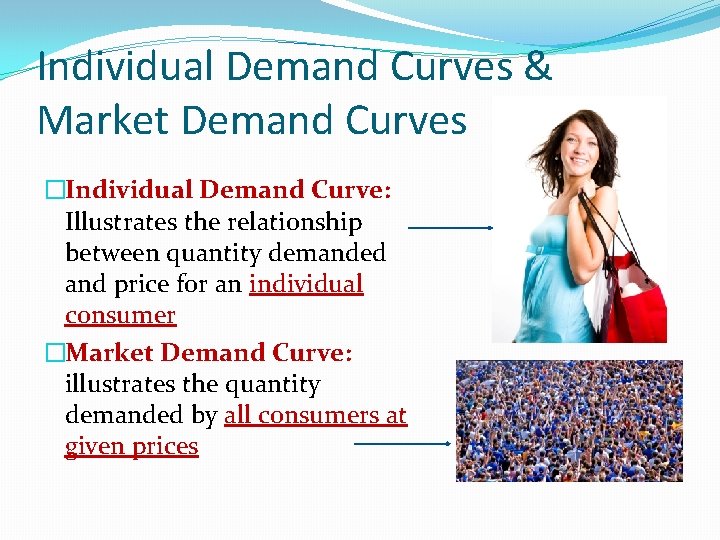
Individual Demand Curves & Market Demand Curves �Individual Demand Curve: Illustrates the relationship between quantity demanded and price for an individual consumer �Market Demand Curve: illustrates the quantity demanded by all consumers at given prices
What is YOUR Demand GHS? Activity �In groups, select a product from the list, or come up with your own. Survey & find out amongst your group what the demand would be at 5 possible price points that you create for your product. (demand schedule) �Interview 2 more students outside your group for their demand record your points on a graph and draw your demand curve. �At what price on the demand curve was quantity demanded the highest? �Why? �Pick an outside factor that would shift your entire curve either right or left. Redraw your demand curve. Explain why this shifted your curve. Products To Sell at GHS? 1. Private Parking Spots 2. Breakfast Burritos 3. GHS Sunglasses 4. GHS Rain jackets 5. GHS Flip flops 6. GHS IPhone cases 7. Your own idea!!
Class Project: GHS Demand for…. . ? What? �How was the Back to School Dance? �What do Red Elephants have the desire to do? �Come up with 5 different options for back to school functions besides a dance. Find out how much GHS students would be willing to pay to attend at your predetermined prices. �Draw a demand schedule and curve based on your information.
• Module 5 Review p. 57 -58 all questions • Read Module 6 Changes in Equilibrium • Strive for a 5
Module 6 Supply & Equilibrium
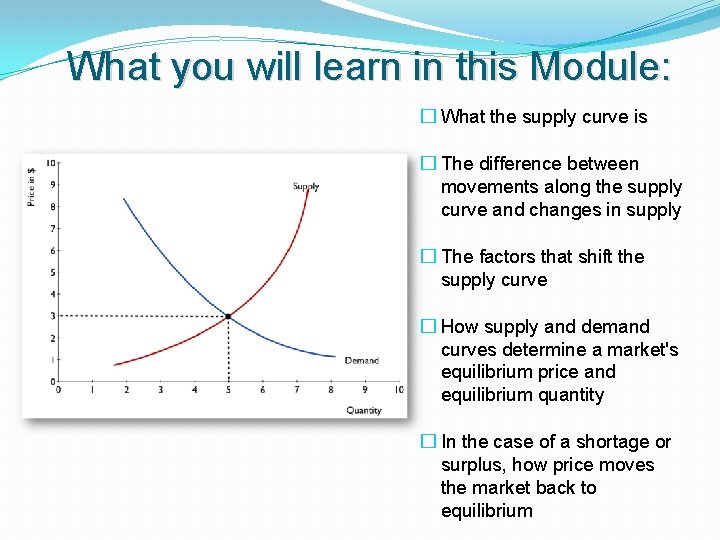
What you will learn in this Module: � What the supply curve is � The difference between movements along the supply curve and changes in supply � The factors that shift the supply curve � How supply and demand curves determine a market's equilibrium price and equilibrium quantity � In the case of a shortage or surplus, how price moves the market back to equilibrium
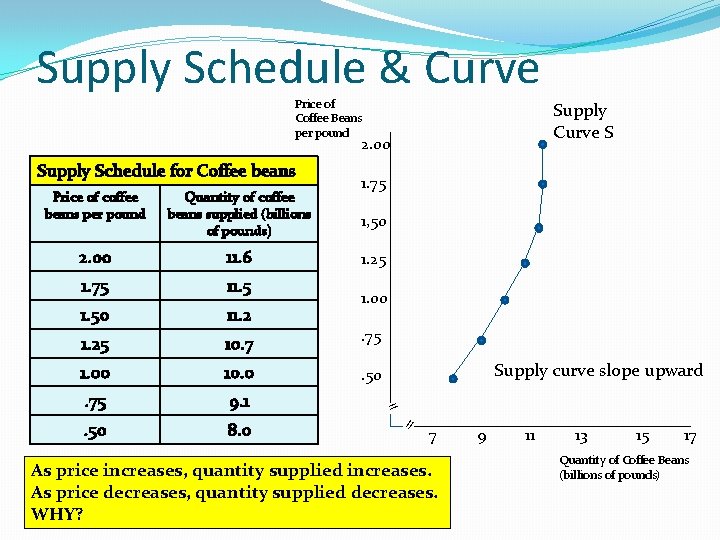
Terms to Know: Supply & Equilibrium 1. Quantity Supplied: �the actual amount of a good or service producers are willing to sell at some specific price 2. Supply schedule: �shows how much of a good or service producers will supply at different prices 3. Supply curve: �shows the relationship between quantity supplied and price
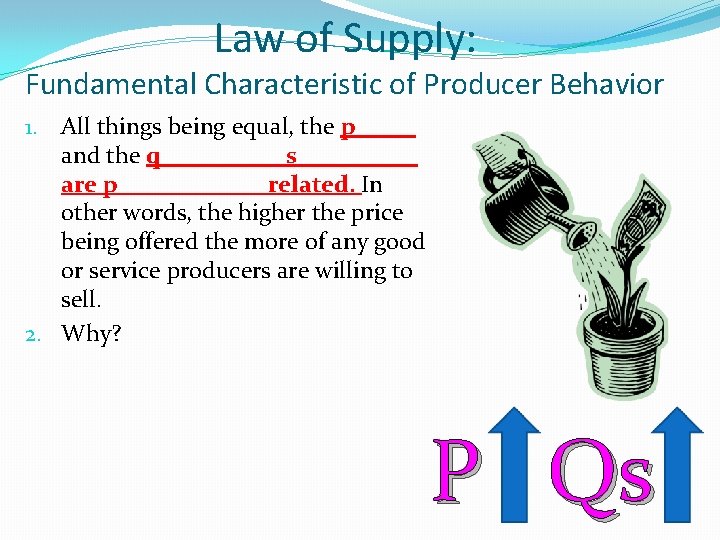
Law of Supply: Fundamental Characteristic of Producer Behavior 1. All things being equal, the p_____ and the q_____ s_____ are p______ related. In other words, the higher the price being offered the more of any good or service producers are willing to sell. 2. Why? P Qs
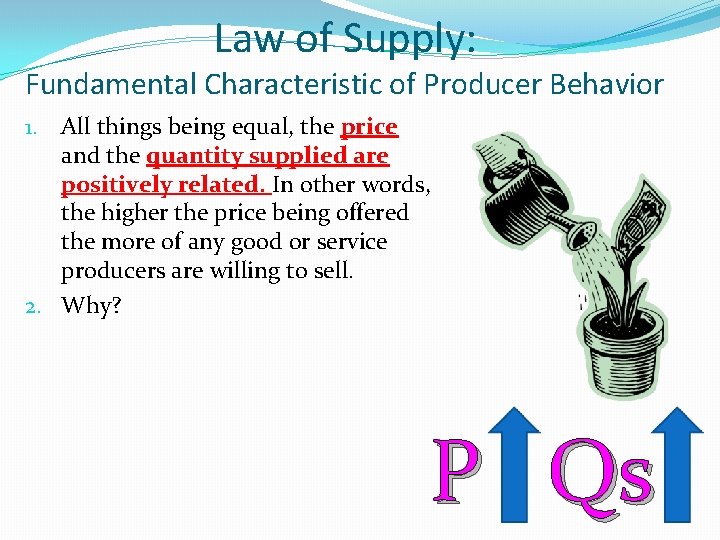
Law of Supply: Fundamental Characteristic of Producer Behavior 1. All things being equal, the price and the quantity supplied are positively related. In other words, the higher the price being offered the more of any good or service producers are willing to sell. 2. Why? P Qs
Supply Schedule & Curve Price of Coffee Beans per pound Supply Curve S 2. 00 1. 75 Price of coffee beans per pound Quantity of coffee beans supplied (billions of pounds) 2. 00 11. 6 1. 75 11. 50 11. 25 10. 7 . 75 1. 00 10. 0 . 50 . 75 9. 1 = . 50 8. 0 = Supply Schedule for Coffee beans 1, 50 1. 25 1. 00 Supply curve slope upward 7 As price increases, quantity supplied increases. As price decreases, quantity supplied decreases. WHY? 9 11 13 15 17 Quantity of Coffee Beans (billions of pounds)
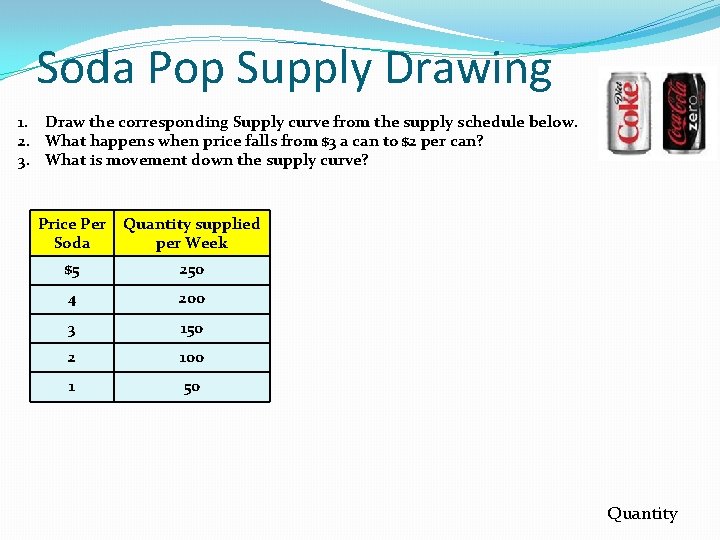
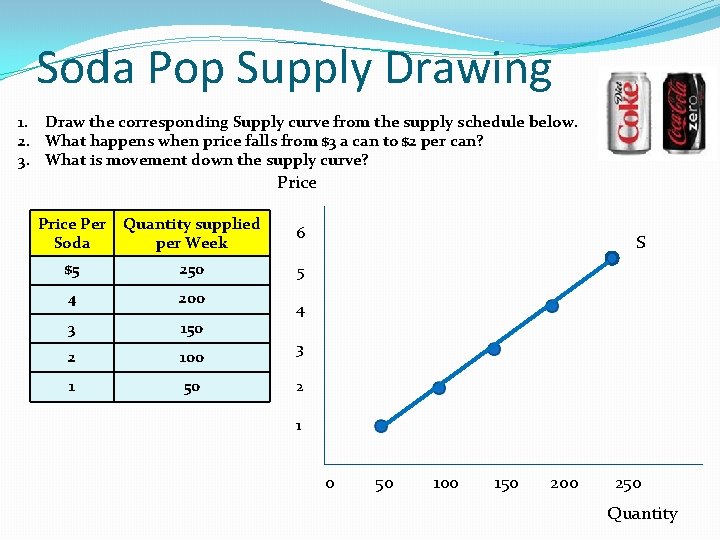
Soda Pop Supply Drawing 1. Draw the corresponding Supply curve from the supply schedule below. 2. What happens when price falls from $3 a can to $2 per can? 3. What is movement down the supply curve? Price Per Soda Quantity supplied per Week $5 250 4 200 3 150 2 100 1 50 Quantity
Soda Pop Supply Drawing 1. Draw the corresponding Supply curve from the supply schedule below. 2. What happens when price falls from $3 a can to $2 per can? 3. What is movement down the supply curve? Price Per Soda Quantity supplied per Week 6 $5 250 5 4 200 3 150 2 100 1 50 S 4 3 2 1 0 50 100 150 200 250 Quantity
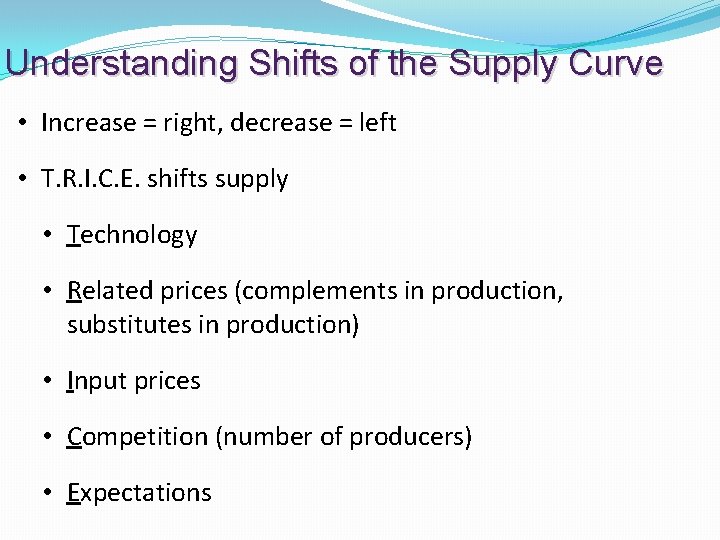
Understanding Shifts of the Supply Curve • Increase = right, decrease = left • T. R. I. C. E. shifts supply • Technology • Related prices (complements in production, substitutes in production) • Input prices • Competition (number of producers) • Expectations
What Else Shifts Supply? Technology ~ Technological improvements mean more e_______ production and l____ c_______ to produce, so an increase in supply or a rightward shift of the curve is the result. � Examples? Genetically altered c______ will increase the supply of _________. Prices of related goods or services ~ If the price of a substitute production good rises, producers might shift production toward the higher priced good causing a decrease in supply of the original good. � Examples? Increase in the price of c_______has lead farmers to decrease the supply of w________, and plant more c________. WHY?
What Else Shifts Supply? Technology ~ Technological improvements mean more efficient production and lower costs to produce, so an increase in supply or a rightward shift of the curve is the result. � Examples? Genetically altered corn will increase the supply of corn and related products. Prices of related goods or services ~ If the price of a substitute production good rises, producers might shift production toward the higher priced good causing a decrease in supply of the original good. � Examples? Increase in the price of corn has lead farmers to decrease the supply of wheat, and plant more corn. WHY? ~~~ Profit~~~~
What Else Shifts Supply? Input (resource prices) ~ A rise in input price (cost to produce) will cause a ________in supply or a ______shift in the supply curve. �A decrease in input prices will cause an _______ in supply or a __________ shift in the supply curve. �Examples? Increase in the input price of _______leads to a decrease in quantity supplied of _________.
What Else Shifts Supply? Input (resource prices) ~ A rise in input price (cost to produce) will cause a decrease in supply or a leftward shift in the supply curve. �A decrease in input prices will cause an increase in supply or a rightward shift in the supply curve. �Examples? Increase in the input price of corn leads to a decrease in quantity supplied of you name it – corn chips, chicken, beef, cereal, etc.
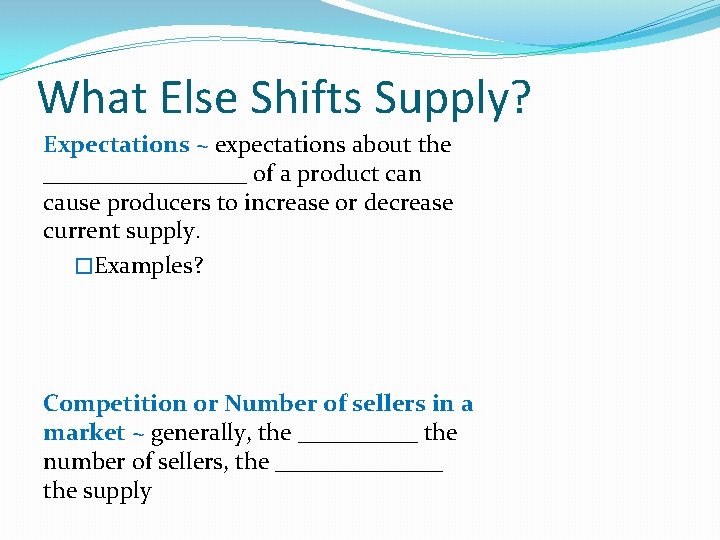
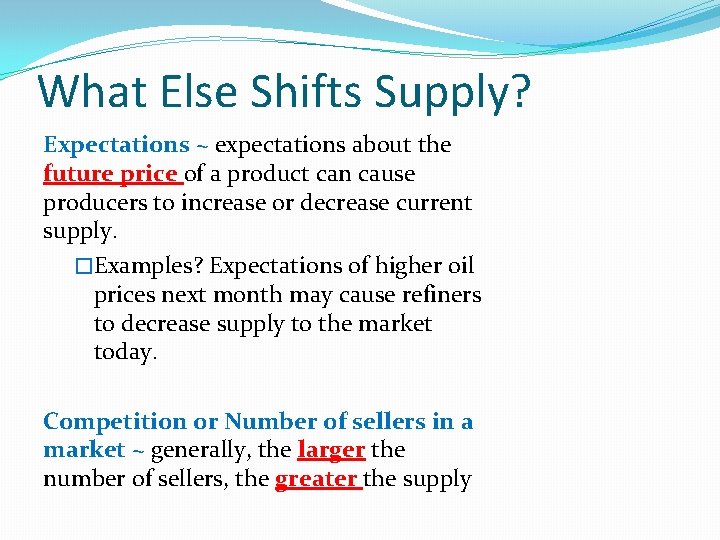
What Else Shifts Supply? Expectations ~ expectations about the _________ of a product can cause producers to increase or decrease current supply. �Examples? Competition or Number of sellers in a market ~ generally, the _____ the number of sellers, the _______ the supply
What Else Shifts Supply? Expectations ~ expectations about the future price of a product can cause producers to increase or decrease current supply. �Examples? Expectations of higher oil prices next month may cause refiners to decrease supply to the market today. Competition or Number of sellers in a market ~ generally, the larger the number of sellers, the greater the supply
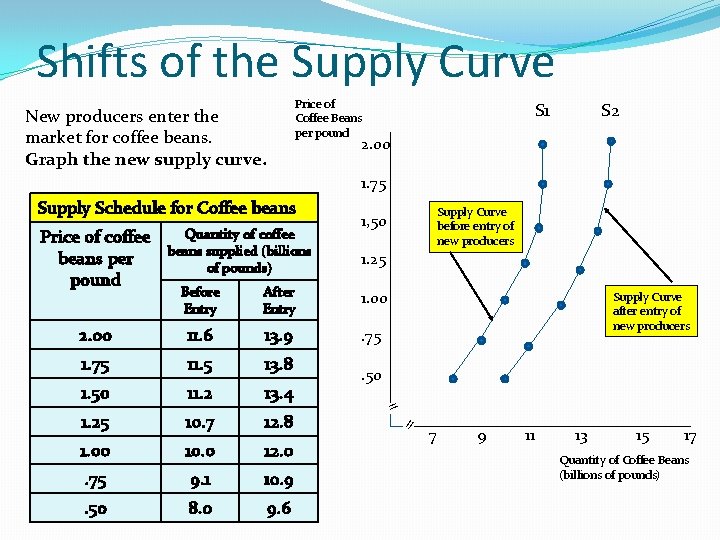
Shifts of the Supply Curve New producers enter the market for coffee beans. Graph the new supply curve. Price of Coffee Beans per pound S 1 S 2 2. 00 1. 75 Price of coffee beans per pound Quantity of coffee beans supplied (billions of pounds) Supply Curve before entry of new producers 1, 50 1. 25 Before Entry After Entry 1. 00 2. 00 11. 6 13. 9 . 75 11. 5 13. 8 1. 50 11. 2 13. 4 1. 25 10. 7 12. 8 1. 00 10. 0 12. 0 . 75 9. 1 10. 9 . 50 8. 0 9. 6 Supply Curve after entry of new producers . 50 = = Supply Schedule for Coffee beans 7 9 11 13 15 17 Quantity of Coffee Beans (billions of pounds)
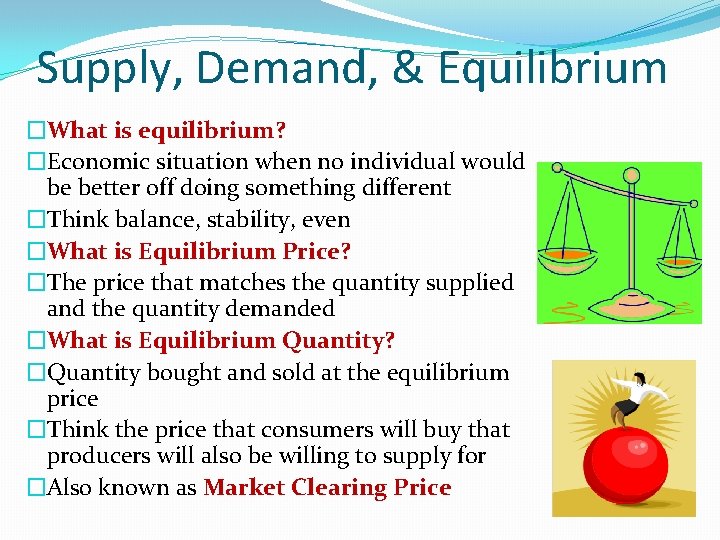
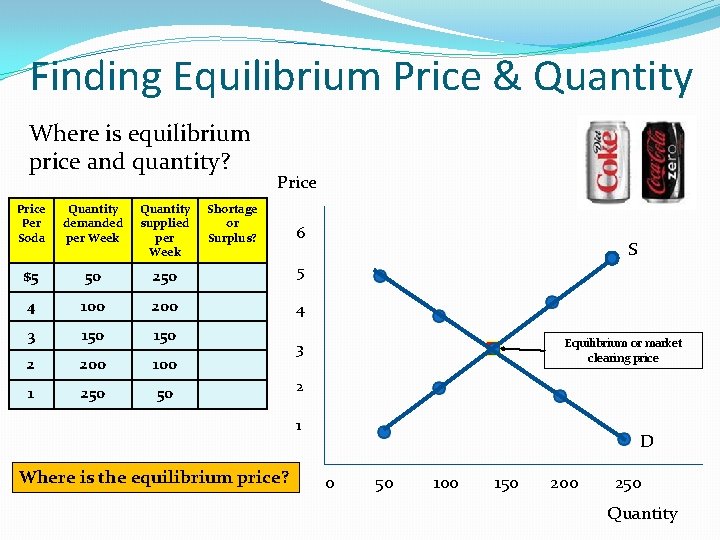
Supply, Demand, & Equilibrium �What is equilibrium? �Economic situation when no individual would be better off doing something different �Think balance, stability, even �What is Equilibrium Price? �The price that matches the quantity supplied and the quantity demanded �What is Equilibrium Quantity? �Quantity bought and sold at the equilibrium price �Think the price that consumers will buy that producers will also be willing to supply for �Also known as Market Clearing Price
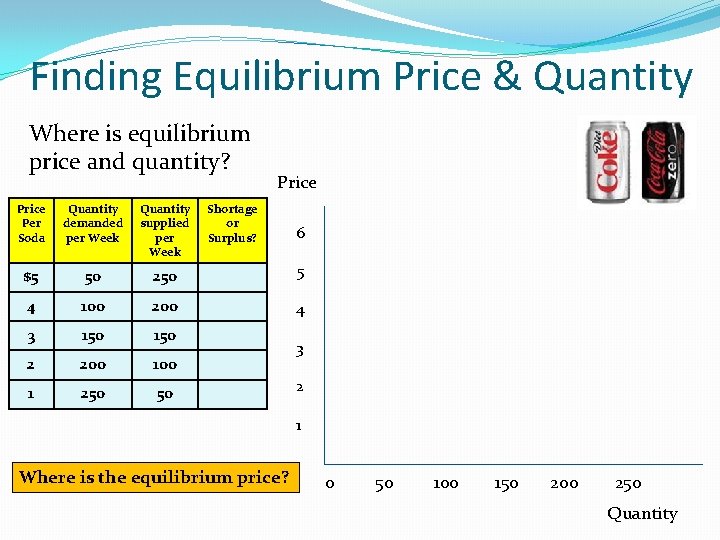
Finding Equilibrium Price & Quantity Where is equilibrium price and quantity? Price Per Soda Quantity demanded per Week Quantity supplied per Week Shortage or Surplus? $5 50 250 5 4 100 200 4 3 150 2 200 1 250 50 6 3 2 1 Where is the equilibrium price? 0 50 100 150 200 250 Quantity
Finding Equilibrium Price & Quantity Where is equilibrium price and quantity? Price Per Soda Quantity demanded per Week Quantity supplied per Week Shortage or Surplus? $5 50 250 5 4 100 200 4 3 150 2 200 1 250 50 6 S Equilibrium or market clearing price 3 2 1 Where is the equilibrium price? D 0 50 100 150 200 250 Quantity
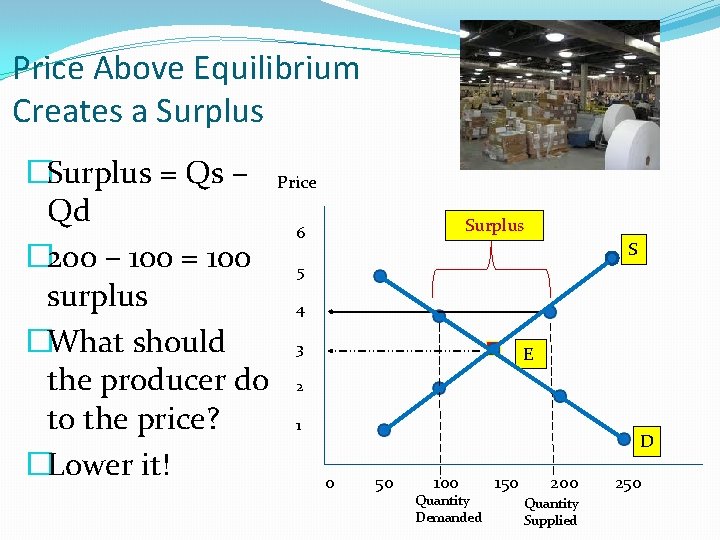
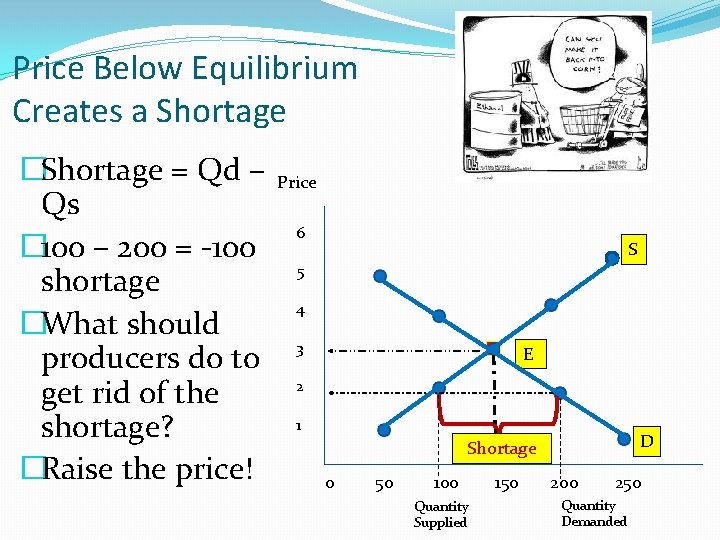
Equilibrium, Surplus & Shortage �Market Clearing Price is where Qd = Qs �At this price there is no tendency for the price to rise or fall ~ the market is in a state of balance �Why do producers lower prices? �Because of a surplus of a product they need to sell �Surplus = Qs – Qd �Why do producers raise their prices above equilibrium? �To eliminate the shortage �Shortage = Qd – Qs
Price Above Equilibrium Creates a Surplus �Surplus = Qs – Price Qd 6 � 200 – 100 = 100 5 surplus 4 �What should 3 the producer do 2 to the price? 1 �Lower it! 0 Surplus S E D 50 100 Quantity Demanded 150 200 Quantity Supplied 250
Price Below Equilibrium Creates a Shortage �Shortage = Qd – Qs � 100 – 200 = -100 shortage �What should producers do to get rid of the shortage? �Raise the price! Price 6 S 5 4 3 E 2 1 D Shortage 0 50 100 Quantity Supplied 150 200 250 Quantity Demanded
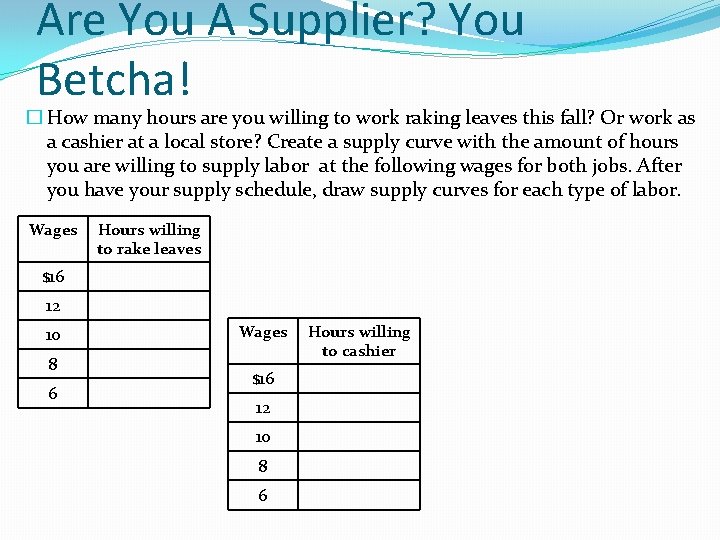
Are You A Supplier? You Betcha! � How many hours are you willing to work raking leaves this fall? Or work as a cashier at a local store? Create a supply curve with the amount of hours you are willing to supply labor at the following wages for both jobs. After you have your supply schedule, draw supply curves for each type of labor. Wages Hours willing to rake leaves $16 12 10 8 6 Wages $16 12 10 8 6 Hours willing to cashier
• Module 6 Review p. 69 -70 all questions • Read Module 7 Changes in Equilibrium • Strive for a 5 & Supply Activity Packet Reasons for Changes in Supply p. 25 -29 (stop at part B)